ISSN(Online): 2320-9801
ISSN (Print): 2320-9798
I
nternational
J
ournal of
I
nnovative
R
esearch in
C
omputer
and
C
ommunication
E
ngineering
(An ISO 3297: 2007 Certified Organization) Website:
www.ijircce.com
Vol. 5, Issue 1, January 2017
Shearlet Transform Based Denoising On
Normal Images Using Hard Threshold
Syed Ali Fathima KMN[1] , Shajun Nisha S[2]
M.Phil. (PG Scholar) Dept of Computer Science, Sadakathullah Appa College, Tirunelveli ,
Tamilnadu, India[1]
Prof& Head, P.G Dept of Computer Science, Sadakathullah Appa College, Tirunelveli, Tamilnadu, India[2]
ABSTRACT: Digital images are collection of picture elements called pixel. Each pixel contains location and intensity value. Sometimes image is corrupted by noise due to poor illumination and atmospheric turbulence. Noise is unwanted information to the pixel value of original image. Removal of the noise is necessary to reduce the minimal damage of the image. Shearlets are a multi schematic framework which allows to efficiently encode anistropic features in multi types of various classes. Shearlet is a novel denoising method which can preserve edges efficiently. In this paper proposed the noise removal transform shearlet by hard threshold for denoising we can denoise an image by eliminating fine details, to improves the image quality.
KEYWORDS: Denoising, Shearlet transform, hard thresholding.
I. INTRODUCTION
The digital image is often corrupted by the imaging device or external environment in digitization and transmission process, this kind of image is called noise image, and removing noises in a digital image is known as image denoising[12].Image Denoising has remained a fundamental problem in the field of image processing. The goal of image denoising is to recover the true original image from such a distorted noisy copy.The restored image should contain less noise than the observations while still keeping sharp transitions (i.e.edges)[8]. Quality degradation takes place in digital images because of corruption by completely different types of noises like Gaussian noise, Poisson noise,etc[13].Noises will get else within the image, a crucial image process operation in image and video is image denoising, Gaussian noise is that the applied statistical noise having a noise likelihood Probability Density Function(PDF) capable that of the conventional distribution, therefore removing fine details within the image[13].The goal of image denoising is to remove noise while retaining the important signal features. There are two basic approaches for image denoising, spatial domain methods and transform domain methods [1]. Although the spatial domain methods need less computation cost, the transform domain methods have less blurring effect.Image denoising has remained a fundamental problem in the field of image processing, Denoising means to removing noise from the signal. It is also known as noise reduction. Noise is an unwanted signal that may occur in the image. The reason behind the noise in image is Imperfect instruments, problems with the data acquisition process, and interfering natural phenomena can all degrade the data of interest [12].Furthermore, noise can be introduced by transmission errors and compression.
II. DENOISING PROCEDURE
The procedure to denoise an image is given as follows: De-noised image = W−1 [T{W (Original Image + Noise)}
Step 1: Apply forward Shearlet transform to a noisy image to get decomposed image.
Step 2: Apply hard thresholding to decomposed image toremove noise.
ISSN(Online): 2320-9801
ISSN (Print): 2320-9798
I
nternational
J
ournal of
I
nnovative
R
esearch in
C
omputer
and
C
ommunication
E
ngineering
(An ISO 3297: 2007 Certified Organization) Website:
www.ijircce.com
Vol. 5, Issue 1, January 2017
Shearlets were introduced with the expressed intent to provide a highly efficient representation of images with edges. In fact, the elements of the shearlet representation form a collection of well-localized waveforms, ranging at various locations, scales and orientations, and with highly anisotropic shapes. This makes the shearlet representation particularly well adapted at representing the edges and the other anisotropic objects which are the dominant features in typical images[2].Shearlet denoising using hard thresholding involves three basic steps- first step involves computation the Shearlet transform of noisy image, second step is used to apply thresholding on noisy Shearlet coefficient according to some rule and finally computing inverse Shearlet transform of modified Shearlet coefficients[15].
A.RELATED WORK:
The distortions of images by noise are common during its acquisition, processing, compression, transmission, and reproduction[6].The interference throughout the transmission degrade the information. Noise may be generated by the transmission error and compression[13].In many applications,image denoising is used to produce good estimates of the original image from noisy observations[12].Image Denoising is an important part of diverse image processing and computer vision problems. A very large portion of digital image processing includes image restoration. Image restoration is a method of removal or reduction of degradation that are incurred during the image capturing. Degradation comes from blurring as well as noise due to the electronic and photometric sources[14]. The important property of a good image denoising model is that it should completely remove noise as far as possible as well as preserve edges[16]. The shearlet representation has emerged in recent years as one of the most effective frameworks for the analysis and processing of multidimensional data[1]. Shearlet Transform which is based on the directional multiscale framework of the shearlet representation. In the field of Normal imaging, denoising seeks to discern relevant information in the several field as the shape, contour, etc. The Shearlet transform is applied for the noisy image to produce decomposed image coefficients. Shearlets provide nearly optimally sparse representations for a large class of functions that are useful to model natural images, many image processing methods benefit from their use[2].Hard Thresholding by Shearlet, we can denoise an image by eliminating fine details[1]. The scope of the paper is to focus on noise removal techniques for natural images. Hard thresholding techniques are used for purpose of image denoising. Keep and kill rule which is not only instinctively appealing but also introduces artifacts in the recovered images is the basis of hard thresholding[16].In particular, the error rates of data estimation from noise are highly dependent on the sparsity properties of the representation, so that many successful applications of shearlets center around restoration tasks such as denoising and inverse problems. Simple threshold denoising method of Shearlet transform can get good performance, for its multi-scale and multi-direction characteristic, image sparse representation. However, there is a lot to be improved.[4]. Shearlet Transform combines multiscale and multi-directional representation and is very efficient to capture intrinsic geometry of the multidimensional image and is optimally sparse in representing image containing edges [11]. The shearlet decomposition procedure is initiated by separating the image into its high pass and low pass components, which is accomplished using Laplacian pyramid[10].Shearlet by hard thresholding is a signal estimation technique that exploits the capabilities of Shearlet transform for signal denoising. It removes noise by killing coefficients that are irrelevant relative to some threshold [9] .Several studies are there on thresholding the Shearlet coefficients.The results evaluate the performance of proposed filter and measure peak signal noise ratio. In this Paper Proposed ,Shearlet is a novel denoising method which can preserve edges efficiently better removes the noise from edges and without distorting the features[13].
B. MOTIVATION AND JUSITIFICATION
ISSN(Online): 2320-9801
ISSN (Print): 2320-9798
I
nternational
J
ournal of
I
nnovative
R
esearch in
C
omputer
and
C
ommunication
E
ngineering
(An ISO 3297: 2007 Certified Organization) Website:
www.ijircce.com
Vol. 5, Issue 1, January 2017
for identifying the Anistropic features and preserved smooth edges. Shearlet is best because it has retained the accurate information. During these advantages It motivates and justified to do work in Shearlet transform.
C. Organisation of the Paper:
The remaining paper is organized as follows: Methodology which include the proposed work of, shearlet with hard thresholding with noises are represented in Section II. Experimental results are shown in Section III. Performance evaluation are discussed in Section IV. Finally Conclusion is presented in Section V.
II.METHODOLOGY
A. OUTLINE OF THE WORK :
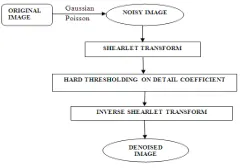
Denoising uses Shearlet Transform. This system is articulated in Fig 1.Gaussian and Poisson noise is added with the two input images such as Lena,Cameraman. Shearlet Transform is used to decompose the noisy image and then apply the hard threshold function. The basic block diagram of Shearlet based image denoising using thresholding is shown in Fig.1.
Fig.1.block diagram of shearlet transform
Fig.1.shows block diagram of shearlet transform, input Original image apply shearlet transform to get a denoised image.
B. SHEARLET TRANSFORM
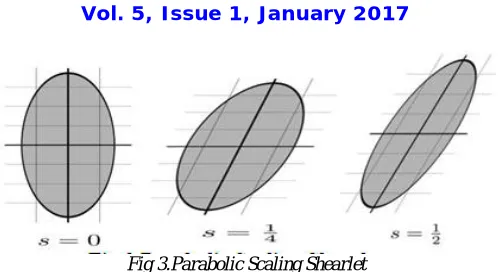
Shearlet has high directional sensitivity and are optimally sparse in representing image containing edges. Shearlets are constructed by parabolic Scaling Fig.3, shearing and translation applied to a few generating functions. parabolic scaling law, which reads length² ≈ width. Originally, shearlets were introduced in 2006,for the analysis as well as sparse approximation of functions Fig.2.Shearlet involves three basic steps are as follows:
i)first step involves computation the Shearlet transform of noisy image,
ii)second step is used to apply thresholding on noisy Shearlet coefficient according to some rule and iii)finally computing inverse Shearlet transform of modified Shearlet coefficients.
As noise has a fine grained structure in the image therefore most of the noise Shearlet Transform is represented here, L2(R2).
ISSN(Online): 2320-9801
ISSN (Print): 2320-9798
I
nternational
J
ournal of
I
nnovative
R
esearch in
C
omputer
and
C
ommunication
E
ngineering
(An ISO 3297: 2007 Certified Organization) Website:
www.ijircce.com
Vol. 5, Issue 1, January 2017
Fig 3.Parabolic Scaling Shearlet
C. HARD THRESHOLDING TECHNIQUES
The basic thresholding functions are hard thresholding as proposed in [2]. Small coefficients are dominated by
noise, while coefficients have a large coefficients contain more signal information as compared to noise so thresholding functions set the coefficients less than threshold to zero. A hard thresholding function doesn’t change rest of coefficients while thresholding reduces its value by absolute threshold value.The hard-thresholding function chooses all Shearlet coefficients that are greater than the given threshold λ and sets the others to zero. The threshold λ is chosen according to the signal energy[6].These methods are to make a noises free in an image.The hard-thresholding function chooses all Shearlet coefficients that are greater than the given threshold λ and sets the others to zero. The threshold λ is chosen according to the signal energy[6].These methods are to make a noises free in an image.
( , ) = ( , ) ( , ) >
0
Where T is Hard threshold. Let S(x, y) represent the initial shearlet coefficient in the point (x, y) in each sub-band K ϵ { K1 K2 …. Kj} at scale j. The aim of this paper is to obtain denoised coefficient D(x,y) at the point S(x,y) by adjusting the pixel values i.e., The major steps are,
i. Compute normalized histogram
ii. Set the threshold T=K and divide f(x,y) into two classes C1 and C2. Probability that f(x,y) is in class C1 is P1(K) and probability that f(x,y) in class C2 is P2(K) = 1-P1(K)
iii. Compute cumulative mean of C1 and C2 i.e.,M1 and M2 iv. Compute Global mean, MG = P1M1 + P2M2
v. Compute the in-between class variance,
σ
B2(k) = [MG P
1(k) – M(k)]
2/ P
1(k) × P
2(k)
vi. Obtain Otsu Threshold, T= argmax [σB2(k)]D. DECOMPOSE THE COEFFICIENTS:
The shearlet transform can be implemented using the succession of a Laplacian pyramid and directional filtering.
For clarity, only two-scale decomposition is used with six directional subbands at each scale. Note that for each directional subband, we only show the modulus of subband coefficients due to directional subband coefficients being complex numbers. Small moduli are colored black, while large moduli are colored white. As can clearly,the size of each shearlet subband is the same as the initial image.
ISSN(Online): 2320-9801
ISSN (Print): 2320-9798
I
nternational
J
ournal of
I
nnovative
R
esearch in
C
omputer
and
C
ommunication
E
ngineering
(An ISO 3297: 2007 Certified Organization) Website:
www.ijircce.com
Vol. 5, Issue 1, January 2017
X N/2. Then each of these sub-signals is again high and low-pass filtered, along the columns. The outcomes obtained are once more down-sampled by two. Optimal choice of thresholds called as image denoising, removing the noise from the image to increase the overall quality of the processed image. The definition of coefficient independent threshold given by Donoho and Johnston depends on the noise power and the size of the image[6]. Shearlet decomposition results in large number of shearlet coefficients and we need to separate noisy coefficients from original ones. Thresholding is very important because thresholding at large values result in loss of information whereas at low values result in background clutter. A four level shearlet decomposition wherein each level consisting of 3, 3, 4 and 4 numbers of shearing directions respectively. Thus, the number of directional sub bands within each level was obtained as 8,8,16 and 16 respectively as the number of directional sub-bands within each level Ns= 2s where Ns is the number of shearing
directions[11].The process, consists of following main stages: i) Read the noisy image as input
ii) Perform shearlet of noisy image and obtain Shearlet coefficients iii) Estimate noise variance from noisy image
iv) Calculate threshold value using various threshold selection rules. v) Apply soft or hard thresholding function to noisy coefficients vi) Perform the inverse shearlet to reconstruct the denoised image[16].
E. NOISE CATEGORIES
Noise is an unwanted or distort signal that may corrupt the quality or the originality of the image. Noise has been produced in the image due to transmission. The classification of noise relies mainly on the characterizing probabilistic specifications. There are the four types of noise categories in image processing,
i)Gaussian noise ii)Poison noise
i)Gaussian Noise:
Gaussian noise is evenly distributed over the signal. This means that each pixel in the noisy image is the sum of the true pixel value and a random Gaussian distributed noise value. As the name indicates, this type of noise has a Gaussian distribution, which has a bell shaped probability distribution function[14], It is also known as Gaussian distribution. It has a probability density function (PDF) of the normal distribution. This noise is added to image during image acquisition like sensor noise caused by low light, high temperature, transmission. e.g. electronic circuit noise.
p(z) =
1
√
2
πσ
e
( )
/2
σ
ii)Poisson Noise:
Poisson noise is also termed as shot noise. It follows Poisson distribution which is similar to Gaussian distribution. It appeared on the image due to the statistical nature of electromagnetic waves.
( ) =
λλ
xfor λ>0 and x=0,1,2….
III. EXPERIMENTAL RESULTS
ISSN(Online): 2320-9801
ISSN (Print): 2320-9798
I
nternational
J
ournal of
I
nnovative
R
esearch in
C
omputer
and
C
ommunication
E
ngineering
(An ISO 3297: 2007 Certified Organization) Website:
www.ijircce.com
Vol. 5, Issue 1, January 2017
Fig.4.Original Image for Lena and Cameraman.
Fig.5.Lena image using shearlet with hard threshold
Fig.6.Cameraman image using shearlet with hard threshold
Fig.6. shows noise images of Gaussian noise and Poisson noise and also depicts the denoised Cameraman image of Shearlet transform using hard thresholding.
IV. PERFORMANCE ANALYSIS A. PERFORMANCE METRICS
i)PSNR:
ISSN(Online): 2320-9801
ISSN (Print): 2320-9798
I
nternational
J
ournal of
I
nnovative
R
esearch in
C
omputer
and
C
ommunication
E
ngineering
(An ISO 3297: 2007 Certified Organization) Website:
www.ijircce.com
Vol. 5, Issue 1, January 2017
PSNR = 20∗log log max
√mse Where MSE is mean square error and MAX is the maximum pixel value of image.
ii)MSE:
The smaller the MSE the closer the estimator is to the actual data. A small mean squared error means that the randomness reflects the data more accurately than a larger mean squared error. The goal is to estimate the signal xij
from noisy observations yij such that Mean Squared error (MSE) is minimum. I.e.
MSE = ∑ ∑ [I(i−j)−K(i−j)]2
iii)RMS
The RMS overall time of a periodic function is equal to the RMS of one period of the function. The RMS value of a continuous function signal can be approximated by taking the RMS of a sequence of equally spaced samples. Additionally, the RMS value of various waveforms can also be determined,
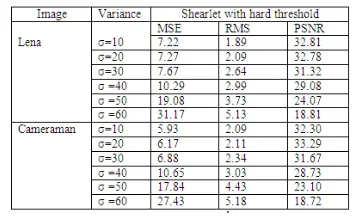
MSE,PSNR,RMS. The experiments shearlet with hard thresholding have been tested and their denoised image results are shown in Table I and Table II. Considered all the metrics, it is observed that performs well for two images such as Lena, Cameraman.
x
rms= ( + + +⋯+ )Table.1 Lena and Cameraman Image Shearlet with Hard threshold in Gaussian noise
Table 1 shows the denoised lena and cameraman image with metrics like PSNR, MSE and RMS for the removal of noises Gaussian.It shows hard thresholding of shearlet transform in Gaussian noise.
Table.2 Lena and Cameraman Image Shearlet with Hard threshold in Poisson noise
Table 2 shows the denoised lena and cameraman image with metrics like PSNR, MSE and RMS for the removal of noise Poisson. It shows hard thresholding of shearlet transform in Poisson noise.
ISSN(Online): 2320-9801
ISSN (Print): 2320-9798
I
nternational
J
ournal of
I
nnovative
R
esearch in
C
omputer
and
C
ommunication
E
ngineering
(An ISO 3297: 2007 Certified Organization) Website:
www.ijircce.com
Vol. 5, Issue 1, January 2017
V.CONCLUSION
This paper presents for natural image denoising based on Shearlet with hard threshold is used to remove noise from the image. The images are corrupted with Gaussian and Poisson noises. The multiscale and multidirectional aspects of the shearlet transform provide a better estimation capability for images exhibiting piecewise smooth edges, Quantitative performance measure such as MSE,RMS,PSNR are used to evaluated the denoised image effect We conclude therefore that the Shearlet Transform with hard threshold is an efficient technique for improving the quality of the image.
REFERENCES
[1]Pooran Singh Negi and Demetrio Labate,”3D Discrete Shearlet Transform and Video Processing”, IEEE Transactions On Image Processing. [2]Glenn R. Easley and Demetrio Labate ,” Image Processing using Shearlets”, IEEE Transactions On Image Processing.
[3]Wang-Q Lim,”Nonseparable Shearlet Transform” ”, IEEE Transactions On Image Processing.
[4]Zhiyong Fan[1,2], Quansen Sun1, Feng Ruan2, Yiguang Gong2 and Zexuan Ji1,“An Improved Image Denoising Algorithm based on Shearlet”,
International Journal of Signal Processing, Image Processing and Pattern Recognition Vol. 6, No. 4, August, 2013,
[5]Abdullah Al Jumah,”Denoising of an Image Using Discrete Stationary Wavelet Transform and Various Thresholding Techniques”, Journal of Signal and Information Processing, 2013, 4, 33-41.
[6] Pankaj Hedaoo1 and Swati S Godbole2,”wavelet thresholding approach for image denoising”, International Journal of Network Security & Its
Applications (IJNSA), Vol.3, No.4, July 2011.
[7]Sakthivel K.,”Contourlet Based Image Denoising Using New-Threshold Function”, International Journal of Innovative Research in Computer and Communication Engineering,March 2014.
[8] Mukesh C. Motwani Mukesh C. Gadiya Rakhi C. Motwani, Frederick C. Harris, Jr.,“Survey of Image Denoising Techniques”.
[9]Anutam1 and Rajni2,”Performance Analysis Of Image Denoising with Wavelet Thresholding Methods for Different levels of Decomposition”,
,International Journal Of Multimedia & Its Applications (IJMA)vol.6,no.3,june 2014.
[10]Anju T S[1],Mr. Nelwin Raj N R[2],”Shearlet Transform Based Satellite Image Denoising Using Optimized Otsu Threshold”,International Journal
of Latest Trends in Engineering and Technology (IJLTET),ISSN: 2278-621XVol 7 issue 1 May 2016.
[11] G. R. Easley, D. Labate, and W.Q. Lim,“Sparse directional image representations using the discrete shearlet transform”,Appl. Comput. Harmon. Analysis, vol.25, Jan. 2008, pp.25-46.
[12]Xiwen, Liu [1, a], Chaoying Liu[2,b],”An Optional Gauss Filter Image Denoising Method Based on Difference Image Fast Fuzzy Clustering”
411-414 (2013) pp1348-1352 Online available since 2013/Sep/03.
[13]Shubh Karman Kaur[1], Rupinder Kaur[2],“An Efficient Threshold Based Mixed Noise Removal Technique”,International Journal on Recent and
Innovation Trends in Computing and Communication ISSN: 2321-8169 Volume: 4 Issue:7 308 – 311.
[14]Jyotsna Patil1, Sunita Jadhav2”,”A Comparative Study of Image Denoising Techniques”, , International Journal of Innovative Research in
Science, Engineering and Technology, Vol. 2, Issue 3, March 2013.
[15]Arun Dixit, Poonam Sharma,“A Comparative Study of Wavelet Thresholding for Image Denoising”, I.J. Image, Graphics and Signal Processing,
vol.39-46 in MECS DOI: 10.5815/ijigsp. Published Online November 2014.
[16]Anutam1 and Rajni2,”Performance Analysis of Image Denoising with Wavelet Thresholding Methods for Different Levels of
Decomposition”,International Journal of Multimedia & Its Applications (IJMA) Vol.6, No.3, June 2014.
[17]Jannath Firthouse P1, Latha Rani G.L2, Shajun Nisha S3,”An Effective Shrinkage Threshold for Contourlet based on Image Denoising in Natural
Images,International Journal of Advanced Research in Computer and Communication Engineering Vol. 5, Issue 6, June 2016.
[18]G. R. Easley, D. Labate, and W.Q. Lim, “Sparse directional image representations using the discrete shearlet transform, ”Appl. Comput. Harmon. Analysis, vol.25, pp.25-46,Jan. 2008.
BIOGRAPHY
K.M.N.Syed Ali Fathima received the B.sc degree in Computer Science from MS University in 2012 and M.sc degree in Computer Science from MS University in 2015.She is currently pursuing the M.Phil degree in Computer Science under the guidance of S. Shajun Nisha. Her Research interest are mainly include domain of Image Denoising.