Proceedings of Recent Advances in Natural Language Processing, pages 363–371,
Graph-Based Approach to Recognizing CST Relations in Polish Texts
Paweł K˛edzia Wrocław University of Science and Technology
Maciej Piasecki Wrocław University of Science and Technology
{pawel.kedzia,maciej.piasecki,arkadiusz.janz}@pwr.edu.pl Arkadiusz Janz Wrocław University of Science and Technology
Abstract
This paper presents a supervised approach to the recognition of Cross-document Structure Theory (CST) relations in Polish texts. In the proposed, graph-based rep-resentation is constructed for sentences. Graphs are built on the basis of licalised syntactic-semantic relations ex-tracted from text. Similarity between sen-tences is calculated on their graphs, and the values are used as features to train the classifiers. Several different configura-tions of graphs, as well as graph similarity methods were analysed for this task. The approach was evaluated on a large open corpus annotated manually with 17 types of selected CST relations. The configu-ration of experiments was similar to those known from SEMEVAL and we obtained very promising results.
1 Introduction
Among large volumes of data available one can find a lot of redundant information, eg. supple-menting, overlapping etc. Manual aggregating and synthesizing valuable information from a massive input is laborious. The aim of multi-document dis-course parsing is to discover the relations or de-pendencies linking text passages. The relation we are aiming for are not limited only to the relations between event descriptions. Recognition of dis-course relationships linking texts can be useful in many information retrieval applications, and may help in information management.
The Cross-document Structure Theory (CST) (Radev,2000) introduces an organized structure of semantic links connecting topically related texts. CST relations recognised correctly for text frag-ments provide a map of the document(s)
seman-tic structure and, e.g., can support multi-document summarization (Kumar et al., 2014). However, due to the large number of relations and often sub-tle differences between them, CST relation recog-nition is known to be much harder than Textual Entailment (TE) recognition.
Our goal is to build a tool for the recognition of CST relations in Polish texts. Firstly, we lim-ited the problem to recognition of relations tween sentence pairs, that is even a harder task be-cause of the limited text material. to be processed. For training we used a part of the KPWr Corpus (Broda et al., 2012) based on Polish Wikinews1. In the work presented here, we focus on the 17 re-lations with the largest coverage in the corpus.
2 Related Works
In (Zhang et al.,2003) CST relations were recog-nized by a supervised approach with boosting on the basis of simple, lexical, syntactic and semantic features, extracted from sentence pairs. The evalu-ation was performed in two steps: binary classifi-cation for relationship detection, and multi-class classification for relationship recognition. This idea was expanded Zhang and Radev (2005) by leveraging both labeled and unlabeled data. The exploitation of unlabeled instances improved the performance. Boosting technique was used in combination with the same set of features to clas-sify the data in CSTBank (Radev et al.,2004). Re-lation detection was significantly improved to F-score =0.8839. However, recognition of the rela-tion type was still unsatisfactory.
Aleixo and Pardo(2008) is one of a few works that address recognition CST relations for lan-guages other than English. They utilised CST in search for topically related Portuguese documents. They applied a supervised approach based on
sim-1https://pl.wikinews.org
ilarity measures calculated for sentence pairs from different documents: cosine similarity and a vari-ant of the Jaccard index. Cut-off thresholds for the similarity were studied in combination with the performance of classifiers.
Zahri and Fukumoto (2011) applied the super-vised learning to identify a limited set of CST re-lations: Identity,Paraphrase,Subsumption, Elab-oration andPartial Overlap. They were used in the multi-document summarization task. SVM al-gorithm was used and examples from CSTBank. The features of (Aleixo and Pardo,2008) were ex-panded with: (i) cosine similarity of word vectors, (ii) intersection of common words measured with the Jaccard Index, (iii) an indicator of longer sen-tence and (iv) one-sided word coverage ratio.
Kumar et al. (2012a) restricted the set of re-lations further down to four: Identity, Subsump-tion,OverlapandElaboration. Four features were used: (i) tf-idf based cosine sentence similarity, (ii) words coverage ratio, (iii) sentence length dif-ference and (iv) the indicator of longer sentence. The best performance of SVM in relation recog-nition was: for Identity F = 0.91, Subsumption 0.59,Elaboration0.54, and0.62forOverlap. For the same relationsKumar et al.(2012b) presented results obtained with SVM, a Feed-Forward neu-ral network and CBR. The features of (Zahri and Fukumoto,2011) were extended with the Jaccard based similarity of noun phrases and verb phrases. CBR based on the cosine similarity measure ex-pressed improved results than in (Kumar et al.,
2012a): Identity 0.966, Subsumption 0.803, De-scription0.786, and0.722forOverlap.
(Maziero et al.,2014) proposed several refine-ments to CST in order to reduce the ambiguity. They improved definitions by several additional constraints on the co-occurrence of different rela-tions in texts. The CST taxonomy was amended by introducing a division based on the form and information content of relations. The improved model was used in evaluation of supervised CST relation recognition in three different settings: bi-nary, multi-class and hierarchical (facilitating the proposed taxonomy of relations). The applied fea-tures included: sentence length difference, ratio of shared words, sentence position in text, differ-ences of word numbers across PoSs, and the num-ber of shared synonyms between sentences. SVM, Naive Bayes and J48 decision tree were used for classification with the best score of J48. The
aver-age F-measure for multi-class scheme was0.403, while for the binary scheme: 0.673. (without the final decision) and for the hierarchical:0.724.
3 Dataset
We utilised a dataset of sentence pairs annotated with CST relations from the KPWr Corpus. The corpus consists of complete documents that were grouped by their similarity into groups of 3 news each. The groups include the most similar, po-tentially topically related documents. The im-posed similarity structure facilitated searching for sentence pairs linked by a CST relation. A cor-pus, with similar distribution of discourse relations linking multiple documents, was also introduced in (Cardoso et al.,2011). It was built from texts from journals in Brazilian Portuguese.
Selected sentences from our corpus were manu-ally annotated with CST relations at least by 3 an-notators (linguists) each. Each annotator was ex-ploring the corpus independently, in order to find and annotate inter-document relations inside doc-ument groups linking text fragments. The annota-tors followed the guidelines of CSTBank (Radev et al.,2004) slightly adapted to Polish.
4 Features in Classification 4.1 Baseline Features
As a starting point we used the set features pro-posed in (Maziero et al.,2014). Our set includes commonly-used, lexical, syntactic and semantic features that were applied for the detection and recognition of CST relationships in supervised ap-proaches. They focus on the grammatical forms in and properties of the linked sentences:
• Shared lemmas – the number of lemmas shared by two sentences,
• Shared PNs – the number of Proper Names shared by two sentences,
• Longest Common Substring – the length of the longest common continuous sub-string of word forms from the two sentences,
• Longest Common Subsequence – the length of the longest common sub-sequence, but the sequences can be discontinuous (i.e. se-quence elements can be separated),
• Is Longer – equals 1 if the first sentence is longer,0for equal,−1if the second is longer, • Shared synsets – the number of synsets shared by the two sentences which is nor-malized by the number of all synsets in the shorter sentence (to make the feature insensi-tive to sentence length differences),
• PoS similarity – cosine measure of vectors of the frequencies of different Part of Speech in both sentences (4 basic PoS were used), • SVO Index – the Jaccard Index calculated
for vectors of frequencies of triples: subject, verb, object for both texts.
These features were used as a baseline model for the description of text pairs, and compared later with the graph-based representation proposed in the following subsections. Several language tools were used to enrich texts for feature ex-traction: Morfeusz(Woli´nski, 2006) – a morpho-logical analysis, WCRFT (Radziszewski, 2013) – tagger, Liner2 (Marci´nczuk et al., 2013) – recognition of Proper Names, Maltparser (Nivre et al., 2007) adapted to Polish (Wróblewska,
2014),WCCL(Radziszewski et al.,2011) – recog-nition of multi-word expressions from plWord-Net (Maziarz et al., 2016;Piasecki et al., 2009),
WoSeDon (K˛edzia et al., 2015; Piasecki et al.,
2016) – Word Sense Disambiguation, IOBBER
(Radziszewski and Pawlaczek,2013) – a syntac-tic chunker,Fextor (Broda et al.,2013) – tool for feature extraction.
4.2 Graph-based Features
The baseline features do not take into account the linguistic structure of the compared sentences. As the parser for Polish has limited accuracy, instead of depending only on the dependency structure produced by the parser we propose a graph-based representation of a sentence (or text) which is flex-ible and can accommodate results of processing by different language tools.
4.2.1 Graph-based Sentence Representation
Each sentenceSiis represented as a directed graph Gi. Thus, a relationR(S1, S2)between sentences
S1 andS2 is represented as a relationR between
graphsG1 andG2:R(G1, G2). For them we will
calculate a similarity valuevsim =SIM(Gi, Gj) whereSIM means one of the similarity measures discussed in Sec.4.2.2. Formally, a directed graph
G = (V, E) where V is a set of vertices and E is set of directed and ordered edgeseA directed edgee= (ns, nt)wherensis the source node and nt is the target node, the direction is fromns to nt. The graphs are built in three steps: creation of nodes and edges on the basis of a sentence and merging the graph with subgraphs extracted from external knowledge sources, i.e. plWordNet and SUMO Ontology (Pease,2011).
Inthe first stepan example sentence pair (Si and Sj) for a relation R is converted into two sepa-rate null graphs, respectively: Gi and Gj. Their nodes are of a selected typeT (the same for both graphs), represent the words from the sentences and are not connected to each other. If we select more than one node type, we would obtain several null graphs for each sentence. Depending on the chosen typeTi of node, one or more words from Sicould be represented by the same node:
• Lemma lower – this is the simplest node type, a node ni ∈ Gj represents a lemma from Sj, which is converted to lowercase. All words from a sentence with the same lemma (irrespectively of PoS) are repre-sented by the same node, e.g., forZ ogrodu zoologicznego we Wrocławiu uciekł w ˛a˙z Boa Dusiciel i przemieszcza si˛e w stron˛e Ostrowa Tumskiego.
we obtain the following null graph: {{w1:z},{w2:ogród},{w3:uciec}, {w4:zoologiczny},{w5:w ˛a˙z},...}
• Lemma PoS lower – in a similar way to
Lemma lower, nodes represent lowercased lemmas, but PoS label is concatenated, e.g. cat:n or the Polish word piec can be morphologically disambiguated as a verb or noun Kasia piecze:v ciasto w piecu:n. Using Lemma lower type, the wordspiecze
and piecu will be represented by a single node labelled as piec, while in Lemma PoS lower type there will be two different nodes: piec:n and piec.v. For Ssample the node of the type Lemma PoS lower
are: {{w1:z-prep},{w2:ogród-subst}, {w3:uciec-praet},{w4:w ˛a˙z-subst},...} • Synset– nodes represent plWordNet synsets
{{w1:ogród-4772},{w2:uciec-3573}, {w3:zoologiczny-8748},...}
• Concept – nodes are concepts from SUMO Ontology. The concepts are assigned to words in a sentence on the basis of synsets recognised by WoSeDon and the mapping between plWordNet and SUMO (K˛edzia and Piasecki, 2014). The null graph of Concept type for SSample is: {{w1:subsumed-CultivatedLandArea},{w2: subsumed-Attribute},{w3:subsumed-Reptile} {w4:equivalent-Snake},...}
Inthe second step the null graph constructed in the first step is expanded by adding edges between nodes. If we have multiple null graphs with differ-ent node types, we need to expand every null graph from the first step with new edges. The edge types are derived from automatically recognised lexical and semantic relations in a sentence. The etype direction depends on the kind of the relation rep-resented:
• w2w – edges represent the word order in a sentence (word to word). If a word w1
oc-curs in a sentence before wordw2, then there
is a directed edge from w1 to w2: ew2w :
(w1, w2).
• h2h – head to head represents the relative order of the heads of agreement phrases in a sentence. Each sentence is divided into chunks of three types: Verb PhraseVP, Noun Phrase NP and Adjective Phrase AdjP, that are next subdivided into smaller,Agreement Phrases (AgP). The relation h2h represents the order ofAgPsheads. If a AgP headwhi occurs in a sentence before the AgP headwhj then the edge is directed from whi to whj: eh2h : (whi, whj).
• ne2ne – an edge type similar tow2wandh2h, but in which edges represent the order of the named entities NE in a sentence. If named entitywneioccurs beforewnejin sentenceS, then a directed edge: ene2ne : (wnei, wnej), is added to the graph.
• malt – edges of this type represent the de-pendency relations. Each dede-pendency rela-tion between two wordswi andwj, is mod-elled in the graph as a directed edge with the same direction. If there is a dependency rela-tiondeprel(wi, wj), then it is added into the
graph as a directed edge with the same direc-tiondeprel:edeprel(wi, wj).
• defender – the type similar to the malt, but relations come fromDefender parser which is based on IOBBER chunker (Kedzia and Maziarz, 2013). Provides deeper relation structures for NPs. We used malt and de-fender relations, because in some situations the relations proposed by Malt are incorrect. If there is a dependency for two wordswiand wj fromDefender, then it is added as a di-rected edge to graph:edef(wi, wj).
• semantic roles – edges marked as srole represent semantic roles from NPSemrel, a Polish shallow semantic parser (Kedzia and Maziarz,2013). The dependencies proposed by Defender are named with semantic roles e.g.agent,theme. If semantic role is assigned to a pair of words:wiandwj, a directed edge is added between the nodes representing wi andwj:esrole : (wi, wj). The edge is labeled with the semantic role.
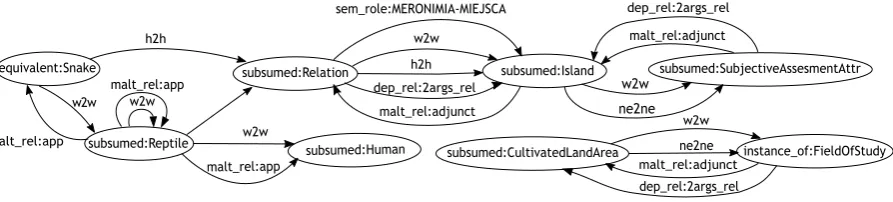
All types of edges and nodes were used in our experiments. A single graph Gi repre-sents sentence Si and contains the edges Ei ∈ {w2w, h2h, ne2ne, malt, def, srole}. A graph for sentence Sexample, with Concept nodes and full set of possible edge types is shown in Fig.1. In the third step the constructed graphs are merged with a subgraph extracted from an Ex-ternal Knowledge Graph(henceforth EKG). Our idea is to add to the graphs built from sen-tences, more semantic information, extracted from
EKG. Let G will be a graph with node type t built for sentence S during second step, G = (Vt, E ∈ {w2w, h2h, ne2ne, malt, def, srole}). EKGplwnis a graph built from plWordNet, where the nodes in EKG(plwn) are the synsets from plWordNet, the edges inEKG(plwn)are the rela-tions from plWordNet.EKGS(plwn)is a subgraph ofEKGplwn. EKGsumois the graph built from SUMO Ontology, where nodes represent concepts from SUMO. The edges inEKGsumocorrespond to SUMO relations, and EKGS(sumo) is a
sub-graph ofEKGsumo. A subgraph of EKG is ex-tracted from the source in the following way: for each word w in sentence S we identify the cor-responding node nEKG in EKGand build a set P NEKGof possible nodes. For each pair of nodes
subsumed:CultivatedLandArea ne2ne instance_of:FieldOfStudy
malt_rel:adjunct
dep_rel:2args_rel equivalent:Snake subsumed:Relation
subsumed:Reptile w2w
h2h
dep_rel:2args_rel
subsumed:Island w2w
sem_role:MERONIMIA-MIEJSCA
malt_rel:app
w2w malt_rel:app
subsumed:Human w2w
malt_rel:adjunct
subsumed:SubjectiveAssesmentAttr
ne2ne
malt_rel:app
malt_rel:adjunct
dep_rel:2args_rel
w2w
w2w h2h
Figure 1: Graph built for sentenceSexamplewithConceptnode type and full set of edges types.
add spi to temporary graph GT(S(EKG)). After
this processGS(EKG) =GT(S(EKG)). Using this procedure we can be built three merged graphs.
With plWordNet,Gmerged=G∪EKGS(plwn)
includes nodes of the type synset (from the first step) edges built insecond stepand edges – rela-tions from plWordNet subgraph.
With SUMO,Gmerged =G∪EKGS(sumo)
in-cludes concept nodes from the sentence and from the subgraph of SUMO Ontology. The edges are the relations from sentence and relations from the SUMO subgraph.
With plWordNet and SUMO, Gmerged = G∪ EKGS(plwn)∪EKGS(sumo) contains full set of nodes: built in first step, from plWordNet and SUMO subgraphs, i.e. edges of all types.
There are 12 possible graph types in to-tal, i.e. 4 types of nodes and 3 types of merge with both EKG, namely: Lemma lower
graph merged with EKGS(SUMO), Lemma PoS
lowermerged withEKGS(plwn),Conceptmerged
with EKGS(sumo) or Synset graph merged with EKGS(plwn)∪EKGS(sumo).
4.2.2 Similarity-based Features
For each instance of relation Ri(S1, S2), a sen-tence pair, from the annotated corpus, see Sec.3
16 graphs were built for both sentences S1 and S2: 4 graphs with different node types in the
second step and 12 graphs with combinations of every node type with both EKG. Thus, each instance of relation Ri is assigned 16 graph-based representations of sentencesRi(S1, S2)⇒ Rik(G1k, G2k), k ∈< 1, . . .16 >. Next, we calculate 8 different similarity measures between the graphs forRi, including 7 similarity measures from the literature and one proposed by us. The measures are explained further on in this section. A single instance of relation Ri from the corpus is converted into a training vector vi of the size 128 (16 graphs × 8 measures). The first
mea-sure is well knownGraph Edit Distance( Fernán-dez and Valiente,2001) (GED), whose value is the minimal sum of the costsc(labelled asγ(M)) of atomic operations transformingG1toG2:
GED(G1, G2) =min(γ(M)) (1) MCS(Bunke and Shearer,1998) is the ratio of the size of maximum common subgraph(mcs) ofG1
andG2to the size of bigger graph of (G1orG2):
MCS(G1, G2) =max|mcs{|(GG1, G2)|
1|,|G2|} (2)
Measure WGU (Wallis et al., 2001) depends on calculating the ratio of the size ofmcsG1andG2
to the sum of sizes of both graphs minusmcssize:
W GU(G1, G2) = |G |mcs(G1, G2)|
1|+|G2| − |mcs(G1, G2)| (3) UGU(Bunke,1997) is a simple measure, whose value is the difference between the sizes ofG1and
G2and the double size of ofmcsG1andG2:
UGU(G1, G2) =|G1|+|G2| −2· |mcs(G1, G2)| (4)
Next measure called MMCSwas proposed by
Fernández and Valiente(2001). TheMMCSvalue expresses the dissimilarity of graphsG1andG2:
MMCS(G1, G2) =|MCS(G1, G2)| − |mcs(G1, G2)| (5) Measure MMCSN (Fernández and Valiente,
2001) depends on calculating ratio of mcs and
MCSfor graphsG1andG2.
MMCSN(G1, G2) = |MCS|mcs((GG1, G2)|
1, G2)| (6)
The last measure from literature isJaccard sim-ilarity (Jaccard,1912):
J(G1, G2) =||GG1∩G2|
1∪G2| (7)
context (neighborhood) of the nodenifromG1is
compared with the context of nodeni inG2. The
neighborhood of node nin graph Gis defined as input nodesG(n)inand output nodesG(n)out.
N(G1(n)) ={G1(n)in∪G1(n)out}
N(G2(n)) ={G2(n)in∪G2(n)out}
S(N(G1(n), G2(n))) = ||NN((GG1(n))∩N(G2(n))| 1(n))∪N(G2(n))| Gmin=G1 ⇐⇒ |G1| ≤ |G2| Gmin=G2 ⇐⇒ |G2|<|G1|
WhereN(G1(n))is the neighborhood of node n
inG1, andN(G2(n))of nodeninG2. The value
ofCTXBowSimis calculated as:
Sim(G1, G2) =CT XBowSim(G1, G2)
= Pn
n∈GminS(N(G1(n), G2(n)))
|Gmin| (8)
The similarity values are used as features during supervised learning to build a classifier. By chang-ing the way of constructchang-ing the graphs and com-puting their similarity we tune the classification process into different aspects of the sentences be-ing compared. The number of features generated for classification is dependent on the number of different graphs types, used to compare sentences, and the number of applied measures for calculat-ing their similarity. Thus, it is a combination of all node representations, allEKGsources and the applied similarity measures.
5 Results and Evaluation
The corpus contains 3469 examples annotated with one of the possible CST relations. For clas-sification we used SVM (Suport Vectors Machine
(Steinwart and Christmann,2008)) and LMT ( Lo-gistic Model Tree (Landwehr et al., 2005)). The classifiers were evaluated according to 10-fold cross-validation scheme (Kohavi,1995).
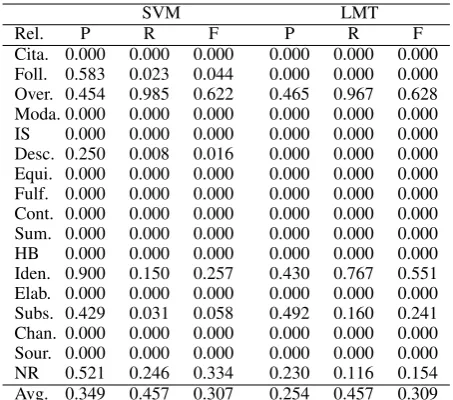
First, the baseline set of features was tested, see Sec. 4.1. The classifiers were tested on relation types, which implies that the training set for the classification was highly unbalanced with respect to different relations. Table1shows the results for SVM and LMT and the baseline feature set. Zero values occurred for very specific relations with a small number of instances, e.g. 3 instances of Ci-tation. Moreover, baseline features express only weak discrimination power.
In a multiclass setting, the average F-score value for SVM was 0.334 and 0.309 for LMT.
SVM LMT
Rel. P R F P R F
Cita. 0.000 0.000 0.000 0.000 0.000 0.000 Foll. 0.583 0.023 0.044 0.000 0.000 0.000 Over. 0.454 0.985 0.622 0.465 0.967 0.628 Moda. 0.000 0.000 0.000 0.000 0.000 0.000 IS 0.000 0.000 0.000 0.000 0.000 0.000 Desc. 0.250 0.008 0.016 0.000 0.000 0.000 Equi. 0.000 0.000 0.000 0.000 0.000 0.000 Fulf. 0.000 0.000 0.000 0.000 0.000 0.000 Cont. 0.000 0.000 0.000 0.000 0.000 0.000 Sum. 0.000 0.000 0.000 0.000 0.000 0.000 HB 0.000 0.000 0.000 0.000 0.000 0.000 Iden. 0.900 0.150 0.257 0.430 0.767 0.551 Elab. 0.000 0.000 0.000 0.000 0.000 0.000 Subs. 0.429 0.031 0.058 0.492 0.160 0.241 Chan. 0.000 0.000 0.000 0.000 0.000 0.000 Sour. 0.000 0.000 0.000 0.000 0.000 0.000 NR 0.521 0.246 0.334 0.230 0.116 0.154 Avg. 0.349 0.457 0.307 0.254 0.457 0.309
Table 1: Results for the classifiers trained on the baseline feature set (lexical, syntactic, semantic).
Many CST relations were not recognized at all. Classifiers showed poor precision and recall in the relations detection task (No relationresult), which means they could not decide whether a pair of sen-tences represents a CST link or not. The perfor-mance at recognition of relations was unsatisfac-tory, even for the most frequent relations including
Overlap,Follow-up,SubsumptionorDescription. For the graph-based approach, SVM and LMT were used again. Table2contains summarized re-sults of classifiers trained with graph-based fea-tures. The performance achieved using graph-based features was better than in the previous ap-proach. A significant improvement could be ob-served for both SVM and LMT. Only for the less frequent relations the classifiers were not able to correctly recognize the type. The average F-score value was0.442for SVM and0.772for LMT. We can note that LMT outperforms SVM in the clas-sification on almost every class.
Table 3 shows the achieved results on a com-bined set of the baseline and graph-based features. A combination of these features had a positive impact on the performance of selected classifiers. The average F-score value was increased to0.749
nega-SVM LMT
Rel. P R F P R F
Cita. 0.000 0.000 0.000 1.000 0.333 0.500 Foll. 0.965 0.180 0.303 0.772 0.853 0.811 Over. 0.510 0.999 0.675 0.969 0.993 0.981 Moda. 0.000 0.000 0.000 0.000 0.000 0.000 IS 0.750 0.462 0.571 0.000 0.000 0.000 Desc. 0.578 0.070 0.125 0.556 0.739 0.634 Equi. 0.667 0.083 0.148 0.286 0.167 0.211 Fulf. 0.667 0.063 0.114 0.531 0.269 0.357 Cont. 0.000 0.000 0.000 0.000 0.000 0.000 Sum. 0.174 0.073 0.103 0.222 0.073 0.110 HB 0.727 0.103 0.180 0.643 0.756 0.695 Iden. 0.898 0.733 0.807 0.902 0.917 0.909 Elab. 0.378 0.114 0.175 0.707 0.431 0.535 Subs. 0.641 0.129 0.215 0.489 0.474 0.482 Chan. 0.000 0.000 0.000 0.000 0.000 0.000 Sour. 1.000 0.820 0.901 0.813 0.520 0.634 NR 0.956 0.437 0.600 0.776 0.749 0.762 Avg. 0.620 0.544 0.448 0.771 0.786 0.772
Table 2: The results for a graph-based approach.
tively affecting the results of classification. We can notice that for less frequent relations like Cita-tion, Modality, Indirect Speech orContradiction, the classifiers were not able to properly recognize types of the CST links.
SVM LMT
Rel. P R F P R F
Cita. 0.000 0.000 0.000 0.000 0.000 0.000 Foll. 0.800 0.967 0.876 0.964 0.961 0.962 Over. 0.947 1.000 0.973 0.980 0.986 0.983 Moda. 0.000 0.000 0.000 0.000 0.000 0.000 IS 0.000 0.000 0.000 0.393 0.423 0.407 Desc. 0.551 0.728 0.627 0.613 0.707 0.657 Equi. 0.333 0.042 0.074 0.295 0.271 0.283 Fulf. 0.710 0.138 0.230 0.561 0.431 0.488 Cont. 0.000 0.000 0.000 0.167 0.150 0.158 Sum. 0.000 0.000 0.000 0.243 0.167 0.198 HB 0.565 0.724 0.635 0.695 0.753 0.723 Iden. 0.887 0.917 0.902 0.948 0.917 0.932 Elab. 0.933 0.341 0.500 0.607 0.577 0.592 Subs. 0.500 0.629 0.557 0.580 0.526 0.551 Chan. 0.000 0.000 0.000 0.000 0.000 0.000 Sour. 0.800 0.160 0.267 0.818 0.720 0.766 NR 0.777 0.723 0.749 0.873 0.868 0.871 Avg. 0.769 0.786 0.755 0.816 0.820 0.817
Table 3: The results for a combined approach -basis features extended with graph-based features. As it was noted earlier, a similar distribution of the relations can be observed in the CSTNews corpus (Cardoso et al., 2011). The authors of CSTNews built it from news documents, i.e. the sources were very similar to those utilised in the corpus applied in this work. In (Maziero et al.,
2014) CSTNews was used to evaluate recognition methods for the refined CST model. The authors stated that their classifier outperforms other CST parsers. Tab. 4 presents the results of our
eval-uation in comparison to the results reported in (Maziero et al., 2014). The comparison was in-direct due to the different languages and data sets, but as both corpora have similar content and struc-ture, this comparison can be informative.
(Maziero et al.,2014) Our LMT
Rel. P R F P R F
Cita. — — — 0.000 0.000 0.000
Foll. 0.282 0.273 0.277 0.964 0.961 0.962 Over. 0.441 0.478 0.458 0.980 0.986 0.983
Moda. — — — 0.000 0.000 0.000
IS 0.529 0.632 0.576 0.393 0.423 0.407
Desc. — — — 0.613 0.707 0.657
Equi. 0.378 0.359 0.368 0.295 0.271 0.283
Fulf. — — — 0.561 0.431 0.488
Cont. 0.273 0.177 0.214 0.167 0.150 0.158
Sum. — — — 0.243 0.167 0.198
HB 0.299 0.260 0.278 0.695 0.753 0.723 Iden. 1.000 1.000 1.000 0.948 0.917 0.932 Elab. 0.405 0.385 0.395 0.607 0.577 0.592 Subs. 0.449 0.447 0.448 0.580 0.526 0.551
Chan. — — — 0.000 0.000 0.000
Sour. — — — 0.818 0.720 0.766
NR 0.773 0.527 0.627 0.873 0.868 0.871
Tran. 0.500 0.500 0.500 — — —
Avg. 0.484 0.458 0.467 0.816 0.820 0.817
Table 4: Comparison of the results.
6 Conclusions
In our approach a sentence S is represented by different graphs referring to many types of the word-level representations. It is possible to ex-press the same sentence S on the morphologi-cal level (Lemma PoS Node type) and/or semantic level (Synset Node type). By merging the graphs built fromSwith some external knowledge graph, we can expand the information stored in the graph ofSand calculate similarity between graphs more accurately. The proposed approach to build graphs is language independent and is not depended on the existence of deeper parsers.
References
Priscila Aleixo and Thiago Alexandre Salgueiro Pardo. 2008. Finding Related Sentences in Multiple Doc-uments for Multidocument Discourse Parsing of Brazilian Portuguese Texts. InCompanion Proceed-ings of the XIV Brazilian Symposium on Multimedia and the Web. ACM, New York, NY, USA, WebMe-dia ’08, pages 298–303.
Bartosz Broda, Paweł K˛edzia, Michał Marci´nczuk, Adam Radziszewski, Radosław Ramocki, and Adam Wardy´nski. 2013. Fextor: A Feature Extrac-tion Framework for Natural Language Processing: A Case Study in Word Sense Disambiguation, Rela-tion RecogniRela-tion and Anaphora ResoluRela-tion, Springer Berlin Heidelberg, Berlin, Heidelberg, pages 41–62. Bartosz Broda, Michał Marci´nczuk, Marek Maziarz, Adam Radziszewski, and Adam Wardy´nski. 2012. KPWr: Towards a Free Corpus of Polish. In Nico-letta Calzolari (Conference Chair), Khalid Choukri, Thierry Declerck, Mehmet U˘gur Do˘gan, Bente Maegaard, Joseph Mariani, Asuncion Moreno, Jan Odijk, and Stelios Piperidis, editors, Proceedings of the Eight International Conference on Language Resources and Evaluation (LREC’12). European Language Resources Association (ELRA), Istanbul, Turkey.
H. Bunke. 1997. On a Relation Between Graph Edit Distance and Maximum Common Subgraph. Pat-tern Recogn. Lett.18(9):689–694.
Horst Bunke and Kim Shearer. 1998. A Graph Dis-tance Metric Based on the Maximal Common Sub-graph. Pattern Recogn. Lett.19(3-4):255–259. Paula C.F. Cardoso, Erick G. Maziero, María
Lucía Castro Jorge, Eloize R.M. Seno, Ariani Di Fe-lippo, Lucia Helena Machado Rino, Maria das Gra-cas Volpe Nunes, and Thiago Alexandre Salgueiro Pardo. 2011. CSTNews - A discourse-annotated corpus for single and multi-document summariza-tion of news texts in Brazilian Portuguese. In Pro-ceedings of the 3rd RST Brazilian Meeting. Cuiabá, Brazil, pages 88–105.
Mirtha-Lina Fernández and Gabriel Valiente. 2001. A Graph Distance Metric Combining Maximum Com-mon Subgraph and Minimum ComCom-mon Supergraph. Pattern Recogn. Lett.22(6-7):753–758.
Paul Jaccard. 1912. The Distribution of the Flora in the Alpine Zone .New Phytologist11(2):37–50. Pawel Kedzia and Marek Maziarz. 2013.
Recogniz-ing semantic relations within Polish noun phrase: A rule-based approach. InRANLP.
Ron Kohavi. 1995. A Study of Cross-validation and Bootstrap for Accuracy Estimation and Model Se-lection. In Proceedings of the 14th International Joint Conference on Artificial Intelligence - Volume 2. Morgan Kaufmann Publishers Inc., San Fran-cisco, CA, USA, IJCAI’95, pages 1137–1143.
Yogan Jaya Kumar, Naomie Salim, Albaraa Abuo-bieda, and Ameer Tawfik Albaham. 2014. Multi document summarization based on news compo-nents using fuzzy cross-document relations. Applied Soft Computing21:265–279.
Yogan Jaya Kumar, Naomie Salim, Ahmed Hamza, and Albarraa Abuobieda. 2012a. Automatic identi-fication of cross-document structural relationships, pages 26–29.
Yogan Jaya Kumar, Naomie Salim, and Basit Raza. 2012b. Cross-document Structural Relationship Identification Using Supervised Machine Learning. Appl. Soft Comput.12(10):3124–3131.
Paweł K˛edzia and Maciej Piasecki. 2014. Ruled-based, Interlingual Motivated Mapping of plWordNet onto SUMO Ontology. In Nicoletta Calzolari, Khalid Choukri, Thierry Declerck, Hrafn Loftsson, Bente Maegaard, Joseph Mariani, Asunción Moreno, Jan Odijk, and Stelios Piperidis, editors, Proceedings of the Ninth International Conference on Language Resources and Evaluation (LREC-2014), Reykjavik, Iceland, May 26-31, 2014.. pages 4351–4358. Paweł K˛edzia, Maciej Piasecki, and Marlena
Orli´nska. 2015. Word sense disambigua-tion based on large scale Polish CLARIN heterogeneous lexical resources. Cognitive Studies / Études cognitives (15):269–292.
https://ispan.waw.pl/journals/index.php/cs-ec/article/download/cs.2015.019/1765.
Niels Landwehr, Mark Hall, and Eibe Frank. 2005. Lo-gistic model trees. Machine Learning 59(1):161– 205.
Michał Marci´nczuk, Jan Koco´n, and Maciej Janicki. 2013. Liner2 – a customizable framework for proper names recognition for Polish. In Robert Bembenik, Lukasz Skonieczny, Henryk Rybinski, Marzena Kryszkiewicz, and Marek Niezgodka, ed-itors, Intelligent Tools for Building a Scientific In-formation Platform, pages 231–253.
Marek Maziarz, Maciej Piasecki, Ewa Rudnicka, Stan Szpakowicz, and Pawel Kedzia. 2016. plWordNet 3.0 - a Comprehensive Lexical-Semantic Resource. InCOLING 2016, 26th International Conference on Computational Linguistics, Proceedings of the Con-ference: Technical Papers, December 11-16, 2016, Osaka, Japan. pages 2259–2268.
Erick Galani Maziero, Maria Lucía Del Rosário Cas-tro Jorge, and Thiago Alexandre Salgueiro Pardo. 2014. Revisiting Cross-document Structure Theory for Multi-document Discourse Parsing. Inf. Process. Manage.50(2):297–314.
Adam Pease. 2011. Ontology: A Practical Guide. Ar-ticulate Software Press, Angwin, CA.
Maciej Piasecki, Pawel K˛edzia, and Marlena Orli´nska. 2016. plWordNet in Word Sense Disambigua-tion task. In GWC 2016, Proceedings of the 8th Global Wordnet Conference, Bucharest, 27-30 Jan-uary 2016 Osaka, Japan. pages 280–290.
Maciej Piasecki, Stanisław Szpakowicz, and Bartosz Broda. 2009. A Wordnet from the Ground Up. Oficyna Wydawnicza Politechniki Wroclawskiej, Wrocław.
Dragomir R. Radev. 2000. A Common Theory of In-formation Fusion from Multiple Text Sources Step One: Cross-document Structure. InProceedings of the 1st SIGdial Workshop on Discourse and Dia-logue - Volume 10. Association for Computational Linguistics, Stroudsburg, PA, USA, SIGDIAL ’00, pages 74–83.
Dragomir R. Radev, Jahna Otterbacher, and Zhu Zhang. 2004. Cst bank: A corpus for the study of cross-document structural relationships. In LREC. European Language Resources Association.
Adam Radziszewski. 2013. A tiered CRF tagger for Polish. In H. Rybi´nski M. Kryszkiewicz M. Niezgódka R. Bembenik, Ł. Skonieczny, editor, Intelligent Tools for Building a Scientific Informa-tion Platform: Advanced Architectures and Solu-tions, Springer Verlag, page to appear.
Adam Radziszewski and Adam Pawlaczek. 2013. Lan-guage Processing and Intelligent Information Sys-tems: 20th International Conference, IIS 2013, Warsaw, Poland, June 17-18, 2013. Proceedings, Springer Berlin Heidelberg, Berlin, Heidelberg, chapter Incorporating Head Recognition into a CRF Chunker, pages 22–27.
Adam Radziszewski, Adam Wardy´nski, and Tomasz ´Sniatowski. 2011. WCCL: A morpho-syntactic fea-ture toolkit. In Proceedings of the Balto-Slavonic Natural Language Processing Workshop (BSNLP 2011). Springer.
Ingo Steinwart and Andreas Christmann. 2008. Sup-port Vector Machines. Springer Publishing Com-pany, Incorporated, 1st edition.
W. D. Wallis, P. Shoubridge, M. Kraetz, and D. Ray. 2001. Graph Distances Using Graph Union. Pattern Recogn. Lett.22(6-7):701–704.
Marcin Woli´nski. 2006. Morfeusz — a practical tool for the morphological analysis of Polish. In Mieczysław A. Kłopotek, Sławomir T. Wierzcho´n, and Krzysztof Trojanowski, editors, Intelligent In-formation Processing and Web Mining, Springer-Verlag, Berlin, Advances in Soft Computing, pages 503–512.
Alina Wróblewska. 2014. Polish Dependency Parser Trained on an Automatically Induced Dependency Bank. Ph.D. dissertation, Institute of Computer Sci-ence, Polish Academy of Sciences, Warsaw. Nik Adilah Hanin Binti Zahri and Fumiyo Fukumoto.
2011. Multi-document Summarization Using Link Analysis Based on Rhetorical Relations between Sentences, Springer Berlin Heidelberg, Berlin, Hei-delberg, pages 328–338.
Zhu Zhang, Jahna Otterbacher, and Dragomir Radev. 2003. Learning Cross-document Structural Rela-tionships Using Boosting. In Proceedings of the Twelfth International Conference on Information and Knowledge Management. ACM, New York, NY, USA, CIKM ’03, pages 124–130.