Rules for Classification and Construction
I Ship
Technology
4 Rigging
Technology
1
Tall Ship Rigs
The following Rules come into force on May 1
st, 1997
Germanischer Lloyd Aktiengesellschaft
Head Office
Vorsetzen 35, 20459 Hamburg, Germany
Phone: +49 40 36149-0
Fax: +49 40 36149-200
[email protected]
www.gl-group.com
"General Terms and Conditions" of the respective latest edition will be applicable
(see Rules for Classification and Construction, I - Ship Technology, Part 0 - Classification and Surveys).
Reproduction by printing or photostatic means is only permissible with the consent of
Germanischer Lloyd Aktiengesellschaft.
Published by: Germanischer Lloyd Aktiengesellschaft, Hamburg
Printed by: Gebrüder Braasch GmbH, Hamburg
Table of Contents
Section 1 Rules for the Masting and Rigging of Sailing Ships (Traditionell Rigs)
A. General ... 1- 1 B. Definitions ... 1- 1 C. Dimensioning of Masts, Topmasts, Yards, Booms and Bowsprits ... 1- 3 D. Standing Rigging ... 1- 9 E. Miscellaneous ... 1- 10
I - Part 4 GL 1997
Table of Contents Chapter 1
Section 1
Rules for the Masting and Rigging of Sailing Ships
(Traditional Rigs)
A. General 1. Scope
1.1 These rules are applicable to all seagoing ships with class
?
100 A5 sailing ship (or training sailing ship).1.2 Germanischer Lloyd (GL) applies these rules to the testing of the masting and rigging also of ships without class where it is commissioned to carry out such testing.
1.3 The construction of the hull is subject to the Society's currently most recent rules for the construc-tion of seagoing ships.
1.4 For ships which cannot be classified accord-ing to Section B. and havaccord-ing a length not exceedaccord-ing 24 m the "Rules for Classification and Construction, I – Ship Technology, Part 3 "Pleasure Craft, Chapter 2, Mast and Rigging" apply.
In cases of doubt an agreement is to be sought with GL Head Office.
2. Documents for approval
2.1 Fully dimensioned drawings of the following parts of the rigging shall be submitted to the Society in triplicate for examination:
– Rigging plan showing sail areas and centres of effort as well as the arrangement and dimen-sions of the standing rigging;
– Masts, upper masts and crosstrees;
– Yards with their fastenings to masts and upper masts;
– Booms for gaff sails with their fastenings to masts and upper masts;
– Bowsprits;
– Fastenings for standing rigging on hull, masts and upper masts;
– Substructures of masts and bowsprits;
– Running rigging, where this is subjected to forces transmitted by yards, booms, etc.
2.2 The forces acting at the crosstree and the cap are to be determined and submitted to GL for ap-proval.
2.3 Calculations of Intact Stability and, if need be, of Damage Stability are likewise to be submitted.
B. Definitions 1. Types of rig
1.1 The term "Rig" is used for the masts and the standing rigging of a sailing ship. In these Rules the running rigging does not come under this term.
1.2 The rigs of sailing ships are of two basic types:
– Square rig – Fore-and-aft rig.
1.3 The masts of square-rigged ships carry yards. (Square- and stay sails.)
1.4 The masts of fore-and-aft rigged ships carry no yards ("schooner rig", gaff-, top- and stay-sails).
2. Types of ships
Depending on the type of rig used, sailing ships are classed as:
2.1 Square-rigged ships (each mast carrying square sails). These include:
– the brig (two masts)
– full-rigged ships with three masts or more (e.g. a four-masted ship-rigged vessel).
2.2 Ships with mixed rig: These include:
– the schooner brig or brigantine (square-rigged foremast and fore-and-aft rigged mainmast) – the topsail schooner or barkentine
(square-rigged foremast, fore-and-aft (square-rigged main and mizzenmast)
I - Part 4
– the bark (square-rigged fore- and mainmast, fore-and-aft rigged mizzenmast)
– the bark with more than three masts (the after-most mast invariably fore-and-aft riggid)
– the square topsail schooner (masts are both square and fore-and-aft rigged).
2.3 Schooners (fore-and-aft rig only). These include:
– the two-masted schooner
– the fore-and-aft schooner with three or more masts (e.g. a five-masted schooner).
3. Nomenclature applied to masts
3.1 Different names are given to the masts on the various types of vessel. The following terms are used:
3.2 Two-masted ships
Independent of the kind of rig there is for
– brigs, – schooner brigs – schooners B A A: foremast B: mainmast Fig. 1.1 3.3 Three-masted ships B A C
Barks, topsail schooners and full-rigged ships: A: foremast B: mainmast C: mizzenmast Fig. 1.2 3.4 Four-masted ships A C B D
Four-masted barks and full-rigged ships: A: foremast
B: mainmast C: mizzenmast
D: jigger or spanker-mast
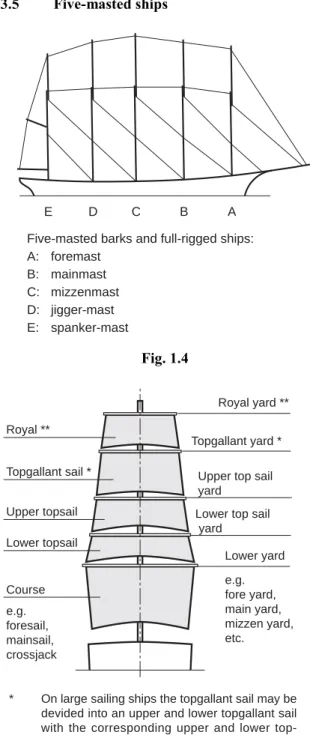
3.5 Five-masted ships
A C B E D
Five-masted barks and full-rigged ships: A: foremast B: mainmast C: mizzenmast D: jigger-mast E: spanker-mast Fig. 1.4 Lower yard Lower top sail yard
Upper top sail yard Topgallant yard * Royal yard ** Course Lower topsail Upper topsail Topgallant sail * Royal ** e.g. foresail, mainsail, crossjack e.g. fore yard, main yard, mizzen yard, etc.
* On large sailing ships the topgallant sail may be devided into an upper and lower topgallant sail with the corresponding upper and lower top-gallant yards.
** On very large sailing ships, the sky yard and/or the sky sail will be arranged above the royal yard.
Fig. 1.5 Nomenclature of yards and sails 4. Nomenclature applied to yards
4.1 The nomenclature applied to the yards is shown in Fig. 1.5.
5. Nomenclature applied to the standing rig-ging
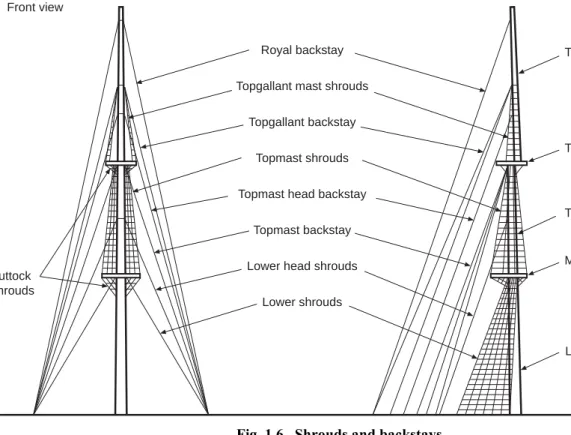
5.1 The nomenclature applied to the shrouds and backstays is shown in Fig. 1.6. The names given to the stays are shown in Fig. 1.7.
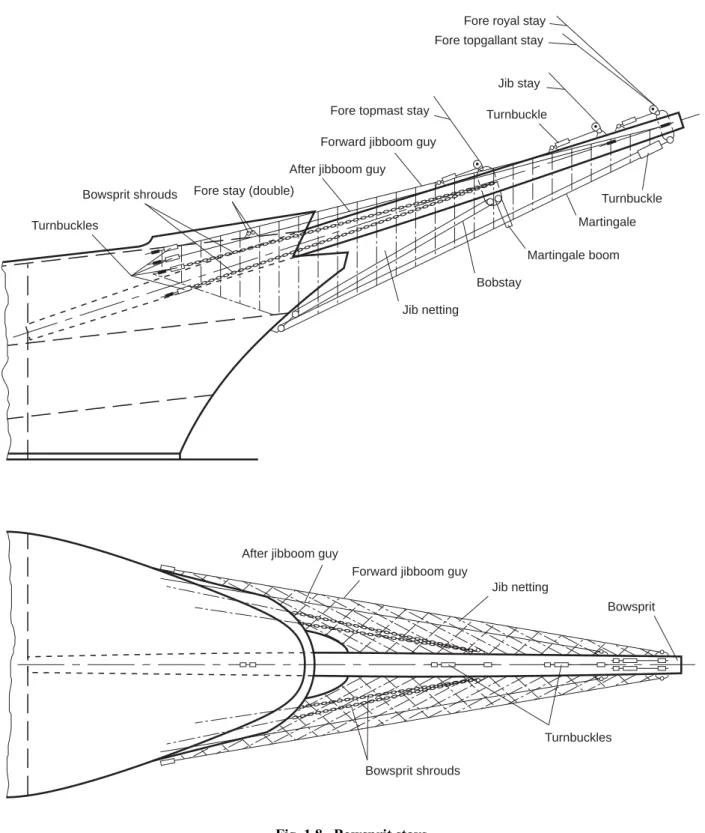
5.2 The names given to the bowsprit stays are shown in Fig. 1.8.
6. Nomenclature applied to sails 6.1 Sails are divided into three typs: – Square sails
– Gaff sails – Stay sails
6.2 The nomenclature applied to square sails is shown in Fig. 1.5.
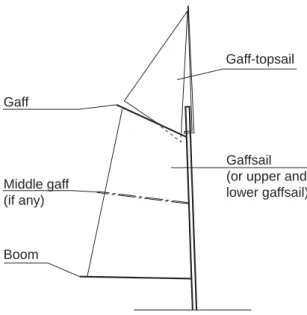
6.3 The lower gaff sails are named according to the masts on which they are carried (e.g. gaff foresail, gaff mainsail) but that on the mizzen is called a spanker. Corresponding names are also given to the gaff-topsails (e.g. main, fore and mizzen gaff-topsail). Further details are shown in Fig. 1.9.
6.4 The nomenclature applied to stay sails is shown in Fig. 1.10
C. Dimensioning of Masts, Topmasts, Yards, Booms and Bowsprits
1. General
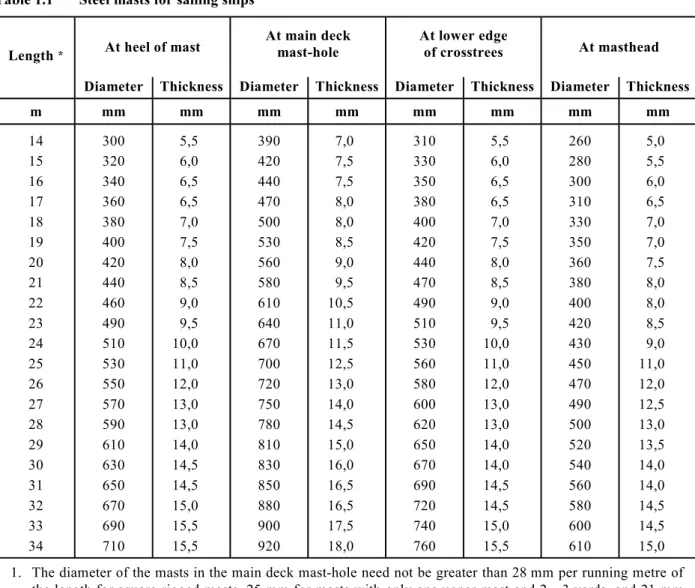
1.1 The dimensions of the parts given in the Tables Nos. 1.1 to 1.7 are based on steel with a tensile strength of 400 – 490 N/mm2. For further details on the materials please refer to "Rules for Classification and Construction, II – Material and Welding Technol-ogy, Part 1 – Metallic Materials".
Where materials of different tensile strength are used, the dimensions given in Tables Nos. 1.1 to 1.7 must be resp. are allowed to be modified accordingly.
I - Part 4
Front view Futtock shrouds Lateral view Topgallant mast Topmast cap Topmast Mast crosstree Lower mast Royal backstay
Topgallant mast shrouds Topgallant backstay
Topmast shrouds Topmast head backstay
Topmast backstay Lower head shrouds
Lower shrouds
Fig. 1.6 Shrouds and backstays
7 8 9 1 2 3 5 6 4 10 13 12 11
1 Fore royal stay 8 Main topgallant stay 2 Fore topgallant stay 9 Main topmast stay 3 Outer jib stay 10 Main stay
4 Inner jib stay 11 Mizzen topgallant stay 5 Fore topmast stay 12 Mizzen topmast stay 6 Fore stay 13 Mizzen stay 7 Main royal stay
After jibboom guy Forward jibboom guy
Fore stay (double) Bowsprit shrouds
Turnbuckles
Jib netting Fore topmast stay
Jib stay Turnbuckle Fore royal stay Fore topgallant stay
Turnbuckle Martingale Martingale boom Bobstay
After jibboom guy
Forward jibboom guy
Jib netting
Bowsprit
Turnbuckles Bowsprit shrouds
Fig. 1.8 Bowsprit stays I - Part 4
Gaff-topsail Gaff Middle gaff (if any) Boom Gaffsail (or upper and lower gaffsail)
Fig. 1.9 Nomenclature of Gaff sails
7 8 10 1 2 5 6 9 4 3
1 Fore top mast stay sail 2 Inner jib
3 Outer jib 4 Flying jib
5 Main top mast stay sail 6 Main topgallant stay sail 7 Main royal stay sail 8 Mizzen stay sail
9 Mizzen topmast stay sail 10 Mizzen topgallant stay sail
1.2 If solid spars are used they get the same di-ameters as specified in the text or Tables depending on their kind of use. This is based on the characteristic values of comparatively light woods as fire and spruce.
The max. diameter of wooden masts, upper masts, yards, booms or bowsprits may be reduced by 10 % if they are made from pitch pine or oregon pine, and by 5 % if they are made from pine or larch. The other diameters are then to be taken from the respective line in the Tables 1.1 to 1.7.
All spars must be of best condition, sufficiently dried, sound and free from sap, branches and detrimental faults. Timber of twisted growth may not be used.
2. Masts
2.1 Length and dimensions of masts
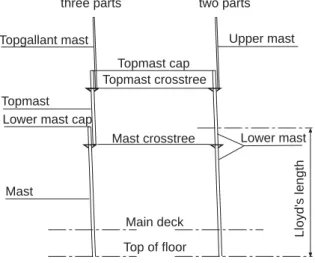
2.1.1 If the mast of a sailing ships consists of three parts (mast, topmast and topgallant mast), the length of the mast may be taken as extending from the top of the floor to the lower mast cap (see Fig. 1.11). The dimensions of the mast may be taken from Table 1.1.
2.1.2 If the mast consists of two parts (lower mast and upper mast), the dimensions of the lower mast – equivalent to what was the mast and the topmast compared to 2.1.1 – must be based on an imaginary length known as the "Lloyd's length". This is the dis-tance measured from the top of the floor to a fictitious mast cap situated, for all masts, about 2 – 3 m above the mast crosstrees.
The dimensions of the parts of the lower mast may be taken from Table 1.1.
Topmast cap Topmast crosstree Mast crosstree Main deck Top of floor Topgallant mast Topmast Lower mast cap
Mast Upper mast Lower mast Lloyd's length Mast consisting of three parts Mast consisting of two parts
Fig. 1.11 Subdivision of masts
The top portion of the lower mast above the "Lloyd's length" may be gradually tapered to the diameter of the topmast at the cap as shown in Table 1.2.
The wall thicknesses of the upper part of the lower mast shall also be as indicated in Table 1.2.
2.1.3 The diameter of the masts in the main deck masthole need not be greater than 28 mm per running metre of length for square-rigged masts, 25 mm for masts with only one upper mast and max. 3 yards, and 21 mm for the masts without yards.
2.1.4 If the diameter of the mast has been deter-mined in accordance with 2.1.3, then the other di-mensions corresponding to this diameter shall be as indicated in Table 1.1.
2.1.5 All masts which are not passed through to the top of the floor must be dimensioned in a different way, if need be. This may also effect the dimensioning of the standing rigging.
2.2 Design requirements
2.2.1 At those points on the mast at which the hoisted yards are hanging, the diameter and the plate thickness of the mast must be at least as great as the maximum diameter and the maximum plate thickness of the yard concerned.
2.2.2 The purpose of the crosstrees is to absorb both the vertical and the lower horizontal forces ex-erted by the upper masts. The crosstrees provides the bottom support for the upper mast.
2.2.3 The mast cap provides the upper support for the upper mast and absorbs the horizontal forces act-ing at that point.
2.2.4 The dimensions of the eye plates needed to fasten the standing rigging to the mast shall be as specified in Table 1.1.
2.2.5 In way of the main deck masthole the masts are to be reinforced over a length of approx. two times the mast diameter (e.g. by using a section with 1,5 times the plate thickness indicated in Table 1.1).
3. Upper masts
3.1 Lengths and dimensions of upper masts 3.1.1 The dimensions of the topmast, when fitted, in accordance with Table 1.2 shall be determined by reference to the actual length.
3.1.2 For the topgallant masts and upper masts of square-rigged masts a diameter at the heel of 25 mm per running metre of length is sufficient. For fore-and-aft rigged masts a figure of 21 mm is sufficient.
I - Part 4
3.1.3 If the diameter of the topgallant mast and the upper mast at the heel has been determined according to 3.1.2 all other dimensions shall be those shown in Table 1.2 for this diameter.
3.2 Design requirements
3.2.1 Upper masts are to be reinforced at the cap, the crosstrees and the sheave-holes (e.g. by using a section having 1.5 times the plate thickness specified in Table 1.2).
3.2.2 At those points on upper masts at which the hoisted yards are hanging, the diameter and the plate thickness of the upper mast must be at least as great as the maximum diameter and the maximum plate thick-ness of the yard concerned.
4. Bowsprit
4.1 Use and dimensions of the bowsprit 4.1.1 The bowsprit is used to secure the lower ends of the various foremast stays (see Fig. 1.8).
4.1.2 The dimensions of the bowsprit shall be those shown in Table 1.7.
4.1.3 The dimensions of the bob stay and bowsprit shrouds shall be those shown in Table 1.8.
4.1.4 The following relationships are also appli-cable:
– Diameter of the martin gale = 0,6 × diameter of the bob stay – Diameter of the martin gale boom =
1,15 × diameter of the bob stay
4.2 Design requirements
4.2.1 The distance between the housing at the heel of the bowsprit and the housing at the stem must be at least 4 times the diameter of the bowsprit.
4.2.2 At the bowsprit, strong horses and hand beck-ets as well as a sufficient number of cross ropes or nets must be fitted. Ships exceeding 700 GRT must be provided with nets underneath their bowsprits, ex-tending up to the forecastle.
4.2.3 The bowsprit is to be reinforced within the housings (e.g. by using a section having 1,5 times the plate thickness specified in Table 1.7).
5. Yards
5.1 Dimensions of yards
5.1.1 The dimensions of yards shall be those in-dicated in Table 1.4.
5.1.2 The diameter in the middle need not exceed 19 mm per running metre for topgallant yards or 18 mm per running metre for royal yards.
5.1.3 If the diameter in the middle has been deter-mined in accordance with 5.1.2, the other dimensions shall be those shown in Table 1.4 for this diameter.
5.2 Arrangement of yards
5.2.1 Yards may be fixed to the mast or adjustable in hight.
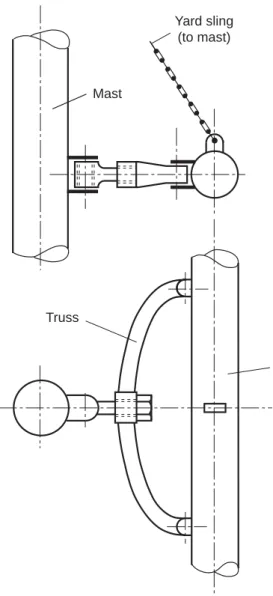
5.2.2 The method of fastening a fixed yard to the mast is shown in Fig. 1.12.
Mast
Yard sling (to mast)
Truss
Yard
The yard sling is designed to support and transmit to the mast the vertical force (structural weight and wind pressure component) acting on the yard. It transmits this force to the mast and/or the upper mast.
The required load of the yard sling shall be that speci-fied in Table 1.5.
5.2.3 The arrangement of an adjustable yard is shown in Fig. 1.13.
Mast
Tie
to sheave-hole in mast
Fig. 1.13 Adjustable yard
The tie is used for hoisting and lowering the yard and also takes the place of the yard sling.
The required load of the tie shall be that specified in Table 1.5.
5.2.4 The purpose of the truss (see Fig. 1.12) is to take up the horizontal force acting on the yard and to transmit this force into the mast and/or upper mast. It must allow the yard to move as required. The dimen-sions of the truss shall be those specified in Table 1.6.
5.3 Design requirements
5.3.1 Yards are to be reinforced in the middle to beyond the truss fastenings (e.g. by including a section with 1.5 times the plate thickness shown in Table 1.4).
5.3.2 Yards are to be provided with strong horses and with a sufficient number of hand beckets or other handles offering the crew safe support. Horses made from wire ropes are to be coated.
6. Booms for gaff sails 6.1 Dimensions
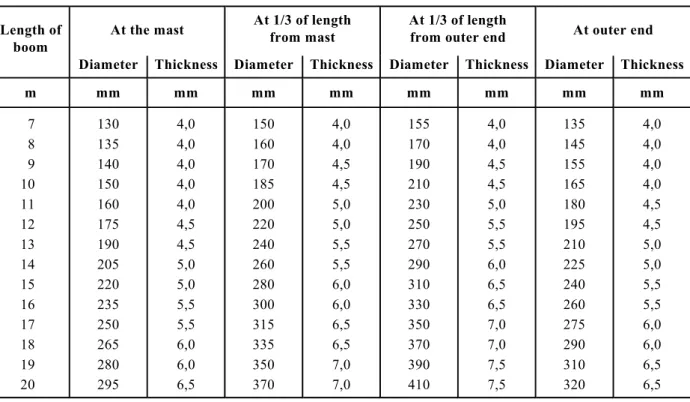
The dimensions of gaff sail booms shall be those specified in Table 1.3.
7. Gaffs for gaff sails 7.1 Dimensions
7.1.1 Depending on their lengths L, the gaff diame-ters are calculated in accordance with the following formulae:
diameter at the mast: 0,015 × L
diameter at 1/3 L distance from mast: 0,021 × L
diameter at outer end: 0,006 × L
7.1.2 If the diameter has been determined in accor-dance with 7.1.1, the pertinent wall thickness shall be as shown in Table 1.3 for this diameter.
D. Standing Rigging 1. General
1.1 In the older rules applicable to standing rig-ging the dimensions were based on wire ropes with a nominal strength of 735 N/mm2. For the same mini-mum breaking strength these wire ropes had a greater metal cross-section than the wire ropes customary to-day with a nominal strength of 1570 N/mm2.
1.2 In order to preserve the same statics condi-tions in the standing rigging – in its interaction with the masts – the metal cross-section of the ropes speci-fied in the aforementioned older rules has been re-tained. This explains the wire rope diameters shown in Tables 1.8 and 1.9.
1.3 The rope construction 6 × 7 FC, according to DIN 3055, is most suitable for the standing rigging. Since these ropes are hard to get now a days the rope construction 6 × 36 IWRC, according to DIN 3064, may be used as a substitute.
Because the inner wires of these ropes are thinner it is to be assumed that their life expectancy is shorter. To this regard the quality of corrosion protection is deci-sive.
I - Part 4
1.4 Ropes of the construction type 6 × 19 FC, according to DIN 3060, have a bigger elasticity than those referred to under 1.3. Apart from having to choose a comparatively bigger diameter (see footnote in the Tables 1.8 and 1.9) the adjustability may be increased, if need be, by using links which can be removed later on.
2. Dimensions of standing rigging
2.1 The dimensions of standing rigging and its fastenings shall be those specified in Tables 1.8 to 1.16.
2.2 For the square-rigged masts of four and five-masted ships, the diameter of the standing rigging may be reduced according to the statements in Table 1.8.
2.3 For full-rigged ships and barks, the length of the masts – except for the aftermost mast – may be taken as the average of the individual mast lengths, and the beam at the main deck may be taken as the average of the deck breadths at the individual masts for determination of the dimensions of the standing rigging.
2.4 Where masts less than 24 m long carry dou-ble topgallant yards, a topmast head backstay shall also be fitted to the topmast cap.
2.5 If the angle made by the bob stay and bow-sprit shrouds with the centre line of the bowbow-sprit is less than 14°, then the bob stay and bowsprit shrouds shall be strengthened accordingly (see Fig. 1.8).
2.6 The dimensions of the turnbuckles are shown in Tables 1.12 to 1.15.
2.7 The dimensions of the other parts of the fas-tenings may be determined by reference to the effec-tive Lifting Appliances Regulations. Their loads shall match those of the corresponding turnbuckles.
3. Design requirements
3.1 Where shrouds are fixed to the mast by shackles, a separate shackle and eye is required for each shroud.
3.2 Wherever possible, standing rigging shall be fixed directly to the sheer strake.
3.3 Where sail-carrying stays (e.g. those fastened to the bowsprit) are led around guide sheaves, the diameters of Keep the guide sheaves must be equal to at least 5 times the nominal diameter of the stay con-cerned.
3.4 Stays shall be arranged in such a way that the forces are properly transmitted between the masts.
3.5 The futtock shrouds may also be constructed in the form of round steel bars.
E. Miscellaneous 1. Components
1.1 Interchangeable components
1.1.1 Where not specified in the Tables, the di-mensions of these components shall be determined in accordance with the loads imposed on them by ref-erence to the effective Lifting Appliances Regulations.
1.1.2 It is not necessary to test each component under load. The testing of randomly selected samples using the standard test loads according to the Lifting Appliances Regulations is sufficient. The scope of the tests shall be determined by the Surveyor responsible. In any event, not less than 20 % of all components should be tested.
1.1.3 Para. 1.1.2 does not apply if the ship owner requires more extensive tests.
1.2 Non-interchangeable components
These components like for instance bearings and eye plates shall be dealt with in accordance with the effec-tive Lifting Appliance Regulations.
1.3 Nominal sizes
The nominal sizes of components according to the Tables 1.11 to 1.15 are to be choosen dependent on the related wire rope diameter according to Table 1.16.
2. Running rigging
2.1 Only those parts of the running rigging form part of the classification to which forces are transmit-ted by the structural components covered by Sections C. and D.
2.2 For running rigging, both fibre ropes (natural or synthetic fibres) and steel wire ropes may be used.
2.3 Running rigging shall be designed to the satisfaction of the Surveyor responsible.
3. Spare parts
3.1 On voyages in International Service each sailing ship must carry on board a spar suitable for a uppermast or lower yard and a second spar suitable for a jibboom or topsail yard.
Ships with schooner rig and sailing ships engaged in Restricted International Service need carry only one spare spar on board. If they have an engine of suffi-cient power, this spare spar is not required.
3.2 It is recommended that, in addition to the above, enough further spare spars be carried to allow one spar for each mast.
3.3 It is further recommended that each vessel carries along a sufficient reserve for the running rig-ging.
3.4 For sailing vessels the following spare sails are required.
Five-masted full rigged ships four-masted full rigged shipsFive-masted barks and full-rigged ships and barksFour-masted barks,
3 lower sails 3 lower topsails 3 upper topsails 1 fore topmast stay sail 1 jib
1 mizzen stays sail or
1 storm mizzen
2 lower sails 3 lower topsails 2 upper topsails 1 fore topmast stay sail 1 jib
1 mizzen stay sail or
1 storm mizzen
1 foresail 1 lower topsail 1 upper topsail 1 fore topmast stay sail 1 jib
1 mizzen stay sail or
1 storm mizzen
Barkentines, schooner briggs, three-masted schooners with yards
Square topsail shooners and
fore and aft schooners Smaller vessels without yards
1 foresail 1 topsail
1 fore topmast stay sail 1 jib
1 main stay sail 1 mainsail
1 fore stay sail 1 jumbo 2
1 boom foresail 1
1 jumbo 2
1 mainsail 1
1 Jib-like head sail.
2 For sailing vessels equipped with sufficiently powerful engines navigating in the North Sea and the Baltic, the boom foresail and
the mainsail are not required. I - Part 4
Table 1.1 Steel masts for sailing ships Length * At heel of mast
At main deck
mast-hole At lower edgeof crosstrees At masthead Diameter Thickness Diameter Thickness Diameter Thickness Diameter Thickness
m mm mm mm mm mm mm mm mm 14 15 16 17 18 19 20 21 22 23 24 25 26 27 28 29 30 31 32 33 34 300 320 340 360 380 400 420 440 460 490 510 530 550 570 590 610 630 650 670 690 710 5,5 6,0 6,5 6,5 7,0 7,5 8,0 8,5 9,0 9,5 10,0 11,0 12,0 13,0 13,0 14,0 14,5 14,5 15,0 15,5 15,5 390 420 440 470 500 530 560 580 610 640 670 700 720 750 780 810 830 850 880 900 920 7,0 7,5 7,5 8,0 8,0 8,5 9,0 9,5 10,5 11,0 11,5 12,5 13,0 14,0 14,5 15,0 16,0 16,5 16,5 17,5 18,0 310 330 350 380 400 420 440 470 490 510 530 560 580 600 620 650 670 690 720 740 760 5,5 6,0 6,5 6,5 7,0 7,5 8,0 8,5 9,0 9,5 10,0 11,0 12,0 13,0 13,0 14,0 14,0 14,5 14,5 15,0 15,5 260 280 300 310 330 350 360 380 400 420 430 450 470 490 500 520 540 560 580 600 610 5,0 5,5 6,0 6,5 7,0 7,0 7,5 8,0 8,0 8,5 9,0 11,0 12,0 12,5 13,0 13,5 14,0 14,0 14,5 14,5 15,0 1. The diameter of the masts in the main deck mast-hole need not be greater than 28 mm per running metre of
the length for square-rigged masts, 25 mm for masts with only one upper mast and 2 – 3 yards, and 21 mm for masts without yards (see C.2.1.3).
2. For the diameters of masts made from solid spars see C.1.2. * The length referred to is the "Lloyd's length", see C.2.1.
Table 1.2 Uppermasts for sailing ships
Topmasts Length At heel At masthead
At topmast
cap Length At heel At masthead
At topmast cap * Dia-meter Thick-ness Dia-meter Thick-ness Dia-meter Thick-ness * Dia-meter Thick-ness Dia-meter Thick-ness Dia-meter Thick-ness m mm mm mm mm mm mm m mm mm mm mm mm mm 9,5 10,0 10,5 11,0 11,5 12,0 12,5 13,0 13,5 14,0 14,5 15,0 290 300 320 330 350 360 370 390 400 420 430 450 6,0 6,0 6,0 6,5 6,5 7,0 7,0 7,5 7,5 7,5 8,0 8,0 250 260 280 290 300 320 330 350 360 370 390 400 6,0 6,0 6,0 6,0 6,0 6,5 6,5 6,5 7,0 7,0 7,0 7,5 220 230 240 250 260 270 280 290 300 310 320 330 4,0 4,0 4,5 5,0 5,0 5,5 5,5 6,0 6,5 6,5 6,5 7,0 15,5 16,0 16,5 17,0 17,5 18,0 18,5 19,0 19,5 20,0 20,5 21,0 460 470 490 500 520 530 550 560 570 590 600 620 8,5 8,5 8,5 9,0 9,0 9,0 9,0 9,5 9,5 9,5 10,0 10,0 410 430 440 460 470 480 500 510 520 540 550 570 7,5 7,5 8,0 8,0 8,0 8,5 8,5 8,5 9,0 9,0 9,0 9,5 340 350 360 370 380 390 400 410 420 430 440 450 7,0 7,0 7,5 7,5 7,5 8,0 8,0 8,0 8,5 8,5 8,5 9,0 1. For topgallant masts and uppermasts see C.3.1.2 and 3.1.3.
2. At those points at which hoisted yards are hanging, the diameter and the plate thickness of masts and uppermasts must be at least as great as the maximum diameter and the maximum plate thickness of the yard concerned. Uppermasts are to be strengthened at the cap, crosstrees and sheave-holes as well as yards which are to be reinforced in the middle to a point beyong the truss bands, e.g. by including a section having 1,5 times the plate thickness (see C.2.2.1, C.3.2 and C.5.3.1).
3. For the diameters of uppermasts made from solid spars see C.1.2. * Regarding the length see C.2.1
I - Part 4
Table 1.3 Booms for gaffsails Length of
boom
At the mast At 1/3 of lengthfrom mast At 1/3 of lengthfrom outer end At outer end Diameter Thickness Diameter Thickness Diameter Thickness Diameter Thickness
m mm mm mm mm mm mm mm mm 7 8 9 10 11 12 13 14 15 16 17 18 19 20 130 135 140 150 160 175 190 205 220 235 250 265 280 295 4,0 4,0 4,0 4,0 4,0 4,5 4,5 5,0 5,0 5,5 5,5 6,0 6,0 6,5 150 160 170 185 200 220 240 260 280 300 315 335 350 370 4,0 4,0 4,5 4,5 5,0 5,0 5,5 5,5 6,0 6,0 6,5 6,5 7,0 7,0 155 170 190 210 230 250 270 290 310 330 350 370 390 410 4,0 4,0 4,5 4,5 5,0 5,5 5,5 6,0 6,5 6,5 7,0 7,0 7,5 7,5 135 145 155 165 180 195 210 225 240 260 275 290 310 320 4,0 4,0 4,0 4,0 4,5 4,5 5,0 5,0 5,5 5,5 6,0 6,0 6,5 6,5 For the diameters of booms made from solid spars see C.1.2.
Table 1.4 Dimensions of yards Length In the middle
1st quarter distance 2nd quarter distance 3rd quarter distance At yardarms Diameter Thick-ness Diameter Thick-ness Diameter Thick-ness Diameter Thick-ness Diameter Thick-ness
m mm mm mm mm mm mm mm mm mm mm 10 11 12 13 14 15 16 17 18 19 20 21 22 23 24 25 26 27 28 29 30 200 220 240 260 280 300 320 340 360 380 400 420 440 460 480 500 520 540 560 580 600 4,5 4,5 4,5 5,0 5,5 5,5 6,0 6,0 6,5 7,0 7,0 7,5 8,0 8,0 8,5 9,0 9,5 9,5 10,0 10,5 11,5 195 215 235 255 275 295 310 330 350 370 390 410 430 450 470 490 510 530 545 565 585 4,5 4,5 4,5 5,0 5,0 5,5 6,0 6,0 6,5 6,5 7,0 7,0 7,5 7,5 8,0 8,5 8,5 9,0 9,0 9,5 10,0 180 200 215 235 250 270 290 305 325 340 360 380 395 415 430 450 470 490 505 525 540 4,5 4,5 4,5 4,5 5,0 5,0 5,5 6,0 6,0 6,5 6,5 7,0 7,0 7,5 7,5 8,0 8,0 8,5 8,5 9,0 9,0 150 165 180 195 210 225 240 255 270 285 300 315 330 345 360 375 390 405 420 435 450 4,5 4,5 4,5 4,5 4,5 5,0 5,0 5,0 5,0 5,5 5,5 5,5 5,5 6,5 6,5 7,0 7,0 7,5 7,5 8,0 8,0 100 110 120 130 140 150 160 170 180 190 200 210 220 230 240 250 260 270 280 290 300 3,0 3,0 3,0 3,0 3,0 3,0 3,5 3,5 3,5 4,0 4,0 4,5 4,5 5,0 5,0 5,5 5,5 6,0 6,5 6,5 7,0 1. The diameter in the middle need not exceed 19 mm for topgallant yards and 18 mm for royal yards per
running metre of length.
2. For the diameters of yards made from solid spars see C.1.2.
I - Part 4
Table 1.5 Required loads of yard slings and ties
Length Required load of yard sling Required load of tie Length Required load of yard sling Required load of tie m kN kN m kN kN 10 11 12 13 14 15 16 17 18 19 20 13,6 16,0 18,5 20,8 23,7 27,3 30,7 34,3 37,9 42,0 46,3 11,2 13,1 15,2 17,1 19,4 22,4 25,2 28,1 31,0 34,4 38,0 21 22 23 24 25 26 27 28 29 30 51,0 55,7 60,5 65,8 71,5 77,6 83,3 89,1 96,9 108,2 41,8 45,6 49,6 53,9 58,6 63,6 68,3 73,6 79,5 84,6 The dimensions of these parts and of the sheave-holes shall be those specified in the effective Lifting Appliances Regulations.
Table 1.6 Main dimensions of trusses Diameter of yard d * a b Æ c Æ e Æ f g mm mm mm mm mm mm mm 200 250 300 350 400 450 500 550 600 750 850 1000 1100 1240 1330 1460 1550 1680 40 45 54 58 64 68 75 80 89 56 60 68 72 80 86 94 100 110 20 24 29 32 39 43 48 52 56 40 45 52 56 61 65 71 74 80 95 105 120 130 145 155 170 180 195
* The intermediate valves are to be interpolated linearly.
I - Part 4
Table 1.7 Bowsprits Length
beyond
At heel In bed between bed andAt ½ distance end of bowsprit
At end of bowsprit bed
Diameter Thickness Diameter Thickness Diameter Thickness Diameter Thickness
m mm mm mm mm mm mm mm mm 8 9 10 11 12 13 14 15 16 17 18 280 330 380 440 490 530 570 610 660 700 740 9,0 9,0 10,0 11,0 11,0 12,0 12,5 13,0 14,0 15,0 15,0 350 410 470 530 590 650 700 750 800 850 900 8,0 10,0 11,0 11,0 11,0 12,5 12,5 14,0 14,0 15,0 15,0 310 370 420 480 530 570 620 660 700 750 800 8,0 10,0 10,0 10,0 11,0 12,0 12,0 14,0 14,0 14,0 15,0 150 170 190 210 230 260 280 300 320 340 360 6,0 7,0 7,0 8,0 9,0 10,0 10,0 10,0 10,0 12,0 12,0 1. For the bowsprit stays and shrouds see C.4.
Table 1.8 Standing rigging for square rigged masts
For the foremasts of schooner brigs and barkentines, the full-rigged masts of three, four and five-masted barks and for all the masts of brigs and three, four and five-masted fullrigged-ships
Length of mast from main deck to top edge of topmast crosstrees [m]
≥ 18 < 19 ≥ 19 < 20 ≥ 20 < 21 ≥ 21 < 22 ≥ 22 < 23 ≥ 23 < 24 ≥ 24 < 25 Beam of vessel at main
deck by mast < 7,2 m ≥ 7,2 m 7,8 m < ≥ 7,8 m 8,4 m< ≥ 8,4 m 9,0 m< ≥ 9,0 m 9,6 m< ≥ 9,6 m 10,2 m < ≥ 10,2 m 10,8 m < ≥ 10,8 m
Required rope diameters of wire ropes for the standing rigging of masts with yards [mm] lower stays
lower shrouds lower head shrouds topmast stays 1 topmast backstays topmast head backstays 20 18 21 20 22 21 24 22 26 24 26 26 28 26 topgallant stays topgallant backstays 15 14 16 15 17 16 19 18 20 19 21 20 22 21 royal stays royal backstays 12 11 13 12 14 13 15 14 16 15 17 16 18 17 Number of lower stays lower shrouds lower head shrouds topmast stays topmast backstays topm. head backstays 2
topgallant stays topgallant backstays Royal stays and backstays 2 4 – 2 2 – 1 1 1 2 5 – 2 2 – 1 1 1 2 5 – 2 2 – 1 1 1 2 5 – 2 2 – 1 1 1 2 5 1 2 2 – 1 1 1 2 5 1 2 2 – 1 2 1 2 5 1 2 2 1 1 2 1 Minimum Diameter [mm] rod 3 bol chain t ⎧ ⎪ ⎨ ⎪⎩ Bobsty chain 3 number ⎧ ⎨ ⎩ Bowsprit 50 40 28 17 1 55 43 30 18 1 60 46 32 19 1 64 50 34 20 1 68 53 36 21 1 72 56 38 22 1 76 59 40 22 2 – The prescribed diameters are valid for rope construction types 6 × 7 FC and 6 × 36 IWRC according to Table 1.10. If wire ropes of the
construction type 6 × 19 FC shall be used instead, the Table values are to be increased by 1 mm up to a rope dia of 21 mm and by 2 mm for a rope dia of 22 mm and more.
– A nominal strength higher than 1570 N/mm2 may not be employed.
– For square rigged masts of four- and five-masted ships the rope dia may be decreased by 1 mm up to a Table value of 23 mm ∅ and by 2 mm for a Table value of 24 mm ∅ and more.
– For barks and full rigged ships, the lengths of the masts-except for the aftermost mast- and the beams of the main deck may be taken as an average in order to allow for a standing rigging of the same diameter.
– The rope diameters as shown in or derived from this Table include non standardized sizes. If these sizes cannot be obtained the next bigger standard size is to be chosen. This applies analogously to rods, bolts and chains.
1 The diameter of topmast shrouds must be at least 70 % of the diameter of the topmast stays.
2 Where masts less than 24 m long carry double topgallant yards, a topmast head backstay shall also be fitted to the topmast cap.
3 If the angle made by the bobstay and bowsprit shrouds with the centre line of the bowsprit is less than 14°, then the bobstay and bowsprit shrouds shall be strengthened accordingly.
I - Part 4
Table 1.8 Standing rigging for square rigged masts (Continued)
For the foremasts of schooner brigs and barkentines, the full-rigged masts of three, four and five-masted barks and for all the masts of brigs and three, four and five-masted fullrigged-ships
Length of mast from main deck to top edge of topmast crosstrees [m]
≥ 25 < 26 ≥ 26 < 27 ≥ 27 < 28 ≥ 28 < 29 Beam of vessel at main
deck by mast < 11,4 m ≥ 11,4 m < 11,9 m ≥ 11,9 m < 12,3 m ≥ 12,3 m < 12,7 m ≥ 12,7 m Required tope diameters of wire ropes for the standing rigging of masts with yards [mm]
lower stays lower shrouds lower head shrouds topmast stays 1 topmast head backstays 30 28 32 30 32 32 34 32 topgallant stays topgallant backstays 24 22 26 24 26 26 28 26 royal stays royal backstays 19 18 20 19 21 20 22 21 Number of lower stays lower shrouds lower head shrouds topmast stays topmast backstays topm. head backstays 2
topgallant stays topgallant backstays royal stays and backstays 2 6 1 2 2 1 1 2 1 2 6 1 2 3 1 1 2 1 2 6 1 2 3 1 1 2 1 2 6 1 2 3 1 1 2 1 Minimum Diameter [mm] rod 3 bol chain t ⎧ ⎪ ⎨ ⎪⎩ Bobsty chain 3 number ⎧ ⎨ ⎩ Bowsprit 80 62 42 23 2 84 65 44 24 2 88 68 46 25 2 92 71 48 26 2
– The prescribed diameters are valid for rope construction types 6 × 7 FC and 6 × 36 IWRC according to Table 1.10. If wire ropes of the construction type 6 × 19 FC shall be used instead, the Table values are to be increased by 1 mm up to a rope dia of 21 mm and by 2 mm for a rope dia of 22 mm and more.
– A nominal strength higher than 1570 N/mm2 may not be employed.
– For square rigged masts of four- and five-masted ships the rope dia may be decreased by 1 mm up to a Table value of 23 mm ∅ and by 2 mm for a Table value of 24 mm ∅ and more.
– For barks and full rigged ships, the lengths of the masts-except for the aftermost mast- and the beams of the main deck may be taken as an average in order to allow for a standing rigging of the same diameter.
– The rope diameters as shown in or derived from this Table include non standardized sizes. If these sizes cannot be obtained the next bigger standard size is to be chosen. This applies analogously to rods, bolts and chains.
1 The diameter of topmast shrouds must be at least 70 % of the diameter of the topmast stays.
2 Where masts less than 24 m long carry double topgallant yards, a topmast head backstay shall also be fitted to the topmast cap.
3 If the angle made by the bobstay and bowsprit shrouds with the centre line of the bowsprit is less than 14°, then the bobstay and bowsprit shrouds shall be strengthened accordingly.
Table 1.8 Standing rigging for square rigged masts (Continued)
For the foremasts of schooner brigs and barkentines, the full-rigged masts of three, four and five-masted barks and for all the masts of brigs and three, four and five-masted fullrigged-ships
Length of mast from main deck to top edge of topmast crosstrees [m]
≥ 29 < 30 ≥ 30 < 31 ≥ 31 < 32 ≥ 32 < 33 Beam of vessel at
main deck by mast < 13,1
m 13,1 m – 14,0 m > 14,0 m 13,5 m 13,5 m – 14,3 m > 14,3 m < 13,9 m 13,9 m – 14,6 m > 14,6 m < 14,3 m 14,3 m – 15,0 m > 15,0 m
Required rope diameters of wire ropes for the standing rigging of masts with yards [mm] lower stays
lower shrouds lower head shrouds topmast stays 1 topmast backstays topmast head backstays 36 34 34 38 36 34 38 38 36 40 38 38 topgallant stays topgallant backstays 30 28 28 30 30 28 32 30 30 32 32 30 royal stays royal backstays 24 22 22 24 24 22 26 24 24 26 26 24 Number of lower stays lower shrouds lower head shrouds topmast stays topmast backstays topm. head backstays 2
topgallant stays topgallant backstays royal stays and backstays 2 6 1 2 3 1 1 2 1 2 6 2 2 3 1 1 2 1 2 6 2 2 3 1 2 2 1 2 6 2 2 3 1 2 2 1 Minimum Diameter [mm] rod 3 bol chain t ⎧ ⎪ ⎨ ⎪⎩ Bobsty chain 3 number ⎧ ⎨ ⎩ Bowsprit 96 74 50 27 2 100 76 52 28 2 103 78 54 29 2 105 80 56 30 2
– The prescribed diameters are valid for rope construction types 6 × 7 FC and 6 × 36 IWRC according to Table 1.10. If wire ropes of the construction type 6 × 19 FC shall be used instead, the Table values are to be increased by 1 mm up to a rope dia of 21 mm and by 2 mm for a rope dia of 22 mm and more.
– A nominal strength higher than 1570 N/mm2 may not be employed.
– For square rigged masts of four- and five-masted ships the rope dia may be decreased by 1 mm up to a Table value of 23 mm ∅ and by 2 mm for a Table value of 24 mm ∅ and more.
– For barks and full rigged ships, the lengths of the masts-except for the aftermost mast- and the beams of the main deck may be taken as an average in order to allow for a standing rigging of the same diameter.
– The rope diameters as shown in or derived from this Table include non standardized sizes. If these sizes cannot be obtained the next bigger standard size is to be chosen. This applies analogously to rods, bolts and chains.
1 The diameter of topmast shrouds must be at least 70 % of the diameter of the topmast stays.
2 Where masts less than 24 m long carry double topgallant yards, a topmast head backstay shall also be fitted to the topmast cap.
3 If the angle made by the bobstay and bowsprit shrouds with the centre line of the bowsprit is less than 14°, then the bobstay and bowsprit shrouds shall be strengthened accordingly.
I - Part 4
Table 1.9 Standing rigging for fore- and -aft rigged masts (Part 1)
For the aftermost mast of three, four and five-masted barks, for the mainmast of barkentines, for the foremast and mainmast of three and four-masted topsail schooners and for the foremast of schooners and three-masted schooners
Length of mast from main deck to top edge of crosstrees [m]
≥ 11 < 12 ≥ 12 < 13 ≥ 13 < 14 ≥ 14 < 15 ≥ 15 < 16 ≥ 16 < 17 ≥ 17 < 18 ≥ 18 < 19 ≥ 19 < 20 ≥ 20 < 21 ≥ 21 < 22 ≥ 22 < 23
Required rope diameters of wire ropes, for the standing rigging of masts without yards [mm] lower stays and
lower shrouds 18 19 20 21 22 24 26 26 28 28 30 30
topmast stays and
topmast backstays 16 17 18 19 20 21 22 24 26 26 28 28
topgallant stays and
topgallant backstays 12 13 14 15 15 16 17 18 19 20 21 22 Number lower stays lower shrouds topmast stays topmast backstays topgallant stays topgallant backstays 2 4 1 1 1 1 2 4 1 1 1 1 2 4 1 1 1 1 2 4 1 1 1 1 2 4 1 1 1 1 2 4 1 2 1 1 2 4 1 2 1 1 2 5 1 2 1 1 2 5 1 2 1 1 2 5 1 2 1 2 2 5 2 3 1 2 2 5 2 3 1 2 – The prescribed diameters are valid for rope construction types 6 × 7 FC and 6 × 36 IWRC according to Table 1.10. If wire ropes of
the construction type 6 × 19 FC shall be used instead, the Table values are to be increased by 1 mm up to a rope dia of 21 mm and by 2 mm for a rope dia of 22 mm and more.
– A nominal strength higher than 1570 N/mm2 may not be employed.
– The rope diameters as shown in or derived from this Table include non standardized sizes. If these sizes cannot be obtained the next bigger standard size is to be chosen.
Table 1.9 Standing rigging for fore- and -aft rigged masts (Part 2)
For the mainmast of schooners and three-masted schooners, for the mizzenmast of four-masted topsail schooners, the mizzenmast of barkentines, three-masted schooners and topsail schooners, the jigger mast of four-masted topsail
schooners, and for the masts of fore-and-aft schooners, luggers, tjalks and cutters
Length of mast from main deck to top edge of crosstrees [m]
≥ 10 < 11 ≥ 11 < 12 ≥ 12 < 13 ≥ 13 < 14 ≥ 14 < 15 ≥ 15 < 16 ≥ 16 < 17 ≥ 17 < 18 ≥ 18 < 19 ≥ 19 < 20 ≥ 20 < 21 ≥ 21 < 22
Required rope diameters of wire ropes for the standing rigging of masts without yards [mm]
forestay 18 19 20 21 22 24 26 26 28 28 30 30
lower shrouds 14 15 16 17 18 19 20 21 22 24 24 26
topmast stay and
topmast backstays 11 12 13 14 15 16 17 18 19 20 21 22
topgallant stay and
topgallant backstays 10 10 10 10 11 12 13 14 14 15 16 17 Number topmast and topgallant stays lower shrouds topmast backstays topgallant backstays 1 3 1 1 1 3 1 1 1 3 1 1 1 3 1 1 1 3 1 1 1 3 1 1 1 4 1 1 1 4 1 1 1 4 2 1 1 4 2 1 1 4 2 1 1 4 2 1 – The prescribed diameters are valid for rope construction types 6 × 7 FC and 6 × 36 IWRC according to Table 1.10. If wire ropes of
the construction type 6 × 19 FC shall be used instead, the Table values are to be increased by 1 mm up to a rope dia of 21 mm and by 2 mm for a rope dia of 22 mm and more.
– A nominal strength higher than 1570 N/mm2 may not be employed.
– The rope diameters as shown in or derived from this Table include non standardized sizes. If these sizes cannot be obtained the next bigger standard size is to be chosen.
– The diameter of the topmast shrouds must be at least 70 % of the dia of the topmast stays.
I - Part 4
Table 1.10 Standing rigging
Wire ropes, galvanized *
Nominal strength 1570 N/mm2 1570 N/mm2 1570 N/mm2
Nominal diameter of
rope
Circumference
Nominal breaking strength
mm mm inches kN 1 kN 1 kN 8 10 12 14 16 18 20 22 24 26 28 32 36 40 44 48 52 56 25 32 38 44 51 57 64 70 76 83 89 102 114 127 140 152 165 176 1 1 1/4 1 1/2 1 3/4 2 2 1/4 2 1/2 2 3/4 3 3 1/4 3 1/2 4 4 1/2 5 5 1/2 6 6 1/2 7 33,4 52,2 75,1 102 134 169 209 252 300 353 409 534 676 835 – – – – 30,9 48,2 69,5 94,6 124 156 193 234 278 326 378 494 625 722 934 1110 1300 1510 – – 80,6 109 143 181 221 271 322 378 438 571 724 894 1080 1290 1510 1750 Filling factor f1 0,470 1 0,455 1 0,580 Spinning factor k1 0,900 0,860 0,782
1 The values shown in the Table are applicable to ropes with fibre core. Where ropes of the same constructions but with a steel wire core are used the nominal breaking strength is increased by approximately 8 %, the filling factor by 16 %.
Table 1.11 Eyes and double-lugs for tensile loads acc. to ISO 6043 Nominal
size 1
Permitted
load b1 b2 b3 d2 d3 r1 r2 t Bolt s1 Fillet weld d1 thread a KN mm mm mm mm mm mm mm mm mm mm mm 1 1,6 2 2,5 3 4 5 6 8 10 12 10 16 20 25 32 40 50 63 80 100 125 16 20 22 25 28 30 35 40 45 50 55 19 23 26 29 32 35 39 45 49 58 64 8 11 12 13 14 15 18 20 23 26 28 18 22 24 26 30 33 39 42 48 52 56 17 21 23 25 28 31 37 40 46 50 54 17,5 22,5 25 27,5 30 32,5 37,5 42,5 47,5 55 60 5 5 6 6 6 6 8 8 8 8 10 23 28 31 34 36 39 46 51 56 63 70 16 20 22 24 27 30 36 39 45 48 52 M 12 M 16 M 20 M 20 M 22 M 24 M 27 M 30 M 36 M 39 M 42 – 6 6 8 8 8 10 10 12 14 14 – 4 4 5 5 5 6 6 7 7 8
Weldable material with a tensile strength of at least 360 N/mm2. Min. bolt strength = 410 N/mm2 1 Nominal size depending on the related wire rope diameter acc. to Table 1.16.
I - Part 4
Table 1.12 Tubular bodies acc. to DIN 82004
Turnbuckles for the standing rigging Nominal size 1 Permitted load d
2× s 3 d3 l1 Thread d1 kN mm mm mm 1 1,6 2 2,5 3 4 5 6 8 10 12 10 16 20 25 32 40 50 63 80 100 125 31,8 × 4,5 38 × 5,6 42,4 × 5,6 44,5 × 6,3 51 × 6,3 57 × 8 63,5 × 8 70 × 8,8 76,1 × 10 88,9 × 10 88,9 × 11 25 30 33 37 41 46 50 57 63 72 78 220 240 260 280 300 320 340 380 420 460 500 M 18 M 22 M 24 M 27 M 30 M 33 M 36 M 42 M 45 M 52 M 56
Material with a tensile strength of at least 360 N/mm2.
1 Nominal size depending on the related wire rope diameter acc. to Table 1.16.
2 l
2 = d1
Table 1.13 Oval Eye screws acc. to DIN 82006
Turnbuckles for the standing rigging Nominal size1 Permitted load a b Thread d1 d2 g l1 l2 kN mm mm mm mm mm mm 1 10 48 21 M 18 12 14 110 180 1,6 2 16 20 58 26 M 22 M 24 16 18 120 130 205 215 2,5 3 25 32 72 32 M 27 M 30 21 23 140 150 245 255 4 5 40 50 94 40 M 33 M 36 26 28 160 170 290 305 6 8 10 12 63 80 100 125 108 115 125 144 45 49 54 60 M 42 M 45 M 52 M 56 29 32 36 41 32 35 39 44 190 210 230 250 340 370 405 450
Material with a tensile strength of at least 360 N/mm2
1 Nominal size depending on the related wire rope diameter acc. to Table 1.16.
I - Part 4
Table 1.14 Double lug screws acc. to DIN 82008
Turnbuckles for the standing rigging Nominal size1 Permitted load b1 b2 b3 Thread d1 d2 d3 l1 l2 r1 1 1,6 2 2,5 3 4 5 6 8 10 12 10 16 20 25 32 40 50 63 80 100 125 10 13 14 15 17 18 22 24 28 31 34 19 23 26 29 32 35 39 45 49 58 64 8 11 12 13 14 15 18 20 23 26 28 M 18 M 22 M 24 M 27 M 30 M 33 M 36 M 42 M 45 M 52 M 56 16 20 22 24 27 30 36 39 45 48 52 17 21 23 25 28 31 37 40 46 50 54 110 120 130 140 150 160 170 190 210 230 250 152 170 185 200 215 230 255 280 310 340 370 17,5 22,5 25 27,5 30 32,5 37,5 42,5 47,5 55 60
Material with a tensile strength of at least 360 N/mm2, Min. bolt strength = 410 N/mm2. 1 Nominal size depending on the related wire rope diameter acc. to Table 1.16.
Table 1.15 Eye screws acc. to DIN 82010
Turnbuckles for the standing rigging Nominal size1 Permitted load b1 Thread d1 d2 d3 l1 l2 kN mm mm mm mm mm 1 1,6 2 2,5 3 4 5 6 8 10 12 10 16 20 25 32 40 50 63 80 100 125 16 20 22 25 28 30 35 40 45 50 55 M 18 M 22 M 24 M 27 M 30 M 33 M 36 M 42 M 45 M 52 M 56 18 23 25 27 30 33 39 42 48 52 56 35 45 50 55 60 65 75 85 95 110 120 110 120 130 140 150 160 170 190 210 230 250 140 155 168 182 195 208 225 250 275 305 335
Material with a tensile strength of at least 360 N/mm2
1 Nominal size depending on the related wire rope diameter acc. to Table 1.16.
Table 1.16 Nominal sizes of components R ope
standard D IN
R ope
core W ire rope diam eter [m m ]
3055 3064 FC IW RC 10 11 – 14 15 + 16 17 + 18 19 + 21 22 + 24 26 + 28 30 – 34 36 – 40 42 – 46 48 – 54 3060 FC 11 12 – 15 16 + 17 18 + 19 20 + 22 24 + 26 28 + 30 32 – 36 38 – 42 44 – 48 50 – 56 N om inal size 1 1,6 2 2,5 3 4 5 6 8 10 12 I - Part 4