Probabilistic topic models for sentiment
analysis on the Web
Chenghua Lin
September 2011
Submitted by Chenghua Lin, to the the University of Exeter as a thesis for the degree of Doctor of Philosophy in Computer Science , September 2011.
This thesis is available for Library use on the understanding that it is copyright material and that no quotation from the thesis may be published without proper acknowledgement.
I certify that all material in this thesis which is not my own work has been identified and that no material has previously been submitted and approved for the award of a degree by this or any other University.
This thesis would not have been possible without the help and support from the following people.
First and foremost, I would like to thank my supervisor Yulan He, who has been an exemplary teacher and mentor in the past three years of my PhD studies. I am extremely grateful to Yulan’s encouragement, support and patience during the difficult time of my research.
My gratitude also goes to my second supervisor Richard Everson, whose input and advice on my work were very useful. Richard is also very generous with his time for discussing research, for which I am grateful.
I also thank Alex Gong, without whose kind help I would not have been able to pursue the research I really enjoy.
I am fortunate to have a number of great friends who have supported me both research wise and non-research wise, particularly Naihui He, Junaid Khan, and Bing Qiao. Without them, my PhD would have been a less enjoyable one. Deepest thanks to my parents and family. Their lifetime love and care help me regain my confidence and make me once again believe in myself. Finally, I thank Yuan. Her kindness, patience and care sustain me.
Sentiment analysis aims to use automated tools to detect subjective information such as opinions, attitudes, and feelings expressed in text, and has received a rapid growth of interest in natural language processing in recent years. Probabilistic topic models, on the other hand, are capable of discovering hidden thematic structure in large archives of documents, and have been an active research area in the field of information retrieval. The work in this thesis focuses on developing topic models for automatic sentiment analysis of web data, by combining the ideas from both research domains.
One noticeable issue of most previous work in sentiment analysis is that the trained classifier is domain dependent, and the labelled corpora required for training could be dif-ficult to acquire in real world applications. Another issue is that the dependencies between sentiment/subjectivity and topics are not taken into consideration. The main contribu-tion of this thesis is therefore the introduccontribu-tion of three probabilistic topic models, which address the above concerns by modelling sentiment/subjectivity and topic simultaneously. The first model is called the joint sentiment-topic (JST) model based on latent Dirich-let allocation (LDA), which detects sentiment and topic simultaneously from text. Unlike supervised approaches to sentiment classification which often fail to produce satisfactory performance when applied to new domains, the weakly-supervised nature of JST makes it highly portable to other domains, where the only supervision information required is a domain-independent sentiment lexicon. Apart from document-level sentiment classifi-cation results, JST can also extract sentiment-bearing topics automatically, which is a distinct feature compared to the existing sentiment analysis approaches.
The second model is a dynamic version of JST called the dynamic joint sentiment-topic (dJST) model. dJST respects the ordering of documents, and allows the analysis of topic and sentiment evolution of document archives that are collected over a long time span. By accounting for the historical dependencies of documents from the past epochs in the generative process, dJST gives a richer posterior topical structure than JST, and can better respond to the permutations of topic prominence. We also derive online infer-ence procedures based on a stochastic EM algorithm for efficiently updating the model parameters.
is the subjectivity label for each sentence; another is the sentiment label for each word token. By viewing the subjectivity detection problem as weakly-supervised generative model learning, subjLDA significantly outperforms the baseline and is comparable to the supervised approach which relies on much larger amounts of data for training.
These models have been evaluated on real world datasets, demonstrating that joint sentiment topic modelling is indeed an important and useful research area with much to offer in the way of good results.
Chapter 3 is based on the previously published work:
Lin, C., He, Y., Everson, R. and R¨uger, S. Weakly-supervised Joint
Sentiment-Topic Detection from Text,IEEE Transactions on Knowledge
and Data Engineering (TKDE), to appear.
Lin, C., He, Y., and Everson, R. A Comparative Study of Bayesian Models
for Unsupervised Sentiment Detection, In Proceedings of the 14th
Con-ference on Computational Natural Language Learning (CoNLL), Uppsala, Sweden, 2010.
Lin, C. and He, Y. Joint Sentiment/Topic Model for Sentiment Analysis, In Proceedings of the 18th ACM Conference on Information and Knowl-edge Management (CIKM), Hong Kong, China, 2009.
Chapter 5 is based on the previously published work:
Lin, C., He, Y. and Everson, R. Sentence Subjectivity Detection with
Weakly-Supervised Learning, InProceedings of the 5th International Joint
Conference on Natural Language Processing (IJCNLP), Chiang Mai, Thai-land, 2011.
Other publications:
He, Y., Lin, C. and Alani, H. Automatically Extracting Polarity-Bearing
Topics for Cross-Domain Sentiment Classification, In Proceedings of the
49th Annual Meeting of the Association for Computational Linguistics (ACL), Portland, Oregon, 2011.
He, Y. and Lin, C. Protein-Protein Interactions Classification from Text
via Local Learning with Class Priors, In Proceedings of the 14th
Inter-national Conference on Applications of Natural Language to Information Systems (NLDB), Saabrucken, Germany, 2009.
1 Introduction 12
1.1 Sentiment Analysis . . . 12
1.2 Probabilistic Topic Models . . . 13
1.3 Research Challenges . . . 14
1.3.1 Training Sentiment Classifier without Labelled Data . . . 14
1.3.2 Simultaneously Detecting Topic and Sentiment . . . 15
1.3.3 Capturing Sentiment and Topic Dynamics . . . 15
1.3.4 Subjectivity Detection without Labelled Data . . . 17
1.4 Thesis Contribution . . . 17 1.5 Thesis Overview . . . 18 2 Related Work 20 2.1 Sentiment Analysis . . . 20 2.1.1 Supervised Approaches . . . 20 2.1.2 Semi-supervised Approaches . . . 22
2.1.2.1 Monolingual Domain Adaptation . . . 22
2.1.2.2 Cross-lingual Sentiment Classification . . . 25
2.1.3 Unsupervised and Weakly-supervised Approaches . . . 26
2.1.4 Sentiment Dynamics and Subjectivity Detection . . . 28
2.1.4.1 Sentiment Dynamics . . . 28
2.1.4.2 Subjectivity Detection . . . 29
2.1.5 Discussion . . . 31
2.2 Generative Topic Models . . . 32
2.2.1 Latent Dirichlet Allocation . . . 34
2.2.1.1 Model Inference . . . 36
2.2.2 Static Topic Models . . . 39
2.2.3 Joint Sentiment and Aspect Models . . . 41
2.2.5 Discussion . . . 46
3 Weakly-Supervised Joint Sentiment-Topic Model 48 3.1 Introduction . . . 48
3.2 Joint Sentiment-Topic (JST) Model . . . 49
3.2.1 Incorporating Model Priors . . . 52
3.2.2 Model Inference . . . 53
3.3 Reverse Joint Sentiment-Topic (Reverse-JST) Model . . . 56
3.4 Experimental Setup . . . 57
3.4.1 Datasets . . . 57
3.4.2 Defining Model Priors . . . 58
3.4.3 Hyperparameter Settings . . . 59
3.4.4 Classifying Document Sentiment . . . 60
3.5 Experimental Results . . . 60
3.5.1 Sentiment Classification Results vs. Different Number of Topics . . . 60
3.5.2 Comparison with Existing Models . . . 64
3.5.3 Sentiment Classification Results with Different Features . . . 65
3.5.4 Topic Extraction . . . 68
3.6 Discussion . . . 69
4 Dynamic Joint Sentiment-Topic Model 70 4.1 Introduction . . . 70
4.2 Dynamic JST (dJST) Model . . . 71
4.2.1 Online Inference . . . 76
4.2.1.1 Deriving the Gibbs Sampler . . . 76
4.2.2 Evolutionary Parameters Estimation . . . 78
4.2.2.1 Estimating the Evolutionary Matrix Et . . . 78
4.2.2.2 Estimating the Weight Vector µt . . . 79
4.2.3 Hyperparameter Settings . . . 80
4.3 Experimental Setup . . . 82
4.3.1 Dataset . . . 82
4.3.2 Evaluation Metrics . . . 84
4.4 Experimental Results . . . 85
4.4.1 Performance vs. Number of Time Slices . . . 85
4.4.2 Comparison with Other Models . . . 88
4.4.3 Exploring Different Input Features . . . 92
4.5 Discussion . . . 97
5 SubjLDA: a Weakly Supervised Topic Model for Subjectivity Detection 98 5.1 Introduction . . . 98
5.2 The SubjLDA Model . . . 99
5.2.1 Model Inference . . . 101
5.3 Experimental Setup . . . 104
5.3.1 Dataset . . . 104
5.3.2 Lexical Prior Knowledge . . . 105
5.3.3 Hyperparameter Setting . . . 106
5.4 Experimental Results . . . 107
5.4.1 Subjectivity Classification Results . . . 107
5.4.2 Performance vs. Incorporating Different Priors . . . 109
5.4.3 Sentiment Topics . . . 113
5.5 Discussions . . . 113
6 Conclusion and Future Work 115 6.1 Future Work . . . 117
6.1.1 Modelling Linguistic Knowledge . . . 117
6.1.2 Incorporating Other Types of Prior Information . . . 118
6.1.3 Automatic Estimation of Topic Number . . . 118
6.1.4 Visualization and User Interfaces . . . 118
A The Fixed-Point Iteration Algorithm for Updating α 119
B Estimating the Weight Vector µt of the dJST Model 122
1.1 Amazon Kindle cover reviews. Text highlighted in green and red indicate
the pros and cons of the product respectively. . . 16
2.1 LDA model. . . 34
3.1 JST model. . . 50
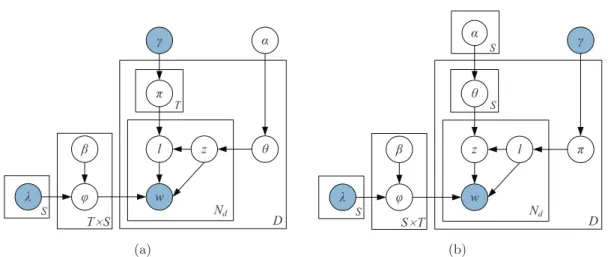
3.2 (a) Reverse-JST model; (b) JST model. . . 55
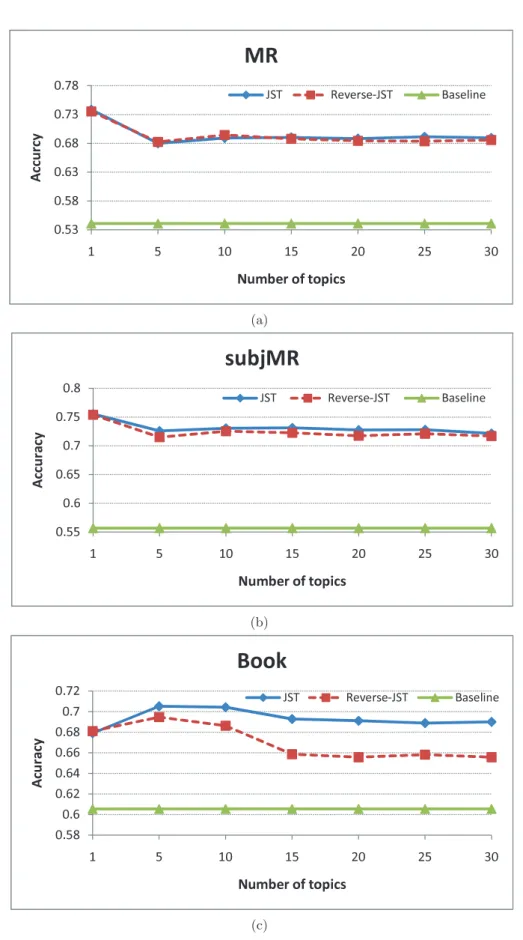
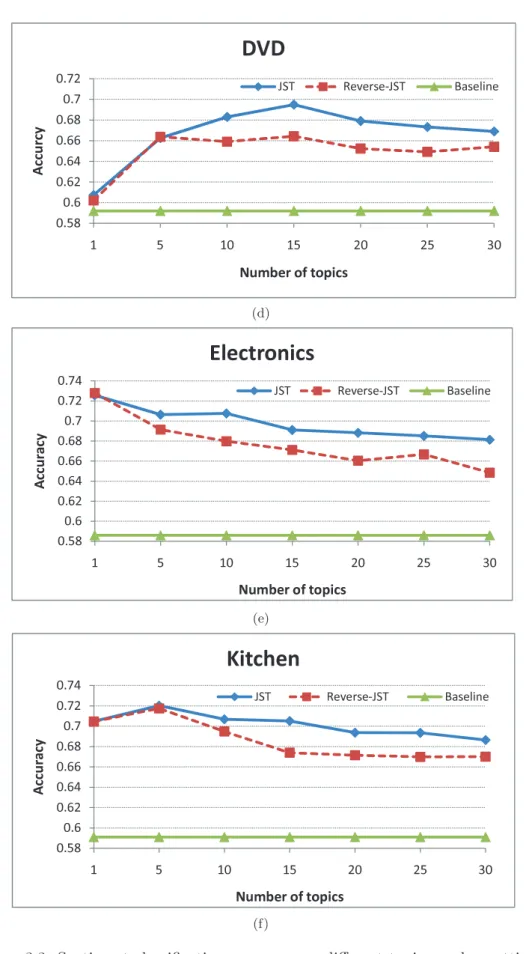
3.3 Sentiment classification accuracy vs. different topic number settings. . . 61
3.3 Sentiment classification accuracy vs. different topic number settings. . . 62
4.1 Dynamic JST model. . . 72
4.2 Three different time slice models with a total number of historical time slices S=3. The variable t−1 denotes epocht−1. . . 73
4.3 Exponential decay function with different decay rates. . . 80
4.4 Dataset statistics. (a) number of reviews of each add-on over the epochs; (b) average user rating for each add-on over the epochs. . . 83
4.5 Perplexity vs. number of time slices. . . 86
4.6 Accuracy vs. number of time slices. . . 87
4.7 Perplexity for each epoch. . . 89
4.8 Perplexity and sentiment classification accuracy versus number of topics. . . 90
4.9 Average training time per epoch with different number of time slices. . . 91
4.10 Performance vs. different input features. Left panel: perplexity; right panel: sentiment classification accuracy. . . 93
4.11 Example topics evolved over time. Topic labels shown above the boxed topics were derived manually from the coloured words and the number denotes epoch number. Topics in upper and lower panels are the positive and negative sentiment topics respectively. . . 95
4.12 Occurrence probability of topics with time. Positive and negative senti-ment topics correspond to the topics listed in the upper and lower panel of Figure 4.11 respectively. . . 96
5.1 subjLDA model. . . 100
5.2 Sentiment lexicon statistics. . . 110
5.3 Subjectivity classification performance vs. different prior information by
gradually adding the subjective and neutral words. The vertical dashed line denotes the point where all the positive and negative words have been incorporated into the model; 200P+400N denotes adding the least frequent 200 positive and 400 negative words. For example, 500Neu denotes adding the least frequent 500 neutral words in addition to all the positive and negative words. . . 111
5.3 Subjectivity classification performance vs. different prior information by
gradually adding the subjective and neutral words. The vertical dashed line denotes the point where all the positive and negative words have been incorporated into the model; 200P+400N denotes adding the least frequent 200 positive and 400 negative words. For example, 500Neu denotes adding the least frequent 500 neutral words in addition to all the positive and negative words. . . 112
2.1 An illustration of four topic examples extracted fromThe American
Polit-ical Science Review by LDA. . . 33
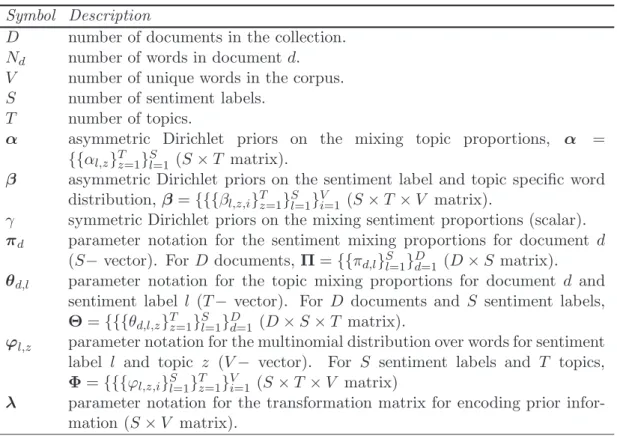
3.1 Parameter notations used in the JST model. . . 51
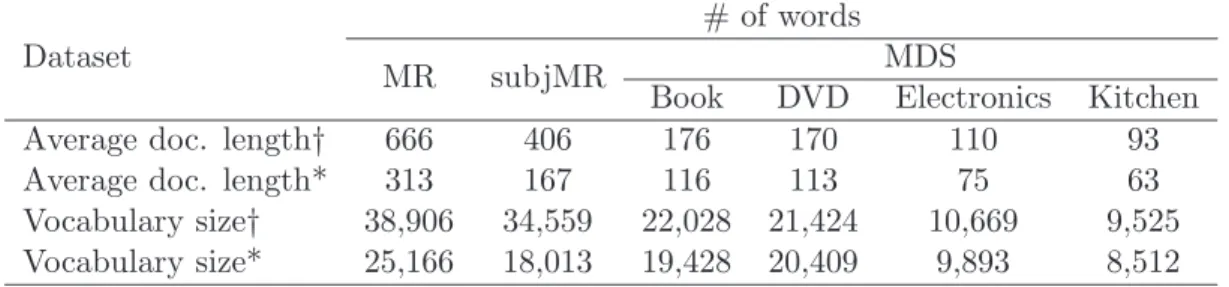
3.2 Dataset statistics. Note: †denotes before preprocessing and * denotes after preprocessing. . . 57
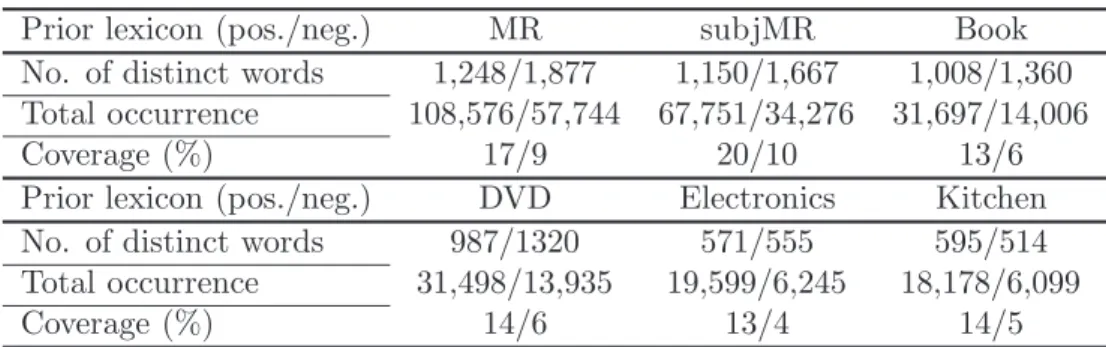
3.3 Prior information statistics. . . 59
3.4 Significant test results. Note: blank denotes the performance of JST and Reverse-JST is significantly undistinguishable; * denotes JST significantly outperforms Reverse-JST. . . 63
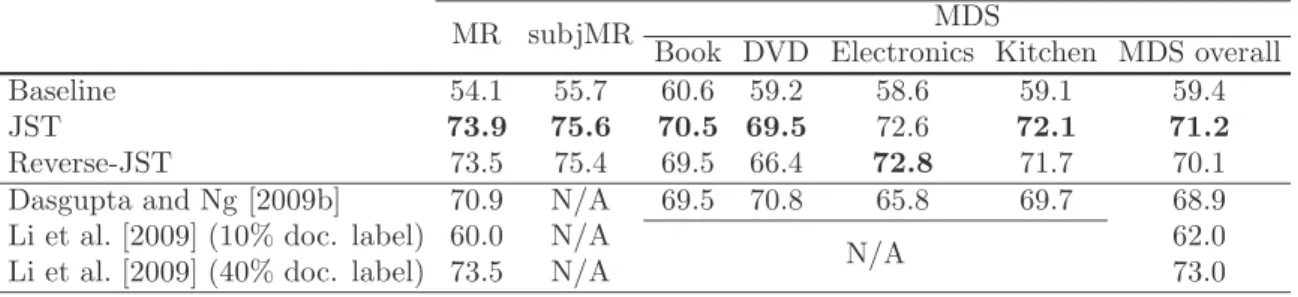
3.5 Performance comparison with existing models on sentiment classification accuracy. (Note: boldface denotes the best results.) . . . 64
3.6 Unigram and bigram features statistics. . . 66
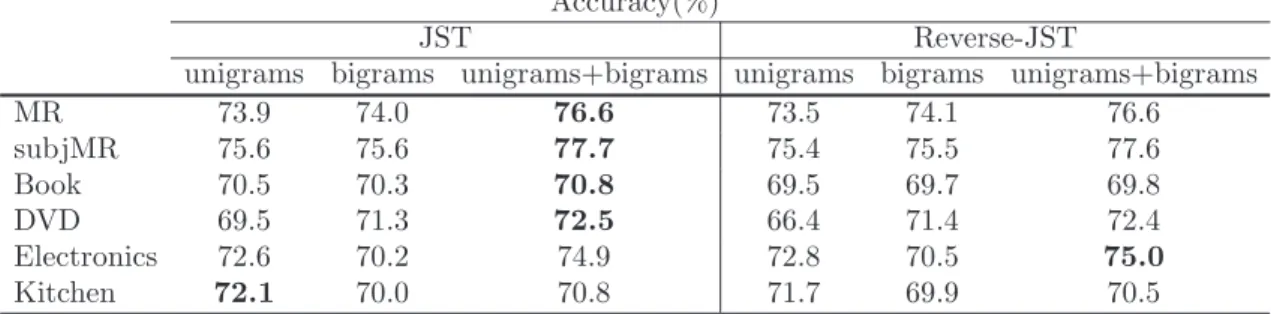
3.7 Sentiment classification results with different features. Note: boldface de-notes the best results. . . 66
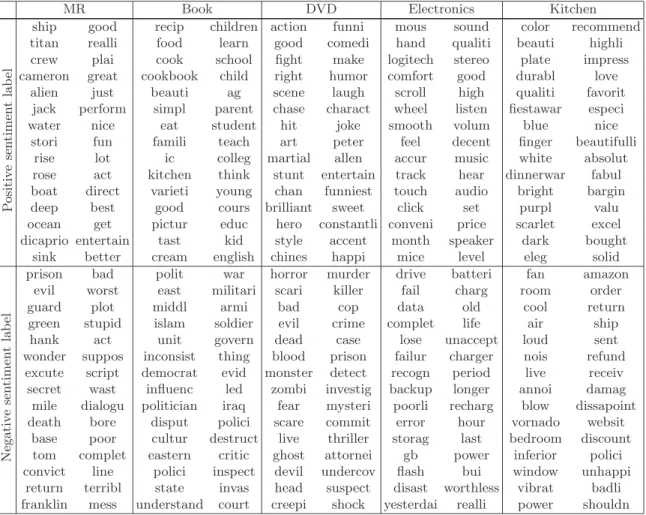
3.8 Topic examples extracted by JST under different sentiment labels. . . 67
4.1 Parameter notations for the dJST model. . . 75
5.1 Notations used for the subjLDA model. . . 101
Introduction
Recent surveys have revealed that opinion-rich resources such as online reviews and social networks are having greater economic impact on both consumers and companies compared to traditional media [Pang and Lee, 2008]. Driven by the demand of gleaning insights into such vast amount of user-generated data, work on developing new algorithms for automated sentiment analysis has bloomed in the past few years. On the other hand, probabilistic topic models [Blei et al., 2003] have attracted a dramatic surge of interest in the field of information retrieval, owing to their capability of discovering the hidden thematic structures in large archives of documents. The work in this thesis therefore focuses on developing topic models for automatic sentiment analysis of web data, by combining the ideas from both research domains described above.
1.1
Sentiment Analysis
Sentiment analysis aims to use automated tools to detect subjective information such as opinions, attitudes, and feelings in text expressed by the opinion holder. This thesis work focuses on two main sentiment analysis tasks here, sentiment classification and subjectivity detection.
Sentiment Classification In sentiment classification, one tries to predict whether the sentiment orientation of a given text is positive, negative or neutral. When classification involves only two classes of labels (i.e. either positive or negative), it is also known as polarity classification [Pang et al., 2002]. Research on sentiment classification has attracted a great deal of attention, where different classification tasks focus on various levels of granularity, e.g., from the document level [Pang et al., 2002], to the finer-grained
sentence [Kim and Hovy, 2004] and word/phrase level [Turney and Littman, 2002]. Apart from the research challenges, the growing interest in this area is largely due to the many useful applications it can offer, such as predicting stock market behaviour based on the sentiment results of Twitter posts [Bollen et al., 2011], measuring public poll opinion of presidential elections from Blog data [OConnor et al., 2010], and handling business intelligence tasks related to customer feedback [Pang and Lee, 2008].
Subjectivity Detection In contrast to sentiment classification that seeks to identify the sentiment orientation of a given opinionated text, subjectivity detection classifies whether the given text expresses opinions (subjective) or reports facts (objective). Such a task of distinguishing subjective information from objective has been reported to be more difficult than sentiment classification [Mihalcea et al., 2007], and is useful for many natural language processing applications. For instance, it is often assumed in sentiment classification that the input documents are opinionated, and ideally contain subjective statements only [Yu and Hatzivassiloglou, 2003]; document summarization systems need to summarize different perspectives and opinions [Pang and Lee, 2008]; for question answering systems, extracting and presenting information of the appropriate type (i.e. opinions or facts) is imperative according to the specific question being asked [Wiebe and Riloff, 2005].
1.2
Probabilistic Topic Models
Probabilistic topic models such as latent Dirichlet allocation (LDA) [Blei et al., 2003] and probabilistic latent semantic analysis (PLSA) [Hofmann, 1999] can capture the semantic properties of documents by modelling documents as a mixture of distributions over words, which are known as topics. The words under each topic tend to co-occur in the same document, and generally have a tight semantic relation with one another. So by inspecting the topics that have high probabilities associating with a document, one can easily interpret what that document is about. For instance, restaurant reviews probably discuss topics about food, service, location, price, etc; whereas electronic device reviews probably cover aspects such as design, quality and functions. Another advantage of topic models is that model learning is fully unsupervised, which does not require any prior annotation or labelling of documents. Hence, topic modelling is suitable for managing and summarizing large document archives [Blei, 2011], and has seen many successful applications such as in analysis of scientific journals [Blei and Lafferty, 2006], Wikipedia articles [Hoffman et al., 2010], academic email [McCallum et al., 2007], and navigation tools for digital libraries [Mimno and McCallum, 2007], etc.
While the existing sentiment analysis approaches [Bollen et al., 2011; Kim and Hovy, 2004; OConnor et al., 2010; Pang et al., 2002; Turney and Littman, 2002; Yu and Hatzivas-siloglou, 2003] have enabled various types of intelligence applications, they mainly focused on detecting the overall sentiment or subjectivity of text without considering the topical information, which makes the results less informative to users. Topic models, on the other hand, provide means for organizing and summarizing large digitized archives of informa-tion in an unsupervised fashion [Blei et al., 2003; Griffiths and Steyvers, 2004]. However, work on this line detects topics alone, with the correlations between topic and sentiment untouched.
The work in this thesis is illuminated by the two research areas described above, to develop new probabilistic topic models for sentiment analysis of web data. Specifically, these new models meet the needs of analysing large collections of opinionated documents, by addressing the limitations of current sentiment analysis approaches which are identified in the following section.
1.3
Research Challenges
In this section, several research challenges in the field of sentiment analysis are identified. These intellectual challenges arise from the tasks of both sentiment classification and subjectivity detection, which motivate the development of the new models in the thesis.
1.3.1 Training Sentiment Classifier without Labelled Data
Among various computational treatments to sentiment analysis, a large portion of work concentrates on classifying a sentiment-bearing document according to its sentiment po-larity, i.e. either positive or negative as a binary classification. Although much work has been done in this line [Kennedy and Inkpen, 2006; Pang and Lee, 2004; Pang et al., 2002; Turney, 2001; Whitelaw et al., 2005], most of the existing approaches rely on supervised learning models trained from labelled corpora where each document has been labelled as positive or negative prior to training. However, such labelled corpora are not always easy to obtain in practical applications. Additionally, it is well-known that sentiment classifiers trained on one domain often fail to produce satisfactory results when applied to other do-mains [Aue and Gamon, 2005; Blitzer et al., 2007]. For example, it was reported by Aue and Gamon [2005] that an in-domain Support Vector Machine (SVM) classifier trained
on movie review data (giving best accuracy of 90.45%) achieved relatively poor accura-cies of 70.29% and 61.36% respectively when tested on book review and product support services data. Such phenomena reflect the fact that sentiments are context dependent, so that sentiment expressions can be quite different for different topics or domains. For instance, when appearing under different topics within movie review data, the adjective “complicated” may have negative sentiment orientation as “complicated role” in one topic,
and conveys positive sentiment as “complicated plot” in another topic. This suggests that
modelling sentiment and topic simultaneously may help find better feature representations for sentiment classification. Therefore, the first research challenge is to develop unsuper-vised or weakly-superunsuper-vised sentiment models that do not require labelled data for training, and yet account for the topic or domain dependencies in sentiment classification.
1.3.2 Simultaneously Detecting Topic and Sentiment
From the application perspective, although it is useful to detect the overall sentiment of a document [Kennedy and Inkpen, 2006; Pang and Lee, 2004; Pang et al., 2002; Whitelaw et al., 2005], it is just as useful, and perhaps even more interesting, to understand the underlying topics and the associated topic sentiments of a document. Take the Amazon Kindle cover reviews shown in Figure 1.1 as an example. This Kindle cover receives a very high average rating from a total of 529 reviews. However, the review bar-chart shows that there are still quite a lot of customers who only gave a 4- or 3-star rating to the product. When making a purchase, despite the overall rating, it would be very helpful to know the pros and cons of the product being discussed in the reviews. An inspection of those two hundred 4- and 3- star reviews reveals that actually, many people think the cover
design andquality are very good, but it is justoverpriced. Having obtained such informa-tion, the Amazon Kindle cover would still be the best buy for the customers with large budgets, while others may choose a less expensive alternative. Nevertheless, people can still easily be overwhelmed by the quantity and variety of the available data, such as the example given above. So the second challenge is to find solutions that can automatically extract sentiment-bearing statements relating to product aspects in order to alleviate the information seeking burden of users.
1.3.3 Capturing Sentiment and Topic Dynamics
Many document collections exhibit dynamics, where the patterns of the documents col-lected at an earlier stage may not be preserved subsequently, especially for collections
Review 1
Title: Lovely quality (4-star)
By Technophobe, 19 April 2011
Beautiful piece of kit, protects my beloved kindle from knocks, scratches etc andlooks very goodat the same time. The locking mechanism that secures
the kindle into the cover is very clever and looks to be safe and secure. The
leather is good quality, and I love the bright apple green - very chic and
smart. Only reason its not 5 stars is it wasn't exactly cheap- bring the price
down a few pounds and it would perhaps represent better value for money and earn it 5 stars. No regrets about buying it though, does what its meant to and looks good at the same time!
Review 2
Title: Very good except the price (4-star)
By Val, 20 June 2011
The cover is very good, clips onto the Kindle easily and great protection
when being transported. It makes holding and reading the Kindle so much
more natural, like reading a book. I do however think the price is too high,
although good qualitythere isn't an enormous amount of leather used.
Figure 1.1: Amazon Kindle cover reviews. Text highlighted in green and red indicate the pros and cons of the product respectively.
that span years or decades. For instance, a mobile application which receives very positive reviews after the release of a first version, could a few months later, as a newer version introduces a bug, receive more prominent negative reviews. However, when analysing a document collection, topic models like LDA posit an assumption that documents have static word co-occurrence patterns, and that the order of documents does not matter. This assumption may not be realistic for many real world datasets such as the mobile review example. For these time-variant collections, we may want to assume that topics change over time, as well as the sentiments associated with the topics. Thus, it is necessary to develop dynamic models that can detect and track the shifts in both topic and sentiment over time in time-variant datasets, which is the third challenge.
1.3.4 Subjectivity Detection without Labelled Data
Work on sentence-level subjectivity detection is relatively sparse compared to document-level sentiment classification. Early work used a bootstrapping algorithm to learn subjec-tive [Riloff and Wiebe, 2003] or both subjecsubjec-tive and objecsubjec-tive [Wiebe and Riloff, 2005] expressions for sentence-level subjectivity detection. In contrast to bootstrapping, there
have been some recent attempts exploring various n-gram features and different level of
lexical instantiation for detecting subjective utterance from conversation data [Murray and Carenini, 2009; Raaijmakers et al., 2008; Wilson and Raaijmakers, 2008]. However, the aforementioned line of work tackled subjectivity detection either as supervised or semi-supervised learning, requiring labelled data and extensive knowledge for training, despite the fact that the gold standard labels at the sentence level could be prohibitively expensive to acquire. Additionally, similar to sentiment classification, subjectivity is also context sensitive, so that subjectivity classifiers trained on one domain often suffer from performance loss when applied to new domains [Pang and Lee, 2008]. Motivated by the above observations, the final challenge of the thesis is to develop a subjectivity detection algorithm that is relatively simple compared to the existing methods (e.g. based on
boot-strapping orn-gram features), and yet can easily be transferred between domains through
unsupervised or weakly-supervised learning without using any labelled data.
1.4
Thesis Contribution
In this thesis, three new topic models are proposed to address the research challenges in sentiment analysis described in Section 1.3. The contributions of this thesis can be summarized in the following aspects:
• A novel probabilistic modeling framework called the joint sentiment-topic (JST)
model based on latent Dirichlet allocation (LDA), which detects sentiment and topic simultaneously from text. A mechanism is introduced to incorporate prior informa-tion about the sentiment lexicons into model learning by modifying the Dirichlet priors of the topic-word distributions. Unlike supervised approaches to sentiment classification, which often fail to produce satisfactory performance when applied to other domains, the weakly-supervised nature of JST makes it highly portable to other domains, as will be verified by the experimental results on datasets from five different domains. Moreover, the topics and topic sentiment detected by JST are indeed coherent and informative.
• A new member of the probabilistic time series models called dynamic joint sentiment-topic (dJST) model, for sequentially analysing the sentiment-topic and sentiment evolution over time in a document collection. The dJST model respects the ordering of documents. By accounting for the historical dependencies of documents from the past epochs in the model generative process, dJST gives a richer posterior topical structure than JST, and thus can better respond to the permutations of topic prominence. For efficiently analysing large corpora, we derived online inference procedures based on a stochastic EM algorithm, allowing the dJST model to be updated sequentially using the newly arrived data and the parameters of the previously estimated model.
• A novel hierarchical topic model called the subjectivity detection LDA (subjLDA)
model, for sentence-level subjectivity detection. The only supervision information needed for subjLDA is a small set of domain-independent subjectivity clues; no labelled documents are used. By viewing the subjectivity detection problem as weakly-supervised generative model learning, subjLDA significantly outperforms the baseline and is comparable to models which rely on a much larger amount of data for training [Wiebe and Riloff, 2005].
1.5
Thesis Overview
This chapter has briefly introduced the research area of sentiment analysis and identified a few limitations of the current sentiment analysis approaches. It then summarized the main contributions of the thesis work in response to the research challenges identified. The remainder of the thesis is structured as follows:
Chapter 2 starts with a literature review of the work on sentiment analysis, which is categorized into supervised, semi-supervised and unsupervised learning. We then review the topic models on which the thesis work is based. The advantages and disadvantages of various approaches are also compared.
Chapter 3 presents the joint sentiment-topic (JST) model and a reparameterized ver-sion of JST called the Reverse-JST model. The mathematical framework of JST and a Gibbs sampling algorithm for estimating the model parameters are described in detail.
Experimental evaluation using the movie review (MR)1 and the multi-domain sentiment
(MDS)2 datasets is also presented.
1
http://www.cs.cornell.edu/people/pabo/movie-review-data
2
Chapter 4 introduces the dynamic joint sentiment-topic (dJST) model by extending the JST model framework. An efficient stochastic EM algorithm for online updating the model parameters with the historical information and the newly arrived data is described in detail. In the experimental evaluation, the dJST model performance is compared to the non-dynamic JST and LDA models using the Mozilla add-on review dataset which was collected as part of the PhD study.
Chapter 5 introduces the subjectivity detection LDA (subjLDA) model for sentence-level subjectivity detection. The subjLDA model framework is first described, followed by the model inference using the Gibbs sampling algorithm. In the evaluation, the subjLDA model performance is compared to the baseline and the LDA model, based on the
Multi-Perspective Question Answering (MPQA)1 dataset.
Chapter 6 summaries the thesis work and outlines a few possible directions for future research.
1
Related Work
This thesis work focuses on developing topic models for automatic sentiment analysis. Therefore, we first survey a range of different machine learning techniques for sentiment analysis in Section 2.1, and then in Section 2.2, we discuss related work on topic models which form the ground of the models we have developed in this thesis.
2.1
Sentiment Analysis
Sentiment classification seeks to identify the polarity of texts according to the sentiment expressed by the opinion holder. In this section, we investigate the work which deals with computational treatments of sentiment using different machine learning techniques, with a focus on document-level sentiment classification.
2.1.1 Supervised Approaches
Most supervised sentiment classification approaches use standard machine learning tech-niques such as support vector machines (SVMs) and Naive Bayes (NB) classifiers. These approaches are corpus-based, in which a domain-specific classifier is trained with labelled training data.
Pioneering work on document-level sentiment classification is by Pang et al. [2002], who employed machine learning techniques including SVMs, NB and Maximum Entropy
(Max-Ent) to determine whether the sentiment expressed in a movie review was “thumbs up’’ or
“thumbs down”. They achieved the best classification accuracy with SVMs using binary features coding whether a unigram was present or not. In subsequent work, Pang and Lee
[2004] further improved sentiment classification accuracy on the movie review dataset us-ing a cascaded approach. Instead of trainus-ing a classifier on the original feature space, they first filtered out the objective sentences from the dataset using a global min-cut inference algorithm, and then used the remaining subjective sentences as input for sentiment classi-fier training. The classification improvement achieved by the cascaded approach suggests that the subjective sentences contain features which are more discriminative and infor-mative than the full dataset for sentiment classification. The movie review dataset (also known as the polarity dataset) used in [Pang and Lee, 2004; Pang et al., 2002] has later on become a benchmark for many sentiment classification studies [Matsumoto et al., 2005; Whitelaw et al., 2005]. Whitelaw et al. [2005] used fine-grained semantic distinctions in
features for sentiment classification, namely the appraisal groups. Specifically, aappraisal
group is defined as coherent groups of words that express together a particular attitude,
such as “extremely boring” and “not terribly funny”. By training a SVM classifier on the
combination of different types of appraisal group features and bag-of-word features, they achieved the best accuracy of 90.2% on the movie review dataset. Matsumoto et al. [2005] proposed a method using the extracted word sub-sequences and dependency sub-trees as features for SVMs training and attained the state-of-the-art accuracy of 93.7%.
A common assumption made by the aforementioned line of work [Pang and Lee, 2004; Pang et al., 2002; Whitelaw et al., 2005] is that the entire document is represented as a flat feature vector (i.e. a bag-of-words format), which limits their ability to exploit sentiment or subjectivity information at a finer-grained level. In this regard, there has been work on incorporating sentence or sub-sentence level sentiment label information for document-level sentiment classification [McDonald et al., 2007; Yessenalina et al., 2010; Zaidan et al., 2007].
McDonald et al. [2007] proposed a fully supervised structured model for joint sentence-and document-level sentiment classification based on sequence classification techniques using constrained Viterbi inference. The joint model leverages both document-level and sentence-level label information, and allows classification decisions from one level (e.g. the document level) to influence decisions at another level (e.g. the sentence level). It was reported that the joint model significantly outperformed both the document- and sentence-classifier that predict a single level label only. Zaidan et al. [2007] used human
annotators to mark the sub-sentence level text spans known as “annotator rationales”,
which support the document’s sentiment label. These annotator rationales were used as additional constraints for SVMs training, which ensure that the resulting classifier will be less confident in classifying the documents that do not contain the rationales. By
exploiting the rationales during the classifier training, the proposed approach achieved 92.2% accuracy on the movie review dataset, and significantly outperformed the baseline SVM which only used the full text of the original documents for training.
More recently, Yessenalina et al. [2010] proposed a supervised multi-level structured model based on structural SVMs, which learns to jointly predict the document label and the labels of a sentence subset that best explain the document sentiment (i.e. the explana-tory sentences). By treating the sentence-level labels as hidden variables, the proposed model does not required sentence-level annotation for training and thus avoids the lower-level labelling cost. Additionally, as opposed to the structured model [McDonald et al., 2007] which optimizes the accuracy for all levels being modelled, they took a different view to formulate the training objective to directly optimize for document-level accuracy. This multi-level structured model achieved 93.22% document-level sentiment classification accuracy on the movie review dataset, which outperformed both the structured model [Mc-Donald et al., 2007] and the approach of Zaidan et al. [2007]. Nevertheless, a reasonable initial guess of the explanatory sentences is required in order to train the model properly.
2.1.2 Semi-supervised Approaches
Supervised sentiment classification approaches usually perform well when the training set is large enough. However, it is well known that the trained classifier often fail to produce satisfactory performance when the test data distribution is significantly different from the distribution of training data. As such, one would have to collect and label data for classifier retraining whenever a new domain is encountered. However, online content varies widely in domains and evolves rapidly over time, making corpora annotation for each domain unrealistic. In response to the labelling cost problem faced by supervised approaches in the sentiment classification task, there has been rising interest in exploring semi-supervised methods which leverage a large amount of unlabelled data and a small amount of labelled data for classifier training, especially for the tasks of domain adaptation and cross-lingual sentiment classification.
2.1.2.1 Monolingual Domain Adaptation
There has been a significant amount of work on domain adaptation for sentiment classifi-cation. Aue and Gamon [2005] explored various strategies for training SVM classifiers for the target domain lacking sufficient labelled data, where training data is obtained from
other domains with rich labelled examples. These strategies include (1) training on a mixture of all the available labelled data (also used as baseline); (2) training on all the available labelled data, but limiting the set of features to those observed in the target domains; (3) using ensembles of classifiers from domains with available labelled data; and (4) combining small amounts of unlabelled data with large amounts of unlabelled data in the target domain for classifier training with an EM algorithm. It was found that the EM approach provided the best classification accuracy of the four strategies because it can take advantage of unlabelled data in the target domain for training. Tan et al. [2007] also leveraged data from both source and target domain for sentiment adaptation, where the target domain data are completely unlabelled. The main idea of their approach is to use classifiers trained on source domains to label some informative documents in the target domain. Those informative documents, picked up by a relative similarity ranking (RSR) method, were then used to retrain a centroid classifier for the target domain sentiment
classification. The approach of Tan et al. outperformed the transductive SVM (TSVM)
baseline classifier in most of the evaluation tasks, obtaining an average of more than 80% accuracy.
In a similar vein, Blitzer et al. [2007] addressed the domain transfer problem with the structural correspondence learning (SCL) algorithm using labelled data from a source domain and unlabelled data from both source and target domains. A key factor to the efficiency of SCL is the selection of pivot features, which are used to link the source and target domains. The pivot feature selection were performed in two stages. Frequent words in both source and target domains were first selected as candidate pivot features and pivots were then chosen based on the mutual information between these candidate features and the source labels. They reduced the relative error due to adaptation between domains by an average of 46% over a supervised baseline model (a linear classifier trained to minimize the Huber loss with stochastic gradient descent), based on the multi-domain sentiment
(MDS) dataset1. In subsequent work, Li and Zong [2008] explored two methods for
multi-domain sentiment classification, which are very similar to the approaches of Aue and Gamon [2005]. The first one combines the feature sets from all domains into one feature set for classifier training (feature fusion); the other combines multiple single classifiers trained on individual domains using meta-learning (classifier fusion). While both methods can achieve better results than the baseline which used single domain supervised learning, it was found that the classifier fusion method consistently outperformed the feature fusion method, which is in line with the observations of Aue and Gamon [2005].
1
Instead of solely relying on source and target domain data for training, there have been studies which incorporate sentiment lexicons, heuristic knowledge, or augmenting feature spaces for improving sentiment classification accuracy. Li et al. [2009] proposed a non-negative matrix tri-factorization approach for semi-supervised sentiment classifica-tion, which learns from lexical prior knowledge of domain-independent sentiment lexicons in conjunction with domain-dependent unlabelled data and a few labelled documents. Although not directly targeting the domain adaptation problem, the proposed approach achieved comparable performance to supervised methods on dataset from four different domains, which suggests that taking advantages of both domain-independent and de-pendent knowledge may benefit general domain sentiment classification. Li et al. [2010] exploited a two-view model, i.e. personal and impersonal view, for sentiment classification. Specifically, personal views consist of sentences which directly express one’s feeling and preference towards a target object; whereas impersonal views tend to provide objective
domain-specific knowledge. For example, the sentence “I love this book.” is a personal
view which contains domain-independent clue “love” that are highly relevant to sentiment
classification. By contrast, an impersonal view “It is too small.” describes one’s objective
evaluation of a target object. It was reported that by employing the two views which were extracted with unsupervised mining, significant performance gain can be achieved with semi-supervised learning using the Co-Training algorithm. More recently, He et al. [2011] proposed to augment polarity-bearing topics for cross-domain sentiment classifi-cation. They first extracted polarity-bearing topics using the joint sentiment-topic (JST) model [Lin et al., 2011b] by incorporating a domain-independent sentiment lexicon; the original document spaces were then augmented with those extracted topics to form a new document representation as input to a Maximum Entropy classifier. They achieved state-of-the-art in-domain supervised classification accuracy in both the movie review and the multi-domain sentiment (MDS) datasets (more than 90% on average) and outperformed SCL [Blitzer et al., 2007] in cross-domain sentiment classification.
There has also been work on addressing domain adaptation by exploring careful struc-turing of features. Dasgupta and Ng [2009a] first mined the unambiguous reviews using spectral clustering, and then exploited those unambiguous reviews to classify the am-biguous reviews via a combination of active learning, transductive learning and ensemble learning. The more recently proposed spectral feature alignment (SFA) algorithm [Pan et al., 2010] addresses the domain transfer problem by aligning domain-specific words from different domains into unified clusters, using domain-independent words as a bridge. Leveraging labelled data only from the source domains, SFA outperformed most previous
approaches in cross domain sentiment classification [Blitzer et al., 2007; Dasgupta and Ng, 2009a; He et al., 2011; Li et al., 2010].
2.1.2.2 Cross-lingual Sentiment Classification
In contrast to monolingual sentiment adaptation which addresses the domain mismatch issue for sentiment classification (e.g. Book vs. Electronics reviews), cross-lingual senti-ment classification focuses on the mismatch arises from language differences, that is to use labelled data from a source language to build a sentiment classifier for a different target language. Semi-supervised techniques have also been widely applied to the task of cross-lingual sentiment classification, owning to the fact that some languages (typically English) have much richer sentiment resources (e.g., labelled corpus and lexicon) than others.
Most cross-lingual sentiment classification approaches focus on transferring sentiment or subjectivity analysis capabilities from English to the language that lacks labelled data for training. Mihalcea et al. [2007] explored two approaches for developing subjectivity classifiers in Romanian leveraging English resources. The lexicon-based approach used a subjectivity lexicon translated from an English one; whereas the corpus-based approach used an English subjectivity classifier and a manually translated parallel corpus for classi-fier training. It was found that the corpus-based approach outperformed the lexicon-based approach which was low in recall. Banea et al. [2008] also leveraged available English resources to generate resources for subjectivity classification in both Romanian and Span-ish. Rather than relying on manual translation, they instead automatically translated the English resources by exploiting machine translation engines, and the classification per-formance was comparable to the approach using manually translated corpora [Mihalcea et al., 2007].
Leveraging English resources for Chinese sentiment classification has also been studied. Wan [2009] proposed to use the Co-Training algorithm for Chinese sentiment classification, which makes use of annotated English reviews and some amounts of unlabelled Chinese reviews as training data. Akin to Banea et al. [2008], the language gap was overcome with the use of readily available machine translation services. The proposed approach achieved more than 80% accuracy in sentiment classification, which outperformed the standard inductive and transductive SVM classifiers. Lu et al. [2011] proposed a maximum entropy-based EM algorithm for joint bilingual sentiment classification at the sentence level. In contrast to Wan [2009] focusing on improving sentiment classification performance in one language, the approach of Lu et al. [2011] can simultaneously learn better monolingual
sentiment classifiers for both English and Chinese by exploiting an unlabelled parallel corpus together with labelled data in each language.
More recently, there is a study investigating the use of machine translation for cross-lingual sentiment classification [Duh et al., 2011]. It was argued that machine translation is ripe for cross-lingual sentiment classification, but the cross-lingual classification problem itself is qualitatively different from the monolingual sentiment adaptation problem which requires better understanding of its special characteristics.
2.1.3 Unsupervised and Weakly-supervised Approaches
The supervised and semi-supervised approaches discussed in Sections 2.1.1 and 2.1.2 can be categorized as corpus-based methods as they use a labelled or unlabelled data to train sentiment classifiers. Given the difficulties of supervised and semi-supervised sentiment analysis, it is conceivable that unsupervised or weakly-supervised approaches to senti-ment classification are even more challenging. Nevertheless, solutions to unsupervised or weakly-supervised sentiment classification are of practical significance owing to its domain-independent nature [Dasgupta and Ng, 2009b].
In the absence of annotated data, unsupervised sentiment classification typically em-ploys a very small number of sentiment seed words as reference features for polarity iden-tification [Read and Carroll, 2009; Turney and Littman, 2002]. The pioneering work in this line is that of Turney and Littman [2002], in which a document is classified as posi-tive or negaposi-tive by the average sentiment orientation of the phrases containing adjecposi-tives or adverbs in the document. The sentiment orientation of a phrase is calculated as the
pointwise mutual information (PMI) with a positive word “excellent” minus the PMI with
a negative word “poor”. The proposed approach achieved an accuracy of 84% for
auto-mobile reviews and 66% for movie reviews. In the same vein, Read and Carroll [2009]
measured the similarity between words and polarity prototypes such as “excellent” and
“good” with three different methods, namely, lexical association (using PMI), semantic
spaces, and distributional similarity. While Turney and Littman [2002] only used one polarity prototype for each sentiment class, Read and Carroll experimented with seven
polarity prototypes obtained from Roget’s Thesaurus and WordNet1 through a selection
process based on their frequency in the Gigaword corpus. The best result was achieved using PMI with 69.1% accuracy obtained on the movie review data.
1
While a fixed number of sentiment seed words have been used in the aforementioned work [Read and Carroll, 2009; Turney and Littman, 2002], there have been attempts to incrementally enlarge the unlabelled examples with self-training based on the original seed word input [Zagibalov and Carroll, 2008a,b]. Starting with a single Chinese sentiment seed
word meaning “good”, Zagibalov and Carroll [2008b] used iterative retraining to gradually
enlarge the seed vocabulary. Those enlarged sentiment-bearing words are selected based on their relative frequency in both the positive and negative parts of the current training data. The sentiment orientation of a document is then determined by the sum of the sen-timent scores of all the sensen-timent-bearing lexical items found in the document. Problems with this approach are that there is no principled mechanism for determining the optimal iteration number for training as well as for selecting the initial seed word, where inap-propriate seed word selection may result in very poor accuracy. As such, in subsequent work, Zagibalov and Carroll [2008a] introduced a way for automatic seed word selection based on some heuristic knowledge, and an iteration control method was proposed so that iterative training stops when there is no change to the classification of any document over the previous two iterations. However, this strategy does not necessarily permit the best classification accuracy. Instead of using sentiment seed words, Dasgupta and Ng [2009b] proposed an unsupervised sentiment classification algorithm where user feedback is pro-vided in a spectral clustering process in an interactive manner to ensure that texts are clustered along the sentiment dimension. Features induced for each dimension of spec-tral clustering can be considered as sentiment-oriented topics. They achieved 70.9% and 69.3% classification accuracy on the movie review and multi-domain sentiment datasets respectively. Nevertheless, human identification of the most important dimensions during spectral clustering is required.
Weakly-supervised sentiment classification approaches are mostly lexicon-based, some of which integrate with corpus-based methods as a hybrid model [Andreevskaia and Bergler, 2008; Melville et al., 2009; Qiu et al., 2009; Tan et al., 2008]. Compared to the seed words used in unsupervised methods, the sentiment lexicon, consisting of a list of positive and negative sentiment bearing words, is usually much larger in size and is used as reference features for sentiment classification. Such sentiment lexicons can be constructed from domain-independent sources in many different ways, ranging from manual approaches [Whitelaw et al., 2005], to semi-automated approaches [Abbasi et al., 2008; Argamon et al., 2009; Kim and Hovy, 2004], and even almost fully automated approaches [Kaji and Kit-suregawa, 2006; Kanayama and Nasukawa, 2006; Turney and Littman, 2002]. Analogous to the unsupervised approach that uses iterative retraining [Zagibalov and Carroll, 2008b],
Qiu et al. [2009] also used a lexicon-based iterative process to iteratively enlarge an initial sentiment dictionary from the first phrase. But instead of using a single seed word as Zagibalov and Carroll [2008b], they started with a much larger Chinese sentiment
dic-tionary HowNet1 as the initial lexicon. Documents classified from the first phase were
taken as a training set to train SVMs, which were subsequently used to revise the results produced from the first phase. This self-supervised approach was tested on reviews from ten different domains, and outperformed the best results of the approach by Zagibalov and Carroll [2008a] on the same data over 6% in F-measure.
In a similar vein, Andreevskaia and Bergler [2008] integrated a lexicon-based system trained on WordNet and a corpus-based classifier trained on a small set of annotated in-domain data for sentence-level sentiment annotation across different in-domains. Melville et al. [2009] combined lexical information from a sentiment lexicon with labelled documents, where word-class probabilities in a Naive Bayes classifier learning were calculated as a weighted combination of word-class distributions estimated from the sentiment lexicon and the labelled documents respectively. It was observed in both studies [Andreevskaia and Bergler, 2008; Melville et al., 2009] that a framework integrating both lexical knowledge and corpus training examples performs better than using lexical knowledge or training data in isolation.
2.1.4 Sentiment Dynamics and Subjectivity Detection
Previous sections have discussed various approaches to sentiment classification ranging from supervised, semi-supervised to unsupervised learning. In this section, we review some related work in sentiment dynamics and subjectivity detection as these two lines of work are closely related to the dynamic joint sentiment-topic (dJST) model and the subjective LDA (subjLDA) model proposed in this thesis, as described in Chapters 4 and 5, respectively.
2.1.4.1 Sentiment Dynamics
Most sentiment classification tasks assume that input data is time-invariant and the sen-timent of data does not exhibit dynamics. However, in reality, sensen-timent distributions of online content evolve over time and exhibit strong correlation with its published time
1
stamp. This observation has thus motivated work on modelling sentiment dynamics in time-variant datasets.
There has not been much work on the automatic detection of sentiment dynamics. Mao and Lebanon [2007; 2009] formulated the sentiment flow detection problem as the prediction of an ordinal sequence based on a sequence of word sets using a variant of conditional random fields and isotonic regression. Their proposed method has mainly been tested for sentence-level sentiment flow prediction within a document. Mei et al. [2007] employed a hidden Markov model (HMM) to tag every word in the collection with a topic and sentiment polarity, where the topic and sentiment of each word were detected by a topic-sentiment mixture model beforehand. The topic life-cycles and sentiment dynamics were then computed by counting the number of words labelled with the corresponding state over time.
In a recent study, Bollen et al. [2009; 2010] showed that public mood patterns from a sentiment analysis of Twitter posts do relate to the fluctuations in macroscopic social and economic indicators in the same time period. However, they mapped each tweet to a six-dimensional mood vector (Tension, Depression, Anger, Vigour, Fatigue, and Confu-sion) as defined in the Profile of Mood States (POMS) [McNair et al., 1971] by simply matching the terms extracted from each tweet to the set of POMS mood adjectives with-out considering the individual topic of each tweet. Similar phenomena have also been observed in the research by Lux [2008], who studied the causal relationship between in-vestors’ mood and subsequent stock price changes, based on weekly survey data on the short-term and medium-term sentiment of German investors. Using the vector autore-gression (VAR) model, it was found that either sentiment is exogenous and drives stock returns, or returns and sentiment define a simultaneous system with mutual causation.
2.1.4.2 Subjectivity Detection
A primary task of sentiment analysis is subjectivity detection, which automatically iden-tifies whether a given piece of text expresses opinions or states facts. While sentiment classification and subjectivity detection are closely related to each other, it has been re-ported that separating subjective and objective instances from text is more difficult than sentiment classification, and the improvement of subjectivity detection can benefit the latter as well, because not every part of a document is equally informative for inferring the document sentiment [Mihalcea et al., 2007].
Compared to sentiment classification, work on subjectivity detection is mostly at sen-tence level and is often viewed as a text classification problem where a classifier is trained from an annotated corpus. An early work by Yu and Hatzivassiloglou [2003] built a
subjec-tivity classification system for opinion question answering. Using variousn-gram features
and a polarity lexicon, the proposed system was able to perform subjectivity classification at both document and sentence level. Pang and Lee [2004] separated subjective sentences from objective ones using a graph-based minimum cut algorithm, where subjective extrac-tions were subsequently used as input for sentiment classifier training which yielded better sentiment accuracy than training on the whole document.
Riloff and Wiebe [2003] proposed a bootstrapping method for sentence-level subjec-tivity detection. They started with high-precision rule-based subjecsubjec-tivity classifiers which automatically identified subjective and objective sentences in un-annotated texts. The subjective expression patterns were learned from syntactic structure output from the pre-viously labelled high confidence texts. The learned patterns were used to automatically identify additional subjective sentences which enlarged the training set, and the entire process was then iterated. In subsequent work, Wiebe and Riloff [2005] performed sub-jectivity detection using a method similar to Riloff and Wiebe [2003], but moved one step forward in that they also learned objective expressions apart from subjective expressions. As the subjective/objective expression patterns are based on syntactic structures, they
are more flexible than unigrams orn-grams.
Wilton and Raaijmakers [2008] compared the performance of classifiers trained using
word n-grams, character n-grams, and phoneme n-grams for recognizing subjective
ut-terances in multiparty conversation. They found that using character n-grams from the
reference transcriptions gave the best results, significantly outperforming word n-grams
in terms of subjective recall and F-measure. Raaijmakers et. al [2008] extended the work of Wilson and Raaijmakers [2008] and further analysed the performance of detecting subjectivity in meeting speech by combining a variety of multimodal features including additional prosodic features. They found that the combination of all features performed best and that the prosodic features were less useful in discriminating between positive and negative utterances. More recently, Murray and Carenini [2009] proposed to learn
subjective patterns from both labelled and unlabelled data usingn-gram word sequences
with varying levels of lexical instantiation. Their approach for learning subjective patterns
relies on n-grams, which is similar to Raaijmakers et. al [2008], but goes beyond fixed
sequences of words by allowing lexical instantiation in varying levels and thus offers more flexibility.
In contrast to most of the aforementioned methods for subjectivity detection relying on either labelled corpora or linguistic pattern extraction for subjectivity classifier train-ing [Murray and Carenini, 2009; Pang and Lee, 2004; Riloff and Wiebe, 2003; Wiebe and Riloff, 2005; Wilson and Raaijmakers, 2008], the subjectivity detection LDA (subjLDA) model [Lin et al., 2011a] proposed in this thesis formulates the subjectivity detection prob-lem as a weakly-supervised generative model learning. Apart from being able to achieve comparable performance to previous approaches using supervised learning [Wiebe and Riloff, 2005], subjLDA is relatively simple and uses only a small set of subjectivity clues as supervised information. Detailed discussion of the subjLDA model will be given in Chapter 5.
2.1.5 Discussion
Sentiment analysis has been an active research area in recently years and has seen many useful applications such as in business intelligence and social economics. Compared to the traditional text classification which focuses on topic identification, sentiment analysis is deemed to be more difficult which poses intellectual challenges in several aspects [Pang and Lee, 2008]:
• Sentiment is often embodied in subtle linguistic mechanisms such as the use of
sar-casm, which makes sentiment classification difficult.
• Sentiment is domain-dependent, where sentiment expressions in different domains
can be quite different. Besides, even for data from the same domain, sentiment distri-butions may vary over time, especially for collections that span years or decades [Read, 2005]. These factors have made the development of a sentiment system for general domains very challenging.
• In contrast to topic-based text categorization, word order in sentiment classification
is of great importance, as the order in which different opinions are presented can result in a completely opposite overall sentiment polarity. So while generally satis-factory performance can be achieved using bag-of-words feature representation for topic categorization, it may not be sufficient for sentiment classification and mod-elling deeper linguistic knowledge is needed for improving classification accuracy.
Driven by these challenges, recent years have seen advances of different machine learning techniques in sentiment analysis.
Supervised methods can usually achieve good performance when training data is suffi-ciently large. However, there are several associated issues. First, supervised classifiers are typically domain-dependent, where classifiers trained on one domain lose accuracy when applied on test data whose distributions differ significantly from the training data. Second, online content varies widely across domains, and in-domain features also evolve over time, which makes the cost of annotating corpora for each domain unrealistic. As a result, there has been active research for developing semi-supervised or unsupervised learning methods for sentiment analysis.
Semi-supervised approaches fall between supervised and unsupervised approaches by leveraging a large amount of unlabelled data and a small amount of labelled data for training. The main advantages of semi-supervised learning are: (1) only a small amount of labelled data is needed, so the labelling cost is much less expensive than supervised approaches; (2) it has been found in many machine learning applications that unlabelled data used in conjunction with a small amount of labelled data can produce considerable improvement in learning accuracy [Bishop, 2006]. Therefore, there has been increasing interest in exploiting semi-supervised learning for domain adaptation and cross-lingual sentiment classification, where some of the approaches even achieve comparable perfor-mance to fully supervised learning.
Unsupervised or weakly-supervised sentiment analysis techniques are promising as they can avoid the domain-dependency problem typically associated with supervised ap-proaches. As an unsupervised classifier will not be able to identify which features are rel-evant to polarity classification in the absence of annotated data, unsupervised approaches normally resort to sentiment lexicons as a form of prior polarity knowledge for model learning. Such domain-independent sentiment lexicons can be acquired automatically or semi-automatically with much less effort compared to labelling a large training dataset. Nevertheless, the performance of unsupervised or weakly-supervised sentiment approaches is still inferior to supervised or semi-supervised learning.
2.2
Generative Topic Models
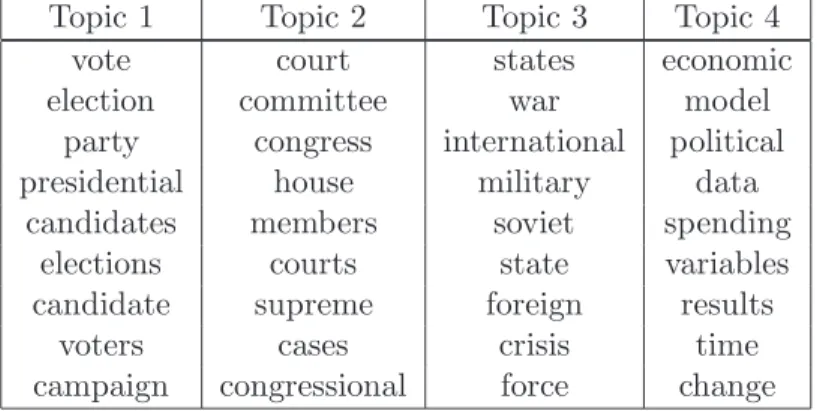
In the field of information retrieval (IR), a variety of probabilistic models have been used to analyse the content of documents and the meaning of words [Blei et al., 2003; Hofmann, 1999]. These models all share the idea that documents are mixtures of topics, where a topic is a multinomial distribution over words. By assigning high probability to a set of
Table 2.1: An illustration of four topic examples extracted from The American Political Science Review by LDA.
Topic 1 Topic 2 Topic 3 Topic 4
vote court states economic
election committee war model
party congress international political
presidential house military data
candidates members soviet spending
elections courts state variables
candidate supreme foreign results
voters cases crisis time
campaign congressional force change
topic words that tend to co-occur in the same document, one can easily interpret what that topic is about as these co-occurring words tend to have some tight semantic relations with one another. Such topic clusters extracted from document collections are useful in many tasks, such as identifying the contents of those documents, retrieving the most relevant documents given a query, tracking changes in contents over time and measuring
the similarities between documents. Table 2.1 shows four topic examples derived fromThe
American Political Science Review1 using latent Dirichlet allocation (LDA) [Blei et al.,
2003] with the topic number being set to 20. We show the top 15 words that have the highest probability under each topic. For instance, seeing the co-occurring words such as
vote,election,party andcandidates under topic 1, one can easily figure out that the topic
is about political elections; likewise, topic words such as war,international, military and
soviet appearing together under topic 3 present clear clues that the topic relates to war and international affairs.
One of the leading topic models is the so called probabilistic latent semantic indexing (pLSI) model (also known as the aspect model) introduced by Hofmann [1999] for doc-ument modelling. pLSI is based on a mixture decomposition derived from a latent class model. In pLSI, each word in a document is modelled as a sample from a mixture model where the mixture components are multinomial random variables that can be viewed as representations of topics. Thus, different words in a document can be generated from different topics, and a document can be represented as the mixing proportions of those mixture components. However, pLSI is still an incomplete generative model in that there is no probability process for defining how the weights of the mixture components for each document are generated, making it difficult to directly apply the learned models to new documents. In this regard, the latent Dirichlet allocation (LDA) model proposed by Blei
1
w z N d D T
Figure 2.1: LDA model.
et al. [2003] solves the problem of pLSI by defining a generative model (i.e., a Dirichlet prior) over the mixture topic proportions for each document. Being able to use powerful statistical learning to infer latent semantic structures of text data, LDA has received con-siderable research interest and has been the foundation of developing numerous statistical models representing richer structures of language.
As LDA provides the basis of the three hierarchical Bayesian models proposed in the thesis, we give a detailed discussion of LDA in the following section.
2.2.1 Latent Dirichlet Allocation
Latent Dirichlet allocation (LDA), originally introduced by Blei et al. [2003], represents documents as random mixtures over latent topics, where each topic is a specialised distri-bution over words. A graphical model of LDA is shown in Figure 2.1, wherein nodes are random variables and edges indicate the dependence between nodes [Steyvers and Griffiths, 2007]. As a directed graph, arrows are used to indicate the direction of the relationship
among nodes, so that arrows point to thechild node from their directparent node. Also
with the standard graphical notation, the shaded and unshaded variables correspond to observed and hidden variables respectively, and the plates represent replicated sampling steps during the generative process [Bishop, 2006].
Given a corpus with a collection ofDdocuments denoted byC={d1, d2, ..., dD}, each
document in the corpus is a sequence ofNd words denoted by d= (w1, w2, ..., wNd), and
denoted by {1,2, ..., V}. Also, let T be the total number of topics. The procedure for
generating a wordwi in documentdby LDA can be boiled down to two stages. First, one
chooses a topiczifrom the per-document topic proportionθd. Following that, one draws a
wordwi from the per-corpus topic-specific word distributionϕzi. The formal definition of
the generative process in LDA corresponding to the graphical model shown in Figure 2.1 is as follows:
• For each topic j∈ {1, ..., T}
– Draw ϕj ∼Dir(β).
• For each document d∈ {1, ...D}
– Draw a distribution θd∼Dir(α).
– For each word wi in documentd
∗ Draw a topic zi ∼Mult(θd),
∗ Draw a wordwi ∼Mult(ϕzi).
The goal of LDA is therefore to find a set of model parameters, here the per-document
topic proportionsΘ={θd}Dd=1 and the per-corpus topic-word distributionsΦ={ϕj}Tj=1,
that can best explain the observed words from the documents. However, exact inference in LDA is generally intractable, and we have to appeal to approximate inference algorithms for posterior estimation.
Approximate posterior inference algorithms generally fall into two categories: sampling approaches and optimization approaches [Hoffman et al., 2010]. Sampling approaches are mainly based on Markov Chain Monte Carlo (MCMC) methods, which can emulate high-dimensional probability distributions by the stationary distribution of a Markov chain. As a special case of MCMC, Gibbs sampling works in the way that the dimensions of a distribution are sampled sequentially one at a time, conditioned on the values of all other variables and data, and the posterior of interest can then be obtained from the Markov chain after it reaches the stationary state [Griffiths and Steyvers, 2004; Heinrich, 2005; Steyvers and Griffiths, 2007]. In contrast, optimization approaches are usually based on variational inference, which optimizes a simplified parametric distribution to be close in Kullback-Leibler divergence to the posterior [Jordan et al., 1999]. When used within a Bayesian hierarchical framework, variational inference is also called variational Bayes (VB). It has been shown in a previous study [Heinrich, 2005] that Gibbs sampling is relatively simple and yet efficient for high-dimensional models such as LDA. Thus, we
choose Gibbs sampling as our model inference technique for all the three models we have developed in this thesis. For completeness, we give the full derivation of deriving a Gibbs sampler for LDA in the next section.
2.2.1.1 Model Inference
In LDA, our target inference is the posterior distributionP(z|w), i.e., the probability of
corresponding topic assignments z given a corpus w. As this distribution covers a large
space of discrete random variables that are difficult to evaluate, a Gibbs sampler is used
to simulate P(z|w) based on the full conditional distribution for a word token. Letting a
word token with indext= (d, n) denote the nth word position in the dth document, the
full conditional distribution can be written as
P(zt|z¬t,w) = P(w,z) P(w,z¬t) = P(w|z) P(w¬t|z¬t)P(w t) · P(z) P(z¬t), (2.1)
where the superscript¬tdenotes a quantity that excludes data with index t. The
hyper-parametersαandβare omitted from Equation 2.1, but they provide a form of smoothing
to the topic distribution. Specifically, the parameter components αj and βj,i can be
re-spectively interpreted as the prior observation counts for the number of times topic j is
sampled from a document and the number of times word wi is sampled from topic j,
before having observed any actual words. Althoughαandβ can be set as an asymmetric
Dirichlet prior, a common practice is to use the symmetric setting where the parameter
components have equal value, i.e.,{αj}Tj=1 =α and {{βji}Tj=1}Vi=1 =β. In the remainder
of this section, we use a symmetricα and β for the LDA Gibbs sampler derivation.
To derive the full conditional distribution in Equation 2.1, we need to evaluate the joint
dist