Developing a Warehouse
Layout Design Framework for
Fast Growing Companies
A Case Study at Oatly AB
Authors: Felix Geuken & Louise Jäger Supervisor: Joakim Kembro
Examiner: Prof. Jan Olhager
Department of Engineering Logistics Faculty of Engineering, LTH
Abstract
Title: Developing a Warehouse Layout Design Framework for Fast Growing Companies – A Case Study at Oatly
Authors: Felix Geuken, Louise Jäger
Supervisor: Joakim Kembro, Department of Industrial Management and Logistics, Faculty of Engineering, Lund University
Problem description: The importance of the warehouse in the supply chain network is increasing and the overall efficiency of a supply chain is to a large extent determined in the warehouses. It is acknowledged that warehouse design is a complex task mainly due to the many relationships to other functions within the company. The complexity is further enhanced by many activities and parallel processes performed within the warehouse. As a consequence, there are many aspects needed to be considered when developing a warehouse layout. Warehouses are generally expensive to change regarding facility, equipment and racks. Companies in volatile and fast moving markets should therefore consider the future demand and flexibility to changes in future demand in the warehouse layout design process.
Purpose: The purpose of the study is to develop an aligned warehouse design solution for current and future operations considering a company´s growth expectation.
Research questions: What aspects should be considered when designing a warehouse layout to ensure that it is aligned with the company´s growth expectations? How can a warehouse layout design be generated that ensures flexibility and ability to handle future warehouse operations? Methodology: To find a warehouse solution that is aligned with the current and future operations a warehouse the answer to the research questions was investigated in current research on warehouse layout design. The aspects found which were considered important for fast growing companies were thereafter put in a framework, the warehouse layout design framework. The framework has its basic structure from current literature on warehouse layout design. The framework has been applied through a single case study at Oatly AB. Oatly AB is suitable for this study as the company has experienced considerable growth during the last few years. Based on the case study, further refinements have been made to the framework.
Conclusion: Aspects that have been found to be especially important for the development of the warehouse layout are growth expectations, the current layout and flexibility for a volatile future demand. The objective of the warehouse, primarily the focus on product portfolio strategy, was also found to be an important aspect for the layout design. The warehouse layout design framework puts additional focus on the growth of the company and as a consequence, forecasting of the expected in-‐ and outbound warehouse material flows. Therefore, the framework is useful for companies facing unsure growth. The main benefit of the framework is the sequence of steps that guide the user towards an aligned warehouse layout. The steps does not allow for any aspects being left out in the analysis. Additional case studies should be made to find other aspects being of high concern for other types of warehouses in different industries. Keywords: Warehouse design, warehouse layout design, layout, flexibility, growth expectations, warehousing
Sammanfattning
Titel: Utveckling av ramverk för design av lagerlayout för snabbväxande företag – En fallstudie på Oatly AB
Författare: Felix Geuken, Louise Jäger
Handledare: Joakim Kembro, Institutionen för teknisk logistik och ekonomi, Lunds Tekniska Högskola vid Lunds universitet
Problembeskrivning: Stora delar av effektiviteten i en logistikkedja bestäms i lagren varför dess betydelse och ökar. Lager är komplexa att designa primärt på grund av dess komplicerade relation till andra funktioner inom företag. Komplexiteten ökar ytterligare genom mängden aktiviteter och parallella processer som pågår i lagret. Som följd finns det många aspekter som måste tas hänsyn till när en lagerlayout ska designas. Eftersom lagerlayouter generellt är dyra att ändra gällande fastigheter, inventarier och hyllsystem bör företag som befinner sig i föränderliga och osäkra marknader överväga den framtida efterfrågan noggrant. Genom noggrant övervägande och flexibilitet i lagerlayouten kan företag bedriva kostnadseffektiv lagerhantering i dessa marknader.
Syfte: Syftet med studien är att utveckla en lagerlayout som är i linje med ett företags nuvarande och framtida lagerverksamhet med hänsyn till företagets förväntade tillväxt.
Forskningsfrågor: Vilka aspekter bör övervägas vid design av lagerlayout för att säkerställa att designen är i linje med företagets förväntade tillväxt? Hur genereras en lagerlayout som säkerställer flexibilitet och förmåga att tillgodose framtida behov för lagerverksamheten?
Metod: För att designa en lagerlayout som är i linje med den nuvarande och framtida lagerverksamheten har ett ramverk för design av lagerlayout utvecklats. Ramverket har sin bas i nuvarande litteratur om lagerdesign och aspekter som påverkar växande företag. Ramverket säkerställer att inga aspekter blir förbisedda. Ramverket har blivit applicerat genom en casestudie på Oatly AB. Oatly AB är lämpat för studien då företaget under de senaste åren har upplevt stark tillväxt. Baserat på casestudien har ytterligare ändringar gjorts på ramverket. Slutsats: Aspekter som har identifierats som viktiga för utvecklandet av lagerlayouter är den förväntade tillväxten, den nuvarande lagerlayouten och flexibilitet för framtida skillnader i efterfrågan i lagerlayouten. Utöver dessa aspekter har lagrets övergripande mål, där framförallt produktstrategi ingår, en stor roll i utformningen av lagrets layout. Ramverket för design av lagerlayout lägger stor vikt vid företagets tillväxt och genom det, prognoser för det förväntade in-‐ och utflödet till och från lagret. Ramverket är därför är användbart för företag som upplever osäker framtida tillväxt. Den främsta fördelen med ramverket är ordningen i vilka stegen hjälper användaren mot en lagerlayout som är i linje med företagets verksamhet. Bredden i ramverket låter inte några aspekter bli förbisedda. För att öka användbarheten i ramverket bör ytterligare studier genomföras för att hitta aspekter som kan vara av stor vikt för andra lagertyper i andra branscher.
Nyckelord: Lagerdesign, design av lagerlayout, layout, flexibilitet, förväntad tillväxt, lagerhantering
Preface
This thesis has been written as the finale of the Master of Science in Industrial Engineering and Management specializing in Supply Chain Management at the Faculty of Engineering at Lund University. The project has been conducted with Lund University and with Oatly AB where a case study has been performed.
We would like to thank Sofia Lindgren at Oatly AB for initiating the project as well as providing us with useful advice and help throughout the project. Also a special thanks to our supervisor at Oatly AB, Magnus Olin, for the support, providing of information and for making us feel welcome during our visits to Landskrona. Last but not least, a great thank to our supervisor at LTH, Joakim Kembro, for valuable discussions and for challenging us throughout the project. Without your input the red thread might still be a bit tangled.
The finalization of this thesis marks the end of an era as five years of student life in Lund now lie behind us. We would like to dedicate a special thanks to our dear friends at the round table who made the long days of writing this thesis a delight. Of course a special thanks to our classmates, the students in the guild of Industrial Engineering and Management and all others who have made our five years in Lund remarkable and memorable.
Lastly, we would like to thank our families and better halves, Madelene Rundin and Axel Janson, for their unconditional support, thoughtful advice and encouraging optimism throughout these years.
The noblest pleasure is the joy of understanding Leonardo da Vinci
Lund, June 2015
Felix Geuken and Louise Jäger
Structure of Thesis
Chapter 1: Introduction………..………….Page no 1
The Introduction starts with a background and problem discussion which present the subject of the thesis, warehouse layout design, and its importance. Thereafter the purpose for the thesis and the two research questions are elaborated. Lastly the delimitations of the thesis are stated. Chapter 2: Frame of Reference………Page no 5 The Frame of Reference provides a theoretical background to warehouse design. A thorough literature review of warehousing and warehousing layout design is presented along with current theory regarding fast growing companies. Relevant aspects in warehouse layout design for fast growing companies are investigated and highlighted throughout the chapter.
Chapter 3: Methodology………..………..…….Page no 23
The Methodology describes the methodological choices made throughout the thesis. The research strategy selected for this thesis is case study. The strategy choice is motivated and case study research is generally described. Thereafter the three parts of the research design are presented; the case at Oatly AB, data collection and data analysis plan. In the methodology chapter the warehouse layout design framework is presented. The data collection and analysis models suggested in the steps of the framework are described. Lastly the strategies of ensuring the research credibility are presented.
Chapter 4: Applying the Framework on the Oatly Case…..………..………Page no 43 In Applying the Framework on the Oatly Case the developed framework is applied to the Oatly warehouse. The chapter is divided into sections for the eight steps of the warehouse layout design framework. Each step is concluded with a summary where the findings and outputs of the steps, and sometimes parts of steps, are presented.
Chapter 5: Analysis of the Warehouse Layout Design Framework……….…Page no 99 Analysis of the Warehouse Layout Design Framework will provide a discussion regarding today’s research in relation to the study and the purpose of the research. The analysis is divided into two steps. The first step analyzes and discusses reviewed theory on aspects in warehouse layout design and frameworks found in literature. The second step analyzes the usability of the developed framework. It also highlights the warehouse layout design framework’s strengths and weaknesses.
Chapter 6: Conclusions and Further Research ……….………Page no 105 Conclusions and Further Research starts with the conclusions of the two research questions presented in chapter 1. Further research which could be conducted to elaborate and strengthen the results of the study is suggested and discussed. The study’s limitations due to the delimitations set in the thesis are identified and discussed.
Table of Contents
1.
Introduction ... 1
1.1.
Background and Problem Discussion ... 1
1.2.
Purpose and Research Questions ... 2
1.3.
Delimitations ... 3
2.
Frame of Reference ... 5
2.1.
Warehouse Design Aspects ... 6
2.1.1.
Supply Chain Strategy Influence on Warehouse Objective and Design ... 6
2.1.2.
Storage Handling Unit Effect on Warehouse Design ... 9
2.1.3.
Warehouse Material Flow Effect on Warehouse Design ... 10
2.1.4.
Demand Pattern and Allocation Policy Effect on Warehouse Design ... 13
2.2.
Aspects Connected to the Warehouse Design Process ... 16
2.2.1.
Product Requirements on the Warehouse ... 16
2.2.2.
Decisions on Equipment and Level of Automation for Material Handling ... 17
2.2.3.
Aisle Configuration and Lane Depth ... 18
3.
Methodology ... 23
3.1.
Case Study as Research Strategy ... 23
3.2.
Research Design ... 25
3.2.1.
Case study in the Oatly AB Case ... 26
3.2.2.
Data Collection ... 27
3.2.3.
Data Analysis ... 29
3.3.
Warehouse Layout Design Framework ... 29
3.3.1.
Step 1: Define Warehouse Objective ... 32
3.3.2.
Step 2: Map Warehouse Activities ... 33
3.3.3.
Step 3: Identify Storage Handling Unit(s) ... 34
3.3.4.
Step 4: Forecast and Analyze Expected Demand ... 35
3.3.5.
Step 5: Analyze Warehouse Equipment Setup ... 35
3.3.6.
Step 6: Plan Space Requirements ... 37
3.3.7.
Step 7: Prepare Possible Warehouse Layouts ... 37
3.3.8.
Step 8: Evaluate Generated Layouts and Identify Preferred Solution ... 38
3.4.
Research Credibility ... 39
4.
Applying the Framework to the Oatly Case ... 43
4.1.
Define warehouse objective ... 44
4.1.1.
Warehouse Type and Supply Chain Network ... 44
4.3.
Storage Handling Units Used in the Oatly Warehouse ... 53
4.4.
Forecast and analyze expected demand ... 55
4.4.1.
Current Demand Profile at the Landskrona Warehouse ... 55
4.4.2.
Three scenarios to explore future demand ... 60
4.5.
Analyze Warehouse Equipment Setup ... 67
4.6.
Plan Space Requirements ... 73
4.7.
Prepare Possible Warehouse Layouts ... 78
4.7.1.
Layout changes in the current facility ... 79
4.7.2.
Planned 50 % west expansion ... 81
4.7.3.
Further external expansion ... 82
4.8.
Evaluate Generated Layouts and Identify Preferred Solution ... 84
4.8.1.
Evaluation table for Assessment of Generated Layouts ... 84
4.8.2.
Evaluation of the Generated Layouts ... 86
4.8.3.
Discussion regarding the preferred solution ... 95
5.
Analysis of the Warehouse Layout Design Framework ... 99
5.1.
Analysis of Reviewed Literature ... 99
5.2.
Assessment of the Warehouse Layout Design Framework ... 101
6.
Conclusions and Further Research ... 105
6.1.
Conclusions ... 105
6.2.
Further research ... 109
References ... 111
Appendix ... I
Appendix A – Pallet positions needed for Increase and Consolidation scenario ... I
Appendix B -‐ Layout suggestions ... V
1.
I
ntroduction
1.1.
Background and Problem Discussion
The importance of the warehouse in the supply chain network is increasing. A company’s competitiveness is directly influenced by its ability to accomplish efficiency in terms of a high rate of zero-‐defect-‐on-‐time deliveries in their supply chain network (Frazelle, 2002). Supply chain efficiency is to a large extent determined in its nodes, the warehouses. In today’s business climate there is a trend towards more product variety and shorter response times. This puts increasing pressure on warehouse performance in terms of storing articles and ability to assemble customer orders. (Rouwenhorst et al., 2000) The warehouse performance is largely determined during the design phase of the warehouse layout. (Rouwenhorst et al., 2000; Gu et al., 2010; Tompkins et al., 2010)
It is acknowledged that warehouse layout design is a highly complex task primarily because the warehouse performance affects, and is affected by, other functions within a company’s ability to operate adequately as well as ensure the company’s competitiveness. (Baker & Canessa, 2009; Roodbergen et al., 2014; Rouwenhorst et al., 2000) For this reason the warehouse services have many stakeholders. Additionally, it may be the only view that end customers have of the company’s operational capabilities. (Roodbergen et al., 2014) Many aspects need to be considered when designing a warehouse both within the warehouse operations and the company’s supply chain network as a whole. These aspects consider both the nature of the business in terms of customer requirements and demand patterns such as seasonality as well as the characteristics and requirements of the product. The degree of complexity of warehouse design is largely determined by the number of activities and parallel processes that are performed in the warehouse.
A warehouse design is fixed in nature as it is often expensive to change after implementation. Both due to high investment costs in new facilities, racks and equipment and due to opportunity costs for down time in operations. (Bartholdi & Hackman, 2014) A warehouse normally operates on an everyday basis. A redesign that requires shut down of departments in the warehouse is not an option for many companies (Gu et al., 2010). High costs derived from lost sales, use of a third party logistics (3PL) provider or lost production rate can cost more than the warehouse investment itself. For this reason it is important for companies that are acting in volatile or fast moving industries or for some other reason are expecting considerable changes in demand to consider flexibility in their design process. This is to ensure a successful warehouse design solution that is aligned with the company strategy for the life span of the investment. (Frazelle, 2002; Gu et al., 2010). The requirements and expectations on warehouses ability are changing. Tompkins et al. (2010) state that it is old fashioned to view warehousing as a non-‐value adding activity. Trends in supply chain management such as supply chain integration and supply chain postponement has led to that more value adding activities are performed within warehouses (Twede et al., 2000; Frazelle, 2002; Gu et al., 2010). Besides storing and distribution other activities such as repacking and final assembly of products has been introduced to the warehousing service portfolio.
To support the design process of warehouses, researchers have formed frameworks (Rouwenhorst et al., 2010; Hassan, 2002; Govindaraj et al., 2000; Bodner et al., 2002; Tompkins et al., 2010; Gu et al., 2010; Baker & Canessa, 2009; Roodbergen et al., 2014). Most frameworks reviewed are based on literature reviews and are yet to be tested in practice while others are
Purpose and Research Questions
developed with the help of experienced practitioners and relate loosely to academia. The availability of frameworks covering the whole design process, from purpose identification to evaluation, is limited in current research (Baker & Canessa, 2009; Rouwenhorst et al., 2000) and there is a need for further research that connects practice with theory (Baker, 2006; Rouwenhorst et al., 2000; Gu et al., 2010). Rouwenhorst et al. (2000) state that most of the articles available on warehouse design are limited to well-‐defined and isolated problems. However, problems related to warehouse layout design are seldom well-‐defined and cannot be reduced to multiple isolated sub-‐problems. This means that warehouse designer need a mixture of creativity and analytical skills to handle the complex interactions between warehouse activities, future demand and space requirements. (Ashayeri & Gelders, 1985)
1.2.
Purpose and Research Questions
Designing a warehouse is an intricate process with many trade-‐off decisions to be made between conflicting objectives. The complexity of the process is further increased by the high number of feasible design solutions. (Rouwenhorst et al., 2000) A warehouse design is fixed in nature as the investment cost for redesign is considerable. To ensure satisfying warehousing performance during the life span of the warehouse it is important to take the corporate strategy and growth expectations into consideration during the design phase. (Roodbergen et al., 2014; Rouwenhorst et al. 2000; Gu et al., 2010) The purpose of the study is to develop an aligned warehouse design solution for current and future operations considering a company’s growth expectations. The literature review made it evident that a method to generate a layout design that incorporates future operations in an adequate way is needed. The following research questions are investigated and answered in the thesis:
RQ1: What aspects should be considered when designing a warehouse layout to ensure that it is aligned with the company’s growth expectations?
RQ2: How can a warehouse layout design be generated that ensures flexibility and ability to handle future warehouse operations?
The research questions answered in this thesis are visualized in figure 1.1. RQ 1 is answered through a literature review of current research on warehouse layout design and research connected to future operations of a company such as forecasting of demand. To answer RQ 2 the aspects found in RQ 1 were used to develop a framework, a warehouse layout design framework, with a structure based in frameworks found in current research. The warehouse layout design framework was thereafter further refined through an in-‐depth case study at Oatly AB. Oatly AB is a fast growing company suitable for the research questions due to its unsure future demand. Oatly AB’s current warehouse solution is neither aligned with the company strategy nor the company’s growth expectations for the time frame considered.
1.3.
Delimitations
The scope of this study is to investigate aspects that should be considered when designing a warehouse layout and how a layout design can be generated. This study is divided into two parts, starting in a review of existing theory about aspects to consider in warehouse design. These aspects are analyzed and put into a framework, warehouse layout design framework. The second part of the study is a single case study at Oatly where the warehouse layout design framework is refined through one practical application.
The aspects considered in the first part are limited to aspects that have a long-‐term (>10 years) effect on the company’s requirements on the warehouse layout design. Operational aspects like work process design and scheduling of staff are not considered. The main objective of developing a new framework is to emphasize the future growth expectations of a company’s effect on the layout designs need for flexibility. The project was limited to 20 weeks which has delimited the depth sought in the solution. The case study looks at a unit-‐load warehouse why the warehouse layout configurations and rack systems investigated in the frame of reference is aimed towards warehouses handling pallets.
The thesis will not aim to change any of the inputs to the developed framework, such as the corporate or supply chain strategy, material in-‐ and outflow, product requirements or development of new rack designs. For this reason procedures in how to change these to enable better flows to the warehouse are not investigated. However, effects on the warehouse from changes in these flows have been investigated. The importance of forecasting expected demand on the warehouse is emphasized in the warehouse layout design framework. The study will highlight what in-‐ and outflows are important to forecast to develop a comprehensive future scenario for the warehouse. This means that this study does not develop procedures to build scenarios to analyze future growth expectations in the case study, it will merely use forecasts provided in the case study in the generation of the solution. In the case study the space requirements for the activities as they are performed today as well as any potential additional activities are considered.
Figure 1.1. Aspects covered in this thesis (RQ1) connected to the warehouse layout design framework (RQ2).
Warehouse layout design framework
Aspects connected to the
warehouse facility planning
Aspects connected to
warehouse
role in the network and its
placement in the supply chain
Delimitations
2.
Frame of Reference
In the frame of reference focus is put on identification of important aspects to consider within warehouse design as well as on support to the development of the framework used in this study. The frame of reference is divided into two main parts, warehouse design aspects and warehouse design process as is visualized in figure 2.1. The warehouse design aspects consider the aspects in warehouse design that affect the warehouse structure. The supply chain strategy is considered to find the long term objective of the warehouse and to identify the economic life span that is suitable for the warehouse. The warehouse placement in the supply chain network and its effect on the warehouse material in-‐ and outflow is elaborated. The storage handling unit affects the work processes and equipment selection in the warehouse.
The second part of the frame of reference is the warehouse design process and refers to aspects that are considered in direct relation to the facility planning of the warehouse both regarding facility size and interior design. Space requirements planning considers aspects such as growth expectations derived from the corporate strategy and forecasts, demand patterns and seasonality and allocation policies. The warehouse facility and the material handling processes within the warehouse are affected by the product requirements. The product requirements will set constraints on the storage environment and ability of the material handling equipment. The level of automation in the warehouse that is economically justifiable is to a large extent determined by the throughput in the warehouse and the cost of rent and labor in the area where the warehouse is located. Lastly the warehouse layout design decisions regarding aisle configurations and lane depth are elaborated.
Figure 2.1. Visual representation of the Frame of Reference
2.1.1. Supply chain strategy influence on the warehouse objective and design
2.1.3. Warehouse material flow effect on warehouse design
2.2. Aspects Connected to the Warehouse Design Process
2.1.4 Demand Pattering and Allocation Policy Effect on Warehouse Design
2.2.2. Decisions on Equipment and Level of Automation for Material Handling 2.2.3. Layout planning decisions regarding aisle configuration and lane depth
2.1.
Warehouse Design Aspects
2.2.1. Product requirements on the warehouse
2.1.2. Storage handling unit effect on warehouse design
Warehouse Design Aspects
2.1.
Warehouse Design Aspects
When designing a warehouse there are many aspects to consider. Design decisions are interconnected which leads to trade-‐off situations and reiterations in the design process. (Gu et al., 2010; Rouwenhorst et al., 2000; Baker & Canessa, 2009) The design aspects need to be considered to avoid sub-‐optimizations in the supply chain and consequently guide the warehouse designer in the trade-‐off situations that emerge in warehouse design. (Gu et al., 2010) Focus is in this section therefore on understanding the interactions within the supply chain and material flow through the warehouse and not on the specific design elements of warehouse design. A warehouse can play many roles in a supply chain. Three typical examples are production warehouses, distribution warehouses and contract warehouses. (van den Berg & Zijm, 1999) The warehouse type’s effect on the warehouse design is elaborated in this section as well as the performance measurements that are commonly used as design criteria for the different warehouse types. The warehouse role and placement in the supply chain network affects the characteristics of the material flow to and from the warehouse. The warehouse design is affected by the storage handling units used in the warehouse in work process design, department allocation and in equipment selection. (Bartholdi & Hackman, 2014) Connected to the material flow are the space requirements. Therefore demand patterns, seasonality and growth expectations will be covered. (Frazelle, 2002; Rouwenhorst et al., 2000; Gu et al., 2010)
2.1.1. Supply Chain Strategy Influence on W arehouse Objective and Design
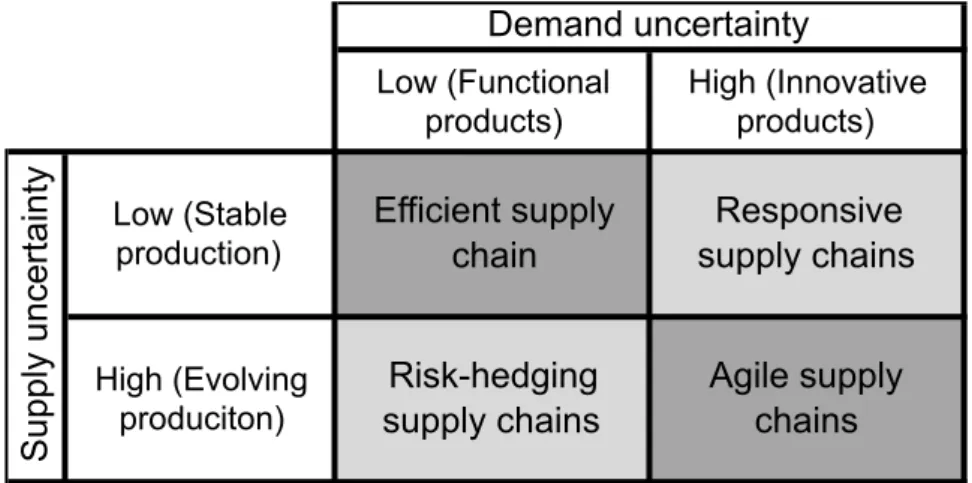
Tompkins et al. (2010, p. 292) state “A facilities layout strategy should emerge from the overall strategic plan”. The focus on the corporate strategy is further supported by Rouwenhorst et al. (2000) who argue for the importance of the top-‐down approach in warehouse layout design to avoid a suboptimal final solution. Demand and supply characteristics affect the material flow in and out of the warehouse. These characteristics are largely determined by the warehouse placement in the supply chain network. (Lee, 2002; Frazelle, 2002) Fisher (1997) states that it is of key concern to understand the demands that the product puts on the supply chain and align the supply chain thereafter. In figure 2.2. a variant of the Fisher-‐matrix developed by Lee (2002) is shown. The figure has two axes; demand uncertainty and supply uncertainty. Depending on the combination of demand and supply uncertainty different types of supply chains are needed. For example companies with low demand uncertainties, with functional products, and low supply uncertainty, stable production, can benefit from an efficient supply chain.
Figure 2.2. Matching of supply and demand uncertainties and supply chain strategy. Based on Lee (2002).
Low (Functional products) High (Innovative products) Low (Stable production)
Efficient supply
chain
Responsive
supply chains
High (Evolving produciton)Risk-hedging
supply chains
Agile supply
chains
Demand uncertainty
Su
pp
ly
un
ce
rt
ai
nt
y
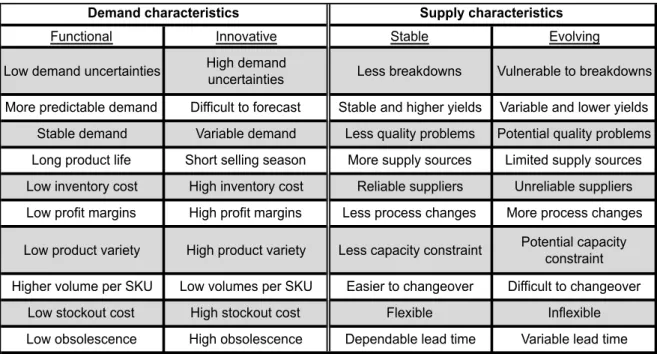
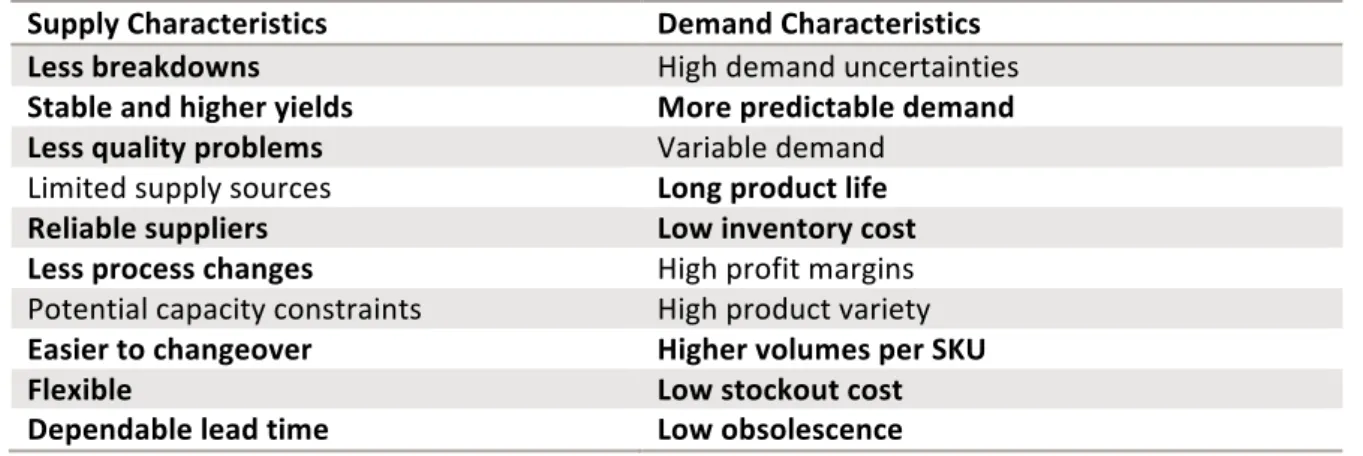
To characterize the demand and supply there are number of parameters that can be taken into consideration when identifying the products and the production. The supply and demand characteristics are shown in table 2.1. as proposed by Lee (2002). In demand the low uncertainties come from functional products and high uncertainties from innovative products. Within supply the low uncertainties come from the stable supply and the high uncertainties from evolving production.
The warehouse role, power and placement in the supply chain need to be considered as aspects in warehouse design to ensure that the warehouse is not designed for suboptimal conditions or to support a different type of supply chain. These aspects are decided in the supply chain strategy. A warehouse can have many different placements in a supply chain network. (Frazelle, 2002) The placement in the network affects the supply and demand uncertainties. The longer the distance from the end customer the more significant is the demand volatility, often referred to as the bullwhip effect. The bullwhip effect causes larger variations in the demand for every upstream actor regarding both ordered amounts and number of orders. The same goes for the supply uncertainty which is increasing with the distance from production. (Lee et al., 1997) Experience and resources are constraints that can affect the ultimate choice of strategy. (Selldin & Olhager, 2007) Fast growing companies are affected by these constraints as the experience on expanding and bigger operations within the company can be limited. Further, the constraints are especially distinguishable if the company is growing faster than the acquiring of resources, both regarding employees and investments. Selldin and Olhager (2007) discuss that many companies might not have the power to design their own supply chain but must adapt to an up-‐ or downstream actor in the supply chain network. The power of each actor in the supply chain is often determined by the size of the actors’ purchasing power or uniqueness. (Edgren & Skärvad, 2014)
Functional Innovative Stable Evolving
Low demand uncertainties High demand
uncertainties Less breakdowns Vulnerable to breakdowns More predictable demand Difficult to forecast Stable and higher yields Variable and lower yields
Stable demand Variable demand Less quality problems Potential quality problems Long product life Short selling season More supply sources Limited supply sources Low inventory cost High inventory cost Reliable suppliers Unreliable suppliers Low profit margins High profit margins Less process changes More process changes Low product variety High product variety Less capacity constraint Potential capacity
constraint Higher volume per SKU Low volumes per SKU Easier to changeover Difficult to changeover
Low stockout cost High stockout cost Flexible Inflexible
Low obsolescence High obsolescence Dependable lead time Variable lead time
Demand characteristics Supply characteristics
Warehouse Design Aspects
The type of warehouse is determined by the objective of the warehouse. The three types of warehouses are distribution, production and contract warehouses. Distribution warehouses can either consolidate units handled within the warehouse, SKUs (Stock Keeping Units), from different suppliers or break-‐up unit loads to distribute smaller quantities. Local and regional warehouses that have the purpose to fulfill customer orders are seen as distribution warehouses. Production warehouses handle raw material, work in progress and finished goods and often have significantly fewer inflows than outflows. (Rouwenhost et al, 2000; Gu et al., 2010) Additionally, van den Berg and Zijm (1999) describe contract warehouses, which is warehouses run by a 3PL provider. As shown in table 2.2, the warehouse types are differentiated by the purpose, warehouse characteristics and common design criteria.
The design criteria commonly used for the different warehouse types can be used in trade-‐off situations in the design process. Design criteria can be viewed as the performance measurements of the warehouse design. The design criteria should be determined in the initial steps of the design process and used for evaluation in the last steps where the preferred solution is identified. (Gu et al., 2010) Decision criteria for warehouse design consider both the warehouse facility design and the operations within the warehouse (Rouwenhorst et al., 2000; Gu et al., 2010). Minimizing operational cost in a warehouse is a design criterion present for both distribution and production warehouses. The cost tends to focus primarily on minimizing the required work force. (Rouwenhorst et al., 2000). For contract warehouses the design criterion to minimize double handling is based on the same grounds as its aim is to minimize non-‐value adding labor which will reduce operational cost. The main difference between a distribution and a production warehouse is the focus on maximum throughput or storage capacity. A contract warehouse has a large inventory turnover and have unpredictable demand which leads to an increased importance of flexibility towards changes in volume and product mix. (van den Berg & Zijm, 1999) Frazelle (2002) states that due to changes in the business climate the warehouse role in the supply chain network is changing why flexibility has become a success factor for all warehouses.
A warehouse can play different roles at the same time in a supply chain. In small companies it is common that production warehouses fulfill external customer orders which means that the warehouses also functions as distribution warehouses. Some companies rent out overcapacity to other companies which would make the warehouse partly contracted. These hybrid warehouses commonly have mixtures between the purposes, warehouse characteristics and design criteria. (Bartholdi & Hackman, 2014; Frazelle, 2002)
2.1.2. Storage Handling Unit Effect on W arehouse Design
In a supply chain, products are often handled in units of decreasing quantity with each node in the network that is visited. From production, finished products are packed in the largest handling unit down to the retail store where consumers purchase single articles (Bartholdi & Hackman, 2014). For this reason, the packaging system of a product is often divided into three levels, tertiary, secondary and primary package. Each level of packaging consists of a number of lower-‐level packages. Tertiary package is the largest handling unit of the product and is often a shrink-‐wrapped pallet or a roll cage. The secondary package, often referred to as retail package, is typically a carton, case, tray or simply plastic shrink film around a certain amount of individual products. The primary package, often referred to as consumer package, is the packaging that is closest to the product. The product is unitized in amounts and sizes that the end consumer demands. (Saghir, 2004) Within a warehouse products are handled in these different units but is then often called storage handling units. In warehouse literature and research the three different packaging system levels are often mentioned as the pallet, case and piece. Where a pallet load is the largest standardized material handling unit and a piece is the smallest unit handled. Figure 2.3. shows an example of a product’s handling unit levels as the packaging system levels are named in warehousing literature. The carton is the equivalent of secondary packaging and unit pack is equivalent for the primary packaging. (Rouwenhorst et al., 2000) WAREHOUSE
TYPE PURPOSE WAREHOUSE CHARACTERISTICS COMMON DESIGN CRITERIA
DISTRIBUTION Fulfill external customer orders
Large number of SKUs.
Quantities per order line small. Complex picking process. Often optimized for cost efficient picking. Maximum throughput, minimal investment and operational costs. PRODUCTION
Store raw material, work in progress and finished products associated with a manufacturing process.
SKUs are in storage for long period of time. Inexpensive storage systems. Bulk storage. Few orders with many order lines or large quantities per order line. Storage capacity, minimal investment, operational cost, response time
CONTRACT, 3PL Provide warehousing as a service to customers.
Standardized storage system. Unpredictable demand.
Minimize double handling, maximum throughput, volume and mix flexibility.
Warehouse Design Aspects
Each handling unit can be a SKU in a warehouse. This means that the same kind of product can be considered as several types of SKUs, one for each level of handling unit. The handling units in a warehouse will determine the need of equipment as well as require different types of operational strategies and warehouse layout formations. (Bartholdi & Hackman, 2014; Rouwenhorst et al., 2010)
Considering handling units, warehouses can be differentiated as unit load warehouses and break-‐up warehouses which breakup storage handling units to the next, lower level. Unit load warehouses handle only one type of handling unit in the warehouse and is therefore receiving and shipping the same level of the packaging system. This is typical for cross docking and for production warehouses. Break-‐up warehouses receive a higher level of handling unit and ships lower level units consolidated into orders in either cartons or pallets. A common example of break-‐up warehouses is distribution warehouses. In a unit load warehouse only one type of handling equipment is needed while in a break-‐up warehouse there is a potential need for different kinds of equipment as orders are consolidated. (Bartholdi & Hackman, 2014)
2.1.3. W arehouse M aterial Flow Effect on W arehouse Design
The traditional view of warehousing, that its mission is to store, reconfigure and shorten lead times, has been challenged and become more complex. The process flow within a warehouse can be described in six primary activities shown in figure 2.4. Lately ancillary activities have been allocated to the warehouses. Among the ancillary activities are handling of returns, repacking and final assembly from production. Due to the changing nature of the ancillary activities the placement in the process flow can be questioned. The following section describes the activities within the warehouse process.
Figure 2.3. Handling units in a warehouse (Bartholdi & Hackman, 2014)
Receiving Put-away Storage Picking Ancillary activites Packing Shipping
The receiving is the first activity that an arriving SKU encounters. Receiving includes receiving order receipt from sender, quality control, inspection of goods, giving it a storage location assignment and, sometimes, labeling of the SKU. (Bartholdi & Hackman, 2014) To be able to handle the incoming goods, docks must be available for incoming trucks or other vehicles as well as available floor space for the receiving activities.
In the put-‐away the SKU is moved to the assigned storage location. As well as putting the item away, it must also be recorded what amount and where the item is moved. In put-‐away the highest level of storage handling unit is handled. This often means full pallet loads which means that the equipment being able to handle pallets are a necessity as well as space as in aisles to access storage locations. If the put away regards cartons it is often possible to handle them manually or with conveyor belts. (Bartholdi & Hackman, 2014)
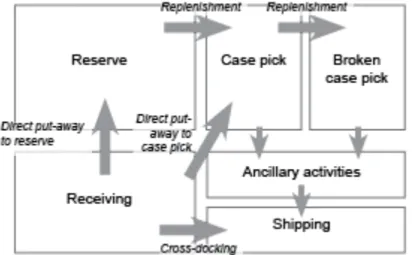
It is easy to believe that the main activity in a warehouse is the storage activity however there are more activities conducted in a warehouse. With more activities comes a more complex flow as shown in figure 2.5. The warehouse activities are visualized in the figure where the arrows are activities including a movement of a SKU. The squares represent activities that have space dedicated to it. The storage areas in figure 2.5 are the reserve, case pick and broken case pick. In the reserve area SKUs are stored in the highest level of handled storage unit often in pallet or other bulk storage. The areas dedicated case pick and broken case pick are often called forward pick areas. The forward pick area is defined as the areas where SKUs are stored for easy retrieval of picking unit. They are often placed to minimize travel to and within the forward pick areas to increase picking speed and reduce labor cost. The forward area can contain any handling unit thus only focusing on the turnover of the SKUs, not only case or broken case. The reserve and the forward pick area are sometimes placed as different types of departments within the warehouse. It is common for warehouses handling pallet loads and cases to have the floor level in the pallet rack as the case picking area and the upper levels in the rack as reserve. Which SKUs are stored in the forward pick area can be determined by the number of times the SKU is requested as well as the cubic flow of the SKU.
The storage essentially consists of the physical containment of the SKUs. To facilitate and increase efficiency in the warehouse it can be divided into several departments with different kinds of storage systems dedicated to different types of SKUs. (Gu et al., 2007) Frazelle (2002) describes a concept, warehouse within a warehouse, shown in figure 2.6, where a common receiving, shipping and reserve area serves a fragmented storage area. The SKUs have been
Warehouse Design Aspects
divided into groups or product families. The groupings of SKUs can be based on the product requirements, popularity, storage handling unit or company if in a 3PL warehouse. Ideally the received SKU is stored in one place until it is demanded and picked up for the next activity in the warehouse. However, the SKU can be moved to another storage location to avoid honeycombing or to conduct replenishment from a reserve area. (Tompkins et al., 2010; Accorsi et al., 2013). The efficiency of the equipment setup in a warehouse, combination of racks and material handling equipment, can be measured as storage density. The storage density is the floor space required per pallet position with the setup.
Connecting the storing of goods to the picking activity is the dispatching of SKUs. Dispatch policies are commonly researched within manufacturing and queuing theory. (Howard & Marklund, 2011; Lee, 2006) A warehouse can be modeled as a queuing system where SKUs arrive to the queue and are stored until they are and dispatched and shipped in a certain order. (Bartholdi & Hackman, 2014) The dispatching policy used in a warehouse is determined either by optimizing operating costs or by the products characteristics. Most warehouse research considers a Last-‐in-‐first-‐out (LIFO) policy as it is often convenient when handling material in a model. However, it is not often the case in reality as most warehouses handling consumer goods needs to ensure freshness of products. In this case a First-‐in-‐first-‐out (FIFO) policy is a more accurate policy. (Lee, 2006) A similar policy to FIFO is First-‐Expired-‐First-‐Out (FEFO), which also is common when handling perishable or fresh goods (Bartholdi & Hackman, 2014).
Order picking is the activity where units are moved from the storage for a customer order. Picking is the activity around which many warehouses are designed. Gu et al. (2007) state that managing the order picking process requires organization of the orders to be picked and of the material handling operations of the picking. Order picking is either labor intensive or investment intensive depending on the equipment and type of dispatch policy used. When considering picking equipment one can differentiate among pick-‐to-‐person and person-‐to-‐pick type of equipment. To reduce warehouse labor or travel time for pickers, which is the most labor intensive parts of the picking activity, equipment that transport the items to the picker can be introduced in the warehouse such as conveyor belts or AS/RS systems (Gu et al., 2007). However, these systems are often expensive and inflexible as they are expensive to change (Bartholdi & Hackman, 2014). Order picking is conducted for different storage handling units such as pallet picks, carton picks and piece picking. The different types of unit picks require different material handling equipment, routes and design of racks and warehouse layouts. The
storage handling unit picked in combination with the equipment choice determine the number of items that can be picked in one route. If multiple picks per route are feasible the length of the route will be affected by aisle configuration as a multiple picks route depend highly on the location-‐to-‐location distance. (Roodbergen et al., 2014) Picking pallets or other large unit load sizes often means a single pick per route. This means that the main part of travels go from the ports to a storage location back to the ports. To reduce dead heading, the times equipment travels without load, dual commands can be introduced which means that a route would consist of one put-‐away and one pick action. This would lead to travel between pallet locations in every cycle. For location-‐to-‐location and ports-‐to-‐location different types of aisle configurations are optimal. (Bartholdi & Hackman, 2014)
An increasing trend in the supply chain is to postpone activities to reduce bounded capital and risk for obsolete inventory. This has led to an increased amount of ancillary activities being conducted within warehouses such as labeling, kitting, packing, repairs and assembly. The ancillary activities affect the layout of a warehouse as they often require space and special equipment. (Tompkins et al., 2010; Bartholdi & Hackman, 2014; Twede et al., 2000) When determining the objective of the warehouse the ancillary activities and services that the warehouse should provide must be considered. When designing the layout the process flow in the warehouse and all activities need to be taken into consideration when allocating space to workstations to minimize wasted time for transporting SKUs around the warehouse.
After picking and/or any ancillary activities the SKUs need to be packed according to the customer order. The packing process can include a sorting element and a check for order completeness which can require special equipment or space. Packing of an order looks different depending on the handling unit of the SKUs. Packing in a unit-‐load warehouse might consist of putting all the pallets in one order in one lane on the shipping square. While carton or piece picking activities might incur packing products on pallets, into cartons or a combination of the two. (Bartholdi & Hackman, 2014) Depending on the packing process, different amounts of space dedicated to packing and packed goods must be allocated.
The shipping activity in a warehouse is the interface for outgoing material flow (Gu et al., 2007). The activity consists of allocating gates for arriving trucks or other vehicles used for transportation to customer, ensuring that the right goods is shipped and register the SKUs departure from the warehouse registry. Research on the shipping activity is limited. However, just like for the receiving activity floor space is required for the shipping activity to ensure efficient material handling and to avoid congestion and delayed shipments. (Bartholdi & Hackman, 2014; Gu et al., 2007)
2.1.4. Dem and Pattern and Allocation Policy Effect on W arehouse Design
When planning a warehouse it is important to consider the space required for all processes in the warehouse. The space requirements for the processes are determined from careful consideration of the current activity profile in the warehouse and the growth expectations of the company. (Rouwenhorst et al., 2000; Gu et al., 2010) In research on frameworks for warehouse design the importance of designing a warehouse capable of accommodating future growth expectations of the company is mentioned. (Rouwenhorst et al., 2000; Gu et al., 2010) However, books, case studies and other more practical literature fail