Available online on 10.01.2019 at http://jddtonline.info
Journal of Drug Delivery and Therapeutics
Open Access to Pharmaceutical and Medical Research© 2011-18, publisher and licensee JDDT, This is an Open Access article which permits unrestricted non-commercial use, provided the original work is properly cited
Open Access
Research Article
Formulation and evaluation of new polyherbal germicidal toothpaste
containing ajwain oil
Namrata Omhare, Sanjay Dhakad, Bharti Pathak NRI Institute of Pharmaceuticals Sciences, Bhopal, India
ABSTRACT
The main object of the present research is to provide a formulation useful as natural herbal tooth paste which obviates the drawbacks of the earlier tooth pastes.And its to provide a good tooth paste which can give effective protection to teeth and free them from any toxicity or toxic residue and irritation when regularly used. It should be cosmetically acceptable having pleasant odour and should not leave stain on teeth or fingers after use. Brightening the teeth by removing stains would be a prerequisite of the formulation.Still another object of the present invention is highlight the potential of extract of ajwain seed in inhibiting the activity of Streptococcus mutans bacteria which are major cause of dental caries. The study attributed presence of naphthalene derivative responsible for such protective antibiofilm activity. Ajwain oil is proven to cure tooth pain. Along with equal parts of clove oil and water, it is used as home remedy to floss mouth and treat tooth ache, bad breath and tooth decay.
Keywords: Halitosis, Gingivitis and Periodontitis
Article Info:Received 17 Oct 2018; Review Completed 26 Dec 2018; Accepted 29 Dec 2018; Available online 10 Jan 2019 Cite this article as:
Omhare N, Dhakad S, Pathak B, Formulation and evaluation of new polyherbal germicidal toothpaste containing ajwain oil, Journal of Drug Delivery and Therapeutics. 2018; 8(6-A):80-84
*Address for Correspondence:
Namrata Omhare, NRI Institute of Pharmaceuticals Sciences, Bhopal, india
INTRODUCTION
Toothpaste is a common product in our families and people hardly care to know about the product which ‘they are using. Toothpaste is an agent used as an effective home care system. It is a paste or gel dentifrice used with a toothbrush as an accessory to clean and maintain the aesthetics and health of teeth by the patients to enhance oral hygiene. Toothpaste is used to promote oral hygiene. Although, brushing teeth twice a day and daily flossing is highly effective in plaque reduction, over 50% of adults have gingivitis on an average of 3 to 4 teeth. Bacteria in dental plaque are one of the main factors causing periodontal inflammation therefore, careful plaque control is very important. However, mechanical plaque removal is inadequately performed by most members of the population. The need for additional help in controlling bacterial plaque provides the rationale for patients to use antimicrobial dentifrices in addition to their mechanical oral hygiene regimens. What many people don’t know is that most of the branded toothpastes contain a number of ingredients that are not healthy for the people or the environment. Bleach and peroxide are commonly used as whitening agents in commercial toothpastes. But both bleach and peroxide can be an irritant to the mouth and skin in small doses and are considered to be hazardous materials because they can cause severe chemical burns in large doses. Artificial flavourings and scents are commonly made
from synthetic chemicals derived from petrochemicals or coal tar.. Commercial toothpaste ingredients also affect the environment. EDTA (ethylenediaminetetraacetic acid) and formaldehyde are commonly used a preservatives in toothpaste and many other cosmetics and personal care products. They are known environmental pollutants. MATERIALS
Collection of fruits the fresh apple fruits, lemon fruit, orange fruit, banana fruit, was collected from Reliance Fresh, narela, Bhopal in the month of October 2015. The peels of the fruits were taken off using a peeler. Orange peel, Lemon peel, Clove oil, Apple peel,Ajwain oil
METHODOLOGY
Before the formulation, the both drugs was evaluated for purity and preformulation study
Maceration Process: This simple widely used procedure
5.3. Extraction Of volatile Oil by Clevenger Apparatus- 50gm of accurately weighed powdered drug has taken in 1 litre distillation flask together with 250ml of water. Added a few pieces of porcelain to it order to avoid bumping during distillation. Kept the distillation flask on the heating mantle and set the distillation assembly. Filled the graduated receiver with water avoiding any air bubbles. Turned the heat on and continued distillation for four hours at a rate which keeps the lower end of the condenser cool. Then allowed the distillate to be collected in the graduated receiver in which the aqueous portion of the distillate is automatically separated and returned to the distillation flask. Measured the volume of volatile oil which separates out as the upper layer in the graduated tube and calculated the % v/w on a dry weight basis.
Determination of percentage yield: The yield of each extract was calculated by using following formula.
% yield = (Weight of extract/ Weight of powder)*100 Phytochemical investigation
Test for flavonoids
Shinoda test: 5ml of (95%v/v) ethanol was added in the extract and then few drops of concentrated HCl and 0.5g mg turnings were added. Pink colour shows presence of flavonoids.
5.5.2. Test for phenolic compounds and tannins
5% FeCl3 solution: To filtrate few drops of Fecl3 solution
was added which give dark blue or greenish black colour. 5.5.3Test for glycosides
Legals test: To hydroalcohalic extract, add 1 ml pyridine
and 1ml sodium nitroprusside. Pink to red colour appears. Test for deoxysugars (keller-killiani test): To 2ml extract add glacial acetic acid one drop 5% FeCl3 and conc. H2SO4. Reddish brown colour appears at junction of the two liquid layers and upper layer appear bluish green.
Test for saponin
Foam test: Shake the drug or dry powder vigorously with water. Persistence foam observed.
Test for alkaloids
Dragendorffs test: To 2-3 ml filtrate add few drops of
drangendorff reagent. Orange brown precipitate is formed. 5.6.1. Composition:
1. Apple peel extract: 2.5g
2. Orange peels extract 2.5g
3. Lemon peels extract 2.5g
4. Ajwain oil 2ml 5. Clove oil 1ml
6. Sodium benzoate 0.5g
7. Tween80 0.5ml 8. Carbapol940 0.5g
9. Saccharine sodium 0.5g
5.6.2. Procedure
2.5 g of the apple peel extract, 2.5g of orange peel extract, 2.5 g of lemon peel extract were mixed and triturated with 2.5g of carbopol 940 and 0.5g of sodium benzoate were added as a preservative in a mortar and pestle. To it 1 ml of Tween 80 was added to remove the stickiness and further 0.5 ml of glycerine was added triturated well, to the above content 50 ml of demineralised water was added and finally made up to 50 g. pH was adjusted with a solution of sodium hydroxide. Ajwain oil was added for microcidal property and Clove oil was added at last to mask the bitter taste and
to give anti‑inflammatory effect .Added 0.5g Saccharine
Sodium as a sweetening agent.
Evaluation Parameters of Tooth Paste 5.7.1. Organoleptic evaluation Colour- yellowish-brown Odour- characteristics
Taste- aromatic and characteristics 5.7.2. Physico-Chemical Tests Limit test for heavy metals
Limit test for heavy metals (Lead, arsenic) was performed by comparing the test sample against standard.
Standard solution prepared by taking 2ml standard lead solution and dilute to 25ml with water. Adjust the pH between 3-4 by using either dilute acetic acid or dilute ammonia solution. Make up the volume to 35ml with water. Test solution is prepared as directed in the individual monograph. Take 25ml and adjust the pH of the solution between 3 to 4 by using dilute acetic acid or dilute ammonia and adjust the volume to 35ml with water.
To each of the Nessler cylinder containing standard and test solution, added 10 ml of freshly prepared hydrogen sulphide solution, mixed, diluted to 50ml with water and allowed to stand for 5min. The colour when viewed downwards over white surface should not be darker for test than standard solution.
Shape retention property
For the evaluation of shape retention property Tooth paste was squeezed out from the tube and put entirely of a tooth brush and the state of the toothpaste after it was allowed to stand for 10 seconds was evaluated based on the below- described criteria;
Grade A): Shape just after the toothpaste is squeezed out on the toothbrush is maintained.
Grade B): Shape just after the toothpaste Is squeezed out on the toothbrush is almost maintained.
Grade C): The toothpaste squeezed from the toothbrush and cannot maintain its shape.
Moisture content:
Toothpaste (10 gm) weighted and dried it in the oven at 105 C then it was cooled. The loss of weight is recorded as percentage moisture content and calculated by the given formula.
Threading property
The threading property of each toothpaste when it was squeezed out on the entirely of a toothbrush and slowly pulled up was evaluated based on the below-described criteria.
Evaluation criteria of threading property;
Grade A): The toothpaste can be put on a toothbrush smoothly without threading.
Grade B): The toothpaste can be put on a toothbrush smoothly, though it caused slight threading.
Foaming Power
You have paste in your mouth and it does not create foam… In order to test the foaming ability of herbal toothpastes, a specific amount of toothpaste was taken in the measuring cylinder. The paste in the cylinder was then mixed with 100 millilitres of water and shaken. The quantity of foam formed in the measuring cylinder was considered as the toothpaste’s ability to create foam. pH Levels (measure of acidity)
The pH of toothpaste should be neutral or nearer to neutral. It is required to remain well within 5.5– 10.5 units.
Determination of pH- The net quantity of 5 gm of sample was accurately weighed and placed in a 150 ml beaker. To this 45 ml of freshly boiled and cooled water was added at 27°C. It was stirred well to make a thorough suspension. The pH was determined within 5 minutes by using pH meter.
Gritty Matter
(Tested on butter paper) This test was done to check the presence of solid particles in the paste. In order to find gritty matter, a small amount of toothpaste was rubbed onto a piece of butter paper. The number and intensity of scratches that appear on the butter paper help in judging the presence of solid particles. The test was important as
regular usage of toothpaste with gritty matter can wear off the teeth in the long run.
Antimicrobial study of formulation
The antibacterial activities of test formulation and marketed herbal formulation were determined by modified agar well diffusion method. In this method, nutrient agar plates were seeded with 0.2 ml of 24 h broth culture of oral flora. The agar plates were allowed to solidify. A sterile 8 mm borer was used to cut wells of equidistance in each of plates. 0.5 ml of formulations or herbal extract was
introduced into the well. The plates were incubated at 370C
for 24 hours. . The antibacterial activity was evaluated by measuring the zones of inhibition (in mm).
RESULTS AND DISCUSSIONS
1. Percentage Yield:
Table 1: Percentage yield of alcoholic extract of apple peels, orange peels and lemon peels.
S. No Extract % Yield
1 Alcoholic extract of apple peel 8.7g
2 Orange peel 9.8g
3 Lemon peels 8.57g
2.Phytochemical screening:
Table 2: Results of Phytochemical screening of Hydro alcoholic extract of apple peels.
S no Phytoconstituents Hydro alcoholic extract
1. Tannins and phenolic compounds +
2. Flavonoids +
3. Tests for glycosides -
4. Tests for saponins +
5. Tests for alkaloids +
Table 3: Results of phytochemical screening of Hydro alcoholic extract of orange peels.
S NO Phytoconstituents Hydro alcoholic extract
1. Tannins and phenolic compounds +
2. Flavonoids +
3. Tests for glycosides -
4. Tests for saponins +
5. Tests for alkaloids +
Table 4: Results of phytochemical screening of Hydro alcoholic extract of lemon peels
S NO Phytoconstituents Hydro alcoholic extract
1. Tannins and phenolic compounds +
3. Tests for glycosides -
4. Tests for saponins +
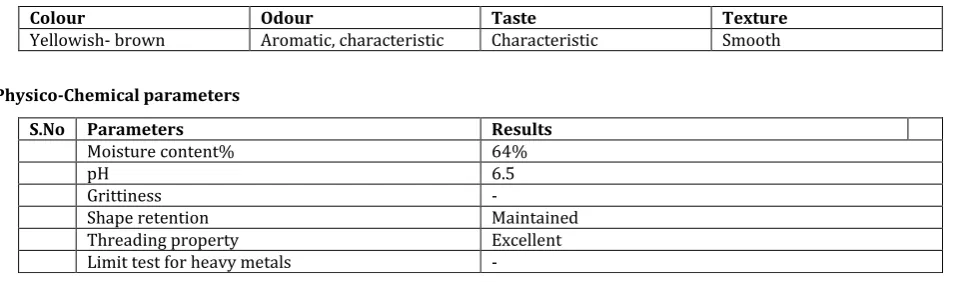
Evaluation Parameters of Tooth Paste Organoleptic evaluation
Colour Odour Taste Texture
Yellowish- brown Aromatic, characteristic Characteristic Smooth
Physico-Chemical parameters
S.No Parameters Results
1. Moisture content% 64%
2. pH 6.5
3. Grittiness -
4. Shape retention Maintained
5. Threading property Excellent
6. Limit test for heavy metals -
Antimicrobial activity of formulation
Figure 1: Inhibition zone photograph of oral flora based on agar well diffusion assay for the herbal test formulation and
herbal marketed formulation.
Healthy teeth are fundamental for the proper function of human body. Proper and regular hygiene is required to prevent dental problems. In allopathic, the treatment of dental problem is highly expensive and cannot be offered by poor people. Hence they use natural alternative methods since their so many generations for their oral hygiene. A study effort has been made for preparing new Polyherbal toothpaste by combining the active constituents of the different extracts to for tooth decay.
For the present study, ajwain oil, clove oil, apple, lemon, orange were subjected for extraction and these extracts were used for the new polyherbal toothpaste with anti-microbial efficacy. The extracts of ajwain oil, clove oil, and apple, lemon, and orange, peels were studied for the phyto constituents present in them, then formulated polyherbal tooth paste and evaluated.Organoleptic characters like appearance, colour, texture, after taste.
Evaluation of formulation was done on the basis of grittiness, moisture content, limit test for heavy metals, pH and foaming power parameters.
Microbial study of herbal marketed formulation and new poly herbal toothpaste was evaluated by determination of zone of inhibition in nutrient agar plates seeded with broth culture of S.mutans. It was found that the polyherbal toothpaste showed promising results, similar to marketed formulation.
Hence, the polyherbal toothpaste formulated is of much advantage when compared to the marketed toothpaste.
CONCLUSION
A study effort has been made for preparing new polyherbal toothpaste by combining the different fruit peel extracts against organism causing dental caries and infection. For the present study apple, lemon, orange ajwain, and clove were subjected for the antimicrobial activity. Finally the polyherbal toothpaste was tested for the antibacterial activity and was compared with commercial toothpaste the result shows significant antibacterial potency for the polyherbal toothpaste for commercial use.
REFERENCES
1 Abhay S, Dinnimath BM, Hullatti KK, formulation and spectral analysis of new poly herbal toothpaste, Journal of Drug Delivery & Therapeutics. 2014; 4(6):68-74
2 Abhay S, Dinnimath BM. Formulation and evalution of new polyherbal toothpaste for oral care. Indian j health sci 2015; 8:24-7.
3 Golpar Radasfhar, Faranak Mahboob and Ehsan Kazemnejad. A study to assess the plaque inhibitory action of herbal- based toothpaste: A double blind controlled clinical trial. Journal of Medicinal Plants Research, 2010; h(12):1182-1186.
4 Pramod Kumar, Shahid H. Ansari and Javed Ali, Herbal Remedies for the Treatment of Periodontal Disease- A patent Review. 2009, Bentham Science Publishers Ltd. 3,221-228, 5 Kokate CK, Practical Pharmacognosy 4th edition, Vallabh
Prakashan, reprint 2003, AP-53A.
6 Banani R. Chowdhury, Arnav Garai, Madhuparna Deb, Souptik Bhattacharya, Herbal Toothpaste – A possible remedy for oral cancel. Banani R. Chowdhury, et al,./Journal of Natural Products, 2013; 6: 44-55.
7 Claudio Mendes Pannuti, Joyce Pereira de Mattos, Paula Nini Ranoya, Alberto Martins de Jesus, Roberto Fraga Moreira Lotufo, Giuseppe Alexandre Romito, Clinical effect of a herbal dentifrice on the control of plaque and gingivitis, A double- blind study, Pesqui, Odontol, Bras, vol 17 no. 4, Sao Paulo Oct./Dec. 2003.
8 Fabiana Ozaki, Claudio Mendes Pannuti, Ana Vitoria Imbronito, Wellington Pessotti, Luciana Saraiva, Nivea maria De Freitas, Graziella Ferrari, Veronica Neto Cabral, Efficacy of a herbal toothpaste on patients with established gingivitis- A randomized controlled trial. Braz. Oral res. Vol. 20 no. 2 Sao Paulo Apr./ June 2006.
9 Md. Nazrul Islam Bhuiyan, Jaripa Begum, Nemai Chandra nandi and Farhana Akter, Constituents of the essential oil from leaves and buds of clove ( Syzigium caryophyllatum(L.) Alston). African Journal of Plant Science. 2010; h (11):451-454.
10 Saini N, Singh GK, Nagori BP. Physicochemical Characterization and spasmolytic activity of essential oil of ajwain (Trachyspermum Ammilinn.) from Rajasthan.
Gorakhpur-273009, India, and Instituto de Qulmica, Organica Universidad Nacinal de Tucuman, Ayacucho 471, S.M. de Tucuman 400, Argentina.
12 Balwant Rai, Associate Professor, Kepler Space Institute, USA, Herbal Formulation (Tooth Paste) as Anti-Precancerous Properties, February 01, 2015, Accepted Date: February 02, 2015, Published.
13 Kokate CK, Purohit A P, Gokhale SB. extraction method. Text Book of Pharmacognosy, 47th ed. Vol. 2. Nirali Prakashan; 2004. P.3.3.
14 G. Samuelsson; Drugs of Natural Origin - A Textbook of Pharmacognosy; Swedish Pharmaceutical Society, Swedish pharmaceutical Press: Stockholm, Sweden, 2004; 5th rev. ed. 15 Satyajit D. Sarker, Zahid Latif, Alexander I. Gray;Natural
Products Isolation book;Totowa, New Jersey,2005;2nd ed. 16 Supelco Bulletin 910: Guide to Solid Phase Extraction; 1998 17 Sachinkumar Vasantrao Patil Jadge D. R Purohit R. N.
Formulation of toothpaste from various forms and extracts of
tender twigs of neem Journal of Pharmacy Research 12/2008; 1(2):148-152.
18 Khan R1, Zakir M, Khanam Z, Shakil S, Khan AU, Novel
compound from Trachyspermum ammi (Ajowan caraway) seeds with antibiofilm and antiadherence activities against Streptococcus mutans: a potential chemotherapeutic agent against dental caries . Accepted 2012 May 8.
19 Priti D. Diwan, Yashashree A. Gadhikar, Shrikant B. Jain, Traditional Ethnomedicinal Plants Used for Oral Health Care by Tribals of Melghat Region, Dist. Amravati (M.S.), India Department of Zoology, Govt.Vidarbha Institute of Science and Humanities, Amravati, M.S., India. Accepted on: 28-04-2013; Finalized on: 30-06-2013.