ISSN (e): 2250-3021, ISSN (p): 2278-8719
Vol. 08, Issue 4 (April. 2018), ||VIII|| PP 01-08
Review on Evolutionary Computing Techniques in Power
System for Economic Load Dispatch
Leena Daniel
1, Dr.KrishnaTeerath Chaturvedi
21
PhD scholar UIT RGPV Bhopal (M.P.) India
2Assistant Professor in Department of Electrical Engineering UIT RGPV, Bhopal (M.P.) India,
Corresponding Authors:Leena Daniel
Abstract
:
The prime focus of the concept economic load dispatch (ELD) is one of the main functions of modern energy management system, which determines the optimal real power setting of generating units with an objective to minimize total fuel cost of thermal plants.Soft computing is the approach to artificial intelligence and it has showed an excellent performance in solving the combined optimization problems. In this paper, issues related to the Study of the soft computing techniques are highlighted for a successful application to solve economic dispatch problem, which is a constrained optimization problem in power systems. Economic dispatch problem is a major problem where objective function is highly non-convex, non-linear, non-differentiable and may have multiple limited minima. Therefore, classical optimization methods may not converge or get trapped to any local minima. The purpose of this work is to find out the advantages of application of the soft computing technique to the economic load dispatch problem.Keywords: - Ant colony optimization, bacteria foraging optimization, economic dispatch, evolutionary algorithm, genetic algorithm
---Date of Submission: 12-04-2018 Date of acceptance: 30-04-2018 ---
I.
INTRODUCTION
The basic object of the electrical power system is to perform the operation with maximum reliability limits with minimum production cost Economic Dispatch (ED) is defined as the process of allocating optimal power generation levels to each of the generating units in the station, so that the entire supply demand can be meet in a most economically manner. In case the load is fixed (i.e. static economic dispatch), the objective is to calculate, for a single period of time, the output power of every generating unit .Unfortunately the load of a power system is always changing, so the generators correspondingly respond i.e. with increase in the load the generator produces more power and vice-versa. This entails for optimal allocation of generators participation in sharing the load at the current interval of time to meet the forecasted load demand for the same interval. As per our definition, economic load dispatch is a means that allows the generators active power to vary within coordinate. The objectives of this study are as follows
1. To minimize the generation cost
2. To minimize the total power loss in the Power System network, 3. To minimize the voltage (and/or current) deviations, and 4. To maximize the quality of the power supplied to the customers
Dynamic programming rise difficulty from curse of dimensionality. Many of the traditional optimization methods required derivative information of the objective function to find the search track. But actual fuel cost functions are non-linear, non-convex and non-differentiable because of ramp rate limits, prohibited operating zones, valve point effects and multi-fuel options. Recently some heuristic techniques such as genetic algorithm [43] combined with simulated annealing; evolutionary programming, improved tabu search, ant swarm optimization, artificial bee colony [44] and particle swarm optimization have been used to solve the complex non-linear optimization problem.
II.
ECONOMIC DISPATCH (ED) PROBLEM
Economic Dispatch is the important optimization problems in power system network, which is used to decide the best combination of power outputs of all generating units to diminish the entirety fuel cost while fulfilling various constraints over the whole dispatch periods.[1] The traditional or static ED problem assumes constant power to be supplied by a given set of units for a certain time and attempts to reduce the cost to supply this energy subject to constraints on the static behavior of the generating units like system load demand. Shortly, static ED determines the loads of generators in a system that will meet a power demand during a single scheduling period for the least cost[8][9][13]. Therefore, it might fail to capture large variations of the load demand due to the ramp rate limits of the generators [20][38]. Due to large variation of the customers load demand and the dynamic nature of the power systems, it became necessary to schedule the load beforehand so that the system can predict impulsive changes in demand in the future. Dynamic ED is an extension of static ED to determine the generation schedule of the committed units so that to meet the predicted load demand over the entire dispatch periods at minimum operating cost under ramp rate and other constraints. The ramp rate constraint is a dynamic constraint which used to maintain the life of the generators, i.e. plant operators, to avoid shortening the life of the generator, try to keep thermal stress within the turbines safe limits. Though the violations of the ramp rate limitations are assessed by examining the generators output over a given time period, this problem cannot be solved for a single value of MW generation. The dynamic ED [21] is not only the most accurate formulation of the economic dispatch problem but also the most difficult to solve because of its large dimensionality. The DED difficulty is usually solve by discretization of the total dispatch period into a numeral of small time intervals, in which the load demand is implicit to be constant and the system is considered to be in a sequential steady state. Over each time interval a static ED problem is solved under static constraints and the ramp rate constraints are enforced between the consecutive intervals. In the DED problem the optimization is done with respect to the dispatchable powers of the units [10][12].
III.
MODIFIED TRADITIONAL TECHNIQUE
The conventional forecasting techniques have been customized and modified so that they are capable to robotically correct the parameters of forecasting model under varying environmental situation. Some of the techniques which are the modified version of these traditional techniques are adaptive load forecasting, stochastic time series and support vector machine based techniques. [2]
3.1. Adaptive Demand Forecasting
Demand forecasting model parameters are inherently corrected to keep record of the shifting load conditions. Hence Demand forecasting is adaptive in nature and can also be used as an on-line software package in the utilities control system. Next state vector is estimated using current prediction error and the current weather data acquisition programs [22]. State vector is determined by total historical data set analysis. Switching between multiple and adaptive regression analysis is possible in this mode. The similar model as in the multiple regression section, given below equation is used in this model.
Y (t) = Xt at + et,
Where, t-sampling time, Y(t)- measured system total load, Xt -vector of adapted variables such as light intensity, temperature, time, wind speed, humidity, day type (workday, weekend), etc., at -transposed vector of regression coefficients and et-Model error at time t.
3.2. Stochastic Time Series
3.2.1 Auto Regressive (AR) Model
Auto-Regressive (AR) model can be used to model the load profile, If the load is assumed to be a linear combination of previous loads, which is given by:
Where, Lk is the predicted load at time k (min), ek is a random load disturbance, αi, i =1……m are unknown coefficients and above given equation is the auto regressive model of order m [25].
3.2.2 Autoregressive Moving-Average (ARMA) Model
ARMA model represent the present value of the time series y (t) linearly in terms of its values at prior periods [y(t-1), y(t-2),..] & in terms of previous values of a white noise [a (t), a (t-1)…]. For an ARMA of order (p, q), the model is written as:
y(t) = φ1y(t -1)+…+ φpy(t-p)+a(t)- φ1a(t-1)-…- φq(t-q).
A recursive scheme is used to identify the parameters, or using a maximum-likelihood approach [23, 25].
IV.
SOFT COMPUTING TECHNIQUES
In present research scenario soft computing techniques are very prominent, efficient and effective to deal the complex economic dispatch solutions. It has been very widely in use over the last few decades. A soft computing technique provides a promising approach which runs in parallel with the human mind to find solution and learn from the environment ambiguity and vagueness. It is fast emerging as a tool to help computer-based intelligent systems mimic the ability of the human mind to employ modes of reasoning that are approximate rather than exact. The soft computing constitutes a collection of disciplines which include fuzzy logic (FL) [27], neural networks (NNs) [28], and evolutionary algorithms (EAs) like genetic algorithms (GAs) etc [2]. Natural intelligence is the product of millions of years of biological evolution. Simulating complex biological evolutionary processes may lead us to discover, how evolution propels living systems toward higher level of intelligence. One of the newer and relatively simple optimization approaches is the GA which is based on the evolutionary principle of natural selection. Perhaps one of the most attractive qualities of GA is that it is a derivative free optimization tool.[4] The demand/ load forecasting techniques are also developed based on the following soft computing/ intelligent techniques. The Knowledge-based expert systems have been utilized for this purpose also.
4.1 Genetic Algorithms
The genetic algorithm (GA) [29] [41] or evolutionary programming (EP) approach is used to identify the autoregressive moving average with exogenous variable model for load demand forecasts. By simulating natural evolutionary process, the algorithm offers the capability of converging towards the global extreme of a complex error surface [10]. It is a global search technique that simulates the natural evolution process and constitutes a stochastic optimization algorithm. Since the GA [42] simultaneously evaluates many points in the search space and need not assume the search space is differentiable or unimodal, it is capable of asymptotically converging towards the global optimal solution, and thus can improve the fitting accuracy of the model. The general scheme of the Genetic Algorithm process is briefly described here. The integer or real valued variables to be determined in the genetic algorithm are represented as a D-dimensional vector P for which a fitness f (p) is assigned [30]. The initial population of k parent vectors Pi, i = 1, k, is generated from a randomly generated range in each dimension. Each parent vector then generates an offspring by merging (crossover) or modifying (mutation) individuals in the current population. Consequently, 2k new individuals are obtained. Of these, k individuals are selected randomly, with higher probability of choosing those with the best fitness values, to become the new parents for the next generation. This process is repeated until ƒ is not improved or the maximum number of generations is reached.[8]
4.2 Biogeography-Based Optimization Algorithm (BBO) Technique
habitat is known as emigration. The colonization rate, λ and the evacuation rate, μ of each habitat is used to probabilistically share information with other habitats/solutions. Every result of solution is customized according to probability 𝑃𝑚𝑜𝑑𝑖𝑓𝑦, which is known as the habitat modification probability, based on other solutions. If a any habitat is chosen for modification, then its λ is used to probabilistically come to a decision whether or not to modify each SIV of that habitat. If a particular SIV in a given habitat is selected for modification, then μ of other habitats are used to probabilistically decide which of the habitats should migrate a randomly selected SIV from those habitats to that particular habitat. Unlike other AI techniques where the recombination process is used to generate a completely new solution, the migration operation in BBO is used to bring changes within an existing solution [40]. In order to prevent the best solutions from being changed by the migration process, few elite solutions are kept the same in the consequent iterations. Immigration and emigration rate of particular habitat which contains 𝑛 species is given as
𝜆𝑛 = I (1 –𝑛/𝑁)
μn = En/N
I, E: the maximum immigration and emigration rates respectively.
N: maximum number of species that a habitat can contain.[4]
4.3 Bacteria Foraging Optimization (BFO)
BFO [32][45] method was motivated by the natural selection which tends to eliminate the animals with poor foraging strategies and favor those having successful foraging strategies. The foraging strategy is governed by four processes namely Chemotaxis, Swarming, Reproduction and Elimination & Dispersal [10].
4.3.1 Chemotaxis
Chemotaxis process is the characteristics of movement of bacteria in search of food and consists of two processes namely swimming and Tumbling. A bacterium is said to be swimming if it moves in a predefined direction, and tumbling if it starts moving in an altogether different direction. Let, j be the index of chemotactic step, k be the reproduction step and l be the elimination dispersal event. Let, θi (j, k, l) is the position of ith bacteria at jth chemotactic step, kith reproduction step and lth elimination dispersal event. The position of the
bacteria in the next chemo tactic step after a tumble is given by:
Where
C (i) denotes step size; Δ (i) random vector;
ΔT (i) transpose of vector Δ (i).
If the health of the bacteria improves after the tumble, the bacteria will continue to swim to the same direction for the specified steps or until the health degrades.
4.3.2 Swarming:
Bacteria exhibits swarm behavior i.e. healthy bacteria try to attract other bacterium so that together they reach the desired location (solution point) more rapidly. The effect of Swarming is to make the bacteria congregate into groups and move as concentric patterns with high bacterial density. Mathematically swarming behavior can be modeled as
Where Jcc = the relative distances of each bacterium from the fittest
bacterium, S = number of bacteria, p number of parameters to be optimized, θm position of the fittest bacteria,
4.3.3 Reproduction
In this step, population members who have had sufficient nutrients will reproduce and the least healthy bacteria will die. The healthy and better population replaces an unhealthful bacterium which gets removed owing to their poor foraging abilities. This makes the population of bacteria constant in the evolution process [33][34].
4.3.4 Elimination and Dispersal
In the evolution process a sudden unforeseen event may drastically alter the evolution and may cause the elimination and/or dispersion to a new environment. abolition and diffusion helps in dropping the behavior of stagnation i.e. being ensnared in a impulsive solution point or local optima[32-34].
4.4. Ant Colony Optimization (ACO)
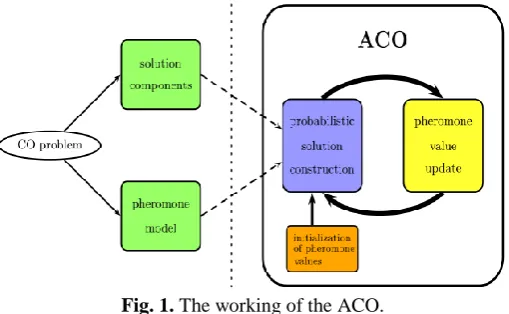
ACO [35] was inspired by the foraging behavior of ant colony. While moving, each ant lays certain amount of pheromone on the path. Ants use the pheromone trails to communicate information among the individuals and based on that each ant decides the shortest path to follow. ACO technique has been successfully used for difficult discrete combinatorial optimization problems such as Traveling Salesman Problem, Sequential Ordering, Routing in communication problems, etc.[12] The algorithm consists of four stages: Solution construction, Pheromone update, Local Search and Pheromone Re-initialization[37].
Fig. 1. The working of the ACO.
The basic way of working of an ACO algorithm is graphically shown in Fig. 1. Given a CO problem to be solved, one first has to derive a finite set C of solution components which are used to assemble solutions to the CO problem. Second, one has to define a set of pheromone values T. This collection of values is usually called the pheromone model, [13] which is technically taken into account as a parameterized probabilistic model. In general, the ACO approach attempts to solve an optimization problem by iterating the following two steps:
Candidate solutions are structured using a pheromone model, which is, a parameterized probability
distribution over the solution space;
The candidate solutions are used to modify the pheromone values in a way that is deemed to bias future sampling toward high quality solutions.
V.
CONCLUSIONS
In this paper a comparative study of different evolutionary techniques to solve the power system ED problem is investigated. Different techniques namely; regression, multiple regression, exponential smoothing, iterative reweighted least squares, ARIMA model, ARMA model, stochastic time series- autoregressive, adaptive load forecasting, support vector machine based, soft computing based models- genetic algorithms, in this paper it is clear that solution quality and robustness of RCGA is better than BCGA. Convergence characteristics of ACO and BFO are attractive and they converge quickly but solution quality is not as good as PSO or GA. From all these findings, it can be concluded that PSO outperforms the others for the chosen set of parameters for solving the Economic Dispatch problem.
REFERENCES
[1]. Nagendra Singh, Yogendra Kumar, Constrained Economic Load Dispatch Using Evolutionary
[2]. Aniruddha Bhattacharya, and Pranab Kumar Chattopadhyay,Biogeography-Based Optim-ization for Different Economic Load Dispatch Problems, IEEE Transactions On Power Systems, Vol. 25, No. 2, May 2010.
[3]. Ali Nazari, Amin Hadidi, Biogeography Based Optimization Algorithm for Economic Load Dispatch of
Power System AMERICAN JOURNAL OF ADVANCED SCIENTIFIC RESEARCH, Vol. 1, Issue. 3, pp. 99-105, 2012.
[4]. Jyoti Jain, Rameshwar Singh, Biogeography-Based Optimization Algorithm for Load Dispatch in Power
System, International Journal of Emerging Technology and Advanced Engineering, Volume 3, Issue 7,July 2013.
[5]. Bhuvnesh Khokhar, K. P. Singh Parmer, Surender Dahiya, Application of Biogeography-based
Optimization for Economic Dispatch Problems, International Journal of Computer Applications Vol. 47– No.13, June 2012.
[6]. A. I. Selvakumar and K. Thanushkodi, “A new particle swarm optimization solution to nonconvex
economic dispatch problems,” IEEE Transaction Power Systems, vol. 22, no. 1, pp. 42–51, Feb. 2007.
[7]. M. A. Abido, “A novel multiobjective evolutionary algorithm for environmental economic power
dispatch,” Electric Power Systems Research,vol. 65, no. 1, pp. 71–81, April 2003.
[8]. W. M. Lin, F. S. Cheng, and M. T. Tsay, “An improved tabu search for economic dispatch with multiple
minima,” IEEE Transaction Power Systems, vol. 7, no. 1, pp. 83–94, Feb. 2003.
[9]. J. Cai, X. Ma, L. Li, Y. Yang, H. Peng, and X. Wang, “Chaotic ant swarm optimization to economic dispatch,” Electric Power System Research, vol. 77, no. 10, pp. 1373–1380, Aug. 2007.
[10]. J. B. Park, K. Lee, J. Shin, and K. Y. Lee, “A particle swarm optimization for economic dispatch with
nonsmooth cost functions,” IEEE Transaction Power Systems, vol. 20, no. 1, pp. 34–42, Feb. 2005.
[11]. Z. Gaing, “Particle swarm optimization to solving the economic dispatch considering the generator
constraints,” IEEE Transaction Power Systems, vol. 18, no. 3, pp. 1187–1195, Aug. 2003.
[12]. Z. Gaing, “Particle swarm optimization to solving the economic dispatch considering the generator
constraints,” IEEE Transaction Power Systems,vol. 18, no. 3, pp. 1187–1195, Aug. 2003.
[13]. Jagadeesh Gunda, P.Acharjee and Sharmila Biswas “Incremental Cost based Combined
[14]. Economic and Emission Dispatch using Hybrid Differential Evolution”, IEEE 2011 International
Conference on Recent Advancements in Electrical, Electronics and Control Engineering, pp13-18, 2011.
[15]. Narendra, K.S and Parthasarathy, K., “Gradient methods for the optimization of dynamical systems
containing neural networks”, IEEE Transactions on Neural Networks, vol. 2, no 2, pp. 252-262, Mar. 1991.
[16]. Hasan, M.A, “Line search and gradient method for solving constrained optimization problems”, IEEE
International Conference on Acoustics, Speech, and Signal Processing, vol. 5, pp. 789-792, May. 2004.
[17]. Bertsekas, D.P, “Projected Newton methods for optimization problems with simple constraints”, IEEE
Conference on Decision and Control including the Symposium on Adaptive Processes, pp. 762-767, Dec. 1981.
[18]. Patrinos, P and Bemporad, A., “Proximal Newton methods for convex composite optimization”, IEEE
52nd Annula Conference on Decision and Control, pp. 2358 – 2363, Dec. 2013.
[19]. Momoh, J.A., Guo, S.X., Ogbuobiri, E.C., Adapa, R., “The quadratic interior point method solving power
system optimization problems”, IEEE Transactions on Power Systems, vol. 9, no. 3, pp. 1327-1336, Aug. 1994.
[20]. Momoh, J.A., Guo, S.X., Ogbuobiri, E.C., Adapa, R., “The quadratic interior point method solving power
system optimization problems”, IEEE Transactions on Power Systems, vol. 9, no. 3, pp. 1327-1336, Aug. 1994.
[21]. Neetu Agrawal, Shilpy Agrawal, K. K. Swarnkar, S. Wadhwani, and A. K. Wadhwani, “Economic Load
Dispatch Problem with Ramp Rate Limit Using BBO”, International Journal of Information and Education Technology, vol 2, no. 5, pp. , Oct. 2012.
[22]. Benhamida, F., Ziane. I., Souag, S, Graa, A., “ Solving dynamic economic load dispatch with ramp rate
limit using quadratic programming”, North American Power Symposium, pp. 1-5, Sept. 2013.
[23]. Arunesh Kumar Singh, Ibraheem, S. Khatoon and Md. Muazzam, “An Overview of Electricity Demand
Forecasting Techniques”, National Conference on Emerging Trends in Electrical, vol. 3, no. 3, pp. 289-298,
[24]. Sobajic, O, Ilich, N, Moussavi, M and Far, B., “A stochastic time series generator with adaptive software
[25]. Wang, W., Portnoy, V. and Pollak, I., “A Stochastic Context-Free Grammar Model for Time Series Analysis”, IEEE International Conference on Acoustics, Speech and Signal Processing, vol. 3, no 3, pp. 1245-1248, Apr. 2007.
[26]. Rashmi Rekha Borgohain and Barnali Goswami, “An Efficient Regression Based Demand Forecasting
Model including temperature with Fuzzy Ideology”, International Journal of Advanced Research in Electrical, Electronics and Instrumentation Engineering, vol. 4, no. 1, pp. Jan. 2015.
[27]. Narottam Dutt Upadhyay and Rameshwar Singh, “Soft Computing Technique Based Economic Load
Dispatch Using Biogeography-Based Optimization Algorithm”, International Journal of Innovative Research in Science, Engineering and Technology, vol. 3, no. 8, pp. Aug. 2014.
[28]. Bhagyashree Hosamani and C R Sharada Prasad, “ ANALYSIS OF ECONOMIC LOAD DISPATCH
USING FUZZIFIED PSO”, International Journal of Research in Engineering and Technology , vol. 3, no. 3, pp. May. 2014.
[29]. Kwang Y. Lee and Arthit Sode-Yome , “Adaptive Hopfield Neural Networks for Economic Load
Dispatch”, IEEE Transactions on Power Systems, vol. 13, no. 2, pp. May. 1998.
[30]. Ling, S.H, Lam, H.K, Leung, F.H.F and ; Lee, Y.S., “Improved genetic algorithm for economic load
dispatch with valve-point loadings”, The 29th Annual Conference of the IEEE Industrial Electronics Society, vol. 1, pp. 442-447, Nov. 2003.
[31]. Warsono, W, Ozveren, C.S. King, D.J. and Bradley, D., “A review of the use of genetic algorithms in
economic load dispatch”, Universities Power Engineering Conference, pp. 1-5, Sept. 2008.
[32]. Bhattacharya, A and Chattopadhyay, P.K., “Biogeography-Based Optimization for Different Economic
Load Dispatch Problems”, IEEE Transactions on Power Systems, vol. 25, no. 2, pp. 1064- 1077, May. 2010.
[33]. Zakaria, Z., Rahman, T.K.A. and Hassan, E.E., “Economic load dispatch via an improved Bacterial
Foraging Optimization”, IEEE 8th International Power Engineering and Optimization Conference, pp. 380-385, Mar. 2014.
[34]. Saber, A.Y and Venayagamoorthy, G.K., “Economic load dispatch using bacterial foraging technique
with particle swarm optimization biased evolution”, Swarm Intelligence Symposium, pp. 1-8, Sept. 2008.
[35]. Ahmed Y. Saber and Ganesh K. Venayagamoorthy , “Economic Load Dispatch using Bacterial Foraging
Technique with Particle Swarm Optimization Biased Evolution”, IEEE Swarm Intelligence Symposium, Sept. 2008.
[36]. N. A. Rahmat and I. Musirin, “Differential Evolution Immunized Ant Colony Optimization Technique in
Solving Economic Load Dispatch Problem”, International Journal for Scientific Research & Development, vol. 5, no. 1B, PP. 157-162, Aug. 2013
[37]. Ismail Musirin, Nur Hazima Faezaa Ismail, Mohd. Rozely Kalil, Muhammad Khayat Idris, and Titik
Khawa Abdul Rahman, “Ant Colony Optimization (ACO) Technique in Economic Power Dispatch Problems”, International MultiConference of Engineers and Computer Scientists, vol. 2, Mar. 2008.
[38]. Pirmahamad Jamalbhai Vasovala, Chinmay Y. Jani, Vasim H. Ghanchi and Parth Harshad Kumar
Bhavsar, “Bus System with the use of Ant Colony Optimization Technique”, International Journal for Scientific Research & Development, vol. 2, no. 3, pp. Mar. 2014.
[39]. Koustav Dasgupta and Sumit Banerjee, “An Analysis of Economic Load Dispatch with Prohibited Zone
and Ramp-rate limit constraints using Different Algorithms”, Power and Energy Systems Towards sustainable Energy, 2014
[40]. Ai Songpu; Mohan Lal Kolhe; Lei Jiao; Qi Zhang “Domestic load forecasting using neural network and its use for missing data analysis”IEEE 9th International Symposium on Advanced Topics in Electrical Engineering (ATEE) 2015.
[41]. Shivani Kanoongo and Prerna Jain, “Biogeography Based Optimization for Different Economic Load
Dispatch Problem with Different Migration Models”, IEEE Conference on Electrical, Electronics and Computer Science, pp. 362-365, Aug 2012
[42]. Barun MandaI ,Provas Kr. Roy, and Kesab Bhattacharya “Hybridization of Particle Swarm Optimization
with Biogeography Based Optimization to Solve Economic Load Dispatch Considering Spinning Reserve and Other Non-Linerarities” IEEE- International Conference On Advances In Engineering, Science And Management, pp. 403-408, Mar. 2012.
[43]. L. Chiang, “Improved genetic algorithm for power economic dispatch of units with valve point loading
and multiple fuels,” IEEE Trans. Power Syst., vol. 20, no. 4, pp. 1690-1699, Mar. 2005
[44]. Y. Labbi, D. Ben Attous, “A Hybrid Ga–Ps Method To Solve The Economic Load Dispatch Problem”,
Journal Of Theoretical And Applied Information Technology, pp 61-68, Mar 2005.
[45]. Kentaro Asano, Masahiro Nakatsuka and Teruhisa Kumano, “Dynamic Economic Load Dispatch by
International organization of Scientific
Research
8 | P a g e
[46]. Mohan Kolhe; Tzu Chao Lin; Jussi Maunuksela “GA-ANN for Short-Term Wind Energy Prediction2011
Asia-Pacific Power and Energy Engineering Conference 2011.
[47]. Santanu Kumar Nayak, B.K.Panigrahi, Krishnanand K.R and P.K.Rout, “Application of Artificial Bee
Colony to Economic Load DispatchbProblem with Ramp Rate Limits and Prohibited Operating Zones”, IEEE World Congress on Nature & Biologically Inspired Computing, pp:1237-1242, 2009.
[48]. Ahmed Y, Saber Ganesh and K. Venayagamoorthy, “Economic Load Dispatch using Bacterial Foraging
Technique with Particle Swarm Optimization Biased Evolution”, IEEE Swarm Intelligence Symposium, Sept. 2008.
[49]. K.T. Chaturvedi, Ruchi Solanki,N. P. Patidar “A New modified particle swarm Optimization (PSO) Technique for Non - Convex Economic Dispatch” (IOSR – JEEE)2014,pg 81-88.
[50]. Karl Mason,JimDuggan,Enda Howley “Multi-objective dynamic economic emission dispatch using
particle swarm optimisation variants”Elsevier Nurocomputing journal Dec.2017
[51]. T. Se, N. H. D. Mathur, "A New Approach To Solve Economic Dispatch Problem Using A Hybrid
ACO-ABC-HS Optimization Algorithm", Electrical Power and Energy Systems, vol. 78, pp. 735-744, 2016. [52]. M. Saka, I. Eke, S. S. Tezcan, M. C. Taplamacioglu, "Application of Vortex Search Algorithm to
Economic Load Dispatch Including Transmission Losses with Valve-Point Loading Effect", 1st International Mediterranean Science and Engineering Congress, pp. 2854-2859, 2016.
[53]. F. P. Mahdi, P. Vasant, V. Kallimani, M. Abdullah-Al-Wadud, "A review on economicemission dispatch
problems using quantum computational intelligence", AIP Conference Proceedings, vol. 1787, 2016.
[54]. Ansil Sharma , Govind Rai , Mohit Jain, Parmeshwar Kumawat “Optimal Setting of Parameters of Power
System Controllers Using PSO Technique for Economic Load Dispatch” Imperial Journal of Interdisciplinary Research (IJIR) Vol-3, Issue-5, 2017
[55]. F. Mahdi, P. Vasant, V. Kallimani, P. Fai, M. Wadud, "Emission Dispatch Problem with Cubic Function
Considering Transmission Loss using Particle Swarm Optimization", Journal of Telecommunication Electronic and ComputerEngineering (JTEC), vol. 8, pp. 17-21, 2016.
[56]. Loau awfak Al Bahrani,Jagdish Chandra Patra “Orthogonal PSO algorithm for economic dispatch of
thermal generating units under various power constraints in smart power grid”Elsevier Applied soft computingVolume 58, 2017 pp 401-426.
[57]. Pradhan Moumita, Provas Kumar. Roy, Tandra. Pal, "Grey wolf optimization applied to economic load
dispatch problems", International Journal of Electrical Power & Energy Systems, vol. 83, pp. 325-334, 2016.