Norm–Based Approximation in Invex
Multi-Objective Programming Problems
Tarek Emam
Dept. of Mathematics, Faculty of Science, Suez University, Egypt.
Dept. of Mathematics, Faculty of Science, University of Hail, KSA.
Abstract--
This paper addresses the problem of capturing nondominated points on convex Pareto frontiers, which are encountered in invex multi-objective programming problems. An algorithm to find a piecewise linear approximation of the nondominated set of convex Pareto frontier are applied.
Index Term--
Approximation, Nondominated points, Invex multi-objective problems, Block norms.
1 INTRODUCTION
In multi-objective programming, several conflicting and non-commensurate objective functions have to be optimized over a feasible set determined by constraint functions. Due to the conflicting nature of the objectives, a unique feasible solution optimizing all the objectives does not exist. Based on the commonly used Pareto concept of optimality, one has to deal with a rather large or infinite number of efficient solutions. In most works, an assumption of convexity was made for the objective functions. Very recently, some generalized convexity has received more attention (see, for example, [1, 3, 6, 7]). A significant generalization of convex functions is invex function introduced first by Hanson [4], which has greatly been applied in nonlinear programming and other branches of pure and applied sciences.
Since there are infinitely many efficient solutions, an approximated description of the solution set becomes an appealing alternative. The approximation algorithm proposed in this paper follows earlier researches initiated by Schandl [9] and continued by Schandl et al. [10]. The approximation comes in the form of a polyhedral distance measure that is being constructed successively during the execution of the algorithm. The measure is being utilized both to evaluate the quality of the approximation and to generate additionally nondominated solutions.
Inspired and motivated by above works, the purpose of this paper is to generate nondominated solutions of invex multi-objective programming problems. The outline of the paper is as follows: In the next section, we mention some mathematical preliminaries that have an important role not only in traditional programming but also in multi-objective programming. In section 3, we state the invex multi-objective programming problem and extend invex functions to the so called cone invex functions and derive some results about it. The oblique norms are defined and a theoretical basis for the approximation algorithm is discussed in section 4. Finally,
approximation approach developed in [9] is applied to an invex multi-objective programming problem in section 5.
2 MATHEMATICAL PRELIMINARIES
To facilitate further discussions, the following notation is used
throughout thesis. Let
u
,
v
R
n be two vectors.1. We denote components of vectors by subscripts and enumerate vectors by superscripts.
2.
u
<
v
denotesu
i<
v
i for alli
=
1,2,...,
n
.u
v
denotes
u
i
v
i for alli
=
1,2,...,
n
, butu
v
.u
v
allows equality. The symbols
,
,
are used accordingly.3. Let
R
n
{
x
R
n:
x
0
}
.IfS
R
n, then nR
S
S
.The setsR
n,
R
n,
S
andS
are definedaccordingly. In the following, we recall some general definitions and notations.
Definition 1 (Cone and convex cone) [2] A subset M of
R
n is called a cone if
x
M
wheneverx
M
and
>
0
. Moreover, a cone M is said to be a convex cone when it is also convex.Definition 2 (Cone Convexity) [2]
Given a set M and a convex cone D in
R
n, M is said to be D-convex if M+D is a D-convex set.Definition 3 (Cone convex function) [2] Let M be a convex
set in
R
n, f be a function from M intoR
k, and D be a convex cone inR
k. Then f is said to be D-convex if for anyM
x
x
1,
2
and for any
[0,1]
,.
)
)
(1
(
)
(
)
(1
)
(
2
1 2
1
D
x
x
f
x
f
x
f
Definition 4 (Invex Set) [4]
The set
M
R
n is said to be invex aty
M
with respect to a map
:
M
M
R
n, ify
(
x
,
y
)
M
, for allM
x
and
[0,1]
.Definition 5 (Invex Function) [4]
Let
M
R
n be an invex set with respect to a map nR
M
M
:
. The functionf
:
M
R
n is said to beinvex at
y
M
with respect to
, if)
(
)
(1
)
(
))
,
(
(
y
x
y
f
x
f
y
f
, for allx
M
and
[0,1]
.f is said to be invex with respect to
on M if it is invex at eachy
M
with respect to the same
.Definition 6 (Domination structure) [2]
For each
z
Z
R
k, we define the set of domination factors{0}
d}
z
z
:
R
{d
D(z)
k
.This means that deviation
d
D
(
z
)
from z is less preferred to the original z. Then the point to set map D from Z tok
R
clearly represent the given preference order. We call D the domination structureDefinition 7 (Nondominated set) [2]
Given a set Z in
R
kand a domination structure D (.), the setof nondominated elements is defined
by
D(z)}
z
s.t.
Z
z
z
no
is
ther
:
Z
z
{
)
,
(
z
D
Z
N
, and is
called the nondominated set.
3 Problem Formulation
Let
f
:
R
n
R
k andg
:
R
n
R
m be invex functions with respect to a map
:
R
n
R
n
R
n. An invex multi-objective programming problem is formulated as follows:(P)
}.
0
)
(
:
{
),
(
M
x
R
g
x
x
to
subiect
x
f
Min
nIn the objective space
R
k, for problem (P), the set of all feasible criterion vectors is as follows:}
),
(
=
:
{
=
)
(
=
f
M
z
z
f
x
x
M
Z
.The most fundamental kind of efficient solution is obtained
when
D
R
k and is usually called a Pareto solution orNoninferior solution.
Definition 8 (efficient solution) [2]
A point
x
*
M
for (P) is be an efficient solution to theproblem (P) if there is no
x
M
such thatf
(
x
)
f
(
x
*)
. The set of all nondominated points N and the set of allefficient points F of problem (P) are defined as follows:
},
.
.
:
{
=
z
Z
z
s
t
z
z
N
' '
and
}.
)
(
:
{
=
x
M
f
x
N
F
Definition 9 (Geoffrion’s proper efficiency) [2]
A point
z
N
is called properly nondominated, if there exists a scalarq
>
0
such that for eachi
,
i
=
1,2,...,
k
, andeach
z
Z
satisfyingz
i>
z
i, there exists at least onei
j
withz
j>
z
j andq
z
z
z
z
j j i i
. Otherwise
z
N
is called improperly nondominated. The set of all properly pointsis denoted by
N
p.Now, we extend the concept of invexity to the cone invexity which enables us to deal with invex multi-objective programming problems.
Definition 10 (Cone Invex Function)
Let
M
R
n be an invex set with respect to a map nR
M
M
:
, f be a function from M intoR
k, and Dbe a convex cone in
R
k. Then, f is said to be D-invex withrespect to
, ifD
y
x
y
f
y
f
x
f
(
)
(1
)
(
)
(
(
,
))
for allM
y
x
,
and
[0,1]
.Remark 1
Let
M
R
n be an invex set with respect to a map nR
M
M
:
. A functionf
:
M
R
k is invex withrespect to
if and only if f isR
k-invex with respect to
.Proposition 1
Let
M
R
n be an invex set with respect to a map nR
M
M
:
and D be a convex cone inR
k. Ifk
R
M
f
:
is D-invex with respect to
, then the set)
(
M
f
is D-convex set.Proof. Let x, y be any two points in the set
f
(
M
)
D
,then there exist
z
1,
z
2
M
andd
1,
d
2
D
such that.
)
(
=
,
)
(
=
f
z
1d
1y
f
z
2d
2x
For
[0,1]
, we have)
(1
]
)
(
[
=
)
(1
1 1
x
y
f
z
d
)
(
)
(1
=
]
)
(
[
f
z
2
d
2
d
1
d
2
f
z
1)).
,
(
(
))
,
(
(
)
(
)
(1
2 1 2 2 1 2 2z
z
z
f
z
z
z
f
z
f
From
2 1 2 1{
))
,
(
(
=
)
(1
y
f
z
z
z
d
x
2 2
1 2
(
)
(
)
(1
)
(
)
(1
d
f
z
f
z
f
z
,
)
(
))}
,
(
z
1z
2
f
M
D
which mean that
f
(
M
)
D
is convex set and hence)
(
M
f
is D-convex set.We assume that the set Z is
R
k-closed and that we can findk
R
u
so thatu
Z
R
k. The pointk
R
z
ˆ
withz
ˆ
i
min{
f
i(
x
)
:
x
M
}
i,i
1
,
2
,...,
k
is called the ideal (utopia) criterion vector, where the
components of
(
1,
2,...,
k)
R
kare small positivenumbers. The point
z
R
2with
z
min{
z
:
z
min
z
j,
j
i
}
Z z j i
i
,
i
1
,
2
is calledthe nadir point. This definition cannot be easily generalized to
more than two dimensions. Define the
set
Z
*
{
z
ˆ
i,
i
1
,
2
,...,
k
}
. Then the ithcomponent,
i
1
,
2
,...,
k
of the default reference point isdefined as
z
i
max{
z
i:
z
Z
*}
,i
1
,
2
,...,
k
.This is a possible generalization of the nadir point concept, can be calculated relatively easily and also provides the utopia point
4 OBLIQUE NORMS IN MULTI-OBJECTIVE PROGRAMMING The concept of oblique norms was introduced in Schandl et al. [11] and Schandl [9]. Since oblique norms can be viewed as a special class of block norms, we first review some basic definitions about block norms and more general, polyhedral gauges.Then oblique norms are discussed in the context of multi-objective programming.
Definition 11 [10]
Let B be a convex and compact set in
R
kcontaining the origin in its interior and letx
R
k. The gauge
of
x
withrespect to B is then defined as
}
:
0
min{
)
(
x
x
B
. Given a gauge
, the set}
1
)
(
:
{
x
R
x
B
k
is called unit ball or sublevel set of level 1.
Definition 12 [10]
If the set B is a convex polytope, then
is called a polyhedral gauge and is sometimes referred to as
k. Let}
,...,
,
{
)
(
B
v
1v
2v
kext
be the set of extreme points of B;k
v
v
v
1,
2,...,
are called fundamental vectors. The half-lines kd
d
d
1,
2,...,
starting at the origin and passing through theextreme points
v
1,
v
2,...,
v
k are called fundamentaldirections.
If B is symmetric with respect to the origin, then it is called a
block norm.
Definition 13
The fundamental vectors defined by the extreme points of a facet of B span a fundamental cone. The cone spanned by the
fundamental vectors
v
i andv
j are referred to asC
(
v
i,
v
j)
. If z is in a fundamental cone C of polyhedral gauge
then one needs to consider only the fundamental vectors generating this cone to calculate the gauge of z. This result was proven in Schandl [10] for the multi-objective case.Theorem 1 [10]
Let
be a polyhedral gauge with unit ballB
R
k. LetC
z
where C is the fundamental cone generated byk
l
v
v
v
1,
2,...,
l,
. Let l i ii
v
z
1 =
=
be a representation ofz
in terms ofv
1,
v
2,...,
v
l. Then l i iz
1 =
=
)
(
.Not that all representations l i i
i
v
z
1 =
=
can be used tocalculate
(
z
)
, even combinations where one or more
'is
are negative which is only possible if
l
>
k
. If C is generated by k fundamental vectors though, the representation ofz
interm
v
1,
v
2,...,
v
k is unique and all corresponding
'is
allcorresponding
'is
are nonnegative.For the definition of oblique norm we additionally need the
concept of sets. Let
u
R
k. The reflection set of u is defined asR
(
u
)
=
{
w
R
k:
w
i=
u
i
i
=
1,2,...,
k
}.
Definition 14
A block norm
with a unit ball B is called oblique if kR
u
u
R
w
u
w
i
)
(
)
=
(
)
(
),
(
, and(ii)
(
z
R
k)
R
k
B
{
z
}
z
(
B
)
Observe that an oblique norm is a block norm where no facet of the unit ball is parallel to any coordinate axis. Moreover, the structure of the norm’s unit ball is the same in each orthant of the coordinate system.This property is convenient for the generation of nondominated solutions of (P) since they may
only occur in
z
ˆ
R
k. An example of an oblique norm inR
kis given in Figure 1.
Fig. 1.
k k R
Schandl et al. [10] show that oblique norms are effective tools to generate nondominated solutions of general multi-objective programs. In particular, we examine the relationship between properly nondominated solutions of invex multi-objective programming problems, and optimal solutions of their scalarization by means of an oblique norm. The following two theorems justify the application of oblique norm for the generation of nondominated solutions.
Theorem 2 [10]
Assume without loss of generality that
0
Z
R
k. Let
be an oblique norm with the unit ball B. Ifz
R
k is a solution ofmax
(
z
)
s.t.z
R
k
Z
.
(
P
)Then
z
is nondominated.Unfortunately, we cannot guarantee to find all nondominated points using an oblique norm with its unit ball’s center in
k
R
Z
in the general setting of Theorem 2. Therefore, thenext Theorem is proved for the invex multi-objective programming problems.
Theorem 3
Let
M
R
n be an invex set with respect to a map nR
M
M
:
andf
:
M
R
k be an invex functionwith respect to same
. Ifz
is properly nondominated with pk
N
R
z
, then there exists an oblique norm
so thatz
solves the problem (P
)max
(
z
)
s.t.z
R
k
Z
Proof. Since
f
:
M
R
k is an invex function with respect to
:
M
M
R
n, then f isR
k-invex with respect to
(see Remark 1). By using Proposition 1, we conclude thatZ
is
R
k-convex set.R
k-convexity of Z implies that thereexists an oblique norm
such thatz
solves the problemP
(see Theorem 3.6 of [10]).
5 DESCRIPTION OF APPROXIMATION APPROACH
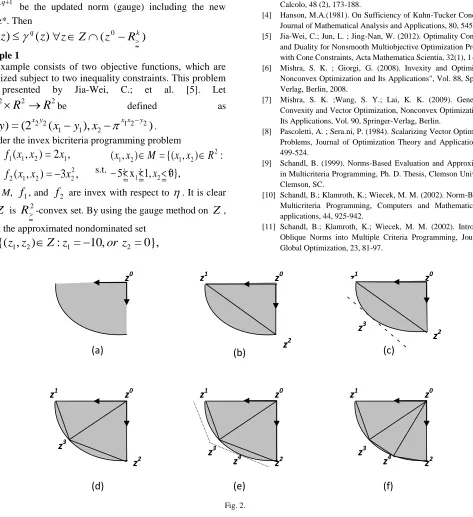
For invex multi-objective programs , an approximation algorithm based on Theorem 2 and 3 can be designed that utilizes oblique norms for the generation of nondominated solutions. To keep explanations straight-forward, the general idea of this approach will be outlined using a bicriteria example problem. The approximation process is started by
choosing a reference point
z
0
Z
R
k and definingk
R
z
0
as the region in which the nondominated set N is
approximated. This might be a currently implemented (not nondominated) solution or just a (not necessarily feasible) guess. A first approximation is obtained by exploring the
feasible set along
l
k
search directionsk l
R
d
d
d
1,
2,...,
, specified by the decision maker. Toobtain nondominated points along these search directions, an adaptation of the direction method introduced in Pascoletti and serafini [8] is modified in Schandl [9]. In the example given in Figure (2-a), the search directions are chosen as the negative
unit vectors in
R
2,d
1=
(
1,0)
andd
2=
(0,
1)
yielding the pointsz
1 andz
2. These two points together with thereference point
z
0 are used to define a cone and a first approximation, see Figure (2-b). Interpreting this approximation as the lower left part of the unit ball of an oblique norm
(or, more general, of a polyhedral gauge) withz
0 as its center, this norm is then maximized in)
(
0 2
z
R
Z
. Consequently the next pointz
3 in theproblem) is found as a solution of problem (
P
), where
is an oblique norm (gauge), see Figure(2-c).The point
z
3 is added to the approximation by building the convex hull of the points generated so far and thus updating the approximation and the underlying norm (gauge) simultaneously as shown in Figure (2-d). Continuing this process, we get a finer approximation of nondominated set while generating of nondominated points and updating the unit ball of the oblique norm (gauge), see Figures (2-e) and (2-f). In each iteration, the point of maximal norm (gauge) is added. Since this point is "farthest away" from the approximation with respect to the current oblique norm (gauge), we always add the point of worst approximation with respect to this norm (gauge).There are two possible stopping criteria; usually, at least one of them must given. The first one is an upper bound
>
0
onthe maximal deviation such that
dev
(
z
)
=
(
z
)
1
. As soon as we getdev
(
z
)
<
for a point that should be added next, the algorithm stops. The other possibility is to give an integermaxConeNo
1
, which specified the maximum number of cones to be generated. The main loop of the algorithm continues until one of possible stopping criteria is satisfied. At the end of the loop the sorted list of r nondominated points is printed and can be used to visualize the approximated set.Observe that in each iteration the maximization problem (
P
)has to be has to be solved only in those cones whose facets were newly generated due to the addition of the last point. This includes new and modified cones. By updating the
with each new point if we assume that Z is
R
k-convex.Theorem 4 [10] Let
Z
R
k beR
k -convex and
q be an approximating oblique norm (oblique gauge) constructed from q nondominated points, or points on the boundary of Z. Letz
be the solution ofmax
q(z
)
s.t.z
Z
(
z
0
R
k)
Let
q1 be the updated norm (gauge) including the new point z*. Then)
(
)
(
1
z
z
qq
)
(
z
0R
kZ
z
Example 1This example consists of two objective functions, which are minimized subject to two inequality constraints. This problem was presented by Jia-Wei, C.; et al. [5]. Let
2 2 2
:
R
R
R
be defined as)
),
(
(2
=
)
,
(
12 22 1 1 2
2y xx y
x
x
y
x
y
x
.Consider the invex bicriteria programming problem
,
3
=
)
,
(
,
2
=
)
,
(
2 2 2
1 2
1 2 1 1
x
x
x
f
min
x
x
x
f
min
s.t.5
x
1,
0},
:
)
,
{(
=
)
,
(
2 1
2 2 1 2
1
x
R
x
x
M
x
x
where M,
f
1, andf
2 are invex with respect to
. It is clear that,Z
isR
2-convex set. By using the gauge method onZ
,we get the approximated nondominated set
0},
=
,
10
=
:
)
,
{(
=
z
1z
2Z
z
1or
z
2N
and hence the efficient set is
0}.
=
,
5
=
:
)
,
{(
=
x
1x
2M
x
1or
x
2F
REFERENCES
[1] Antczak, T. (2009). On G-invex multiobjective programming, J. Glob. Optim., 43, 97-109.
[2] Chankong, V. ; Haimes, Y. Y. (1983). Multiobjective decision making Theory and methodology, North-Holland, New York. Amsterdam. Oxford.
[3] Emam, T. (2011). Roughly B-invex Programming Problems, Calcolo, 48 (2), 173-188.
[4] Hanson, M.A.(1981). On Sufficiency of Kuhn-Tucker Conditions, Journal of Mathematical Analysis and Applications, 80, 545-550. [5] Jia-Wei, C.; Jun, L. ; Jing-Nan, W. (2012). Optimality Conditions
and Duality for Nonsmooth Multiobjective Optimization Problems with Cone Constraints, Acta Mathematica Scientia, 32(1), 1-12 . [6] Mishra, S. K. ; Giorgi, G. (2008). Invexity and Optimization,
Nonconvex Optimization and Its Applications", Vol. 88, Springer-Verlag, Berlin, 2008.
[7] Mishra, S. K. ;Wang, S. Y.; Lai, K. K. (2009). Generalized Convexity and Vector Optimization, Nonconvex Optimization and Its Applications, Vol. 90, Springer-Verlag, Berlin.
[8] Pascoletti, A. ; Sera.ni, P. (1984). Scalarizing Vector Optimization Problems, Journal of Optimization Theory and Applications, 42, 499-524.
[9] Schandl, B. (1999). Norms-Based Evaluation and Approximation in Multicriteria Programming, Ph. D. Thesis, Clemson University, Clemson, SC.
[10] Schandl, B.; Klamroth, K.; Wiecek, M. M. (2002). Norm-Based in Multicriteria Programming, Computers and Mathematics with applications, 44, 925-942.
[11] Schandl, B.; Klamroth, K.; Wiecek, M. M. (2002). Introducing Oblique Norms into Multiple Criteria Programming, Journal of Global Optimization, 23, 81-97.
Fig. 2.