OpenBU http://open.bu.edu
Theses & Dissertations Boston University Theses & Dissertations
2016
A theory of flow network typings
and its optimization problems
https://hdl.handle.net/2144/19750
GRADUATE SCHOOL OF ARTS AND SCIENCES
Dissertation
A THEORY OF FLOW NETWORK TYPINGS AND ITS OPTIMIZATION PROBLEMS
by
MOHAMMAD SABER MIRZAEI
M.S., Iran University of Science and Technology, 2011 B.S., Sharif University of Technology, 2003
Submitted in partial fulfillment of the requirements for the degree of
Doctor of Philosophy 2016
First Reader
Assaf Kfoury, PhD
Professor of Computer Science
Second Reader
Azer Bestavros, PhD
Professor of Computer Science
Third Reader
Lorenzo Orecchia, PhD Professor of Computer Science
The complexities of this project would not have been possible without the help and guidance of professors, friends, staff and many other members of the Boston University community. Special gratitude is directed towards my advisor, professor Assaf Kfoury for his support and encouragement throughout my PhD.
I dedicate this thesis to my loving parents, without their support and devotion I would not have accomplished this great feat. .
PROBLEMS
MOHAMMAD SABER MIRZAEI
Boston University, Graduate School of Arts and Sciences, 2016 Major Professor: Assaf Kfoury, Professor of Computer Science
ABSTRACT
Many large-scale and safety critical systems can be modeled as flow networks. Traditional ap-proaches of analysis of flow networks are whole-system approaches in that they require prior knowledge of the entire network before an analysis is undertaken, which can quickly become in-tractable as the size of the network increases.
In this thesis we study an alternative approach to the analysis of flow networks, which is mod-ular, incremental and order-oblivious. The formal mechanism for realizing this compositional approach is an appropriately defined theory of network typings. Typings are formalized differ-ently depending on how networks are specified and which of their properties is being verified. We illustrate this approach by considering a particular family of flow networks, calledadditive flow networks.
In additive flow networks, every edge is assigned a constant gain/loss factor which is activated provided a non-zero amount of flow enters that edge. We show that the analysis of additive flow networks, more specifically the max-flow problem, is NP-hard, even when the underlying graph is planar.
The theory of network typings gives rise to different forms of graph decomposition problems. We focus on one problem, which we call thegraph reassemblingproblem. Given an abstraction of a flow network as a graph G = (V,E), one possible definition of this problem is specified in two steps: (1) We cut every edge ofGinto two halves to obtain a collection of∣V∣one-vertex components, and (2) we splice the two halves of all the edges, one edge at a time, in some order that minimizes the complexity of constructing a typing forG, starting from the typings of its one-vertex
One optimization is minimizing “maximum” edge-boundary degree of components encoun-tered during the reassembling ofG (denoted as α measure). Another is to minimize the “sum” of all edge-boundary degrees encountered during this process (denoted by β measure). Finally, we study different variations of graph reassembling (with respect to minimizingαorβ) and their relation with problems such as Linear Arrangement, Routing Tree Embedding, and Tree Layout.
1 Introduction 1
1.1 Motivation . . . 1
1.2 Thesis Contributions and Organization . . . 2
2 Related Work 7 2.1 A Theory of Typings for Flow Networks . . . 7
2.2 Graph Reassembling and Graph Embedding . . . 9
2.2.1 Minimum Congestion Communication Tree Embedding . . . 10
2.2.2 Minimum Congestion Communication Tree Embedding . . . 12
3 Compositional Design and Analysis of Flow Network 13 3.1 Background and Our Methodology . . . 13
3.2 Formal Definitions and Preliminary Lemmas . . . 18
3.3 Network Typings . . . 23
3.4 Existence of Principal Network Typings . . . 31
3.5 Complexity of Computing Principal Typings . . . 41
3.6 Supplementary Proofs and Lemmas for Section3.5. . . 43
3.6.1 Proof ofLemma 13 . . . 43
3.6.2 Proof ofLemma 14 . . . 49
3.7 Conclusion and Future work . . . 62
4 Max-Flow and Shortest Path Problems in Additive Flow Networks 64 4.1 Background and Motivation . . . 64
4.3 Shortest Path Problem in Additive Flow Network . . . 69
4.4 Maximum Flow Problem in Additive Flow Network . . . 79
4.5 Conclusion and Future Work . . . 83
5 Efficient Reassembling of Graphs 85 5.1 Background and Motivation . . . 86
5.2 Problem Statement . . . 87
5.3 Formal Definitions and Preliminary Lemmas . . . 91
5.3.1 Binary Graph-Reassembling . . . 93
5.3.2 Optimization Problems . . . 96
5.3.3 Linear Graph-Reassembling . . . 97
5.4 Examples . . . 100
5.5 α-Optimization of Linear Reassembling Is NP-Hard . . . 107
5.6 β-Optimization of Linear Reassembling Is NP-Hard . . . 112
5.7 α-Optimization of Balanced Reassembling Is NP-Hard . . . 122
5.8 β-Optimization of Balanced Reassembling Is NP-Hard . . . 128
5.9 Supplementary Proofs for Sections5.5and5.6 . . . 136
5.10 Conclusion and Future Work . . . 144
6 Graph Reassembling as a Graph Embedding Problem 146 6.1 Background and Motivation . . . 146
6.2 Definitions and Problem Statement . . . 147
6.3 Minimum Length of Tree Layout . . . 149
6.3.1 Min Tree Length of Complete Graphs . . . 149
6.3.2 Min Tree Length of General Graphs . . . 158
6.4 Layout Tree Problem in Relation with Graph Reassembling . . . 160
6.5 Tree Length of Routing Trees . . . 163
6.6 Conclusion and Future Work . . . 165
Bibliography 169
Curriculum Vitae 176
3.1 Vertexvof degree5is transformed into a cycle with5vertices. . . 23
3.2 One-vertex networkN and its principal typings whenc=10,c=0, andc= −10 . . 26
3.3 A 3-vertex additive networkN and and its space of all feasible IO assignments whenc1=4andc2=8. . . 28
3.4 For Example9, a disconnected2-vertex additive networkN. . . 29
3.5 Example for the proof of Lemma17. . . 47
3.6 Example of a planar network and its transformation into a 3-regular network . . . . 51
3.7 The planar networkN′is re-drawn on a rectangular grid . . . 52
3.8 Macro expansion ofMerge(M,M′,Θ, ∂,C). . . 54
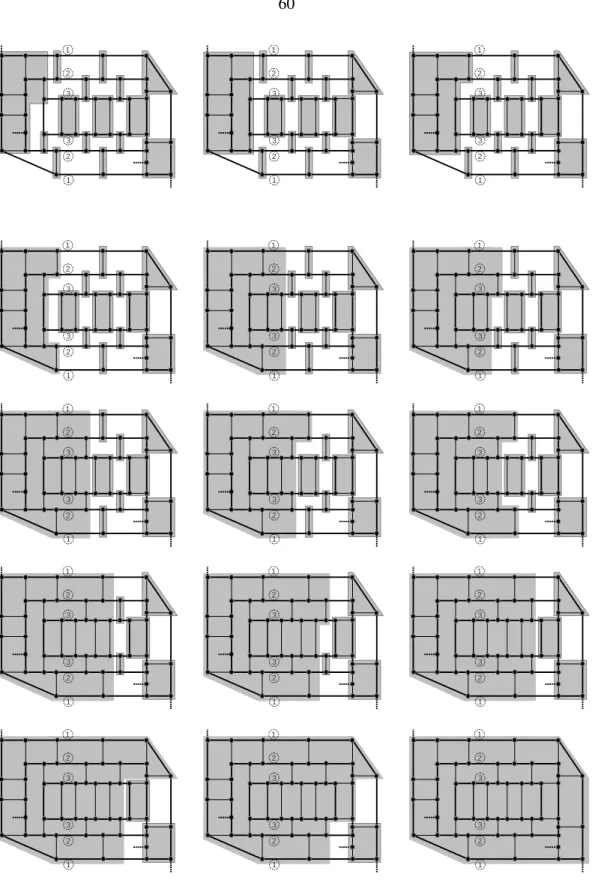
3.9 Progress of Algorithm1on a good3-outerplanar embedding . . . 59
3.10 Main iterationof Algorithm1on a good3-outerplanar embedding. . . 60
4.1 An example of an additive flow network and a feasible flow for it . . . 68
4.2 The gadget that replaces a vertex of degree4 . . . 74
4.3 The gadget replacing a vertex with some forbidden transitions. . . 75
4.4 The gadget replacing vertexvof degree4involve in forbidden transitions. . . 76
4.5 The additive flow network, constructed based on the graphGin4.5a. . . 77
4.6 Underlying graph of a 3CNF formulaϕ . . . 80
4.7 The gadget that replaces every pair of literal-vertices{x,̃x}. . . 81
4.8 The flow network constructed from the graph of CNF formulaϕ . . . 81
5.1 Two different drawings of the hypercube graphQ3 . . . 101
5.2 Complete graphK8. . . 103
5.3 Star graphS7. . . 104 x
5.5 For the statement of Lemma94. . . 126
6.1 Planar embedding ofTrepresented as the embedding of nodes onk+2linesLi . . 151
6.2 TreeT∉T(R,∆)and the alternative treeT′constructed fromT . . . 152
6.3 Representation of initial treeTand its modified versioñT. . . 156
6.4 Two planar embeddings of an optimal layout treeTof size2n−1 . . . 158
6.5 The structure of rooted tree layout for augmented graphG. . . 162
PTAS . . . Polynomial-time Approximation Scheme MinArr . . . minimum linear arrangement problem
f . . . flow function assigning flow values to edge of a network
fin . . . amount of entering flow to a network
fout . . . amount of departing a network
NNCC . . . not necessarily closed convex
g . . . gain function assigning gain values to edge of a network
U . . . capacity function assigning flow capacity values to edge of a network Ein,out . . . set of input/output edges
E# . . . set of internal edges
R . . . set of real values
R+ . . . set of non-negative real values
PAFT . . . Path Avoiding Forbidden Transitions problem
T . . . the set of all possible edge transitions in a graph
F . . . the set of forbidden edge transitions in a graph
T . . . algebraic characterization of flow assignments to outer edges
Θ . . . reassembling sequence
B . . . binary reassembling tree
∂(M) . . . set of input/output edges of componentM
GRAPHS(2∗) the class of all simple graphs with the size of power-of-2
α . . . max edge boundary degree encountered during the reassembling process
β . . . sum of edge boundary degrees encountered during the reassembling process
ϕ . . . bijective mapping from vertices of input graph to vertices of underlying graph
δ . . . congestion of an edge of the input graph after embedding
λ . . . dilation of an edge of the input graph after embedding T . . . layout tree
LA . . . tree length of a layout tree embedding
CutWidth . . . minimum cutwidth linear arrangement problem MinArr . . . minimum linear arrangement problem
Introduction
1.1 Motivation
Many large-scale and safety critical systems can be considered as interconnected sub-systems or modules communicating via flows. Each sub-system can be consumer and/or producer of flow of other(s). These flow connections are characterized by a set of variables and are regulated by a set of constraints thereof, reflecting inherent or assumed properties or rules governing how the modules operate and communicate as well as what constitutes safe operation. The general term flow abstractly represents streams of objects (such as commodities being shipped in a network, vehicles on a road, fluid in a pipe andetc.), data packets or expendable resources (such as electric energy, compute cycles) andetc.
Traditionally, the design and implementation offlow networks, follows a bottom-up approach providing analysis and certification of desirable invariants of the system as a whole network. Hence, most traditional flow network algorithms and frameworks can be considered as whole network approaches, in the sense that the view of the “complete” and “homogenous” system is required in order to be able to apply some property analysis on the system.
Analysis and verification of different properties across large-scale systems is a critical task which can quickly become costly or intractable as the size and complexity of a model increases. Putting the issue of algorithmic complexity aside, it may be the case that sub-systems must be modeled or combined without the full knowledge of the their internal details. This limitation may rise for the sake of privacy, modular structure and other reasons such as having heterogeneous or unknown parts (to be developed in future). The need for an alternative view toward flow network
systems is the background to this work; a group effort to develop an integrated framework suit-able for compositional analysis of flow networks that is simultaneously: modular (“distributed in space”), incremental(“distributed in time”), and order-oblivious (“components can be modeled and analyzed in any order”). These are the three defining properties of what we call a seamlessly compositional approach to system modeling and system analysis. Several previous works explain the methodology behind this environment, as well as its state of development and implementation [14,15,16,59, 60, 62, 63, 88]. This incremental group effort provides an algebraic framework (calledtypings theory) providing an efficient and compositional analysis of flow networks in their standard definition. The standard flow networks are regulated by the flow conservation at every edge and every vertex. In other words, the amount of flow entering a flow network or a sub-network is equivalent to the amount of flow departing that.
In this thesis we cover an augmented variation of this framework which enables the compo-sitional analysis of a more general definition of standard flow networks, calledadditive flow net-works. Additive flow networks are a special case of so calledgeneralized flow networks in the sense that to every edge is assigned a constant gain/loss factor which upon entering any amount of flow is activated and hence rules out the flow conservation constraint at every edge.
Due to compositional approach used in this framework, the efficiency of so called typings theory gives rise to some optimization problems with the most important one called graph re-assemblingproblem. Abstractly, graph reassembling problem targets the problem of finding the optimal possible order of combining different components of a flow network which maximizes the efficiency of the typing framework’s algorithms. Different possible constrains on the modular structure of the system enforce limitations or constrains on the order of combining sub-networks, which in turn bring about different variations of graph reassembling problem to be investigated.
1.2 Thesis Contributions and Organization
The inherent properties of many large-scale and safety critical flow systems calls for an integrated framework suitable for compositional analysis of flow networks that is simultaneously: modular
(distributed in space), incremental (distributed in time), and order-oblivious (components can be modeled and analyzed in any order). Hence, in this report we cover a framework which enables the compositional analysis of flow network systems as well as the algorithmic and optimization problems arising in the development of this framework. In this context, the contributions of this thesis span following aspects:
• A compositional framework for flow networks (Chapter3): The background leading to this work, is a group effort to develop an integrated compositional framework for modeling and analysis of flow network systems. The central concept of this approach is an abstract representation of flow information of a network (or sub-network)N using what we call a
network typing. Given a networkN, with multiple input edges and multiple output edges, a typing forN is a formal algebraic characterization of flow assignments to its set of in-put/output edges. A typing forN is principalif it comprises exactly all the feasible flow information inN, restricted to its input/output edges. Thus, a principal typing, in particular, captures the value of all maximal feasible flows (i.e., the information on value of maximum in/out flow forN). In this thesis we study a customized typings framework for the analysis of a more general definition of standard flow networks, calledadditive flow networks. Addi-tive flow networks are a special case of so calledgeneralized flow networksin the sense that to every edge is assigned a constant gain/loss factor which is activated provided a non-zero amount of flow enters that edge (and hence rules out the flow conservation constraint at every edge).
In our formulation, a typing T for networkN is in the form of a finite set of disjoint and not necessarily closed convex (NNCC) polyhedraT = {P1, . . . , P`}, in higher-dimensional
Euclidean space Rd, where dis the edge-boundary degree of N (the number of N’s in-put/output edges). Having so definedT, an input-output assignmentr= ⟨r1, . . . , rd⟩toN’s
outer edges is said to satisfyT ifris a point inPifor somei∈ {1, . . . , `}.
LetT1andT2be typings for networksN1 andN2. One of our results shows that the typing of bigger component built by connecting some edges ofN1andN2can be obtained by direct
algebraic operations onT1andT2, without any need to re-examine the internal details of the two componentsN1 andN2. Also the compositionality of our framework guarantees that when analyzingN1 andN2separately, neitherT1 norT2 depends on the other, even if they are communicating parts of a bigger network.
Finally, given a networkN partitioned into finitely many componentsN1,N2,N3, . . . (pos-sibly as small as one-vertex components) with respective principal typings T1, T2, T3, . . ., our framework propose an approach to assemble these typings in any order and compute a principal typing for the original networkN. The efficiency of computing the final typingT
depends on a judicious partitioning ofN and the order of combining sub-network, which is to decrease as much as possible the number of edges running between separate components, and again recursively when assembling larger components from smaller components. Using this methodology, we present an efficient algorithm for finding the typing for a networkN when the underlying graph ofN isk-outerplanar andkis a small integer value relative to the size ofN.
• Max-flow problem in additive flow networks (Chapter4): In standard definition of flow network problems, such as the max-flow problem, it is assumed that iff units of flow enter the edgee= ⟨v, w⟩at its tail v, then exactlyf units will reach its head u. In practice this assumption in many flow models does not hold. For instance, in the well-knowngeneralized flow networks, if f(e) units of flow enter v, and a gain factor g(e) is assigned to e, then
g(e) ×f(e)units reachu.
In contrast to the well-studied generalized flow networks, are the flow networks where an additive fixed gain factor is assigned to every edgeif used. Flow networks with additive gains and losses (additive flow networksfor short), are different in many aspects from standard and generalized flow networks due to some properties such asflow discontinuity, lack of max-flow/min-cutduality, and unsuitability ofaugmented pathmethods. Similarly, in the context of shortest path problem which is tighly related to max-flow problem in generalized flow networks, some basic properties of the shortest path do not hold in the additive case. For
instance, it is not anymore the case that the sub-path, the prefix or the suffix of a shortest path must themselves be shortest. These properties make additive flow networks harder to analyze. We show that the shortest path problem and the maximum in/out-flow problems are NP-hard for the class of planar additive flow networks.
• (Chapter5) efficient reassembling of graphs: Besides the questions of optimization and study of different reassembling variations which are naturally suggested, graphreassembling
is a part of the execution by programs in flow network typings framework, which drastically effects their computational efficiency. Simply speaking, in network reassembling, the net-work is taken apart and reassembled in an order determined by the designer. For instance, a typingT for a network componentN formally expresses a constraining relation between the flow variables denoting the input/output edges ofN. The smaller the set of input/output edges of N is, the easier and more efficient it is to formulate and analyze the typing T. Hence, in the process of finding principal typingT incrementally from the smaller compo-nents, it is very important to keep the set of input/output edges of the intermediate com-ponents as small as possible. This give rise to thegraph reassemblingproblem. Given an abstraction of a flow network in the form of a connected graphG = (V,E), one possible definition of the reassembling ofGis specified in two steps: (1) We cut every edge of G into two halves to obtain a collection ofn= ∣V∣one-vertex components, and (2) we splice the two halves of all the edges, one edge at a time, in some order that minimizes the ”maximum” edge-boundary degree of any component encountered during the reassembling ofG(called
αmeasure) or ”sum” of all edge-boundary degrees encountered during the reassembling of
G(calledβmeasure). We define and study different variations of graph reassembling prob-lem,i.e., linear graph reassembling andbalanced graph reassembling. We show that the both problem variations are NP-hard problems.
• Graph reassembling as an graph embedding problem (Chapter6): Every reassembling sequence for graphGcorresponds to a unique rooted binary treeB(calledbinary reassem-bling tree), where the set of its leaf nodes is bijectively related to the set of one-vertex
com-ponents ofGand the root node correspond to the reassembled graphG. Every internal node
w ∈ VI(B), as the root of a subtree, represented by Bw, correspond to the vertex induced
sub-graph ofGcomprising the set of vertices represented by leaf nodes ofBw. Accordingly,
the graph reassembling problem can be translated into a special case of graph embedding problem where, given an input graphG, the goal is to find a binary tree Band a bijective mapping from the set of vertices ofGonto the leaf nodes ofB. We study the graph reassem-bling problem as a variation of graph embedding problem, calledtree layoutproblem (as a special case ofcommunication tree embeddingproblems). Informally speaking, tree layout problem concerns the task of embedding the vertices of an input graphGinto the leaf nodes of some binary treeT. Different optimization problems have been studied in the context of communication tree problems such as well-known minimum edgedilationand minimum edgecongestionproblems. We investigate a third and less investigate measurei.e.tree length, which is a representative for average edge dilation (communication delay) measure and also for average edge congestion measure. We show that finding a tree layoutTfor an arbitrary graphGwith minimum tree length is an NP-hard task.
Related Work
2.1 A Theory of Typings for Flow Networks
Many large-scale and safety critical systems can be considered as collection of interconnected sub-systems or modules communicating via flows connections. These flow connections are char-acterized by a set of variables and are regulated by a set of constraints thereof, reflecting inherent or assumed properties or rules governing how the modules operate and communicate as well as what constitutes safe operation.
Traditionally, the design and implementation of such constrained-flow networks, follows a bottom-up approach providing analysis and certification of desirable invariants of the system as a whole network. For instance, the development of real-time applications necessitates the use of real-time kernels so that timing properties at the application layer (top) can be established through knowledge and/or tweaking of much lower-level system details (bottom), such as worst-case execution or context-switching times [28, 67, 82], specific scheduling and power parame-ters [9,80,85,89], among many others.
The analysis and verification of different properties across large-scale systems is a critical task which can quickly become intractable as the size and complexity of a model increases. Hence, while justifiable in some instances, such vertical and whole-network approaches do not lend them-selves well to emerging practices in the assembly of complex large-scale systems.
The need for an alternative andhorizontalapproach toward network systems is the background to this thesis,i.e.a group effort for development of an integrated framework suitable for composi-tional analysis of flow networks that is simultaneously: modular, incremental, and order-oblivious.
These are the three defining properties of what we call a seamlessly compositional approach to system modeling and system analysis.
This group work was initiated by introducing NetSketch, an integrated environment for the modeling, design and analysis of large-scale safety-critical systems with interchangeable parts [14, 15, 88]. NetSketch is conceived to assist system integrators in two types of activities: (1) as a modeling tool, it enables the abstraction of an existing system while retaining sufficient informa-tion about it to carry out future analysis of safety properties, and (2) as a design tool, NetSketch enables the exploration of alternative safe designs as well as the identification of minimal require-ments for outsourced subsystems. NetSketch is an embodiment of a lightweight formal verification philosophy, whereby the power of a rigorous formalism is made accessible via a user friendly in-terface. NetSketch does so by exposing tradeoffs between exactness of analysis and scalability, and by combining traditional whole-system analysis with a more flexible compositional analysis. The compositional analysis is based on a strongly-typed Domain-Specific Language (DSL) for describ-ing and reasondescrib-ing about systems at various levels of sketchiness along with invariants that need to be enforced thereupon. Formal analysis is at the heart of modeling and design of systems using NetScetch. For example, regarding a modeling activity in which the user identifies the boundaries of interconnecting network components that need to be encapsulated into a single sub-network, NetSketch infers an appropriate set of constraints of that encapsulated subsystem. This set of constrains representing the flow properties of different components is calledtyping. Similarly, in conjunction with a design activity in which the user specifies a subsystem as a set of alternative designs (or else as aholeto be designed later), NetSketch must perform type checking to establish the safety of the design or the minimal requirements to be expected of any network component that can fill the hole in future.
A simplified version of a DSL for NetSketch along side with a formal semantics and type system for it was introduced in [16] and further studied in [59]. This DSL is further specialized for compositional analysis of flow networks. This DSL provides a formal approach for inductive assembling of flow networks from small networks or modules to produce arbitrarily large ones, with interchangeable functionally-equivalent parts. In these works, associated with this DSL is
presented a type theory, a system of formal annotations to express desirable properties of flow networks together with rules that enforce them as invariants across their interfaces, i.e., the rules guarantee the properties are preserved as larger networks are built from smaller ones. A prerequisite for a type theory is a formal semantics, i.e., a rigorous definition of the entities that qualify as feasible flows through the networks, possibly restricted to satisfying additional efficiency or safety requirements. This is carried out and presented as a denotational semantics in [16,59].
Further more, the theory of typings for standard networks is studied in [61, 62, 63] where a representation of so called typing customized for standard networks is defined. In these reports the concept ofprincipal typingfor an arbitrary flow networkN is formulated as a typing which comprises exactly all the feasible flow information inN, restricted to its input/output edges. Ad-ditionally, authors study the different elements of a typing theory for standard flow networks as well as presenting efficient and customized algorithms in this framework for standard flow net-works (such as efficientBindoperator and an algorithm for finding a principal typing for standard flow networks). Particularly, in [63], authors adapt the concept of principal typing to the particular problem of computing a maximum-value feasible flow. Using the same methodology, in [62], au-thor uses typings framework for finding the value of max flow in standard flow networks when the underlying graph isk-outerplanar.
2.2 Graph Reassembling and Graph Embedding
The compositional approach used in typings theory gives rise to some optimization problems with the most important one calledgraph reassemblingproblem. Given an abstraction of a flow network in the form of a connected graphG= (V,E), one possible definition of the reassembling ofGis specified in two steps: (1) We cut every edge ofGinto two halves to obtain a collection ofn= ∣V∣ one-vertex components, and (2) we splice the two halves of all the edges, one edge at a time, in some order that minimizes the complexity of constructing a typing forG, starting from the typings of its one-vertex components. One optimization is to minimize the “maximum” edge-boundary degree of any component encountered during the reassembling ofG(denoted asαmeasure).
An-other optimization is to minimize the “sum” of all edge-boundary degrees encountered during the reassembling ofG(denoted byβmeasure).
Every reassembling sequence for graphGcorrespond to a unique binary treeB(calledbinary reassembling tree), where the set of leaf nodes is bijectively related to the set of one-vertex compo-nents and the root node correspond to the reassembled graphG. Every internal nodew∈VI(B),
as the root of a subtree, represented byBw, correspond to the vertex induced sub-graph ofG
com-prising the set of vertices represented by leaf nodes ofBw. Accordingly, the graph reassembling
problem can be viewed as a special case of graph embedding problems in the sense that, given an input graphG, the goal is to find a binary treeBand a bijective mapping from the set of vertices of
Gto the leaf nodes ofB.
In the rest of this chapter we cover the relation between graph reassembling problem and some graph embedding problems. This set of graph embedding problems belong to the category of generalcommunication tree embedding problems.
Consider a group of terminals communicating via a finite networkG= (V,E), where the set of vertices (finite setV) and edges (finite setE), respectively represent the collection of terminals and their direct communication links. Communication tree embedding problem is the problem of mapping the set of terminals onto the set of vertices of some physical network represented by a treeT. Accordingly, the two verticesv, u∈ V(G)that are directly connected viae∈E(V), are connected indirectly via some pathPT(v, u)inT.
2.2.1 Minimum Congestion Communication Tree Embedding
In the context of communication tree embedding, there are different measures to be minimized. Corresponding to ourα measure in this report, is theedge congestion measure, which represents the maximum communication traffic on the edges of the host treeT.
When the host treeTis a simple path, this problem is a case of the well-studiedCutwidth prob-lem (CutWidth) where first was used as a theoretical model for the number of channels in an opti-mallinear layoutof a circuit [1,68]. In this thesis we show that CutWidth and a variation of graph reassembling, which we callα-optimal linear graph reassembling, are polynomially reducible to
each other. This problem originally was shown to be hard for general graphs in [38]. This NP-hardness result is later extended to the class of planar graphs with maximum degree3[75]. Among several classes of graphs where CutWidth is polynomially solvable are trees [24,99], bipartite per-mutation graphs [49] and unit interval graphs [53]. In [7] it is shown that there is polynomial-time approximation scheme (PTAS) for CutWidth when the input graph is “dense”. In the general case, the best approximation result, to the best of our knowledge, has approximation ratioO(log2n), wheren= ∣V∣is the size of the input graph [66].
In the case where the vertices of the input graphG are mapped onto the leaf nodes of some general host tree, the underlying tree is called arouting treeand the related problems are referred to as routing tree embedding problems. In a particular case that all internal nodes of a routing tree have degree3, we speak of a tree layout. Seymour and Thomas in [86] show that minimum congestion tree layout problem, referred to as theminimum carving-width problemis NP-hard for general graphs. Later, the problem of finding tree layouts with minimum congestion was studied by Khuller [65], who presented a polynomial time algorithm for constructing a layoutT whose congestion is within a O(logn) factor from the optimal. In [86] authors also study the relation between minimum carving-width (i.e.minimum congestion of tree layout) of planar graphs and theirbranch decomposition. Facilitating this relation, authors present a practical implementation of an algorithm for computing the optimal carving-width of planar graphs inO(n4). The computation efficiency of the method of Seymour and Thomas for planar graphs, is initially improved in [50] and later in [48], where it is improved toO(n3).
An undirected graphHis said to be immersed inGif a graph, isomorphic toH, can be obtained from a subgraph ofGafter lifting pairs of adjacent edges,i.e., removing two adjacent edges{v, w}
and {w, u} and adding the edge {v, u}. Robertson and Seymour in their Graph Minors series prove that any set of graphs contains a finite number of immersion minimal elements [83]. Simply speaking, for any classCof graphs, the set of graphs not inCcontains a finite set (calledimmersion obstruction setofC) of immersion minimal elements. It is easy to check that the class of graphs with carving-width (i.e.minimum congestion tree layout) bounded by k is immersion-closed for any k. In other word, the carving-width of a graph is not smaller than the carving-width of any
of its immersions. While obstruction sets are well-studied for parameters that are closed under minors [6,19, 30, 90, 92], the study of obstruction characterization for immersion closed graph classes is relatively new to be studied. Using this idea the characterizations of graphs that have carving-width at mostkfork≤3are presented in [13].
2.2.2 Minimum Congestion Communication Tree Embedding
Ourβ measure in graph reassembling problem is related totree lengthmeasure, which is defined in the context of communication tree embedding problems. Tree length is equivalent to the sum-mation of edge congestions (carving-width) in the underlying host treeT. The tree length of a tree embedding represents the average distance (hence, average communication delay) between vertices of the source graph, and equivalently the average traffic on the edges of the host tree.
When the host tree T is a simple path, the problem of finding an optimal tree layout with minimum tree length is equivalent toMinimum Linear Arrangementproblem (MinArr). MinArr is shown to be NP-hard for general graphs [37], bipartite graphs [32], interval graphs and permutation graphs [25]. Among several classes of graphs where MinArr is solvable in polynomial time are trees [45, 87], certain Halin graphs [31, 72], outerplanar graphs [35], unit interval graphs [53] and Chord graphs [84]. In this Thesis we further study the relation between this problem and our problem ofβ-optimal linear graph reassembling.
While the problem of finding optimal tree layouts with respect to minimum congestion is rel-atively well-studied, to our best knowledge, this problem was not investigated before our work in [71]. Along with some other graph embedding problem, we will cover this problem in Chap-ter6.
Compositional Design and Analysis of Flow Network
Many large-scale and safety critical systems can be modeled as flow networks. Traditional ap-proaches of analysis of flow networks are whole-system approaches in that they require prior knowledge of the entire network before an analysis is undertaken, which can quickly become in-tractable as the size of the network increases.
In this chapter we study an alternative approach to the analysis of flow networks, which is
modular,incrementalandorder-oblivious. The formal mechanism for realizing this compositional approach is an appropriately defined theory ofnetwork typings. Typings are formalized differently depending on how networks are specified and which of their properties is being verified. We illustrate this approach by considering a particular family of flow networks, calledadditive flow networks. In additive flow networks, every edge is assigned a constant gain/loss factor which is activated provided a non-zero amount of flow enters that edge.
Using this methodology, we present an efficient algorithm for finding the typing for an additive networkN when the underlying graph ofN isk-outerplanar andkis a small integer value relative to the size ofN.
3.1 Background and Our Methodology
Background and motivation. The background to the compositional design and analysis of flow networks in this chapter is a group effort to develop an integrated environment for system modeling and system analysis that are simultaneously: modular(“distributed in space”),incremental (“dis-tributed in time”), andorder-oblivious(“components can be modeled and analyzed inanyorder”).
These are the three defining properties of what we call a seamlesslycompositionalapproach to sys-tem modeling and syssys-tem analysis. Several previous works explain the methodology behind this environment, as well as its state of development and implementation [14,15,16,59,60,62,63,88]. Besides our main goal (i.e.providing a compositional framework for analysis of flow networks), to illustrate our methodology, we consider the classicalmaximum in/out flow problem(max-flow for short) as a direct application of this framework. A solution for this problem is an algorithm which, given an arbitrary networkN with one source vertex sand one sink vertext, computes a maximal feasible flow f inN departings, or reachingt. Thatf is afeasible flow, meansf is an assignment of non-negative values to the edges of N satisfyingcapacity constraints at every edge andflow conservationat every vertex other thansandt. Thatf ismaximalin-flow (similarly out-flow), means the net outflow departing vertex s (or, the net inflow arriving the vertex t) is maximized. A standard assessment of a max-flow algorithm measures its run-time complexity as a function of the size ofN. Our methodology is broader, in that it can be applied again to tackle other network-related problems with different measures of what qualifies as an acceptable solution. In this chapter we consider flow networks in standard form as well as a special case called flow networks with additive gains and losses (additive flow networks for short). In contrary with stan-dard flow networks, additive flow networks are networks where a fixed value, positive or negative, is added to the flowf(e)on an edgee,providedf(e) ≠0. The discontinuity in the flow in such networks,i.e., a fixed non-zero value is added or subtracted along an edge only if that edge is used, makes the complexity of standard optimizations considerably harder.
In the context of standard networks, starting with the algorithm of Ford and Fulkerson in the 1950’s [34], several different solutions have been found for the max-flow problem, based on the same fundamental concept ofaugmenting path. A refinement of the augmenting-path method is the
blocking flowmethod [29], which several reseedgehers have used to devise better-performing algo-rithms. Another family of max-flow algorithms uses the so-calledpreflow pushmethod (also called
push relabelmethod), initiated by Goldberg and Tarjan in the 1980’s [39,44]. A survey of these families of max-flow algorithms to the end of the 1990’s can be found in several reports [8,40]. Further developments introduced variants of the augmenting-path algorithms and the closely
re-lated blocking-flow algorithms, variants of the preflow-push algorithms, and algorithms combining different parts of all of these methodologies [41,43,70]. More recently, an altogether different approach to the max-flow problem uses the notion ofpseudoflow[22,51].
On the other hand, no polynomial solution is known for max-flow problem in additive case. In fact this problem has been shown to be NP-hard in [20]. In this chapter we study the compositional analysis of additive flow networks, while in Chapter4we show that the max-flow problem stays NP-hard for the class of planar graphs.
The design and analysis of any of the aforementioned algorithms presumes that the given net-workN is known in its entirety. No design of an algorithm and its analysis are undertaken until all the pieces (nodes, edges, and their capacities) are in place. We may therefore qualify such an approach to design and analysis as awhole-networkapproach.
Overview of our methodology. The central concept of our approach is what we call anetwork typing. To make this work, a network (or network component)N is allowed to have “dangling edges”; in effect,N is allowed to have multiple sources orinput edges(i.e., edges whose tails are not incident on any vertex) and multiple sinks oroutput edges (i.e., edges whose heads are not incident on any vertex). Given a networkN, with multiple input edges and multiple output edges, a typing forN is a formal algebraic characterization of all the feasible flows inN – including, in particular, all maximal feasible flows.
More precisely, asoundtypingT for networkN specifies conditions on input/output edges of
N such that every assignmentfof values to the input/output edges satisfying these conditions can be extended to a feasible flowginN. Moreover, if the input/output conditions specified byT are satisfied byeveryinput/output assignmentf extendable to a feasible flowg, then we say thatT is not only sound but alsoprincipalforN.
In our formulation, a typing T for network N is in the form of a finite set of disjoint not necessarily closed convex(NNCC) polyhedra,1T = {P1, . . . , P`}, in higher-dimensional Euclidean
1
For want of a better one, we use the acronym “NNCC” as a shorthand fornon-necessarily-closed convex, which we adopted from earlier work by other researchers related to static analysis of programs [10,11,12]. Aclosed convex polyhedronin the spaceRdis the intersection of finitely many closed half-spaces, with each closed half-space being
space Rd, wheredis the edge-boundary degree ofN (the number ofN’s outer edges). Having so definedT, an input-output assignmentr = ⟨r1, . . . , rd⟩ toN’s outer edges is said to satisfyT
ifris a point inPi for somei∈ {1, . . . , `}. Due to possible discontinuity in the flow (in additive
flow networks) the state of all feasible flows and accordingly typingT is not always possible to be represented by one compact convex set (“polytope” for short). Therefore, the formulation of typings for standard network corresponds to one compact convex set.
Let T1 and T2 be principal typings for networksN1 andN2. If we connect N1 andN2 by linking some of their output edges to some of their input edges, we obtain a new network which we denote (only in this introduction)N1⊕ N2. One of our results shows that the principal typing of
N1⊕ N2can be obtained by direct (and relatively easy) algebraic operations onT1andT2, without any need to re-examine the internal details of the two componentsN1andN2. Put differently, an analysis (to produce a principal typing) for the assembled networkN1⊕ N2 can be directly and easily obtained from the analysis ofN1and the analysis ofN2.
What we have just described is the counterpart of what type theorists of programming lan-guages call amodular(orsyntax-directed)analysis(ortype inference) – which infers a type for the whole program from the types of its subprograms, and the latter from the types of their respective subprograms, and so on recursively, down to the types of the smallest program fragments.
Because our network typings are denoted by NNCCs (or polytopes for standard networks), we can in fact make our approach not only modular but alsocompositional, in the following sense. If T1 andT2 are principal typings for networks N1 andN2, then neither T1 nor T2 depends on the other; that is, the analysis (to produceT1) forN1 and the analysis (to produceT2) forN2 can be carried out independently of each other without knowledge that the two will be subsequently assembled together.
Given a networkN partitioned into finitely many componentsN1,N2,N3, . . .with respective
defined by a linear inequality of the forma1x1+a2x2+ ⋯ +adxd ⩽bfor some coefficientsa1, a2, . . . , ad, b∈ R.
Anopen convex polyhedronis defined in the same way, with all the non-strict inequalities in the formulas replaced by strict ones; and anot-necessarily-closed convex polyhedronis again defined in the same way, with some (possibly none, possibly all) of the non-strict inequalities replaced by strict ones. All these polyhedra are alsoboundedin this report, but we omit this qualifier for succintness. We reserve the name “polytope” forcompact (i.e., bounded and closed) convex polyhedron.
principal typingsT1, T2, T3, . . ., we can then assemble these typings inanyorder – first in pairs, then in sets of four, then in sets of eight, etc. – to obtain a principal typing T for the whole ofN. Efficiency in computing the final principal typing T depends on a judicious partitioning ofN, which is to decrease as much as possible the number of edges running between separate components, and again recursively when assembling larger components from smaller components. At the end of this procedure, every input/output functionf extendable to a maximal feasible flow
ginN can be directly read off the final typingT – but observe: notf′itself.
In contrast to the prevailingwhole-networkapproaches, we call ours acompositionalapproach to the design and analysis of flow network algorithm.
Highlights. Our main contribution in this chapter is therefore a different framework for the design and analysis of additive network algorithms, which we here illustrate by presenting a new algorithm for the classical problem of computing a maximum flow. Our final algorithm combines several intermediate algorithms, each of independent interest for computing network typings. We mention some salient features distinguishing our approach from others:
1. As formulated in this chapter, using our framework one can calculate and return only the
value(s) of flows on (subsets of) input/output edges, including the value of a maximum flow, without specifying a set of actualpaths from source vertices to sink vertices that will carry such a flow. Other approaches handle the two problems simultaneously: Inherent in their operation is that, in order to compute a maximum-flowvalue, they need to determine a set of maximum-flowpaths; ours does not need to.
2. We view the uncoupling of the two problems just described as an advantage. It underlies our need to be able to replace components – broken or defective – by other components as long as their principal typings are equal, without regard to how they may direct flow internally from input ports to output ports.
3. As far as run-time complexity is concerned, our final algorithm performs badly on some networks,e.g., networks whose graphs are dense. However, on other special classes of
net-works, ours outperforms the best currently available algorithms (e.g., on networks whose graphs are outerplanar ork-outerplanar for a smallkin general).
4. In all cases, our algorithms do not impose any restrictions on flow capacities, in contrast to some of the best-performing algorithms of other approaches. In this report, flow capacities can be arbitrarily large or small, independent of each other, and not restricted to integral values.
3.2 Formal Definitions and Preliminary Lemmas
We give two equivalent definitions of flow networks with additive gains and losses. The first, perhaps more natural, was used by other researchers and ourselves in earlier work [20, 73]; the second is more convenient for our later analysis in this report. Note that our definitions for additive flow networks generalize and comprise the definition of the standard flow networks. Hence, our typing framework and positive results represented in this capter are directly implied for standard flow networks. For a costumed representation of this framework as well as efficient algorithms for standard case, one can refer to our earlier report in [63]. Throughout, we writeRfor the set of real numbers, andR+for the set of non-negative real numbers.
Definition 1(Flow Networks with Additive Gains and Losses). A flow networkN with additive gains and losses (additive flow networkfor short) is a quadrupleN = (V,E,U, g)whereVis a finite set of vertices,Eis a finite set of edges,U∶E→R+is an(upper bound) capacity function
on edges, andg∶E→Ris anadditive-gain functionon edges.
With every edge e ∈ E we associate two endpoints, denoted tail(e) and head(e), with the informal understanding that flow “moves” fromtail(e)tohead(e). The setEis the disjoint union of three sets: the setE# ofinternaledges, the set Ein ofinputedges, and the setEout ofoutput
edges:
E# ∶= {e∈E∣head(e) ∈Vandtail(e) ∈V} (the internal edges ofN),
Eout ∶= {e∈E∣head(e) /∈Vandtail(e) ∈V} (the output edges ofN).
The members of input/output edgesEin∪Eoutfor short are called theouteredges ofN. For brevity,
we writeEin,outto denote the disjoint unionEin∪Eout; the notation is ambiguous, but the context
will make clear which member ofEin,outis an input edge and which is an output edge. Note that
an outer edge has only one of its two endpoints inV. We make two assumptions:
• for every internal edgee∈E#, the two endpoints ofeare distinct,head(e) ≠tail(e), i.e., there are no self-loops,
• for all internal edgese, e′∈E#, ife≠e′then{head(e),tail(e)} ≠ {head(e′),tail(e′)}, i.e., there are no multi-edges.
If e ∈ E#, with head(e) = v and tail(e) = w, we may write the vertex pair ⟨v, w⟩ to uniquely
represente.2
◻
LetN = (V,E,U, g)be defined as above. Theunderlying graphofN isG= (V,E), which is obtained by omittingN’s capacity functionUandN’s additive-gain functiong. The underly-ing graph G = (V,E)is simple (no self-loops, no multi-edges), finite, and directed, with a few “dangling” edges (the outer edges).
We do not assumeN is connected as a directed graph – an assumption often made in studies of network flows, which is sensible when there is only one input edge (or “source node”) and only one output edge (or “sink node”).3
The power-set operator is denoted by P( ), so that P(E) = {A∣A ⊆ E}. Two functions in(∶)V→P(E)andout(∶)V→P(E)respectively represent the set of incoming edges and the set of outgoing edges for every vertexv∈V:
in(v) ∶= {e∈E∣head(e) =v} and out(v) ∶= {e∈E∣tail(e) =v}. 2
The notation of vertex pairs is not available to represent outer edges; that is, although we may takeE#⊆V×V, it
is not the case thatEin,out⊆V×V, ifEin,out≠ ∅. 3
Presence of multiple sources and multiple sinks is not incidental, but crucial to the way we develop and use our compositional analysis.
Theindegreeandoutdegreefunctions are defined for every vertexv∈V, respectively asdeg+(v) ∶= ∣in(v) ∣anddeg−(v) ∶= ∣out(v) ∣. We also posedegree(v) ∶=deg+(v) +deg−(v).
AflowinN is a functionf ∶E→R+that assigns a non-negative real number to everye∈E. A flowf isfeasibleif it satisfies thecapacity constraint on every edge andflow conservationat every vertex:
Capacity constraint. For everye∈E, it holds that0⩽f(e) ⩽U(e). Flow conservation. For everyv∈V, it holds that
∑
e∈in(v), f(e)>0
max(0, f(e) +g(e)) = ∑
e∈out(v)
f(e).
Observe carefully how the left-hand side of the flow-conservation equality is set up: The amount
g(e) is added to f(e) provided f(e) > 0, i.e., provided the linke carries some non-zero flow. However, if the linkeislossy, withg(e)being a relatively large negative amount such thatf(e) + g(e) ⩽0, thenmax(0, f(e) +g(e)) =0,i.e., no flow carried by the linkereaches the vertexv.
Let N = (V,E,U, g)andN′ = (V′,E′,U′, g′)be two additive flow networks. We say the outer edges ofN andN′can beidentifiediff there is a one-one renaming of the outer edges ofN (orN′) such that Ein = E′in andEout = E′out. If the outer edges ofN andN′ can be identified,
we will not need to explicitly mention the renaming function (which is not necessarily unique) that does the identification and it will suffice to know that it exists. We say thatN andN′areequivalent
iff:
• the outer edges ofN andN′can be identified, and
• for every feasible flowf∶E→R+there is a feasible flowf′∶E′→R+, and for every feasible flowf′∶E′→R+there is a feasible flowf∶E→R+, such thatf(e) =f′(e)for everye∈Ein,out=E′in,out.
We next give the definition of flow networks which we use in the rest of the report.
addi-tive flow networkN = (V,E,U, g)in a modified form is identical to Definition1, except for two parts:
1. The additive-gain functiongis set up differently, by satisfying the following conditions: • g∶V→R (instead ofg∶E→Rin Definition1),
• for everyv∈V, ifg(v) ≠0, thendeg+(v) =deg−(v) =1. 2. For everyv∈V, it holds thatdegree(v) ⩽3.
The rest of Definition1is repeated here with no change.
◻
The definition of a flow f ∶ E → R+ is the same for additive flow networks in both forms, the original (Definition 1) and the modified (Definition 2), and so are the capacity-constraint inequalities the same. However, the flow-conservation equalities have to be adjusted.
Flow conservation (modified form). For everyv∈Vsuch thatg(v) =0, it holds that
∑
e∈in(v)
f(e) = ∑
e∈out(v)
f(e).
For everyv∈Vsuch thatg(v) ≠0, within(v) = {e1}andout(v) = {e2}, it holds that
max(0, iff(e1) ≠0thenf(e1) +g(v)else0) =f(e2).
We use the notion of equivalence to compare two additive networks, whether in the original form or in the modified form, possibly with each of the two in a different form.
Proposition 3. For every additive networkN = (V,E,U, g) in the original form (Definition1), withn∶= ∣V∣andm ∶= ∣E∣, there is an equivalent additive networkN′ = (V′,E′,U′, g′)in the modified form (Definition2) such that∣V′∣ ⩽n+5mand∣E′∣ ⩽6m. Moreover, if the underlying graph ofN is planar, then so is the underlying graph ofN′.
Proof. We first transformN into an additive networkN1 = (V1,E1,U1, g1)satisfying part 1 in Definition 2. For this, we insert a fresh vertex in the middle of edge eif g(e) ≠ 0, for every
e ∈ E, and appropriately defineg1 ∶ V1 → R fromg ∶ E → Rto make N andN1 equivalent (all straightforward details omitted). For the resulting N1, we have n1 ∶= ∣V1∣ ⩽ n+m and
m1 ∶= ∣E1∣ ⩽2m.
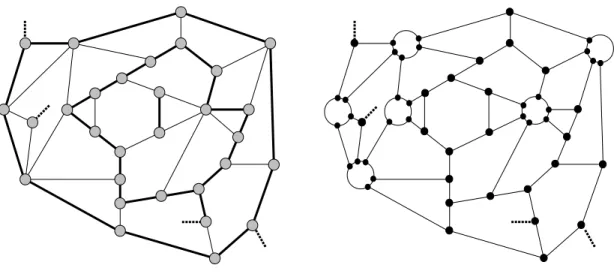
We next transformN1 into the desired N′, satisfying both parts in Definition2, by replacing every vertex v ∈ V1 such that p = degree(v) ⩾ 3 by an appropriate cycle with p vertices, say
{v1, . . . , vp}. Note thatg(v) =0inN1, becausedegree(v) ⩾3. Let the edges incident tovbe:
{e1, . . . , ep} = {e∈E1∣head(e) =vortail(e) =v}.
We introduce p new edges {e′1, . . . , e′p} to form a directed cycle connecting the new vertices
{v1, . . . , vp} and we make each new vertex vi the new endpoint of edge ei instead of vertex v,
for every1 ⩽ i ⩽ p. An example of the transformation from the vertex v to the directed cycle replacing it is shown in Figure 3.1. We complete the transformation by setting g(vi) = 0 and
U(e′i) =“very large number” for every1⩽i⩽p.
This transformation is repeated for every vertex in N1 of degree⩾ 3 to produce the desired networkN′. It is straightforward to check thatN′is a network in the modified form of Definition2 andN′ is equivalent toN. Because the number of newly introduced vertices and the number of newly introduced edges are each at most∑v∈V1degree(e), and since∑v∈V1degree(e) =2m1, we have:
∣V′∣ ⩽n1+2m1 ⩽n+m+4m=n+5m and ∣E′∣ ⩽m1+2m1=3m1⩽6m.
It is readily seen that the transformation fromN toN1, and then the transformation fromN1 to
ν
e
1e
2e
3e
4e
5 ν1 ν3 ν4 ν2 ν5e
1e
3e
4e
5e
2Figure 3.1:For the proof of Proposition3. Vertexvof degree5(on the left) is transformed into a cycle with 5vertices (on the right) each of degree3. The capacity of every new edge in the cycle is a “very
large number”.
3.3 Network Typings
For a precise definition of typings (Definition 4), we use standard notions of vector spaces and polyhedral analysis. A closed half-spaceH inRd is specified by anon-strict linear inequality:
H = {x ∈ Rd∣aTx ⩽ b} for some coefficient vectora ∈ Rd and scalar b ∈ R. The boundary ofH is thehyperplanespecified by the corresponding linear equality{x∈ Rd∣aTx= b}. The complement of H is an open half-spaceH′ specified by a strictlinear inequality: H′ = {x ∈
Rd∣aTx>b}.4
Anot-necessarily-closed convex(NNCC)polyhedronP in the Euclidean spaceRdiseitherthe intersection of a finite number of not-necessarily-closed half-spaces, ord=0 andP = ∅. More specifically, whend⩾1,P is the set of simultaneous solutions of finitely many linear inequalities, strict and non-strict, each of the form:
a1x1+ ⋯ +adxd & b (3.1)
where a1, . . . , ad, b ∈ Rand & ∈ {⩽,<}. In the rest of this chapter, we only need to consider inequalities5 of form 3.1 where a1, . . . , ad ∈ {0,±1}. As a result, every not-necessarily-closed
4
We reserved boldface names,e.g.,aandx, to denote vectors. To explicitly mention the entries ofa, we write them between angle brackets as⟨a1, . . . , ad⟩and view them as a column vector. As usual,aTis the transpose ofaandaTx
is the dot producta⋅x.
5
half-space has a unique representation in the form of equation3.1. Although our definition does not require it, all of our NNCC polyhedra will bebounded; we omit the qualifier for succintness. A special case of NNCC polyhedra are thecompact convex polyhedra, commonly calledpolytopes, when all defining linear inequalities are non-strict.
Definition 4(Network Typings). LetN = (V,E,U, g)be an additive flow network, with∣Ein,out∣ = d⩾2, accounting for at least one input edge and at least one output edge. Atyping forN is a finite set of disjoint NNCC polyhedra in the spaceRd, denoted byT = {P1, . . . , P`}, withPi∩Pj = ∅
for all1⩽i<j⩽`.
◻
Aninput/output assignment(orIO assignmentfor short) for the networkN = (V,E,U, g)is a functionf ∶Ein,out →R+which assigns a non-negative value to every outer edge. Assuming a fixed ordering of the outer edges inEin,out, an IO assignmentf specifies a point in the spaceRd, namely, the point⟨f(e) ∣e∈Ein,out⟩. For convenience, we use the names of the outer edges as the
names of thedcoordinates of the spaceRdrelative to that fixed ordering ofEin,out.
Definition 5 (Typing Satisfaction). Let N be an additive flow network, and T = {P1, . . . , P`}
a typing for N, as in Definition 4. We say an IO assignment f ∶ Ein,out → R+ satisfies T iff
⟨f(e) ∣e∈Ein,out⟩is a point in one of the NNCC polyhedra ofT,i.e., there isi∈ {1, . . . , `}such
that⟨f(e) ∣e∈Ein,out⟩ ∈Pi.
We say a flowf ∶E→R+ satisfiesT iff the corresponding IO assignmentf′ ∶Ein,out→R+
obtained by restrictingf toEin,outsatisfiesT.
◻
LetN be an additive flow network andT = {P1, . . . , P`}be a typing forN, as in Definitions4
and5. We introduce two notions,soundnessandcompleteness, with which we measure the extent to which the typingTis too restrictive or too liberal, as a constraint on IO assignments guaranteeing their safety,i.e., guaranteeing that they can be directed through the networkN without violating any of its internal constraints.
Soundness. T issoundiff every IO assignmentf ∶ Ein,out →R+satisfyingT is extendable to a feasible flow.
Completeness. T iscompleteiff every feasible flowf ∶E→R+satisfiesT.
Soundness meansT is restrictive enough to exclude all “unsafe” IO assignments. Completeness meansT is liberal enough to include all “safe” IO assignments. Expressed differently:
⋃T ⊆ {f ∶Ein,out→R+∣f is extendable to a feasible flow} (soundness ofT)
⋃T ⊇ {f ∶Ein,out→R+∣f is extendable to a feasible flow} (completeness ofT)
Definition 6(Principal Typings). LetN be an additive flow network andT = {P1, . . . , P`}be a
typing forN, as in Definitions4 and5. T is aprincipal typing forN iffT is both sound and
complete forN.
◻
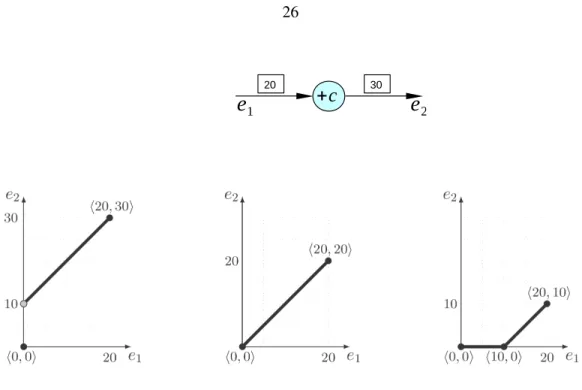
Example 7. At the top of Figure3.2is a one-vertex additive networkN in modified form (Defini-tion2). The additive gain isc. Whenc= +10, its principal typingT is a set of two disjoint NNCC polyhedra{P1, P2}, withP1= {⟨0,0⟩}and
P2= { ⟨r1, r2⟩ ∣0<r1⩽20,10<r2⩽30, r1+10=r2}.
Whenc = 0, N is a standard flow network and a principal typingT′ forN consists of a single NNCC polyhedronP′, which is in fact a polytope. In earlier reports [62,64] it is shown that for every standard networkN, there exists a unique principal typing consisting of exactly one polytope.
P′can be decomposed into two disjoint NNCC polyhedra{P1′, P2′}, withP1′= {⟨0,0⟩}and
P2′= { ⟨r1, r2⟩ ∣0<r1⩽20,0<r2⩽20, r1=r2}.
When c = −10, a principal typing T′′ can be written as a set of three disjoint NNCC polyhedra
{P1′′, P2′′, P3′′}, withP1′′= {⟨0,0⟩}and
P2′′= { ⟨r1,0⟩ ∣0<r1⩽10} and P2′′= { ⟨r1, r2⟩ ∣10<r1⩽20,0<r2⩽10, r1−10=r2},
30
e
2+
c
20
e
1Figure 3.2:For Example7, a one-vertex additive networkN (at the top) and its space of all feasible IO assignments whenc=10(left),c=0(middle), andc= −10(right), respectively. Additive gain
cis inserted in the vertex, upper-bound capacities are boxed edge labels. The shaded point in R2(on the left) is excluded from the feasible IO assignment space.
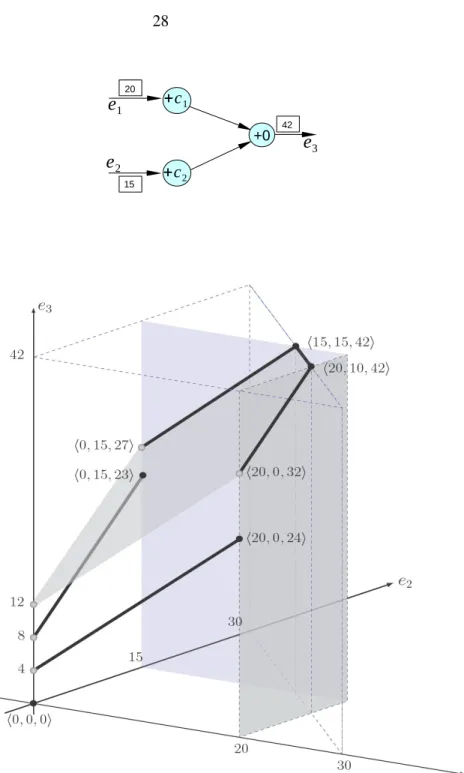
Example 8. On the left of Figure 3.3, there is a three-vertex additive network N in modified form (Definition 2) where the additive gains c1 and c2 are left unspecified. When c1 ⩾ 0 and
c2 ⩾0, a principal typingT forN consists of four disjoint NNCC polyhedra{P1, P2, P3, P4}in the Euclidean spaceR3, with:
P1 = { ⟨0,0,0⟩ },
P2 = { ⟨r1,0, r3⟩ ∈R3 ∣0<r1⩽20, c1<r3⩽min{20+c1,42}, r1+c1=r3},
P3 = { ⟨0, r2, r3⟩ ∈R3 ∣0<r2⩽15, c2<r3⩽min{15+c2,42}, r2+c2=r3},
P4 = { ⟨r1, r2, r3⟩ ∈R3∣0<r1⩽20, 0<r2⩽15, c1,2<r3⩽min{35+c1,2,42}, r1+r2+c1,2=r3},
where we writec1,2forc1+c2. Whenc1 =4andc2 =8, a graphical representation ofT is shown on the right of Figure3.3. Observe that, whenc1 =c2 =0, the four NNCC polyhedra ofT lie on the same hyperplane (namely, the hyperplane defined by the equatione1+e2 = e3) and together they collapse into a single polytope.
When one or both of {c1, c2} is negative, a principal typingT′ of N consists of five or six NNCC polyhedra. For a specific case, considerc1= −5andc2=8, in which case a principal typing
T′consists of five disjoint NNCC polyhedra{P1′, P2′, P3′, P4′, P5′}with:
P1′ = { ⟨0,0,0⟩ },
P2′ = { ⟨r1,0,0⟩ ∈R3 ∣0<r1⩽5},
P3′ = { ⟨r1,0, r3⟩ ∈R3 ∣5<r1⩽20, 0<r3⩽15, r1−5=r3},
P4′ = { ⟨0, r2, r3⟩ ∈R3 ∣0<r2⩽15, 8<r3⩽23, r2+8=r3},
P5′ = { ⟨r1, r2, r3⟩ ∈R3∣5<r1⩽20, 0<r2⩽15, 8<r3⩽38, r1+r2+3=r3}.
+0 20 15 42
e
1e
2e
3 +0 +4 +8 20 15 42e
1e
2e
3 +c2 +c1Figure 3.3:For Example8, a3-vertex additive networkN(at the top) and its principal typingT ⊆R3(at the bottom) whenc1=4andc2=8. Additive gains are inserted in vertices, upper-bound capacities are boxed numbers, missing upper-bound capacities are a “very large” number. Shaded points
and edges inR3are excluded from this networks feasible IO assignment space.
additive gain factor of every vertex is inserted in that vertex. As mentioned before, in this frame-work we do not assumeN is connected as a directed graph. A principal typingT forN consists of four disjoint NNCC polyhedra{P1, P2, P3, P4}in the Euclidean spaceR4, with:
P1 = { ⟨0,0,0,0⟩ }, P2 = { ⟨r1,0, r3,0⟩ ∈R4 ∣0<r1⩽20, 5<r3⩽25, r1+5=r3}, P3 = { ⟨0, r2,0, r4⟩ ∈R4 ∣0<r2⩽20, 0<r4⩽20, r2=r4}, P4 = { ⟨r1, r2, r3, r4⟩ ∈R4∣0<r1⩽20, 0<r2⩽20, 5<r3⩽25, 0<r4⩽20, r1+r2+5=r3+r4, r1+5=r3, r2=r4},
◻
30e
3 +5 20e
1 20e
4 +0 20e
2Figure 3.4:For Example9, a disconnected2-vertex additive networkN.
We use the names of the outer edges of networkN as the coordinates of the Euclidean space Rd, withd= ∣Ein,out∣.
LetC(P)be the set of constraints representing a NNCC polyhedronP ⊆Rd,i.e.P =Poly(C), where the operatorPoly(⋯)refers to the polyhedron in Rddefined by the enclosed inequalities and equalities. We say constraintC ∈ C is redundant iffC − {C}defines the same NNCC asP,
i.e.P =Poly(C − {C}).
We say an NNCC polyhedron P ⊆ Rd is ∅-adequate iff P is a singleton set containing the point0= ⟨0, . . . ,0⟩.
{1, . . . , d}to be the ordering onEin,out.
LetX ⊆ Ein,outbe a subset of the outer edges such thatX∩Ein ≠ ∅. We collect the indices
induced byXby defining:
Iin = {idx(e) ∣e∈X∩Ein}, Iout= {idx(e) ∣e∈X∩Eout},
J = {idx(e) ∣e/∈X}.
We poseI =Iin⊎Iout. We say an NNCC polyhedronP⊆RdisX-adequateiff there exists a unique (possibly empty) setC0of constraints defined onX(each of form3.1) s.t. one of the following two cases holds:
(†) Iin ≠ ∅ ≠ Iout and there are non-negative scalars {am,i, aM,i}i∈I∪ {bj}j∈J ∪ {cin} ⊆ R+
(subscripts “m” an “M” are for “min” and “max”, resp.) and a (possibly negative) scalar
cout∈Rsuch that:
P =Poly({am,i<ei⩽aM,i}i∈I ∪ {ej=bj}j∈J ∪ {0< ∑ i∈Iin ei⩽cin} ∪ { ∑ i∈Iout ei=cout+ ∑ i∈Iin ei} ∪ C0). (‡) Iin ≠ ∅,Iout = ∅, and there are non-negative scalars{am,i, aM,i}i∈I∪ {bj}j∈J ∪ {cin} ⊆R+
such that:
P=Poly({am,i<ei⩽aM,i}i∈I ∪ {ej=bj}j∈J ∪ {0< ∑ i∈Iin
ei⩽cin} ∪ C0).
Every constraint inC(P)is linear, where the coefficients of the variables involved are in the set
{0,−1,+1}. We also assume that in the adequate representation of an NNCCP, every constraint ofC(P)is non-redundant. It is left to reader and not hard to check that everyX-adequate NNCC
P, representing a set of IO assignments of some networkN has a unique representation, where
X⊆Ein,out.
By this definition, anX-adequate NNCC polyhedron is entirely contained in the first orthant
value of every dimension inXis positive and the value corresponding to every dimension not in
X is fixed (i.e.for every two point of p1, p2 ∈ P and every outer edge e ∉ X, the values of the dimension corresponding toeinp1is the same as that ofp2).
Definition 10(Typings in Adequate Form). LetN be an additive flow network andT = {P1, . . . , P`}
be a typing forN, as in Definitions4and5,i.e.,T is a set of pairwise disjoint NNCC polyhedra in Rd. We sayT is inadequate formiff for everyP ∈T there is a subsetX⊆Ein,outsuch thatP is
X-adequate.
◻
It is easy to extract an adequate representation of the typings shown in Examples7,8 and9. Notice that in theX-adequate representation of NNCCP4 in Example9we haveC0 = {r1+5 =
r3, r2 =r4}, whereX = {e1, e2, e3, e4}. In adequate representation of other NNCCs the setC0 is empty (the same holds for all NNCCs in Examples7and8).
3.4 Existence of Principal Network Typings
We prove the existence of a principal typing in adequate form for an arbitrarily given additive networkN (Theorem11), from which we can extract the value of a maximum flow inN (Corol-lary 15) efficiently. Theorem 11 does not estimate the cost of computing a principal typing in adequate form, which we study in Section3.5. We first describe the process of “disassembling” and “reassembling” a network, which provides a compositional approach for calculating the prin-cipal typing of a flow network.
LetN = (V,E,U, g)be an arbitrary network. The process of disassemblingN involves “cut-ting in halves” its internal edges: If internal edge e ∈ E# is cut in two halves, then we remove eand introduce a new input edge e+ with head(e+) = head(e) and a new output edge e− with
tail(e−) =tail(e). From the givenN, we define another networkBreakUp(N )where every inter-nal edgee∈E#is cut into two halves. LetE(+)# be the set of new input edges, andE
(−)
# the set of
new output edges. The input edges and output edges ofBreakUp(N )are therefore:Ein∪E(+)# and
If we callN0the disassembled network resulting fromBreakUp(N ), thenN0hasn= ∣V∣ ⩾1 one-vertex components and there are no internal edges inN0:
N0 = BreakUp(N ) = {M1,M2, . . . ,Mn}.
We reassemble the originalN by defining the sequence of networks:N0,N1, . . . ,NmwhereNm=
N andNk+1 =Bind(e,Nk)for every0⩽i<m= ∣E#∣, whereBindis the operation that splices e+ande−. What we call thereassembling sequenceΘis the order in which the internal edges are spliced,i.e., if:
N1=Bind(e1,N0), N2=Bind(e2,N1), . . . , Nm=Bind(em,Nm−1)
thenΘ =e1e2⋯em, where{e1, . . . , em} =E#. The external dimensionof a network component M, denoted byexDim(M), is the number of its input/output edges (dangling edges) ofM. For each of the intermediate networksNkwith0⩽i⩽m, we define:
index(Nk) ∶=max{exDim(M) ∣ Mis a component ofNk}
and alsoindex(Θ) ∶=max{index(N0),index(N1), . . . ,index(Nn)}.
Theorem 11(Existence of Principal Typings). For every additive flow networkN = (V,E,U, g), there exists a principal typingT = {P1, . . . , P`}in adequate form, as specified in Definitions4, 5,
and10.
Proof. We can assumeN is in modified form (Definition2) by Proposition3, and moreover that, for everyv∈V, ifg(v) ≠0thendegree(v) =2and ifdegree(v) =3theng(v) =0.
We disassembleN intoN0 =BreakUp(N ), consisting ofnseparate one-vertex components, and choose a particular reassembling sequenceΘ=e1e2⋯emso that ifN1=Bind(e1,N0), . . . ,Nm=
Bind(em,Nm−1),then for everyk⩾0, there is amain componentinNk, denotedÑk, withnk⩾1
vertices and (n−nk) one-vertex components. The latter one-vertex components are always a