R E S E A R C H
Open Access
New delay-dependent observer-based
control for uncertain stochastic time-delay
systems
Xiu-feng Miao
1*and Long-suo Li
2*Correspondence:[email protected]
1School of Basic Science, Harbin University of Commerce, Harbin, China
Full list of author information is available at the end of the article
Abstract
This paper considers the problem of estimating the state vector of uncertain stochastic time-delay systems, while the system states are unmeasured. The system under study involves parameter uncertainties, noise disturbances and time delay, and they are dependent on the state. Based on the Lyapunov–Krasovskii functional approach, we present a delay-dependent condition for the existence of a state observer in terms of a linear matrix inequality. A numerical example is exploited to show the validity of the results obtained.
Keywords: Stochastic system; State estimation; Asymptotical stability; Time delay; LMI
1 Introduction
Uncertain stochastic time-delay systems have come to play an important role in many branches of science and engineering applications. Some recent improved research results pertaining to the analysis for stochastic time-delay systems have been reported; see [1– 6] and the references therein. It is well known that the dynamic behaviour of many in-dustrial processes contains inherent time delays due to the distributed nature of the sys-tems [7–17]. Both time delay and uncertainties are inevitable in real applications. Sys-tems have difficulty keeping nice performances, because time delay and/or uncertainties often destroy the stability of systems. As regards being based on the size of the time de-lays of the systems, the criteria for time-delay systems can be classified into two groups: independent criteria and dependent criteria. Generally speaking, since delay-dependent conditions make use of information on the length of the delay, they are less con-servative than delay-independent ones. To obtain delay-dependent conditions, the main approaches consist of model transformations of an original system and the bounding tech-nique [18,19].
On the other hand, the availability for direct measurements of all the state variables is rare in practice. In most cases, we need to estimate unmeasurable state variables. For this particular task, a state observer is more common, in order to accurately reconstruct the state variables of the systems [20–24]. The problem of observer design for uncertain stochastic time-delay systems has been investigated by many researchers. For example,
the authors in [25] designed an exponent filter estimate state for stochastic nonlinear sys-tems with time delay by using a high-gain observer-based approach. The authors of [26] investigated a stochastic system with process noises and sensor noises, and they gave a design method of observer minimizing the upper bound of an error variance. In [27], the authors dealt with the output feedback sliding mode control for Itô stochastic time-delay systems. The delay-independent sufficient condition for the asymptotic stability in prob-ability of the overall closed-loop stochastic system was derived. To the best of the author’s knowledge, so far little work is available in the literature that addresses a delay-dependent condition of the existence of observer for uncertain stochastic time-delay systems.
This article considers state estimation for a class of Itô-type stochastic systems subject to time delay and parameter uncertainties. The system states are unmeasured. The stochas-tic system involves parameter uncertainties and time delay, and they are dependent on the state. The objective is to design a robust observer such that the dynamics of the estimation error is guaranteed to be asymptotically stable in the mean square. Attention is focused on the design of the gain matrix and the state-feedback controller. This paper derived an ob-server design method of uncertain stochastic time-delay systems by constructing a proper Lyapunov–Krasovskii functional and by making use of the free weighting matrix method. In [27], the authors obtained some theorems, but conclusions are independent of time delay. Consequently, this will largely restrict the applying area of the conclusions. The in-novation of this paper is that the delay-dependent sufficient condition for the existence of such a state observer for any admissible uncertainties is given. We present a new method to estimate the stochastic systems. Based on the new criterion, a delay-dependent con-dition for the existence of state observer is derived in terms of a linear matrix inequality (LMI), therefore it is in the sense of being conservative reduced. A numerical example is exploited to show the validity of the results obtained.
In this paper, we work on the complete probability space (Ω,F,P) with the filtra-tion Ft{t≥0} satisfying the usual conditions. Rn and Rm×n denote, respectively, the
n-dimensional Euclidean space and the set of allm×nreal matrices.L2[0,∞) is the space of
square-integrable vector functions over [0,∞).C2,1(Rn×R
+;R+) denotes the family of all
nonnegative functionsV(x(t),t) onRn×R
+that are continuously twice differentiable inx
and once differentiable int. Letτ> 0 and denote byC([–τ, 0];Rn) the family of continuous functionsϕfrom [–τ, 0] toRnwith the normϕ=sup
θ∈[–τ,0]|ϕ(θ)|, where| · |and ·
are the usual Euclidean norm inRnand theL
2[0,∞) norm, respectively.P> 0 means the
matrixPis symmetric positive definite, the notationU>V, whereUandVare symmetric matrices, means thatU–V is a positive definite matrix.E(x) stands for the expectation of stochastic variablex,BT represents the transposed matrix ofB,Idenote the identity matrix of compatible dimension; moreover, [A B∗D] = [BA BTD]. The shorthanddiag{F1, . . . ,Fn} denotes a block diagonal matrix with diagonal blocks being the matricesF1, . . . ,Fn.
2 Preliminaries
Consider the following stochastic time-delay systems described in Itô’s form:
dx(t) =A+ΔA(t)x(t) +Aτ+ΔAτ(t)
x(t–τ) +Bu(t)dt+Dx(t) dω(t), (1a)
x(t) =ϕ(t), t∈[–τ, 0], (1b)
wherex(t)∈Rnis the state,u(t)∈Rpis the control input,y(t)∈Rris the measured output, τ is a real constant time delay satisfying 0≤τ <∞.ϕ(t)∈C([–τ, 0];Rn) is a continuous vector-valued initial function, andω(t) is a one-dimensional Brownian motion satisfying
Edω(t)= 0, Edω2(t)= d(t).
Here,A∈Rn×n,Aτ∈Rn×n,B∈Rn×p,D∈Rn×n,C∈Rr×nare known real constant matri-ces of appropriate dimensions. Moreover,ΔA(t) andΔAτ(t) are unknown matrices rep-resenting time-varying parameter uncertainties, and they are assumed to be of the form
ΔA(t) ΔAτ(t)
=GF(t)H1 H2
, (2)
whereG,H1,H2are known real constant matrices andF(t) is an unknown time-varying
matrix function satisfying
F(t)TF(t)≤I, ∀t. (3)
The parameter uncertaintiesΔA(t) andΔAτ(t) are said to be admissible if both (2) and (3) hold.
Definition 1([28]) System (1a)–(1c) is said to be robustly asymptotically mean-square stable if for all admissible uncertainties (2) and (3) the following holds for any initial con-dition:
lim t→∞E
x(t) 2
= 0.
Remark1 Uncertain stochastic time-delay systems in the form of (1a)–(1c) are common in many branches of engineering applications [1,3,5]. It is observed that, in system (1a)– (1c), parameter uncertainties, Itô-type stochastic disturbances and time delay are con-sidered simultaneously, also they are dependent on the state. The aim of this paper is to design a state observer of system (1a)–(1c) such that dynamics of the estimation error is asymptotically stable in the mean square.
Before presenting the main results of this article, we first introduce the following several lemmas, which will be essential for later developments.
Lemma 1(Schur complement [29]) For a given the symmetric matrix X=XX11T X12 12X22
,the following conditions are equivalent:
(a) X< 0,
(b) X11< 0,X22–X12TX11–1X12< 0,
(c) X22< 0,X11–X12X22–1X12T < 0.
Lemma 2([27]) Let G,H and F(t)be real matrices of appropriate dimensions with F(t) satisfying F(t)TF(t)≤I.Then,for any scalarε> 0,we have
Lemma 3([30]) Let us have any positive definite matrix R> 0,scalarτ> 0.If there exists a vector function x(t) : [0,τ]→Rn,such thatτ
0 xT(s)Rx(s) ds and
τ
0 xT(s) ds are well defined,
then we have the following inequality:
–τ
τ
0
xT(s)Rx(s) ds≤–
τ
0
xT(s) ds·R·
τ
0
x(s) ds.
3 Main results
We design an observer to asymptotically estimate x(t). Let us propose the following Luenberger-type observer [31] of the uncertain stochastic time-delay system (1a)–(1c):
dx(t) =ˆ Ax(t) +ˆ Aτx(tˆ –τ) +Bu(t) +L
y(t) –Cx(t)ˆ dt, (4)
whereL∈Rn×ris the observer gain to be designed later. From (1a)–(1c) and (4), the error vectore(t) =x(t) –x(t) can be expressed asˆ
de(t) =A–LC+ΔA(t)e(t) +Aτ+ΔAτ(t)
e(t–τ) +ΔA(t)x(t)ˆ
+ΔAτ(t)x(tˆ –τ)
dt+Dx(t) +ˆ De(t)dω(t). (5)
We introduce the following new state variable for convenience:
¯
x(t) =Ax(t) +ˆ Aτx(tˆ –τ) +Bu(t) +L
y(t) –Cx(t)ˆ , (6)
¯
e(t) =A–LC+ΔA(t)e(t) +Aτ+ΔAτ(t)
e(t–τ) +ΔA(t)x(t)ˆ
+ΔAτ(t)x(tˆ –τ), (7)
then we rewrite the systems (4) and (5) as
dx(t) =ˆ x(t) dt,¯ de(t) =e(t) dt¯ +Dx(t) +ˆ De(t)dω(t). (8)
Next, we will analyze the stability of the observer system (4) and the error system (5). We aim at designing a gain matrix and a state-feedback matrix such that the error systems are asymptotically stable in the mean square. In the following theorem, we present a delay-dependent LMI condition for the observer design of the error systems withu(t)≡0.
Theorem 1 Consider the stochastic time-delay system(1a)–(1c)with u(t)≡0.The state observer has the form of (4).If there exist matrices P> 0,Q1> 0,Q2> 0,N1,N2,N3,N4,and
positive scalarε> 0satisfying the following linear matrix inequality(LMI):
⎡ ⎢ ⎢ ⎢ ⎢ ⎢ ⎢ ⎢ ⎢ ⎢ ⎢ ⎢ ⎢ ⎢ ⎣
(1, 1) (1, 2) (1, 3) 0 –N1 0 ATP 0 0 0
∗ (2, 2) 0 (2, 4) 0 –N3 CTYT (2, 8) PG 0
∗ ∗ (3, 3) 0 –N2 0 ATτP 0 0 0
∗ ∗ ∗ (4, 4) 0 –N4 0 ATτP 0 0
∗ ∗ ∗ ∗ –τ–1P 0 0 0 0 0
∗ ∗ ∗ ∗ ∗ –τ–1P 0 0 0 0 ∗ ∗ ∗ ∗ ∗ ∗ –τ–1P 0 0 0 ∗ ∗ ∗ ∗ ∗ ∗ ∗ –τ–1P 0 PG
∗ ∗ ∗ ∗ ∗ ∗ ∗ ∗ 1
4εI 0
∗ ∗ ∗ ∗ ∗ ∗ ∗ ∗ ∗ 1
4εI ⎤ ⎥ ⎥ ⎥ ⎥ ⎥ ⎥ ⎥ ⎥ ⎥ ⎥ ⎥ ⎥ ⎥ ⎦
with
(1, 1) =ATP+PA+Q1+DTPD+ 2εH1TH1+N1, (1, 2) =YC+DTPD,
(1, 3) =PAτ –N1+N2T, (2, 4) =PAτ –N3+N4T,
(2, 2) =ATP+PA–YC–CTYT+Q2+DTPD+ 2εH1TH1+N3,
(3, 3) = 2εH2TH2–Q1–N2, (4, 4) = 2εH2TH2–Q2–N4,
(2, 8) =ATP–CTYT,
then the error systems are asymptotically stable in the mean square,and the observer gain is given by L=P–1Y.
Proof LetP¯=0PP0> 0,Q¯ =Q1 0
0 Q2
> 0. Now we choose a Lyapunov–Krasovskii func-tional candidateV(x(t),ˆ e(t))∈C2,1(Rn×R+;R+) as follows:
Vx(t),ˆ e(t),t=xT(t) eT(t)P¯xT(t) eT(t)T
+
t
t–τ
xT(t) eT(t)Q¯xT(t) eT(t)Tds
+
t
t–τ
t
s
¯
xT(α)Px(¯ α) dαds+
t
t–τ
t
s
¯
eT(α)P¯e(α) dαds. (10)
By using Itô’s formula [32], we obtain the differential operator
LVx(t),ˆ e(t),t
= 2xˆT(t)Px(t) + 2e¯ T(t)Pe(t) +¯ Dx(t) +ˆ De(t)TPDx(t) +ˆ De(t)
+xˆT(t)Q1x(t) –ˆ xˆT(t–τ)Q1x(tˆ –τ) +eT(t)Q1e(t) –eT(t–τ)Q1e(t–τ)
+τx¯T(t)Px(t) –¯
t
t–τ ¯
xT(s)Px(s) ds¯ +τ¯eT(t)Pe(t) –¯
t
t–τ ¯
eT(s)P¯e(s) ds. (11)
By using the well-known Leibniz–Newton formula inequality, we have
ExˆT(t)N1+xˆT(t–τ)N2
ˆ
x(t) –x(tˆ –τ) –
t
t–τ ˆ
x(s) ds
= 0,
EeT(t)N3+eT(t–τ)N4
e(t) –e(t–τ) –
t
t–τ e(s) ds
= 0.
Using the properties of stochastic integral, one has
EeT(t)N3+eT(t–τ)N4
t
t–τ
Dx(t) +ˆ De(t)dω(t)
= 0.
Noticing Eq. (8), one has
ExˆT(t)N1+xˆT(t–τ)N2
ˆ
x(t) –x(tˆ –τ) –
t
t–τ ¯
x(s) ds
EeT(t)N3+eT(t–τ)N4
e(t) –e(t–τ) –
t
t–τ ¯
e(s) ds
= 0. (13)
Furthermore, we can also obtain the following two inequalities from Lemma3:
–τ
t
t–τ ¯
xT(s)Px(s) ds¯ ≤
t
t–τ ¯
xT(s) ds
·(–P)·
t
t–τ ¯ x(s) ds , (14) –τ t
t–τ ¯
eT(s)Pe(s) ds¯ ≤
t
t–τ ¯
eT(s) ds
·(–P)·
t
t–τ ¯
e(s) ds
. (15)
Adding the left sides of Eqs. (12) and (13) toLV(x(t),ˆ e(t),t), combining with (14) and (15), we have
ELVx(t),ˆ e(t),t≤EηT(t)Σ η(t), (16)
where Σ= ⎡ ⎢ ⎢ ⎢ ⎢ ⎢ ⎢ ⎢ ⎢ ⎣
(1, 1) (1, 2) PAτ–N1+N2T 0 –N1 0
∗ (2, 2) PΔAT
τ(t) (2, 4) 0 –N3
∗ ∗ –Q1–N2 0 –N2 0
∗ ∗ ∗ –Q2–N4 0 –N4
∗ ∗ ∗ ∗ –τ–1P 0
∗ ∗ ∗ ∗ ∗ –τ–1P
⎤ ⎥ ⎥ ⎥ ⎥ ⎥ ⎥ ⎥ ⎥ ⎦ + ⎡ ⎢ ⎢ ⎢ ⎢ ⎢ ⎢ ⎢ ⎢ ⎣ AT CTLT
AT τ 0 0 0 ⎤ ⎥ ⎥ ⎥ ⎥ ⎥ ⎥ ⎥ ⎥ ⎦
(τP)
⎡ ⎢ ⎢ ⎢ ⎢ ⎢ ⎢ ⎢ ⎢ ⎣ AT CTLT
AT τ 0 0 0 ⎤ ⎥ ⎥ ⎥ ⎥ ⎥ ⎥ ⎥ ⎥ ⎦ T + ⎡ ⎢ ⎢ ⎢ ⎢ ⎢ ⎢ ⎢ ⎢ ⎣
ΔAT(t) (A–LC+ΔA(t))T
ΔAT τ(t) (Aτ+ΔAτ(t))T
0 0 ⎤ ⎥ ⎥ ⎥ ⎥ ⎥ ⎥ ⎥ ⎥ ⎦
(τP)
⎡ ⎢ ⎢ ⎢ ⎢ ⎢ ⎢ ⎢ ⎢ ⎣
ΔAT(t) (A–LC+ΔA(t))T
ΔAT τ(t) (Aτ +ΔAτ(t))T
0 0 ⎤ ⎥ ⎥ ⎥ ⎥ ⎥ ⎥ ⎥ ⎥ ⎦ T , (17) with
η(t) =
ˆ
xT(t) eT(t) xˆT(t–τ) eT(t–τ) tt–τx¯T(s) ds tt–τe¯T(s) ds
T ,
(1, 1) =ATP+PA+Q1+DTPD+N1,
(1, 2) =ΔAT(t)P+PLC+DTPD,
(2, 2) = (A–LC+ΔA(t))TP+P(A–LC+ΔA(t)) +Q2+DTPD+N3,
By applying the Schur decomposition result, we can see thatΣ< 0 if and only if
⎡ ⎢ ⎢ ⎢ ⎢ ⎢ ⎢ ⎢ ⎢ ⎢ ⎢ ⎣
(1, 1) (1, 2) PAτ–N1+N2T 0 –N1 0 AT (1, 8) ∗ (2, 2) PΔAT
τ(t) (2, 4) 0 –N3 CTLT (2, 8)
∗ ∗ –Q1–N2 0 –N2 0 ATτ (3, 8)
∗ ∗ ∗ –Q2–N4 0 –N4 0 (4, 8)
∗ ∗ ∗ ∗ –τ–1P 0 0 0
∗ ∗ ∗ ∗ ∗ –τ–1P 0 0
∗ ∗ ∗ ∗ ∗ ∗ –τ–1P–1 0
∗ ∗ ∗ ∗ ∗ ∗ ∗ –τ–1P–1
⎤ ⎥ ⎥ ⎥ ⎥ ⎥ ⎥ ⎥ ⎥ ⎥ ⎥ ⎦
< 0, (18)
with
(1, 1) =ATP+PA+Q1+DTPD+N1,
(1, 2) =ΔAT(t)P+PLC+DTPD,
(2, 2) = (A–LC+ΔA(t))TP+P(A–LC+ΔA(t)) +Q2+DTPD+N3,
(2, 4) =P(Aτ+ΔATτ(t)) –N3+N4T,
(1, 8) =ΔAT(t),
(2, 8) = (A–LC+ΔA(t))T,
(3, 8) =ΔATτ(t),
(4, 8) = (Aτ +ΔAτ(t))T.
Noting that pre- and post-multiplying bydiag{I,I,I,I,I,I,P,P}and considering the con-dition (2) (3), we can write the matrix inequality (18) as
⎡ ⎢ ⎢ ⎢ ⎢ ⎢ ⎢ ⎢ ⎢ ⎢ ⎣
(1, 1) (1, 2) PAτ–N1+N2T 0 –N1 0 ATP 0
∗ (2, 2) 0 (2, 4) 0 –N3 CTLTP (A–LC)TP
∗ ∗ –Q1–N2 0 –N2 0 ATτP 0 ∗ ∗ ∗ –Q2–N4 0 –N4 0 ATτP
∗ ∗ ∗ ∗ –τ–1P 0 0 0
∗ ∗ ∗ ∗ ∗ –τ–1P 0 0
∗ ∗ ∗ ∗ ∗ ∗ –τ–1P 0
∗ ∗ ∗ ∗ ∗ ∗ ∗ –τ–1P
⎤ ⎥ ⎥ ⎥ ⎥ ⎥ ⎥ ⎥ ⎥ ⎥ ⎦
+H¯TF¯T(t)G¯T+G¯F(t)¯ H¯ < 0, (19)
with
(1, 1) =ATP+PA+Q1+DTPD+N1,
(1, 2) =PLC+DTPD,
(2, 2) = (A–LC)TP+P(A–LC) +Q2+DTPD+N3,
(2, 4) =PAτ –N3+N4T.
Here, H¯ = [(H1)1,1, (H1)2,2, (H2)3,3, (H2)4,4, (H1)5,1, (H1)6,2, (H2)7,3, (H2)8,4] denotes a block
84th blockH2, and all other blocks are zero matrices, i.e., ¯ H= ⎡ ⎢ ⎢ ⎢ ⎢ ⎢ ⎢ ⎢ ⎢ ⎢ ⎢ ⎢ ⎢ ⎢ ⎣
H1 0 0 0
0 H1 0 0
0 0 H2 0
0 0 0 H2
H1 0 0 0
0 H1 0 0
0 0 H2 0
0 0 0 H2
⎤ ⎥ ⎥ ⎥ ⎥ ⎥ ⎥ ⎥ ⎥ ⎥ ⎥ ⎥ ⎥ ⎥ ⎦ .
Similarly, G¯ = [(PG)2,1, (PG)2,2, (PG)2,3, (PG)2,4, (PG)8,5, (PG)8,6, (PG)8,7, (PG)8,8],
further-more,F(t) denotes a block diagonal matrix with diagonal blocks being the matrix¯ F(t). LetL=P–1Y. By utilizing Lemma2and the Schur decomposition result again, it follows
that the matrix inequality (19) is implied by the LMI (9) for a scalarε> 0, which guarantees thatELV(x(t),ˆ e(t),t) < 0. Hence, the trivial solution of the error system is asymptotically
stable in the mean square.
Remark2 A delay-dependent sufficient condition for the existence of the observer is given in Theorem1. It is easy to see that the LMI condition in (9) is dependent on the length of delay and is less conservative than the delay-independent ones. The largest upper bound of the delayτsuch that the LMI in (9) holds can be obtained by solving the following LMI problem:
max τ
subject to ε1> 0,ε2> 0,ε3> 0,P> 0,Q1> 0,Q2> 0 and the LMI (9).
Next, we consider the state-feedback-based controller problem for the stochastic time-delay systems (1a)–(1c). A time-delay-dependent LMI technique will be developed in order to obtain the state-feedback observer. The following theorem shows that the controller is reachable in the stochastic theory.
Theorem 2 Consider the uncertain stochastic time-delay system(1a)–(1c).The state ob-server has the form of (4).If there exist matrices P> 0,Q1> 0,Q2> 0,N1,N2,N3,N4,and
positive scalarsε> 0,σ> 0such that the following LMI is satisfied:
⎡ ⎢ ⎢ ⎢ ⎢ ⎢ ⎢ ⎢ ⎢ ⎢ ⎢ ⎢ ⎢ ⎢ ⎢ ⎢ ⎢ ⎢ ⎢ ⎣
(1, 1) (1, 2) (1, 3) 0 –N1 0 ATP 0 0 0 0 PB
∗ (2, 2) 0 (2, 4) 0 –N3 CTYT (2, 8) PG 0 0 0
∗ ∗ (3, 3) 0 –N2 0 ATτP 0 0 0 0 0
∗ ∗ ∗ (4, 4) 0 –N4 0 ATτP 0 0 0 0
∗ ∗ ∗ ∗ –τ–1P 0 0 0 0 0 0 0
∗ ∗ ∗ ∗ ∗ –τ–1P 0 0 0 0 0 0
∗ ∗ ∗ ∗ ∗ ∗ –τ–1P 0 0 0 PB 0
∗ ∗ ∗ ∗ ∗ ∗ ∗ –τ–1P 0 PG 0 0
∗ ∗ ∗ ∗ ∗ ∗ ∗ ∗ 1
4εI 0 0 0
∗ ∗ ∗ ∗ ∗ ∗ ∗ ∗ ∗ 1
4εI 0 0
∗ ∗ ∗ ∗ ∗ ∗ ∗ ∗ ∗ ∗ σI 0
∗ ∗ ∗ ∗ ∗ ∗ ∗ ∗ ∗ ∗ ∗ –1
3σI
with
(1, 1) =ATP+PA+Q1+DTPD+ 2εH1TH1+N1,
(1, 2) =YC+DTPD, (1, 3) =PAτ–N1+N2T,
(2, 4) =PAτ –N3+N4T,
(2, 2) =ATP+PA–YC–CTYT+Q2+DTPD+ 2εH1TH1+N3,
(3, 3) = 2εH2TH2–Q1–N2, (4, 4) = 2εH2TH2–Q2–N4,
(2, 8) =ATP–CTYT,
then the overall closed-loop stochastic time-delay system is asymptotically stable in the mean square.In this case,the observer gain is given by L=P–1Y and an appropriate robust
stabilizing state-feedback controller can be chosen as u(x) =Kx(t),ˆ K=σ–1BTP.
Proof Applying the controlleru(x) =σ–1BTPx(t) to the system (4), and similar to the proofˆ of Theorem1, we can obtainELV(x(t),ˆ e(t),t) < 0 if LMI (20) is satisfied. It implies that the trivial solution of the closed-loop system is asymptotically stable in the mean square.
Theorem2provides a delay-dependent sufficient condition for the existence of the ro-bust observer of uncertain stochastic time-delay systems by state feedback. A desired gain matrix and state-feedback controller can be obtained by solving the LMI (20).
Remark3 In [33], the state estimation method is given for a class of stochastic systems, but the stochastic disturbance is independent on the system state. However, the stochastic disturbance of uncertain systems we investigated in this paper is state dependent. In [34], the disturbance–observer design method is given for time-delay uncertain systems, and the considered uncertainties do not contain stochastic disturbances by Brown motion. The systems in this paper include not only parameter uncertainties but also a stochastic disturbance, it is derived that the closed-loop system maintains good stability despite the presence of parameter uncertainties and a stochastic factor by Brown motion. Then the method of this paper has some advantage in convergence property, the proposed method can be applied to a more general class of nonlinear systems.
4 Simulation study
In order to illustrate the usefulness and flexibility of the theory developed in the above section, we present a simple numerical example in this section.
Example1 We consider the uncertain stochastic time-delay system (1a)–(1c) with
A=
⎡ ⎢ ⎣
–1.5 0.2 0.2
–1.25 –1.3 1
1.1 0.2 –1.2
⎤ ⎥
⎦, Aτ=
⎡ ⎢ ⎣
–1.4 0.5 –0.6
–0.4 –0.2 –1.2
0.1 1 –1.6
⎤ ⎥ ⎦,
D=
⎡ ⎢ ⎣
–0.01 0.02 0.15
0.12 –0.03 0.02
0.06 –0.03 0.15
⎤ ⎥
⎦, B=
0.01 0.02 0.2
T
, C=
1 1 0
F(t) = 0.2sin(t), G=
0.01 0.02 0.2
T ,
H1=
0.03 0.03 0.01
, H2=
0.01 0.02 0.05
.
Solving LMI (20) yields the maximum allowable bound of the time delay asτ= 0.4454. This means that, for any time delayτ satisfying 0 <τ ≤0.4454, there exist a gain matrix and a state-feedback matrix such that the resulting augmented system is asymptotically stable in the mean square. For this example, if we choose the time delay asτ= 0.2, then, by using the Matlab control toolbox to solve the LMI (20), we obtain
P=
⎡ ⎢ ⎣
1.2345 –0.3159 –0.0001
–0.3159 0.9683 –0.1272
–0.0001 –0.1272 0.8011
⎤ ⎥
⎦, Q1=
⎡ ⎢ ⎣
1.5954 –0.1394 –0.3721
–0.1394 1.5292 –0.7039
–0.3721 –0.7039 1.2157
⎤ ⎥ ⎦,
Q2=
⎡ ⎢ ⎣
1.6596 –0.1156 –0.2824
–0.1156 1.6058 –0.6390
–0.2824 –0.6390 1.3066
⎤ ⎥
⎦, N1=
⎡ ⎢ ⎣
–0.9757 0.2730 –0.0499
0.2730 –0.4601 0.1040
–0.0499 0.1040 –0.9590
⎤ ⎥ ⎦,
N2=
⎡ ⎢ ⎣
0.4629 –0.1114 0.1730
–0.1114 0.1556 0.1018
0.1730 0.1018 0.5298
⎤ ⎥
⎦, N3=
⎡ ⎢ ⎣
–0.9673 0.2660 –0.0279
0.2660 –0.4891 0.0700
–0.0279 0.0700 –0.9134
⎤ ⎥ ⎦,
N4=
⎡ ⎢ ⎣
0.4289 –0.1119 0.1311
–0.1119 0.1588 0.0585
0.1311 0.0585 0.4984
⎤ ⎥
⎦, ε= 5.7143, σ= 0.7306.
By Theorem2, we can obtain the desired gain matrix and state-feedback matrix as fol-lows:
L=P–1Y=
0.1165 0.1139 0.1520
T
, K=
0.0825 0.1870 0.1845
.
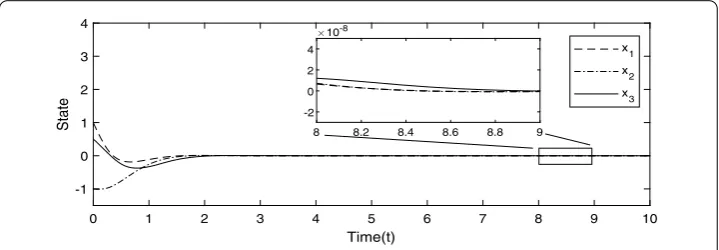
[image:10.595.118.478.585.710.2]State response trajectories for the open-loop and closed-loop systems are given. Fig-ure1is for the state response trajectories for the open-loop systems without uncertainties, Figs.2–4are the state response trajectories for the open-loop systems with uncertainties. We can see that the system is stable without parameter uncertainties and stochastic dis-turbances in Fig.1, but from Figs.2–4, the parameter uncertainties and stochastic dis-turbances makes the stability of the system decline. In [35], Higham gives a numerical
Figure 2Response trajectory ofx1for the open-loop systems with uncertainties
[image:11.595.117.485.391.537.2]Figure 3Response trajectory of statex2for the open-loop systems with uncertainties
Figure 4Response trajectory of statex3for the open-loop systems with uncertainties
simulation algorithm for the system with stochastic disturbances. Now, by using a sim-ilar approach, we take the initial parameters asx(t) = (1 –1 0.5)T,x(t) = (–1.5 1 –1.5)ˆ T, t∈[–0.2, 0], the simulation timet∈[0,T] withT= 10,δt=T/N, withN= 104, step size
t=RδtwithR= 5. Figures5–7show the average trajectories over eight paths ofx1(t),
x2(t) andx3(t) and their estimates, respectively. From the figures, we can see that the
sim-ulation result is satisfactory. The control performance of the state and parametric estima-tion is still very well despite the presence of the stochastic factor.
5 Conclusions
ex-Figure 5The simulation for statex1of the closed-loop systems with uncertainties
[image:12.595.115.479.233.373.2]Figure 6The simulation for statex2of the closed-loop systems with uncertainties
Figure 7The simulation for statex3of the closed-loop systems with uncertainties
istence of the observer are given. Also, the desired gain matrix and state-feedback con-troller are constructed by solving certain LMIs, which can be implemented by using the LMI control toolbox. Moreover, one can readily obtain the delay-dependent results on the existence of an observer for the uncertain stochastic time-delay system. The numerical ex-ample has demonstrated the effectiveness of the proposed method.
Conflicts of interest
The authors declare that there is no conflict of interests regarding the publication of this article.
Funding
[image:12.595.118.479.404.539.2]Availability of data and materials
Data sharing not applicable to this article as no datasets were generated during the current study.
Competing interests
The authors declare that they have no competing interests.
Authors’ contributions
All authors contributed equally to the writing of this paper. All authors read and approved the final manuscript.
Author details
1School of Basic Science, Harbin University of Commerce, Harbin, China.2Department of Mathematics, Harbin Institute of
Technology, Harbin, China.
Publisher’s Note
Springer Nature remains neutral with regard to jurisdictional claims in published maps and institutional affiliations.
Received: 8 July 2019 Accepted: 29 October 2019
References
1. Xu, S.Y., Lam, J., Chen, T.W.: RobustH∞control for uncertain discrete stochastic time-delay systems. Syst. Control Lett. 51, 203–215 (2004)
2. Nowak, M., Sigmund, K.: The evolution of stochastic strategies in the prisoner’s dilemma. Acta Appl. Math.20, 247–265 (1990)
3. Mao, X.R., Marion, G., Renshaw, E.: Environmental noise suppresses explosion in population dynamics. Stoch. Process. Appl.97, 95–110 (2002)
4. Wan, L., Zhou, Q.H.: Stochastic Lotka–Volterra model with infinite delay. Stat. Probab. Lett.79, 698–706 (2009) 5. Niu, Y.G., Ho, D.W.C., Lam, J.: Robust integral sliding mode control for uncertain stochastic systems with time-varying
delay. Automatica41, 873–880 (2005)
6. Wang, J., Li, C.: Stabilization of a class of stochastic systems with time delays. J. Appl. Math. (2014)
https://doi.org/10.1155/2014/274681
7. Malek-Zavarei, M., Jamshidi, M.: Time Delay Systems: Analysis, Optimization and Applications. North Holland, Amsterdam (1987)
8. Luan, X., Liu, F., Shi, P.: Finite-time filtering for non-linear stochastic systems with partially known transition jump rates. IET Control Theory Appl.45, 735–745 (2009)
9. He, Y., Wang, Q.G., Lin, C., Wu, M.: Delay-range-dependent stability for systems with time-varying delay. Automatica 43(2), 371–376 (2007)
10. Chen, L., Han, Z., Ma, Z.: Exponential stability for impulsive stochastic nonlinear network systems with time delay. J. Appl. Math. (2014)https://doi.org/10.1155/2014/787568
11. Sakthivel, R., Mathiyalagan, K., Marshal Anthoni, S.: Robust stability and control for uncertain neutral time delay systems. Int. J. Control85, 373–383 (2012)
12. Lu, R., Li, H., Zhu, Y.: QuantizedH∞filtering for singular time-varying delay systems with unreliable communication channel. Circuits Syst. Signal Process.31(2), 521–538 (2012)
13. Sun, J., Liu, G.P., Chen, J., Rees, D.: Improved delay-range-dependent stability criteria for linear systems with time-varying delays. Automatica46(2), 466–470 (2010)
14. Zhang, H., Liu, Z., Huang, G.B.: Novel delay-dependent robust stability analysis for switched neutral-type neural networks with time-varying delays via SC technique. IEEE Trans. Syst. Man Cybern., Part B, Cybern.40(6), 1480–1491 (2010)
15. Zheng, C.D., Shan, Q.H., Zhang, H., Wang, Z.: On stabilization of stochastic Cohen–Grossberg neural networks with mode-dependent mixed time-delays and Markovian switching. IEEE Trans. Neural Netw. Learn. Syst.24(5), 800–811 (2013)
16. Feng, Z.G., Lam, J., Gao, H.J.:α-Dissipativity analysis and synthesis of singular time-delay systems. Automatica47, 2548–2552 (2011)
17. Feng, Z.G., Lam, J., Yang, G.H.: Optimal partitioning method for stability analysis of continuous/discrete delay systems. Int. J. Robust Nonlinear Control (2013).https://doi.org/10.1002/rnc.3106
18. Park, P.: A delay-dependent stability criterion for systems with uncertain time-invariant delays. IEEE Trans. Autom. Control44, 876–877 (1999)
19. Moon, Y.S., Park, P., Kwon, W.H., Lee, Y.S.: Delay-dependent robust stabilization of uncertain state-delayed systems. Int. J. Control74, 1447–1455 (2001)
20. Wang, Z.D., Huang, B., Unbehauen, H.: RobustH∞observer design of linear time-delay systems with parametric uncertainty. Syst. Control Lett.42, 303–312 (2001)
21. Tong, S.C., Li, C.Y., Li, Y.M.: Fuzzy adaptive observer backstepping control for MIMO nonlinear systems. Fuzzy Sets Syst. 160(19), 2755–2775 (2009)
22. Liu, Y.G., Zhang, J.F.: Reduced-order observer-based control design for nonlinear stochastic systems. Syst. Control Lett. 52, 123–135 (2004)
23. Rathinasamy, S., Karimi, H.R., Raajananthini, K., et al.: Observer-based tracking control for switched stochastic systems based on a hybrid 2-D model. Int. J. Robust Nonlinear Control28(2), 478–491 (2018)
24. Sakthivel, R., Susana Ramya, L., Selvaraj, P.: Observer-based state tracking control of uncertain stochastic systems via repetitive controller. Int. J. Control48, 2272–2281 (2017)
26. Jung, J., Huh, K., Lee, T.H.: Observer design methodology for stochastic and deterministic robustness. Int. J. Control 81(7), 1172–1192 (2008)
27. Niu, Y.G., Ho, D.W.C.: Robust observer design for Itô stochastic time-delay systems via sliding mode control. Syst. Control Lett.55, 781–793 (2006)
28. Wang, C., Shen, Y.: Delay-range-dependent stability for uncertain stochastic systems with interval time-varying delay and nonlinear perturbations. Int. J. Comput. Math.89(8), 983–997 (2012)
29. Boyd, S., Ghaoui, L., Feron, E., et al.: Linear Matrix Inequalities in System and Control Theory. Studies in Applied Mathematics. SIAM, Philadelphia (1994)
30. Raja, R., Anthoni, S.M.: Stability criteria for stochastic recurrent neural networks with two time-varying delays and impulses. Int. J. Comput. Appl.1(28), 28–35 (2010)
31. Luenberger, D.G.: Observers for multi-variable systems. IEEE Trans. Autom. Control11, 190–197 (1966) 32. Mao, X.R.: Stochastic Differential Equations and Applications. Horwood, Chichester (1997)
33. Xie, L., Khargonekar, P.P.: Lyapunov-based adaptive state estimation for a class of nonlinear stochastic systems. Automatica48, 1423–1431 (2012)
34. Chen, M., Chen, W.H.: Disturbance-observer-based robust control for time delay uncertain systems. Int. J. Control. Autom. Syst.8(2), 445–453 (2010)