ISSN: 1992-8645 www.jatit.org E-ISSN: 1817-3195
719
APPLICATION OF CLONAL SELECTION ALGORITHM ON
IGNITION ADVANCED ANGLE OF HYDROGEN-FUELED
ENGINE
LIJUN WANG,DONGFEI WANG
Mechanical Engineering College, North China University of Water Resources and Electric Power, Zhengzhou, 450045, Henan, China
ABSTRACT
Clonal selection was a natural choice mode of immune system, in which the antibody with high affinity for antigen was promoted and the antibody with low affinity was restrained under the action of clonal selection mechanism. And Clonal Selection Algorithm (CSA) as one kind of searching methods adopted group search strategy, exchanged information between antibodies and achieved global optimal solution search by simulating the high variation and cloning characteristics of B lymphocyte. A simulation model of the best ignition advanced angle of hydrogen-fueled engine based on CSA was constructed. The advantages of CSA and the features of BP neural network were all adopted in this model. The simulation results show that this new model predicts the best ignition advanced angle of hydrogen-fueled engine quickly and accurately. What’s the important is that it overcomes BP neural network’s shortcomings of slow convergence speed and easily running into the local minimum value.
Keywords: Clonal Selection Algorithm, BP Neural Network, Ignition Advanced Angle, Hydrogen-Fueled
Engine
1. INTRODUCTION
As a substitute fuel of vehicle engine, Hydrogen is an ideal way to solve these problems of energy crisis and environmental pollution for its clean, permanent and regeneration advantages. However, there are still many problems to be solved in the process of putting hydrogen-fueled engine into reality as common as petrol engine, such as how to improve the maximum output power and how to restrain the abnormal combustion [1]. But optimizing and controlling the ignition angle is an effective method to solve these problems and improves the performance of hydrogen-fueled engine. The traditional methods controlling the ignition angle are through controlling the load and the revolving speed of the engine. The centrifugal advance machinery and vacuum advancer are commonly used controller devices. This method is simple linear control. It is difficult to realize precise control over the nonlinear system of the engine with this linear approach. However the electronic control ignition system can make this approach come true. This system completes combustion initialization and controls the ignition time according to the best advanced ignition angle data which the ECU calls from the ROM, on the basis of the load sensor information and rotational speed
sensor information. The electronic control ignition system makes the actual ignition angle of the engine approach the ideal ignition angle. But, there is still one problem needed to be solved. It is that a large number of the best advanced ignition angle data is to be needed, because the best ignition advanced angle changes along with engine operating conditions changing, and the engine operating conditions constantly changes.
720 agile and robust and can recognize and respond to recognized receptors within a single reference step. L. Liu and W.B. Xu [4] proposed a new artificial immune network for parallel affinity calculation of antibodies according to time complexity of AINFCM algorithm.
In this paper, the artificial immune system’s characteristics, high intelligent, parallel distributed search, selecting the memory and cloning are used to solve complicated issues of the best ignition advanced angle of hydrogen-fueled engine. This study shows that artificial immune algorithm has an outstanding advantage on forecasting the best ignition advanced angle.
2. BIONIC MECHANISM OF CLONAL
SELECTION ALGORITHM
In 2000, De Castro working in the University of Campinas in Brazil put forward Clonal Selection Algorithm (CSA) by simulating the clonal selection principle of B lymphocyte. CSA is one kind of searching methods which adopts group search strategy, emphasizes on information exchange between individuals in the group and completes the global optimal solution search by simulating the high variation and cloning characteristics of B lymphocyte. Because of the novel structure, keeping population diversity and high convergence speed, it is suitable for solving optimization problem of complicated functions.
2.1 Principle of Clonal Selection
The clonal selection is a natural choice mode of the immune system. In the immune system, the immune response process of producing antibodies is a learning process [5]. When a B lymphocyte was activated, it begins to clone a large number of cells like itself. In this process, the mutation probability is as 9 times large as the ordinary. Such a high probability can make a great difference in antibodies attached in offspring generation and parent generation, which strengthens the affinity of different antigens. If these new cells are capable to combine antigens beyond activation threshold, they can be activated and continue to clone next generation. Therefore, B lymphocytes with high affinity are more likely to be cloned. In other words, in the competition of B lymphocytes and pathogens, B lymphocytes with high affinity and high adaptability are more likely to be copied in the next generation. So this process is called the clonal selection process.
Clonal selection principle is used to describe the characteristics of the immune system, and in this principle only those B lymphocytes that can
identify antigen will be chosen and happen to propagate, while those who can't identify antigen will not be chose [6].
2.2 Steps of Clonal Selection Algorithm
Step1. Antigen recognition: making the problem to solve abstract into antigen form according to the immune system. Antigen recognition is corresponding solution of the problem.
Step2. Initial antibody group: defining antibody group as problems’ solution. The quality of the solution is assessed by the affinity between antibody and antigen. So the higher the affinity is, the better solution is.
Step3. Affinity calculation: calculating the affinity between antibody and antigen, and the affinity between antibody and antibody. The affinity between antibody and antibody is indicated by the hamming distance. According to the evaluation of affinity, the optimal individual is chosen and copied and produces temporary group that is composed by antibody and memory cells, namely the solution set after the evolution [7].
Step4. Differentiation of memory cells: making the antibody whose affinity with antigen is bigger to join memory cells. Because of the limited number of memory cells, these new antibodies will replace the low affinity memory cells.
Step5. The promotion and suppression of antibodies: promoting the higher affinity antibodies and suppressing the higher density antibody. Therefore, the effective methods to prevent premature convergence are restraining the antibody which reaches a certain scale and which is not the optimal solution. At the same time, improving the antibody of small scale is needed [8].
Step6. Group update: higher affinity antibodies joining memory cells. Higher affinity antibodies replace the memory cells which are selected from the antibody cells randomly, while the antibodies with low affinity will die automatically.
Step7. Evaluating new antibody group: if the antibody can't satisfy termination conditions, turn to step3 and begin again; if the antibody meets termination conditions, the current antibody is the best solution.
3. THE BEST ADVANCED ANGLE
OPTIMIZATION MODEL BASED ON CLONAL SELECTION ALGORITHM
ISSN: 1992-8645 www.jatit.org E-ISSN: 1817-3195
[image:3.612.125.282.514.709.2]721 (T), intake pipe pressure (p) and so on, which is a complex nonlinear function, namelyQopt = f n
(
, , ,ρ T p)
. It is very difficult to establish an accurate analytical formula to express the relationship between Qopt and these parameters. Now the MAP diagram of gasoline engines, which is composed of the best advanced ignition angle, is obtained through a large number of experimental simulations of the function relationQopt = f n(
,ρ)
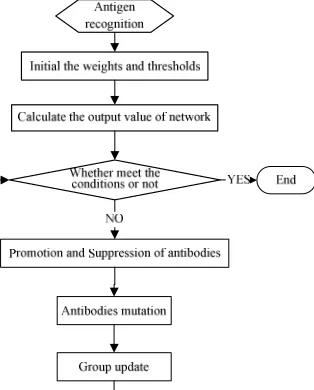
. However CSA is one kind of searching methods which adopts group search strategy emphasizes information exchange between individuals in the group and completes the global optimal solution search by simulating the high variation and cloning characteristics of B lymphocyte. Because of the novel structure, keeping population diversity and high convergence speed, it is suitable for solving optimization problem of complicated functions. Therefore, in this study there are only two parameters considered, the speed and the load having influence on the best ignition advanced angle. The CSA model is established and the optimal process is shown in Figure 1.The operation process of this new model is that: establishing BP network model and fitting out the complex function relations between the input and the output with generalization approximation characteristics of neural network [9]; then using the CSA characteristics of group search and rapid convergence, and finding weights and threshold value with higher affinity. Therefore this proposed model integrates the advantage of CSA and the BP network.
Figure 1: The Flow Chart of CSA Model
The following steps describe how to achieve CSA.
a. Coding mode
Because network weights and thresholds are expressed by real number, real number coding mode is adopted in this algorithm. Meanwhile, it can reduce the length of the string and speed up the speed of the algorithm. In this, the length of antibodyL is,L = (s + u + )v + u + , where s is the 1 1 number of input neurons, u is the number of output neuron and v is the number of hidden layer neurons.
b. Calculating the affinity between antibody and antigen
Each antibody (gm) is corresponding to weights and thresholds of BP network, and the antigen is corresponding to the error. The affinity ( F ) m
between antibody and antigen is defined as network error function (E ). m
1 1
m
m
F
E
=
+ (1)
where,
(
)
2s v
( p ) ( p )
m i i
p 1 i 1
E d 0
= =
=
∑ ∑
− (2)c. Calculation Antibody concentration
The antibody concentration is used to represent the similarity degree between antibody and the other individual in group. Here, the antibody concentration is calculated by measuring sum of distance with other antibodies [10].
1
N
m m n
n
d g g
=
=
∑
− (3)Where gm−gn is Euclidean distance in
m
g andgn,N is the number of antibodies. So the concentration Cmof antibody gm is:
m
m d
1 C
e
= (4)
The greater the concentration of antibody is, the more similar the antibody with other antibodies is. So when all antibodies are the same as others, the concentration of antibody is 1.
d. Antibody promotion and suppression According to the expectations of the survival antibody promoting antibodies with high affinity and restraining antibodies with high concentrations, the expectancy formula of antibody is as follows:
m m
m
F EX
C
722
4. ANALYSIS OF EXPERIMENT RESULT
The following is the application of CSA in the engine ignition advanced angle optimization. In this model, the BP neural network had three-layer-network-structure, in which input layer contained two neurons, hidden layer had 10 neurons, and output layer was one neuron. So the number of weights and thresholds was 41. The learning rate η was set 0.2, and error precision was set 0.001. According to the structure of neural network, the number of antibodies of CSA was set 80, and antibody length was 45. Because the cloning number n has a great influence on the convergence of algorithm, the number was set 8. Variation is an important operator of clonal selection, which maintains the population diversity and prevented the premature phenomenon. Here the high frequency variation rate was set 0.2. In this model, the fitness value was equal to the value of the decoding antibody. Termination condition was the maximum cycle times set 50.
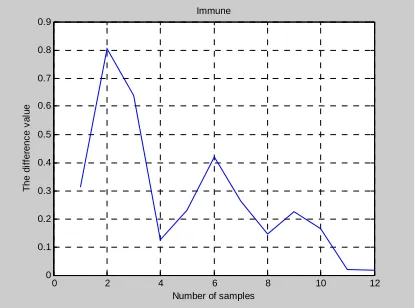
The difference value changing curve of training value and expected value of CSA and BP neural network are shown in Figure 2 and Figure 3, respectively.
0 2 4 6 8 10 12
0 0.1 0.2 0.3 0.4 0.5 0.6 0.7 0.8 0.9
Immune
Number of samples
T
h
e
d
if
fe
re
n
c
e
v
a
lu
[image:4.612.314.521.74.250.2]e
Figure 2: The Value Difference Change Curve Of CSA
0 2 4 6 8 10 12
0 0.1 0.2 0.3 0.4 0.5 0.6 0.7 0.8 0.9
BP network
Number of samples
T
h
e
d
if
fe
re
n
c
e
v
a
lu
e
Figure 3: The Value Difference Change Curve Of BP Network
[image:4.612.90.299.408.562.2]It is shown that the trend of difference value between training values and expected values of CSA turn down in 12 training samples from the Figure 2. The maximum difference value is 0.8, the minimum is 0.02, and the mean of 12 difference values is 0.28. While in Figure 3 we can see that the maximum difference value of BP neural network between training value and the expected value is 0.82, the minimum is 0.05, and the mean value is 0.3. Comparing to BP network, the training values of CSA are more closed to expected values.
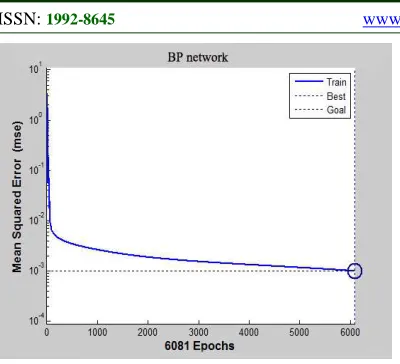
The changing curve of the training error with iteration times of CSA is shown in Figure 4 and the change curve of BP neural network is shown in Figure 5.
The error convergence curve of CSA is shown as Figure 4, from which we can see that when the iteration number comes up to 100, the error is closed to 0.01, and then the changing trend tends to be gentle. The error comes to 0.001, when the iteration number is 1776.
[image:4.612.314.518.526.688.2]ISSN: 1992-8645 www.jatit.org E-ISSN: 1817-3195
[image:5.612.92.292.72.254.2]723
Figure 5: The Convergence Curve Of BP Network
In Figure 5, it is shown the error convergence curve of BP neural network. When the iterations are 100, the error is 0.01 and the following changing curve trends gently. When iterations reach 6081, the error is 0.001. From above data, it was concluded that convergence speed of CSA was faster than that of BP neural network.
Operating BP algorithm and CSA each 5 times separately and listing iterations of error convergence in Table 1.
It can be seen that the iterative steps of BP network have bigger difference in Table 1. Because the initial values of training are different, BP algorithm performance is not stable, sometimes falls into local minimum values, which leads to the network be divergent, or the speed is very slow. However, iteration steps of CSA are relatively stable, and the number of each operation is very near. What’s the important is that the CSA can effectively avoid falling into local extremes. At the same time, it improves the algorithm convergence speed.
Table 1: Comparison Of Two Methods’ Training Iterations
Serial
number 1 2 3 4 5 AVG
CSA
iterations 2089 1428 1776 2048 1133 1695 BP
iterations 4954 6081 7132 4649 9004 6364
CSA time(s) 11 7 9 10 5 8.4
BP time(s) 28 32 38 24 49 34.2
5. THE CONCLUSION
In this paper, the new simulation model of hydrogen-fueled engine the best ignition advanced angle was constructed based on the CSA. Combining novel structure, diversity of population
and high convergence speed of CSA with BP neural network’s self-learning and adaptive characteristics, the proposed model can simulate and predict the ignition advanced angle effectively by using of the original MAP graph data tested by experiments.
The antibody promotion and suppression strategy of CSA keep this model with high rate of convergence, for it selects optimal ones from better ones.
Group update strategy of CSA can effectively keep the population diversity and avoid falling into local minimum.
With CSA training weights and thresholds, BP network can fit out optimal values closer to the expected values.
Therefore, experiment results showed that this proposed model was stable and high fitting, and it overcame the shortcomings of BP neural network, such as slow rate of convergence and falling into local minimum.
ACKNOWLEDGEMENTS
This work was supported by National Nature Science Foundation of China (51076046), Zhengzhou Measuring & Control Technology and Instrumentations Key Laboratory (121PYFZX181), HASTIT and Startup Research Foundation for High Level Talents of North China University of Water Resources and Electric Power.
REFERENCES:
[1] N. Saravanan, G. Nagarajan, S. Naray, “An experimental investigation on DI diesel engine with hydrogen fuel”, Renewable Energy, Vol. 33, No. 5, 2008, pp. 415-421.
[2] G.C. Silva, R.M. Palhares, W.M. Caminhas, “Immune inspired Fault Detection and Diagnosis: A fuzzy-based approach of the negative selection algorithm and participatory clustering”, Expert Systems with Applications, Vol. 39, No. 16, 2012, pp. 12474-12486. [3] K.A. Williams, F Garbanzo, C.L. Karr,
“Experimental implementation of an artificial immune system on a robotic manipulator”,
Applied Artificial Intelligence, Vol. 24, No. 3,
2010, pp. 175-193.
[4] L Liu, WB Xu, “A parallelized artificial immune network for fuzzy clustering”, International
Journal of Computer Mathematics, Vol. 87, No.
724 [5] L.N. Castro, F.J. Von. Zuben, “Clonal selection
algorithm with engineering applications”, Proc
GECCO'00, Vol. 1, 2000, pp. 36-37.
[6] L.N. Castro, F.J. Von. Zuben, “Learning and optimization using the clonal selection principle”, IEEE Transactions on Evolutionary
Computation, Vol. 6, No. 3, 2002, pp. 239-251.
[7] M. Bereta, Michal, T Burczynski, “Evolving ensembles of linear classifiers by means of clonal selection algorithm”, Control and
Cybernetics, Vol. 39, No. 2, 2010, pp. 325-342.
[8] L.S. Batista, D.B. Oliveira, F.G. Guimaraes, E.J. Silva, “Dynamic Multiobjective Clonal Selection Algorithm for Engineering Design”,
IEEE Transactions On Magnetics, Vol. 46, No.
8, 2010, pp. 3033-3036.
[9] A. Sedki, Ouazar, D. Ouazar, “Hybrid Particle Swarm and Neural Network Approach for Streamflow Forecasting”, Mathematical modeling of Natural Phenomena, Vol. 5, No. 7, 2010, pp. 132-138.
[10] C. McEwan, E. Hart, “On Clonal Selection”,
Theoretical Computer Science, Vol. 412, No. 6,