Munich Personal RePEc Archive
Accounting for Needs in Cost Sharing
Billette de Villemeur, Etienne and Leroux, Justin
August 2016
Online at
https://mpra.ub.uni-muenchen.de/73434/
Accounting for Needs in Cost Sharing
∗
´
Etienne Billette de Villemeur
Universit´e de Lille and Chaires Universitaires Toussaint Louverture
Justin Leroux
HEC Montr´eal, CIRANO and CR´
E
This version: August 9, 2016
Abstract
We introduce basic needs in cost-sharing problems so that agents with higher needs are not penalized, all the while holding them responsible for their con-sumption. We characterize axiomatically two families of cost-sharing rules, each favoring one aspect—compensation or responsibility—over the other. We also identify specific variants of those rules that protect small users from the cost externality imposed by larger users. Lastly, we show how one can implement these schemes with realistic informational assumptions; i.e., without making explicit interpersonal comparisons of needs and consumption.
Keywords: Cost Sharing; Needs; Responsibility; Liberal Egalitarianism.
JEL code: D63.
∗We thank seminar participants at the Montreal Environmental and Resource Economics
1
Introduction
Most allocation mechanisms rely only on demand, that is to say on what biologists would call wants. We argue in favor of introducing objective characteristics to com-plement this subjective input. Specifically, we study pricing formulas that do not penalize agents with higher needs.
Some public utilities, like water and wastewater services, are essential to achieving a decent standard of living. In a society where households differ in terms of their basic needs for utility services, these should be taken into account when setting utility rates. In practice, commendable efforts have been made in this regard, with rate schedules typically taking the form of multi-part tariffs (block pricing), including discounts given to households with higher needs (for the case of water supply in the US, see AWWA, 2012). These discounts can take the form of a rebate to low-income households, which is subsidized by a higher overall rate structure. Alternatively, increasing-block rate schedules subsidize the lowest block through rate premiums for large users, hence affording all households a low rate to meet basic needs. In the case of water services, this also addresses the issue of resource conservation.1 Nevertheless, while these practices recognize the fact that some households should be subsidized, the design of such subsidies, both in shape and in magnitude, is largely left to rule-of-thumb considerations.2
Our aim is to design a pricing scheme that does not penalize agents for having higher needs. As we shall see below, social transfers to finance the basic needs of the poor actually cannot achieve this. This is because what will remain to be paid will necessarily depend on their needs. Alternatively, adjusting prices to reflect differences in income may be unfeasible, either because it is too informationally costly or simply illegal. In fact, our objective is not quite the same as making essential consumption ’affordable’; we merely require that agents with higher needs are not at a disadvantage in their ability to achieve a given welfare level.
We develop a framework to formally take matters of partial responsibility into account when devising rates for utility services, which we will assume to be water
1
The recent move towards ”water budget-based rates” or, more accurately, to ”sustainable” rate design in some U.S. municipalities reflects these concerns (Barr and Ash, 2015; Barraqu´e and Montginoul, 2015; Dinar and Ash, 2015)
2
services to fix ideas.3 Each agent is summarized by her water consumption and her basic water needs, which may differ from one agent to the next. For instance, one can think of agents as being households of possibly different sizes. We take the view that agents should not be penalized for their needs, but are fully responsible for their consumption beyond those needs.
Our approach builds on the axiomatic framework of liberal egalitarianism, which aims at compensating differences in “non-responsibility” characteristics while reward-ing differences in characteristics under the agents’ control. Classically, agents are deemed responsible for their effort but have no control over their talents. Here, agents have no control over their basic water needs—say, 50 liters of clean water per day (Gleick, 1996)—but are responsible for their consumption beyond that amount. Thus, water consumption is a ’hybrid’ characteristic of sorts: the portion required to meet basic needs falls into the non-responsibility category, whereas the remainder falls into the sphere of responsibility.
A general theme of that literature is that the two desiderata of compensation and reward are incompatible (Bossert, 1995; Bossert and Fleurbaey, 1996; Cappelen and Tungodden, 2006). Accordingly, one must set less ambitious goals for redistributive policies. This is typically done by giving priority to one ideal—compensation or re-ward—while limiting the scope of the other (Fleurbaey 2008, and references therein), leading to the Egalitarian Equivalent and Conditional Equality solutions, respec-tively. Likewise, we characterize two polar families of solutions: Conditional Equality
solutions emphasize responsibility for excessive usage (Theorem 1) while Egalitarian Equivalent solutions stress compensation for differences in needs (Theorem 4).
Contrasting with previous results, the solutions we obtain are not unique because they depend on two additional dimensions that the literature is currently not equipped to handle: how to account for ’hybrid’ characteristics and how to account for cost externalities. The latter is embodied by the nonlinearity of the cost function, which links the agents through the requirement of balancing the budget. Regarding the for-mer, each family of solutions will produce different solutions whether one measures responsibility in terms of consumption (q) beyond needs (¯q), formallyq−q¯, or in terms of its fraction relative to one’s own needs, (q−q¯)/q¯, for example. We call these views
absolute responsibility and relative responsibility, respectively. When welfare can be
3
evaluated by means of a (common) utility function—i.e., when agents differ only in their needs—and when the responsibility measure is chosen so as to reflect the actual welfare of the agents—a more sophisticated exercise—Conditional Equality solutions are actually compatible with a much stronger compensation requirement than when responsibility is computed arbitrarily (Theorem 3). This implies that, when differ-ences in needs summarize the relevant differdiffer-ences across agents, sufficient knowledge of the utility function can afford greater compatibility between the desiderata of com-pensation and reward, a sharp contrast with existing results in the literature on liberal egalitarianism.
Even with a specific view on responsibility, much freedom remains regarding how to account for cost externalities within each family of solutions. Indeed, the par-tial responsibility approach determines what portion of the total cost is devoted to meeting basic needs. How to split the remainder—for which agents are deemed re-sponsible—falls into the realm of cost-sharing theory. In principle, any cost-sharing rule can be associated with each family of solutions and with each responsibility view. However, given the nature of the service at hand, when costs are convex we posit an axiom that protects parsimonious users from the cost externality caused by wasteful users. When costs are concave, so that there are economies of scale, we ask ’small users’ to fully benefit from a further reduction in their consumption. This charac-terizes unique solutions: theserial (Moulin and Shenker, 1992) and decreasing-serial
(de Frutos, 1998) cost-sharing variant of each family of solutions, respectively when costs are convex or concave (Propositions 2-5).
Lastly, we show how one can implement the above schemes with realistic informa-tional assumptions; i.e., without making explicit interpersonal comparisons of needs and consumption, which would prove very difficult and possibly counterproductive for all but very small populations. In particular, we use household size as a proxy for needs and denote by ¯qs the needs of a household of sizes. Using aggregate
infor-mation to summarize distributional aspects, we design rate schedules that otherwise explicitly depend on the sole individual characteristics of households.
For instance, consider affine costs of the formC(Q) = F+cQ, withF, c >0, where
Q is the aggregate demand of the population.4 When responsibility is measured by
4
absolute responsibility,q−q¯s, thedecreasing serial conditional equality solution5yields
the following rate schedule for households of sizes:
F +cQ¯
N +c(q−q¯s), (1)
where ¯Q is the quantity needed to cover the needs of the entire population, and N
is the total number of households. In addition to splitting the fixed cost equally, this rate schedule shares the cost of the population’s needs equally before pricing consumption at marginal cost (minus a rebate equal to the cost of meeting one’s own needs).
The rate schedule changes significantly under the relative responsibility view. As-suming responsibility is identically distributed across types, we obtain the following rate schedule for households of size s:
F N +
c
¯
qs/ Q/N¯
q (2)
The result is still a two-part tariff but one where only the fixed cost is split equally. No rebate is granted, and consumption is priced at a rate that is inversely proportional to one’s needs.
By contrast, the family of egalitarian equivalent solutions is based on utility com-parisons with households having a hypothetical reference level of needs, ¯q0, chosen by the planner. Under the decreasing serial egalitarian equivalent solution, which emphasizes compensating differences in needs over responsibility, the rate schedule for households of size s is as follows:
F
N +cq+ [us(q,q¯s)−us(q,q¯0)]−
1
N
X
t
Z ∞ z=0
[ut(z,q¯t)−ut(z,q¯0)]nt(z)dz,
where us(q,q¯s) is the utility of a representative household of size s and where ns(q)
is the density of households that are consuming q units in the distribution of size-s
households. The cost-sharing portion of the schedule, F
N +cq, splits the fixed cost
equally and prices consumption at marginal cost. Needs are completely absent from that component. However, they enter in the remaining, redistributive portion to
5
ensure that heterogeneity in needs does not drive differences in welfare.
The remainder is organized as follows. The next section offers a brief discussion of the related literature. Section 3 presents the formal model. In Section 4, we take the cost-sharing rule as given in order to focus on our contribution; namely, the introduction of essential needs in cost-sharing problems. We then introduce a specific property of the rate function, which aims at protecting small users while still holding them accountable, and show how doing so calls for adopting a specific underlying cost-sharing rule depending on the convexity of the externality (Section 5). Finally, we show in Section 6 how these abstract formulas actually boil down to specific two-part tariffs for which we provide an explicit and complete determination using only coarse information on characteristics of the population.
2
Related Literature
Liberal egalitarianism. Our work expands the literature on liberal egalitarianism in two ways. First, we extend the theory to settings with externalities. To our knowledge, the only other effort in this direction is Billette de Villemeur and Leroux (2011), which tackles the issue of global climate change and the design of transfer schemes between countries to account for their responsibility in current emissions and, possibly, their non-responsibility in past emissions. Externalities are introduced through a (nonlinear) damage function, but basic needs are absent from their setting. Our second contribution has to do with our consideration of a characteristic—here, consumption—for which one is both partly responsible and partly non-responsible. Ooghe and Peichl (2014) and Ooghe (2015) very recently introduced the notion of ’partial control’ over some characteristics to handle different degrees of responsibility in any given characteristic. According to this ’soft cut’, an agent may be responsible for, say, only 30% of his intellectual skills, the remainder being attributable to inborn abilities or environmental factors. Our view of consumption as a hybrid characteristic differs from theirs in that we deem households fully non-responsible for the portion aimed at satisfying their needs, but fully responsible for the remaining portion, viewed as discretionary.
interpre-David, 1959; Morgan, 1962). How to account for differences in ability and needs is still the topic of lively discussions in public economics, in particular in the literature on taxation, but not only (e.g., Mayshar and Yitshaki, 1996, Trannoy, 2003, Duclos et al. 2005, Duclos and Araar 2007). Ebert (1997) adopts an axiomatic approach to discuss the comparison of income distributions when the population consists of heterogeneous households. Observing that economic growth had done very little for the poorer half of the third world population, some economists at the World Bank have pointed out the importance of looking at basic needs (Streeten and Burki, 1978; Streeten, 1979; Hicks and Streeten, 1979). Similarly, rather than being concerned with the ’afford-ability’ of services to low-income households, as do most approaches to rate setting, we focus on the material—as opposed to the financial—needs of households.
Fair division. Despite mounting empirical evidence suggesting that needs are a relevant ingredient of fairness (Konow, 2001; Traub et al, 2005; Schwettman, 2012), the literature on fair division has only recently considered basic needs in a formal fashion. Specifically, although in a setting different from ours, Berganti˜nos et al. (2012) and Manjunath (2012) modify the classical rationing problem—where a fixed social endowment must be divided among several recipients—to account for a minimal requirement. There, agents are indifferent between receiving less than this minimal share and receiving nothing.
Because we ask for full cost recovery, the relevant strand of the fair division liter-ature is that of cost sharing. Yet, this literliter-ature does not explicitly address the issue of basic needs. The closest work in that direction lead to sharing rules that protect small users when costs are convex (Moulin and Shenker, 1992) or guarantee that small users will indeed be rewarded from reducing their consumption to the tune of their effort (de Frutos, 1998). We build upon these two sharing rules to complement our approach (Section 5).
3
Accounting for Needs
The Model. Let N ={1, ..., n} be the set of agents. Agent i consumes a quantity
qi ≥ 0 of water. Serving all of the agents’ demands Q = Pni=1qi costs C(Q) ≥ 0,
where C is an increasing cost function.6
6
Full cost recovery is essential to the sustainability of the infrastructure.7 Thus, we require that the agents’ water bills, xi’s, cover the total cost:
n
X
i=1
xi ≥C(Q) . (3)
We denote by Γ the class of cost functions. Our aim is to define appropriate formulas to compute the agents’ bills. We restrict ourselves to the case where no profits are made, owing to the public nature of the service, so that the budget constraint (3) is binding.
The needs of agent i, in terms of water use, are denoted ¯qi ≥ 0. We adopt a
quasi-linear setup, where agent i’s utility level is defined by:
Ui(qi,q¯i, x) = ui(qi,q¯i)−xi.
The utility functionui, which is possibly agent specific, is defined onD≡
(x, y)∈R2
+|x≥y .8 It is assumed to be increasing in qi and decreasing in ¯qi. We denote by Υ the class
of utility functions. When agents consume exactly their needs, they share a common utility level u that, without loss of generality, we can set to zero. Formally,
ui( ¯qi,q¯i)≡0, ∀¯qi ≥0,∀i∈N.
Defining responsibility. Our aim is to design a pricing rule that does not penalize agents with higher needs while taking individual responsibilities into account. In order to do so, we must define the sphere of responsibility of the agents. We consider that agents are not responsible for their essential needs, ¯qi, but are responsible for any
consumption beyond those needs. The extent of their responsibility can be measured in many different ways. For the sake of generality, we define a real-valued function,
positive’, and use ’nonnegative’ when zero is not excluded.
7
For example, while it remains an empirical matter whether pricing water actually leads to economic efficiency in practice, it is widely recognized that full cost recovery is essential to the sus-tainability of the infrastructure (Massarutto, 2007; AWWA, 2012; Canadian Water and Wastewater Association, 2015) and is “a key preoccupation” of many OECD countries (OECD, 2010). Still in the context of water services, Massarutto (2007) identifies three important benefits of recovering costs through the pricing structure: to “ensure the viability of water management systems”, to “maintain asset value over time”, and to “guarantee the remuneration of inputs”.
8
con-r1(¯q1, q1)
r2
(¯
q2 ,q2
)
¯ q
q
¯
q2
q2
¯
q1 q1
C
( ¯Q)
C( Q
)
equal resp
onsib ility
(absol ute)
equal r espons
ibility (relat
[image:10.612.93.480.89.335.2]ive)
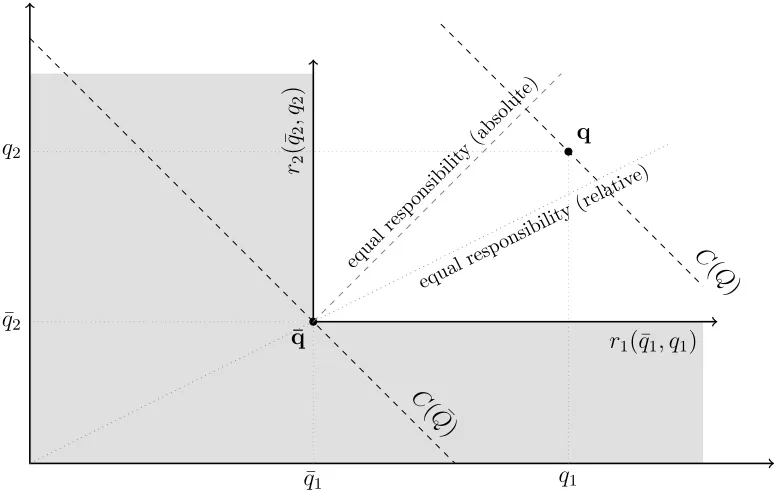
Figure 1: Responsibility is measured from q¯. Given the position of q relative to q¯
in this figure, if responsibility is defined as qi−q¯i (absolute responsibility) agent 1 is
considered to bear more responsibility than agent 2 in her discretionary consumption. If it is defined as (qi−q¯i)/q¯i (relative responsibility), the reverse holds.
r(qi,q¯i), defined on D, which is increasing in water consumption qi, non-increasing
in needs ¯qi, and normalized to zero when qi = ¯qi. When no confusion is possible,
we abuse notations slightly by denoting ri = r(qi,q¯i). We denote by R the class of
responsibility functions.
A consumption-needs profile (or simplya profile) is a list of nconsumption-needs pairs that we shall denote (q,¯q)∈Dn, abusing notations slightly.9
Rate functions and cost-sharing rules. Having defined the notion of
re-sponsibility, we can now share the total cost according to the responsibility profile,
r≡(r1, r2, ..., rn). In doing so,cost-sharing rules(ξ) will allow us to highlight the
dis-tinction between the handling of the production externality—governed by the shape of the cost function—and the redistribution problem that follows from taking
essen-9
tial needs into account. We ultimately provide pricing formulas, that we shall refer to as rate functions (x).
Formally, let C(q,¯q) stand for the portion of the cost for which the population is considered to be responsible, once needs are accounted for. The principles of liberal reward and compensation will guide us in defining C(q,q¯). A cost-sharing rule is a mapping that splits this portion of the cost across users: ξ : Rn×Γ → Rn, such that P
iξi(r,C) = C(q,¯q). By contrast, a rate function takes all the information in
the economy into account and is a mapping x : Dn ×R×Υ×Γ → Rn such that
P
i∈Nxi(q,¯q, r, u, C) =C(Q) whereC(Q) is the total cost to be covered.
Section 6 will be devoted to obtaining explicit formulas based on illustrative ex-amples. Until then, fix the cost function, C, the common utility function,u, and the responsibility function, r. As a result, we abuse notations slightly and write x(q,¯q) instead of the more cumbersome x(q,¯q, r, u, C).
4
Fair Treatment
4.1
Interdependence and Anonymity
A natural and seemingly minimal fairness requirement is that two agents with iden-tical needs face the same pricing schedule:
Axiom. (Equal Rate Schedule for Equal Needs, ERSEN)
The functions qi 7→xi(q,¯q) and qj 7→xj(q,¯q) must be identical whenever q¯i = ¯qj.
As it turns out, however, ERSENis unfeasible:
Theorem 1. No rate function satisfies ERSEN unless the cost function is linear.
Proof. Let (q,¯q)∈Dn such that ¯qi = ¯qj for some i6=j. By budget balance, the rate
schedule of agent 1, f :q′
i 7→xi((qi′,q−i),q¯), writes as follows:
f(q′
i)−f(qi) =C(Q−qi+q′i)−C(Q) ∀q ′
i ∈[¯qi,+∞). (4)
By ERSEN, the function f cannot depend on qj, so that :
f(q′
i)−f(qi) = C Q−qi+q ′
i−qj+q ′ j
−C Q−qj +q ′ j
for all q′ i, q
′ j
∈[¯qi,+∞)×[¯qj,+∞). Taken together, Expressions (4) and (5) yield:
C(Q−qi+qi′)−C(Q) = C Q−qi+qi′−qj+q′j
−C Q−qj +qj′
, (6)
for all q′ i, q
′ j
∈[¯qi,+∞)×[¯qj,+∞).
Already, Expression (6) suggests that C increases at a constant rate. We prove this formally by rewriting the expression as a Cauchy functional equation. Leth >0 and consider q′
i =qi+h and qj′ =qj +h. Expression (6) becomes:
C(Q+h)−C(Q) = C(Q+ 2h)−C(Q+h) ∀h≥0. (7)
Rearranging and defining g :h7→C(Q+h) on R+ yields:
g(2h) +g(0) = 2g(h) ∀h≥0. (8)
Expression (8) must hold for allhand thus defines a functional equation ing. This is a well-known Cauchy equation (Acz´el, 1967), which requires g—and therefore C—to be linear in its argument. Having started from an arbitrary profile (q,¯q), linearity follows on the full domain ofC.
ERSEN effectively requires that the rate schedule an agent faces depends only on the profile of needs, but not on the consumption vector. However, this ignores the interdependence that exists between agents through the cost function. Theorem 1 makes it clear that, if this interdependence is not accounted for, rate schedules cannot be determined ex ante, on the sole basis of needs.10 It follows that we must depart from the simplistic view according to which agents can ignore the impact they have on others, as is assumed to be the case under perfect competition, for instance. We therefore adopt a more comprehensive view in which bills depend explicitly on the entire profile of consumption and needs.
Moreover, just as individuals cannot be considered in isolation, essential needs can-not be handled separately from consumption beyond them. Financing the provision of essential needs ( ¯Q) through, say, the income tax—and having agents pay forQ−Q¯
through a pricing scheme that depends on the sole qi’s, ignoring the ¯qi’s—would not
solve our problem. In fact, agents’ bills would be required to financeC(Q)−C Q¯
,
10
which depends explicitly on ¯Q. This is in contradiction with the fact that once essential needs have been financed, they can be ignored in pricing the remaining consumption.
Even worse, if agents’ bills were to depend solely on the qi’s, an agent whose
needs happened to increase but whose consumption remained unchanged would end up paying the same amount despite a lower responsibility in consumption. This can lead to situations where one agent ends up paying more than another despite having both lower responsibility and higher needs. Indeed, consider any i such that
qi > qj > q¯j for some j 6= i. Nevertheless, her needs can increase to some level
¯
qi ∈ (¯qj, qi) such that ri < rj even though she ends up paying more than j (because
qi > qj).
In addition, budget balance would necessarily be violated. Suppose the needs of the population happen to decrease, while again consumption remains unchanged. Then, the portion of costs that must be financed through pricing—C(Q)−C Q¯
—increases and revenue requirements are no longer met.
We shall thus stick to our encompassing approach, which aims at financing the total cost, C(Q), by accounting jointly for theqi’s and the ¯qi’s.
The fairness requirement we shall adopt is that the rate function satisfiesanonymity. Formally, we shall require that, for any permutation of the agents π :N →N:
xπ(i)(qπ;¯qπ) =xi(q;q¯) for all i∈N,
where qπ (resp. ¯qπ) is the vector of consumption (resp. needs) after permutation of
the agents along π.
Remark 1. Anonymity implies the equal treatment of equals: (qi,q¯i) = (qj,q¯j) =⇒
xi(q;q¯) = xj(q;q¯). Two users with identical needs and identical consumption must
pay the same bill.
4.2
The Reward Principle: Responsibility Axioms
A minimal requirement in terms of responsibility is that the portion of costs resulting from consumption above and beyond the needs of the population, C(Q)−
C( ¯Q), be distributed to users according to their contribution to this cost. This leads us to introducing a cost-sharing rule, ξ, to split C(Q) −C( ¯Q) according to the responsibility profile, r. Keeping with the desideratum of anonymity, we shall consider only symmetric cost-sharing rules:
ξ r, C −C( ¯Q)
is a symmetric function of the variables ri, i∈N.
The functionξ embodies how we want to hold agents accountable for their consump-tion.11 Given ξ, the following axioms specify how responsibility is assigned, and are presented in decreasing order of stringency.
Axiom. (Shared Responsibility, SR)
xk(q,¯q)−xk(¯q,q¯) =ξk(r, C−C( ¯Q)) ∀k∈N
A less demanding axiom consists in sharing C(Q)− C( ¯Q) according to ξ only when all agents have equal needs.
Axiom. (Shared Responsibility for Uniform Needs, SRUN)
[¯qi = ¯qj,∀i, j ∈N] =⇒
xk(q,q¯)−xk(q¯,q¯) = ξk(r, C −C( ¯Q)),∀k ∈N
Finally, an even less demanding axiom consists in sharing costs according to ξ
only when the needs of all are identical and equal to a reference level, ¯q0 ∈R+.
Axiom. (Shared Responsibility for Reference Needs, SRRN)
For some reference level of needs, q¯0 ∈R+:
[¯qi = ¯q0,∀i∈N] =⇒ [xk(q,¯q0)−xk(¯q0,¯q0) = ξk(r0, C −C(nq¯0)),∀k∈N]
where q¯0 = (¯q0,q¯0, ...,q¯0) and r0,i =r(qi,q¯0) for all i∈N.
11
If needs were not an issue, we would be back to the classical cost-sharing framework where
4.3
The Compensation Principle: No Responsibility for One’s
Needs
Throughout, we take the view that agents are not responsible for their needs. Ideally, difference in needs should not drive differences in welfare:
Axiom. (Group Solidarity, GS)
For any i ∈ N and any two profiles (q,q) and (q,q′
) such that q′
i 6=qi and q ′ j = qj
for all j ∈N\ {i}, then
[ui(qi,q¯ ′ i)−x
′
i]−[ui(qi,q¯i)−xi] =
uj qj,q¯ ′ j
−x′ j
−[uj(qj,q¯j)−xj],
for all j ∈N, where x=x(q,q) and x′
=x(q,q′
).
Another, weaker approach consists in requiring that when two agents bear an equal responsibility, their welfare should be equal:
Axiom. (Equal Welfare for Equal Responsibility, EWER)
ri =rj =⇒ ui(qi,q¯i)−xi =uj(qj,q¯j)−xj
We shall also consider a weaker axiom, which consists in requiring equality of welfare only if all agents bear an equal responsibility:
Axiom. (Uniform Welfare for Uniform Responsibility, UWUR)
[ri =rj,∀i, j ∈N] =⇒ [ui(qi,q¯i)−xi =uj(qj,q¯j)−xj,∀i, j ∈N]
An even weaker axiom consists in having the same requirement only if this common level of responsibility is equal to a reference level:
Axiom. (Uniform Welfare for Reference Responsibility, UWRR)
For some reference responsibility level, r0 ∈R+ :
[r(qi,q¯i) = r0,∀i∈N] =⇒ [ui(qi,q¯i)−xi =uj(qj,q¯j)−xj,∀i, j ∈N]
4.4
Pricing Mechanisms
We now turn to the design of pricing mechanisms. The principles of responsibility and compensation will determine how to allocate the cost of meeting the needs of the population, C Q¯
, but not only. As we shall see, these principles will also interact with how the cost C(Q)−C Q¯
, is to be split. The two portions of the cost cannot be considered in isolation.
Conditional Equality: SR+UWRR
Turning first to rate functions that prioritize holding agents responsible for their consumption, we identify the strongest compensation axioms compatible with SR.
We find thatUWRRandSRjointly characterize a family of rate functions, which we callConditional Equality solutions,12that is parametrized by the choice of a reference responsibility level, r0:
Theorem 2. A rate function x satisfies SR and UWRR if and only if x = xCE
where, for some reference level r0 >0,
xCEi (q,¯q) =
C Q¯
n +ξi r, C −C( ¯Q)
+ui qi0,q¯i
− 1
n
X
j∈N
uj qj0,q¯j
,
for all i∈N, where q0
i is defined by r(q0i,q¯i) = r0.
Proof. In Appendix A.1.
A special variant of the Conditional Equality solutions consists in choosing zero responsibility as a reference: q0 = q¯. This implies charging households the same
fee to meet their own needs, whatever those needs may be. Should they choose to consume more, they would bear the consequences according to the cost-sharing rule in effect.
Corollary 1. The unique rate function satisfying SRand UWMCis the following:
xCE0
i (q,q¯) =
C Q¯
n +ξi(r, C−C( ¯Q)) for all i∈N.
12
A limit of xCE0 is that compensation for needs is established on the basis of a single scenario which is unlikely to ever arise. However, it possesses the advantage of not requiring knowledge of the utility function.
Theorem 2 is generically tight becausexCEgenerically does not satisfy the stronger
compensation axiomUWUR. The only exception is when the agents share a common utility function and the responsibility function, r, reflects the utility derived by the agents:
Proposition 1. xCE does not satisfy UWUR unless the following two assertions
are true:
(1) all agents share a common utility function; i.e., ui =u∈Υ, for all i∈N
(2) the responsibility function co-varies with agents utility; i.e., r = ρ◦u, for some increasing function ρ:R→R+.
Proof. In Appendix A.2.
In fact, when the conditions of Proposition 1 are true, SR is even compatible with the stronger compensation axiomEWER. Together, they characterize a unique solution:
Theorem 3. If ui = u ∈ Υ, for all i ∈ N and if r = ρ◦u, for some increasing
function ρ:R→R+, a rate function x satisfies EWER and SR if and only if
x≡xCE0
Proof. In Appendix A.3.
The above result applies only to specific circumstances: agents differ only in their needs, but not in their preferences. A remarkable feature of the above characteriza-tion is that it does not require specifying a reference responsibility level, although it obviously requires knowledge of the (common) utility function.13
Theorem 3 is a tight characterization becauseSRis incompatible with the strongest solidarity axiom, GS, as Theorem 4 below implies.
13
Egalitarian Equivalence: GS+SRRN
We now turn to rate functions that prioritize negating the impact of differences in needs on welfare. AxiomGS embodies this desideratum. We show thatGS together with SRRN determine a family of rate functions, which we call the Egalitarian Equivalent solutions,14 that is parametrized by a reference level of needs, ¯q0:
Theorem 4. A rate function x satisfies GS and SRRN if and only if x = xEE
where, for a given reference level of needs, q¯0 >0,
xEE
i (q,¯q) =
C(nq¯0)
n +ξi(r0, C −C(nq¯0))
+ [ui(qi,q¯i)−ui(qi,q¯0)]−
1
n
n
X
k=1
[uk(qk,q¯k)−uk(qk,q¯0)],
for all i∈N, where r0 = (r(q1,q¯0), r(q2,q¯0), ..., r(qn,q¯0)).15
Proof. In Appendix A.4.
xEE measures responsibility relative to the common reference level, ¯q0: r i,0 =
r(qi,q¯0) and splits costs accordingly. Differences between actual needs and the
refer-ence level are compensated for so as to preserve the relative welfare distribution. The characterization is tight, in the sense that the Egalitarian Equivalent solution does not satisfy stronger responsibility axioms. This can be shown by considering a profile (q,(¯q1,q¯1, ...,q¯1))∈Dnsuch that ¯q1 6= ¯q0 to obtain thatSRUNis not satisfied. The formal proof can be found in Appendix A.5.
Remark 2. The cost-sharing portion of the transfer, (1/n)C(nq¯0)+ξi(r0, C −C(nq¯0)), is driven by the consumption profile of the agents and by the cost structure, but is actually independent of individual needs. By contrast, the redistributive component of the bill, [ui(qi,q¯i)−ui(qi,q¯0)]−(1/n)P
n
k=1[uk(qk,q¯k)−uk(qk,q¯0)], is based on
the benefits the agents derive from consumption and is independent of costs.
Remark 3. Whenever needs summarize all relevant differences across agents so that they share a common utility function u, whatever the value of ¯q0, the Egalitarian
14
The name reflects the fact that this family of solutions is reminiscent of the egalitarian equivalent allocations in the seminal contribution by Pazner and Schmeidler (1978).
15
Given the domain of definition of the utility functions, xEE
Equivalent solution fully addresses the issue of differences in needs whenever con-sumption is uniform. Formally, if q1 = q2 = ... = qn, then ui(qi,q¯i)−xEEi (q,¯q) =
uj(qj,q¯j)−xjEE(q,¯q) for all i, j ∈N. In other words, under xEE, any differences in
utility levels are attributable to differences in consumption.
Remark 4. The fact that the Conditional Equality solutions satisfy weaker compen-sation axioms does not mean that the Egalitarian Equivalent solutions are more re-distributive. Indeed, for the latter, the parameter ¯q0 dictates both the portion of the cost to be shared in an egalitarian fashion and how differences in needs are accounted for. In particular, when ¯q0 = 0, the portion of costs to be split equally underxEE is nil—C(nq¯0)/n= 0—and users are held responsible for their whole consumption. By contrast,xCE always splits equally the portion of costs corresponding to the needs of
the population: C Q¯
.
5
Protecting small users while holding them
re-sponsible
5.1
Convex Costs
We introduce an axiom that aims to protect parsimonious users from the cost ex-ternality caused by wasteful users: An agent who increases her responsibility level cannot lead consumers with lower responsibility to pay a higher amount.
Axiom. (Independence of Higher Responsibility, IHR) For all (q,¯q) and
(q′,¯q′) such that¯q′ =q¯and r′ ≥r. For all i∈N,defineL(i) ={j ∈N s.t. r
j ≤ri}
the set of users with lower responsibility than i. Then,
r′
j =rj for all j ∈L(i)
=⇒
ξj r′, C −C Q¯′
=ξj r, C −C Q¯
for all j ∈L(i) .
Remark 5. Note that for a given profile (q,q¯), such thatqi > qj and ¯qi >q¯j for some
i and j, then one can find two functional forms ˜r and ˆr such that
˜
Hence, the identity of consumers with a smaller responsibility depends on how re-sponsibility is measured; i.e., upon the specific functional form for r (Figure 1).
Serial Conditional Equality
Recall that r(·,q¯i) maps an agent’s consumption to her responsibility level, given
her needs. Define the inverse of this function, gi(·) = (r) −1
(·,q¯i), which maps a
responsibility level to the corresponding consumption level given the needs of the agent.
Proposition 2. The unique rate function satisfying UWMC, SR and IHR is the
following:
xSCEi 0(q,q¯) =
CQˆi
(n−i+ 1) −
i−1
X
k=1
CQˆk
(n−k) (n−k+ 1) for all i∈N,
where, for all k ∈N,
ˆ
Qk = k−1
X
i=1
qi+ n
X
i=k
gi(rk),
where the set of agents is ordered so as to have r1 ≤r2 ≤...≤rn.
Proof. In Appendix B.1.
Remark 6. xSCE0 amounts to applying the serial cost-sharing rule to responsibility levels. In fact,
xSCEi 0(q,¯q) =
1
nC Q¯
+
i
X
k=1 1
n−k+ 1
h
CQˆk−CQˆk−1i,
with ˆQ0 = ¯Q. This is of notable interest because the serial cost-sharing rule is known for its strong incentives properties (Moulin and Shenker, 1992).
Notice that a higher responsibility level leads to a higher bill: ri ≥ rj implies
xSCE0
i (q,¯q)≥xjSCE0(q,¯q) because
ˆ
Qk+1−Qˆk=
n
X
i=k+1
Serial Egalitarian Equivalence
Proposition 3. A rate function x satisfies GS, SRRN and IHR if and only if
x=xSEE where, for a given reference level of needs q¯
0 >0,
xSEE
i (q,¯q) =
CQ˜i
(n−i+ 1) −
i−1
X
k=1
CQ˜k
(n−k) (n−k+ 1)
+ [ui(qi,q¯i)−ui(qi,q¯0)]−
1
n
n
X
k=1
[uk(qk,q¯k)−uk(qk,q¯0)]
for all i∈N, whereQ˜k =Pk
l=1ql+ (n−k)qk with the set of agents ordered so as to
have q1 ≤q2 ≤...≤qn.16
Proof. In Appendix B.2.
Remark 7. The expression forxSEE is independent of the form of responsibility.
Remark 8. xSEE amounts to applying the serial cost-sharing rule directly to
con-sumption, along with transfers to compensate for differences in needs. In fact,
xSEEi (q,¯q) =
1
nC
ninf
j qj
+
i−1
X
k=1 1
n−k
h
CQ˜k+1−CQ˜ki
+ [ui(qi,q¯i)−ui(qi,q¯0)]−
1
n
n
X
k=1
[uk(qk,q¯k)−uk(qk,q¯0)].
Note that the compensation terms may affect the well-known incentives properties of the serial cost-sharing rule.
At first blush, the expressions of xSCE0 and xSEE may seem similar, with xSEE
having an additional compensation term. However, note that agents are ordered according to their consumption under xSEE but are ordered according to their
re-sponsibility level under xSCE0. Also, the Qk’s that enter in the cost-sharing portion
stand for different aggregate consumption levels. In particular, xSEE applies the
se-rial cost-sharing rule directly on consumption levels, with needs appearing only in the compensation portion. By contrast, xSCE0 applies the serial cost-sharing rule to responsibility levels which, by design, take individual needs into account.
16
xSEE is well defined only on the subdomain{(q
,¯q)∈Dn|min
5.2
Concave Costs
With increasing marginal cost, we wished to protect users with smaller responsibility levels from bearing a high marginal cost due to the presence of ’large users’. By con-trast, when the technology exhibits increasing returns to scale, we want ’small users’ to fully benefit from a further reduction in their consumption. It follows that larger users never benefit from the effort of smaller users in reducing their consumption.
Axiom. (Independence of Lower Responsibility, ILR) For all (q,q¯) and
(q′
,¯q′
)such that ¯q′
=¯qandr′
≤r. For all i∈N,defineH(i) ={j ∈N s.t. rj ≥ri}
the set of users with higher responsibility level than i. Then,
r′
j =rj for all j ∈H(i)
=⇒
ξj r ′
, C −C Q¯′
=ξj r, C −C Q¯
for all j ∈H(i) .
Decreasing Serial Conditional Equality
Proposition 4. The unique rate function satisfying UWMC, SR and ILR is the
following:
xDSCEi 0(q,q¯) =
C Qˇi
i −
n
X
k=i+1
C Qˇk
k(k−1) for all i∈N,
where, for all k ∈N,
ˇ
Qk=
k
X
l=1
gl(rk) + n
X
l=k+1
ql,
where the set of agents is ordered so as to have r1 ≤r2 ≤...≤rn.
Proof. In Appendix B.3.
Remark 9. xDSCE0 amounts to applying the decreasing serial cost-sharing rule to responsibility levels in order to split the associated costs. In fact,
xDSCE0
i (q,¯q) =
1
nC Qˇ
n
−
n−1
X
k=i
1
k
C Qˇk+1
−C Qˇk
Note that a higher responsibility level indeed leads to a higher bill: qr
i ≥qjrimplies
xDSCE0
i (q,q¯)≥xjDSCE0(q,q¯) because
ˇ
Qk+1−Qˇk= k
X
l=1
[gl(rk+1)−gl(rk)]≥0.
Decreasing Serial Egalitarian Equivalence
Proposition 5. A rate function x satisfies GS, SRRN and ILR if and only if
x=xSEE where, for a given reference level of needs q¯
0 >0,
xDSEEi (q,¯q) =
CQ˘i
i −
n−1
X
k=i+1
CQ˘k
k(k−1)
+ [ui(qi,q¯i)−ui(qi,q¯0)]− 1
n
n
X
k=1
[uk(qk,q¯k)−uk(qk,q¯0)]
for all i∈ N, where Q˘k = kq k+
Pn
l=k+1ql for all k = 1, ..., n, with the set of agents
ordered so as to have q1 ≤q2 ≤...≤qn.17
Proof. In Appendix B.4.
Remark 10. xDSEE amounts to applying the decreasing serial cost-sharing rule
di-rectly to consumption, along with transfers to compensate for differences in needs. In fact,
xDSEEi (q,¯q) =
1
nC
nsup
j
qj
−
n−1
X
k=i
1
k
h
CQ˘k+1−CQ˘ki
+ [ui(qi,q¯i)−ui(qi,q¯0)]−
1
n
n
X
k=1
[uk(qk,q¯k)−uk(qk,q¯0)]
6
Accounting for responsibility in practice
In practice, making explicit interpersonal comparisons of needs and consumption would be very difficult and possibly counterproductive. Nevertheless, we show how one can implement the above schemes with realistic informational assumptions.18
17
6.1
Pricing using aggregate distributions
We now represent the population by a distribution. Assume that there is a finite number of types in the needs dimension due to, say, household size, and let ¯qs denote
the needs of a household of sizes ∈S. The planner does not know each individual’s utility function, but has enough information to infer, us, the typical utility
func-tion of a household of type s ∈ S. Let ns(q) be the density of type-s households
with consumption level q and let Ns(q) be the associated cumulative distribution:
Ns(q) =
Rq
z=0ns(z)dz. Define n(q) =
P
s∈Sns(q) and N(q) = Ps∈SNs(q). We
slightly abuse notation and writer(q, s) instead of r(q,q¯s) whenever it is
unambigu-ous. Given the responsibility function r, define nr
s(ρ) the density of type-s
house-holds with responsibility levelρ. LetNr
s (ρ) be the associated cumulative distribution:
Nr s (ρ) =
Rρ
z=0n
r
s(z)dz and defineNr(ρ) =
P
s∈SN r
s(ρ). We now define the following
continuous counterparts to the quantities ˆQ,Q,˜ Qˇ and ˘Q, respectively corresponding to the SCE0, SEE, DSCE0 and DSEE schemes:
SCE0 : Qˆ(ρ) =X
s∈S
Z +∞
0
gs(inf{ρ, z})nrs(z)dz
(9)
SEE : Q˜(q) =
Z ∞
0
inf{q, z}n(z)dz (10)
DSCE0 : Qˇ(ρ) =
Z ∞ z=0
X
s∈S
gs(sup{ρ, z})nrs(z)dz (11)
DSEE : Q˘(q) =
Z ∞ z=0
sup{q, z}n(z)dz (12)
with gs(·)≡r−1(·,q¯s).
following forms:
xSCE0(ρ) = C Q¯
N +
Z ρ
z=0
1
N −Nr(z)C ′ˆ
Q(z)dQˆ(z)
dρ dz (13)
xSEE(q, s) = C(Ninfq)
N +
Z q
z=0
C′˜
Q(z)dz (14)
+ [us(q,q¯s)−u(qs,q¯0)]−
1
N
X
t∈S
Z ∞ z=0
[ut(z,q¯t)−ut(z,q¯0)]nt(z)dz
xDSCE0(ρ) = 1
NC Qˇsup
−
Z sup~ρ
z=ρ
1
Nr(z)C ′ ˇ
Q(z)dQˇ(z)
dz dz (15)
xDSEE(q, s) = 1
N C(Nsupq)−
Z supq
z=q
C′˘
Q(z)dz (16)
+ [us(q,q¯s)−us(q,q¯0)]− 1
N
X
t∈S
Z ∞ z=0
[ut(z,q¯t)−ut(z,q¯0)]nt(z)dz
where ˇQsup = ˇQ(supρ~) with supρ~ the largest responsibility level in the population and where N still denotes the total number of households.
xSCEi 0(q,¯q) =
CQˆi
(n−i+ 1)−
i−1
X
k=1
CQˆk
(n−k) (n−k+ 1) for all i∈N,where, f orallk ∈N,Qˆ
k
=
k−1
X
i=1
qi+
6.2
Illustrative Examples
To illustrate, we now consider two specific forms for r. In the absolute responsibility view,r(q, s) =q−q¯s, whereas in therelative responsibility view,r(q, s) = (q−q¯s)/q¯s.
If s indeed denotes household size, the former holds households equally responsible for consumption above needs regardless of their size. By contrast, the latter view holds larger households less responsible than smaller households for an identical con-sumption level above needs. In other words, needs also impact the way concon-sumption beyond them is considered.
Decreasing Returns to Scale : Quadratic Costs
as a reference yields:
xSCE0(q, s) = 1
N cQ2
2 +cQ
q−q¯s−
Q−Q¯ N
. (17)
In words, users share the total cost equally and are rewarded or penalized for deviation from the average responsibility level. These deviations are valued at marginal cost.
Under relative responsibility, however, marginal consumption is not priced equally across household types. When responsibility is equally distributed across types, we obtain the following expression:
xSCE0(q, s) = 1
N cQ2
2 +cQ ¯
Q N
q−q¯s
¯
qs
− Q−¯Q¯
Q
. (18)
Again,xSCE0charges everyone the average cost and prices deviations from the average responsibility, but this time at the marginal cost of responsibility if needs were equal to ¯Q/N. Observe that if ¯qs >Q/N¯ consumption is priced at less than the marginal
cost while the consumption of households with lower-than-average needs (¯qs <Q/N¯ )
is priced above marginal cost.19
The serial egalitarian equivalent solution takes on the following form:
xSEE(q, s) =cQ
q− Q 2N
(19)
+ [us(q,q¯s)−us(q,q¯0)]− 1
N
X
t∈S
Z ∞ z=0
[ut(z,q¯t)−ut(z,q¯0)]nt(z)dz.
Recall that the expression for xSEE is independent of the responsibility view (e.g.,
absolute or relative responsibility). However, payments now depend upon the utility function. This calls for an observation. Suppose that a household’s type is simply its size and that ¯qs= ˜q×s for some reference per-person level of needs, ˜q. Given a
con-sumption level,q, it seems natural for the total bill to be lower for larger households. For this to be the case, it must be that us(q,q˜×s) is decreasing in s, according to
Expression (19). This implies that household utility cannot be written as a simple sum of the utility of its members,s×vq˜(q/s), wherevq˜is some increasing and concave
19
function. Indeed, we would have:
d
ds[s×v˜q(q/s)] =vq˜
q
s
−q
sv
′
˜
q
q
s
≥0, (20)
by the concavity of vq˜. Thus, one must refrain from modeling households as a sum of individual utility functions.20
Increasing Returns to Scale: Affine Costs
Assume costs are of the form C(Q) = F +cQ, with F, c∈ R+. When responsibility is measured by absolute responsibility, the decreasing serial conditional equality rule yields:
xDSCE0(q, s) = F +cQ¯
N +c(q−q¯s). (21)
In addition to splitting the fixed cost equally, xDSCE0 also splits the cost of the population’s needs equally before charging users at marginal cost with a rebate equal to the cost of meeting their needs.
Under the relative responsibility view, and if responsibility is identically dis-tributed across types, we obtain:
xDSCE0(q, s) = F
N +c
1 ¯
qs/ Q/N¯
q. (22)
As with absolute responsibility, xDSCE0 splits the fixed cost equally. No rebate is granted, however, but consumption is priced at a rate that is inversely proportional to one’s needs.
We now turn to xDSCEE:
20
xDSEE(q, s) = F
N +cq (23)
+ [us(q,q¯s)−us(q,q¯0)]−
1
N
X
t∈S
Z ∞ z=0
[ut(z,q¯t)−ut(z,q¯0)]nt(z)dz
The cost-sharing portion ofxDSEEsplits the fixed cost equally and prices
consump-tion at marginal cost. Needs are completely absent from that component. However, the redistributive portion ofxDSEE ensures that heterogeneity in needs does not drive
differences in welfare.
References
[1] American Water Works Association (2012), M1 Principles of Water Rates, Fees and Charges, AWWA, 6th ed.
[2] Barr, T. and T. Ash (2015) “Sustainable Water Rate Design at the Western Municipal Water District: The Art of Revenue Recovery, Water Use Efficiency, and Customer Equity” In: Dinar, Ariel, Victor Pochat and Jose Albiac, Water Pricing Experiences and Innovations, Springer, pp. 373-392.
[3] Barraqu´e, B. and M. Montginoul (2015) “How to Integrate Social Objectives into Water Pricing” In: Dinar, Ariel, Victor Pochat and Jose Albiac, Water Pricing Experiences and Innovations, Springer, pp. 359-371.
[4] Berganti˜nos, G., J. Mass´o and A. Neme (2012), “The division problem with voluntary participation,” Social Choice and Welfare,38, 371-406.
[5] Billette de Villemeur, E. and J. Leroux (2011) ’Sharing the cost of global warm-ing’, Scandinavian Journal of Economics,113, 758-783.
[6] Billette de Villemeur, E. and J. Leroux (2016) ’Individualistic pricing cannot handle variable demands: Budget balance requires acknowledging interdepen-dence’, mimeo, available at http://ssrn.com/abstract=2816063
[8] Bossert, W. (1995) ’Redistribution mechanisms based on individual characteris-tics’, Math. Soc. Sci.,29 1-17.
[9] Bossert, W., and M. Fleurbaey (1996) ’Redistribution and Compensation’, Soc. Choice Welfare, 13 343-355.
[10] Canadian Water and Wastewater Association (2015), “Rates and Full Cost Pric-ing”, CWWA Members’ Briefing Book. Also available on the CWWA website: http://www.cwwa.ca/policy e.asp Accessed Nov. 12th 2015.
[11] Cappelen, A. and B. Tungodden (2006) “A Liberal Egalitarian Paradox,” Eco-nomics and Philosophy,22, 393-408.
[12] David, M. (1959). “Welfare, income, and budget needs”, The Review of Eco-nomics and Statistics,41, 393-399.
[13] Dinar, A. and T. Ash (2015) “Water Budget Rate Structure: Experiences from Several Urban Utilities in Southern California” In: Manuel Lago et al., Use of Economic Incentives in Water Policy, Springer, pp. 147-170.
[14] Duclos, J. Y., and A. Araar (2007)Poverty and equity: measurement, policy and estimation with DAD (Vol. 2). Springer Science & Business Media.
[15] Duclos, J. Y., Makdissi, P., and Q. Wodon (2005) “Poverty-Reducing Tax Re-forms with Heterogeneous Agents”,Journal of Public Economic Theory,7, 107-116.
[16] Ebert, U. (1997). “Social welfare when needs differ: An axiomatic approach”,
Economica, 64, 233-244.
[17] Federation of Canadian Municipalities (2006), “Water and Sewer Rates: Full Cost Recovery,” National Guide to Sustainable Municipal Infrastructure,
https://www.fcm.ca/Documents/reports/Infraguide/Water and Sewer Rates Full Cost Recovery Accessed on Nov. 12th 2015.
[18] Fleurbaey, M. (1995) ’Equality and Responsibility’,European Economic Review,
39 683-689.
[20] Fleurbaey, M. (2008), Fairness, Responsibility and Welfare, Oxford University Press.
[21] Fleurbaey, M., C. Hagner´e, and A. Trannoy (2014) “Welfare comparisons of income distributions and family size”, Journal of Mathematical Economics, 51,
12-27
[22] de Frutos, M. A. (1998) “Decreasing Serial Cost Sharing under Economies of Scale,” Journal of Economic Theory, 79, 245-275.
[23] Garvy, G. (1954) “Functional and size distributions of income and their mean-ing”, The American Economic Review, 44, 236-253.
[24] Gleick, P.H. (1996) “Basic Water Requirements for Human Activities: Meeting Basic Needs”, Water International, 21, 83-92.
[25] Hicks, N. and P. Streeten (1979) “Indicators of development: the search for a basic needs yardstick”, World Development, 7, 567-580.
[26] Konow, J. (2001) “Fair and square: the four sides of distributive justice,”Journal of Economic Behavior & Organization, 46, 136-164.
[27] Manjunath, V. (2012) “When too little is as good as nothing at all: Rationing a disposable good among satiable people with acceptance thresholds,”Games and Economic Behavior, 74, 576-587.
[28] Massarutto, A. (2007) “Water Pricing and Full Cost Recovery of Water Services: Economic Incentive or Instrument of Public Finance?”, Water Policy,9, 591- 613.
[29] Mayshar, J., and S. Yitzhaki (1996) “Dalton-improving tax reform: When house-holds differ in ability and needs”, Journal of Public Economics, 62, 399-412.
[30] Morgan, J. (1962) “The anatomy of income distribution”, The Review of Eco-nomics and Statistics,44, 270-283.
[31] Moulin, H. (2002) “Axiomatic cost and surplus sharing”, in Handbook of Social Choice and Welfare, Chapter 6, 289-357.
[33] Moulin, H. and S. Shenker (1992) “Serial Cost Sharing,”Econometrica,60, 1009-1037.
[34] OECD (2010), Pricing Water Resources and Water and Sanitation Services, OECD Studies on Water.
[35] Ooghe, E. (2015) “Partial Compensation/Responsibility,” Theory and Decision,
78, 305-317.
[36] Ooghe, E., and A. Peichl (2014) “Fair and Efficient Taxation under Partial Con-trol,” The Economic Journal, doi 10.1111/ecoj.1216
[37] Pazner, E.A. and D. Schmeidler (1978) “Egalitarian Equivalent Allocations: A New Concept of Economic Equity”,Quaterly Journal of Economics,92(4), 671-687.
[38] Streeten, A.M. (1979) “Basic Needs: Premises and Promises”,Journal of Policy Modeling,1, 136-146.
[39] Streeten, P. and S.J. Burki (1978) “Basic needs: some issues”, World Develop-ment, 6, 411-421.
A
Appendix: Section 4 Proofs
A.1
Proof of Theorem 2
Letr0 ∈R
+ be a reference responsibility level and (q0,¯q)∈ P be such that,
r q0i,q¯i
=r0, for all i∈N. (24)
By UWRR,
ui qi0,q¯i
−xi q0,q
=uj q0j,q¯j
−xj q0,q
, for all i, j ∈N. (25)
Hence, for all i∈N,
xi q0,q
=ui q0i,q¯i
− 1
n
X
j∈N
uj qj0,q¯j
−xj q0,q
, (26)
= C(Q 0)
n +ui q
0
i,q¯i
− 1
n
X
j∈N
uj qj0,q¯j
, (27)
where Q0 ≡P
j∈Nq0j.
Applying SR between profiles (q0,¯q) and (¯q,q¯) yields:
xi(q0,¯q)−xi(q¯,q¯) = ξi r0, C−C( ¯Q)
. (28)
Hence, by symmetry ofξ,
xi(¯q,q¯) =xi q0,q¯
− C(Q
0)−C Q¯
n . (29)
Applying SR between profiles (¯q,¯q) and (q,¯q) yields:
xi(q,¯q)−xi(q¯,¯q) = ξi r, C −C( ¯Q)
Thus,
xi(q,¯q) = ξi r, C −C( ¯Q)
+xi(¯q,q¯) (31)
=ξi r, C −C( ¯Q)
+xi q0,¯q
−C(Q
0)−C Q¯
n (32)
=ξi r, C −C( ¯Q)
+ C Q¯
n +ui q
0
i,q¯i
− 1
n
X
j∈N
uj q0j,q¯j
. (33)
A.2
Proof of Proposition 1
Let (q0,¯q) ∈ P and (q1,¯q) ∈ P be two profiles associated respectively with the uniform responsibility profilesr0 = (r0, r0, ..., r0) andr1 = (r1, r1, ..., r1) withr1 6=r0. Suppose that x satisfies UWUR so that it satisfies in particular UWRR for the reference responsibility level r0. If it does also satisfy SR, it must be written as
xi(q,q¯) =
C Q¯
n +ξi r, C−C( ¯Q)
+ui qi0,q¯i
−1
n
X
j∈N
uj qj0,q¯j
, for all i∈N.
(34) This says in particular that when q=q1,we have:
xi q1,¯q
= C Q¯
n +ξi r
1, C −C( ¯Q)
+ui qi0,q¯i
−1
n
X
j∈N
uj qj0,q¯j
, for all i∈N.
(35) By symmetry of ξ, we have ξi r1, C −C Q¯
=
C(Q1)−C Q¯
/n, for all i∈ N
so that
xi q1,¯q
= C(Q 1)
n +ui q
0
i,q¯i
− 1
n
X
j∈N
uj qj0,q¯j
, for all i∈N. (36)
If x(q,q) satisfies UWRR for the reference responsibility level r1 (to which q1 is
associated), it must be the case that
ui qi1,q¯i
−xi q1,¯q
=uj q1j,q¯j
−xj q1,¯q
, for all i, j ∈N. (37)
From the expression of xi(q1,q¯) established above, we must have
u q1,q¯
−u q0,q¯
=u q1,q¯
−u q0,q¯
This implies in turn that
ui qi1,q¯i
−ui qi0,q¯i
= 1
n
X
j∈N
uj qj1,q¯j
−uj qj0,q¯j
, for all i∈N. (39)
This must be true for any responsibility level r0 and r1 and the associated profiles (q0,q¯)∈ P and (q1,¯q)∈ P . Thus, by setting r1 = 0 and considering the associated profile (q¯,¯q)∈ P, we obtain that, for SR and UWURto be compatible, the utility function must be such that
ui qi0,q¯i
= 1
n
X
j∈N
uj q0j,q¯j
(40)
for all i∈N and for all profiles (q0,q¯)∈ P such that
r q0i,q¯i
=r0, for all i∈N. (41)
Fix r0 and q¯ and define, for all i ∈ N, q(r0,q¯
i) = {q ∈R+|r(q,q¯i) =r0}. By
continuity and strict monotonicity ofr, q(r0,q¯
i) is a singleton and (r0,q¯i)7→q(r0,q¯i)
defines a continuous function that is increasing in its first argument. Also, define
u0 = 1
n
P
j∈Nuj(q(r0,q¯j),q¯j). It follows from Expression (40) that we must have
ui(q(r0,q¯i),q¯i) = u0 for all i and all ¯qi. Because u0 depends neither upon i, nor
upon ¯qi, it must be that (¯qi, r0)7→ui(q(r0,q¯i),q¯i) is a function ofr0 only. Therefore,
for all r0,all i and all ¯q
i,
ui q r0,q¯i
,q¯i
=v r0
(42) for some function v on R. Because ui and q are both continuous and increasing in
their first argument, v is also a continuously increasing function.
Finally, let (qi,q¯i) ∈ D, evaluating the above expression at r0 = r(qi,q¯i), and
noticing that
q(r(qi,q¯i),q¯i) =qi (43)
yields:
ui(qi,q¯i) =v(r(qi,q¯i)). (44)
This in turn implies that the utility must be a transformation of the responsibility function:
Because v is a continuous and increasing function of R, we can write:
r=ρ◦u, (46)
with ρ =v−1, so that r is a transformation of the common utility functionu, as was to be shown.
A.3
Proof of Theorem 3
Only if. Let x satisfy EWER and SR. Because EWER is more demanding than
UWUR,xmust also satisfyUWUR. By Proposition 1, this can only occur ifui =u
for some utility function uand r=ρ◦ufor some continuous and increasing function
ρ. BecauseUWUR is more demanding than UWRR, xmust also satisfy UWRR. By Theorem 2, x must be a Conditional Equivalent solution:
xCEi (q,¯q) =
C Q¯
n +ξi r, C −C( ¯Q)
+u qi0,q¯i
− 1
n
X
j∈N
u qj0,q¯j
, (47)
whereuis the common utility function andq0 is such that, for alli∈N,r(q0
i,q¯i) = r0
for some reference responsibility level, r0. Moreover, it follows from r = ρ◦u that
u(q0
i,q¯i) = ρ−1(r0) for all i∈N. Hence,
xCEi (q,¯q) =
C Q¯
n +ξi r, C−C( ¯Q)
, for all i∈N. (48)
If. We already know from Theorem 1 that xCE0 satisfies SR. Let (q,¯q) ∈ Dn
such that r(qi,q¯i) = r(qj,q¯j)for some i, j ∈ N. It follows from the symmetry of ξ
that
ξi r, C −C( ¯Q)
=ξj r, C −C( ¯Q)
. (49)
As a result,
xCEi 0(q,q¯) =x CE0
j (q,¯q). (50)
Moreover, because r = ρ◦u for some continuous and increasing function ρ, we can write u=ρ−1 ◦r. Thus,
and ui =uj =u yields
ui(qi,q¯i)−xCEi 0(q,¯q) =uj(qj,q¯j)−xjCE0(q,¯q). (52)
Hence, xCE0 satisfies EWER.
A.4
Proof of Theorem 4
Let ¯q0 ∈ R+ be a reference level of needs and denote by q¯0 = (¯q0,q¯0, ...,q¯0) ∈ Rn+ the associated reference vector. Let (q,¯q) ∈ Dn such that miniqi ≥ q¯0. By budget
balance and anonymity,
xi(¯q0,q¯0) =
C(nq¯0)
n . (53)
By SRRN,
xi(q,q¯0)−xi(¯q0,q¯0) = ξi(r0, C−C(nq¯0)) for all i∈N, (54)
where r0,i =r(qi,q¯0) for all i.
Define¯q1
0 = (¯q1,q¯0, ...,q¯0). ApplyingGSbetween (q,¯q0) and (q,¯q10) yields, for all
j 6= 1:
u1(q1,q¯1)−x11−u1(q1,q¯0) +x01 = uj(qj,q¯0)−x1j −uj(qj,q¯0) +x0j (55)
where x0
j =xj(q,q¯0) and x1j =xj(q,q¯10) for all j ∈N. This yields:
x0j −x1j =u1(q1,q¯1)−u1(q1,q¯0) +x01 −x11, (56)
hence, by budget balance:
x11−x01 = n
−1
n [u1(q1,q¯1)−u1(q1,q¯0)]
x1
j −x0j =−n1 [u1(q1,q¯1)−u1(q1,q¯0)] ∀j 6= 1.
(57)
Applying GSto profiles q,¯qk
0
where¯qk
j ≤n:
ui(qi,q¯i)−xki −ui(qi,q¯i) +xki−1 (58)
= uk(qk,q¯k)−xkk−uk(qk,q¯0) +xk −1
k (59)
= uj(qj,q¯0)−xkj −uj(qj,q¯0) +xkj−1 (60)
Hence, for all k = 1, ..., n, and all agents 1 ≤i≤k ≤j ≤n:
xk−1
i −x
k
i (61)
= uk(qk,q¯k)−uk(qk,q¯0) +xk −1
k −x
k
k (62)
= xk−1
j −x
k
j (63)
By budget balance, P
j x k j −x
k−1
j
= 0, yielding:
xkk−x k−1
k =
n−1
n [uk(qk,q¯k)−uk(qk,q¯0)] (64) xkj −x
k−1
j = −
1
n[uk(qk,q¯k)−uk(qk,q¯0)] for all j 6=k. (65)
Summing up over all iterations k yields the following:
xn
1 −x01 =
n
X
k>1
xk
1 −xk
−1
1
+x11 −x01 (66)
= −1
n
n
X
j>1
[uj(qj, qj)−uj(qj,q¯0)] +
1− 1
n
[u1(q1; ¯q1)−u1(q1; ¯q0)](67)
= [u1(q1,q¯1)−u1(q1,q¯0)]− 1
n
n
X
j=1
[uj(qj,q¯j)−uj(qj; ¯q0)] (68)
Likewise, for all i∈N:
xn
i −x0i = [ui(qi,q¯i)−ui(qi,q¯0)]−
1
n
n
X
j=1
[uj(qj,q¯j)−uj(qj,q¯0)] (69)
Finally, upon noticing that xn
yields:
xi(q,¯q) = ξi(r0, C −C(nq¯0)) +xi(¯q0,q¯0) (70) + [ui(qi,q¯i)−ui(qi,q¯0)]−
1
n
n
X
j=1
[uj(qj,q¯j)−uj(qj,q¯0)]. (71)
Expression (53) yields the result.
A.5
Proof of tightness of the characterization of EE by SRRN
and GS
LetxEE be the egalitarian equivalent solution defined relative to reference needs level
¯
q0 ≥0 and consider a profile (q,¯q1)∈ Dn such that ¯q1 = (¯q1,q¯1, ...,q¯1) with ¯q1 >q¯0. Then:
xEEi (q,¯q1)−xEEi (¯q1,¯q1) =
C(nq¯0)
n +ξi(r0, C−C(nq¯0)) (72)
+ [ui(qi,q¯1)−ui(qi,q¯0)]−
1
n
n
X
k=1
[uk(qk,q¯1)−uk(qk,q¯0)]
−
C(nq¯0)
n +ξi(¯r0, C−C(nq¯0))...
...+ [ui(¯q1,q¯1)−ui(¯q1,q¯0)]− 1
n
n
X
k=1
[uk(¯q1,q¯1)−uk(¯q1,q¯0)]
!
where¯r0 ≡(r(¯q1,q¯0), r(¯q1,q¯0), ..., r(¯q1,q¯0))∈Rn+. Hence, upon noticing thatξi(¯r0, C−C(nq¯0)) = 1
n(C(nq¯1)−C(nq¯0)), Expression (72) simplifies into:
xEE
i (q,¯q1)−x EE
i (¯q1,¯q1) = ξi(r0, C−C(nq¯0))− 1
n(C(nq¯1)−C(nq¯0)) (73)
+ (ui(qi,q¯1)−ui(¯q1,q¯1)−[ui(qi,q¯0)−ui(¯q1,q¯0)]) −1
n
n
X
k=1
(uk(qk,q¯1)−uk(qk,q¯0)−[uk(¯q1,q¯1)−uk(¯q1,q¯0)])
The above expression reveals that xEE
i (q,¯q1)−xEEi (¯q1,¯q1) depends onui, hence
the case that:
xEEi (q,¯q1)−x EE
i (¯q1,¯q1) = ξi(r1, C−C(nq¯1)) , as required by SRUN.
B
Section 5 Proofs
B.1
Proof of Proposition 2
Let (q¯q)∈Dn
+. By UWMC,
xi(¯q,¯q) = xj(q¯,¯q) for all i, j ∈N (74)
=⇒ xi(¯q,q¯) =
C Q¯
n for all i∈N (75)
by budget balance. Without any loss of generality, assume that r1 ≤ r2 ≤ ... ≤ rn.
Let fi : w 7→ r(w,q¯i) map consumption to individual responsibility for agent i. By
construction, fi is monotonic and strictly increasing. Its inverse, gi :v 7→fi−1(v) is
well defined and is also monotonic and strictly increasing. Note that gi(ri) = qi for
alli∈N.
Define the following profile:
q1= (q1, g2(r1), ..., gi(r1), ..., gn(r1)). (76)
Note that, by construction (q1,¯q) is such that r1
i = r1 for all i ∈ N. Applying SR with profile (q1,¯q) yields:
xi q1,¯q
−xi(¯q,q¯) =ξi r1, C−C Q¯
, (77)
By symmetry of ξ and because allr1
i are identical, we have:
ξi r1, C−C Q¯
= 1
n
C Q1
−C Q¯
, (78)
where
ˆ
Q1 =
n
X
q1 =
n
X
Similarly, let
q2= (q1, q2, g3(r2), ..., gi(r2), ..., gn(r2)). (80) Again by construction (q2,¯q