Linguistic Insights and Computational
Applications
Farah Benamara
∗IRIT-Universit´e de Toulouse
Maite Taboada
∗∗ Simon Fraser UniversityYannick Mathieu
† LLF-CNRSThe study of evaluation, affect, and subjectivity is a multidisciplinary enterprise, including sociology, psychology, economics, linguistics, and computer science. A number of excellent computational linguistics and linguistic surveys of the field exist. Most surveys, however, do not bring the two disciplines together to show how methods from linguistics can benefit computational sentiment analysis systems. In this survey, we show how incorporating linguistic insights, discourse information, and other contextual phenomena, in combination with the statistical exploitation of data, can result in an improvement over approaches that take advantage of only one of these perspectives. We first provide a comprehensive introduction to evaluative language from both a linguistic and computational perspective. We then argue that the standard computational definition of the concept of evaluative language neglects the dynamic nature of evaluation, in which the interpretation of a given evaluation depends on linguistic and extra-linguistic contextual factors. We thus propose a dynamic definition that incorporates update functions. The update functions allow for different contextual aspects to be incorporated into the calculation of sentiment for evaluative words or expressions, and can be applied at all levels of discourse. We explore each level and highlight which linguistic aspects contribute to accurate extraction of sentiment. We end the review by outlining what we believe the future directions of sentiment analysis are, and the role that discourse and contextual information need to play.
∗118 Route de Narbonne, 31062 Toulouse, France. E-mail:[email protected]. ∗∗8888 University Dr., Burnaby, BC, V5A 1S6, Canada. E-mail:[email protected].
†Universit´e Paris 7, Paris Diderot, Bat. Olympe de Gouges 8 place Paul Ricœr, case 7031, 75205 Paris Cedex 13, France. E-mail:[email protected].
Submission received: 30 October 2015; revised version received: 19 February 2016; accepted for publication: 8 June 2016.
1. Introduction
Evaluation aspects of language allow us to convey feelings, assessments of people, situations and objects, and to share and contrast those opinions with other speakers. An increased interest in subjectivity, evaluation, and opinion can be viewed as part of what has been termed theaffective turnin philosophy, sociology, and political science (Clough and Halley 2007), and affective computing in artificial intelligence (Picard 1997). This interest has met with the rise of the social web, and the possibility of widely broadcasting emotions, evaluations, and opinions.
The study of evaluation, affect, and subjectivity is a multidisciplinary enterprise, including sociology (Voas 2014), psychology (Ortony et al. 1988; Davidson et al. 2003), economics (Rick and Loewenstein 2008), and computer science (Pang and Lee 2008; Scherer et al. 2010; Cambria and Hussain 2012; Liu 2012, 2015). In linguistics, studies have been framed within a wide range of theories, such as Appraisal theory (Martin and White 2005), stance (Biber and Finegan 1989), evaluation (Hunston and Thompson 2000b), and nonveridicality (Taboada and Trnavac 2013) (cf. Section 2.3). In computer science, most current research examines the expression and automatic extraction of opinion at three main levels of granularity (Liu 2012): the document, the sentence, and the aspect. The first level aims to categorize documents globally as being positive or negative, whereas the second one determines the subjective orientation and then the opinion orientation (positive or negative) of sequences of words in the sentence that are determined to be subjective. The aspect level focuses on extracting opinions according to the target domain features or aspects (cf. Section 3.2). Extraction methods used in each of the three levels rely on a variety of approaches going from bag-of-words representations and structured representations based on the use of grammar and dependency relations, to more sophisticated models that address the complexity of language, such as negation, speculation, and various context-dependent phenomena.
A number of excellent computational linguistics and linguistic surveys of the field exist. Hunston and Thompson (2000b) proposed in their book Evaluation in Text an overview of how evaluative expressions can be analyzed lexically, grammatically, and textually, and a recent edited collection (Thompson and Alba-Juez 2014) focuses on theoretical and empirical studies of evaluative text at different linguistic levels (phono-logical, lexical, or semantic), and in different text genres and contexts. Computational approaches to evaluative text (known assentiment analysis) have been reviewed by Pang and Lee (2008), Liu (2012, 2015), and Feldman (2013), among others. This is clearly an important topic: A Google Scholar search for “sentiment analysis” yields about 31,000 publications, and the Pang and Lee survey alone has more than 4,700 citations.
In this survey, we focus on linguistic aspects of evaluative language, and show how the treatment of linguistic phenomena, in particular at the discourse level, can benefit computational sentiment analysis systems, and help such systems advance beyond representations that include only bags of words or bags of sentences. We also show how discourse and pragmatic information can help move beyond current sentence-level approaches that typically account for local contextual phenomena, and do so by relying on polarity lexicons and shallow or deep syntactic parsing.
can have a positive impact on a range of computational applications (Webber et al. 2012). We believe that future breakthroughs in natural language processing (NLP) applications will require developing synergies between machine learning techniques and bag-of-words representations on the one hand, and in-depth theoretical accounts, together with detailed analyses of linguistic phenomena, on the other hand. In particular, we investigate:
r
The complex lexical semantics of evaluative expressions, including semantic categorization and domain dependency.r
Contextual effects deriving from negation, modality, and nonveridicality.r
Topicality, coherence relations, discourse structure, and other related discourse-level phenomena.r
Complex evaluative language phenomena such as implicit evaluation, figurative language (irony, sarcasm), and intent detection.r
Extra-linguistic information, such as social network structure and user profiles.The article is organized around four main parts. The first (in Section 2) provides a comprehensive introduction to evaluative language, focusing on linguistic theories and how evaluative phenomena are described. Section 3 contains a computational definition of the problem statement, and a brief explanation of the standard approaches that have been applied in sentiment analysis. We argue that the standard definition of the concept of evaluative language is not sufficient to address discourse and contextual phenomena, and thus Section 4 introduces a new dynamic definition. Then, in Sections 5 and 6 we move from current approaches to future directions in sentiment analysis. Under current approaches, we discuss local and sentence-level phenomena, and in the new directions section we overview the main discourse and context-level phenomena that we believe need to be addressed to accurately capture sentiment. The last section summarizes what we believe are the future directions of sentiment analysis, emphasizing the importance of discourse and contextual information.
2. Linguistic Approaches to Evaluative Text
2.1 Stance
We could begin at different points, but one of the earliest attempts to describe evaluative language comes from Biber, Finegan, and colleagues. In a series of papers (Biber and Finegan 1988, 1989; Conrad and Biber 2000), they describe stance as the expression of the speaker’s attitudes, feelings, and judgment, as well as their commitment towards the message. Stance, in this sense, encompasses evidentiality (commitment towards the message) and affect (positive or negative evaluation). The initial focus (Biber and Finegan 1988) was on adverbials (personally, frankly, unquestionably, of course, apparently). Later on, Biber and Finegan (1989) added adjectives, verbs, modal verbs, and hedges as markers of evidentiality and affect. In both papers, the classification of stance markers leads to an analysis of texts based on cluster analysis. The clusters represent different stance styles, such as Emphatic Expression of Affect, Expository Expression of Doubt, or Faceless. Within each of those styles one can find different genres/registers. For instance, Emphatic Expression of Affect includes texts such as personal letters, face-to-face conversations, and romance fiction. On the other hand, Faceless texts were found in the following genres: academic prose, press reportage, radio broadcasts, biographies, official documents and letters, among others.
This kind of genre classification, identifying how much the writer/speaker is in-volved, and how much evaluation is being displayed, is useful to gauge the “volume” of a text. If we know that we are dealing with a highly subjective genre, then finding high levels of subjective and evaluative words is not surprising. On the other hand, in what Biber and Finegan call Faceless texts, a high proportion of evaluative expressions is more significant, and is probably indicative of an overtly subjective text (i.e., one with a higher “volume,” from the point of view of evaluative language).
The termstance, in Biber and Finegan’s work, is quite close to our use of evaluative language or opinion. There is another meaning of stance, with regard to position in a debate, namely, for or against, or ideological position (Somasundaran and Wiebe 2009). We will not have much to say about recognizing positions, although it is an active and related area of research (Thomas et al. 2006; Hasan and Ng 2013). The SemEval 2016 competition included both sentiment analysis and stance detection tasks, where stance is defined as “automatically determining from text whether the author is in favor of, against, or neutral towards a proposition or target (Mohammad et al. in press). Targets mentioned in the SemEval task include legalization of abortion, atheism, climate change, or Hillary Clinton. The SemEval task organizers further specify that sentiment analysis and stance detection are different in that sentiment analysis attempts to capture polarity in a piece of text, whereas stance detection aims at extracting the author’s standpoint towards a target that may not be explicitly mentioned in the text. Stance detection may be seen as a textual entailment task, because the stance may have to be inferred from what is present in the text, such as the fact that the author does not like Hillary Clinton if they express favorable views of another candidate.
2.2 Evidentiality
Biber and Finegan only briefly touch on evidentiality, but it is an area of study in its own right, examining the linguistic coding of attitudes towards knowledge, and in par-ticular ways of expressing it cross-linguistically (Chafe and Nichols 1986). Evidentiality expresses three basic types of meaning (Chafe 1986; Boye and Harder 2009):
r
Mode of knowing: belief with constructions such asI think, I guess; induction withmust, seem, evidently; and deduction withshould, could, presumably.r
Source of knowledge indicated by verbs indicating the source of input (see, hear, feel).Evidentiality has not received a great deal of attention in the sentiment analysis literature, even though it provides a set of resources to ascertain the reliability of an opinion, and is within the realm of speculation (Vincze et al. 2008; Saur´ı and Pustejovsky 2009). Some aspects of it, however, are captured in the Engagement system within the Appraisal framework, which we will discuss later.
2.3 Nonveridicality
Nonveridicality usually includes a host of phenomena that indicate that individual words and phrases may not be reliable for the purposes of sentiment analysis, also known asirrealis. Irrealis in general refers to expressions that indicate that the events mentioned in an utterance are not factual. Nonveridicality is wider, including all contexts that are not veridical—that is, which are not based on truth or existence (Giannakidou 1995; Zwarts 1995). The class of nonveridical operators typically includes negation, modal verbs, intensional verbs (believe, think, want, suggest), imperatives, ques-tions, protasis of conditionals, habituals, and the subjunctive, (in languages that have an expression of subjunctive) (Trnavac and Taboada 2012).
Nonveridicality is different from evidentiality in that evidential markers may code nonveridical meanings, but also different shades within veridical propositions. A speaker may present something as fact (thus veridical), but at the same time distance themselves from the reliability of the statement through evidential markers (e.g.,Critics say it’s a good movie).
Nonveridicality is relevant in sentiment analysis because evaluative expressions in the scope of a nonveridical operator may not be reliable, that is, they may express the opposite polarity of the evaluative expression (when in the scope of negation), may see their polarity downtoned or otherwise hedged (in the presence of modal verbs or intensional verbs), or may interact with nonveridical operators in complex ways. The presence of conditionals as nonveridical operators has led to some work on the nature of coherence relations and their role in evaluative language (Asher et al. 2009; Trnavac and Taboada 2012). We discuss computational treatment of nonveridicality in Section 5.
2.4 Subjectivity
The term subjectivity has different senses and has been adopted in computational linguistics to encompass automatic extraction of both sentiment and polarity (Wiebe et al. 2004). Subjectivity in linguistics is a much more general and complex phenomenon, often relating to point of view. Researchers working with this definition are inter-ested in deixis, locative expressions, and use of modal verbs, among other phenomena (Langacker 1990). The connections to sentiment analysis are obvious, because epistemic modals convey subjective meaning and are related to evidentiality.
the latter can be conveyed not through overt subjective expressions, but through associ-ation, metaphor, or inference. Distilling such forms of opinion is certainly important in sentiment analysis, but also particularly difficult, as they rely on world knowledge that is inaccessible to most systems. We will discuss the role of some of these in Section 6.
Our discussion of subjectivity will then be circumscribed to the distinction between objective and subjective statements. Wiebe and colleagues have devoted considerable effort to finding indicators of subjectivity in sentences (Wiebe et al. 2004; Wiebe and Riloff 2005; Wilson et al. 2006). They propose a set of clues to subjectivity, some of them lexical and some syntactic. Among the lexical clues are psychological verbs and verbs of judgment (dread, love, commend, reprove); verbs and adjectives that usually involve an experiencer (fuss, worry, please, upset, embarrass, dislike); and adjectives that have been previously annotated for polarity. The syntactic clues are learned from manually annotated data (Riloff and Wiebe 2003; Wiebe et al. 2003).
2.5 Evaluation and Pattern Grammar
Under the label “evaluation” we will examine a fruitful area of research that has studied evaluation and opinion within a functional framework. The best example of such endeavor is the edited volume by Hunston and Thompson (2000b). Hunston and Thompson (2000a), in their Introduction, propose that there are two aspects to evaluative language: modality and something else, which is variously called evaluation, appraisal, or stance. Modality tends to express opinions about propositions, such as their likelihood (It may rain). It also tends to be more grammaticalized. Evaluation, on the other hand, expresses opinions about entities, and is mostly (although not exclu-sively) expressed through adjectives. Hunston and Thompson review some of the main approaches to the study of subjectivity, and note that there seem to be approaches that separate modality and evaluation as two distinct phenomena (Halliday 1985; Martin 2000; White 2003; Halliday and Matthiessen 2014). Other researchers combine the two expressions of opinion, often under one label, such as stance (Biber and Finegan 1989; Conrad and Biber 2000). In sentiment analysis, modality has been included as one of the phenomena that affect evaluative language. A comprehensive treatment of such phenomena, however, such as the one offered by nonveridicality (see Section 2.3) seems beneficial, as it provides a unified framework to deal with all valence shifters. Hunston and Thompson (2000a) espouse a combining approach, and propose that the cover term for both aspects should be “evaluation.”
Hunston and Thompson (2000a, page 6) argue that evaluation has three major functions:
r
To express the speaker’s or writer’s opinion.r
To construct and maintain relations between the speaker/writer and hearer/reader.r
To organize the discourse.as one of argumentation. A writer not only expresses opinion, and engages with the reader, but also presents arguments in a certain order and with a certain organization. Evaluation at the end of units such as paragraphs indicates that a point in the argument has been made, and that the writer assumes the reader accepts that point. In general, Hunston and Thompson argue that evaluation is expressed as much by text as it is by individual lexical items and by grammar. We would argue that, in addition to location in the text, other textual and discourse characteristics, in particular coherence relations (see Section 6.1), play a role in the interpretation of evaluation.
Pattern-based descriptions of language are of special relevance here, because they avoid a distinction between lexis and grammar, but rather treat them as part of the same object of description (Hunston and Francis 2000). Subjectivity spans over the two, sometimes being conveyed by a single word, sometimes by a phrase, and sometimes by an entire grammatical structure. Hunston and Francis (2000, page 37) define patterns of a word as “all the words and structures which are regularly associated with the word and which contribute to its meaning.”
The most in-depth description of patterns and evaluation is Hunston (2011), where a case is clearly made that certain patterns contribute to evaluative meanings, with a distinction between patterns that perform the function of evaluation, namely, “per-formative” patterns, according to Hunston (2011, page 139), and patterns that report evaluation. Examples of performative patterns are it and there patterns, as in It is amazing that. . . ; There is something admirable about. . .An example of a pattern that reports evaluation is Verb +that, as inMost people said that he was aloof. Hunston also discusses phrases that accompany evaluation, such as as(is) humanly possible; to the point of;or
bordering on.
Work on evaluative language within linguistics has seen steady publication in the last few years, including a follow-up volume, edited by Thompson and Alba-Juez (2014). This new collection places even more emphasis on the whole-text nature of evaluation: The title isEvaluation in Context, and the papers therein clearly demonstrate the pervasive nature of evaluation, in addition to its connection to emotion. In the introduction, Alba-Juez and Thompson argue that evaluation permeates all aspects of the language:
r
The phonological level through intonation and pitch.r
The morphological with suffixes in morphologically rich languages, but also in English. Consider the use of the suffix–letin the termdeanlet, coined by Ginsberg (2011) to describe a new class of academic administrators.r
The lexical level. This is self-evident, as most of our discussion, and the discussion in the sentiment analysis literature has focused on words.r
The syntactic level. Systems of modality and nonveridicality, but also word order and structural aspects, as discussed within pattern grammar.r
The semantic level. This is the thorniest aspect, and includes pragmatics as well. It refers to the non-compositional nature of some evaluative expressions and their context-dependence.A long mealmay be positive if it is with friends, but is perhaps negative with business relations.That is why we believe that bags-of-words approaches need to be complemented with information from other levels.
2.6 Appraisal
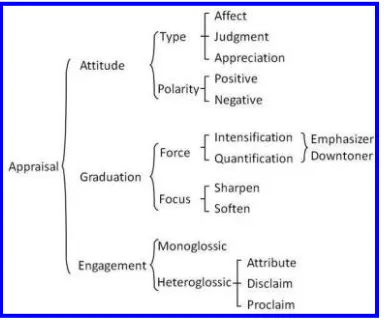
Appraisal belongs in the systemic-functional tradition started by Halliday (Halliday and Matthiessen 2014), and has been developed by Jim Martin, Peter White, and col-leagues (Martin 2000; Martin and White 2005; White 2012; Martin 2014). Martin (2000) characterizes appraisal as the set of resources used to negotiate emotions, judgments, and valuations, alongside resources for amplifying and engaging with those evalua-tions. He considers that appraisal resources form a system of their own within the lan-guage (in the sense of system within Systemic Functional Linguistics), and divides the Appraisal system into three distinct sub-systems (see Figure 1): Attitude, Graduation, and Engagement.
The central aspect of the theory is the Attitude system and its three subsystems, Affect, Judgment, and Appreciation. Affect is used to construe emotional responses about the speaker or somebody else’s reactions (e.g.,happiness, sadness, fear). Judgment conveys moral evaluations of character about somebody else than the speaker (e.g.,
ethical, deceptive, brave). Appreciation captures aesthetic qualities of objects and natural phenomena (remarkable, elegant, innovative).
Computational treatment of Appraisal (see Section 6) typically involves inscribed instances, that is, those that are explicitly present in the text via a word with positive or negative meaning. Instances that are not inscribed are considered to be invoked (also sometimes called evoked), in which “an evaluative response is projected by reference to events or states which are conventionally prized” (Hunston and Thompson 2000b, page 142). Thus, a bright kidora vicious kidare inscribed. On the other hand,a kid who reads a lotora kid who tears the wings off butterflies present invoked Appraisal. Because it is easier to identify automatically, most research in computational linguistics has focused on inscribed Appraisal and evaluation. We discuss implicit or invoked evaluation in Section 6, together with metaphor, irony, and sarcasm.
[image:8.486.47.239.478.638.2]In addition to the very central Attitude system, Martin and White (2005) argue that two other systems play a crucial role in the expression of opinion. The Graduation system is responsible for a speaker’s ability to intensify or weaken the strength of the
Figure 1
opinions that they express, and has Force and Focus as subsystems. Force captures the intensification or downtoning of words that are inherently gradable, whereas Focus represents how speakers can sharpen or soften words that are usually non-gradable. Examples of intensification and downtoning aresomewhat interestinganda little bit sad. Ina true friendthe meaning offriend, usually a non-gradable word, is sharpened. On the other hand,a friend of sortsimplies a softening of the meaning.
The Engagement system is the set of linguistic options that allow the individual to convey the degree of their commitment to the opinion being presented. It makes a fundamental distinction between heteroglossic and monoglossic expressions, following proposals by Bakhtin (1981). In a heteroglossic expression, inter-subjective positioning is open, because utterances invoke, acknowledge, respond to, anticipate, revise, or challenge a range of convergent and divergent alternative utterances (Martin and White 2005; White 2012, 2003). The other option is monoglossia, where no alternative view or openness to accept one is present. Monoglossic utterances are presented as facts.
Appraisal is quite well understood (at least in English), with a wide range of studies dealing with different genres and other languages. The Appraisal framework provides a very rich description of different aspects of evaluation and subjective positioning. From the early stages of sentiment analysis and opinion mining, it was always obvious to researchers in those areas that Appraisal could be helpful in identifying types of opin-ions, and in pinpointing the contribution of intensifiers and valence shifters (Polanyi and Zaenen 2006) in general. We further discuss computational treatments of Appraisal in Section 5.1.4.
3. Evaluative Language in Computational Linguistics
After an introduction to evaluation and subjectivity in linguistics, we now present research in computational linguistics, starting with a basic problem definition and a common characterization of evaluative language. We then provide a short overview of standard approaches in sentiment analysis.
3.1 Problem Definition
In computational linguistics, evaluative language is used as an umbrella term that covers a variety of phenomena including opinion, sentiment, attitude, appraisal, affect, point of view, subjectivity, belief, desire, and speculation. Although computational linguists do not always seek to distinguish between these phenomena, most of them commonly agree to define evaluative language as being a subjective piece of language expressed by a holder (a person, a group, an institution) towards a topic or target (an object, a person, an action, an event). A key element in this definition is that an evaluative expression is always associated with a polarized scale regarding social or moral norms (badvs. good,love vs. hate,in favor of vs. against, prefervs. dislike,better
vs. worse, etc.). Hence, the sentence in Example (1) is evaluative because it expresses a positive evaluation towards the food served in a restaurant, whereas Example (2) is not. Indeed, Example (1) can be paraphrased asI loved the food, orGo to this restaurant; I recommend it. On the other hand, Example (2) expresses an emotion, namely, the author’s subjective feelings and affect, and is not as easily characterized on a polar scale (except if we accept that jealousy is conventionally defined as negative).
(1) This restaurant serves incredibly delicious food.
In the remainder of this survey, we focus on automatic detection ofpolarized evalua-tionin text, excluding other forms of evaluative language. For the sake of readability, the terms evaluation, evaluative language, and polarized evaluation are used interchange-ably. We leave outside of the scope of this survey research on emotion detection and classification, which is surveyed by Khurshid (2013) and Mohammad (2016). Related, but also somewhat beyond our scope, is work on detecting negation and speculation, in particular in biomedical text (Saur´ı and Pustejovsky 2009; Councill et al. 2010; Morante and Sporleder 2012a; Cruz et al. 2016).
A frequently used definition of evaluative language as a structured model has been proposed by Liu (2012), drawing from Kim and Hovy (2004) and Hu and Liu (2004a). This model is a quintuple (e, a, s, h, t) whereeis the entity that is the topic or target of the opinion (restaurantin Example (1)),athe specific aspect or feature of that entity (food),sthe sentiment or evaluation towardsa(incredibly delicious),hthe opinion holder or source (the author in our example), and tthe posting time ofs. Liu (2012) further represents s by a triple (y, o, i) in order to capture the sentiment type or sentiment semantic categoryy(deliciousdenotes an appreciation), sentiment polarity or orientation
o (deliciousis positive), and sentiment valence i, also known as rate or strength, that indicates the degree of evaluation on a given scale (incredibly deliciousis stronger than
delicious). Sentiment type can be defined according to linguistic-based or psychology-based classifications. We discuss some of them in Section 5.1.
Liu (2012) notes that sentiment analysis based on this model corresponds to aspect-based or feature-aspect-based sentiment analysis in which systems relate each sentiment sto an aspecta(or more generally an entitye). Aspect-based models of sentiment have been most popular in the domain of consumer reviews, where movies, books, restaurants, hotels, or other consumer products are evaluated in a decompositional manner, with each aspect (e.g., ambiance, food, service, or price for a restaurant) evaluated separately. In Section 4.2, we will introduce a new definition, because we believe that contextual phenomena need to be accounted for in a definition of evaluative language.
3.2 Standard Approaches
assumption where subjective vs. objective sentences were postulated to be more likely to appear together. Hatzivassiloglou and McKeown (1997) studied subjectivity at the expression level, focusing on the prior sentiment orientation of adjectives. Using a supervised learning method, they empirically demonstrated that adjectives connected with the conjunctions and and or usually share the same orientation, whereas the conjunction but tends to connect adjectives with opposite orientations. Turney and Littman (2002) extended this approach to infer semantic orientation of words (not only adjectives) in large corpora.
Since 2000, computational approaches to evaluative language, labeled either as sentiment analysis or opinion mining, have become one of the most popular appli-cations of NLP in academic research institutions and industry. In the new century, however, and moving away from the early approaches where linguistics (and thus context) played a central role, sentiment analysis has become more a computational modelization problem than a linguistic one. Popular and commonly used approaches (“standard” approaches) focus on the automatic extraction of one or several elements of the quadruple (e, a,s, h), making sentiment analysis a field that involves roughly three main sub-tasks: (1) topic/aspect extraction, (2) holder identification, and (3) sentiment determination. These tasks are either performed independently from each other or simultaneously. When sub-tasks (1), (2), and (3) are treated independently, the depen-dencies between sentiment and topics are ignored. To account for these dependepen-dencies, two main approaches have been explored: sequential learning (Jakob and Gurevych 2010; Yang and Cardie 2012; Mitchell et al. 2013; Vo and Zhang 2015) and probabilistic joint sentiment-topic models, which are capable of detecting sentiment and topic at the same time in an unsupervised fashion (Hu and Liu 2004a; Zhuang et al. 2006; Lin and He 2009; Wang and Ester 2014; Nguyen and Shirai 2015), even though some approaches still require a seed of sentiment-bearing words and/or aspect seeds (Qiu et al. 2009; Hai et al. 2012).
In the following sections we overview the standard approaches to evaluative text on the three tasks just mentioned. The overview is necessarily brief, because our aim is not to provide an exhaustive survey of the field of sentiment analysis, but to focus on how more linguistically informed representations can contribute to the analysis and extraction of evaluation. For an excellent benchmark comparison of twenty-four different sentiment analysis systems, see Ribeiro et al. 2016.
3.2.1 Topic/Aspect and Holder Detection. Tasks (1) and (2) are important sub-tasks in sentiment analysis (Hu and Liu 2004a; Kim and Hovy 2005; Popescu and Etzioni 2005; Stoyanov and Cardie 2008; Wiegand and Klakow 2010). The holder can be the author, expressing their own evaluation (The movie is great), or the author stating or reporting someone else’s evaluation (My mother loves the movie; My mother said that the movie is great) (Wiebe and Riloff 2005). The holder evaluates a topic or target that is the entity or a part or attribute of the entity that the sentiment is predicated upon (Liu 2015). A topic is thus a global entitye(e.g., a product, service, person, event, or issue) organized hierarchically into a set of attributes or aspectsa(e.g.,engine, tiresare part of the entity
car), as can be done in a thesaurus or domain ontology.
extraction tasks that generally exploit noun or noun phrases, dependency relations, some syntactic patterns at the sentence level, knowledge representation paradigms (like hierarchies or domain ontologies), and external sources (e.g., Wikipedia) to identify explicit aspects (Hu and Liu 2004a; Popescu and Etzioni 2005; Zhao and Li 2009; Wu et al. 2009).1
3.2.2 Sentiment Determination.Task (3), sentiment determination, is probably the most studied. It consists of identifying polarity or orientation. In its simplest form, it corre-sponds to the binary orientation (positive or negative) of a subjective span regardless of external context within or outside a sentence or document. Some researchers argue instead for a ternary classification, with a neutral category to indicate the absence of evaluation (Koppel and Schler 2006; Agarwal et al. 2011). The intensity of a subjective span is often combined with its prior binary polarity to form anevaluation scorethat tells us about the degree of the evaluation, that is, how positive or negative the word is. Several types of scales have been used in sentiment analysis research, going from con-tinuous scales (Benamara et al. 2007) to discrete ones (Taboada et al. 2011). For example, if we have a three-point scale to encode strength, we can proposescore(good)= +1 and
score(brilliant)= +3. Generally, there is no consensus on how many points are needed on the scale, but the chosen length of the scale has to ensure a trade-off between a fine-grained categorization of subjective words and the reliability of this categorization with respect to human judgments.
Two main approaches have been proposed, corpus-based (mostly using machine learning techniques) and lexicon-based systems, which typically perform, in their most simplistic form, a lexical lookup and combine the meaning of individual words to derive the overall sentence or document sentiment (Hu and Liu 2004a; Kim and Hovy 2004; Taboada et al. 2011). For example, Kim and Hovy (2004) propose a three-step algorithm to compute sentence-level opinion orientation: First find the sentiment orientation of a word using a propagation algorithm that estimates its polarity on the basis of paradig-matic relations it may have with seed sentiments words, as encoded in WordNet. Then, compute the sentence sentiment orientation. In this second step, only words that appear near a holder and/or topic are considered. The sentiment scores of these words are then combined with various aggregation functions (average, geometric mean, etc.). Hu and Liu (2004a) propose a similar approach, taking into account in addition opposition words (likebut,however). They also generate a feature-based summary of each review.
At the sentence level, the task is to determine the subjective orientation and then the opinion orientation of sequences of words in the sentence that are determined to be subjective or express an opinion (Riloff and Wiebe 2003; Yu and Vasileios 2003; Wiebe and Riloff 2005; Taboada et al. 2011), with the assumption that each sentence usually contains a single opinion. To better compute the contextual polarity of opinion expressions, some researchers have used subjectivity word sense disambiguation to identify whether a given word has a subjective or an objective sense (Akkaya et al. 2009). Other approaches identify valence shifters (negation, modality, and intensifiers) that strengthen, weaken, or reverse the prior polarity of a word or an expression (Polanyi and Zaenen 2006; Moilanen and Pulman 2007; Shaikh et al. 2007; Choi and Cardie 2008). The contextual polarity of individual expressions is then used for sentence as well as document classification (Kennedy and Inkpen 2006; Li et al. 2010).
At the document level, the standard task is either a classification problem, catego-rizing documents globally as being positive, negative, or neutral towards a given topic (Pang et al. 2002; Turney 2002; Mullen and Nigel 2004; Blitzer et al. 2007), or regression, assigning a multi-scale rating to the document (Pang and Lee 2005; Goldberg and Zhu 2006; Snyder and Barzilay 2007; Lu et al. 2009; Lizhen et al. 2010; Leung et al. 2011; Moghaddam and Ester 2011; Ganu et al. 2013).
The classification/regression approach to determining document sentiment typi-cally uses bag-of-words representations (BOW), which model each text as a vector of the number of occurrences, or the frequency with which each word/construction appears. Bag-of-words features also includen-grams, parts of speech, and features that account for the presence/absence of subjective words (including emoticons), or valence shifting words (e.g., negation, intensifiers). Bags of words disregard grammar and cannot easily move beyond the scope of the analyzed corpus. The approach is, however, quite simple to implement and does keep token frequency. Bags of words are attractive because, through feature reduction techniques, they reduce a large feature space of possibly hundreds of thousands of dimensions to a manageable size that can help classifiers boost their performance (Abbasi et al. 2008; Liang et al. 2015).
To account for word order, BOWs may include syntactic dependency relations that rely on the assumption that specific syntactic phrases are likely to be used to express opinions such as adjective–noun, subject–verb, or verb–object relationships (Dave et al. 2003; Gamon 2004; Matsumoto et al. 2005; Ng et al. 2006; Joshi and Penstein-Ros´e 2009; Xia and Zong 2010), thus becoming, more precisely, bags of phrases. These insights on the types of structures that convey sentiment are the ones formalized in pattern grammar (see Section 2.5). Experiments show a mitigated success. First of all, some de-pendency relations are not frequent enough for the classifier to generalize well. Second, dependencies provide only grammatical relations between words within a sentence, but inter-sentential relations that may influence the sentence’s sentiment polarity are not considered.
Bag-of-words approaches are popular in particular for long documents and very large corpora, where classification accuracy can exceed 80%. The effectiveness of super-vised learning, however, depends on the availability of labeled (sometimes unbalanced) data in one domain that usually involves high costs in terms of work and time, because it involves collecting and labeling data. In addition, some languages lack such resources. To overcome this problem, unsupervised (Turney and Littman 2002; Feng et al. 2013) or semi-supervised learning have been proposed. Semi-supervised learning methods use a large amount of unlabeled data together with labeled data to build better classifiers (Li et al. 2011; T¨ackstr ¨om and McDonald 2011; Raksha et al. 2015; Yang et al. 2015). Popular approaches include self-training (He and Zhou 2011), co-training (Wan 2009), and structural learning methods that learn good functional structures using unlabeled data (Ren et al. 2014).
adaptation, which approximates the target-domain distribution by assigning different weights to the source domain labeled data, andlabeling adaptation. The last one is the most widely used in sentiment analysis (Blitzer et al. 2007; Pan et al. 2010; Samdani and Yih 2011; Bollegala et al. 2013; Cambria and Hussain 2015). It aims at learning a new labeling function for the target domain to account for those words that are assigned different polarity labels. For example,longmay be positive in the phone domain (long battery life) and negative in the restaurant domain (long wait times). This means that this method treats knowledge from every source domain as a valuable contribution to the task on the target domain. However, in addition to data sampled from different distributions (in the source and target domains), label adaptation approaches may suffer fromnegative transferwhere instead of improving performance, the transfer from other domains degrades the performance on the target domain. One possible solution is active learning, which relies on a small amount of good labeled data in the target domain to quickly reduce the difference between the two domains (Rai et al. 2010; Li et al. 2013b). Compared with machine learning, lexicon-based methods make use of the linguistic information contained in the text that makes them more robust across different domains (Kennedy and Inkpen 2006; Taboada et al. 2011). Furthermore, Brooke et al. (2009) showed that porting dictionaries to a new language or a new domain is not an onerous task, probably less onerous than labeling data in a new domain for a classifier. Com-bining lexicon-based learning and corpus-based learning could be a good solution to incorporate both domain-specific and domain-independent knowledge. This has been investigated in several studies relying either on a complete lexicon or fully labeled corpus (Andreevskaia and Bergler 2008; Qiu et al. 2009), or a partially labeled corpus as training examples (Yang et al. 2015).
4. Towards a Dynamic Model of Evaluative Language
The model presented in Section 3, whereevaluation=(e, a, s, h,t), is an operationalized representation that views sentiment analysis as an information extraction task. The model builds a structured representation from any unstructured evaluative text that captures the core elements relative to the evaluations expressed in the text. Liu (2012) points out that not all applications need all five elements of the quintuple. In some cases, it is hard to distinguish between entity and aspect, or there is no need to deal with aspect. In other cases, opinion holder or time can be ignored.
Although this model covers the essential elements for dealing with evaluative language in real scenarios, we argue that it is rather static because linguistic and extra-linguistic contextual factors that directly impact one or several elements of the quintuple are hidden in the structured representation. We show in Section 4.1 that each element is context-dependent at different linguistic levels and that a new dynamic model that explicitly incorporates context is necessary. We think that such a dynamic model needs to combine two complementary perspectives: aconceptualone, allowing for a theoretical characterization of the problem from a linguistic point of view, and a computational
In this section, we first motivate why a new model is needed, discuss some of the quintuple elements, and then present a new dynamic definition of evaluative language.
4.1 Motivation
Holder (h) and topic + aspect (e,a).Aspects may be explicit or implicit (Hu and Liu 2004a). Explicit aspects appear as nouns or noun phrases, as inThe characters are great, which explicitly refers to the movie characters. Implicit aspects are generally inferred from the text through common sense or pragmatic knowledge, as in the restaurant review in Example (3), where the pronounitdoes not refer to the potential antecedentnew vegan restaurant, but to an implicit aspect of a restaurant, its food. This is a form of bridging inference (Haviland and Clark 1974).
(3) We went to the new vegan restaurant yesterday. It was all too raw and chewy for me.
Despite substantial progress in the field, implicit topic/aspect identification as well as complex explicit aspects (which use, for example, verbal constructions) remain un-solved. See Section 6.2 for a survey of the existing work that tackles this hard problem.
In addition to the explicit vs. implicit nature of aspects, the way holders, topics, and aspects are extracted heavily depends on the corpus genre. For example, review-style corpora typically discuss one main topic and its related aspects and are the viewpoints of one holder (the review writer). Other corpus genres, however, do not meet these characteristics. Some areauthor-orientedlike blogs where all the documents (posts and comments) can be attributed to the blogs’ owners. A blogger, for example, may compare two different products in the same post. Others are bothmulti-topic and multi-holder
documents like news articles, where each pair (topic, holder) has its own evaluation, which means that different quintuples are needed to account for opinions about differ-ent topics (old or new) and from differdiffer-ent holders. In addition, social media corpora are composed offollow-upevaluations, where topics are dynamic over conversation threads (i.e., not necessarily known in advance). For example, posts on a forum or tweets are often responses to earlier posts, and the lack of context makes it difficult for machines to figure out whether the post is in agreement or disagreement. Finally, in amulti-topic
setting, the author introduces and elaborates on a main topic, switches to other related topics, or reverts back to an older topic. This is known asdiscourse popping, where a topic switch is signaled by the fact that the new information does not attach to the prior clause, but rather to an earlier one that dominates it (Asher and Lascarides 2003).
Investigating evaluations toward a given topic and how related topics influence the holder’s evaluation on this main topic is an interesting and challenging research problem (He et al. 2013). Multi-topic sentiment analysis is generally seen as a special case of multi-aspect sentiment analysis (Hu and Liu 2004b; Zhao et al. 2010). With the rise of social media, tracking follow-up evaluations and how they change towards a topic over time has become very popular (Wang et al. 2012; Farzindar and Inkpen 2015). See also Section 6.4 on the contribution of social network structure to sentiment analysis.
are three evaluative expressions in the movie review in Example (4): The first two are positive explicit expressions (underlined), whereas the last one (in italics) is an implicit positive opinion. Not moving from one’s seat is not inherently positive or negative; it only becomes positive in the context of watching a movie.
(4) What a great animated movie. I was so scared the whole time that Ididn’t even move from my seat.
Compared with explicit evaluation, little work has been done on implicit eval-uation, mainly because it is difficult to discriminate between explicit, implicit, and objective statements, even for humans (see Section 6.2). Obviously, the treatment of explicit evaluation is not always easy, especially when complex linguistic devices are used. Consider, for example, the ironic statement in Example (5). The overall evaluation is negative even though there are no explicit negative words. In this construction, the author conveys a message that fails to make sense against the context. The excerpt in Example (6) illustrates another interesting phenomenon particularly common in reviews, namedthwarted expectations, where the author sets up a deliberate contrast to the preceding discourse (Pang et al. 2002; Turney 2002). This example contains four opinions: The first three are strongly negative whereas the last one (introduced by the conjunctionbutin the last sentence) is positive. A bag of words approach would classify this review as negative. An aspect-based sentiment analysis system would probably do better, by classifying the last sentence as being positive towards the TV series and the first three as negative towards particular aspects of the series. This is, in part, the counter-expectation strategy discussed within Appraisal as a way of flagging invoked Appraisal (Martin and White 2005). It is obvious from these examples that thespart of the definition of evaluation is context dependent.
(5) I love when my phone turns the volume down automatically.
(6) The characters are unpleasant. The scenario is totally absurd. The decoration seems to be made of cardboard. But, all these elements make the charm of this TV series.
Polarity (o) and Intensity (i).Sentimentsis further defined by Liu (2012) as a triple of
y=type of sentiment;o=orientation or polarity; andi=intensity of the opinion (cf. Section 3.1). With respect to polarity, the prior polarity of a word, that is, its polarity in the dictionary sense, may be different fromcontextual polarity, which is determined on the basis of a sentiment composition process that captures how opinion expressions interact with each other and with specific linguistic operators such as intensifiers, nega-tion, or modality (Polanyi and Zaenen 2006; Moilanen and Pulman 2007; Wilson et al. 2009). For instance, inThis restaurant is not good enough, the prior positive orientation of the wordgoodhas to be combined with the negationnotand the modifierenough. Apart from local linguistic operators, prior polarity may also vary according to the context outside of the utterance, including domain factors (Aue and Gamon 2005; Blitzer et al. 2007; Bollegala et al. 2011). A given span may be subjective in one context and objec-tive in another. Haas and Versley (2015) observe that seemingly neutral adjecobjec-tives can become polar when combined with aspects of a movie (elaborate continuation,expanded vision), as can words that are intensified (simply intrusivewas considered negative, but
for expressions of surprise and astonishment as in This movie surprised me. The way evaluative language is used depends also on cultural or social differences, which makes polarity vary according to a specific situation, group, or culture. For instance, Thompson and Alba-Juez (2014) point out that utterances such asYeahandright, depending on the situation, the kind of speaker, and the way in which they are spoken, may be intended as positive signs of agreement or as very negative disagreement. Liu (2015) also points out that there may be a difference between author and reader standpoints: Asmall restaurant
does not convey a universal negative feeling.
Another interesting property of evaluative language is its multi-dimensional na-ture. Apart from the traditional binary categorization (positive vs. negative) of eval-uation towards a given target, researchers have suggested that sentiment analysis is a quantification task, one where the goal is not to classify an individual text, but to estimate the percentage of texts that are positive or negative (Esuli and Sebastiani 2015). Evaluative language may also take several other forms. For example, evalua-tion involving comparatives expresses an ordering towards targets based on some of their shared aspects, for example,the picture quality of camera X is better than that of Y
(Jindal and Liu 2006a, 2006b). There are also evaluations that concern relative judgment towards actions or intentions, preferring them or not over others (e.g.,I prefer the first season over the second one, or Shall we see Game of Thrones next week?). In this last case, reasoning about preferences determines an order over outcomes that predicts how a rational agent will act (Cadilhac et al. 2012; Chen et al. 2013). Other forms of evalu-ative language involve finding a consensus or conflict over participants by identifying agreement/disagreement on a given topic in a debate or discussion (Somasundaran and Wiebe 2009; Mukherjee and Bhattacharyya 2012). We address preferences and intentions in Section 6.5.
4.2 A New Dynamic Model of Evaluative Language
We hope to have established by now that evaluative language is context-dependent at different discourse organization levels:
r
The sentence: Interactions with linguistic operators like negation, modality, and intensifiers; or syntactic constraints such as altering the order of constituents in a clause or sentence.r
The document: Discourse connectives, discourse structure, rhetorical relations, topicality.r
Beyond the document:2Effects of various pragmatic phenomena such as common-sense knowledge, domain dependency, genre bias, cultural and social constraints, time constraints.Inspired by Polanyi and Zaenen’s (2006) first attempt to study contextual valence shifting phenomena, as well as recent linguistic studies on evaluation (Thompson and Alba-Juez 2014) that characterize it as a dynamic phenomenon, we propose a more flexible and abstract model of evaluative language that extends Liu’s (2012) model to
take into account context. The model is represented as a system of two main components
hΩ, ℑi, where:
r
Ω =(e, a, s, h) is a quadruple that corresponds to theintrinsic propertiesof evaluative language (target, aspect, sentiment, and holder). The sentiment elementsis additionally composed of a quadruple (span,category, pol,val) to encode span (the evaluative expression), semantic category, polarity, and strength. Elements ofΩresemble those of Liu (2012), except that we restrictsto textual spans composed of explicit subjective tokens only (adjectives, verbs, nouns, adverbs, emoticons), excluding local operators at the sentence level. The aim is to explicitly separate the prior sentiment orientation ofs(i.e., its value out of context) from its contextual interpretation that is considered to be part of theextrinsic propertiesof evaluation (seeℑbelow). In addition, polarity (pol) is used as an umbrella term that covers any polarized scale in order to extend the traditional positive/negative categorization. Polarized scales may bepositive–negative, for–against, positive–neutral–negative, or any number of stars in a star scale. If any of the four elements ofΩis not lexicalized, then their corresponding values are underspecified.3
r
A set of functionsℑ={F1,...,Fn}that capture theextrinsic propertiesof an evaluation by adjusting or adapting the prior values ofΩwhen they are interpreted in a given context, such that∀Fi∈ ℑ,Fi:Ω7→Updatel(Ω).
These functions act as complex update operators at different discourse organization levelsl(sentence, document, beyond the document), and their interpretation reflects the special influence that they have on
evaluative expressions. For example, at the sentence level, one can design a function to account for the role of negation or modality. At the document level, functions may use discourse relations or argumentative structure to update the prior polarity of an evaluation. At the extra-linguistic level, some functions can account for the conversation thread. We expressively avoid defining all the functions that may be included inℑ, so that users can specify them according to need and available NLP techniques. Not all functions are necessary for all applications, and some of them can be left out.
Let us illustrate this model with Example (4), reproduced again as Example (7). We explain how the model behaves when applied at the sentence level,4but it can also be easily applied at a finer or more-coarse grained level.
(7) What a great animated movie. I was so scared the whole time that I didn’t even move from my seat.
In Example (7), the immediate interpretation ofgreatin the first sentence leads to a positive evaluation that remains stable after updating the intrinsic property of polarity, i.e.,Ω1 =Update(Ω1)=(movie, , (great, ,+,1), author). In the second sentence, the
sen-3 Note that we do not include a time dimension in our definition for simplicity purposes. In cases where time is important, an elementtmay be added.
timent spanscaredis generally given a negative evaluation out of context,Ω2 =(movie, , (scared, ,−,1), author). At the sentence level, the evaluation inscaredis influenced by the adverbso, which modifies the prior intensity of the evaluation:Updatesentence(Ω2)=
(movie, , (so scared, ,−,2), author). Then, if one takes into account the discursive context given by the first sentence, the prior polarity of scared has to be updated:
Updatediscourse(Ω2)= (movie, , (so scared, ,+,2), author). Finally, the pragmatic level tells us about the presence of an additional positive evaluation, as already explained in the previous section:Updatepragmatic(Ω2)=(movie, ,{(so scared, ,+,2), (didn’t move...seat,
,+,2)}, author).
In practical sentiment analysis systems, the complete instantiation of the model
hΩ, ℑidepends on their context-sensitiveness. As far as we know, no existing system deals simultaneously with all levels of context. Most systems are either static and context insensitive, or they exploit one or two levels at most. Some deal with local factors at the sentence level, for example, the presence of negation in the proximity of polarized words using dependency parsing; others deal with discourse; whereas others deal with domain and genre factors, or figurative language. Overall, two main directions have been explored to deal with context: (a) extend the bag-of-words model by incorporating more contextual information; and (b) combine theories and knowl-edge from linguistics with the statistical exploitation of data. In the next two sections, we explore these two directions, focusing on how sentiment analysis systems can be made much more effective and accurate by explicitly considering context in its wider sense. We investigate several dimensions of context, and for each dimension, we outline which linguistic aspects contribute to accurate extraction of sentiment.
5. Current Approaches: From Lexical Semantics to the Sentence
The sentiment analysis problem can be described as the process of moving from the bottom–up, starting at the word level and ending with context. In this section, we describe how sentiment is expressed and extracted at the word, phrase, and sentence levels, and in the next section we address discourse and contextual phenomena.
5.1 Lexical Semantics of Evaluative Expressions
Finding subjective words (and their associated prior polarity) is an active research topic where both corpus-based and lexicon-based approaches have been deployed. There are several manually or automatically created lexical resources. Most of them share four main characteristics: They are domain-and language-specific, of limited coverage, and they group evaluative expressions along a binary positive/negative axis.
within general linguistic resources such as WordNet, or syntactic properties such as dependency relations.5 Compared with lexicon expansion and domain and language adaptation, few studies propose to enhance the binary categorization of evaluative expressions. In the remainder of this section, we focus on these studies, as we believe they can be beneficial to subjective lexicon creation. Studies can be roughly divided into how they approach categorization of lexical expressions: by tackling intensity, emo-tion, and either syntactic or semantic principles for classification (including Appraisal categories).
5.1.1 Intensity-Based Categorizations.One way to improve upon simple polarity determi-nation is to associate with each subjective entry an evaluation score or intensity level. SentiWordnet (Baccianella et al. 2010) is an extension of WordNet (Fellbaum 1998) that assigns to each synset three sentiment scores: positive (P), negative (N), and objective (O). Hence different senses of the same term may have different sentiment scores. For example, the adjectivehappyhas four senses: The first two expressing joy or pleasure are highly positive (P=0.875 and P=0.75, respectively); the third corresponding to
eagerly disposed to actorto be of service (as inhappy to help) is ambiguous (P=0.5 and
O=0.5); and the last sense (a happy turn of phrase) is likely to be objective (P=0.125 and O=0.875). Although SentiWordNet has been successfully deployed to derive document-level sentiment orientation (Denecke 2009; Martin-Wanton et al. 2010; Popat et al. 2013; Manoussos et al. 2014), word-sense disambiguation algorithms are often needed to find the right sense of a given term. Other intensity-based lexicons in English include Q-WordNet (Agerri and Garc´ıa-Serrano 2010), the MPQA Subjectivity Lexicon (Wiebe et al. 2005), and SO-CAL (Taboada et al. 2011).
Methods for automatic ordering of polar adjectives according to their intensity include pattern-based approaches, assuming one single intensity-scale for all adjec-tives (de Melo and Bansal 2013), or corpus-driven techniques, providing intensity levels to adjectives that bear the same semantic property (Ruppenhofer et al. 2014; Sharma et al. 2015).
5.1.2 Emotion and Affect Categorizations.A second way to enhance polarity consists of encoding, in addition to polarity and/or intensity, information about the semantic cat-egory of the evaluative expression. Categories can be defined according to psychologi-cally based classifications of emotions and affect of various sorts that attempt to group evaluation into a set of basic emotions such as anger, fear, surprise, or love (Osgood et al. 1957; Izard 1971; Russell 1983; Ekman 1984; Ortony et al. 1988). Well-known Affect resources in English include the General Inquier (Stone et al. 1962), the Affective Norms for English Words (ANEW) (Bradley and Lang 1999), the LIWC Dictionary,6and the LEW list (Francisco et al. 2010). WordNet-Affect is also a resource for the lexical representation of affective knowledge (Strapparava and Valitutti 2004). It associates with each affective synset from WordNet an emotion class, following the classes defined within Ortony et al.’s (1988) model of emotions. Other interesting affective resources are SenticNet (Poria et al. 2013) and the EmotiNet knowledge base (Balahur et al. 2011), which associates polarity and affective information with affective situations such as accomplishing a goal,failing an exam, or celebrating a special occasion. Modeling such situations is particularly important for recognizing implicit emotions (Balahur et al.
2012). Besides the obvious usefulness of affect lexicons in emotion detection, their use in sentiment analysis tasks has shown to be helpful (Agarwal et al. 2009), especially in figurative language detection (Reyes and Rosso 2012) (see Section 6.3).
The choice of the right resources to use generally depends on the task and the corpus genre. Musto et al. (2014) compare the effectiveness of SentiWordNet, WordNet-Affect, MPQA, and SenticNet for sentiment classification of Twitter posts. Their results show that MPQA and SentiWordNet performed the best. This is interesting because although MPQA is a lexicon with small coverage, its results are comparable to a general-purpose lexicon like SentiWordNet. To overcome coverage limitation, one can consider combining several lexicons. This can, however, lead to polarity inconsistency, where the same word appears with different polarities in different dictionaries. Dragut et al. (2012) point out that sentiment dictionaries have two main problems: They exhibit substantial (intra-dictionary) inaccuracies, and have (inter-dictionary) inconsistencies. They propose a method to detect polarity assignment inconsistencies for the words and synsets within and across dictionaries.
5.1.3 Syntactic and Semantic Categorizations. Other categories have been proposed in the literature to deal with the complex lexical semantics of evaluative expressions. Some are both syntactically and semantically driven, whereas others are exclusively semantic. Levin (1993) classifies over 3,000 English verbs according to shared meaning and syntactic behavior. She examines verb behavior with respect to a wide range of syntactic alternations that reflect verb meaning. Several classes are sentiment relevant such as Judgment Verbs or Verbs of Psychological State. Mathieu (2005) offers a semantic classification of sentiment in which verbs and nouns are split into 38 semantic classes, according to their meaning (Love, Fear, Astonish, etc.). She points out that syntactic structure influences the interpretation of evaluative expressions and distinguishes be-tween three classes of verbs that mean: The experience or the causation of a rather unpleasant feeling, pleasant feeling, and neither pleasant nor unpleasant. Semantic classes are linked by meaning, intensity, and antonymy relationships. She associates a set of linguistic properties with words and classes and builds semantic representations, described by means of feature structures. Mathieu and Fellbaum (2010) extended this classification to English verbs of emotion.
SentiFrameNet (Ruppenhofer and Rehbein 2012) is probably the best example of the syntactico-semantic categorization of evaluative expressions. It extends FrameNet (Baker et al. 1998) to connect opinion source and target to semantic roles, and to add semantic features such as polarity, intensity, and affectedness (changes of state that leave an event participant in a changed state). Evaluative language per se is not described in FrameNet, but several frames are relevant for sentiment analysis like JUDGMENT, OPINION, EMOTION DIRECTED, and semantic roles such as JUDGE or EXPERIENCER. Each frame is associated with a set of lexical units composed of words that evoke that frame. Example (8) illustrates the frame elements of the lexical unitsplendid(from the frame DESIRABILITY).
(8) [On clear days,]Circumstance[the view]Evalueewas [absolutely]Degree splendid.
done to show the real effectiveness of this deep representation in practical sentiment analysis systems.
Purely semantic categorizations include the categories defined within the MPQA project (Wiebe et al. 2005), and the Blogoscopy lexicon (Daille et al. 2011), which classifies opinions according to four main categories following Charaudeau (1992), and the lexicon model for subjectivity description of Dutch verbs proposed by Maks and Vossen (2012). Drawing from Levin (1993), Mathieu (2005), and Wierzbicka (1987), Asher et al. (2009) group each opinion expression into four main categories: REPORTING, which provides, at least indirectly, a judgment by the author on the opinion expressed; JUDGMENT, which contains normative evaluations of objects and actions; ADVICE, which describes an opinion on a course of action for the reader; and SENTIMENT-APPRECIATION, containing feelings and appreciations. Subcategories include, for ex-ample, INFORM, ASSERT, EVALUATION, FEAR, ASTONISHMENT, BLAME, and so forth. These categories have been successfully deployed as features for consensus detection in book reviews (Benamara et al. 2014) and for studying opinion in discourse (Benamara et al. 2016). Also, the ADVICE category, which is decomposed into SUGGEST, HOPE, and RECOMMEND, has been used for extracting customer suggestions from reviews (Negi and Buitelaar 2015). We further discuss discourse-based sentiment analysis and suggestion detection in Section 6.
Even though efforts have been made to move beyond positive/negative classifica-tion, the resulting lexicons are not widely used in the sentiment analysis community. We do believe that the semantic categorizations discussed in this section are necessary for a better understanding of evaluative language and hope that further studies will leverage such categorizations to enhance current bag-of-words approaches. One categorization that deserves separate treatment, because of its comprehensiveness, is Appraisal. After an introduction to the theory itself in Section 2.6, in the next section we discuss compu-tational treatments of Appraisal.
5.1.4 Semantic Categorizations: Appraisal in Sentiment Analysis.An early surge of interest in Appraisal led to publications proposing how to automatically identify expressions that could be characterized as belonging to the three subtypes of Attitude (Affect, Judgment, and Appreciation). The potential gains are obvious: A positive or a negative expression is informative in itself, but even more so if we know whether it refers to personal feelings, opinions about others, or evaluations of objects. Taboada and Grieve (2004) first proposed a classification of adjectives as to whether they mostly conveyed one of the three main Attitude categories (Affect, Judgment, Appreciation). They then used this classification of adjectives to determine what type of Attitude was predomi-nant in a text.
positively to the classification in part because they contain sentiment words that are not adjectives.
Although it was a breakthrough in terms of using sentiment-specific adjectives, and using linguistic insights (phrases rather than isolated adjectives; intensification and negation), the work of Whitelaw and colleagues did not explicitly utilize the in-formation contained in the Appraisal groups. That is, whether a text contained more Appreciation than Judgment, for instance, was not part of the classification or the infor-mation extracted from the text. The authors do point out potential benefits of Appraisal analysis, including identifying the Appraiser and Appraised (what elsewhere have been termedsourceandtarget). Similar work by Read and Carroll uses a corpus annotated for Appraisal (not only Attitude, but also Graduation and Engagement) to train a classifier that detects whether unseen words and phrases are instances of Appraisal and, when they are, their polarity (Read and Carroll 2012b, 2012a).
Work by Argamon, Bloom, and colleagues (Bloom et al. 2007; Argamon et al. 2009; Bloom and Argamon 2010) also focused on using Appraisal to build lexicons. Of note is the effort in Bloom et al. (2007) to extract adjectives according to Appraisal categories (the three top-level Attitude types) and present them as output (rather than just use them as input to build a lexicon). Furthermore, their system assigns a target to each adjective, specifying whether, for example, it refers to an actor, a character, or the plot or special effects of a movie. This linking of Appraisal expression and target is achieved via dependency parsing. Their method seems to perform well, as shown by a manual evaluation of the extracted expressions, and by its potential usefulness in creating rules for opinion patterns. In a follow-up paper, Bloom and Argamon (2010) present an automatic method for linking Appraisal expressions and patterns.
Such linking of Appraisal expressions and targets precedes later work in feature-based sentiment extraction or opinion mining (Titov and McDonald 2008; Brody and Elhadad 2010; Liu 2012), which seems to have developed independently, and without taking into account the possibility of bootstrapping the identification of features with Appraisal expressions. Information on whether an Appraisal expression is likely to be Judgement rather than Appreciation will help determine whether its target is human or not, and vice versa.
A notable exception in the practical application of Appraisal is the Attitude Analysis Model of Neviarouskaya and colleagues (Neviarouskaya 2010; Neviarouskaya et al. 2010b, 2010a; Neviarouskaya and Aono 2013). They propose a method of assigning what are essentially Attitude values to adjectives. In their system, a classifier is trained to determine whether a particular word or phrase expresses the three basic types of Attitude, with the determination being done in context, that is, taking into account the sentence in which the word appears.