Lightweight Word-Level Confidence Estimation
for Neural Interactive Translation Prediction
Rebecca KnowlesandPhilipp Koehn Department of Computer Science Center for Language and Speech Processing
Johns Hopkins University
{rknowles,phi}@jhu.edu
Abstract
In neural interactive translation prediction, a system provides translation suggestions (“auto-complete” functionality) for human translators. These translation suggestions may be rejected by the translator in pre-dictable ways; being able to estimate con-fidence in the quality of translation sug-gestions could be useful in providing addi-tional information for users of the system. We show that a very small set of features (which are already generated as byprod-ucts of the process of translation predic-tion) can be used in a simple model to esti-mate confidence for interactive translation prediction.
1 Introduction
In neural interactive translation prediction ( Wue-bker et al., 2016; Knowles and Koehn, 2016), a human translator interacts with machine transla-tion output by accepting or rejecting suggestransla-tions as they type a translation from beginning to end. By accepting a system suggestion, the translator implicitly provides an “OK” quality label for that token. Similarly, by rejecting a suggestion (and providing a correction), they implicitly provide a “BAD” quality label for the system’s suggestion.
The system’s suggestions may be wrong (“BAD”) in predictable ways. For example, if one suggestion is incorrect, the subsequent suggestion may then be more likely to be incorrect. We seek to show that using these implicit labels and model scores we can predict whether subsequent tokens will be accepted as “OK” or rejected as “BAD” by the translator. This confidence estimation has a twofold purpose. First, if we can detect poten-tially “BAD” tokens before showing them to the translator, we may be able to increase translator
trust in suggestions and reduce time spent reading incorrect suggestions, either by indicating confi-dence (by color, shading, or some other visual in-dication), providing multiple alternate translation options, or by simply not showing low-confidence predictions to the user. Second, if we can identify “BAD” tokens, we can save on computation. If we are confident that a prediction is wrong, we can wait to predict subsequent tokens until the human translator provides a correction rather than com-pleting a translation that is likely to be rejected. Computer aided translation (CAT) tools such as Lilt1or CASMACAT2typically provide the trans-lator with either full sentence predictions or pre-dictions consisting of several tokens, which need to be recomputed each time the system is found to have made an erroneous prediction.
Speed is of the essence in interactive translation prediction; predictions (of several tokens or a full sentence) must be computed quickly enough that the translator does not experience lag in the user interface. For this reason, we focus on confidence estimation using a very small set of features that can be collected naturally in the process of the in-teractive translation prediction computation. We present results based on a simulation using refer-ence text.
2 Related Work
In this work we use a neural machine translation (MT) model that consists of an encoder, a decoder, and an attention mechanism, based on the ap-proach described inBahdanau et al.(2015). Such systems have been highly successful in recent MT evaluations (Bojar et al.,2017).
Neural MT models have been applied to the task of interactive translation prediction.
Interac-1
https://lilt.com/
Figure 1: Example of interactive translation prediction inCASMACAT. The system provides predictions for several tokens, conditioned on the source sentence and the prefix generated by the human translator. Figure fromKnowles and Koehn(2016).
tive translation prediction provides a human trans-lator using a CAT tool with functionality similar to “auto-complete” (as provided on smartphones, tablets, etc.). As the translator begins typing a translation, the interactive translation prediction system provides suggestions for the next target-language token(s). Figure 1 provides an exam-ple of an interactive translation prediction user in-terface in CASMACAT. The translator can accept these suggestions (for example by using theTAB key) or they can override them by typing differ-ent characters and tokens. Whenever the translator overrides the system suggestions, the system must adapt to the newly extended sentence prefix and provide new suggestions for how to continue the translation. In the case of neural interactive trans-lation prediction,3this is quite simple: rather than feeding the originally predicted token (rejected as incorrect by the translator) back into the model to predict the next word, the system instead feeds the translator’s token(s) into the model, then continues producing the translation token by token.
Knowles and Koehn(2016) note that the neural interactive translation prediction system recovers well from failure (predicting an incorrect token) when the correct token’s model score is also (rel-atively) high. This suggests the feasibility of us-ing features like the model score (which is already generated by the system) to predict when the sys-tem should be more or less confident in the quality of its predictions. Early work on word-level con-fidence estimation, such as Gandrabur and Fos-ter (2003), focused on estimating the system’s confidence in translations in a similar interactive translation prediction setting (using a maxent MT model). Gonz´alez-Rubio et al.(2010b) explored how confidence information might be able to be used in an interactive machine translation setting to lessen human effort, andGonz´alez-Rubio et al. (2010a) suggested using confidence measures to
3As described in detail in Wuebker et al. (2016) and Knowles and Koehn(2016).
determine which sentences need human interven-tion in the form of interactive translainterven-tion predic-tion and which are likely to be of high enough quality for the MT output to be used without edit-ing. Both of these focus on interactive machine translation using statistical machine translation.
Today, the task of word-level quality estimation typically focuses on assigning “OK”/“BAD” la-bels to individual tokens in a full sentence trans-lation (Bojar et al.,2017). This task has been ex-plored in-depth through the shared task on Qual-ity Estimation at WMT, which was initially intro-duced in 2012 (Callison-Burch et al.,2012). The open-source tool QUEST++ (Specia et al.,2015) provides an implementation of word-, sentence-, and document-level quality estimation, using an extensive set of features that have been found to be useful for the task.
The vital difference between the word-level quality estimation task and confidence estima-tion for interactive translaestima-tion predicestima-tion is that each human interaction in the interactive trans-lation prediction setting provides a gold-standard “OK”/“BAD” label for a token, such that the full prefix of the sentence is labeled, and the task is now to predict the quality of the next token (po-tentially conditioning on the previous tokens). Ad-ditionally, in the standard word-level quality esti-mation task, it is possible to extract features from both the full source sentence and the full machine translation output. In the interactive translation prediction setting as we have described it, the tar-get output is produced one word at a time, through interaction with the user, meaning that target side features can only be extracted from the prefix pro-duced so far.
3 Experiments & Results
3.1 Data and MT Systems
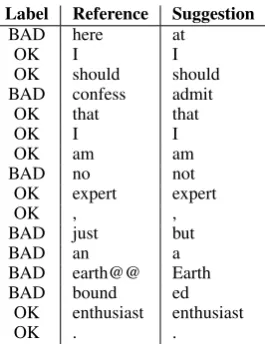
Input:An dieser Stelle sollte ich zugeben, dass ich kein Ex-perte, sondern nur ein erdgebundener Enthusiast bin.
Label Reference Suggestion
BAD here at
OK I I
OK should should BAD confess admit
OK that that
OK I I
OK am am
BAD no not OK expert expert
OK , ,
BAD just but
BAD an a
BAD earth@@ Earth BAD bound ed
OK enthusiast enthusiast
OK . .
Figure 2: An example sentence demonstrating how the labels are obtained. A “BAD” label is applied when the predicted token does not match the reference token. The @@ symbol is a product of byte-pair encoding (and would not be displayed to users in a CAT tool).
English-German (en-de), German-English (de-en), English-Czech (en-cs), and Czech-English (cs-en). The models were trained with Nematus (Sennrich et al.,2017) and are available publicly.4 We use WMT 2016 test data for training and development and report results on WMT 2017 test data. Both of these data sets consist of between 64,000 and 73,000 tokens.
For each sentence in the data set, we run neu-ral interactive translation prediction (using a mod-ified version of Nematus), simulating the actions of a real user with the reference translation. We use a beam size of 1 for speed. The interactive translation prediction system starts by producing a prediction for the first token; this is compared against the reference, generating an “OK” label if the prediction and reference are equal, and “BAD” otherwise. For each subsequent word, the system produces a prediction (adjusting to the reference as needed) and generates a label for each prediction by comparing it to the reference. Figure2provides an example, showing the source sentence, the ref-erence sentence, the output of the interactive trans-lation prediction system simulated against the ref-erence, and the labels assigned. Each target lan-guage pair of gold token and prediction is asso-ciated with a label and constitutes a single
train-4http://data.statmt.org/rsennrich/
wmt16_systems/
Language Pair WPA BLEU
en-de 60.7% 24.2
de-en 62.7% 29.6
en-cs 56.1% 19.1
[image:3.595.335.498.62.130.2]cs-en 57.0% 24.5
Table 1: Word prediction accuracy (WPA) of neu-ral interactive translation prediction with beam size 1 and BLEU score for standard neural ma-chine translation decoding with beam size 1 on WMT 2017 test set.
ing instance. Using the example in Figure2, the first token (at) receives the label “BAD” because it does not match the reference, while the second token (I) receives the label “OK” because it does match.
Table 1 shows baseline word prediction accu-racy scores on the WMT 2017 test data. Word pre-diction accuracy (WPA) is calculated as the per-centage of the time that the system correctly pre-dicts the next token of the sentence. The WPA is the percentage of the data that has the “OK” la-bel. The slightly lower WPA scores for the Czech language tasks are consistent with the expecta-tion that Czech-English translaexpecta-tion is more diffi-cult than German-English. We show the BLEU scores reported on standard decoding with beam size of 1 on WMT 2017 data in Table1.5
3.2 Metrics
Following Logacheva et al. (2016), we report scores for F1-BAD and F1-mult (the product of
F1-BAD andF1-OK scores). F1-BAD is of
inter-est because we seek in particular to be able to la-bel incorrect predictions (of which there are fewer than correct predictions).F1-mult has been shown
to be more robust to pessimistic classifiers (those which label most tokens as “BAD”).
3.3 Features
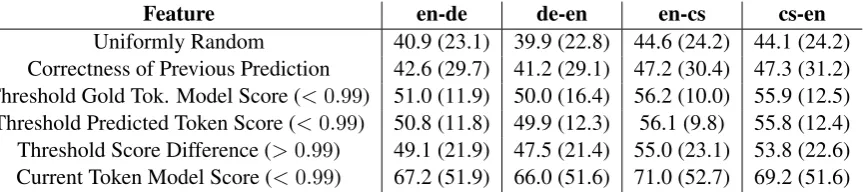
Here we describe the small set of simple features we explored, all of which are generated as byprod-ucts of the neural interactive translation prediction system’s computations. In Table2we show base-line results of using simple heuristics (based on the first five features) to predict labels on the train-ing/development data. We also include a baseline
5Note that larger beam sizes and ensembling do improve
[image:3.595.116.249.83.259.2]Feature en-de de-en en-cs cs-en Uniformly Random 40.9 (23.1) 39.9 (22.8) 44.6 (24.2) 44.1 (24.2) Correctness of Previous Prediction 42.6 (29.7) 41.2 (29.1) 47.2 (30.4) 47.3 (31.2) Threshold Gold Tok. Model Score (<0.99) 51.0 (11.9) 50.0 (16.4) 56.2 (10.0) 55.9 (12.5) Threshold Predicted Token Score (<0.99) 50.8 (11.8) 49.9 (12.3) 56.1 (9.8) 55.8 (12.4) Threshold Score Difference (>0.99) 49.1 (21.9) 47.5 (21.4) 55.0 (23.1) 53.8 (22.6) Current Token Model Score (<0.99) 67.2 (51.9) 66.0 (51.6) 71.0 (52.7) 69.2 (51.6)
Table 2: Performance of simple heuristics for individual features on WMT 2016 data set (used for training and development). The first value isF1-BAD, and the value in parentheses isF1-mult.
that assigns the labels (uniformly) randomly.6 Correctness of Previous Prediction: Making one error can result in a sequence of errors, so the simplest feature we use is the gold-standard label assigned to the previous token. Since the first to-ken has no previous toto-ken from which to draw a label, we set its value for this feature to “OK” (as the majority of tokens are “OK”). On the training data, using this feature as the label (that is, predict-ing the previous token’s gold-standard label as the current token’s label) provides an initial baseline.
Gold Token Model Score:We can examine the score that the model assigned to the previous gold-standard token. Knowles and Koehn(2016) note that even when the system did not correctly pre-dict the previous token, it may be more likely to recover well (and predict subsequent tokens cor-rectly) if the model assigned a relatively high score to the gold token. We can use this as a simple clas-sifier by thresholding. While thresholding obtains a higherF1-BAD score with the threshold of 0.99
(labeling the token as “OK” if the model score is greater than 0.99, and “BAD” otherwise), this pro-duces a very pessimistic classifier, and theF1-mult
score suffers accordingly.
Predicted Token Model Score: In this case, we take the score that the model gave to its previ-ous prediction (which may or may not have been correct), with the intuition that very high scores may indicate higher confidence. We again see that thresholding this value (labeling the token as “OK” if the model score is greater than 0.99, and “BAD” otherwise) produces a pessimistic model.
Score Difference: We compute the difference between the two previous features (gold token model score subtracted from the predicted token model score). This will be 0 when the predicted token was correct. A high difference may indicate a potential error being made by the system (when
6Averaged across 5 runs.
the model assigns high probability to its predic-tion and very low probability to the gold token), which may have an impact on subsequent predic-tions. Thresholding (labeling the token as “OK” if the difference in scores is less than 0.99, and “BAD” otherwise) this feature results in a higher F1-mult score and a less pessimistic labeling.
Current Token Model Score: We take the score that the model gave to the current predic-tion (for which we are currently trying to predict the “OK” or “BAD” label). Again, this is based on the intuition that very high scores may indicate higher confidence.
Index: We add the index of the word in the sen-tence as a feature.
First token: We add a feature that indicates if the token is the first token in a sentence.
3.4 Evaluation
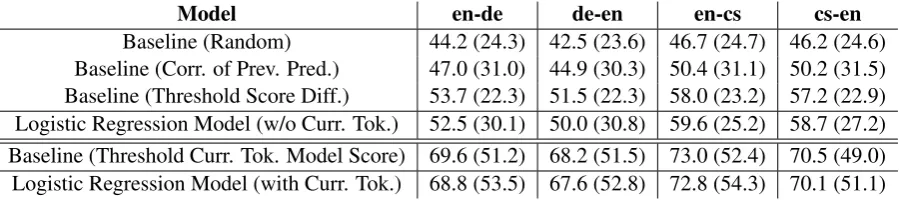
In addition to using thresholding or simple heuris-tics with the features, we train logistic regres-sion classifiers with scikit-learn (Pedregosa et al., 2011) on the WMT 2016 data set, using class weighting (with a weight of 2 on “BAD”). All other parameters are set to defaults, including the threshold. We report results on the WMT 2017 test sets in Table3.
We find that the Current Token Model Score feature drastically outperforms all other features when thresholded, obtaining the best results in terms ofF1-BAD on train and test data. The
logis-tic regression model that includes it and all other features shows slight improvements in terms of F1-mult (at the cost of slight losses toF1-BAD).
If we restrict ourselves to the features available before the new token is predicted, we find that the logistic regression model (without the Cur-rent Token Model Score) outperforms baselines in terms ofF1-BAD and the threshold score
Model en-de de-en en-cs cs-en Baseline (Random) 44.2 (24.3) 42.5 (23.6) 46.7 (24.7) 46.2 (24.6) Baseline (Corr. of Prev. Pred.) 47.0 (31.0) 44.9 (30.3) 50.4 (31.1) 50.2 (31.5) Baseline (Threshold Score Diff.) 53.7 (22.3) 51.5 (22.3) 58.0 (23.2) 57.2 (22.9) Logistic Regression Model (w/o Curr. Tok.) 52.5 (30.1) 50.0 (30.8) 59.6 (25.2) 58.7 (27.2) Baseline (Threshold Curr. Tok. Model Score) 69.6 (51.2) 68.2 (51.5) 73.0 (52.4) 70.5 (49.0) Logistic Regression Model (with Curr. Tok.) 68.8 (53.5) 67.6 (52.8) 72.8 (54.3) 70.1 (51.1)
Table 3: Results on WMT 2017 test data. We show baselines and models built with and without the Current Token Model Score. The first value isF1-BAD, and the value in parentheses isF1-mult.
cs-en data. For the en-de and de-en data, we find that it outperforms the threshold score difference baseline in terms ofF1-mult and the correctness of
previous prediction baseline in terms ofF1-BAD.
4 Conclusions and Future Work
A very small set of features can be used in a sim-ple trained model or even with simsim-ple heuristics to estimate confidence for interactive translation pre-diction. This work provides a proof-of-concept of how this can be done for neural interactive trans-lation in particular, using the sorts of features that are already produced in the process of generat-ing predictions, which is desirable in a settgenerat-ing that requires very fast computation in order to serve translations to the user without lag.
We worked with a very limited feature set here, drawing on intuitions from previous work on in-teractive translation prediction. One could cer-tainly explore a wide range of more complex fea-tures, such as the number of previous errors, the number of tokens since the last error, sparse word-specific features, or even features derived from the attention mechanism (as proposed byRikters and Fishel(2017) for general MT confidence estima-tion). It would also be interesting to explore the types of features used in QUEST++ (Specia et al.,
2015) and other word-level quality estimation sys-tems which are applicable to this setting.7 In this model, we only use features that reference the cur-rent or previous token or the position of the to-ken in the sentence; a longer history (such as se-quences of errors) may also be a fruitful avenue to explore. We have used a simple, out-of-the-box
7
Since QUEST++ is used for quality estimation after a full translation is produced, we would need to use a modified subset of these features for interactive translation prediction confidence estimation. For example, we could not use n-gram features that include target context beyond the sequence of tokens generated so far.
model; in particular we did not optimize specif-ically for either of the metrics, nor did we make significant efforts to elegantly handle the label im-balance in labels. Attention to both of these areas could easily result in improvement.
While we evaluated withF1-BAD andF1-mult,
it may also be useful to evaluate the system in terms of the computational costs saved by hold-ing off on makhold-ing full sentence predictions fol-lowing low-confidence tokens. This, or a user-centric metric (like those described in Gandrabur and Foster(2003)) could also be valuable. Ueff-ing and Ney(2005) propose an evaluation metric called prediction F-measure, which incorporates the keystroke ratio that models human effort by the number of keystroke actions needed to com-plete translations.
Additionally, there is work to be done on the user interface side to determine how best to use confidence estimation for interactive translation prediction. What is the best way to communicate the confidence estimate to the user? Is it sufficient to use a visual representation (color, shading), or would it be preferable to show multiple sugges-tions or (no suggessugges-tions) when the system is not confident? Answering these questions would cer-tainly require user studies rather than simulations. It would also be interesting to explore possible dif-ferences between real data from user interactions and our simulations using references.
Acknowledgments
References
Dzmitry Bahdanau, Kyunghyun Cho, and Yoshua Ben-gio. 2015. Neural machine translation by jointly learning to align and translate. InICLR.
Ondˇrej Bojar, Rajen Chatterjee, Christian Federmann, Yvette Graham, Barry Haddow, Shujian Huang, Matthias Huck, Philipp Koehn, Qun Liu, Varvara Logacheva, Christof Monz, Matteo Negri, Matt Post, Raphael Rubino, Lucia Specia, and Marco Turchi. 2017. Findings of the 2017 conference on machine translation (wmt17). In Proceedings of the Second Conference on Machine Translation, Volume 2: Shared Task Papers, pages 169–214, Copenhagen, Denmark. Association for Computa-tional Linguistics.
Chris Callison-Burch, Philipp Koehn, Christof Monz, Matt Post, Radu Soricut, and Lucia Specia. 2012.
Findings of the 2012 workshop on statistical ma-chine translation. In Proceedings of the Seventh Workshop on Statistical Machine Translation, pages 10–48, Montreal, Canada. Association for Compu-tational Linguistics.
Simona Gandrabur and George Foster. 2003. Confi-dence estimation for translation prediction. In Pro-ceedings of the Seventh Conference on Natural Lan-guage Learning at HLT-NAACL 2003 - Volume 4, CONLL ’03, pages 95–102, Stroudsburg, PA, USA. Association for Computational Linguistics.
Jes´us Gonz´alez-Rubio, Daniel Ortiz-Mart´ınez, and Francisco Casacuberta. 2010a. Balancing user effort and translation error in interactive machine transla-tion via confidence measures. InProceedings of the ACL 2010 Conference Short Papers, ACLShort ’10, pages 173–177, Stroudsburg, PA, USA. Association for Computational Linguistics.
Jes´us Gonz´alez-Rubio, Daniel Ortiz-Mart´ınez, and Francisco Casacuberta. 2010b. On the use of confi-dence measures within an interactive-predictive ma-chine translation system. In Proceedings of 14th Annual Conference of the European Association for Machine Translation.
Rebecca Knowles and Philipp Koehn. 2016. Neural interactive translation prediction. In Proceedings of the Conference of the Association for Machine Translation in the Americas (AMTA).
Varvara Logacheva, Michal Lukasik, and Lucia Specia. 2016. Metrics for evaluation of word-level machine translation quality estimation. InProceedings of the 54th Annual Meeting of the Association for Compu-tational Linguistics (Volume 2: Short Papers), pages 585–590, Berlin, Germany. Association for Compu-tational Linguistics.
F. Pedregosa, G. Varoquaux, A. Gramfort, V. Michel, B. Thirion, O. Grisel, M. Blondel, P. Pretten-hofer, R. Weiss, V. Dubourg, J. Vanderplas, A. Pas-sos, D. Cournapeau, M. Brucher, M. Perrot, and E. Duchesnay. 2011. Scikit-learn: Machine learning
in Python. Journal of Machine Learning Research, 12:2825–2830.
Matss Rikters and Mark Fishel. 2017. Confidence Through Attention. In Proceedings of the 16th Machine Translation Summit (MT Summit 2017), Nagoya, Japan.
Rico Sennrich, Orhan Firat, Kyunghyun Cho, Alexan-dra Birch, Barry Haddow, Julian Hitschler, Marcin Junczys-Dowmunt, Samuel L¨aubli, Antonio Valerio Miceli Barone, Jozef Mokry, and Maria Nadejde. 2017. Nematus: a toolkit for neural machine trans-lation. InProceedings of the Software Demonstra-tions of the 15th Conference of the European Chap-ter of the Association for Computational Linguistics, pages 65–68, Valencia, Spain. Association for Com-putational Linguistics.
Rico Sennrich, Barry Haddow, and Alexandra Birch. 2016. Edinburgh neural machine translation sys-tems for WMT 16. InProceedings of the First Con-ference on Machine Translation (WMT).
Lucia Specia, Gustavo Paetzold, and Carolina Scarton. 2015.Multi-level translation quality prediction with quest++. InACL-IJCNLP 2015 System Demonstra-tions, pages 115–120, Beijing, China.
Nicola Ueffing and Hermann Ney. 2005. Application of word-level confidence measures in interactive sta-tistical machine translation. In In Proceedings of EAMT 2005 (10th Annual Conference of the Eu-ropean Association for Machine Translation, pages 262–270.