http://wrap.warwick.ac.uk
Original citation:
Shi, Lei and Cristea, Alexandra I. (2014) Designing visualisation and interaction for
social e-learning : a case study in Topolor 2. In: Rensing, Christoph and de Freitas, Sara
and Ley, Tobias and Muñoz-Merino, Pedro J., (eds.) Open Learning and Teaching in
Educational Communities : 9th European Conference on Technology Enhanced
Learning, EC-TEL 2014, Graz, Austria, September 16-19, 2014, Proceedings. Lecture
Notes in Computer Science, Volume 8719 . Springer International Publishing, pp.
526-529. ISBN 9783319111995
Permanent WRAP url:
http://wrap.warwick.ac.uk/62143
Copyright and reuse:
The Warwick Research Archive Portal (WRAP) makes this work by researchers of the
University of Warwick available open access under the following conditions. Copyright ©
and all moral rights to the version of the paper presented here belong to the individual
author(s) and/or other copyright owners. To the extent reasonable and practicable the
material made available in WRAP has been checked for eligibility before being made
available.
Copies of full items can be used for personal research or study, educational, or not-for
profit purposes without prior permission or charge. Provided that the authors, title and
full bibliographic details are credited, a hyperlink and/or URL is given for the original
metadata page and the content is not changed in any way.
Publisher’s statement:
“The final publication is available at Springer via http://dx.doi.org/
http://dx.doi.org/10.1007/978-3-319-11200-8_57
"
A note on versions:
The version presented here may differ from the published version or, version of record, if
you wish to cite this item you are advised to consult the publisher’s version. Please see
the ‘permanent WRAP url’ above for details on accessing the published version and note
that access may require a subscription.
Designing Visualisation and Interaction for
Social E-Learning: A Case Study in Topolor 2
Lei Shi and Alexandra I. Cristea
Department of Computer Science, University of Warwick, CV4 7AL, Coventry, UK {lei.shi, acristea}@dcs.warwick.ac.uk
Abstract. This paper presents the design of the visualisation and interaction in Topolor 2, an online learning system that supports social e-learning using adaptation and personalisation techniques. The main goal of this study is to investigate if and how the visualisation and interaction design based on self-determination theory (SDT) can improve the learning experience and learning efficiency. The goal of this paper and demonstration is to showcase the new design of the visualisation and interaction features hands-on at the conference.
Keywords: self-determined theory, social e-learning, system design, evaluation.
1 Introduction
Social e-learning is a process in which learners achieve learning goals by sharing knowledge, skills and abilities in a community where they have common interests [5]. Sustainable social e-learning occurs along with learners’ interaction with one another and their motivation in participation. The abundant resources shared within a learning community offer opportunities for learners to connect to various learning content and peers, whereas one of the biggest challenges is how to direct and motivate learners to access the most appropriate resources and benefit from them. Adaptation and personalisation have been suggested as potential solutions to tackle this challenge [3].
2 Self-Determination Theory
Self-determination theory (SDT) is an empirical motivation theory, which proffers that individuals become increasingly self-determined and self-motivated when they feel satisfaction of their psychological need of autonomy, competence and relatedness [2]. According to SDT, people strive for autonomy over their actions and decisions; they tend to obtain competence in their actions and surroundings; and since activities such as learning often occur in a social context, relatedness is proposed as the third essential psychological need. In all, SDT defines the following needs [2] to fulfil: • Autonomy: a sense of internal assent of one’s own behaviours;
• Competence: a sense of controlling the outcome and experience mastery;
• Relatedness: a sense of connection and interaction with others within a community. It is expected that an e-learning system that fulfils all the above three psychological needs can sustainably increase the learners’ intrinsic motivation, and thus improve the learning experience and learning efficiency [1]. Therefore, in this study, SDT guides the design of the visualisation and interaction in the second version of Topolor.
3 Visualisation and Interaction Design based on SDT
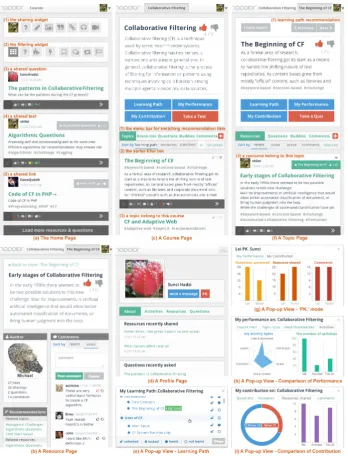
To Fulfil the Autonomy Need. Topolor lets learners feel in charge of their own behaviours and feel in control of their learning progress. A learner can clearly see the ‘layered’ learning goal of the course, i.e., the long-term goal to complete the course, the medium-term goal to finish a topic and the short-term goal to read a resource, as well as the reason for recommendations. A learner knows what is happening in the community on the home page (Fig. 1 (a)), a course page (Fig. 1 (c)) and a topic page (Fig. 1 (f)) that show various lists of, e.g., resources and peers’ activities, and she can adjust the lists using various filter-sorter widgets (Fig. 1 (a. 2) and (c. 2))).
Fig. 1. The user interface of Topolor 2
a peer’s profile page (Fig. 1 (d), showing a learner’s learning activities). A learner can check her contribution to the learning community and compare her performance and contribution with others. The data in the user model are visualised and opened to the learners (Fig. 2 (g), (h), (i)), which potentially encourages them to contribute more to the community, as seeing each other’s status may stimulate imitation and competition.
4 Conclusion and Future Work
This paper has presented the new visualisation and interaction features in Topolor 2, an online social e-learning system using adaptation and personalisation techniques. These new features were designed rooted in self-determination theory (SDT), aiming at improving the learning experience and learning efficiency in social e-learning. We intend to demonstrate Topolor 2 to researchers and practitioners in the conference and both showcase these new features and gather feedback on further improvements.
The preliminary evaluations were conducted using questionnaires that consisted of seven 5-point Likert scale (from 1: strongly disagree to 5: strongly agree) questions asking the comparison between Topolor 2 and other regular e-learning systems, including I believe Topolor a) helped me learn more topics; b) helped me learn more profoundly (deeply); c) increased my learning outcomes more; d) was easier to use; e) was more useful; f) was easier to learn how to use; and g) was easier to remember how to use. 25 completed questionnaires were collected. The mean values for each of the answers were a: 3.6, b: 4.0, c: 4.0, d: 4.0, e: 4.0, f: 4.1 and g: 4.3 (all>3.0, the neutral value). The standard deviation values for each of the answers were a: 0.71, b: 0.76, c: 0.68, d: 0.57, e: 0.64, f: 0.67 and g: 0.74, and the results’ Cronbach’s alpha value was 0.82 (≥0.8, indicating the results were reliable). The results indicated that the visualisation and interaction designed based on SDT had positive effect on the perceived learning experience and learning efficiency. The future work will start with investigating how each feature can improve the learning experience and learning efficiency, analysing the usage data tracked by Topolor’s logging mechanism.
References
1. Muntean, C. I.: Raising engagement in e-learning through gamification. Proc. of the 6th Intl. Conf. on Virtual Learning. pp. 323-329 (2011).
2. Ryan, R.M., Deci, E.L.: Self-determination theory and the facilitation of intrinsic motivation, social development, and well-being. Am. Psychol. 55, 1, 68 (2000). 3. Shi, L., Cristea, A.I., Foss, J.G.K., Al-Qudah, D.A., Qaffas, A.: A social
personalized adaptive e-learning environment: a case study in Topolor. IADIS Int. J. WWWInternet. 11, 2 (2013).
4. Shi, L., Al-Qudah, D. A., Cristea, A. I.: Designing Social Personalized Adaptive e-Learning. Proc. of the 18th ACM Conf. on Innovation and Technology in Computer Science Education. pp. 341–341 (2013).