Proceedings of the 2019 Conference on Empirical Methods in Natural Language Processing
1105
A systematic comparison of methods for low-resource dependency parsing
on genuinely low-resource languages
Clara Vania1 Yova Kementchedjhieva2 Anders Søgaard2 Adam Lopez1
1School of Informatics, University of Edinburgh, UK 2University of Copenhagen, Copenhagen, Denmark
[email protected], {yova|soegaard}@di.ku.dk, [email protected]
Abstract
Parsers are available for only a handful of the world’s languages, since they require lots of training data. How far can we get with just a small amount of training data? We sys-tematically compare a set of simple strate-gies for improving low-resource parsers: data augmentation, which has not been tested be-fore; cross-lingual training; and translitera-tion. Experimenting on three typologically diverse low-resource languages—North Sámi, Galician, and Kazah—We find that (1) when only the low-resource treebank is available, data augmentation is very helpful; (2) when a related high-resource treebank is available, cross-lingual training is helpful and comple-ments data augmentation; and (3) when the high-resource treebank uses a different writ-ing system, transliteration into a shared ortho-graphic spaces is also very helpful.
1 Introduction
Large annotated treebanks are available for only a tiny fraction of the world’s languages, and there is a wealth of literature on strategies for parsing with few resources (Hwa et al.,2005;Zeman and Resnik, 2008; McDonald et al., 2011; Søgaard,
2011). A popular approach is to train a parser on a related high-resource language and adapt it to the low-resource language. This approach benefits from the availability of Universal Dependencies (UD;Nivre et al.,2016), prompting substantial re-search (Tiedemann and Agic, 2016; Agi´c, 2017;
Rosa and Mareˇcek,2018), along with the VarDial and the CoNLL UD shared tasks (Zampieri et al.,
2017;Zeman et al.,2017,2018).
But low-resource parsing is still difficult. The organizers of the CoNLL 2018 UD shared task (Zeman et al.,2018) report that, in general, results on the task’s nine low-resource treebanks “are ex-tremely low and the outputs are hardly useful for
downstream applications.” So if we want to build a parser in a language with few resources, what can we do? To answer this question, we systemat-ically compare several practical strategies for low-resource parsing, asking:
1. What can we do with only a very smalltarget
treebank for a low-resource language?
2. What can we do if we also have asource tree-bank for a related high-resource language?
3. What if the source and target treebanks do not share a writing system?
Each of these scenarios requires different ap-proaches. Data augmentationis applicable in all scenarios, and has proven useful for low-resource NLP in general (Fadaee et al., 2017; Bergmanis et al.,2017;Sahin and Steedman,2018). Transfer learning via cross-lingual training is applicable in scenarios 2 and 3. Finally,transliterationmay be useful in scenario 3.
To keep our scenarios as realistic as possible, we assume that no taggers are available since this would entail substantial annotation. Therefore, our neural parsing models must learn to parse from words or characters—that is, they must be lexi-calized—even though there may be little shared vocabulary between source and target treebanks. While this may intuitively seem to make cross-lingual training difficult, recent results have shown that lexical parameter sharing on characters and words can in fact improve cross-lingual parsing (de Lhoneux et al., 2018); and that in some cir-cumstances, a lexicalized parser can outperform a delexicalized one, even in a low-resource setting (Falenska and C¸etino˘glu,2017).
Sámi and Finnish (Uralic); Galician and Por-tuguese (Romance); and Kazakh and Turkish (Tur-kic), which have different writing systems1. To
avoid optimistic evaluation, we extensively exper-iment only with North Sámi, which we also anal-yse to understand why our cross-lingual training outperforms the other parsing strategies. We treat Galician and Kazakh as truly held-out, and test only our best methods on these languages. Our results show that:
1. When no source treebank is available, data augmentation is very helpful: dependency tree morphing improves labeled attachment score (LAS) by as much as 9.3%. Our anal-ysis suggests that syntactic rather than lexi-cal variation is most useful for data augmen-tation.
2. When a source treebank is available, cross-lingual parsing improves LAS up to 16.2%, but data augmentation still helps, by an addi-tional 2.6%. Our analysis suggests that im-provements from cross-lingual parsing occur because the parser learns syntactic regulari-ties about word order, since it does not have access to POS and has little reusable informa-tion about word forms.
3. If source and target treebanks have differ-ent writing systems, transliterating them to a common orthography is very effective.
2 Methods
We describe three techniques for improving low-resource parsing: (1) two data augmentation meth-ods which have not been applied before for depen-dency parsing, (2) cross-lingual training, and (3) transliteration.
2.1 Data augmentation by dependency tree morphing (Morph)
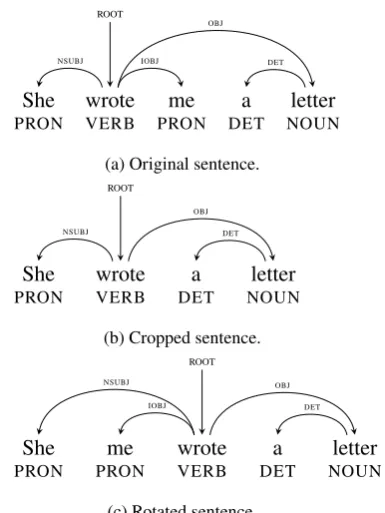
Sahin and Steedman (2018) introduce two opera-tions to augment a dataset for low-resource POS tagging. Their method assumes access to a depen-dency tree, but they do not test it for dependepen-dency parsing, which we do here for the first time. The first operation,cropping, removes some parts of a sentence to create a smaller or simpler, meaningful
1We select high-resource language based on language
family, since it is the most straightforward way to define lan-guage relatedness. However, other measurement (e.g., WALS (Dryer and Haspelmath,2013) properties) might be used.
She wrote me a letter
PRON VERB PRON DET NOUN
ROOT
NSUBJ IOBJ DET
OBJ
(a) Original sentence.
She wrote a letter
PRON VERB DET NOUN
ROOT
NSUBJ
OBJ DET
(b) Cropped sentence.
She me wrote a letter
PRON PRON VERB DET NOUN
ROOT
IOBJ
NSUBJ OBJ
DET
[image:2.595.325.518.61.318.2](c) Rotated sentence.
Figure 1: Examples of dependency tree morphing op-erations on the sentence “She wrote me a letter”.
sentence. The second operation,rotation, keeps all the words in the sentence but re-orders subtrees at-tached to therootverb, in particular those attached
by NSUBJ (nominal subject), OBJ (direct object),
IOBJ (indirect object), or OBL (oblique nominal)
dependencies. Figure1illustrates both operations.
It is important to note that while both opera-tions change the set of words or the word order, they do not change the dependencies. The sen-tences themselves may be awkward or ill-formed, but the corresponding analyses are still likely to be correct, and thus beneficial for learning. This is because they provide the model with more exam-ples of variations in argument structure (cropping) and in constituent order (rotation), which may ben-efit languages with flexible word order and rich morphology. Some of our low-resource languages have these properties—while North Sámi has a fixed word order (SVO), Galician and Kazakh have relatively free word order. All three lan-guages use case marking on nouns, so word order may not be as important for correct attachment.
2.2 Data augmentation by nonce sentence generation (Nonce)
Our next data augmentation method is adapted from Gulordava et al. (2018). The main idea is to create nonce sentences by replacing some of the words which have the same syntactic anno-tations. For each training sentence, we replace each content word—nouns, verbs, or adjective— with an alternative word having the same universal POS, morphological features, and dependency la-bel.2 Specifically, for each content word, we first
stochastically choose whether to replace it; then, if we have chosen to replace it, we uniformly sam-ple the replacement word type meeting the corre-sponding constraints. For instance, given a sen-tence “He borrowed a book from the library.”, we can generate the following sentences:
(1) a. He bought a book from the shop .
b. He wore a umbrella from the library .
This generation method is only based on syntac-tic features (i.e., morphology and dependency la-bels), so it sometimes produces nonsensical sen-tences like 1b. But since we only replace words if they have the same morphological features and dependency label, this method preserves the origi-nal tree structures in the treebank. Following ( Gu-lordava et al.,2018), we generate five nonce sen-tences for each original sentence.
2.3 Cross-lingual training
When a source treebank is available, model fer is a viable option. We perform model trans-fer by cross-lingual parser training: we first train on both source and target treebanks to produce a single model, and then fine tune the model only on the target treebank. In our preliminary experi-ments (AppendixA), we found that fine tuning on the target treebank was effective in all settings, so we use it in all applicable experiments reported in this paper.
2.4 Transliteration
Two related languages might not share a writing system even when they belong to the same fam-ily. We evaluate whether a simple translitera-tion would be helpful for cross-lingual training in this case. In our study, the Turkish treebank is
2The dependency label constraint is new to this paper.
written in extended Latin while the Kazakh tree-bank is written in Cyrillic. This difference poten-tially makes model transfer less useful, and means we might not be able to leverage lexical similar-ities between the two languages. We pre-process both treebanks by transliterating them to the same “pivot” alphabet, basic Latin.3
The mapping from Turkish is straightforward. Its alphabet consists of 29 letters, 23 of which are in basic Latin. The other six letters, ‘c¸’,‘˘g’, ‘ı’, ‘¨o’, ‘s¸’, and ‘¨u’, add diacritics to basic Latin char-acters, facilitating different pronunciations.4 We
map these to their basic Latin counterparts, e.g., ‘c¸’ to ‘c’. For Kazakh, we use a simple dictionary created by a Kazakh computational linguist to map each Cyrillic letter to the basic Latin alphabet.5.
3 Experimental Setup
3.1 Dependency Parsing Model
We use the Uppsala parser, a transition-based neu-ral dependency parser (de Lhoneux et al.,2017a,b;
Kiperwasser and Goldberg,2016). The parser uses an arc-hybrid transition system (Kuhlmann et al.,
2011), extended with a static-dynamic oracle and SWAP transition to allow non-projective
depen-dency trees (Nivre,2009).
Letw = w0, . . . , w|w| be an input sentence of length|w|and letw0 represent an artificial ROOT token. We create a vector representation for each input tokenwi by concatenating(; )its word
em-bedding,ew(wi)and its character-based word
em-bedding,ec(wi):
xi = [ew(wi);ec(wi)] (1)
Here,ec(wi)is the output of acharacter-level
bidi-rectional LSTM (biLSTM) encoder run over the characters ofwi(Ling et al.,2015); this makes the
model fully open-vocabulary, since it can produce representations for any character sequence. We then obtain a context-sensitive encodinghi using
aword-levelbiLSTM encoder:
hi = [LSTMf(x0:i);LSTMb(x|w|:i)] (2)
We then create a configuration by concatenating the encoding of a fixed number of words on the top of the stack and the beginning of the buffer. Given 3Another possible pivot is phonemes (Tsvetkov et al., 2016). We leave this as future work.
4https://www.omniglot.com/writing/turkish.htm
5The mapping from Kazakh Cyrilic into basic Latin
Language Treebank ID train dev. test
Finnish fi_tdt 14981 1875 1555
North Sámi sme_giella 1128 1129 865
Portuguese pt_bosque 8329 560 477
Galician gl_treegal 300 300 400
Turkish tr_imst 3685 975 975
[image:4.595.328.504.64.129.2]Kazakh kk_ktb 15 16 1047
Table 1: Train/dev split used for each treebank.
this configuration, we predict a transition and its arc label using a multi-layer perceptron (MLP). More details of the core parser can be found in
de Lhoneux et al.(2017a,b).
3.2 Parameter sharing
To train cross-lingual models, we use the strategy of de Lhoneux et al. (2018) for parameter shar-ing, which usessoftsharing for word and charac-ter paramecharac-ters, andhard sharing for the MLP pa-rameters. Soft parameter sharing uses a language embedding, which, in theory, learns what parame-ters to share between the two languages. Letcj be
an embedding of character cj in a tokenwi from
the treebank of language k, and letlk be the
lan-guage embedding. For sharing on characters, we concatenate character and language embedding:
[cj;lk] for input to the character-level biLSTM.
Similarly, for input to the word-level biLSTM, we concatenate the language embedding to the word embedding, modifying Eq. 1to
xi = [ew(wi);ec(wi);lk] (3)
We use the default hyperparameters ofde Lhoneux et al. (2018) in our experiments. We fine-tune each model by training it further only on the tar-get treebank (Shi et al.,2016). We use early stop-ping based on Label Attachment Score (LAS) on development set.
3.3 Datasets
We use Universal Dependencies (UD) treebanks version 2.2 (Nivre et al.,2018). None of our target treebanks have a development set, so we generate new train/dev splits by 50:50 (Table 1). Having large development sets allow us to perform better analysis for this study.
4 Parsing North Sámi
North Sámi is our largest low-resource treebank, so we use it for a full evaluation and analysis of
original +Morph +Nonce
T100 1128 7636 4934
T50 564 3838 2700
[image:4.595.78.283.64.155.2]T10 141 854 661
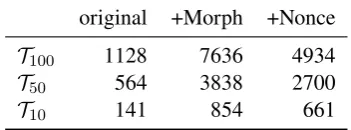
Table 2: Number of North Sámi training sentences.
different strategies before testing on the other lan-guages. To understand the effect of target tree-bank size, we generate three datasets with different
trainingsizes: T10(⇠10%),T50(⇠50%), andT100 (100%). Table 2 reports the number of training sentences after we augment the data using meth-ods described in Section2. We apply MORPHand
NONCEseparately to understand the effect of each
method and to control the amount of noise in the augmented data.
We employ two baselines: a monolingual model (§3.1) and a cross-lingual model (§2.3), both
with-out data augmentation. The monolingual model acts as a simple baseline, to resemble a situation when the target treebank does not have any source treebank (i.e., no available treebanks from related languages). The cross-lingual model serves as a strong baseline, simulating a case when there is a source treebank. We compare both baselines to models trained with MORPHand NONCE
augmen-tation methods. Table3reports our results, and we review our motivating scenarios below.
Scenario 1: we only have a very small tar-get treebank. In the monolingual experiments, we observe that both dependency tree morph-ing (MORPH) and nonce sentence generation
(NONCE) improve performance, indicating the
strong benefits of data augmentation when there are no other resources available except the target treebank itself. In particular, when the number of training data is the lowest (T10), data augmenta-tions improves performance up to 9.3% LAS.
MONOLINGUAL CROSS-LINGUAL
size mono-base +Morph +Nonce cross-base +Morph +Nonce
T100 53.3 56.0 (+3.3) 56.3 (+3.0) 61.3 (+8.0) 60.9 (+7.6) 61.7 (+8.4)
T50 42.5 46.6 (+4.1) 46.5 (+4.0) 52.0 (+9.5) 51.7 (+9.2) 52.0 (+9.5)
[image:5.595.319.513.200.364.2]T10 18.5 27.1 (+8.6) 27.8 (+9.3) 34.7 (+16.2) 37.3 (+18.8) 35.4 (+16.9)
Table 3: LAS results on North Sámi development data. mono-baseandcross-baseare models without data aug-mentation. % improvements overmono-baseshown in parentheses.
4.1 What is learned from Finnish?
Why do cross-lingual training and data augmen-tation help? To put this question in context, we first consider their relationship. Finnish and North Sámi are mutually unintelligible, but they are ty-pologically similar: of the 49 (mostly syntactic) linguistic features annotated for North Sámi in the Word Atlas of Languages (WALS; Dryer and Haspelmath, 2013), Finnish shares the same val-ues for 42 of them.6 Despite this and their
phy-logenetic and geographical relatedness, they share very little vocabulary: only 6.5% of North Sámi tokens appear in Finnish data, and these words are either proper nouns or closed class words such as pronouns or conjunctions. However, both lan-guages do share many character-trigrams (72.5%, token-level), especially on suffixes.
Now we turn to an analysis of the T10 data set-ting, where we see the largest gains for all meth-ods.
4.2 Analysis of data augmentation
For dependency parsing, POS features are im-portant because they can provide strong signals whether there exists dependency between two words in a given sentence. For example, subject
and object dependencies often occur between a
NOUNand a VERB, as can be seen in Fig. 1a. We
investigate the extent to which data augmentation is useful for learning POS features, using diagnos-tic classifiers (Veldhoen et al., 2016; Adi et al.,
2016;Shi et al., 2016) to probe our model repre-sentations. Our central question is: do the models learn useful representations of POS, despite hav-ing no direct access to it? And if so, is this helped by data augmentation?
After training each model, we freeze the param-eters and generate context-dependent representa-6There are 192 linguistic features in WALS, but only 49
are defined for North Sámi. These features are mostly syn-tactic, annotated within different areas such as morphology, phonology, nominal and verbal categories, and word order.
POS %dev baseline %diff. with
+Morph +Nonce
INTJ 0.1 0.0 20.0 20.0
PART 1.5 70.1 7.7 0.8
NUM 1.9 19.2 15.1 -4.1
ADP 1.9 15.7 24.5 19.7
SCONJ 2.4 57.8 5.9 7.6
AUX 3.2 26.3 27.2 -4.9
CCONJ 3.4 91.3 -0.8 -4.2
PROPN 4.7 5.9 5.9 -5.9
ADJ 6.5 12.7 3.8 0.2
ADV 9.0 42.9 11.8 11.5
PRON 13.4 63.2 5.4 -2.7
VERB 25.7 72.4 -6.2 -4.5
NOUN 26.4 67.0 8.6 13.2
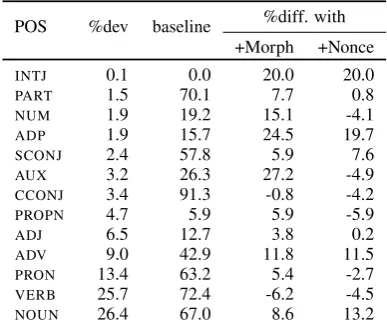
Table 4: Results for the monolingual POS predictions, ordered by the frequency of each tag in the dev split (%dev). %diff shows the difference between each aug-mentation method and monolingual models.
tions (i.e., the output ofword-levelbiLSTM,hi in
Eq. 2), for the training and development data. We then train a feed-forward neural network classifier to predict the POS tag of each word, using only the representation as input. To filter out the ef-fect of cross-lingual training, we only analyze rep-resentations trained using the monolingual mod-els. Our training and development data consists of 6321 and 7710 tokens, respectively. The percent-age of OOV tokens is 40.5%.
Table 4 reports the POS prediction accuracy. We observe that representations generated with monolingual MORPH seem to learn better POS,
for most of the tags. On the other hand, rep-resentations generated with monolingual NONCE
sometimes produce lower accuracy on some tags; only on nouns the accuracy is better than mono-lingual MORPH. We hypothesize that this is
be-cause NONCE sometimes generates meaningless
sentences which confuse the model. In parsing this effect is less apparent, mainly because mono-lingual NONCEhas the poorest POS representation
representa-Top nearest Finnish words
North Sámi char-level word-level
borrat(VERB; eat) herrat(NOUN; gentleman) k¨ayd¨a(VERB; go) kerrat(NOUN; time) otan(VERB; take) naurat(VERB; laugh) sain(VERB; get)
veahki(NOUN; help) nuuhki(VERB; sniff) tyhj¨aksi(ADJ; empty) v¨aki(NOUN; power) johonki(PRON; something) avarsi(VERB; expand) l¨aht¨okohdaksi(NOUN; basis) divrras(ADJ; expensive) harras(ADJ; devout) v¨altt¨am¨at¨ont¨a(ADJ; essential)
reipas(ADJ; brave) mahdollista(ADJ; possible)
[image:6.595.320.512.247.323.2]sarjaporras(NOUN; series) kilpailukykyisempi(ADJ; competitive)
Table 5: Most similar Finnish words for each North Sámi word based on cosine similarity.
tion of nouns.
4.3 Effects of cross-lingual training
Next, we analyze the effect of cross-lingual train-ing by compartrain-ing the monoltrain-ingual baseline to the cross-lingual model with MORPH.
Cross-lingual representations. The fact that cross-lingual model improves parsing perfor-mance is interesting, since Finnish and North Sámi have so little common vocabulary. What linguis-tic knowledge is transferred through cross-lingual training? We analyze whether words with the same POS category from the source and target treebanks have similar representations. To do this, we analyze the head predictions, and col-lect North Sámi tokens for which only the cross-lingual model correctly predicts the headword.7
For these words, we compare token-level represen-tations of North Sámidevelopmentdata to Finnish
trainingdata.
We ask the following questions: Given the rep-resentation of a North Sámi word, what is the Finnish word with the most similar representation? Do they share the same POS category? Informa-tion other than POS may very well be captured, but we expect that the representations will reflect sim-ilar POS since POS is highly revelant to parsing. We usecosine distanceto measure similarity.
We look at four categories for which cross-lingual training substantial improves results on the development set: adjectives, nouns, pronouns, and verbs. We analyze representations generated by two layers of the model in §3.1: (1) the output of character-level biLSTM (char-level),ec(wi)and
7Another possible way is to look at the label predictions.
But since the monolingual baseline LAS is very low, we fo-cus on the unlabeled attachment prediction since it is more accurate.
POS char-level (%) word-level (%)
ADJ 12.1 37.1
NOUN 55.8 63.5
PRON 12.9 68.0
VERB 34.2 69.0
Table 6: # of North Sámi tokens for which the most similar Finnish word has the same POS.
(2) the output of word-level biLSTM (word-level), i.e.,hiin Eq. 2.
Table 5 shows examples of top three closest Finnish training words for a given North Sámi word. We observe that character-level represen-tation focuses on orthographic similarity of suf-fixes, rather than POS. On the word-level repre-sentations, we find more cases when the top clos-est Finnish words have the same POS with the North Sámi word. In fact, when we compare the most similar Finnish word (Table6) quantita-tively, we find that the word-level representations of North Sámi are often similar to Finnish word with the same POS; the same trend does not hold for character-level representations. Since very few word tokens are shared, this suggests that improve-ments in cross-lingual training might simply be due to syntactic (i.e. word order) similarities be-tween the two languages, captured in the dynam-ics of the biLSTM encoder—despite the fact that it knows very little about the North Sámi tokens themselves. The word-level representation has ad-vantage over the char-level representation in the way that it has access to contextual information like word order, and it has knowledge about the other words in the sentence.
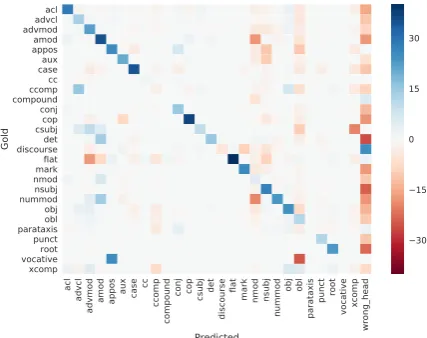
com-Figure 2: Differences between cross-lingual vs. mono-lingual confusion matrices. The last column represents cases ofincorrect heads and the other columns repre-sent cases forcorrectheads, i.e., each row summing to 100%. Blue cells show higher cross-lingual values and red cells show higher monolingual values.
pared to the cross-lingual models. Looking at the produced parse trees, one striking difference is that monolingual model sometimes predicts a “root-less" tree. That is, it fails to assign a head of any word with index ‘0’ and label the dependency with a root label. In cases where the monolin-gual model predicts wrong parses and the cross-lingual model predicts the correct ones, we find that the “rootless" trees are predicted more than 50% of the time.8 Meanwhile, the cross-lingual
model learns to assign a word with head index ‘0’, although sometimes it is the incorrect word (e.g., it is the second word, but the parser predicts the fifth word). This pattern suggests that more training ex-amples at least helps the model to learn structural properties of a well-formed tree.
The ability of a parser to predict labels is con-tingent on its ability to predict heads, so we focus our analysis on two cases. How do monolingual and cross-lingual head prediction compare? And if both models predict the correct head, how do they compare on label prediction?
Figure2shows thedifferencebetween two con-fusion matrices: one for cross-lingual and one for monolingual models. The last column shows cases ofincorrectheads and the other columns show la-bel predictions when the heads are correct, i.e., each row summing to 100%. Here, blue cells 8The parsing model enforces the constraint that every tree
should have a head, i.e., an arc pointing from a dummy root to a node in the tree. It does not, however, enforce that this arc be labeledroot—the model must learn the labeling.
CROSS-LINGUAL
Language zero-shot +fastText +Morph
Galician 51.9 72.8 71.0
Kazakh 12.5 27.7 28.4
[image:7.595.74.288.63.232.2]Kazakh (translit.) 21.2 31.1 36.7
Table 7: LAS results ondevelopment sets. zero-shot
denotes results where we predict using model trained only on the source treebank.
highlight confusions that are more common for the cross-lingual model, while red cells highlight those more common for the monolingual model. For head prediction (last column), we observe that monolingual model makes higher errors especially for nominals and modifier words. In cases when both both models predict the correct heads, we ob-serve that cross-lingual training gives further im-provements in predicting most of the labels. In particular, regarding the “rootless" trees discussed before, we see evidence that cross-lingual training helps in predicting the correct root index, and the correctrootlabel.
5 Parsing truly low-resource languages
Now we turn to two truly low-resource treebanks: Galician and Kazakh. These treebanks are most analogous to the North SamiT10setting and there-fore we apply the best approach, cross-lingual training with MORPH augmentation. Table1
pro-vides the statistics of the augmented data. For Galician, we use the Portuguese treebank as source while for Kazakh we use Turkish. Portuguese and Galician have high vocabulary overlap; 62.9% of Galician tokens appear in Portuguese data, while for Turkish and Kazakh they do not share vocabu-lary since they use different writing systems. How-ever, after transliterating them into the same basic Latin alphabet, we observe that 9.5% of Kazakh tokens appear in the Turkish data. Both language pairs also share many (token-level) character tri-grams: 96.0% for Galician-Portuguese and 66.3% for transliterated Kazakh-Turkish.
To compare our best approach, we create two baselines: (1) a pre-trained parsing model of the source treebank (zero-shot learning), and (2) a cross-lingual model initialized with monolingual
[image:7.595.311.522.67.129.2]CROSS-LINGUAL
baseline best system +fastText +Morph rank
Galician 66.16 74.25 70.46 69.21 10/27
[image:8.595.134.469.76.134.2]Kazakh (translit.) 24.21 31.93 25.28 28.23 2/27
Table 8: Comparison to CoNLL 2018 UD Shared Task ontest sets. best systemis the state-of-the-art model for each treebank: UDPipe-Future (Straka,2018) for Galician and Uppsala (Smith et al.,2018) for Kazakh.rankshows our best model position in the shared task ranking for each treebank.
a strong baseline, in a case when we have access to pre-trained word embeddings, for the source and/or the target languages.
We treat a pre-trained word embedding as an external embedding, and concatenate it with the other representations, i.e., modifying Eq. 3 to xi = [ew(wi);ep(wi);ec(wi);lk], where ep(wi)
represents a pre-trained word embedding of wi,
which we update during training. We use the pre-trained monolingual fastText embeddings ( Bo-janowski et al.,2017).9 We concatenate the source
and target pre-trained word embeddings.10 For
our experiments with transliteration (§2.4), we transliterate the entries of both the source and the target pre-trained word embeddings.
5.1 Experimental results
Table7reports the LAS performance on the devel-opment sets. MORPH augmentation improves
per-formance over the zero-shot baseline and achieves comparable or better LAS with a cross-lingual model trained with pre-trained word embeddings.
Next, we look at the effects of transliteration (see Kazakh vs Kazakh (translit.) in Table7). In the zero-shot experiments, simply mapping both Turkish and Kazakh characters to the Latin alpha-bet improves accuracy from 12.5 to 21.2 LAS. Cross-lingual training with MORPH further
im-proves performance to 36.7 LAS.
5.2 Comparison with CoNLL 2018
To see how our best approach (i.e., cross-lingual model with MORPHaugmentation) compares with
the current state-of-the-art models, we compare it to the recent results from CoNLL 2018 shared task. Training state-of-the-art models may require lots of engineering and data resources. Our goal, however, is not to achieve the best performance,
9The embeddings are available at
https://fasttext.cc/docs/en/pretrained-vectors.html.
10If a word occurs in both source and target, we use the
word embedding of the source language.
but rather to systematically investigate how far simple approaches can take us. We report perfor-mance of the following: (1) the shared task base-line model (UDPipe v1.2; Straka and Straková,
2017) and (2) the best system for each treebank, (3) our best approach, and (4) a cross-lingual model with fastText embeddings.
Table8 presents the overall comparison on the test sets. For each treebank, we apply the same sentence segmentation and tokenization used by each best system.11 We see that our approach
outperforms the baseline models on both lan-guages. For Kazakh, our model (with transliter-ation) achieves a competitive LAS (28.23), which would be the second position in the shared task ranking. As comparison, the best system for Kazakh (Smith et al., 2018) trained a multi-treebank model with four source multi-treebanks, while we only use one source treebank. Their system use predicted POS as input, while ours depends solely on words and characters. The use of more treebanks and predicted POS is beyond the scope of our paper, but it is interesting that our ap-proach can achieve the second best with such min-imal resources. For Galician, our best approach outperforms baseline by 8.09 LAS points. Note that, Galician treebank does not come with train-ing data. We use 50:50 train/dev split, while other teams might use higher split for training (for ex-ample, the best system (Straka,2018) uses 90:10 train/dev split). Since we treat Galician as our test data, we did not tune on the proportion for training data, but we guess that this is the main reason why our system achieve rank 10 out of 27.
Compared to cross-lingual models with fastText embeddings (fastText vs. MORPH), we observe
that our approach achieve better or comparable performance, showing its potential when there is
11UD shared task only provides unsegmented (i.e.,
not enough monolingual data available for train-ing word embeddtrain-ings.
6 Conclusions
In this paper, we investigated various low-resource parsing scenarios. We demonstrate that in the ex-tremely low-resource setting, data augmentation improves parsing performance both in monolin-gual and cross-linmonolin-gual settings. We also show that transfer learning is possible with lexicalized
parsers. In addition, we show that transfer learn-ing between two languages with different writlearn-ing systems is possible, and future work should con-sider transliteration for other language pairs.
While we have not exhausted all the possible techniques (e.g., use of external resources ( Ra-sooli and Collins,2017;Rosa and Mareˇcek,2018), predicted POS (Ammar et al., 2016), multiple source treebanks (Lim et al.,2018;Stymne et al.,
2018), among others), we show that simple meth-ods which leverage the linguistic annotations in the treebank can improve low-resource parsing. Fu-ture work might explore different augmentation methods, such as the use ofsyntheticsource tree-banks (Wang and Eisner,2018) or contextualized language model (Peters et al., 2018;Howard and Ruder,2018;Devlin et al., 2018) for scoring the augmented data (e.g., using perplexity).
Finally, while the techniques presented in this paper might be applicable to other low-resource languages, we want to also highlight the impor-tance of understanding the characteristics of lan-guages being studied. For example, we showed that although North Sami and Finnish do not share vocabulary, cross-lingual training is still helpful because they share similar syntactic structures. Different language pairs might benefit from other types of similarity (e.g., morphological) and in-vestigating this would be another interesting future work for low-resource dependency parsing.
Acknowledgments
Clara Vania is supported by the Indonesian En-dowment Fund for Education (LPDP), the Cen-tre for Doctoral Training in Data Science, funded by the UK EPSRC (grant EP/L016427/1), and the University of Edinburgh. Anders Søgaard is sup-ported by a Google Focused Research Award. We thank Aibek Makazhanov for helping with Kazakh transliteration, and Miryam de Lhoneux for parser implementation. We also thank Andreas Grivas,
Maria Corkery, Ida Szubert, Gozde Gul Sahin, Sameer Bansal, Marco Damonte, Naomi Saphra, Nikolay Bogoychev, and anonymous reviewers for helpful discussion of this work and comments on previous drafts of the paper.
References
Yossi Adi, Einat Kermany, Yonatan Belinkov, Ofer Lavi, and Yoav Goldberg. 2016. Fine-grained anal-ysis of sentence embeddings using auxiliary predic-tion tasks.CoRR, abs/1608.04207.
ˇZeljko Agi´c. 2017. Cross-Lingual Parser Selection for Low-Resource Languages. In Proceedings of the NoDaLiDa 2017 Workshop on Universal Dependen-cies (UDW 2017), pages 1–10. Association for Com-putational Linguistics.
Waleed Ammar, George Mulcaire, Miguel Ballesteros, Chris Dyer, and Noah Smith. 2016. Many Lan-guages, One Parser. Transactions of the Association for Computational Linguistics, 4:431–444.
Toms Bergmanis, Katharina Kann, Hinrich Sch¨utze, and Sharon Goldwater. 2017. Training data augmen-tation for low-resource morphological inflection. In
Proceedings of the CoNLL SIGMORPHON 2017 Shared Task: Universal Morphological Reinflection, pages 31–39. Association for Computational Lin-guistics.
Piotr Bojanowski, Edouard Grave, Armand Joulin, and Tomas Mikolov. 2017. Enriching Word Vectors with Subword Information. Transactions of the Associa-tion for ComputaAssocia-tional Linguistics, 5:135–146.
Jacob Devlin, Ming-Wei Chang, Kenton Lee, and Kristina Toutanova. 2018. BERT: Pre-training of Deep Bidirectional Transformers for Language Un-derstanding. arXiv preprint arXiv:1810.04805.
Matthew S. Dryer and Martin Haspelmath, editors. 2013. WALS Online. Max Planck Institute for Evo-lutionary Anthropology, Leipzig.
Marzieh Fadaee, Arianna Bisazza, and Christof Monz. 2017. Data augmentation for low-resource neural machine translation. InProceedings of the 55th An-nual Meeting of the Association for Computational Linguistics (Volume 2: Short Papers), pages 567– 573. Association for Computational Linguistics.
Agnieszka Falenska and ¨Ozlem C¸etino˘glu. 2017. Lex-icalized vs. delexLex-icalized parsing in low-resource scenarios. InProceedings of the 15th International Conference on Parsing Technologies, pages 18–24. Association for Computational Linguistics.
Kristina Gulordava, Piotr Bojanowski, Edouard Grave, Tal Linzen, and Marco Baroni. 2018. Colorless Green Recurrent Networks Dream Hierarchically. In
American Chapter of the Association for Computa-tional Linguistics: Human Language Technologies, Volume 1 (Long Papers), pages 1195–1205. Associ-ation for ComputAssoci-ational Linguistics.
Jeremy Howard and Sebastian Ruder. 2018. Universal Language Model Fine-tuning for Text Classification. InProceedings of the 56th Annual Meeting of the As-sociation for Computational Linguistics (Volume 1: Long Papers), pages 328–339. Association for Com-putational Linguistics.
Rebecca Hwa, Philip Resnik, Amy Weinberg, Clara Cabezas, and Okan Kolak. 2005. Bootstrapping parsers via syntactic projection across parallel texts.
Nat. Lang. Eng., 11(3):311–325.
Eliyahu Kiperwasser and Yoav Goldberg. 2016. Sim-ple and Accurate Dependency Parsing Using Bidi-rectional LSTM Feature Representations. Transac-tions of the Association for Computational Linguis-tics, 4:313–327.
Marco Kuhlmann, Carlos Gómez-Rodrìguez, and Gior-gio Satta. 2011. Dynamic Programming Algorithms for Transition-Based Dependency Parsers. In Pro-ceedings of the 49th Annual Meeting of the Asso-ciation for Computational Linguistics: Human Lan-guage Technologies, pages 673–682. Association for Computational Linguistics.
Miryam de Lhoneux, Johannes Bjerva, Isabelle Augen-stein, and Anders Søgaard. 2018. Parameter sharing between dependency parsers for related languages. In Proceedings of the 2018 Conference on Empiri-cal Methods in Natural Language Processing, pages 4992–4997. Association for Computational Linguis-tics.
Miryam de Lhoneux, Yan Shao, Ali Basirat, Eliyahu Kiperwasser, Sara Stymne, Yoav Goldberg, and Joakim Nivre. 2017a. From Raw Text to Universal Dependencies – Look, No Tags! InProceedings of the CoNLL 2017 Shared Task: Multilingual Parsing from Raw Text to Universal Dependencies., Vancou-ver, Canada.
Miryam de Lhoneux, Sara Stymne, and Joakim Nivre. 2017b. Arc-Hybrid Non-Projective Dependency Parsing with a Static-Dynamic Oracle. In Proceed-ings of the The 15th International Conference on Parsing Technologies (IWPT)., Pisa, Italy.
KyungTae Lim, Niko Partanen, and Thierry Poibeau. 2018. Multilingual dependency parsing for low-resource languages: Case studies on north saami and komi-zyrian. InProceedings of the Eleventh In-ternational Conference on Language Resources and Evaluation (LREC-2018). European Language Re-source Association.
Wang Ling, Chris Dyer, Alan W Black, Isabel Tran-coso, Ramon Fermandez, Silvio Amir, Luis Marujo, and Tiago Luis. 2015. Finding Function in Form: Compositional Character Models for Open Vocab-ulary Word Representation. In Proceedings of the
2015 Conference on Empirical Methods in Natu-ral Language Processing, pages 1520–1530, Lis-bon, Portugal. Association for Computational Lin-guistics.
Ryan McDonald, Slav Petrov, and Keith Hall. 2011. Multi-Source Transfer of Delexicalized Dependency Parsers. InProceedings of the 2011 Conference on Empirical Methods in Natural Language Process-ing, pages 62–72. Association for Computational Linguistics.
Joakim Nivre. 2009. Non-Projective Dependency Pars-ing in Expected Linear Time. InProceedings of the Joint Conference of the 47th Annual Meeting of the ACL and the 4th International Joint Conference on Natural Language Processing of the AFNLP, pages 351–359. Association for Computational Linguis-tics.
Macke-tanz, Aibek Makazhanov, Michael Mandl, Christo-pher Manning, Ruli Manurung, C´t´lina M´r´ n-duc, David Mareˇcek, Katrin Marheinecke, Héctor Martínez Alonso, André Martins, Jan Maˇsek, Yuji Matsumoto, Ryan McDonald, Gustavo Mendonc¸a, Niko Miekka, Anna Missil¨a, C´t´lin Mititelu, Yusuke Miyao, Simonetta Montemagni, Amir More, Laura Moreno Romero, Shinsuke Mori, Bjartur Mortensen, Bohdan Moskalevskyi, Kadri Muis-chnek, Yugo Murawaki, Kaili M¨u¨urisep, Pinkey Nainwani, Juan Ignacio Navarro Hor˜niacek, Anna Nedoluzhko, Gunta Neˇspore-B¯erzkalne, L˜Ïng Nguy˜ên Th‡, Huy`ên Nguy˜ên Th‡ Minh, Vitaly Nikolaev, Rattima Nitisaroj, Hanna Nurmi, Stina Ojala, AdédayÂOlúòkun, Mai Omura, Petya Osen-ova, Robert ¨Ostling, Lilja Øvrelid, Niko Partanen, Elena Pascual, Marco Passarotti, Agnieszka Pate-juk, Siyao Peng, Cenel-Augusto Perez, Guy Per-rier, Slav Petrov, Jussi Piitulainen, Emily Pitler, Barbara Plank, Thierry Poibeau, Martin Popel, Lauma Pretkalnin¸a, Sophie Prévost, Prokopis Proko-pidis, Adam Przepiórkowski, Tiina Puolakainen, Sampo Pyysalo, Andriela R¨a¨abis, Alexandre Rade-maker, Loganathan Ramasamy, Taraka Rama, Car-los Ramisch, Vinit Ravishankar, Livy Real, Siva Reddy, Georg Rehm, Michael Rießler, Larissa Ri-naldi, Laura Rituma, Luisa Rocha, Mykhailo Ro-manenko, Rudolf Rosa, Davide Rovati, Valentin Ros,ca, Olga Rudina, Shoval Sadde, Shadi Saleh,
Tanja Samardˇzi´c, Stephanie Samson, Manuela San-guinetti, Baiba Saul¯ıte, Yanin Sawanakunanon, Nathan Schneider, Sebastian Schuster, Djamé Sed-dah, Wolfgang Seeker, Mojgan Seraji, Mo Shen, Atsuko Shimada, Muh Shohibussirri, Dmitry Sichinava, Natalia Silveira, Maria Simi, Radu Simionescu, Katalin Simkó, Mária ˇSimková, Kiril Simov, Aaron Smith, Isabela Soares-Bastos, An-tonio Stella, Milan Straka, Jana Strnadová, Alane Suhr, Umut Sulubacak, Zsolt Szántó, Dima Taji, Yuta Takahashi, Takaaki Tanaka, Isabelle Tel-lier, Trond Trosterud, Anna Trukhina, Reut Tsar-faty, Francis Tyers, Sumire Uematsu, Zdeˇnka Ureˇsová, Larraitz Uria, Hans Uszkoreit, Sowmya Vajjala, Daniel van Niekerk, Gertjan van No-ord, Viktor Varga, Veronika Vincze, Lars Wallin, Jonathan North Washington, Seyi Williams, Mats Wirén, Tsegay Woldemariam, Tak-sum Wong, Chunxiao Yan, Marat M. Yavrumyan, Zhuoran Yu, Zdenˇek ˇZabokrtsk˛, Amir Zeldes, Daniel Zeman, Manying Zhang, and Hanzhi Zhu. 2018. Univer-sal Dependencies 2.2. LINDAT/CLARIN digital li-brary at the Institute of Formal and Applied Linguis-tics (ÚFAL), Faculty of MathemaLinguis-tics and Physics, Charles University.
Joakim Nivre, Marie-Catherine de Marneffe, Filip Gin-ter, Yoav Goldberg, Jan Hajic, Christopher D. Man-ning, Ryan McDonald, Slav Petrov, Sampo Pyysalo, Natalia Silveira, Reut Tsarfaty, and Daniel Zeman. 2016. Universal dependencies v1: A multilingual treebank collection. InProceedings of the Tenth In-ternational Conference on Language Resources and Evaluation (LREC 2016), Paris, France. European
Language Resources Association (ELRA).
Matthew E. Peters, Mark Neumann, Mohit Iyyer, Matt Gardner, Christopher Clark, Kenton Lee, and Luke Zettlemoyer. 2018. Deep contextualized word repre-sentations. InProc. of NAACL.
Mohammad Sadegh Rasooli and Michael Collins. 2017. Cross-lingual syntactic transfer with limited resources. Transactions of the Association for Com-putational Linguistics, 5:279–293.
Rudolf Rosa and David Mareˇcek. 2018. Cuni x-ling: Parsing under-resourced languages in conll 2018 ud shared task. In Proceedings of the CoNLL 2018 Shared Task: Multilingual Parsing from Raw Text to Universal Dependencies, pages 187–196. Associ-ation for ComputAssoci-ational Linguistics.
Gozde Gul Sahin and Mark Steedman. 2018. Data Augmentation via Dependency Tree Morphing for Low-Resource Languages. In Proceedings of the 2018 Conference on Empirical Methods in Natural Language Processing, pages 5004–5009. Associa-tion for ComputaAssocia-tional Linguistics.
Xing Shi, Inkit Padhi, and Kevin Knight. 2016. Does string-based neural mt learn source syntax? In Pro-ceedings of the 2016 Conference on Empirical Meth-ods in Natural Language Processing, pages 1526– 1534. Association for Computational Linguistics. Aaron Smith, Bernd Bohnet, Miryam de Lhoneux,
Joakim Nivre, Yan Shao, and Sara Stymne. 2018. 82 Treebanks, 34 Models: Universal Dependency Parsing with Multi-Treebank Models. In Proceed-ings of the CoNLL 2018 Shared Task: Multilingual Parsing from Raw Text to Universal Dependencies, pages 113–123. Association for Computational Lin-guistics.
Anders Søgaard. 2011. Data point selection for cross-language adaptation of dependency parsers. In Pro-ceedings of the 49th Annual Meeting of the Asso-ciation for Computational Linguistics: Human Lan-guage Technologies, pages 682–686. Association for Computational Linguistics.
Milan Straka. 2018. UDPipe 2.0 Prototype at CoNLL 2018 UD Shared Task. InProceedings of the CoNLL 2018 Shared Task: Multilingual Parsing from Raw Text to Universal Dependencies, pages 197–207. As-sociation for Computational Linguistics.
J¨org Tiedemann and ˇZeljko Agic. 2016. Synthetic tree-banking for cross-lingual dependency parsing. J. Ar-tif. Int. Res., 55(1):209–248.
Yulia Tsvetkov, Sunayana Sitaram, Manaal Faruqui, Guillaume Lample, Patrick Littell, David Mortensen, Alan W Black, Lori Levin, and Chris Dyer. 2016. Polyglot neural language models: A case study in cross-lingual phonetic representation learning. In Proceedings of the 2016 Conference of the North American Chapter of the Association for Computational Linguistics: Human Language Technologies, pages 1357–1366. Association for Computational Linguistics.
Sara Veldhoen, Dieuwke Hupkes, and Willem H. Zuidema. 2016. Diagnostic classifiers revealing how neural networks process hierarchical structure. InCoCo@NIPS.
Dingquan Wang and Jason Eisner. 2018. Synthetic data made to order: The case of parsing. In Proceed-ings of the 2018 Conference on Empirical Methods in Natural Language Processing, pages 1325–1337. Association for Computational Linguistics.
Marcos Zampieri, Shervin Malmasi, Nikola Ljubeˇsi´c, Preslav Nakov, Ahmed Ali, J¨org Tiedemann, Yves Scherrer, and No¨emi Aepli. 2017. Findings of the vardial evaluation campaign 2017. InProceedings of the Fourth Workshop on NLP for Similar Lan-guages, Varieties and Dialects (VarDial), pages 1– 15. Association for Computational Linguistics.
Daniel Zeman, Jan Haji{ˇc}, Martin Popel, Martin Pot-thast, Milan Straka, Filip Ginter, Joakim Nivre, and Slav Petrov. 2018. CoNLL 2018 Shared Task: Mul-tilingual Parsing from Raw Text to Universal Depen-dencies. InProceedings of the CoNLL 2018 Shared Task: Multilingual Parsing from Raw Text to Univer-sal Dependencies, pages 1–21. Association for Com-putational Linguistics.
Daniel Zeman, Martin Popel, Milan Straka, Jan Ha-jic, Joakim Nivre, Filip Ginter, Juhani Luotolahti, Sampo Pyysalo, Slav Petrov, Martin Potthast, Fran-cis Tyers, Elena Badmaeva, Memduh Gokirmak, Anna Nedoluzhko, Silvie Cinkova, Jan Hajic jr., Jaroslava Hlavacova, Václava Kettnerová, Zdenka Uresova, Jenna Kanerva, Stina Ojala, Anna Mis-sil¨a, Christopher D. Manning, Sebastian Schuster, Siva Reddy, Dima Taji, Nizar Habash, Herman Le-ung, Marie-Catherine de Marneffe, Manuela San-guinetti, Maria Simi, Hiroshi Kanayama, Valeria de-Paiva, Kira Droganova, Héctor Martínez Alonso, C¸a˘grı C¸¨oltekin, Umut Sulubacak, Hans Uszkor-eit, Vivien Macketanz, Aljoscha Burchardt, Kim Harris, Katrin Marheinecke, Georg Rehm, Tolga Kayadelen, Mohammed Attia, Ali Elkahky, Zhuoran Yu, Emily Pitler, Saran Lertpradit, Michael Mandl, Jesse Kirchner, Hector Fernandez Alcalde, Jana Str-nadová, Esha Banerjee, Ruli Manurung, Antonio Stella, Atsuko Shimada, Sookyoung Kwak, Gustavo Mendonca, Tatiana Lando, Rattima Nitisaroj, and
Josie Li. 2017. CoNLL 2017 Shared Task: Multi-lingual Parsing from Raw Text to Universal Depen-dencies. InProceedings of the CoNLL 2017 Shared Task: Multilingual Parsing from Raw Text to Univer-sal Dependencies, pages 1–19. Association for Com-putational Linguistics.