Teamwork and
Project Management
Karl A. Smith
University of Minnesota
December, 2002
McGraw-Hill’s BEST Series
Basic Engineering Series and Tools
Preface . . . 4
Chapter One: Teamwork and Project Management In Engineering . . . 11
What is Engineering? . . . 12
Engineering Design . . . 14
Teamwork and Engineering . . . 16
Systems Approach . . . 21
Reflection: Project Management and Teamwork in Engineering . . . 26
Chapter Two: Teamwork . . . 31
Definition of a Team . . . 32
Types of Learning Teams . . . 33
Groups and Teams . . . 36
Importance of Diversity . . . 37
Reflection: On Diversity . . . 38
Characteristics of Effective Teams . . . 41
Reflection: Interdependence and Teamwork . . . 44
Chapter Three: Teamwork Skills and Problem Solving . . . 49
Importance of Task and Relationship . . . 49
Organization -- Group Norms . . . 51
Communication . . . 57
Leadership . . . 59
Decision Making . . . 62
Conflict Management . . . 67
Teamwork Challenges and Problems . . . 72
Reflection: Teamwork . . . 75
Chapter Four: Project Management Principles and Practices . . . 87
What is a Project? . . . 89
Keys to Project Success . . . 91
Project Life Cycle . . . 93
Project Planning . . . 98
Reflection: Project Management . . . 101
Chapter Five: Project Manager’s Role . . . 108
Changes in the Workplace . . . 108
Changes in Project Management . . . 114
Skills Necessary for Effective Project Managers . . . 116
Critical Success Factors and Their Importance for System Implementation . . . 118
Project Manager's Role Over the Project Life Cycle . . . 119
Chapter Six: Project Scheduling . . . 127
Work Breakdown Structure . . . 128
Critical Path Method . . . 129
Project Resource and Cost Considerations . . . 139
The Role of Computer-Based Project Management Software . . . 144
Reflection: Avoiding Analysis Paralysis . . . 145
Chapter Seven: Project Monitoring and Evaluation . . . 150
Meetings . . . 151
Monitoring Team Effectiveness . . . 153
Team Talk Analysis . . . 161
Project Evaluation . . . 164
Building Quality Into Projects . . . 167
Reflection: Paying Attention . . . 169
Chapter Eight: Project Management Documentation and Communications . . . 174
Project Documentation . . . 174
Project Communications . . . 180
Reflection: Documentation . . . 183
Chapter Nine: Project Management Software . . . 186
Personal Data Assistants . . . 186
Project Management Software . . . 187
Project Management and the World Wide Web . . . 191
Chapter Ten: Where to Go From Here . . . 196
Preface
When McGraw-Hill invited me to write a module on project management and teamwork for
their BEST series I thought What a terrific idea! I had been teaching project management and
teamwork courses for seniors in engineering; graduate students in professional masters programs
especially at the University of Minnesota’s Center for the Development of Technological
Leadership; and participants in short courses in the University of Minnesota Executive
Development Program, governmental agencies, and private companies. It would not have
occurred to me to write a book for first-year students. I immediately embraced the idea and
started work.
I’ve been teaching a course for first year students at the University of Minnesota for more
than 20 years. It has evolved into a course titled How to Model It: Building Models to Solve
Engineering Problems, which I have been teaching with colleagues and undergraduate student
teaching assistants for the past 10 years. We also wrote a book to accompany the course -- How
to Model it: Problem solving for the computer age (Starfield, Smith & Bleloch, 1994). Since
this course makes extensive use of project teams I know that a book on project management and
teamwork is needed.
Teamwork and projects are at the heart of the approach I use in teaching students at all
levels, including faculty in faculty development workshops. I’ve learned that it isn’t easy for
students to work effectively in project teams or for faculty to organize and manage them, but the
potential for extraordinary work from teams makes it worth the effort. Also, projects and
teamwork are a central part of engineering work in the world outside the classroom..
Teamwork and Project Management 5 Karl A. Smith
of teamwork. The middle part focuses on the nature of projects and the project managers’ role.
The last part emphasizes the particulars on scheduling, monitoring, and documentation. Overall,
my goals for readers of Project Management and Teamwork are the following:
! To understand the dynamics of team development and interpersonal problem solving.
! To identify strategies for accelerating the development of true team effectiveness.
! To understand the critical dimensions of project scope, time and cost management.
! To understanding critical technical competencies in project management
! To explore a variety of "best practices" including anticipating, preventing and overcoming
barriers to project success.
As you engage with this book, be sure to continually reflect on what you’re learning and how
you can apply it to the projects and teams you work on each day, in classes, on the job, and in
social, professional and community organizations. An important key to success in projects and
teams is to routinely work at a “meta level”. “Going meta” means reflecting individually and
talking with others about how the projects and teams you’re involved with are going, sharing
successes and insights, and working together to identify and solve team problems. Working at
the meta-level also means that you are simultaneously thinking about the task and how well the
team is working. The personal story (sidebar) describes some of the questions I’ve grappled
with and how I got interested in this project. I encourage you to develop your own stories as you
work your way through this book.
One of the messages of the story in the box is the importance of checking a variety of
resources to help formulate and solve the problems you encounter. Another message is that,
isolated work. Collaborative problem solving and teamwork are central to engineering.
Engineers must learn to solve problems by themselves of course, but they must also learn to
work collaboratively to effectively solve the other 95 percent of the problems they will face as
professional engineers. There may be a tendency to think that this 95 percent – this asking
questions and searching other sources for the solution – is either trivial or else unrelated to
engineering. However, working with others to formulate and solve problems and accomplish
joint tasks is critical to success in engineering.
[sidebar] Personal Story
I have been involved in engineering, as a student and as a professional, for over thirty years.
Frequently I have grappled with the question, What is the engineering method? Is it applied
science? Is it design? As a professor I have struggled with the question, What should my
students learn and how should they learn it? These concerns prompted me to address the
question, What is the nature of engineering expertise and how can it be developed effectively?
A study conducted by one of my colleagues (Johnson, 1982) provides valuable insight into
the activities of engineers. My colleague was hired to collect protocol from engineering experts
while they solved difficult problems. Working with a team of professors, he developed a set of
difficult and interesting problems, which he took to chief engineers in large companies. In case
after case the following scenario was repeated. The engineer would read the problem and say,
"This is an interesting problem." My colleague would ask, "How would you solve it?" The
engineer would say, "I'd check the engineers on the floor to see if any of them had solved it." In
response, my colleague would say, "Suppose that didn't work." "I'd assign the problem to one of
Teamwork and Project Management 7 Karl A. Smith
that didn't work," retorted my colleague. "Well, then I'd call my friends in other companies to
see if any of them had solved it." Again my colleague would say, "Suppose that didn't work."
"Then I'd call some vendors to see if any of them had a solution." My colleague, growing
impatient at not hearing a problem solution, would say, "Suppose that didn't work." At some
stage in this interchange, the engineer would say, "Well, gee, I guess I'd have to solve it myself."
To which my colleague would reply, "What percentage of the problems you encounter fall into
this category?" Engineer after engineer replied, "About five percent"!
Acknowledgments
Many people deserve credit for guidance in this project. Michael B. Mahler, a graduate
student in civil engineering at the University of Minnesota who I’ve taught with and worked
with on project management for many years, provided enormous insight into the process of what
will work for students and was a source of constant support and encouragement. Robert C.
Johns co-taught the project management course with me a Minnesota and provided lots of good
ideas. Anthony M. Starfield, co-creator of the first year course, How to Model It, and co-author
of the book by the same title encouraged me to use the questioning format of the How to Model
It book to engage the reader. The five manuscript reviewers provided terrific assistance. Holly
Stark and Eric Munson, McGraw-Hill; and Byron Gottfried, Consulting Editor, initiated the idea
and provided guidance throughout. A special note of thanks to my daughters, Riawa and Sharla
Smith, who helped with the editing and graphics.
A special acknowledgment to Michigan State University, which provided me with a
Roger Johnson (whose cooperative learning model provides the theoretical basis for this book)
for their great ideas, generosity, and steadfast support.
Most of all I thank the hundreds of students who learned from and with me in project
management courses for their patience, perseverance, wonderful suggestions and ideas, and
interest and enthusiasm in project management and teamwork.
Comments and Suggestions
Please send your comments and suggestions to “Karl A. Smith” <[email protected]>.
Preface to the Second Edition
Welcome to the second edition of Project Management and Teamwork. Many things have
changed since I wrote the first edition in 1998-99. Teamwork has gotten increased emphasis
from ABET and from employers, the World has gotten smaller and our sense of interdependence
has greatly increased, the importance of professional responsibility and ethics has magnified,
projects are becoming much more common. Because teamwork and projects are prevalent in
engineering in business, industry and government, they are also becoming common in
engineering classes. In addition to the importance of teamwork in the profession, teams are used
in classes because students working in well-structured teams learn more, remember it longer, and
develop superior problem-solving skills compared with students working individually. All these
changes increase the importance of learning (and practicing) the concepts, principles, and
heuristics in this book.
Teamwork and Project Management 9 Karl A. Smith
the Institute of Technology at the University of Minnesota. They apparently are voting with their
feet, recognizing the importance of teamwork and project management skills. I really appreciate
their enthusiasm. The teaching team has grown considerably and now includes several graduate
students. The current teaching team includes Brandon Pierce, Connie Kampf, and Lori
Engstrom. and they have been wonderful in helping revise the course, and therefore, have had
lots of influence on this book. Two adjunct faculty, Tim Eiler and Randy Carlson, will start
teaching the course this year and I suspect the next iteration of this book will include lots of their
ideas.
The reviewers and editors made many wonderful suggestions for improving the book, many
of which I've incorporated in this edition. The most notable is probably the title change from
Project Management and Teamwork to Teamwork and Project Management, which was
suggested by Kelly Lowery and John Griffin.
Project Management and Teamwork was designed for first-year students, but was used by
other students, especially those in senior-level capstone design courses. Teamwork and Project
Management is still designed to be accessible by first-year students, but will be applicable for
upper division students who haven't had an opportunity to focus on Teamwork and Project
Management skills in earlier courses and programs.
Chapter One, the introduction and overview, was extensively revised. Chapters Two and
Three, the teamwork chapters were updated and expanded. Chapters Four and Five on project
management basics were rearranged and new material on Scoping Projects was added, based on
new developments and the importance of planning. The errors were corrected in Chapter Six, but
Tom Peters wrote in his book The Project 50, "In the new economy, all work is project
work". My intention is that this book will help prepare you to work in the new economy. Good
teamwork and project work to you!
References
Johnson, P.E. 1982. Personal communication.
Peters, Tom. 1999. The project 50: Fifty ways to transform every “task” into a project that
matters. New York: Knopf.
Starfield, Anthony M., Smith Karl A., and Bleloch, Andrew L. 1994. How to model it: Problem
Chapter One: Teamwork and Project Management In Engineering
Teamwork and Project Management is designed to help you prepare for professional practice
in the new economy. Teamwork has gotten increased emphasis from employers, the World has
gotten smaller and our sense of interdependence has greatly increased, the importance of
professional responsibility and ethics has magnified, and projects (and project-type
organizations) are becoming much more common. All these changes highlight the importance of
learning (and practicing) the concepts, principles, and heuristics in this book.
According to Thomas Friedman (2000) "the world is ten years old." Friedman's central
notion is GLOBALIZATION, that is, "the inexorable integration of markets, nation-states, and
technologies to a degree never witnessed before -- in a way that is enabling individuals,
corporations and nation-states to reach around the world farther, faster, deeper and cheaper than
ever before, and in a way that is enabling the world to reach into individuals, corporations and
nation-states farther, faster, deeper, and cheaper than ever before (p. 9)."
This is the world in which you’ll be working. It is very different from the world I started
working in as an engineer in 1969, but it is the world I try to cope with every semester with
undergraduate students in Civil Engineering and graduate students in three professional Masters
programs in which I teach – Management of Technology, Manufacturing Systems Engineering,
and Infrastructure Systems Engineering. The engineering graduates in these one-day-per week
two-year programs are working full-time and most of the participants work globally.
The essence of the globalization economy (according to James Surowiecki, Slate) is the
notion that: "Innovation replaces tradition. The present -- or perhaps the future -- replaces the
past." The importance of innovation and creativity in engineering is one of the features added to
As we start this journey together here are some suggestions that I think will help you get the
most from this book. The essence of the suggestions are ACTIVITY, REFLECTION, and
COLLABORATION. First, I encourage you to engage in the activities, especially the exercises
in the book as they will help connect you with the material and its real-world applications.
Second, periodically throughout the book, I’ll ask you to stop and reflect. I encourage you to
take advantage of the opportunity. My goal is to give you a chance to describe what you already
know and to get you to think. Then when you read what I have to say about the topic you’ll have
a basis for comparing and contrasting. Finally, I encourage you to collaborate with others.
Working together is the norm in projects. Working together to learn the material in this book will
make it easier and, very likely, you’ll remember it longer.
My goal for this chapter is to create a context for teamwork and project management in
engineering. Let’s start my exploring the nature of engineering. Before you read ahead for
various answers to the question “What is engineering?” Please complete the following reflection.
What is Engineering?
Reflection: What is engineering and what does it mean to learn to engineer in school? What is
your experience with engineering? Did you learn about engineering in high school? Do you
have a brother or sister, mother or father, or other family relative or friend who is an engineer?
Take a minute to reflect on your where you learned about engineering and what your impressions
of engineering are. What did you come up with?
Since there are few high school courses in engineering, it is relatively difficult for first-year
Teamwork and Project Management 13 Karl A. Smith
accomplishments; they are so ubiquitous that we don't notice most of them. One of the foremost
thinkers and writers on engineering, mechanical engineering professor, Billy Koen, is noted for
asking four probing questions of his audiences (Koen, 1984). Koen’s first three questions are
explored at the beginning of the chapter, and his forth at the end. The first question is:
1. Can you name one thing in the room in which you are sitting (excluding yourself, of
course) that was not developed, produced, or delivered by an engineer?
Koen finds that the question is usually greeted with bewildered silence. I have posed Koen’s
questions to hundreds of first-year students, and they come up with some great suggestions: the
air (but how does it get into the room?), dirt (trapped in peoples shoes), electromagnetic
radiation (but the lights generate much more than the background). Almost every thing that we
encounter was developed, produced, or delivered by an engineer or engineers.
Koen’s second question is:
2. Can you name a profession that is affecting your life more incisively than is engineering?
Again, students name several professions but on reflection note that if it were not for
engineering, politicians would have a difficult time spreading their ideas; medical doctors,
without their tools, would be severely limited in what they could do; lawyers wouldn’t have
much to read; and so forth. Things such as telephones, computers, airplanes, and skyscrapers –
which have an enormous effect on our lives -- are all products of engineering.
Koen’s third question is:
3. Since engineering is evidently very important, can you now define the engineering
method for solving a problem?
they have a ready response to the question “What is the scientific method?” Students list things
like “applied science,” “problem solving,” “trial and error,” etc., but almost no one (over the
fifteen or so years that I’ve been asking this question) says “design.”
If you were to ask practicing engineers the question “What is the engineering method”? they
would likely respond “Engineering is design!” A group of national engineering leaders stated
that:
Design in a major sense is the essence of engineering; it begins with the identification of
a need and ends with a product or system in the hands of a user. It is primarily concerned
with synthesis rather than the analysis which is central to engineering science. Design,
above all else, distinguishes engineering from science (Hancock, 1986).
We’ll explore the concept of engineering design next – and save Koen’s fourth and final
question for the end of the chapter. In closing this section, I offer my favorite definition of an
engineer – an engineer is a jack of all trades and a master of some.
Engineering Design
If design is the essence of engineering, the next question is “what is design”? What comes to
mind when you consider the term “design.” Do you think of product design (such as
automobiles), architectural design, set and costume design (as in theater), or interface design (as
in computer)? Take a moment to collect your thoughts on design.
The Accreditation Board for Engineering and Technology (ABET), the group that accredits
engineering programs, defined engineering design as “the process of devising a system,
component or process to meet a desired need.”
Teamwork and Project Management 15 Karl A. Smith
that it is quite different from the formal process typically described. For example, Eugene
Ferguson (1992) writes:
Those who observe the process of engineering design find that it is not a totally formal
affair, and that drawings and specifications come into existence as a result of a social
process. The various members of a design group can be expected to have divergent
views of the most desirable ways to accomplish the design they are working on. As
Louis Bucciarelli (1994), an engineering professor who has observed engineering
designers at work, points out, informal negotiations, discussions, laughter, gossip, and
banter among members of a design group often have a leavening effect on its outcome.
Recent work on engineering design indicates that design is a more social process than we once
thought. Larry Leifer (Stanford Center for Design Research) claims that engineering design is "a
social process that identifies a need, defines a problem, and specifies a plan that enables others to
manufacture the solutions." Leifer's research shows that design is fundamentally a social
activity. He describes practices such as "negotiating understanding," "conserving ambiguity,"
"tailoring engineering communications for recipients," and " manipulating mundane
representations."
If design is the heart of engineering and
design is a social process, then it follows that
project management and teamwork are
essential to engineering. Many problems with engineering result from poor team dynamics and
inadequate project management.
1991; Hapgood, 1992; Ferguson, 1992, can give students considerable insight into engineering.
One of the most interesting insights into engineering design is the ABC News Nightline show
documenting the design process at the product design firm IDEO (The Deep Dive, 1999). David
Kelly, IDEO’s ? challenges the viewer to “look around, the only things not designed by humans
are in nature.” Five steps are key to IDEO’s expertise in the innovative design practice:
1. Understand the market/client/technology/constraints
2. Observe real people in real situations
3. Visualize new-to-the-world concepts and ultimate customers
4. Evaluate and refine prototypes
5. Implement new concept for commercialization
I hope you have an opportunity to view this video/DVD. Students who I’ve shown it to exclaim
– “I want to work at a place like that!”.
Now that we’ve explored engineering, and I’ve tried to deepen your understanding of the
role of design, I turn to the role of teamwork and project management in engineering.
Teamwork and Engineering
How important is teamwork in the
practice of engineering? Take a moment and
reflect on your experiences and conversations
on the importance and role of teamwork in
engineering practice?
The quotes from Rockefeller and Welch stress the importance of teamwork from a corporate
"I will pay more for the ability to deal with people than any other ability under the sun."
--John D. Rockefeller
"If you can't operate as a team player, no matter how valuable you've been, you really don't belong at GE" (1993)
Teamwork and Project Management 17 Karl A. Smith
Chief Executive Officer (CEO) perspective, but what about the importance for engineering
graduates?
Teamwork and project management are central to engineering. Learning how to organize
and manage projects, and to participate effectively in project teams, will not only serve you well
in engineering school, where there are lots of group projects, but will also be critical to your
success as a professional engineer. The Boeing Company uses the following checklist when
considering new employees.
Employer’s Checklist — Boeing Company
U A good grasp of these engineering fundamentals: Mathematics (including statistics)
Physical and life sciences
Information technology
U A good understanding of the design and manufacturing process (i.e., an understanding of engineering)
U A basic understanding of the context in which engineering is practiced, including: Economics and business practice
History
The environment
Customer and societal needs
U A multidisciplinary systems perspective U Good communication skills
What Employers Want
• Learning to Learn
• Listening and Oral Communication • Competence in Reading, Writing, and
Computation
• Adaptability: Creative Thinking and Problem Solving
• Personal Management: Self-Esteem, Goal Setting/Motivation, and
Personal/Career Development • Group Effectiveness: Interpersonal
Skills, Negotiation, and Teamwork • Organizational Effectiveness and
Leadership
Workplace basics: The skills employers want. 1988. American Society for Training and Development and U.S. Department of Labor. Verbal
Graphic
Listening
U High ethical standards
U An ability to think critically and creatively as well as independently and cooperatively U Flexibility--an ability and the self-confidence to adapt to rapid/major change
U Curiosity and a lifelong desire to learn
U A profound understanding of the importance of teamwork
ASEE Prism, December 1996, p. 11.
The Boeing Company checklist has been undergoing updates and refinements and the following
were added (or revised extensively) in a list titled “Desired attributes of a global engineer”:
U An awareness of the boundaries of one’s knowledge, along with an appreciation for other areas of knowledge and their interrelatedness
with one’s own expertise
U An awareness and strong appreciation for other cultures and their diversity,
their distinctiveness, and their inherent
value
U A strong commitment to teamwork, including extensive experience with and
understanding of team dynamics
Teamwork and Project Management 19 Karl A. Smith
others.
The emphasis on teamwork is not entirely new as shown in the 1988 report Workplace
basics.
The importance of teamwork in business and industry is also embedded in the concepts of
concurrent (or simultaneous) engineering and total quality management. The following quote
elaborates on this point:
In concurrent engineering (CE), the key ingredient is teamwork. People from many
departments collaborate over the life of a product--from idea to obsolescence--to ensure
that it reflects customers' needs and desires. . .Since the very start of CE, product
development must involve all parts of an organization, effective teamwork depends
upon sharing ideas and goals beyond immediate assignments and departmental
loyalties. Such behavior is not typically taught in the engineering schools of U.S.
colleges and universities. For CE to succeed, teamwork and sharing must be valued just
as highly as the traditional attributes of technical competence and creativity, and they
must be rewarded by making them an integral part of the engineer's performance
evaluation (Shina, 1991).
The increased emphasis on teamwork in engineering classes is due, in part to the emphasis
by employers, but is also due to engineering education research on active and cooperative
learning, and the emphasis of the Accreditation Board for Engineering and Technology (ABET).
To maintain ABET accreditation, engineering departments must demonstrate that all of their
graduates have the following eleven general skills and abilities:
a. an ability to apply knowledge of mathematics, science, and engineering
Top Three Main Engineering Work Activities
(Burton, Parker & LeBold, 1998)
Engineering Total
• Design – 36% • Computer
applications – 31% • Management – 29%
Civil/Architectural
1. Management – 45% 2. Design – 39% 3. Computer
applications – 20%
Burton, L., Parker, L, & LeBold, W. 1998. U.S. engineering career trends.
ASEE Prism, 7(9), 18-21.
c. an ability to design a system, component, or process to meet desired needs
d. an ability to function on multi-disciplinary teams
e. an ability to identify, formulate, and solve engineering problems
f. an understanding of professional and ethical responsibility
g. an ability to communicate effectively
h. the broad education necessary to understand the impact of engineering solutions in a global
and societal context
i. a recognition of the need for, and an ability to engage in life-long learning
j. a knowledge of contemporary issues
k. an ability to use the techniques, skills, and modern engineering tools necessary for
engineering practice.
As you no doubt have recognized there
is a confluence of pressures emphasizing
teamwork in engineering education and
practice. We do, of course, need to leave
room for the “maverick”, but most, if not all,
engineering graduates need to develop skills
for working cooperatively with others, as
indicated by the Top Three Engineering
Work Activities.
The full list of work activity reported by engineers as shown in the Table 1.1. Note that 66%
Teamwork and Project Management 21 Karl A. Smith
Rank Order of Work Activities, 1993
(Burton, Parker & LeBold, 1996)
Activity Percent Mentioning
1. Design 66%
2. Computer Applications 58%
3. Management 49%
4. Development 47%
5. Accounting, etc. 42%
6. Applied Research 39%
7. Quality or Productivity 33%
8. Employee Relations 23%
9. Sales 20%
10. Basic Research 15%
11. Production 14%
12. Professional Services 10%
13. Other Work Activities 8%
14. Teaching 8%
Fundamental Tools for the Next Generation of Engineers and Project Managers
I’ve stressed the importance of teamwork for engineering education and practice, but that’s
not all. If engineers are going to become “The Master Integrators” as emphasized by Joe
Bordona (?), there are three additional tools that are fundamental:
• Systems/systems thinking/systems engineering
• Models
Systems Approach
In addition to teamwork, another idea emphasized not only in employer checklists like
Boeing’s but also in the new accreditation criteria for the Accreditation Board for Engineering
and Technology is that of systems and the systems approach.
A system is a whole that cannot be divided up into independent parts (Ackoff, 1994).
Systems are made up of sets of components that work together for a specified overall objective.
The systems approach is simply a way of thinking about total systems and their components.
Five basic considerations that must be kept in mind when thinking about the meaning of a
system: (1) the total system’s objectives and, more specifically, the performance measures of the
whole system; (2) the system's environment: the fixed constraints; (3) the resources of the
system; (4) the components of the system, their activities, goals, and measures of performance;
and (5) the management of the system (Churchman, 1968).
Systems thinking is a discipline for seeing wholes. It is a framework for seeing
interrelationships rather than things, for seeing patterns of change rather than static "snapshots."
It is a set of principles and a set of specific tools and techniques (Senge, 1990). An implication
of the systems approach is the importance of getting everybody involved to improve whole
systems (Weisbord, 1987). The systems approach is commonly operationalized through learning
organizations.
The Art & Practice of the Learning Organization
Peter Senge (In Ray & Rinzler, 1993)
1. Building Shared Vision. The idea of building shared vision stresses that you never quite
finish it--it's an ongoing process.
Teamwork and Project Management 23 Karl A. Smith
each individual's personal mastery--each individual's capacity to create their life the way
they truly want.
3. Mental Models. Our vision of current reality has everything to do with the third
discipline--mental models--because what we really have in our lives is constructions, internal pictures
that we continually use of interpret and make sense out of the world.
4. Team Learning. Individual learning, no matter how wonderful it is or how great it makes us
feel, if fundamentally irrelevant to organizations, because virtually all important decisions
occur in groups. The learning unit of organizations are "teams," groups of people who need
one another to act.
5. Systems Thinking. The last discipline, the one that ties them all together, is systems
thinking.
As in many project management books, a systems theme, and will be one of the integrating
themes in this book. The idea of systems, along with that of the learning organization, has
important contributions to make not only to your study of project management but many other
things you will be studying in engineering. Here, for example, are eight principles for learning
from Xerox (Jordon, 1997):
1. Learning is fundamentally social.
2. Cracking the whip stifles learning.
3. Learning needs an environment that supports it.
4. Learning crosses hierarchical bounds.
5. Self-directed learning fuels the fire.
7. Failure to learn is often the fault of the system, not the people.
8. Sometimes the best learning is unlearning.
The above list from Xerox indicates that the ideas in this book are not only important for your
project work but also for your day-to-day work in engineering school.
Model and Modeling
Modeling in its broadest sense is the cost-effective use of something in place of something
else for some cognitive purpose (Rothenberg, 1989). A model represents reality for the given
purpose; the model is an abstraction of reality, however, in the sense that it cannot represent all
aspects of reality. Models are characterized by three essential attributes: (1) Reference: It is of
something (its referent); (2) Purpose: It has an intended cognitive purpose with respect to its
referent; (3) Cost-effectiveness: It is more cost-effective to use the model for this purpose than to
use the referent itself.
A problem that I often give to help students learn about these attributes of modeling
involves determining the maximum number of Ping-Pong balls that could fit in the room they’re
sitting in. First I give them about 20 seconds and ask each person to guess. Next I ask them to
work in groups for about 5-10 minutes to develop not only a numerical estimate but also a
description of the method they use. At this stage students typically model the room as a
rectangular box and the ball as a cube. They then determine the number by dividing the volume
of the room by the volume of a ball. I ask them what they would do if I gave them the rest of the
class period to work on the problem. Sooner or later a student says “Who cares how many
Ping-Pong balls could fit in the room!” I thank that student and report that we can now stop. In any
problem that involves modeling, the purpose must be specified. Without knowing the purpose,
Teamwork and Project Management 25 Karl A. Smith
answer might be good enough.
An essential aspect of modeling is the use of heuristics (Starfield, Smith and Bleloch, 1994),
which may be generally defined as methods or strategies that aid in discovery or problem
solving. Although difficult to define, heuristics are relatively easy to identify using the
characteristics listed by Koen (1984, 1985, 2002): (1) Heuristics do not guarantee a solution;
(2) Two heuristics may contradict or give different answers to the same question and still be
useful; (3) Heuristics permit the solving of unsolvable problems or reduce the search time to a
satisfactory solution; (4) The heuristic depends on the immediate context instead of absolute
truth as a standard of validity.
Thus, a heuristic is anything that provides a plausible aid or direction in the solution of a
problem but is in the final analysis unjustified, incapable of justification, and fallible. It is used
to guide, to discover, and to reveal. Heuristics are also a key part of the Koen's definition of the
engineering method: The engineering method is the use of heuristics to cause the best change in
a poorly understood situation within the available resources (p. 70). Typical engineering
heuristics include: (1) Rules of thumb and orders of magnitude; (2) Factors of safety; (3)
Heuristics that determine the engineer's attitude toward his or her work; (4) Heuristics that
engineers use to keep risk within acceptable bounds; and (5) Rules of thumb that are important in
resource allocation.
Models and heuristics will constitute a major part of this book. The Critical Path Method
(CPM) is a procedure for modeling complex projects with interdependent activities. Visual
representations include Gantt charts and network diagrams. My goal is for you to develop skills
and confidence to organize, manage, be a participant, and lead project teams. This goal is
engineering educator, Myron Tribus summarized the purpose of engineering schools as follows
(1996):
The purpose of a School of Engineering is to teach students to create value through the
design of high quality products and systems of production, and services, and to organize
and lead people in the continuous improvement of these designs.
Notice that in Tribus' statement, management is considered an integral part of engineering. He
also elaborates on the importance of group work for learning to engineer:
The main tool for teaching wisdom and character is the group project. Experiences with
group activities, in which the members of the groups are required to exhibit honesty,
integrity, perseverance, creativity and cooperation, provide the basis for critical review
by both students and teachers. Teachers will need to learn to function more as coaches
and resources and less as givers of knowledge.
Reflection: Project Management and Teamwork in Engineering
As I finished writing this book, I was reminded of a book I read almost 20 years ago –
Excellence in Engineering – by W.H. Roadstrum (1978). I was unable to locate my copy (I
probably loaned it out) but did find the second edition, Being Successful as an Engineer
(Roadstrum, 1988). In this edition, Roadstrum remarks “Engineering is almost completely
divorced from this concept of routine and continuous. Engineering work is project work” (p. 7).
Engineering is project work! This is the essence of Roadstrum’s book. The first two chapters,
“What Engineering Is” and “The Engineer,” cover ground similar to the material given in this
chapter, but from a perspective about 15 years ago. Roadstrum then addresses “The Project and
the Project Team” and “”Project Control” in Chapters 3 and 4. Although I had not looked at
Teamwork and Project Management 27 Karl A. Smith
Being Successful as an Engineer addresses a broad range of topics, including problem
solving, laboratory work, design, research and development, manufacturing and quality control,
systems, proposal work, human relations, and creativity. Roadstrum writes, “Design is the heart
of the engineering process – its most characteristic activity.” Furthermore, he states “If you and
I are going to understand engineering, we’ll have to understand design.” (p. 97).
Roadstrum elaborates on the role of the project engineer, with the following statement:
Every engineer looks forward to the time when he can have a project of his own. A
project engineer has the best job in the business. He has ultimate responsibility for the
work as a whole. He is the real architect of the project solution. Even more than his
colleagues, he looks at the job as a whole from the beginning. He watches carefully to
make all details come together into a timely, economical, fresh, and effective meeting
of the need (p166).
Roadstrum’s book and ideas no doubt influenced my decision to develop skills and expertise in
project management, however, the specific reference lay dormant until now. I hope my book
will influence your experience and practice of project management in engineering.
As a final note, recall the discussion at the beginning of the chapter of Professor Billy
Koen’s probing questions. Koen’s fourth question in case you’re interested is “Lacking a ready
answer [to the third question – What is the engineering method?], can you then name a nationally
known engineer who is wise, well-read, and recognized as a scholar in the field of engineering –
one t to whom I can turn to find out what engineering really is”? To whom would you turn?
Difficult, isn’t it? No other profession lacks knowledgeable, clearly recognized spokespersons. I
Questions
1. What is engineering? How does engineering differ from science? What role does design
play in engineering?
2. What is a model? Why are models useful in project management and in engineering?
3. What is a system? Why are many project management books organized around a systems
approach?
Exercises
1. Summarize your course work and experiences with engineering and design. What are some
of the key things you’ve learned about engineers and engineering? Do you have relatives or
friends who are project managers or engineers? If so, talk with them.
2. Why should you, as a first year engineering student, be interested in project management
and teamwork? Take a minute and reflect. Jot down at least three reasons why a first year
engineering student should be interested in project management and teamwork. What did
you come up with? Did you say, for instance, that project management and teamwork are
integral to engineering professional practice?
3. Inventory your good experiences with projects and teamwork. Have you had experience
with a team that had extraordinary accomplishments? If so, describe the situation,
especially the characteristics of the team and project that led to extraordinary success. What
were some of the characteristics— “a sense of urgency”?, “a project too complex or timeline
too short for one person to complete”?, or “need for synergistic interaction”?
References
Ackoff, Russell L. 1994. The democratic corporation: A radical prescription for recreating
Teamwork and Project Management 29 Karl A. Smith
Adams, James L. 1991. Flying buttresses, entropy, and o-rings: The world of an engineer.
Cambridge, MA: Harvard University Press.
Bucciarelli, Louis. 1994. Designing engineers. Cambridge, MA: MIT Press.
Burton, Lawrence, Parker, Linda, and LeBold, William K. U.S. engineering career trends. ASEE
Prism, 7(9), 18-21.
Chapman, William L.;Bahill, A. Terry and Wymore, A. Wayne. 1992. Engineering Modeling
and Design. Boca Raton, FL: CRC Press.
Churchman, C. West. 1968. The systems approach. New York: Laurel.
Ferguson, Eugene S. 1992. Engineering and the minds eye. Cambridge, MA: MIT Press.
Hapgood, Fred. 1992. Up the infinite corridor: MIT and the technical imagination. Reading,
MA: Addison-Wesley.
Jordon, Brigitte. 1996. 8 principles for learning. Fast Company, Issue 5, October/November,
116.
Koen, B.V. 1984. Toward a definition of the engineering method. Engineering Education, 75,
151-155.
Koen, Billy V. 1985. Definition of the engineering method. Washington: American Society for
Engineering Education.
Koen, Billy V. 2002. Discussion of the method. Oxford: Oxford University Press.
Leifer, Larry. 1997. NTU Faculty Forum reference on design in groups–Design failure is due to
team dynamics failure.
Papalambros, Panos Y. and Wilde, Douglass J. 1988. Principles of optimal design: Modeling
and computation. Cambridge, England: Cambridge University Press.
strategies for leadership and organizational change. Los Angeles: Tarcher/Perigee.
Roadstrum, W.H. 1988. Being successful as an engineer. San Jose: Engineering Press.
Rothenberg, James. 1989. "The nature of modeling," Artificial intelligence, simulation &
modeling, ed. L.E. Widman, K.A. Loparo and N.R. Nielsen (New York: Wiley).
Senge, Peter. 1990. The fifth discipline: The art and practice of the learning organization.
New York: Doubleday.
Shina, S.G. 1991. "New rules for world-class companies," Special Report on Concurrent
Engineering, ed. A. Rosenblatt & G.F. Watson, IEEE Spectrum, 28 (7), 22-37.
Starfield, Anthony M.; Smith, Karl A. and Bleloch, Andrew L. 1994. How to model it: Problem
solving for the computer age. Edina, MN: Burgess.
Tribus, Myron. 1996. "Total quality management in schools of business and engineering,” In
Harry V. Roberts (Ed.), Academic initiatives in total quality for higher education, 17-40.
Milwaukee: ASQC Quality Press.
Weisbord, Marvin R. 1987. Productive workplaces: Organizing and managing for dignity,
Chapter Two: Teamwork
Reflection: Think about a really effective
team that you’ve been a member of, a team
that accomplished extraordinary things and
perhaps was even a great place to be. Start
by thinking about teams in an academic,
professional, or work setting. If no examples
come to mind, then think about social or
community-based teams. If again you don’t conjure up an example, then think about sports
teams. Finally, if you don’t come up with a scenario from any of these contexts, then simply
imagine yourself as a member of a really effective team. OK, got a picture of the team in mind?
As you recall (or imagine) this highly effective team experience, try to extract the specific
characteristics of the team. What was it about the team that made it so effective? Please make a
list.
Look over the list you made in the above Reflection. Did you preface your list with “it
depends”? The characteristics of an effective team depend, of course, on the purpose of the
team. In large measure they depend on the team’s task goals (those concerning what the team is
to do) and maintenance goals (those concerning how the team functions). Michael Schrage
(1991) states emphatically:
[P]eople must understand that real value in the sciences, the arts, commerce, and,
indeed one’s personal and professional lives, come largely from the process of
collaboration. What’s more, the quality and quantity of meaningful collaboration often
depend upon the tools used to create it (p. 27). . . Collaboration is a purposive
"Everyone has to work together; if we can't get everybody working toward common goals, nothing is going to happen."
--Harold K. Sperlich Former President, Chrysler Corporation
Coming together is a beginning; Keeping together is progress; Working together is success.
relationship. At the heart of collaboration is a desire or need to: solve a problem,
create, or discover something.
Let’s assume that it’s a team that has both task and maintenance goals, since most effective
teams have a job to do (a report to write, project to complete, presentation to give, etc.) but also a
goal of getting better at working with one another.
I’ve used the Reflection above with hundreds of faculty and students in workshop and
classroom settings. Here is a typical list of the characteristics of effective teams:
good participation
respect
careful listening
leadership
constructively managed conflict
fun, liked to be there
common goal
sense of purpose
good meeting facilitation
empowered members
members take responsibility
effective decision making
My goal for this chapter is to help you get a sense of the essential characteristics of teams
that perform at a high level by drawing on your experience (as I have tried to do above) and start
connecting you with some of the rapidly expanding literature in this area. I remind you of the
importance of maintaining a team climate that embraces and celebrates diversity. I summarize
some of the classic work on stages of team development. Finally, I aim to familiarize you with
emerging notions, such as “Communities of Practice,” “Network Quotient,” and “Emotional
Intelligence.”
Project Management and Teamwork 33 Karl A. Smith
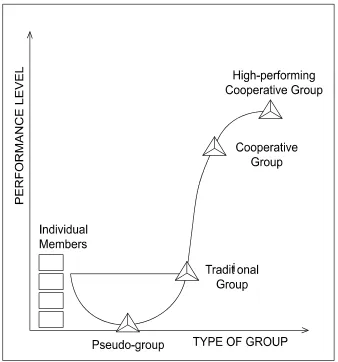
Figure 2.1Group Performance Katzenbach and Smith (1993) studied teams that performed at a variety of levels and came
up with four categories: Pseudo Teams that perform below the level of the average member.
Potential Teams that don’t quite get going but struggle along at or slightly above the level of the
average member. Real Teams that perform quite well, and High-Performing Teams that perform
at an extraordinary level. Katzenbach and Smith then looked for common characteristics of real
teams and high-performing teams. All real teams had the following characteristics: a small
number of people with complementary skills who are committed to a common purpose,
performance goals, and approach for which they hold
themselves mutually accountable. High-performing teams
met all the conditions of real teams, and in addition, had
members who were deeply committed to one another’s
personal growth and success.
Reflection: Now think about the teams that are being used
in your engineering classes. Think about your most
successful/effective team project experience. What were
the characteristics of the team? What were the conditions?
Are they similar to your most effective teams? Describe the team development process.
Types of Learning Teams
There is nothing magical about teamwork in engineering classes. For example, some types
of learning teams increase the quality of classroom life and facilitate student learning. Other
life. To use teamwork effectively, you must know what is and what is not an effective team.
There are many types of teams that can be used in classrooms. Formal cooperative learning
groups is just one of them, although they are becoming quite common (Johnson, Johnson &
Smith, 1998b). When you choose to use (or are asked or required to use) instructional groups,
you must ask yourself “What type of group or team am I involved in”? The following checklist
and accompanying Figure 2.1 may be helpful in answering that question.
1. Pseudo-Learning Group: Students are assigned to work together but they have no interest
in doing so. They believe they will be evaluated by being ranked from the highest performer to
the lowest performer. While on the surface students talk to each other, under the surface they are
competing. They see each other as rivals who must be defeated, block or interfere with each
other's learning, hide information from each other, attempt to mislead and confuse each other,
and distrust each other. Students would achieve more if they were working alone.
2. Traditional Classroom Learning Group: Students are assigned to work together and
accept that they must do so. Assignments are structured, however, so that very little joint work
is required. Students believe that they will be evaluated and rewarded as individuals, not as
members of the group. They interact primarily to clarify how assignments are to be done. They
seek each other's information, but have no motivation to teach what they know to their
groupmates. Helping and sharing is minimized. Some students loaf, seeking a free ride on the
efforts of their more conscientious groupmates. The conscientious members feel exploited and
do less. The result is that the sum of the whole is more than the potential of some of the
members, but the more hard working and conscientious students would perform higher if they
worked alone.
Project Management and Teamwork 35 Karl A. Smith
complexity of the task and the necessity for diverse perspectives, they are relieved to do so.
They know that their success depends on the efforts of all group members. The group format is
clearly defined. First, the group goal of maximizing all members' learning provides a
compelling common purpose that motivates members to roll up their sleeves and accomplish
something beyond their individual achievements. Second, group members hold themselves and
each other accountable for doing high quality work to achieve their mutual goals. Third, group
members work face-to-face to produce joint work-products. They do real work together.
Students promote each other's success through helping, sharing, assisting, explaining, and
encouraging. They provide both academic and personal support based on a commitment to and
caring about each other. Fourth, group members are taught teamwork skills and are expected to
use them to coordinate their efforts and achieve their goals. Both task and teambuilding skills
are emphasized. All members share responsibility for providing leadership. Finally, groups
analyze how effectively they are achieving their goals and how well members are working
together. There is an emphasis on continual improvement of the quality of learning and
teamwork processes. A recent “students guide to success in active learning” is available in the
book Striving for Excellence in College (Browne & Keeley, 1997).
4. High-Performance Cooperative Learning Group: This is a group that meets all the
criteria for being a cooperative learning group and outperforms all reasonable expectations,
given its membership. What differentiates the high-performance group from the cooperative
learning group is the level of commitment members have to each other and the group's success.
Jennifer Futernick, who is part of a high-performing, rapid response team at McKinsey &
Smith, 1993). Ken Hoepner of the Burlington Northern Intermodal Transport Team (also
described in Katzenbach & Smith, 1993) stated: "Not only did we trust each other, not only did
we respect each other, but we gave a damn about the rest of the people on this team. If we saw
somebody vulnerable, we were there to help." Members' mutual concern for each other's
personal growth enables high-performance cooperative groups to perform far above
expectations, and also to have lots of fun. The bad news about extraordinarily high-performance
cooperative learning groups is that they are rare. Most groups never achieve this level of
development.
Groups and Teams
I’ve been using the term “team” in reference to projects and “group”in reference to learning.
Many folks, including me, use these two terms interchangeably and I will continue to do so
throughout this book. The traditional literature focuses on groups, while recently some have
been making distinctions between groups and teams. For example, Katzenbach and Smith
Project Management and Teamwork 37 Karl A. Smith
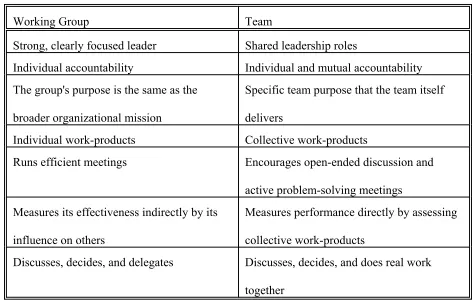
Table 2.1
Not All Groups Are Teams: How to Tell the Difference
Working Group Team
Strong, clearly focused leader Shared leadership roles
Individual accountability Individual and mutual accountability The group's purpose is the same as the
broader organizational mission
Specific team purpose that the team itself
delivers
Individual work-products Collective work-products
Runs efficient meetings Encourages open-ended discussion and
active problem-solving meetings Measures its effectiveness indirectly by its
influence on others
Measures performance directly by assessing
collective work-products
Discusses, decides, and delegates Discusses, decides, and does real work
together
Are there any surprises in this list from your perspective? Many students emphasize the
importance of a strong leader, but Katzenback and Smith indicate that “real” teams have shared
leadership roles. Also notice that the literature on “high-performance” teams indicates that they
are composed of members with complementary skills, that is, they’re diverse.
Importance of Diversity
Often we must work with people who are different from us or difficult to work with but
whose skills, talents, expertise, experience, etc. are essential to the project. It may seen
Bulls basketball team). Can you imagine more a more diverse group than one made up of
Dennis Rodman, Michael Jordon, and Scottie Pippin). Phil Jackson is an “expert at managing
diversity”. Diversity has many faces, including preferred learning style – visual, auditory,
kinesthetic; background and experience; ethnic and cultural heritage; and sex, gender, and sexual
orientation. The evidence from effective groups is that diversity is important, that is, the better
the group represents the broader community, the more likely it is to make significant, creative,
and desired contributions. Participating in and managing diverse groups is not always easy,
since diverse groups usually bring a diversity of ideas and priorities. Here are some
considerations that may help you learn to manage diverse groups more effectively (Cabanis,
1997; Cherbeneau, Jeanne. 1997):
1. Learning skills for working with all kinds of people
4. Stress that effective teams are diverse
5. Stress the importance of requirements
6. Emphasize performance
7. Developing perspective taking skills
8. Respect and appreciation for alternative perspectives, etc.
Chicago Bulls’ head coach Phil Jackson advocates that “Good teams become great ones
when the members trust each other enough to surrender the ‘me’ for the ‘we’.” His recent book
Sacred hoops: Spiritual lessons of a hardwood warrior Phil Jackson and Hugh Delehanty
(1995) offer terrific advice on organizing and managing extraordinarily high performing teams.
Reflection: On Diversity
One of the greatest challenges I faced as co-coordinator of the Bush Faculty Development
Project Management and Teamwork 39 Karl A. Smith
science, mathematics, and engineering colleagues recognize the importance of the discrepancy
between the rapidly growing diversity of the population and the lack of diversity among the
student body. My most memorable exposure to these issues was the September 1997 conference
held at Penn State “Best Practices in Diversity: Exploring Practical Applications for the 21st
Century.” It was a real eye-opener for me to see and hear so many people deeply engaged in
“making the great diversity of our nation work for the future” (from Graham Spanier’s welcome
letter). The conference was particularly memorable because it came at the beginning of my
sabbatic leave at Michigan State University and since they had so many students, faculty, staff,
and administrators participating in the conference they chartered a bus and we rode with one
another from Lansing to State College and back.
Let’s start by exploring the question, “Why bother”? Why should we be concerned about the
diversity dimension of students’ team experiences?
First, there is little attention paid and little willingness to recognize that not all students are
the same. University of Minnesota Astronomy professor Larry Rudnick once said “I used to
think all students learn exactly the same way I do; perhaps a little slower.” It seems that many
faculty feel this way not only about learning styles but about many other things as well –
outlook, cultural or ethnic background, experience, motivation, expectations, and sexual
orientation. Not only is this “sameness” approach simpler and easier, it’s also safer. If faculty
only have to design one instructional system, a “one size fits all,” and probably the one they
experienced as a student, then it’s familiar and manageable. If faculty acknowledge that learners
are different then they must face lots of unknowns, and more work. The consequence for
students is that if faculty don’t provide opportunities for a diversity of experiences in the
teams with diverse membership.
The consequences of ignoring differences are enormous. For example, students from some
cultures (some Native Americans and Asians, for example) are reluctant to correct others or to
make them look bad in front of their peers. Students face this in situations like the individual
test followed by a group test format where individual students get a higher score but don’t
contradict the group during the group exam portion. When asked a typical response is “In my
culture it’s unacceptable to correct someone else.” One group dealt with this by always having
the Asian-American student go first during the group exam portion. Furthermore, ignoring
differences makes many people feel unwelcome, which we address in the next section.
Second, the demographics of the United States are changing very rapidly and undergraduate
engineering enrollments don’t reflect the broader diversity. Often people don’t choose to be in
situations where they don’t see some of themselves mirrored.
William. A. Wulf (1998), President of the National Academy of Engineering, stressed this
point in “Diversity in Engineering.” He opened the article with the following:
Every time an engineering problem is approached with a pale, male design team, it may
be difficult to find the best solution, understand the design options, or know how to
evaluate the constraints.
Wulf also made a case for the connection between diversity and creativity, as indicated by the
following:
Collective diversity, or diversity of the group – the kind of diversity that people usually
talk about – is just as essential to good engineering as individual diversity. At a
fundamental level, men, women, ethnic minorities, racial minorities, and people with
Project Management and Teamwork 41 Karl A. Smith
“gene pool” from which creativity springs.
If people don’t see themselves represented then it’s hard for them to be interested in the
designs, products and services created by engineers. Furthermore, engineering is going to be
deprived of marvelous talents.
Finally, it’s the law of the land. At least three times (Brown vs. Board of Education, Title
IX, PL 94-142) the United States Supreme Court and Congress have re-emphasized that all
citizens have equal rights and opportunities. Essentially these three decisions and laws stress
that all individuals, regardless of differences, have a right to access to the broader peer group!
Characteristics of Effective Teams
The research on highly effective teams both in the classroom (Johnson, Johnson & Smith,
1991, 1998a, 1998b) and in the workplace (Bennis & Biederman, 1997; Hargrove, 1998;
Katzenbach & Smith, 1993; Schrage, 1991, 1996) reveals a short list of characteristics:
1. Positive Interdependence, such as common goal or single product
2. Individual and group accountability, that is, each person taking responsibility for his or her
work and the overall work of the group.
3. Promotive interaction, usually face-to-face, where each member does real work.
4. Teamwork skills where each member has and practices effective communication (especially
careful listening), decision making, problem solving, conflict management, and leadership.
5. Group processing where the group periodically reflects on how well the group is working,
celebrates the things that are going well and problem solves the things that aren’t.
Teams have become commonplace in engineering practice and are making inroads in
Building Team Performance (Katzenbach & Smith, 1994)
• Establish urgency and direction • Select members based on skill and
potential, not personalities • Pay attention to first meeting and
actions
• Set clear rules of behavior
• Set some immediate performance-oriented tasks and goals
• Challenge the group regularly with fresh information
• Spend lots of time together • Exploit the power of positive
feedback, recognition, and reward very practical guides — The Team Handbook
and The Team Memory Jogger — to
conceptual and theoretical treatises —
Joining Together: Group Theory and Group
Skills and Groups that work (and those that
doesn’t): Creating conditions for effective
teamwork. Check out one of these to
broaden and deepen your understanding of
teamwork. Four books were highlighted in
this chapter — Shared Minds: The New
Technologies of Collaboration, The Wisdom of Teams: Creating the High-Performance
Organization, and Organizing Genius: The Secrets of Creative Collaboration, and Mastering the
art of creative collaboration. These four books focus on extraordinary teams — teams that
perform at unusually high levels where members experience accomplishments through
synergistic interaction that they rarely experience in other settings. They provide lots of
examples and insights into high performance teams.
Stages of Team Development
Teams often progress through a series of stages. One of the most common “sequential-stage
theories” was formulated by Bruce W. Tuckman (Tuckman, 1965, Tuckman & Jensen, 1977).
He noted that teams develop through five sequential stages, which he labeled forming, storming,
norming, performing, and adjourning. Members get to know one another and start to learn to