licensing copies, or posting to personal, institutional or third party
websites are prohibited.
In most cases authors are permitted to post their version of the
article (e.g. in Word or Tex form) to their personal website or
institutional repository. Authors requiring further information
regarding Elsevier’s archiving and manuscript policies are
encouraged to visit:
Research Report
Regional specificity and practice: Dynamic changes in object
and spatial working memory
Susan M. Landau
a,⁎
, Hugh Garavan
b, Eric H. Schumacher
c, Mark D' Esposito
aaHenry H. Wheeler Brain Imaging Center, Helen Wills Neuroscience Institute, and Department of Psychology, University of California, Berkeley,
Berkeley, CA 94720-3192, USA
bDepartment of Psychology, Trinity College, Dublin 2, Ireland
c
School of Psychology, Georgia Institute of Technology, Atlanta, GA 30332, USA
A R T I C L E I N F O A B S T R A C T
Article history:
Accepted 22 August 2007
Available online 5 September 2007
Working memory (WM) tasks engage a network of brain regions that includes primary, unimodal, and multimodal associative cortices. Little is known, however, about whether task practice influences these types of regions differently. In this experiment, we used event-related fMRI to examine practice-related activation changes in different region types over the course of a scanning session while participants performed a delayed-recognition task. The task contained separate WM processing stages (encoding, maintenance, retrieval) and different materials (object, spatial), which allowed us to investigate the influence of practice on different component processes. We observed significant monotonic decreases, and not increases, in fMRI signal primarily in unimodal and multimodal regions. These decreases occurred during WM encoding and retrieval, but not during maintenance. Finally, regions specific to the type of memoranda (e.g., spatial or object) showed a lesser degree of sensitivity to practice as compared to regions activated by both types of memoranda, suggesting that these regions may be specialized more for carrying out processing within a particular modality than for experience-related flexibility. Overall, these findings indicate that task practice does not have a uniform effect on stages of WM processing, the type of WM memoranda being processed or on different types of brain regions. Instead, regions engaged during WM encoding and retrieval may have greater capacity for functional plasticity than WM maintenance. Additionally, the degree of specialization within brain regions may determine processing efficiency. Unimodal and multimodal regions that participate in both object and spatial processing may be specialized for flexible experience-related change, while those supporting primary sensorimotor processing may operate at optimal efficiency and are less susceptible to practice.
© 2007 Elsevier B.V. All rights reserved.
Keywords:
Event-related fMRI Learning
Practice Plasticity
1.
Introduction
The ability to adapt flexibly to new experiences with practice is a critical feature of human learning. While the cognitive processes
that change as a task becomes practiced have been well explored (Anderson, 1982; Logan, 1988; Schneider and Shiffrin, 1977), there is a limited understanding of how the underlying neural archi-tecture may be specialized for practice-related change.
⁎Corresponding author.Fax: +1 510 642 3004.
E-mail address:[email protected](S.M. Landau).
0006-8993/$–see front matter © 2007 Elsevier B.V. All rights reserved. doi:10.1016/j.brainres.2007.08.057
a va i l a b l e a t w w w. s c i e n c e d i r e c t . c o m
A number of possible mechanisms have been proposed to underlie neural plasticity related to practice, including changes to dentrite, synapse, and glial structure; and meta-bolic alterations (Kolb and Whishaw, 1998; Sanes and Dono-ghue, 2000). It is unknown, however, the extent to which these mechanisms may operate differently for brain regions that are more or less susceptible to practice-related plasticity.Mesulam (1998)has explicated a model of varying functional properties of brain regions in which high-level cognitive processes such as working memory (WM) engage a network of primary, unimodal, and multimodal cortical regions that corresponds to a continuum of increasingly abstract levels of processing. Each type of region in the network is thought to have a set of specialized adaptations, although multimodal regions (e.g., posterior parietal and prefrontal cortex) in particular are thought to be critical for the flexible, adaptive skills required for WM (Mesulam, 1998).
In this experiment, we set out to examine practice-related functional plasticity across a network of brain regions support-ing attentional and executive control processes thought to be required early in learning (Kelly and Garavan, 2005; Schneider and Chein, 2003). We also sought to investigate changes that occur during processing of different types of information (e.g., verbal, visual, and spatial), which differentially recruit differ-ent nodes of these attdiffer-entional/executive networks (D'Esposito et al., 1998; Postle and D'Esposito, 1999; Wager and Smith, 2003). While practice-related neuroplasticity has been reported within these networks, there is little agreement in the lite-rature about whether some processes and brain regions are disproportionately influenced. We predict that functional changes in primary, unimodal, and multimodal brain regions would vary along a continuum such that primary regions would show the least amount of practice-related change and multimodal regions would show the most. To test this predict-ion, we conducted an exploratory analysis of practice-related neural changes using a well-studied WM task (Smith et al., 1995) that required the temporary retention of different types of information (object and spatial). Based on previous findings that WM encoding was influenced by practice to a greater extent than other WM processes (Landau et al., 2004), we also used an event-related design to examine separate WM compo-nents (target/encoding; delay/maintenance; probe/retrieval).
2.
Results
2.1. Behavioral
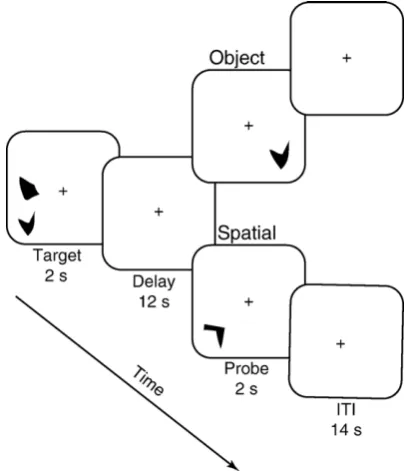
Participants performed a delayed recognition test with object and spatial tasks (Fig. 1) for a total of 10 fMRI scanning runs. Object and spatial trials were performed in separate scanning runs (see Experimental procedures), and the object and spatial runs were ordered in a pseudorandom interleaved fashion such that practice-related changes could be examined across a series of five runs for each task individually (e.g., object: 1, 4, 6, 7, 9; spatial: 2, 3, 5, 8, 10) and collapsed across tasks (e.g., col-lapsing across object and spatial trials for each of the five runs).
Fig. 2 shows the change in RT and error rate over the
course of the scanning session for object and spatial runs. An ANOVA with factors Practice (runs 1–5) and Task (object,
spatial) showed a significant linear decrease in RTs across runs [F(1,8) = 7.86,pb0.03], collapsing across object and spatial trials. Decreases in RT for object and spatial trials separately were not significant. The mean RT, collapsed across runs, was 1666 ms for object trials and 1430 ms for spatial trials. The mean error rate was 0.15 for both object and spatial trials. Object trials had a higher mean RT than spatial trials [F(1,8) = 15.12,pb0.01], but there was no difference in accuracy bet-ween tasks [F(1,8) = 0.29, pN0.60] or across runs [F(1,8) = 1.16,
pb0.30].
Although the dissociation of object and spatial tasks per se was not the focus of this experiment, we did examine the RT and accuracy data to verify that participants attended selec-tively to object and spatial features. With respect to the influence of foils on accuracy and RT (see Experimental procedures), our results replicate the double dissociation shown bySmith et al. (1995). Briefly, within-subjects ANOVAs with factors Task (object, spatial) and Foil Difficulty (similar/ dissimilar or near/far) revealed significant interactions for both object trials [F(1,8) = 9.41,pb0.02] and spatial trials [F(1,8) = 21.40,pb0.005]. RT was higher for similar than dissimilar foils for object trials, and higher for near than far foils for spatial trials. On object trials, RT was also higher for far foils. Similar to the RT data, ANOVAs performed on arcsine-transformed error rate scores revealed interactions of task and foil difficulty for object and spatial trials. Error rates for object trials were
Fig. 1 –Schematic depiction of the two tasks in the delayed recognition task. Both object and spatial trials began with a 2-s encoding period where two stimuli were presented in different locations on the screen, followed by a 12-s delay. During the probe period, one stimulus appeared and participants had to decide whether the stimulus matched either one of the shapes (for object trials) or one of the positions (for spatial trials) of the stimuli during encoding. Participants pressed a right button to indicate a match and a left button to indicate a non-match. The correct response is
[image:3.595.326.531.404.640.2]disproportionately higher for similar compared with dissimilar foils [F(1,8) = 7.93,pb0.05], while error rates for spatial trials were disproportionately higher for far compared with near foils [F(1,8) = 5.97,pb0.05].
2.2. Mapwise analysis: identification of task-active regions
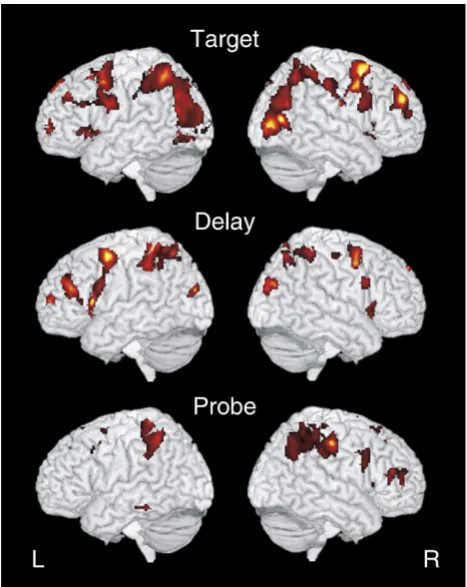
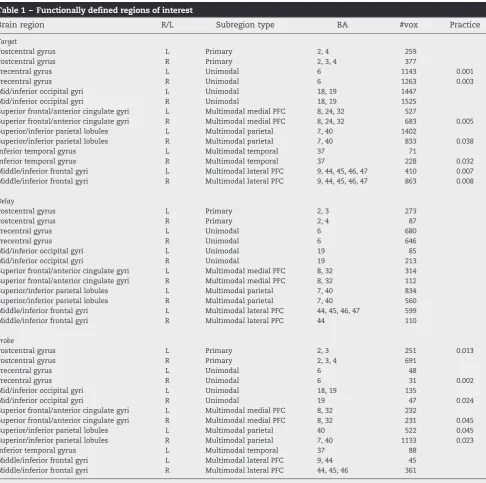
In order to test hypotheses about the relationship between practice and region type, we first identified a map of regions active across all trials relative to fixation for each trial period (target, delay, probe). As shown inFig. 3and listed inTable 1, we found regions active across all three task periods (target, delay, probe) in bilateral occipital, parietal, and frontal cortex. Regions of overlap across all three task periods included right middle prefrontal/premotor regions, and bilateral superior parietal regions.
2.3. Regional analysis
For our analysis of practice effects at the regional level, we first collapsed across all brain regions for each trial period. Repeated-measures ANOVAs with factor Practice (runs 1–5) and Task (object, spatial) for all three trial periods revealed a
significant linear trend of run for the target period only, indicating that activation during this period decreased signif-icantly over the course of the five runs (Target,pb0.001; Delay,
p= 0.128; Probe,p= 0.079). There were no cubic or 4th order (i.e., non-linear) changes in activation for any trial period, and no region showed a main effect of task or significant interaction with task during any trial period.
Next, cortical region types were examined in order to in-vestigate our hypothesis that primary, unimodal, and multi-modal regions would show increasing sensitivity to practice. Repeated-measures ANOVAs with factors Practice (runs 1–5) and Region Type (primary, unimodal, multimodal) were conducted for all trial periods and for all multimodal subregions (lateral frontal, medial frontal, parietal, and temporal). Effect sizes (partial eta squared) of the linear decrease across runs for different region types are shown in
Fig. 4. The individual ROIs contributing to these parameter estimates in the figures are shown inFig. 3and listed inTable 1. During the target, there were statistically significant decreases in activation for unimodal and multimodal regions (effect sizes: unimodal, 0.704; multimodal lateral frontal, 0.663; multimodal medial frontal, 0.653; multimodal parietal, 0.342; multimodal temporal, 0.392; all pb0.01), but not for primary regions (0.253). During the delay, there were no significant practice-related effects. During the probe, only multimodal parietal regions showed a significant practice effect (0.418;p= 0.045).
Fig. 3–Regions significant for the main effect of task are shown for the target, delay, and probe periods. Regions are listed inTable 1and were used to test for effects of practice over the course of the session.
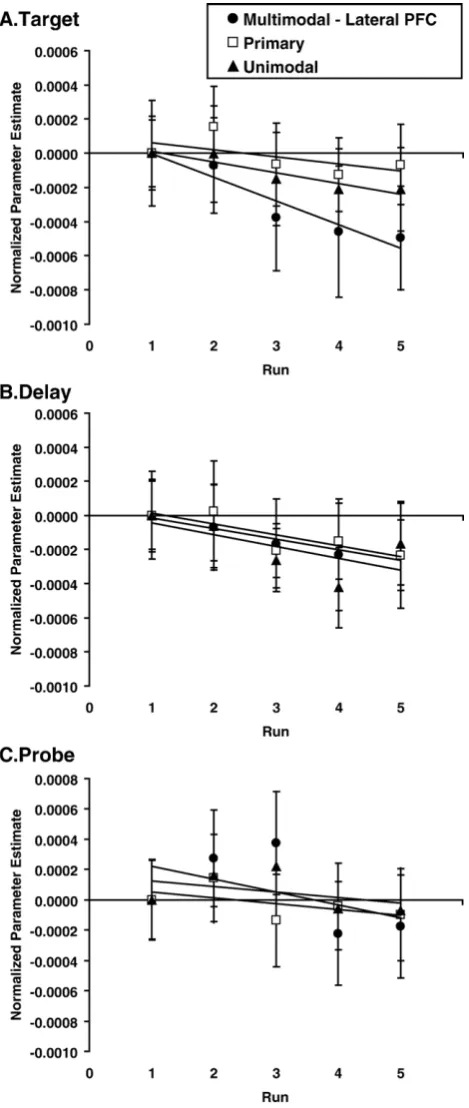
[image:4.595.50.280.73.433.2] [image:4.595.307.541.425.719.2]Finally, in order to determine whether different region types decreased at different rates with practice, we were also interested in interactions between Region Type and Practice. During the target, we observed such an interaction, and a follow-up two-sample t-test revealed that the multimodal lateral PFC regions decreased disproportionately relative to the primary regions [F(1,10) = 14.30,p= 0.004].Fig. 5illustrates the decreases across runs for primary, unimodal, and multimodal lateral PFC regions (other multimodal regions are not shown) for all three trial periods. As shown inFig. 5A, multimodal lateral frontal regions decreased from the first to the last run by 39.4%, unimodal regions decreased by
13.6%, and primary regions decreased by 8.1%. During the delay and probe periods, multimodal PFC regions did not decrease disproportionately relative to other region types (Figs. 5B, C).
We also examined other multimodal regions for interac-tions with other regions across runs. During the delay, there were no significant effects of Practice or interactions with Region Type. During the probe, we observed a second Region Type by Practice interaction. A follow-up two-sample t-test revealed that multimodal temporal regions decreased dispro-portionately with respect to primary regions [F(1,10) = 7.32,
[image:5.595.61.548.85.568.2]p= 0.024] (not shown).
Table 1 –Functionally defined regions of interest
Brain region R/L Subregion type BA #vox Practice
Target
Postcentral gyrus L Primary 2, 4 259
Postcentral gyrus R Primary 2, 3, 4 377
Precentral gyrus L Unimodal 6 1143 0.001
Precentral gyrus R Unimodal 6 1263 0.003
Mid/inferior occipital gyri L Unimodal 18, 19 1447
Mid/inferior occipital gyri R Unimodal 18, 19 1525
Superior frontal/anterior cingulate gyri L Multimodal medial PFC 8, 24, 32 527
Superior frontal/anterior cingulate gyri R Multimodal medial PFC 8, 24, 32 683 0.005
Superior/inferior parietal lobules L Multimodal parietal 7, 40 1402
Superior/inferior parietal lobules R Multimodal parietal 7, 40 833 0.038
Inferior temporal gyrus L Multimodal temporal 37 71
Inferior temporal gyrus R Multimodal temporal 37 228 0.032
Middle/inferior frontal gyri L Multimodal lateral PFC 9, 44, 45, 46, 47 410 0.007 Middle/inferior frontal gyri R Multimodal lateral PFC 9, 44, 45, 46, 47 863 0.008
Delay
Postcentral gyrus L Primary 2, 3 273
Postcentral gyrus R Primary 2, 4 87
Precentral gyrus L Unimodal 6 680
Precentral gyrus R Unimodal 6 646
Mid/inferior occipital gyri L Unimodal 19 85
Mid/inferior occipital gyri R Unimodal 19 213
Superior frontal/anterior cingulate gyri L Multimodal medial PFC 8, 32 314 Superior frontal/anterior cingulate gyri R Multimodal medial PFC 8, 32 112
Superior/inferior parietal lobules L Multimodal parietal 7, 40 834
Superior/inferior parietal lobules R Multimodal parietal 7, 40 560
Middle/inferior frontal gyri L Multimodal lateral PFC 44, 45, 46, 47 599
Middle/inferior frontal gyri R Multimodal lateral PFC 44 110
Probe
Postcentral gyrus L Primary 2, 3 251 0.013
Postcentral gyrus R Primary 2, 3, 4 691
Precentral gyrus L Unimodal 6 48
Precentral gyrus R Unimodal 6 31 0.002
Mid/inferior occipital gyri L Unimodal 18, 19 135
Mid/inferior occipital gyri R Unimodal 19 47 0.024
Superior frontal/anterior cingulate gyri L Multimodal medial PFC 8, 32 232
Superior frontal/anterior cingulate gyri R Multimodal medial PFC 8, 32 231 0.045
Superior/inferior parietal lobules L Multimodal parietal 40 522 0.045
Superior/inferior parietal lobules R Multimodal parietal 7, 40 1133 0.023
Inferior temporal gyrus L Multimodal temporal 37 88
Middle/inferior frontal gyri L Multimodal lateral PFC 9, 44 45
Middle/inferior frontal gyri R Multimodal lateral PFC 44, 45, 46 361
Locations of activation comprising statistical parametric maps of the main effect of task for each trial period (target, delay, probe). L, left; R, right; BA, Brodmann's areas.
2.4. Regions of interest (ROI) analysis: main effect
In addition to collapsing across cortical region types, we char-acterized the individual ROIs making up those region types with respect to practice. Repeated-measures ANOVAs were carried out for individual ROIs, and the results of this analysis are listed inTable 1. During the target, middle/inferior frontal regions, bilateral precentral, right angular gyrus, right middle temporal gyrus, and right parietal regions showed significant decreases across runs. No significant practice effects were observed in any individual ROI during the delay. During the probe, right anterior cingulate/medial prefrontal regions, left postcentral gyrus, right precentral gyrus, bilateral parietal regions, and right occipital regions showed significant decreases across runs.
2.5. Regions of interest (ROI) analysis: task-specific regions
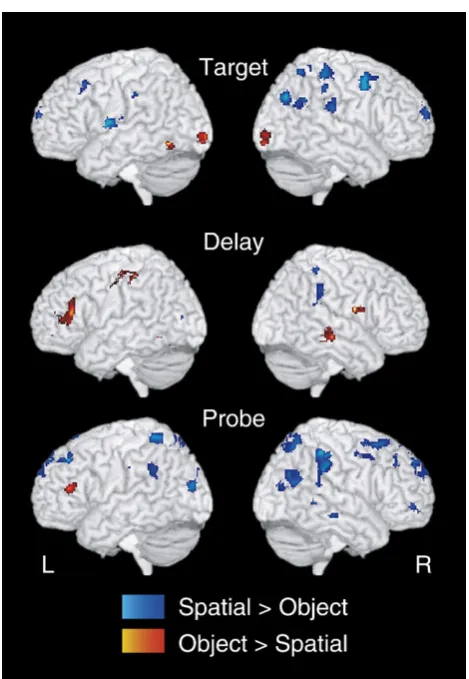
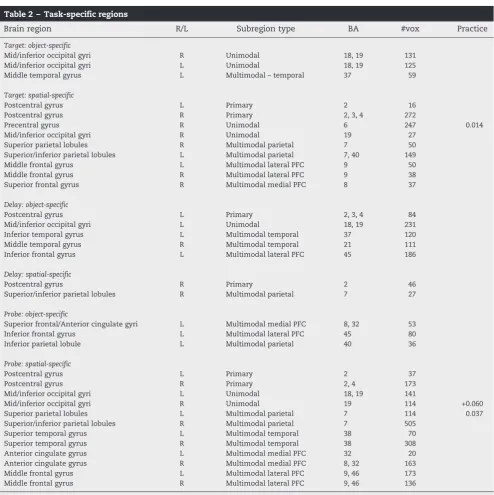
Task-specific regions were identified with the mapwise contrast of object vs. spatial trials. As shown inFig. 6 and listed inTable 2, during the target there were object-specific activations within bilateral occipital and left temporal regions, while there was widespread spatial-specific activation across bilateral frontal and parietal regions. During the delay, there was object-specific activation across a primarily left-latera-lized network including motor, occipital, temporal, and inferior frontal regions. Spatial-specific activation was
pri-marily right-lateralized, and was observed in the right postcentral gyrus and parietal regions. Finally, during the probe, we observed primarily left-lateralized object-specific activation in the left parietal and left superior/medial, and inferior frontal regions. Object-specific activation was bilateral and widespread, and was located bilateral postcentral, occip-ital, parietal, and temporal regions, medial PFC, and middle frontal gyri.
Repeated-measures analysis of variance (ANOVA) on these task-specific ROIs revealed that most did not show effects of
Fig. 4–Effect sizes (partial eta squared) of the linear decrease in signal across runs 1 to 5 are shown for primary, unimodal, and multimodal regions during the three trial periods. Effect sizes that represented statistically significant decreases in activation across runs (pbbbb0.05) are indicated with an asterisk (*).
Fig. 5–Changes in parameter estimates across runs and during (A) target, (B) delay, and (C) probe trial periods averaged separately across primary and frontal multimodal subregions (see Experimental procedures). To illustrate relative changes in activation between region types across runs, parameter estimates were shifted so that parameter estimates
[image:6.595.49.286.68.199.2] [image:6.595.308.543.223.778.2]practice (seeTable 2). There were two regions that did show practice-related decreases, one spatial-specific region in the right precentral gyrus during the target, and the other spatial-specific region in the left superior parietal lobule during the probe. Both of these regions overlapped with main effect ROIs that showed effects of practice as well (Table 1).
3.
Discussion
We examined the regional specificity of practice-related changes in activation over the course of a scanning session while participants performed a delayed recognition task with two trial types (object, spatial) and three trial periods (target, delay, probe). When activity was collapsed across all regions of the brain, there appeared to be significant decreases in activation across runs during the encoding stage of the task (e.g., target period). Further examination of different region types (primary, unimodal, multimodal cortex) revealed that multimodal and unimodal regions decreased to a greater extent than primary (e.g., somatosensory and motor) regions
(shown inFig. 4). Practice effects interacted with region type such that multimodal lateral frontal regions decreased dis-proportionately relative to primary regions during the target (shown in Fig. 5A), and temporal regions decreased dispro-portionately relative to primary regions during the probe. Finally, we identified task-specific regions by direct compar-ison of the spatial and object tasks, and activation in only two spatial-specific regions (target, right premotor; probe, left superior parietal) decreased with practice.
The decreases in activation that we observed are consistent with our predictions that unimodal and multimodal regions would exhibit greater practice effects than primary regions. However, practice-effects were only observed during the target (WM encoding) and probe (WM retrieval), but not during the delay (WM maintenance). Furthermore, the task-specific regions (e.g., object- or spatial-specific regions) appeared to show a lesser degree of sensitivity to practice, suggesting that these regions may be specialized more for carrying out pro-cessing within a particular modality than for learning-related plasticity. Overall, these findings suggest that multimodal and unimodal regions are more sensitive to practice than primary sensory regions, perhaps because they are specially adapted for flexible behavior.
3.1. Practice and behavioral performance
Activation changes occurred during both the target, as we have reported previously (Landau et al., 2004), and during the probe period, indicating that increased efficiency of both encoding and retrieval processes may underlie the improve-ments in the speed of task performance. In other words, the improvement in reaction times is most likely primarily due to increasing neural efficiency related to encoding processes, and secondarily, to retrieval processes. However, several studies have shown that practice-related changes in activa-tion are not necessarily accompanied by changes in behavioral performance (Landau et al., 2004; Olesen et al., 2004; Sayala et al., 2006), indicating that it is not possible to determine a clear link between the activation decreases and the faster reaction times.
3.2. Characterization of region types
It is important to note that our method of collapsing across large regions of cortex (primary, unimodal, multimodal region types) did involve combining functionally heterogeneous areas, such as extrastriate and premotor cortex. This first type of analysis biased us against identifying effects within
precise subregions of our ROIs, such as potential regional spe-cialization of object and spatial processing within dorsal and ventral PFC as has been reported previously (Buchel et al., 1999; Courtney et al., 1996; Owen et al., 1998; Sayala et al., 2006). Sayala et al. (2006), for example, examined regions specializing in object and spatial processing for changes with practice, and reported that decreases for spatial-specific regions were more common than decreases for object-specific regions. Consistent with these results, we only identified practice-related effects in spatial-specific regions (premotor region during the target and parietal regions during the probe). It should be noted, however, that identifying regions that
Fig. 6–Task-specific regions generated from the contrast Object vs. Spatial for target, delay, and probe trial periods. Object-specific regions are shown in red/yellow,
[image:7.595.54.289.81.421.2]specialize in object or spatial processing is complicated by the possibility of practice-dependent shifts in either laterality, e.g., from right to left PFC (Goldberg et al., 1994) or in anatomy, e.g., from medial frontal to insular regions (Petersen et al., 1998; Raichle et al., 1994).
Nonetheless, our individual main effect ROI analysis was designed to reveal the individual characteristics of the ROIs that contributed to the overall effects we observed across primary, unimodal, and multimodal regions. This analysis revealed, for example, that although decreases were observed at the regional level for unimodal areas (Fig. 4), these
[image:8.595.49.544.81.577.2]de-creases were clearly driven by the premotor (and not extra-striate) unimodal ROIs (seeTable 1). Overall, the ROI analysis was broadly consistent with the regional analysis. However, there were a number of individual ROIs during the probe period that showed significant practice-related decreases (Table 1), whereas only parietal regions reached significance at the regional level. The significance level and effect size of these practice effects, however, were lower than those during the target (seeTable 1andFig. 4), which may explain why they were less robust at the regional level than those during the target.
Table 2–Task-specific regions
Brain region R/L Subregion type BA #vox Practice
Target: object-specific
Mid/inferior occipital gyri R Unimodal 18, 19 131
Mid/inferior occipital gyri L Unimodal 18, 19 125
Middle temporal gyrus L Multimodal–temporal 37 59
Target: spatial-specific
Postcentral gyrus L Primary 2 16
Postcentral gyrus R Primary 2, 3, 4 272
Precentral gyrus R Unimodal 6 247 0.014
Mid/inferior occipital gyri R Unimodal 19 27
Superior parietal lobules R Multimodal parietal 7 50
Superior/inferior parietal lobules L Multimodal parietal 7, 40 149
Middle frontal gyrus L Multimodal lateral PFC 9 50
Middle frontal gyrus R Multimodal lateral PFC 9 38
Superior frontal gyrus R Multimodal medial PFC 8 37
Delay: object-specific
Postcentral gyrus L Primary 2, 3, 4 84
Mid/inferior occipital gyri L Unimodal 18, 19 231
Inferior temporal gyrus L Multimodal temporal 37 120
Middle temporal gyrus R Multimodal temporal 21 111
Inferior frontal gyrus L Multimodal lateral PFC 45 186
Delay: spatial-specific
Postcentral gyrus R Primary 2 46
Superior/inferior parietal lobules R Multimodal parietal 7 27
Probe: object-specific
Superior frontal/Anterior cingulate gyri L Multimodal medial PFC 8, 32 53
Inferior frontal gyrus L Multimodal lateral PFC 45 80
Inferior parietal lobule L Multimodal parietal 40 36
Probe: spatial-specific
Postcentral gyrus L Primary 2 37
Postcentral gyrus R Primary 2, 4 173
Mid/inferior occipital gyri L Unimodal 18, 19 141
Mid/inferior occipital gyri R Unimodal 19 114 +0.060
Superior parietal lobules L Multimodal parietal 7 114 0.037
Superior/inferior parietal lobules R Multimodal parietal 7 505
Superior temporal gyrus L Multimodal temporal 38 70
Superior temporal gyrus R Multimodal temporal 38 308
Anterior cingulate gyrus L Multimodal medial PFC 32 20
Anterior cingulate gyrus R Multimodal medial PFC 8, 32 163
Middle frontal gyrus L Multimodal lateral PFC 9, 46 173
Middle frontal gyrus R Multimodal lateral PFC 9, 46 136
Locations of activation comprising statistical parametric maps of the contrast Object vs. Spatial for each trial period (target, delay, probe). L, left; R, right; BA, Brodmann's areas; obj, object; spl, spatial.
+ indicates a marginally significant effect (0.05bpb0.10).
3.3. Practice and regional specificity
At the regional level, our findings support the hypothesis that practice influences brain regions differently depending on their capacity for top-down, adaptive function. Primary sen-sory and motor regions, which perform the least amount of top-down processing, showed the lowest sensitivity to prac-tice, while unimodal and multimodal regions, which show increasingly higher levels of top-down processing, are maxi-mally flexible. The ROI analysis revealed that premotor cortex was driving the practice effects observed for unimodal cortex overall, a finding that is consistent with the robust practice effects also shown by the neighboring multimodal lateral frontal regions. A spatial-specific region within left premotor cortex was also sensitive to practice in the task-specific ROI analysis.
The analysis of task-specific ROIs (Fig. 6; Table 2) also provides some insight into the question of regional specific-ity. These ROIs differed from our main effect ROIs in that they were reliably active during object trials to a greater extent than spatial trials, and vice versa. Interestingly, the majority of these ROIs did not decrease over the session, even those located in multimodal and unimodal regions. Thus it appears that functional plasticity does not occur uni-formly across the multimodal and unimodal network. Object-specific and spatial-Object-specific subregions within this network may operate with less adaptability, since they are specialized for certain kinds of information, and show less sensitivity to practice.
Overall our findings are consistent with the Control System proposed bySchneider and Chein (2003) and with theories suggesting that multimodal regions participate in top-down modulatory and selection processes and are capable of greater flexible change, whereas primary sensory and motor regions participate in bottom-up perceptual and motor processes that may be less susceptible to adaptation (Mesulam, 1998). Func-tional plasticity has also been reported during practice on a number of WM tasks in higher-level associative regions (Garavan et al., 2000; Olesen et al., 2004).
Electrophysiological experiments have supported the idea that neurons in the prefrontal cortex, in particular, are capable of highly flexible behavior depending on context and task demands (Funahashi, 2001; Miller, 2000). The disproportionate practice-related decreases in multimodal frontal regions com-pared with primary regions in our current experiment are a further example of adaptive flexibility to changing task de-mands. The activation decreases we observed are also con-sistent with the neural efficiency hypothesis, which proposes that the development of skill results in more efficient use of neural circuits and reduced activation (Haier et al., 1992; Landau et al., 2004; Neubauer et al., 2004; Rypma and D'Esposito, 1999). In our task, top-down, goal-driven attention mechanisms that are required during encoding and retrieval of object and spatial information may change as the task becomes well practiced, and this is reflected by decreases in activation. In contrast, perceptual and motor processes, asso-ciated with primary visual and motor cortex, are more stable from early to late in practice and thus show little activation change. Following theories of neural efficiency, perceptual regions (compared with multimodal and unimodal regions)
may be maximally efficient because they are frequently used across multiple domains. In other words, perceptual regions may be less influenced by experience since they have reached optimal efficiency from consistent use.
3.4. Practice and WM processes
Why practice primarily influenced WM encoding and retrieval to a greater extent than maintenance is a question that remains open for further exploration. Early in the session, the task is novel and participants have not developed strat-egies to encode and retrieve the stimuli with optimal effi-ciency. As the task is performed repetitively throughout the session, participants learn to identify characteristics of the object locations or spatial positions that allow them to efficiently and effectively retrieve them. This increased effi-ciency during retrieval is also reflected in our behavioral data, in which subjects had faster RTs from early to late in the session. Thus, task practice and the development of strategies for stimulus encoding strongly influence top-down attentional mechanisms, such as encoding the salient stimulus-specific characteristics. WM maintenance also engages regions in-volved in top-down processing, but it is possible that this processing is less strategic, or that the network may show a different type of practice-related change that we were not able to detect here, such as alterations in connectivity.
The current findings are in agreement with practice-related decreases we observed previously for a similar WM task (face recognition) in that these decreases were also specific to the encoding period (Landau et al., 2004). Taken together, these data suggest that changes in activity may represent flexible changes in encoding and retrieval strategies that develop with experience on a variety of stimulus types. The delay period, in contrast, may be less susceptible to experience-dependent change. Furthermore, in the current paradigm, encoding may have been the most demanding phase of the task, since there were two stimuli that had to be attended to and encoded based on the relevant features (object shape or spatial position). During the probe period, only one object was presented for recognition, so the decision may have been more familiarity-based and therefore less dependent on strategy use than during encoding.
3.5. Temporal dynamics of experience-dependent WM networks
Our results provide evidence that unimodal and multimodal regions, in particular, play a critical role in top-down mod-ulation of attentional processes related to learning. These processes are susceptible to modulation as strategies are developed over the course of the session and the task be-comes well practiced. Additionally, our neuroimaging find-ings provide insight into the interpretation of our behavioral data in that they suggest that the decreases in RT from early to late in the session may be a result of the successful imple-mentation of strategies over the course of the session and subsequent improvement of the efficiency of WM encoding and retrieval.
ques-tions about interpretation. For example, we chose not to model changes in global signal as a nuisance variable, as is frequently done in fMRI studies, raising the possibility that fluctuations in scanner gain could have accounted for the practice effects we reported. While we cannot rule this out, we believe that this is unlikely because we did not find practice effects across all regions or across all trial periods, and offsets in scanner gain would have been expected to influence these factors somewhat uniformly.
This study contributes to a growing body of work showing that task experience may alter the contributions of brain regions, depending on their role in the specific or abstract nature of the task. Thus as a task becomes well practiced, strategy development and shifts in attention from specific to more general features may result in a change in the under-lying network engaged by the task.Schumacher et al. (2005), for example, have reported differential effects of practice for right vs. left dorsolateral prefrontal cortex with practice on a choice-reaction task over several scanning sessions, suggest-ing that the functional topography associated with a task depends critically on participants' level of task skill. The interaction of regional specialization and practice has impor-tant implications for WM studies that do not directly consider the role of task experience on neural activation. If unimodal and multimodal regions decrease more than sensory regions with task practice, then the overall task-active network may be biased early in the session toward identifying regions involved in unimodal and multimodal, integrative processing. The fact that these effects occurred over a single scanning session raises the question of how different time courses of training would influence functional plasticity. Here, a key goal was to investigate the extent to which practice may play a role in“typical”non-practice fMRI studies, when subjects are not intentionally trying to improve their skills, but studies of task learning have used a variety of intentional learning para-digms, sometimes with scanning sessions occurring before and after an extended period of task practice. Studies using both motor and non-motor tasks have shown expansions in the cortical area engaged by the learned task after days or weeks of practice (Karni et al., 1995; Olesen et al., 2004), which is considerably different from the within-session decreases in activation that we and others have reported (Garavan et al., 2000; Landau et al., 2004; Sayala et al., 2006). Thus, the im-plications of our results may not extend to a longer time frame of practice, since short-term and long-term practice may en-gage different types of neural mechanisms (Karni et al., 1998; Landau and D'Esposito, 2006), although this issue clearly war-rants further investigation.
In summary, the findings reported here highlight the importance of examining the temporal dynamics of brain activity, as opposed to a static activation“snapshot”of data that is collapsed across time and trial periods of a WM task. Strategies such as examining changes in a network of activation over time (Fletcher et al., 1999) and changes in BOLD signal over a small number of trials (Yamaguchi et al., 2004) provide insight into neural mechanisms than can be observed by examining a fixed activation profile. Examining dynamic neural properties using these techniques reveals a more complete view of the subtle and complex processes that occur with task repetition, strategy development, and
behav-ioral flexibility. The results presented here complement these strategies and provide insight into the role of regional spe-cialization in functional plasticity.
4.
Experimental procedures
4.1. Participants
Eleven right-handed participants (mean age = 23.5, 9 male) were recruited from the University of California, Berkeley campus. All participants gave written, informed consent prior to participation in the study. Participants were screened against medical, neurological, and psychiatric illnesses, and for use of prescription medications. Behavioral data for two participants were lost due to technical difficulties.
4.2. Behavioral task
Fig. 1illustrates the trial periods of the object and spatial tasks. Each 30-s trial was composed of (1) a 2-second target period, (2) a 12-second delay period, (3) a 2-second probe period, and (4) a 14-second inter-trial interval. During the target period, each participant saw two different images pre-sented simultaneously. The objects were irregular polygons designed to be difficult to encode with verbal strategies ( Att-neave and Arnould, 1956; Smith et al., 1995). The two objects were presented in two of eight possible positions along the circumference of an imaginary circle that was centered about a fixation cross.
Object and spatial tasks differed only with respect to the instruction screen presented at the beginning of each object or spatial block of trials. For object trials, participants were instructed to attend to the shape of the objects; for spatial trials, participants were instructed to attend to the spatial position of the objects on the screen. During the delay period, a crosshair appeared at the center of the screen. During the probe period, a single object appeared and participants were required to give a motor response indicating whether it matched either one of the stimuli (shape of the stimulus for object trials; spatial position of the stimulus for spatial trials) presented at the target.
Before performing the WM task described above, each par-ticipant also performed one fMRI run of a task used to derive an individual hemodynamic response function (HRF). During this run, a central white fixation cross changed briefly (200 ms) to a flickering checkerboard presented to the left or right hemifield every 20 s, cueing the participant to make a bilateral button press. Twenty such events occurred during the 400-s run.
4.3. MRI data acquisition
The fMRI scanning session consisted of 10 fMRI runs for each participant, plus an additional run for deriving the HRF as described above. Object and spatial trials were presented in separate blocks of trials. There were five runs for each type of task (object, spatial), and 8 trials per run, totaling 40 object trials and 40 spatial trials. Importantly, object and spatial runs were interleaved in a pseudorandomized way, and the order was fixed across subjects as follows: object (run 1), spatial (run 2), spatial (run 3), object (run 4), spatial (run 5), object (run 6), object (run 7), spatial (run 8), object (run 9), spatial (run 10). Using this sequence of runs, practice-related changes could be examined across series of five runs for each task individually (e.g., object: 1, 4, 6, 7, 9; spatial: 2, 3, 5, 8, 10) and collapsed across tasks (e.g., collapsing across object and spatial trials for each of the five runs).
Functional and structural images were acquired with a Varian INOVA 4.0T scanner and a TEM send-and-receive RF head coil. Head movement was restricted using a foam cushion adjusted for each participant. Participants viewed a back-lit projection screen at their waist from within the magnet bore through a mirror mounted on the head coil.
Functional images were acquired using a 2-shot gradient echo EPI sequence (TR = 2180, TE = 28 ms, matrix size = 64 × 64, FOV = 22.4 cm) was used to acquire data sensitive to the blood oxygen level dependent (BOLD) signal. Twenty axial slices of 3.5 mm voxels (with 0.5 mm interslice gap) were acquired. Each slice was acquired with a 22.4 cm2field of view with a 64 × 64 matrix size resulting in an in-plane resolution of 3.5 × 3.5 mm. This slice prescription allowed for whole-brain coverage. Data were acquired during 10 runs lasting 6 min each. Twenty seconds of dummy gradient and RF pulses preceded each scan to approach steady-state tissue magnetization. Two high-resolution structural T1-weighted scans were also acquired for anatomical localization. The first collected 20 axial slices in the same plane as the EPI images (TR = 200 ms, TE = 5 ms, matrix size = 256 × 256, FOV = 22.4 cm). The second was a 3-D MPFLASH scan (TR = 9 ms, TE = 4.8 ms, T1 = 300 ms).
4.4. MRI data preparation
Off-line data processing was performed using the VoxBo analysis package (www.voxbo.org) and SPM2. Initial data preparation proceeded in the following steps: image recon-struction; sinc interpolation in time (to correct for the fMRI slice acquisition sequence); motion correction (six-parameter, rigid-body, least-squares alignment); slice-wise motion com-pensation (to remove spatially coherent signal changes via the application of a partial correlation method to each slice in time) (Aguirre et al., 1998a; Zarahn et al., 1997b).
Each participant's brain was normalized to the Montreal Neurological Institute reference brain. Spatial normalization was performed as a two-step procedure: first, a structural image acquired to overlay the EPI images was coregistered to the high-resolution MPFLASH anatomical structural image. Second, this structural image was spatially normalized. The two resulting transformations were combined into a single transformation and used to spatially normalize the EPI images directly.
4.5. Data modeling
Images were smoothed with a 7 mm FWHM Gaussian kernel and masked using a whole-brain mask to remove extraneous signal caused by ghosting. Since fMRI data are temporally auto-correlated under the null-hypothesis (Zarahn et al., 1997b), statistical analyses were conducted within the frame-work of the modified general linear model (GLM) for serially correlated error terms (Worsley and Friston, 1995). A time-domain representation of the expected 1/f power structure
(Zarahn et al., 1997b) and a notch filter that removed
frequencies above the 0.24 Hz and below 0.02 Hz (i.e., the portions of highest power in the noise spectrum) were placed in the convolution matrix (Worsley and Friston, 1995).
The rationale for empirically deriving a HRF is described elsewhere (Aguirre et al., 1998b). An HRF was derived from primary sensorimotor cortex for each participant in the following manner. Each HRF was the trial-averaged response to 20 saccades and manual button presses that occurred during the HRF run as described above. These functional data were modeled using a Fourier basis set of four sines and four cosines. A partialFtest was used to evaluate the significance of activity of voxels in primary motor cortex, and a HRF estimate was extracted from the suprathreshold voxels by averaging their time series. This empirical estimate of the HRF was used in subsequent analyses for each participant.
The general linear model (GLM) describes fMRI signal change as a series of amplitude-scaled and time-shifted covariates. Each covariate modeled a series of a brief neural events convolved by the participant's empirical HRF. A set of covariates were used to model the target, delay, and probe periods for both object and spatial tasks. The covariates for each trial period, convolved with individual HRFs, modeled the data as follows: the target modeledt= 0–2 s of a trial; late target
t= 4–6 s; delay t= 12–14 s; and probe t= 14–16 s. Additional nuisance covariates were included to model an intercept, trial-specific effects, late target (t= 4–6 s), and early delay (t= 8–10 s).
The nuisance late target/early delay covariates were included to avoid contamination of delay-related activation by variance that was not captured by the target covariate (Zarahn et al., 1997a). Therefore, all delay-related activity reported in this analysis arises from the delay covariate and not the nuisance late target/early delay covariates.
Normalized whole-brain maps for each condition were calculated for each participant. Random-effects analyses were carried out by performing voxel-levelt-tests on these maps.
4.6. Mapwise analyses
We identified a map of task-active regions for each trial period (target, delay, probe) by conducting one-tailed across-partici-pantst-tests for activation relative to fixation baseline. These maps were thresholded using a peak criterion of pb0.001, uncorrected, and applying a clusterwise correction of 54 voxels, accounting for smoothing (Cao, 1999), resulting in an overall threshold ofpb0.05.
We also generated a map of task-specific regions (object-specific, spatial-specific) based on the contrast of object vs. spatial trials. Target and probe maps were thresholded with a peak criterion ofpb0.005. Due to lower statistical power to detect activation during the delay period in the absence of stimuli, we used a peak criterion of pb0.01. The same clusterwise threshold as used above (54 voxels) was applied to all maps.
4.7. Regional analyses
Functionally defined individual ROIs were then defined by delineating local peaks of activity within each Brodmann Areas (BAs) of interest. A normalized template map containing locations of BAs that correspond to stereotaxic coordinates (Drury et al., 1999) was used to constrain the ROIs within BAs. This template map was plotted on the MNI/ICBM anatomical template (http://www.psychology.nottingham.ac.uk/staff/cr1/ lesion.html#brod) and visualized with MRIcro (Rorden and Brett, 2000). Using this method, sets of functionally defined ROIs based on BAs were defined for each trial period and are listed in the tables. Mean parameter estimates of voxels within each ROI for each scanning run were obtained for each participant.
To examine differences in practice effects between prima-ry, unimodal, and multimodal regions, we collapsed across ROIs based on the cytoarchitectonic properties of the neurons in particular regions as well as their functional roles ( Mesu-lam, 1998). Specifically, we grouped ROIs based on whether they were in primary cortex, which consisted of bilateral primary somatosensory motor (BAs 2, 3, 4) and visual (BA 17) regions; unimodal cortex, which consisted of premotor (BA 6) and extrastriate (BAs 18, 19) regions; or multimodal cortex. Because of the heterogeneity of multimodal cortex, we carried out analyses separately for multimodal subregions as follows: lateral frontal multimodal cortex included BAs 9, 44, 45, 46, and 47; parietal multimodal cortex included BAs 7 and 40; medial frontal multimodal cortex included BAs 8, 24, and 32; and temporal multimodal cortex included BAs 21, 37, and 38. Repeated-measures ANOVAs were all conducted atα= 0.05 on mean parameter estimates as described in the Results. Because we were interested in any kind of systematic change in activation over the course of the session, we examined significant linear and/or higher order (i.e., quadratic, cubic, or fourth order effects) effects of practice for each region. We observed no significant higher order effects, so all reported practice effects are significant linear monotonic decreases.
4.8. Regions-of-interest (ROI) analyses
Individual ROIs from both the main effect and object vs. spatial analyses were also probed for effects of practice. As can be seen inTables 1 and 2, individual ROIs were grouped when they had some general functional commonalities and func-tional clusters tended to overlap across BAs (e.g., BAs 2, 3, and 4 and BAs 18 and 19) in order to reduce the number of statistical tests being conducted. ROIs smaller than the extent criterion (54 voxels) sometimes resulted when a region from the mapwise analysis extended between two heterogeneous ROIs (e.g., BAs 2, 3, and 4 and BA 6). Repeated-measures ANOVAs were then conducted atα= 0.05 as described in the Results. Again, we observed no significant higher order (i.e., non-linear) effects of practice.
Acknowledgments
We thank Leon Deouell, John Jinks-Ollinger, and Rayhan Lal for their assistance with analysis of the imaging data. This re-search was supported by a pre-doctoral fellowship from the National Science Foundation and grants from the National Institute of Health (NS 40813 and MH63901) and Dana Foundation.
R E F E R E N C E S
Aguirre, G.K., Zarahn, E., D'Esposito, M., 1998a. The inferential impact of global signal covariates in functional neuroimaging analyses. Neuroimage 8, 302–306.
Aguirre, G.K., Zarahn, E., D'Esposito, M., 1998b. The variability of human, BOLD hemodynamic responses. Neuroimage 8, 360–369.
Anderson, J.R, 1982. Acquisition of cognitive skill. Psychol. Rev. 89, 369–406.
Attneave, R., Arnould, M.D., 1956. Methodological considerations in the quantitative study of shape and pattern in perception. Psychol. Bull. 53, 452–471.
Buchel, C., Coull, J.T., Friston, K.J., 1999. The predictive value of changes in effective connectivity for human learning. Science 283, 1538–1541.
Cao, J., 1999. The size of the connected components of excursion sets of X2, t, and F fields. Adv. Appl. Probab. 31, 577–594. Courtney, S.M., Ungerleider, L.G., Keil, K., Haxby, J.V., 1996. Object
and spatial visual working memory activate separate neural systems in human cortex. Cereb. Cortex 6, 39–49.
D'Esposito, M., Aguirre, G.K., Zarahn, E., Ballard, D., Shin, R.K., Lease, J., 1998. Functional MRI studies of spatial and nonspatial working memory. Brain Res. Cogn. Brain Res. 7, 1–13.
Drury, H.A., Van Essen, D.C., Corbetta, M., Snyder, A.Z., 1999. Surface-based analyses of the human cerebral cortex. In: Toga, A (Ed.), Brain Warping. Academic Press, pp. 337–363.
Fletcher, P., Buchel, C., Josephs, O., Friston, K., Dolan, R., 1999. Learning-related neuronal responses in prefrontal cortex studied with functional neuroimaging. Cereb. Cortex 9, 168–178.
Funahashi, S., 2001. Neuronal mechanisms of executive control by the prefrontal cortex. Neurosci. Res. 39, 147–165.
Goldberg, E., Podell, K., Lovell, M., 1994. Lateralization of frontal lobe functions and cognitive novelty. J. Neuropsychiatry 6, 371–378.
Haier, R.J., Siegel Jr., B.V., MacLachlan, A., Soderling, E., Lottenberg, S., Buchsbaum, M.S., 1992. Regional glucose metabolic changes after learning a complex visuospatial/motor task: a positron emission tomographic study. Brain Res. 570, 134–143. Karni, A., Meyer, G., Jezzard, P., Adams, M.M., Turner, R.,
Ungerleider, L.G., 1995. Functional MRI evidence for adult motor cortex plasticity during motor skill learning. Nature 377, 155–158.
Karni, A., Meyer, G., Rey-Hipolito, C., Jezzard, P., Adams, M.M., et al., 1998. The acquisition of skilled motor performance: fast and slow experience-driven changes in primary motor cortex. Proc. Natl. Acad. Sci. U. S. A. 95, 861–868.
Kelly, A.M., Garavan, H., 2005. Human functional neuroimaging of brain changes associated with practice. Cereb. Cortex 15, 1089–1102.
Kolb, B., Whishaw, I.Q., 1998. Brain plasticity and behavior. Annu. Rev. Psychol. 49, 43–64.
Landau, S.M., D'Esposito, M., 2006. Sequence learning in pianists and nonpianists: an fMRI study of motor expertise. Cogn. Affect. Behav. Neurosci. 6, 246–259.
Landau, S.M., Schumacher, E.H., Garavan, H., Druzgal, T.J., D'Esposito, M., 2004. A functional MRI study of the influence of practice on component processes of working memory. Neuroimage 22, 211–221.
Logan, G.D., 1988. Automaticity, resources, and memory: theoretical controversies and practical implications. Hum. Factors 30, 583–598.
Mesulam, M.M., 1998. From sensation to cognition. Brain 121 (Pt 6), 1013–1052.
Miller, E.K., 2000. The prefrontal cortex and cognitive control. Nat. Rev., Neurosci. 1, 59–65.
Neubauer, A.C., Grabner, R.H., Freudenthaler, H.H., Beckmann, J.F., Guthke, J., 2004. Intelligence and individual differences in becoming neurally efficient. Acta Psychol. (Amst) 116, 55–74. Olesen, P.J., Westerberg, H., Klingberg, T., 2004. Increased
pre-frontal and parietal activity after training of working memory. Nat. Neurosci. 7, 75–79.
Owen, A.M., Stern, C.E., Look, R.B., Tracey, I., Rosen, B.R., Petrides, M., 1998. Functional organization of spatial and nonspatial working memory processing within the human lateral frontal cortex. Proc. Natl. Acad. Sci. U. S. A. 95, 7721–7726.
Petersen, S.E., van Mier, H., Fiez, J.A., Raichle, M.E., 1998. The
effects of practice on the functional anatomy of task performance. Proc. Natl. Acad. Sci. U. S. A. 95, 853–860. Postle, B.R., D'Esposito, M., 1999.“What”-Then-Where”in visual
working memory: an event-related fMRI study. J. Cogn. Neurosci. 11, 585–597.
Raichle, M.E., Fiez, J.A., Videen, T.O., MacLeod, A.M., Pardo, J.V., et al., 1994. Practice-related changes in human brain functional anatomy during nonmotor learning. Cereb. Cortex 4, 8–26. Rorden, C., Brett, M., 2000. Stereotaxic display of brain lesions.
Behav. Neurol. 12, 191–200.
Rypma, B., D'Esposito, M., 1999. The roles of prefrontal brain regions in components of working memory: effects of memory load and individual differences. Proc. Natl. Acad. Sci. U. S. A. 96, 6558–6563.
Sanes, J.N., Donoghue, J.P., 2000. Plasticity and primary motor cortex. Annu. Rev. Neurosci. 23, 393–415.
Sayala, S., Sala, J.B., Courtney, S.M., 2006. Increased neural efficiency with repeated performance of a working memory task is information-type dependent. Cereb. Cortex 16, 609–617. Schneider, W, Chein, J.M., 2003. Controlled and automatic
processing: behavior, theory, and biological mechanisms. Cogn. Sci. 27, 525–559.
Schneider, W., Shiffrin, R.M., 1977. Controlled and automatic human information processing: I. Detection, search, and attention. Psychol. Rev. 84, 1–66.
Schumacher, E.H., Hendricks, M.J., D'Esposito, M., 2005. Sustained involvement of a frontal-parietal network for spatial response selection with practice of a spatial choice-reaction task. Neuropsychologia 43, 1444–1455.
Smith, E.E., Jonides, J., Koeppe, R.A., Awh, E., Schumacher, E., Minoshima, S., 1995. Spatial versus object working memory: PET Investigations. J. Cogn. Neurosci. 7, 337–356.
Wager, T.D., Smith, E.E., 2003. Neuroimaging studies of working memory: a meta-analysis. Cogn. Affect. Behav. Neurosci. 3, 255–274.
Worsley, K.J., Friston, K.J., 1995. Analysis of fMRI time-series revisited—again. Neuroimage 2, 173–181.
Yamaguchi, S., Hale, L.A., D'Esposito, M., Knight, R.T., 2004. Rapid prefrontal-hippocampal habituation to novel events.
J. Neurosci. 24, 5356–5363.
Zarahn, E., Aguirre, G., D'Esposito, M., 1997a. A trial-based experimental design for fMRI. Neuroimage 6, 122–138. Zarahn, E., Aguirre, G.K., D'Esposito, M., 1997b. Empirical analyses