July 2008, Volume 27, Issue 3. http://www.jstatsoft.org/
Automatic Time Series Forecasting: The
forecast
Package for
R
Rob J. Hyndman Monash University Yeasmin Khandakar Monash University AbstractAutomatic forecasts of large numbers of univariate time series are often needed in business and other contexts. We describe two automatic forecasting algorithms that have
been implemented in the forecast package for R. The first is based on innovations state
space models that underly exponential smoothing methods. The second is a step-wise algorithm for forecasting with ARIMA models. The algorithms are applicable to both seasonal and non-seasonal data, and are compared and illustrated using four real time
series. We also briefly describe some of the other functionality available in the forecast
package.
Keywords: ARIMA models, automatic forecasting, exponential smoothing, prediction inter-vals, state space models, time series, R.
1. Introduction
Automatic forecasts of large numbers of univariate time series are often needed in business. It is common to have over one thousand product lines that need forecasting at least monthly. Even when a smaller number of forecasts are required, there may be nobody suitably trained in the use of time series models to produce them. In these circumstances, an automatic forecasting algorithm is an essential tool. Automatic forecasting algorithms must determine an appropriate time series model, estimate the parameters and compute the forecasts. They must be robust to unusual time series patterns, and applicable to large numbers of series without user intervention. The most popular automatic forecasting algorithms are based on either exponential smoothing or ARIMA models.
In this article, we discuss the implementation of two automatic univariate forecasting methods in theforecast package for R. We also briefly describe some univariate forecasting methods that are part of the forecast package.
The forecast package for theR system for statistical computing (R Development Core Team 2008) is part of the forecastingbundle (Hyndman 2008a,b,c,d) which also contains the pack-agesfma,expsmoothandMcomp, and is available from the ComprehensiveRArchive Network at http://CRAN.R-project.org/package=forecasting. Version 1.11 of the package was used for this paper. The forecastpackage contains functions for univariate forecasting, while the other three packages contain large collections of real time series data that are suitable for testing forecasting methods. Thefma package contains the 90 data sets fromMakridakis et al.(1998), theexpsmoothpackage contains 24 data sets fromHyndmanet al.(2008b), and theMcomppackage contains the 1001 time series from the M-competition (Makridakiset al. 1982) and the 3003 time series from the M3-competition (Makridakis and Hibon 2000). Theforecastpackage implements automatic forecasting using exponential smoothing, ARIMA models, the Theta method (Assimakopoulos and Nikolopoulos 2000), cubic splines (Hyndman et al.2005a), as well as other common forecasting methods. In this article, we primarily discuss the exponential smoothing approach (in Section2) and the ARIMA modelling approach (in Section 3) to automatic forecasting. In Section 4, we describe the implementation of these methods in theforecastpackage, along with other features of the package.
2. Exponential smoothing
Although exponential smoothing methods have been around since the 1950s, a modelling framework incorporating procedures for model selection was not developed until relatively recently. Ord et al.(1997),Hyndman et al.(2002) and Hyndmanet al. (2005b) have shown that all exponential smoothing methods (including non-linear methods) are optimal forecasts from innovations state space models.
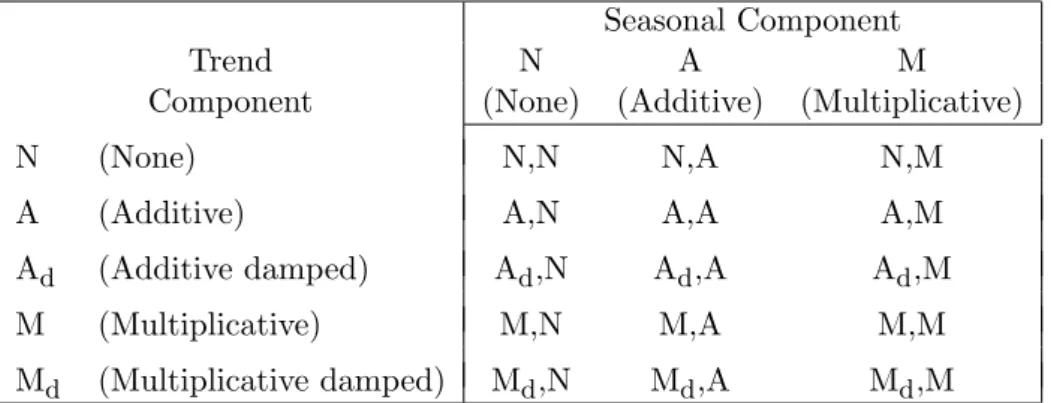
Exponential smoothing methods were originally classified by Pegels’ (1969) taxonomy. This was later extended by Gardner (1985), modified by Hyndman et al. (2002), and extended again byTaylor(2003), giving a total of fifteen methods seen in the following table.
Seasonal Component
Trend N A M
Component (None) (Additive) (Multiplicative)
N (None) N,N N,A N,M
A (Additive) A,N A,A A,M
Ad (Additive damped) Ad,N Ad,A Ad,M
M (Multiplicative) M,N M,A M,M
Md (Multiplicative damped) Md,N Md,A Md,M
Table 1: The fifteen exponential smoothing methods.
Some of these methods are better known under other names. For example, cell (N,N) describes the simple exponential smoothing (or SES) method, cell (A,N) describes Holt’s linear method, and cell (Ad,N) describes the damped trend method. The additive Holt-Winters’ method is given by cell (A,A) and the multiplicative Holt-Winters’ method is given by cell (A,M). The
other cells correspond to less commonly used but analogous methods. 2.1. Point forecasts for all methods
We denote the observed time series by y1, y2, . . . , yn. A forecast of yt+h based on all of the
data up to time tis denoted by ˆyt+h|t. To illustrate the method, we give the point forecasts
and updating equations for method (A,A), the Holt-Winters’ additive method:
Level: `t = α(yt−st−m) + (1−α)(`t−1+bt−1) (1a) Growth: bt = β∗(`t−`t−1) + (1−β∗)bt−1 (1b) Seasonal: st = γ(yt−`t−1−bt−1) + (1−γ)st−m (1c)
Forecast: yˆt+h|t = `t+bth+st−m+h+m. (1d)
where m is the length of seasonality (e.g., the number of months or quarters in a year), `t
represents the level of the series,bt denotes the growth, st is the seasonal component, ˆyt+h|t
is the forecast for h periods ahead, andh+m =(h−1) modm+ 1. To use method (1), we need values for the initial states`0,b0 ands1−m, . . . , s0, and for the smoothing parametersα,
β∗ and γ. All of these will be estimated from the observed data.
Equation (1c) is slightly different from the usual Holt-Winters equations such as those in Makridakiset al.(1998) or Bowerman et al. (2005). These authors replace (1c) with
st=γ∗(yt−`t) + (1−γ∗)st−m.
If`tis substituted using (1a), we obtain
st=γ∗(1−α)(yt−`t−1−bt−1) +{1−γ∗(1−α)}st−m.
Thus, we obtain identical forecasts using this approach by replacingγ in (1c) withγ∗(1−α). The modification given in (1c) was proposed by Ord et al. (1997) to make the state space formulation simpler. It is equivalent to Archibald’s (1990) variation of the Holt-Winters’ method.
Table2 gives recursive formulae for computing point forecastsh periods ahead for all of the exponential smoothing methods. Some interesting special cases can be obtained by setting the smoothing parameters to extreme values. For example, ifα = 0, the level is constant over time; ifβ∗ = 0, the slope is constant over time; and ifγ = 0, the seasonal pattern is constant over time. At the other extreme, na¨ıve forecasts (i.e., ˆyt+h|t=ytfor allh) are obtained using
the (N,N) method with α = 1. Finally, the additive and multiplicative trend methods are special cases of their damped counterparts obtained by lettingφ= 1.
2.2. Innovations state space models
For each exponential smoothing method in Table 2, Hyndman et al. (2008b) describe two possible innovations state space models, one corresponding to a model with additive errors and the other to a model with multiplicative errors. If the same parameter values are used, these two models give equivalent point forecasts, although different prediction intervals. Thus there are 30 potential models described in this classification.
Historically, the nature of the error component has often been ignored, because the distinction between additive and multiplicative errors makes no difference to point forecasts.
S eason al T ren d N A M ` t = α y t + (1 − α ) ` t − 1 ` t = α ( y t − s t − m ) + (1 − α ) ` t − 1 ` t = α ( y t/s t − m ) + (1 − α ) ` t − 1 N s t = γ ( y t − ` t − 1 ) + (1 − γ ) s t − m s t = γ ( y t/` t − 1) + (1 − γ ) s t − m ˆ y t + h | t = ` t ˆ y t + h | t = ` t + s t − m + h + m ˆ y t + h | t = ` ts t − m + h + m ` t = α y t + (1 − α )( ` t − 1 + b t − 1 ) ` t = α ( y t − s t − m ) + (1 − α )( ` t − 1 + b t − 1) ` t = α ( y t/s t − m ) + (1 − α )( ` t − 1 + b t − 1 ) A b t = β ∗ ( ` t − ` t − 1) + (1 − β ∗ ) b t − 1 b t = β ∗ ( ` t − ` t − 1 ) + (1 − β ∗ ) b t − 1 b t = β ∗ ( ` t − ` t − 1 ) + (1 − β ∗ ) b t − 1 s t = γ ( y t − ` t − 1 − b t − 1 ) + (1 − γ ) s t − m s t = γ ( y t/ ( ` t − 1 − b t − 1)) + (1 − γ ) s t − m ˆ y t + h | t = ` t + hb t ˆ y t + h | t = ` t + hb t + s t − m + h + m ˆ y t + h | t = ( ` t + hb t) s t − m + h + m ` t = α y t + (1 − α )( ` t − 1 + φb t − 1 ) ` t = α ( y t − s t − m ) + (1 − α )( ` t − 1 + φb t − 1) ` t = α ( y t/s t − m ) + (1 − α )( ` t − 1 + φb t − 1 ) A d b t = β ∗ ( ` t − ` t − 1) + (1 − β ∗ ) φb t − 1 b t = β ∗ ( ` t − ` t − 1 ) + (1 − β ∗ ) φb t − 1 b t = β ∗ ( ` t − ` t − 1 ) + (1 − β ∗ ) φb t − 1 s t = γ ( y t − ` t − 1 − φb t − 1 ) + (1 − γ ) s t − m s t = γ ( y t/ ( ` t − 1 − φb t − 1)) + (1 − γ ) s t − m ˆ y t + h | t = ` t + φ h b t ˆ y t + h | t = ` t + φ h b t + s t − m + h + m ˆ y t + h | t = ( ` t + φ h b t) s t − m + h + m ` t = α y t + (1 − α ) ` t − 1 b t − 1 ` t = α ( y t − s t − m ) + (1 − α ) ` t − 1b t − 1 ` t = α ( y t/s t − m ) + (1 − α ) ` t − 1 b t − 1 M b t = β ∗ ( ` t/` t − 1) + (1 − β ∗ ) b t − 1 b t = β ∗ ( ` t/` t − 1 ) + (1 − β ∗ ) b t − 1 b t = β ∗ ( ` t/` t − 1) + (1 − β ∗ ) b t − 1 s t = γ ( y t − ` t − 1 b t − 1 ) + (1 − γ ) s t − m s t = γ ( y t/ ( ` t − 1b t − 1)) + (1 − γ ) s t − m ˆ y t + h | t = ` tb h t ˆ y t + h | t = ` tb h t + s t − m + h + m ˆ y t + h | t = ` tb h t s t − m + h + m ` t = α y t + (1 − α ) ` t − 1 b φ t − 1 ` t = α ( y t − s t − m ) + (1 − α ) ` t − 1b φ t − 1 ` t = α ( y t/s t − m ) + (1 − α ) ` t − 1 b φ t − 1 M d b t = β ∗ ( ` t/` t − 1) + (1 − β ∗ ) b φ t − 1 b t = β ∗ ( ` t/` t − 1 ) + (1 − β ∗ ) b φ t − 1 b t = β ∗ ( ` t/` t − 1) + (1 − β ∗ ) b φ t − 1 s t = γ ( y t − ` t − 1 b φ t − 1 ) + (1 − γ ) s t − m s t = γ ( y t/ ( ` t − 1b φ t − 1)) + (1 − γ ) s t − m ˆ y t + h | t = ` tb φ h t ˆ y t + h | t = ` tb φ h t + s t − m + h + m ˆ y t + h | t = ` tb φ h t s t − m + h + m T ab le 2: F or m u lae for re cu rs iv e calc ul at ion s and p oi n t fore cas ts . In eac h case, ` t d en ot es the ser ies lev el at ti m e t , b t d en ot es the sl op e at ti me t , s t d en ot es th e season al comp on en t of th e se ri es at tim e t , an d m d en ot es th e n um b er of se ason s in a y ear ; α , β ∗ , γ an d φ ar e cons tan ts, φ h = φ + φ 2 + ·· · + φ h an d h + m = ( h − 1) mo d m + 1.
We are careful to distinguish exponential smoothingmethods from the underlying state space
models. An exponential smoothing method is an algorithm for producing point forecasts only. The underlying stochastic state space model gives the same point forecasts, but also provides a framework for computing prediction intervals and other properties.
To distinguish the models with additive and multiplicative errors, we add an extra letter to the front of the method notation. The triplet (E,T,S) refers to the three components: error, trend and seasonality. So the model ETS(A,A,N) has additive errors, additive trend and no seasonality—in other words, this is Holt’s linear method with additive errors. Similarly, ETS(M,Md,M) refers to a model with multiplicative errors, a damped multiplicative trend and multiplicative seasonality. The notation ETS(·,·,·) helps in remembering the order in which the components are specified.
Once a model is specified, we can study the probability distribution of future values of the series and find, for example, the conditional mean of a future observation given knowledge of the past. We denote this as µt+h|t = E(yt+h | xt), where xt contains the unobserved
components such as `t, bt and st. For h = 1 we use µt ≡ µt+1|t as a shorthand notation.
For many models, these conditional means will be identical to the point forecasts given in Table2, so that µt+h|t = ˆyt+h|t. However, for other models (those with multiplicative trend
or multiplicative seasonality), the conditional mean and the point forecast will differ slightly forh≥2.
We illustrate these ideas using the damped trend method ofGardner and McKenzie (1985).
Additive error model: ETS(A,Ad,N)
Letµt= ˆyt=`t−1+bt−1 denote the one-step forecast ofytassuming that we know the values
of all parameters. Also, letεt =yt−µt denote the one-step forecast error at time t. From
the equations in Table2, we find that
yt = `t−1+φbt−1+εt (2)
`t = `t−1+φbt−1+αεt (3)
bt = φbt−1+β∗(`t−`t−1−φbt−1) =φbt−1+αβ∗εt. (4)
We simplify the last expression by settingβ =αβ∗. The three equations above constitute a state space model underlying the damped Holt’s method. Note that it is aninnovations state space model (Anderson and Moore 1979;Aoki 1987) because the same error term appears in each equation. We can write it in standard state space notation by defining the state vector asxt= (`t, bt)0 and expressing (2)–(4) as yt = [1 φ]xt−1+εt (5a) xt = 1 φ 0 φ xt−1+ α β εt. (5b)
The model is fully specified once we state the distribution of the error term εt. Usually we
assume that these are independent and identically distributed, following a normal distribution with mean 0 and varianceσ2, which we write as εt∼NID(0, σ2).
Multiplicative error model: ETS(M,Ad,N)
A model with multiplicative error can be derived similarly, by first settingεt= (yt−µt)/µt,
we find yt = (`t−1+φbt−1)(1 +εt) `t = (`t−1+φbt−1)(1 +αεt) bt = φbt−1+β(`t−1+φbt−1)εt, or yt = [1 φ]xt−1(1 +εt) xt = 1 φ 0 φ xt−1+ [1 φ]xt−1 α β εt.
Again we assume thatεt∼NID(0, σ2).
Of course, this is a nonlinear state space model, which is usually considered difficult to handle in estimating and forecasting. However, that is one of the many advantages of the innovations form of state space models — we can still compute forecasts, the likelihood and prediction intervals for this nonlinear model with no more effort than is required for the additive error model.
2.3. State space models for all exponential smoothing methods
There are similar state space models for all 30 exponential smoothing variations. The general model involves a state vectorxt = (`t, bt, st, st−1, . . . , st−m+1)0 and state space equations of the form
yt = w(xt−1) +r(xt−1)εt (6a)
xt = f(xt−1) +g(xt−1)εt (6b)
where {εt} is a Gaussian white noise process with mean zero and variance σ2, and µt =
w(xt−1). The model with additive errors has r(xt−1) = 1, so that yt =µt+εt. The model
with multiplicative errors hasr(xt−1) = µt, so that yt=µt(1 +εt). Thus, εt= (yt−µt)/µt
is the relative error for the multiplicative model. The models are not unique. Clearly, any value ofr(xt−1) will lead to identical point forecasts for yt.
All of the methods in Table2 can be written in the form (6a) and (6b). The specific form for each model is given inHyndmanet al. (2008b).
Some of the combinations of trend, seasonality and error can occasionally lead to numeri-cal difficulties; specifinumeri-cally, any model equation that requires division by a state component could involve division by zero. This is a problem for models with additive errors and either multiplicative trend or multiplicative seasonality, as well as for the model with multiplicative errors, multiplicative trend and additive seasonality. These models should therefore be used with caution.
The multiplicative error models are useful when the data are strictly positive, but are not numerically stable when the data contain zeros or negative values. So when the time series is not strictly positive, only the six fully additive models may be applied.
The point forecasts given in Table2are easily obtained from these models by iterating equa-tions (6a) and (6b) for t = n+ 1, n+ 2, . . . , n+h, setting εn+j = 0 for j = 1, . . . , h. In
most cases (notable exceptions being models with multiplicative seasonality or multiplicative trend forh ≥ 2), the point forecasts can be shown to be equal to µt+h|t =E(yt+h |xt), the
conditional expectation of the corresponding state space model.
The models also provide a means of obtaining prediction intervals. In the case of the linear models, where the forecast distributions are normal, we can derive the conditional variance vt+h|t=VAR(yt+h|xt) and obtain prediction intervals accordingly. This approach also works
for many of the nonlinear models. Detailed derivations of the results for many models are given inHyndman et al.(2005b).
A more direct approach that works for all of the models is to simply simulate many future sample paths conditional on the last estimate of the state vector,xt. Then prediction intervals
can be obtained from the percentiles of the simulated sample paths. Point forecasts can also be obtained in this way by taking the average of the simulated values at each future time period. An advantage of this approach is that we generate an estimate of the complete predictive distribution, which is especially useful in applications such as inventory planning, where expected costs depend on the whole distribution.
2.4. Estimation
In order to use these models for forecasting, we need to know the values of x0 and the parameters α,β,γ and φ. It is easy to compute the likelihood of the innovations state space model (6), and so obtain maximum likelihood estimates. Ordet al. (1997) show that
L∗(θ,x0) =nlog Xn t=1 ε2t+ 2 n X t=1 log|r(xt−1)| (7)
is equal to twice the negative logarithm of the likelihood function (with constant terms eliminated), conditional on the parameters θ = (α, β, γ, φ)0 and the initial states x0 = (`0, b0, s0, s−1, . . . , s−m+1)0, where n is the number of observations. This is easily computed by simply using the recursive equations in Table2. Unlike state space models with multiple sources of error, we do not need to use the Kalman filter to compute the likelihood.
The parametersθ and the initial states x0 can be estimated by minimizing L∗. Most imple-mentations of exponential smoothing use an ad hoc heuristic scheme to estimatex0. However, with modern computers, there is no reason why we cannot estimatex0 along withθ, and the resulting forecasts are often substantially better when we do.
We constrain the initial states x0 so that the seasonal indices add to zero for additive sea-sonality, and add tomfor multiplicative seasonality. There have been several suggestions for restricting the parameter space for α, β and γ. The traditional approach is to ensure that the various equations can be interpreted as weighted averages, thus requiring α, β∗ = β/α, γ∗ =γ/(1−α) and φto all lie within (0,1). This suggests
0< α <1, 0< β < α, 0< γ <1−α, and 0< φ <1.
However,Hyndman et al. (2008a) show that these restrictions are usually stricter than nec-essary (although in a few cases they are not restrictive enough).
2.5. Model selection
Forecast accuracy measures such as mean squared error (MSE) can be used for selecting a model for a given set of data, provided the errors are computed from data in a hold-out set
and not from the same data as were used for model estimation. However, there are often too few out-of-sample errors to draw reliable conclusions. Consequently, a penalized method based on the in-sample fit is usually better.
One such approach uses a penalized likelihood such as Akaike’s Information Criterion: AIC =L∗( ˆθ,xˆ0) + 2q,
whereq is the number of parameters inθ plus the number of free states in x0, and ˆθ and ˆx0 denote the estimates ofθ and x0. We select the model that minimizes the AIC amongst all of the models that are appropriate for the data.
The AIC also provides a method for selecting between the additive and multiplicative error models. The point forecasts from the two models are identical so that standard forecast accuracy measures such as the MSE or mean absolute percentage error (MAPE) are unable to select between the error types. The AIC is able to select between the error types because it is based on likelihood rather than one-step forecasts.
Obviously, other model selection criteria (such as the BIC) could also be used in a similar manner.
2.6. Automatic forecasting
We combine the preceding ideas to obtain a robust and widely applicable automatic forecasting algorithm. The steps involved are summarized below.
1. For each series, apply all models that are appropriate, optimizing the parameters (both smoothing parameters and the initial state variable) of the model in each case.
2. Select the best of the models according to the AIC.
3. Produce point forecasts using the best model (with optimized parameters) for as many steps ahead as required.
4. Obtain prediction intervals for the best model either using the analytical results of Hyndmanet al.(2005b), or by simulating future sample paths for{yn+1, . . . , yn+h}and
finding theα/2 and 1−α/2 percentiles of the simulated data at each forecasting horizon. If simulation is used, the sample paths may be generated using the normal distribution for errors (parametric bootstrap) or using the resampled errors (ordinary bootstrap). Hyndmanet al.(2002) applied this automatic forecasting strategy to the M-competition data (Makridakiset al.1982) and the IJF-M3 competition data (Makridakis and Hibon 2000) using a restricted set of exponential smoothing models, and demonstrated that the methodology is particularly good at short term forecasts (up to about 6 periods ahead), and especially for seasonal short-term series (beating all other methods in the competitions for these series).
3. ARIMA models
A common obstacle for many people in using Autoregressive Integrated Moving Average (ARIMA) models for forecasting is that the order selection process is usually considered subjective and difficult to apply. But it does not have to be. There have been several attempts to automate ARIMA modelling in the last 25 years.
Hannan and Rissanen (1982) proposed a method to identify the order of an ARMA model for a stationary series. In their method the innovations can be obtained by fitting a long
autoregressive model to the data, and then the likelihood of potential models is computed via a series of standard regressions. They established the asymptotic properties of the procedure under very general conditions.
G´omez (1998) extended the Hannan-Rissanen identification method to include multiplicative seasonal ARIMA model identification. G´omez and Maravall (1998) implemented this auto-matic identification procedure in the software TRAMO and SEATS. For a given series, the algorithm attempts to find the model with the minimum BIC.
Liu(1989) proposed a method for identification of seasonal ARIMA models using a filtering method and certain heuristic rules; this algorithm is used in the SCA-Expertsoftware. An-other approach is described by M´elard and Pasteels (2000) whose algorithm for univariate ARIMA models also allows intervention analysis. It is implemented in the software package “Time Series Expert” (TSE-AX).
Other algorithms are in use in commercial software, although they are not documented in the public domain literature. In particular, Forecast Pro (Goodrich 2000) is well-known for its excellent automatic ARIMA algorithm which was used in the M3-forecasting competition (Makridakis and Hibon 2000). Another proprietary algorithm is implemented in Autobox (Reilly 2000). Ord and Lowe (1996) provide an early review of some of the commercial software that implement automatic ARIMA forecasting.
3.1. Choosing the model order using unit root tests and the AIC A non-seasonal ARIMA(p, d, q) process is given by
φ(B)(1−Bd)yt = c+θ(B)εt
where {εt} is a white noise process with mean zero and variance σ2, B is the backshift operator, andφ(z) andθ(z) are polynomials of orderpandqrespectively. To ensure causality and invertibility, it is assumed thatφ(z) and θ(z) have no roots for |z|< 1 (Brockwell and Davis 1991). Ifc6= 0, there is an implied polynomial of orderdin the forecast function. The seasonal ARIMA(p, d, q)(P, D, Q)m process is given by
Φ(Bm)φ(B)(1−Bm)D(1−B)dyt = c+ Θ(Bm)θ(B)εt
where Φ(z) and Θ(z) are polynomials of ordersP andQrespectively, each containing no roots inside the unit circle. Ifc6= 0, there is an implied polynomial of order d+Din the forecast function.
The main task in automatic ARIMA forecasting is selecting an appropriate model order, that is the valuesp,q,P,Q,D,d. Ifdand D are known, we can select the ordersp,q,P and Q via an information criterion such as the AIC:
AIC =−2 log(L) + 2(p+q+P +Q+k)
wherek= 1 ifc6= 0 and 0 otherwise, andLis the maximized likelihood of the model fitted to thedifferenced data (1−Bm)D(1−B)dy
t. The likelihood of the full model forytis not actually
defined and so the value of the AIC for different levels of differencing are not comparable. One solution to this difficulty is the “diffuse prior” approach which is outlined in Durbin and Koopman (2001) and implemented in the arima() function (Ripley 2002) in R. In this
approach, the initial values of the time series (before the observed values) are assumed to have mean zero and a large variance. However, choosing d and D by minimizing the AIC using this approach tends to lead to over-differencing. For forecasting purposes, we believe it is better to make as few differences as possible because over-differencing harms forecasts (Smith and Yadav 1994) and widens prediction intervals. (Although, seeHendry 1997, for a contrary view.)
Consequently, we need some other approach to choose d and D. We prefer unit-root tests. However, most unit-root tests are based on a null hypothesis that a unit root exists which biases results towards more differences rather than fewer differences. For example, variations on the Dickey-Fuller test (Dickey and Fuller 1981) all assume there is a unit root at lag 1, and the HEGY test ofHylleberget al.(1990) is based on a null hypothesis that there is a seasonal unit root. Instead, we prefer unit-root tests based on a null hypothesis of no unit-root. For non-seasonal data, we consider ARIMA(p, d, q) models whered is selected based on suc-cessive KPSS unit-root tests (Kwiatkowskiet al. 1992). That is, we test the data for a unit root; if the test result is significant, we test the differenced data for a unit root; and so on. We stop this procedure when we obtain our first insignificant result.
For seasonal data, we consider ARIMA(p, d, q)(P, D, Q)m models where m is the seasonal
frequency andD= 0 or D= 1 depending on an extended Canova-Hansen test (Canova and Hansen 1995). Canova and Hansen only provide critical values for 2 < m < 13. In our implementation of their test, we allow any value of m >1. Let Cm be the critical value for
seasonal periodm. We plottedCm against m for values ofm up to 365 and noted that they
fit the lineCm = 0.269m0.928 almost exactly. So form >12, we use this simple expression to
obtain the critical value.
We note in passing that the null hypothesis for the Canova-Hansen test is not an ARIMA model as it includes seasonal dummy terms. It is a test for whether the seasonal pattern changes sufficiently over time to warrant a seasonal unit root, or whether a stable seasonal pattern modelled using fixed dummy variables is more appropriate. Nevertheless, we have found that the test is still useful for choosingDin a strictly ARIMA framework (i.e., without seasonal dummy variables). If a stable seasonal pattern is selected (i.e., the null hypothesis is not rejected), the seasonality is effectively handled by stationary seasonal AR and MA terms. AfterDis selected, we choosedby applying successive KPSS unit-root tests to the seasonally differenced data (if D = 1) or the original data (if D = 0). Once d (and possibly D) are selected, we proceed to select the values of p,q,P and Qby minimizing the AIC. We allow c6= 0 for models whered+D <2.
3.2. A step-wise procedure for traversing the model space
Suppose we have seasonal data and we consider ARIMA(p, d, q)(P, D, Q)m models where p
and q can take values from 0 to 3, and P and Q can take values from 0 to 1. Whenc = 0 there is a total of 288 possible models, and whenc6= 0 there is a total of 192 possible models, giving 480 models altogether. If the values of p,d,q,P,Dand Q are allowed to range more widely, the number of possible models increases rapidly. Consequently, it is often not feasible to simply fit every potential model and choose the one with the lowest AIC. Instead, we need a way of traversing the space of models efficiently in order to arrive at the model with the lowest AIC value.
Step 1: We try four possible models to start with.
ARIMA(2, d,2) ifm= 1 and ARIMA(2, d,2)(1, D,1) ifm >1.
ARIMA(0, d,0) ifm= 1 and ARIMA(0, d,0)(0, D,0) ifm >1.
ARIMA(1, d,0) ifm= 1 and ARIMA(1, d,0)(1, D,0) ifm >1.
ARIMA(0, d,1) ifm= 1 and ARIMA(0, d,1)(0, D,1) ifm >1.
Ifd+D≤1, these models are fitted withc6= 0. Otherwise, we setc= 0. Of these four models, we select the one with the smallest AIC value. This is called the “current” model and is denoted by ARIMA(p, d, q) if m= 1 or ARIMA(p, d, q)(P, D, Q)m ifm >1.
Step 2: We consider up to thirteen variations on the current model:
where one of p,q,P andQ is allowed to vary by±1 from the current model;
where pand q both vary by ±1 from the current model;
where P and Qboth vary by ±1 from the current model;
where the constant c is included if the current model has c= 0 or excluded if the current model has c6= 0.
Whenever a model with lower AIC is found, it becomes the new “current” model and the procedure is repeated. This process finishes when we cannot find a model close to the current model with lower AIC.
There are several constraints on the fitted models to avoid problems with convergence or near unit-roots. The constraints are outlined below.
The values of p and q are not allowed to exceed specified upper bounds (with default values of 5 in each case).
The values of P and Q are not allowed to exceed specified upper bounds (with default values of 2 in each case).
We reject any model which is “close” to non-invertible or non-causal. Specifically, we compute the roots of φ(B)Φ(B) and θ(B)Θ(B). If either have a root that is smaller than 1.001 in absolute value, the model is rejected.
If there are any errors arising in the non-linear optimization routine used for estimation, the model is rejected. The rationale here is that any model that is difficult to fit is probably not a good model for the data.
The algorithm is guaranteed to return a valid model because the model space is finite and at least one of the starting models will be accepted (the model with no AR or MA parameters). The selected model is used to produce forecasts.
3.3. Comparisons with exponential smoothing
There is a widespread myth that ARIMA models are more general than exponential smooth-ing. This is not true. The two classes of models overlap. The linear exponential smoothing models are all special cases of ARIMA models—the equivalences are discussed in Hyndman
et al. (2008a). However, the non-linear exponential smoothing models have no equivalent ARIMA counterpart. On the other hand, there are many ARIMA models which have no exponential smoothing counterpart. Thus, the two model classes overlap and are complimen-tary; each has its strengths and weaknesses.
The exponential smoothing state space models are all non-stationary. Models with seasonality or non-damped trend (or both) have two unit roots; all other models—that is, non-seasonal models with either no trend or damped trend—have one unit root. It is possible to define a stationary model with similar characteristics to exponential smoothing, but this is not normally done. The philosophy of exponential smoothing is that the world is non-stationary. So if a stationary model is required, ARIMA models are better.
One advantage of the exponential smoothing models is that they can be non-linear. So time series that exhibit non-linear characteristics including heteroscedasticity may be better modelled using exponential smoothing state space models.
For seasonal data, there are many more ARIMA models than the 30 possible models in the exponential smoothing class of Section 2. It may be thought that the larger model class is advantageous. However, the results inHyndman et al. (2002) show that the exponential smoothing models performed better than the ARIMA models for the seasonal M3 competition data. (For the annual M3 data, the ARIMA models performed better.) In a discussion of these results, Hyndman (2001) speculates that the larger model space of ARIMA models actually harms forecasting performance because it introduces additional uncertainty. The smaller exponential smoothing class is sufficiently rich to capture the dynamics of almost all real business and economic time series.
4. The
forecast
package
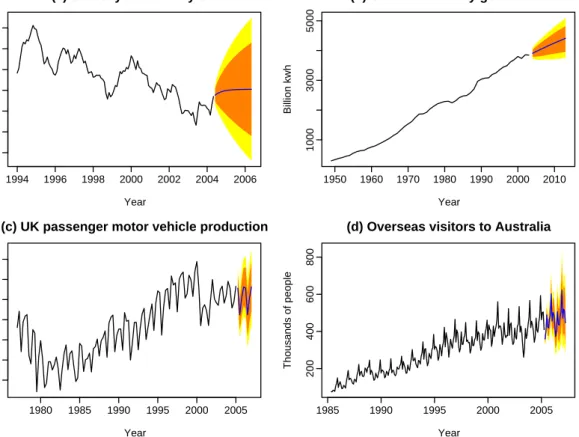
The algorithms and modelling frameworks for automatic univariate time series forecasting are implemented in theforecastpackage inR. We illustrate the methods using the following four real time series shown in Figure1.
Figure 1(a) shows 125 monthly US government bond yields (percent per annum) from January 1994 to May 2004.
Figure 1(b) displays 55 observations of annual US net electricity generation (billion kwh) for 1949 through 2003.
Figure 1(c) presents 113 quarterly observations of passenger motor vehicle production in the U.K. (thousands of cars) for the first quarter of 1977 through the first quarter of 2005.
Figure1(d) shows 240 monthly observations of the number of short term overseas visitors to Australia from May 1985 to April 2005.
4.1. Implementation of the automatic exponential smoothing algorithm The innovations state space modelling framework described in Section2 is implemented via theets()function in theforecastpackage. The models chosen via the algorithm for the four data sets were:
ETS(A,Ad,N) for monthly US 10-year bonds yield (α= 0.99,β = 0.12,φ= 0.80, `0= 5.30, b0= 0.71);
(a) US 10−year bonds yield
Year
Percentage per annum
1994 1996 1998 2000 2002 2004 2006 2 3 4 5 6 7 8
(b) US net electricity generation
Year Billion kwh 1950 1960 1970 1980 1990 2000 2010 1000 3000 5000
(c) UK passenger motor vehicle production
Year Thousands of cars 1980 1985 1990 1995 2000 2005 200 300 400 500
(d) Overseas visitors to Australia
Year Thousands of people 1985 1990 1995 2000 2005 200 400 600 800
Figure 1: Four time series showing point forecasts and 80% & 95% prediction intervals ob-tained using exponential smoothing state space models.
ETS(M,Md,N) for annual US net electricity generation (α= 0.99,β = 0.01,φ= 0.97, `0= 262.5,b0= 1.12);
ETS(A,N,A) for quarterly UK motor vehicle production
(α= 0.60,γ = 0.01,`0 = 343.5,s−3 = 24.58,s−2= 21.94,s−1 =−44.65,s0 =−1.87);
ETS(M,A,M) for monthly Australian overseas visitors
(α = 0.68, β = 0.01, γ = 0.17, `0 = 84.5, b0 = 2.87, s−11 = 0.858, s−10 = 0.867,
s−9 = 1.012, s−8 = 0.943, s−7 = 0.824, s−6 = 0.995, s−5 = 1.109, s−4 = 1.371,
s−3 = 0.963,s−2= 1.064, s−1 = 1.062, s0 = 0.934).
Although there is a lot of computation involved, it can be handled remarkably quickly on modern computers. Each of the forecasts shown in Figure1took no more than a few seconds on a standard PC. The US electricity generation series took the longest as there are no analyt-ical prediction intervals available for the ETS(M,Md,N) model. Consequently, the prediction
intervals for this series were computed using simulation of 5000 future sample paths.
To apply the algorithm to the US net electricity generation time series usnetelec, we use the following command.
R> etsfit <- ets(usnetelec)
The object etsfit is of class “ets” and contains all of the necessary information about the fitted model including model parameters, the value of the state vector xt for all t, residuals
and so on. Printing theetsfit object shows the main items of interest. R> etsfit ETS(M,Md,N) Call: ets(y = usnetelec) Smoothing parameters: alpha = 0.99 beta = 0.01 phi = 0.965 Initial states: l = 262.5316 b = 1.1207 sigma: 0.0239
AIC AICc BIC 628.82 630.05 638.86
Some goodness-of-fit measures (defined in Hyndman and Koehler 2006) are obtained using
accuracy().
R> accuracy(etsfit)
ME RMSE MAE MPE MAPE MASE -1.3934 49.5024 33.7931 -0.0572 1.8129 0.4788
There are also coef(),plot(),summary(),residuals(),fitted()and simulate() meth-ods for objects of class “ets”. Theplot()function shows time plots of the original time series along with the extracted components (level, growth and seasonal).
The forecast()function computes the required forecasts which are then plotted as in Fig-ure 1(b).
R> fcast <- forecast(etsfit) R> plot(fcast)
Printing the fcastobject gives a table showing the prediction intervals.
R> fcast Point Forecast Lo 80 Hi 80 Lo 95 Hi 95 2004 3909 3784 4032 3721 4090 2005 3969 3793 4142 3707 4228 2006 4029 3808 4241 3695 4359 2007 4087 3828 4336 3705 4491 2008 4144 3842 4425 3709 4605 2009 4200 3870 4515 3718 4712
2010 4254 3893 4602 3729 4811 2011 4308 3908 4684 3728 4909 2012 4360 3938 4765 3738 5007 2013 4410 3955 4843 3759 5096
Theets()function also provides the useful feature of applying a fitted model to a new data set. For example, we could withhold 10 observations from the usnetelec data set when fitting, then compute the one-step forecast errors for the out-of-sample data.
R> fit <- ets(usnetelec[1:45])
R> test <- ets(usnetelec[46:55], model = fit) R> accuracy(test)
We can also look at the measures of forecast accuracy where the forecasts are based on only the fitting data.
R> accuracy(forecast(fit,10), usnetelec[46:55])
4.2. The HoltWinters() function
There is another implementation of exponential smoothing inRvia theHoltWinters() func-tion (Meyer 2002) in the stats package. It implements only the (N,N), (A,N), (A,A) and (A,M) methods. The initial states x0 are fixed using a heuristic algorithm. Because of the way the initial states are estimated, a full three years of seasonal data are required to imple-ment the seasonal forecasts usingHoltWinters(). (See Hyndman and Kostenko (2007) for the minimal sample size required.) The smoothing parameters are optimized by minimizing the average squared prediction errors, which is equivalent to minimizing (7) in the case of additive errors.
There is apredict() method for the resulting object which can produce point forecasts and prediction intervals. Although it is nowhere documented, it appears that the prediction inter-vals produced by predict() for an object of class HoltWinters are based on an equivalent ARIMA model in the case of the (N,N), (A,N) and (A,A) methods, assuming additive er-rors. These prediction intervals are equivalent to the prediction intervals that arise from the (A,N,N), (A,A,N) and (A,A,A) state space models. For the (A,M) method, the prediction interval provided by predict() appears to be based on Chatfield and Yar (1991) which is an approximation to the true prediction interval arising from the (A,A,M) model. Prediction intervals with multiplicative errors are not possible using theHoltWinters()function.
4.3. Implementation of the automatic ARIMA algorithm
The algorithm of Section 3 is applied to the same four time series. Unlike the exponential smoothing algorithm, the ARIMA class of models assumes homoscedasticity, which is not always appropriate. Consequently, transformations are sometimes necessary. For these four time series, we model the raw data for series (a)–(c), but the logged data for series (d). The prediction intervals are back-transformed with the point forecasts to preserve the probability coverage.
To apply this algorithm to the US net electricity generation time series usnetelec, we use the following commands.
R> arimafit <- auto.arima(usnetelec) R> fcast <- forecast(arimafit)
R> plot(fcast)
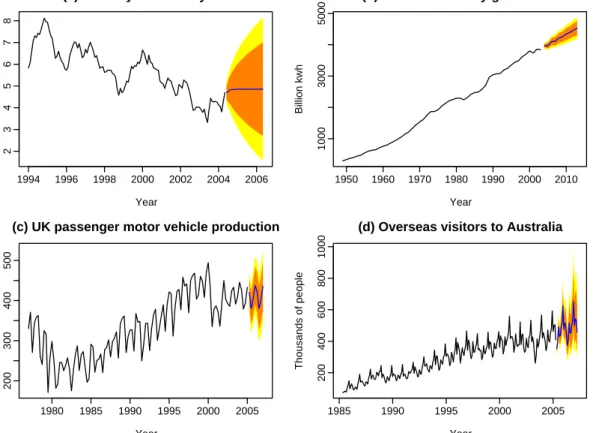
The function auto.arima()implements the algorithm of Section 3and returns an object of classArima. The resulting forecasts are shown in Figure2. The fitted models are as follows:
ARIMA(0,1,1) for monthly US 10-year bonds yield (θ1 = 0.322);
ARIMA(2,1,2) with drift for annual US net electricity generation (φ1=−1.3031, φ2 =−0.4334,θ1 = 1.5280,θ2 = 0.8338,c= 66.1473);
ARIMA(3,1,1)(2,0,1)4 model for quarterly UK motor vehicle production
(φ1 =−0.9570, φ2 =−0.4500, φ3 =−0.3314, θ1 = 0.5784, Φ1 = 0.6743, Φ2 = 0.3175, Θ1 =−0.8364;
ARIMA(1,1,1)(2,0,0)12model with drift for monthly Australian overseas visitors (φ1= 0.4740, θ1=−0.7393, Φ1 = 0.4728, Φ2= 0.4780, c= 0.0110).
Note that the Rparameterization has θ(B) = (1 +θ1B+· · ·+θqB) and φ(B) = (1−φ1B+
· · · −φqB), and similarly for the seasonal terms.
A summary of the forecasts is available, part of which is shown below.
R> summary(fcast)
(a) US 10−year bonds yield
Year
Percentage per annum
1994 1996 1998 2000 2002 2004 2006 2 3 4 5 6 7 8
(b) US net electricity generation
Year Billion kwh 1950 1960 1970 1980 1990 2000 2010 1000 3000 5000
(c) UK passenger motor vehicle production
Year Thousands of cars 1980 1985 1990 1995 2000 2005 200 300 400 500
(d) Overseas visitors to Australia
Year Thousands of people 1985 1990 1995 2000 2005 200 400 600 800 1000
Figure 2: Four time series showing point forecasts and 80% & 95% prediction intervals ob-tained using ARIMA models.
Forecast method: ARIMA(2,1,2) with drift Series: usnetelec
Coefficients:
ar1 ar2 ma1 ma2 drift -1.303 -0.433 1.528 0.834 66.15 s.e. 0.212 0.209 0.142 0.119 7.56
sigma^2 estimated as 2053: log likelihood = -283 AIC = 579 AICc = 580 BIC = 589
In-sample error measures:
ME RMSE MAE MPE MAPE MASE 0.0548 44.8955 32.3317 -0.6171 2.1011 0.4581 Forecasts: Point Forecast Lo 80 Hi 80 Lo 95 Hi 95 2004 3969 3911 4027 3880 4058 2005 3970 3879 4062 3830 4111 2006 4097 3977 4217 3913 4281 2007 4112 3976 4248 3905 4320 2008 4219 4061 4376 3978 4459 2009 4254 4085 4424 3995 4514 2010 4343 4156 4529 4058 4628 2011 4393 4195 4591 4090 4696 2012 4470 4258 4682 4146 4794 2013 4529 4306 4752 4188 4870
The in-sample error measures for the two models are very similar. Note that the information criteria are not comparable.
The forecast package also contains the function Arima() which is largely a wrapper to the
arima()function in the statspackage. TheArima() function in the forecastpackage makes it easier to include a drift term whend+D= 1. (Settinginclude.mean=TRUEin thearima()
function from thestatspackage will only work whend+D= 0.) It also provides the facility for fitting an existing ARIMA model to a new data set (as was demonstrated for theets()
function earlier).
One-step forecasts for ARIMA models are now available via a fitted() function. We also provide a new functionarima.errors()which returns the original time series after adjusting for regression variables. If there are no regression variables in the ARIMA model, then the errors will be identical to the original series. If there are regression variables in the ARIMA model, then the errors will be equal to the original series minus the effect of the regression variables, but leaving in the serial correlation that is modelled with the AR and MA terms. In contrast,residuals()provides true residuals, removing the AR and MA terms as well. The generic functionssummary(),print(), fitted()and forecast() apply to models ob-tained from either theArima()orarima() functions.
4.4. The forecast() function
Theforecast()function is generic and has S3 methods for a wide range of time series models. It computes point forecasts and prediction intervals from the time series model. Methods exist for models fitted using ets(), auto.arima(), Arima(),arima(),ar(), HoltWinters() and
StructTS().
There is also a method for atsobject. If a time series object is passed as the first argument to
forecast(), the function will produce forecasts based on the exponential smoothing algorithm of Section2.
In most cases, there is an existingpredict()function which is intended to do much the same thing. Unfortunately, the resulting objects from the predict() function contain different information in each case and so it is not possible to build generic functions (such as plot()
and summary()) for the results. So, instead, forecast() acts as a wrapper to predict(), and packages the information obtained in a common format (theforecast class). We also define a defaultpredict()method which is used when no existingpredict()function exists, and calls the relevant forecast()function. Thus, predict() methods parallelforecast()
methods, but the latter provide consistent output that is more useable. 4.5. The forecast class
The output from the forecast() function is an object of class “forecast” and includes at least the following information:
the original series;
point forecasts;
prediction intervals of specified coverage;
the forecasting method used and information about the fitted model;
residuals from the fitted model;
one-step forecasts from the fitted model for the period of the observed data.
There areprint(),plot()andsummary()methods for the “forecast” class. Figures1and2 were produced using theplot() method.
The prediction intervals are, by default, computed for 80% and 95% coverage, although other values are possible if requested. Fan charts (Wallis 1999) are possible using the combination
plot(forecast(model.object, fan = TRUE)).
4.6. Other functions
We now briefly describe some of the other features of the forecast package. Each of the following functions produces an object of class “forecast”.
croston() implements Croston’s (1972) method for intermittent demand forecasting. In this method, the time series is decomposed into two separate sequences: the non-zero values and the time intervals between non-zero values. These are then independently forecast using simple exponential smoothing and the forecasts of the original series are obtained as ratios of the two sets of forecasts. No prediction intervals are provided because there is no underlying stochastic model (Shenstone and Hyndman 2005).
Hyndman and Billah(2003) showed that these were equivalent to a special case of simple exponential smoothing with drift.
splinef()gives cubic-spline forecasts, based on fitting a cubic spline to the historical data and extrapolating it linearly. The details of this method, and the associated prediction intervals, are discussed in Hyndmanet al. (2005a).
meanf()returns forecasts based on the historical mean.
rwf()gives “na¨ıve” forecasts equal to the most recent observation assuming a random walk model. This function also allows forecasting using a random walk with drift.
In addition, there are some new plotting functions for time series.
tsdisplay()provides a time plot along with an ACF and PACF.
seasonplot()produces a seasonal plot as described inMakridakiset al. (1998).
References
Anderson BDO, Moore JB (1979). Optimal Filtering. Prentice-Hall, Englewood Cliffs. Aoki M (1987). State Space Modeling of Time Series. Springer-Verlag, Berlin.
Archibald BC (1990). “Parameter Space of the Holt-Winters’ Model.”International Journal of Forecasting,6, 199–209.
Assimakopoulos V, Nikolopoulos K (2000). “The Theta Model: A Decomposition Approach to Forecasting.”International Journal of Forecasting,16, 521–530.
Bowerman BL, O’Connell RT, Koehler AB (2005). Forecasting, Time Series and Regression: An Applied Approach. Thomson Brooks/Cole, Belmont CA.
Brockwell PJ, Davis RA (1991). Time Series: Theory and Methods. 2nd edition. Springer-Verlag, New York.
Canova F, Hansen BE (1995). “Are Seasonal Patterns Constant Over Time? A Test for Seasonal Stability.”Journal of Business and Economic Statistics,13, 237–252.
Chatfield C, Yar M (1991). “Prediction Intervals for Multiplicative Holt-Winters.” Interna-tional Journal of Forecasting,7, 31–37.
Croston JD (1972). “Forecasting and Stock Control for Intermittent Demands.”Operational Research Quarterly,23(3), 289–304.
Dickey DA, Fuller WA (1981). “Likelihood Ratio Statistics for Autoregressive Time Series with a Unit Root.” Econometrica,49, 1057–1071.
Durbin J, Koopman SJ (2001). Time Series Analysis by State Space Methods. Oxford Uni-versity Press, Oxford.
Gardner Jr ES (1985). “Exponential Smoothing: The State of the Art.”Journal of Forecasting, 4, 1–28.
Gardner Jr ES, McKenzie E (1985). “Forecasting Trends in Time Series.” Management Science,31(10), 1237–1246.
G´omez V (1998). “Automatic Model Identification in the Presence of Missing Observations and Outliers.” Working paper D-98009, Ministerio de Econom´ıa y Hacienda, Direcci´on General de An´alisis y Programaci´on Presupuestaria.
G´omez V, Maravall A (1998). “Programs TRAMO and SEATS, Instructions for the Users.”
Working paper 97001, Ministerio de Econom´ıa y Hacienda, Direcci´on General de An´alisis y Programaci´on Presupuestaria.
Goodrich RL (2000). “The Forecast ProMethodology.”International Journal of Forecasting, 16(4), 533–535.
Hannan EJ, Rissanen J (1982). “Recursive Estimation of Mixed Autoregressive-Moving Av-erage Order.”Biometrika,69(1), 81–94.
Hendry DF (1997). “The Econometrics of Macroeconomic Forecasting.”The Economic Jour-nal,107(444), 1330–1357.
Hylleberg S, Engle R, Granger C, Yoo B (1990). “Seasonal Integration and Cointegration.”
Journal of Econometrics,44, 215–238.
Hyndman RJ (2001). “It’s Time To Move from ‘What’ To ‘Why’—Comments on the M3-Competition.”International Journal of Forecasting,17(4), 567–570.
Hyndman RJ (2008a).expsmooth: Data Sets from “Forecasting with Exponential Smoothing” by Hyndman, Koehler, Ord & Snyder (2008). Rpackage version 1.11, URLhttp://CRAN. R-project.org/package=forecasting.
Hyndman RJ (2008b). fma: Data Sets from “Forecasting: Methods and Applications” By Makridakis, Wheelwright & Hyndman (1998). Rpackage version 1.11, URLhttp://CRAN. R-project.org/package=forecasting.
Hyndman RJ (2008c). forecast: Forecasting Functions for Time Series. R package ver-sion 1.11, URL http://CRAN.R-project.org/package=forecasting.
Hyndman RJ (2008d). Mcomp: Data from the M-Competitions. R package version 1.11, URLhttp://CRAN.R-project.org/package=forecasting.
Hyndman RJ, Akram M, Archibald BC (2008a). “The Admissible Parameter Space for Ex-ponential Smoothing Models.” Annals of the Institute of Statistical Mathematics, 60(2), 407–426.
Hyndman RJ, Billah B (2003). “Unmasking the Theta Method.” International Journal of Forecasting,19(2), 287–290.
Hyndman RJ, King ML, Pitrun I, Billah B (2005a). “Local Linear Forecasts Using Cubic Smoothing Splines.”Australian & New Zealand Journal of Statistics,47(1), 87–99.
Hyndman RJ, Koehler AB (2006). “Another Look at Measures of Forecast Accuracy.” Inter-national Journal of Forecasting,22, 679–688.
Hyndman RJ, Koehler AB, Ord JK, Snyder RD (2005b). “Prediction Intervals for Exponential Smoothing Using Two New Classes of State Space Models.” Journal of Forecasting, 24, 17–37.
Hyndman RJ, Koehler AB, Ord JK, Snyder RD (2008b). Forecasting with Exponen-tial Smoothing: The State Space Approach. Springer-Verlag. URL http://www. exponentialsmoothing.net/.
Hyndman RJ, Koehler AB, Snyder RD, Grose S (2002). “A State Space Framework for Automatic Forecasting Using Exponential Smoothing Methods.” International Journal of Forecasting,18(3), 439–454.
Hyndman RJ, Kostenko AV (2007). “Minimum Sample Size Requirements for Seasonal Fore-casting Models.”Foresight: The International Journal of Applied Forecasting,6, 12–15. Kwiatkowski D, Phillips PC, Schmidt P, Shin Y (1992). “Testing the Null Hypothesis of
Stationarity Against the Alternative of a Unit Root.” Journal of Econometrics, 54, 159– 178.
Liu LM (1989). “Identification of Seasonal Arima Models Using a Filtering Method.” Com-munications in Statistics: Theory & Methods,18, 2279–2288.
Makridakis S, Anderson A, Carbone R, Fildes R, Hibon M, Lewandowski R, Newton J, Parzen E, Winkler R (1982). “The Accuracy of Extrapolation (Time Series) Methods: Results of a Forecasting Competition.”Journal of Forecasting,1, 111–153.
Makridakis S, Hibon M (2000). “The M3-Competition: Results, Conclusions and Implica-tions.”International Journal of Forecasting,16, 451–476.
Makridakis S, Wheelwright SC, Hyndman RJ (1998). Forecasting: Methods and Applica-tions. 3rd edition. John Wiley & Sons, New York. URLhttp://www.robhyndman.info/ forecasting/.
M´elard G, Pasteels JM (2000). “Automatic ARIMA Modeling Including Intervention, Using Time Series Expert Software.”International Journal of Forecasting,16, 497–508.
Meyer D (2002). “Naive Time Series Forecasting Methods.” R News, 2(2), 7–10. URL http://CRAN.R-project.org/doc/Rnews/.
Ord JK, Koehler AB, Snyder RD (1997). “Estimation and Prediction for a Class of Dynamic Nonlinear Statistical Models.” Journal of the American Statistical Association, 92, 1621– 1629.
Ord K, Lowe S (1996). “Automatic Forecasting.” The American Statistician,50(1), 88–94. Pegels CC (1969). “Exponential Forecasting: Some New Variations.” Management Science,
RDevelopment Core Team (2008).R: A Language and Environment for Statistical Computing.
RFoundation for Statistical Computing, Vienna, Austria. ISBN 3-900051-07-0, URLhttp: //www.R-project.org/.
Reilly D (2000). “TheAutoboxSystem.”International Journal of Forecasting,16(4), 531–533. Ripley BD (2002). “Time Series in R 1.5.0.” R News, 2(2), 2–7. URL http://CRAN.
R-project.org/doc/Rnews/.
Shenstone L, Hyndman RJ (2005). “Stochastic Models Underlying Croston’s Method for Intermittent Demand Forecasting.”Journal of Forecasting,24, 389–402.
Smith J, Yadav S (1994). “Forecasting Costs Incurred from Unit Differencing Fractionally Integrated Processes.”International Journal of Forecasting,10(4), 507–514.
Taylor JW (2003). “Exponential Smoothing with a Damped Multiplicative Trend.” Interna-tional Journal of Forecasting,19, 715–725.
Wallis KF (1999). “Asymmetric Density Forecasts of Inflation and the Bank of England’s Fan Chart.”National Institute Economic Review,167(1), 106–112.
Affiliation: Rob J. Hyndman
Department of Econometrics & Business Statistics Monash University
Clayton VIC 3800, Australia
E-mail: [email protected] URL:http://www.robhyndman.info
Yeasmin Khandakar
Department of Econometrics & Business Statistics Monash University
Clayton VIC 3800, Australia
E-mail: [email protected]
Journal of Statistical Software
http://www.jstatsoft.org/ published by the American Statistical Association http://www.amstat.org/Volume 27, Issue 3 Submitted: 2007-05-29