Vol. 4, N 2, 2016, pp. 361365
UDC 811.111'243+(004.738.4:159.953)
PARALLEL THINKING TOOLS
IN ESP LANGUAGE INSTRUCTION
Ljubica Kardaleska, Gabriela Nedelkoska FON University, Faculty of Foreign Languages, Skopje, Macedonia
Phone: +389 (71) 387 146, +389 (71) 248 005
E-Mail: [email protected], [email protected]
Abstract. This paper focuses on the educational significance and effects of application of parallel thinking (and in particular the technique of The Six Thinking Hats) on enhancing vocabulary retention and reading comprehension in teaching English for Specific Purposes. The initial assumption that as an active and experiential method it should yield beneficial pedagogical implications has been confirmed.
Key words: parallel thinking, the Six Thinking Hats, dialogic classroom, traditional lecture mode versus active learning, ESP vocabulary and reading comprehension
1.INTRODUCTION
English for Specific Puproses (ESP) without doubt is becoming one of the most important strands of English Language Teaching (ELT) today (Januleviciene, V., 2003). The challenge lies in the fact that the classroom faces content-based learning, which is a kind of ESP teaching and learning process where the focus is shifted from pure language-based instruction to the integration of mastering both language for professional communication and the content matter of professional disciplines (Snow, M. A., Met, M., & Genesee, F., 1989). And it is particularly notable in cases where students are expected to decode and critically analyse a voluminous body of written texts.
Modern classrooms tend to put the emphasis on the learner as „doer‟ and „creator‟. In the past same instruction was used for all students, while today we have personalized real world tasks, discussing the opportunities of language use beyond the classroom, not confined within the classroom. Learners create and are trained to present and share their findings to their classmates and wider audiences, not just to the teacher.
Another important factor to be considered is the fact that in the era of changing paradigms, creativity and creating active learning contexts are regarded essential ingredients in education. In addition to the notion of lateral thinking, Edward de Bono (1995) designed a new concept and term known as „parallel thinking‟. Parallel thinking does not follow the same line of reasoning as the traditional thinking, known also as adversarial thinking. Namely, proponents of parallel thinking believe that traditional argument thinking lacks a creative element, and its limitations are that it is only aimed at discovering the „truth‟ not building anything. The advantage of the parallel thinking is
that all views are considered and are an integral part of the final design. Since an issue is viewed from multiple perspectives, the decision making process and the final outcome is better, more coherent, and that results in improved quality and integrated teaching in the contexts of professionally-oriented language practice. In parallel thinking, all parties involved think in parallel, and this method of teaching and learning is described as coordinated and co-operative. These notions are becoming increasingly important in today‟s educational reforms and approaches.
The aim of this paper is two-fold: to test the parallel thinking method in an English as a Second Language (ESL) classroom and its effect on reading comprehension, by creating conceptual framework for the integration of language and content teaching.
For the purposes of this paper, the Six Thinking Hats method as a parallel thinking tool was selected as a method to be tested. Each colour of the six metaphorical hats represents a specific angle or viewpoint. A problem is seen in a different light and regardless of how contradictory the views are, they are accepted in parallel. The Six Thinking Hats offer numerous benefits, the essential ones being: enhancer of creativity, productivity and communication, a facilitation tool, and a mechanism that enables maximizing and organizing one‟s thoughts.
2.RESEARCH OBJECTIVES
Critical reasoning and inquiry are essential tools for dealing with new information. Today teachers should employ proven methods in order to enhance their students‟ abilities to decode an unknown written text and thereby advance their capacities for higher order thinking, a reading skill required as essential in the 21 century. The search for such methods has led us to test the effects of parallel thinking tools and illustrate our understanding of the technique known as Six Thinking Hats. This research is based on the assumption that it improves students‟ comprehension providing better retention of new concepts and vocabulary. This hypothesis was tested in an ESP classroom.
3.SIX THINKING HATS TECHNIQUE
The technique of Six Thinking Hats (de Bono, E., 1985) posits that human brain thinks in six different ways, which can be further developed, each represented by a different hat colour (blue, white, red, black, yellow and green). Since all angles of the problem are not normally addressed by humans the metaphorical hats switches provide different perspective which are then viewed together to provide a more creative or out-of-the-box perspective.
The six directions (hat colours) are:
1. Blue – thinking about organization, process, goal, agenda and decision making. 2. White – neutral thinking, focusing on pure information and facts.
3. Red – intuitive thinking, involving emotions and hunches.
4.EXPERIMENT AND RESULTS
It has come to our notice that the problem of learners is not insufficient input and inadequate exposure to new vocabularies but inability to retain the new words they encounter. This elicited the need to utilize appropriate strategies and approaches especially in the ESL classroom because of the immense exposure to new words in L2 texts. Finding creative ways to process a text has led us to explore dealing with huge sources in a way which ensures better understanding and even more important – retention of ESP vocabulary. Authentic texts (excerpts of recent issues of specialized reference literature – on political sciences) served as material for the purposes of this research. They were complemented with vocabulary and reading comprehension exercises.
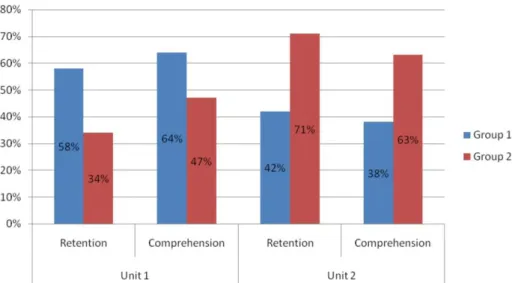
It can be viewed a small-scale in terms of the moderate sample size (n=12), implying reserved approach in the interpretation of results, however, its structure and the quality of the outcome obtained was quite pin-pointing. Divided into control and experimental group 12 respondents (language level - B2) were covered by this research. Each of the six respondents of the experimental group (Group 1) was given a hat along with guidelines as to how to approach the given reading task. The control group (Group 2) on the other hand was given the same task but without any specific directions, i.e. they were asked to read the text and do the exercises. The level of comprehension was tested with the exercises following the reading task, while the respondents were asked to do the retention exercises two weeks after being introduced to the vocabulary. As expected, the level of retention and comprehension is evidently higher (58%/64% vs. 34%/47%) with the respondents of the experimental group (Group 1). To further prove the benefit of this technique the groups switched roles the following week, meaning this time Group 2 was given hats and guidelines, while Group 1 just the text and accompanying exercises. The results follow the same trend, i.e. Group 2 showed significantly higher retention (71%) and comprehension (63%) results as compared to Group 1 (42%/38%).
What needs to be emphasized here parallel to the positive outcome on the exercises is the class climate or rather the climate within the two separate groups. Namely, the group using the six thinking hats technique manifested higher involvement and vigor during the assignments which viewed in terms of motivation provides an additional benefit for the participants. This might be due to the newly discovered ability to make internal connections and relationships between the incoming and existing information.
Furthermore, these classes relied heavily on thoughtful discussions. Students jotted down their ideas and sifted through them later. The indirect benefit of this exercise (incorporating the Six Thinking Hats method) was that they learned how to figure out which ideas to include. To present the final outcome of the dialogue process, students demonstrated their creativity by concept mapping and visually depicting how the concepts are related. It helped them master the technical terms, build their vocabulary and the overall set of ideas of the analyzed text, thereby enriching their reading comprehension with an additional skill.
In the L2 learning context, there is none activity to guarantee intrinsically-motivated behaviors for all individuals. Deci, Vallerand et al. (1991:338) argue that “people are motivated to internalize the regulation of uninteresting behaviors that are valuable for effective functioning” if: 1) they identify with the personal utility of the activity; 2) they are offered choices about the activity in an autonomy supportive environment; and 3) their sentiment and views are respected and acknowledged.
7. CONCLUSION
In an ESP classroom, students are encouraged to master specialized vocabulary and be able to explain complex concepts behind it. The most effective methods contributing to enhancing vocabulary building and reading comprehension include clear explanatory texts of the key terms, synonyms, lexical chunks and collocations. An attempt to make their learning ESP a purposeful learning experience, led us to one alternative approach.
Namely, one of the alternative methods (which allows incorporating both the above approach and additional benefits) is the parallel thinking approach, applied through its most prominent tool The Six Thinking Hats. In our research, it involved dialogic teaching (Alexander, R.J., 2008), awareness of varied opposing views, while contributing to the development of the higher order thinking skills, such as analysis, synthesis and evaluation, as well as elements of argumentation and critical thinking. It is believed that the percentage of what students read and retain is higher, since students are required not only to provide definitions for the words in question, but also understanding of what they mean in the big picture.
As an experiential and task-based learning, this method creates positive learning environment and encourages cooperation. At the same time, it encourages creative and critical thinking, while contributing to the expected learning outcomes.
REFERENCES
Alexander, R.J., (2008). Towards Dialogic Teaching: rethinking classroom talk (4th edition), Dialogos, UK.
de Bono, E. (1995). Parallel thinking, Penguin Books
de Bono, E. (1985). The Six Thinking Hats. Little, Brown and Company
Deci, E. L., Vallerand, R. J., Pelletier, L. G. and Ryan, R. M. (1991). Motivation and education: The self-determined perspective. Educational Psychologist, 26(3 &4),325-34 Januleviciene, V. (2003). ,,Recycling in ESP” in IATEFL issues February-March. Snow, M. A., Met, M., & Genesee, F. (1989). A conceptual framework for the integration