Geometries, Reactivity and Binding Energy
of Urea on Mg
9
O
9
Antonio Luiz de Almeida
1*, Joao Batista Lopes Martins
21
Universidade do Estado da Bahia, Brazil
2
Universidade de Brasilia, Brazil
*Corresponding author: Antonio L. de Almeida: [email protected]
Abstract:
Keywords: Urea, DFT, Reactivity, Binding Energy.
Introduction
The reaction capacity of the metal oxides is perhaps the most important property of these oxides and determined by their electronic structures. The presence of the oxygen ions in the structure of these crystals of the closed shell 2s22p6 configuration, thereby making the oxygen ions formally O2- (i.e., the "oxide" ion). The chemical concept of ionic charge is useful, however, the actual distribution of electron density in a crystalline structure is very complicated to fit perfectly into such a simple concept. MgO is a highly ionic metal oxides example whose charge density of electrons in the crystal resembles that of a set of Mg2+ and O2- ions. It should be noted that the O2- "free" ion does not exist, compared to the free O atom, unless it is stabilized by means of positively charged linkers.
Citation: Almeida A.L., Martins J.B.L. (2020) Geometries, Reactivity and Binding Energy of Urea on Mg9O9. Open Science Journal 5(3)
Received: 5th May 2020
Accepted: 1st June 2020
Published: 28th July 2020
Copyright: © 2020 This is an open access article under the terms of the Creative Commons Attribution License, which permits unrestricted use, distribution, and reproduction in any medium, provided the original author and source are credited.
Funding: The author(s) received no specific funding for this work
Competing Interests: The author has declared that no competing interests exists.
When we take a MgO cluster system we see that the reactive capacity of its atoms varies with the location of the atoms in the corners, sides or surfaces. A study based on quantum chemistry in order to understand the reactive degree of these atomic sites are of fundamental importance linked to the catalytic processes for metallurgy, pharmaceuticals, catalytic processes in general. Defects and vacancies take part in these processes, in many cases, decisively. The spatial distribution of the two electrons associated with a neutral oxygen vacancy depends on the degree of covalence of the oxygen-cation bond and topological factors: the crystalline structure of the oxide and the coordination of the place of the wave. In some cases, as in the MgO, the electrons are trapped in the place of the wave by the strong electrostatic potential exerted by the neighboring cations, thus forming a surface center F. Oxide surfaces have great applications in advanced technologies such as corrosion protection, coating for thermal applications, in catalysis as inert supports or directly as catalysts, in microelectronics due to their dielectric properties. There are many technological applications of MgO[1-4] in which all deserve highlight and of the many technological applications alkaline earth metal oxide (MgO) is also widely used in many technological applications such as: catalysis, toxic residue remediation, refractory ceramic glass additives, optically transparent, adsorbent for many pollutants, paints and superconductors, among others. MgO is a white hygroscopic solid mineral occurring naturally as periclase and as a non-toxic and environmentally correct material with high reactivity and adsorption capacities, and is a suitable adsorbent for aqueous solution cations and anions due to its favorable electrostatic attractive mechanism. In this work we investigated the properties of the adsorption processes of a urea molecule in an cluster of (MgO)18 (Mg9O9)[5-9]. This model of MgO cluster allows us to investigate the urea adsorption energies at the three coordinating Mg (cluster cluster), four coordination (cluster cluster) and five (cluster cluster) coordination sites. The importance of urea (CH4N2O) as fertilizer[10] in the agricultural industry has grown enormously in recent years and according to all forecasts. We will analyze the molecular bonding energy CH4N2O-MgO, charge distribution, bond length, angles and dihedrons, highest occupied molecular orbital (HOMO) and the lowest unoccupied molecular orbital (LUMO), reactivity of molecular adsorption sites. Various methods of spectroscopy, IR spectroscopy, microwaves and Raman can provide information on the geometry of molecular structures. X-ray crystallography, neutron diffraction, and electron diffraction can provide information on the molecular structure for crystalline solids based on the distance between nuclei and the concentration of electron density. NMR methods can be used to determine information regarding the lengths of atomic bonds, angles and dehydrates.
Methods
In quantum chemistry, numerical analyzes are made with what is named
“level theory” (LT) defined as the set of calculation procedures from the
edge of the MgO cluster and (Figure 1-D) the urea molecule adsorbed onto the surface of the MgO cluster with vacancy F. All optimization calculations were performed with the properties of the frozen MgO crystalline structure, ie, the distances of the adjacent atoms Mg-O of the cluster were kept constant at 2.106Ǻ.
Figure 1-A Figure 1-B
Figure 1-C Figure 1-D
The HOMO (Highest Occupied Molecular Orbital) shows the ability to donate an electron whereas LUMO (Lowest Unoccupied Molecular Orbital) as an electron acceptor shows the ability to obtain an electron. Both the HOMO and LUMO are the main orbitals that take part in chemical stability. The eigenvalues of LUMO and HOMO and their energy gap reflect the chemical activity of the molecule. Recently the energy gap between HOMO and LUMO orbital has been used to prove the bioactivity from intramolecular charge transfer[15,16].
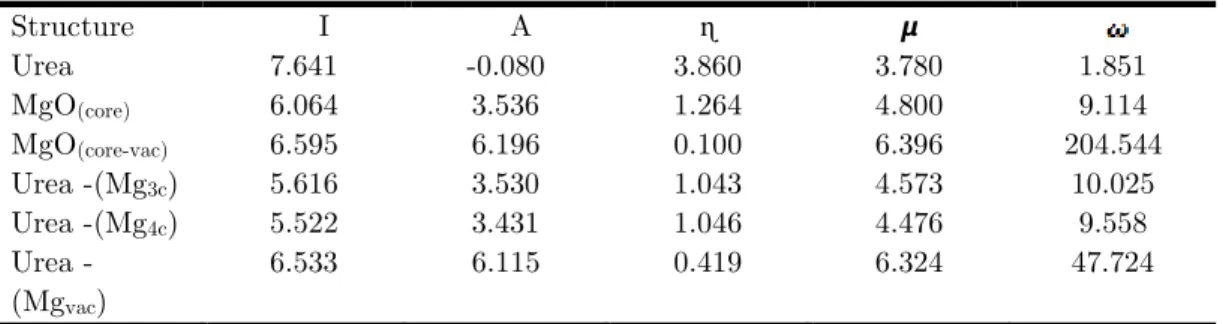
values are negative) defined as μ=1/2(I+A), while the global philicity index (ω)[20] can be evaluated using the electronic chemical potential and chemical
hardness (ɳ)[33] as ω=μ2/2ɳ (Electrophilicity promotes quantitative results on the electronic absorption capacity of a system). Table 01 summarize the results above cited for urea molecule isolated CH4N2O, isolated MgO(core), isolated MgO (core-vac) (cluster of MgO with vacancy F), (Mg3c)-urea (molecule of adsorbed urea on a coordinating Mg atom three of the cluster of MgO), (Mg4c)-urea (molecule of adsorbed urea on a coordinating Mg atom four of the cluster of MgO) and (Mgvac)-urea (molecule of adsorbed urea on a coordinating Mg atom surface vacant of the cluster of MgO).
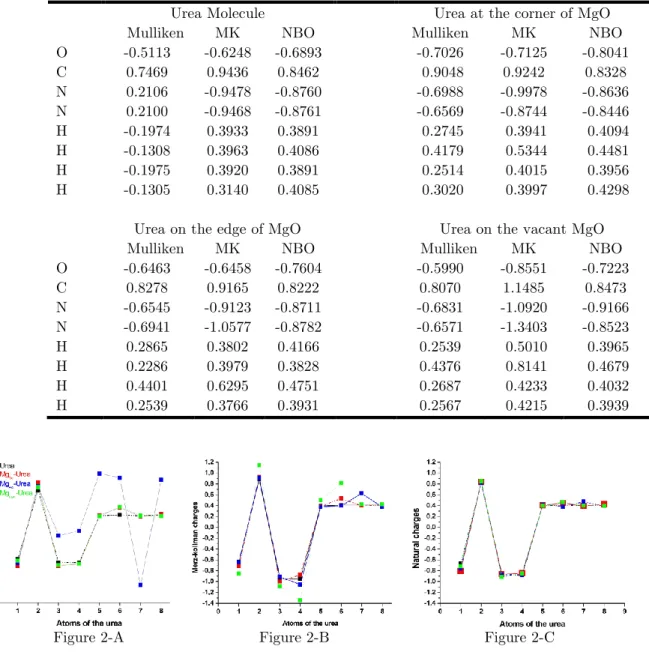
Analysis of the distribution of electronic charges by the various atoms of a molecule is of fundamental importance to analyze the reactivity of atomic sites in a molecule (local reactivity). Although the concept of "atomic charge" in a molecule is not an observable quantum chemistry greatness, atomic charges has been a key concept for understanding a large number of chemical reactions, as well as being of fundamental importance for the understanding of a range of phenomena, such as dipole moments, chemical shifts in nuclear magnetic resonance (NMR), structures and molecular properties. Because of its great importance a large number of theoretical and experimental contributions have been proposed [34-36] for a better understanding of the atomic charges distributions in a molecules.
Analysis of Mulliken has the advantage of simplicity because its populations overlap divided equally between the two atoms of a bond and therefore. However it promotes a number of results that come at odds with expectations [37-40]. The electrostatic potential approach, has been far more promising, assigns point charges at atomic centers in order to best reproduce the electrostatic potential. Here, the main weakness is that the molecular electrostatic arises in a much more subtle and nonisotropic density than can be explained by a simple set of atom-centered point charges. Another promising method for the proposed load distribution in atoms in molecules has been "natural atomic charges" that has proven to be independent of the wave functions used in the calculations[38,41-42]. As expected Mulliken is more dependent on the basis set. Merhz-Kollman and NBO shows almost the same trend for the atomic charges. In table 3 are presents the atomic charges of the systems studied. In the table Mulliken means Mulliken charges, MK means Merhz-Kollman and NBO means Natural Bond Orders. Figure 2 illustrates in summary the values contained in table 3.
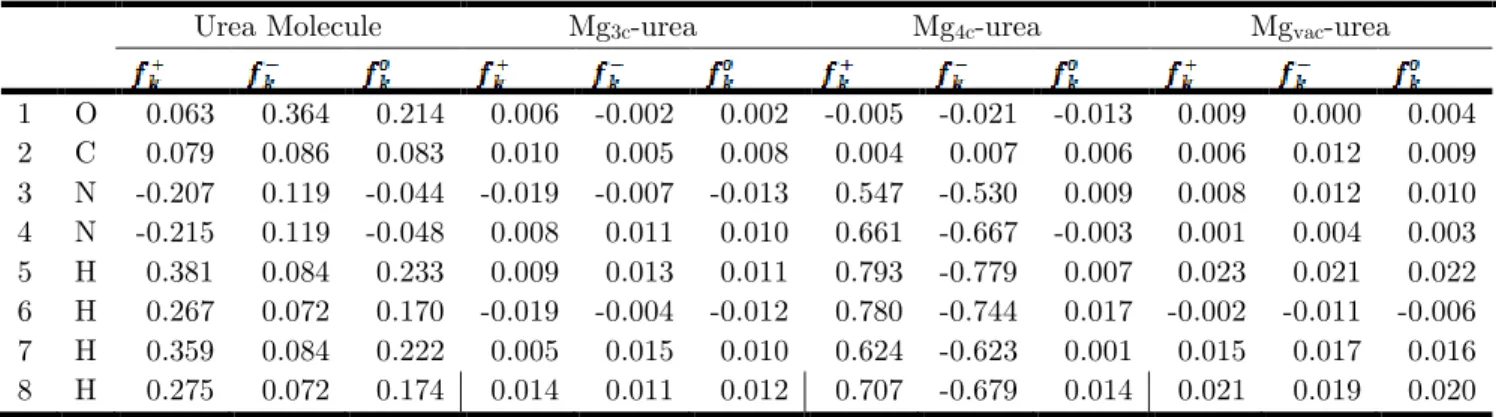
To describe the site reactivity or site selectivity, Yang et al.57 proposed the atom condensed Fukui function, based on the idea of electronic population around an atom in a molecule, similar to the procedure followed in the population analysis technique. The condensed Fukui function for an atom k undergoing nucleophilic (fk+), electrophilic (fk-), or radical attack (fko). The Table 4 are present this values and Table 5 are present the relevant relations as support for analysis of values. The condensed-to-atom Fukui functions (fk) at the atom k are usually evaluated from differences in atomic charges
(1) (2) ]
(3)
[29,30] is very important to characterize the reactivity of a site within a molecule toward a nucleophilic or an electrophilic attack [29,30]. When Δfk>0 then the site is favored for a nucleophilic attack, whereas if Δfk<0 then the site may be favored for an electrophilic attack. Thus, with the numerical results of Δfk we see, through Table 4, that the oxygen atom of the urea molecule has a much more appreciated electrophilic character while in the isolated urea molecule and it loses this character as the molecule of urea is adsorbed at the different sites of the MgO cluster. The carbon atom has an electrophilic character in the isolated molecule of urea, in a relation far less than the oxygen atom, but also loses electrophilic character as it adsorbs to MgO. The two nitrogen atoms are the ones that present the highest electrophilic in the solubility of urea molecule and completely lose that character, changing to the character nucleophilic attack in Mg4c-Urea. Hydrogen atoms follow by a nucleophilic character suffering variations but with a high nucleophilic degree in Mg4c-Urea.
Results
The binding energy BE of our MgO-urea study systems were calculated using the total energies of the, optimized systems, based on the expression:
] (4)
so that
and .
Table 1 shows how much the overall reactivity properties in the systems studied and therefore the urgency of careful studies for the understanding of the molecular adsorption processes in MgO clusters. The results of Table 1 are in electron-volt units. This table shows values demonstrating how much the values on the global indices are affected with the interaction of the urea molecule with the MgO cluster. In reference to the clusters of MgO it is seen that the vacancy greatly changes the index values. A higher (or less) HOMO energy corresponds to the more reactive molecule in reaction with electrophiles, while lower LUMO energy is essential for molecular reaction with nucleophiles. The Table 1 shows that energy required (I) to remove an electron from a urea molecule is bigger than the other systems. MgO(core-vac) raises ionization potential by approximately 8% that MgO(core) and the adsorption processes of the urea molecule with the MgO clusters further reduce the ionization potential of the systems and the adsorption processes of the urea molecule with the MgO clusters further reduces the ionization potential of the systems at the adsorption sites urea-(Mg3c) and urea-(Mg4c) while urea-(Mgvac) presents values close to the MgO(core-vac) which brings us to the urea-(Mgvac) binding energy closed at 0.0eV.
The electronic affinity (A), Table 1, presents much greater variations than the ionization energy (I) for the different studied systems, which shows that the different atomic positions significantly influence the E(LUMO) values. The chemical potential (µ), the absolute hardness (ɳ) and global philicity index (ω),
Table 1 Values of Reactivity descriptors for isolated urea molecule and isolated regular MgO(core) and vacant MgO(core-vac) and for adsorption systems urea-(Mg3c), urea-(Mg4c), urea-(Mgvac)
Structure I A ɳ 𝞵
Urea 7.641 -0.080 3.860 3.780 1.851
MgO(core) 6.064 3.536 1.264 4.800 9.114
MgO(core-vac) 6.595 6.196 0.100 6.396 204.544
Urea -(Mg3c) 5.616 3.530 1.043 4.573 10.025
Urea -(Mg4c) 5.522 3.431 1.046 4.476 9.558
Urea -(Mgvac)
6.533 6.115 0.419 6.324 47.724
Urea means isolated urea molecule. MgO(core) means regular MgO cluster. urea-(Mg3c) means urea adsorbed on the
coordination site three of MgO. Urea-(Mg4c) means urea adsorbed on the coordination site four of MgO. Urea-(Mgvac)
means urea adsorbed on surface of MgO vacant.
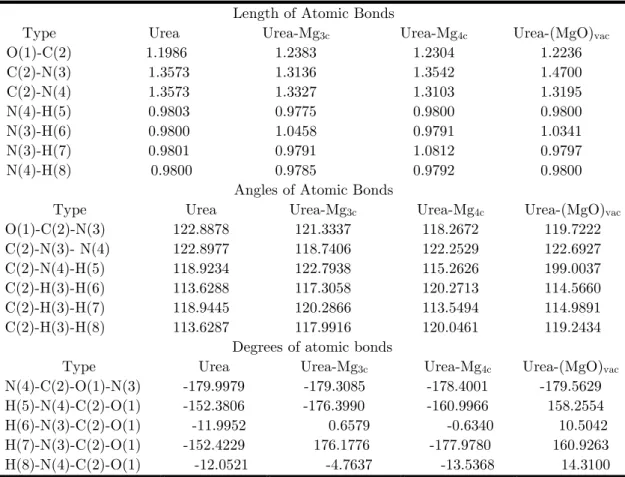
Table 2 Geometric Properties, Length (Å), Angle (o) and Dihedral (o) of atomic bonds of isolated and adsorbed urea molecule in Mg3c, Mg4c and (MgO)vac of the Mg9O9 adsorption sites.
Length of Atomic Bonds
Type Urea Urea-Mg3c Urea-Mg4c Urea-(MgO)vac
O(1)-C(2) 1.1986 1.2383 1.2304 1.2236
C(2)-N(3) 1.3573 1.3136 1.3542 1.4700
C(2)-N(4) 1.3573 1.3327 1.3103 1.3195
N(4)-H(5) 0.9803 0.9775 0.9800 0.9800
N(3)-H(6) 0.9800 1.0458 0.9791 1.0341
N(3)-H(7) 0.9801 0.9791 1.0812 0.9797
N(4)-H(8) 0.9800 0.9785 0.9792 0.9800
Angles of Atomic Bonds
Type Urea Urea-Mg3c Urea-Mg4c Urea-(MgO)vac
O(1)-C(2)-N(3) 122.8878 121.3337 118.2672 119.7222
C(2)-N(3)- N(4) 122.8977 118.7406 122.2529 122.6927
C(2)-N(4)-H(5) 118.9234 122.7938 115.2626 199.0037
C(2)-H(3)-H(6) 113.6288 117.3058 120.2713 114.5660
C(2)-H(3)-H(7) 118.9445 120.2866 113.5494 114.9891
C(2)-H(3)-H(8) 113.6287 117.9916 120.0461 119.2434
Degrees of atomic bonds
Type Urea Urea-Mg3c Urea-Mg4c Urea-(MgO)vac
N(4)-C(2)-O(1)-N(3) -179.9979 -179.3085 -178.4001 -179.5629
H(5)-N(4)-C(2)-O(1) -152.3806 -176.3990 -160.9966 158.2554
H(6)-N(3)-C(2)-O(1) -11.9952 0.6579 -0.6340 10.5042
H(7)-N(3)-C(2)-O(1) -152.4229 176.1776 -177.9780 160.9263
H(8)-N(4)-C(2)-O(1) -12.0521 -4.7637 -13.5368 14.3100 Urea means isolated urea molecule. Urea-(Mg3c) means urea adsorbed on the coordination site three
of MgO. Urea-Mg4c means urea adsorbed on the coordination site four of MgO. Urea-(MgO)vac means
urea adsorbed on surface on the coordination site five of MgO vacant.
the model of the systems studied. Table 3 shows that in all three methods, Mulliken, Merz-Kolman and Natural Bond Order, there was no significant variation in the total charge of the Urea molecule in the MgO adsorption sites, but small variations in the second decimal place of the total charge values of the molecule of Urea.
Table 3 Atomic charges of Mulliken, Merz-Kolman (MK) and Natural Bond Order (NBO) of the urea molecule isolated and adsorbed on the respective Mg9O9 adsorption sites.
Urea Molecule Urea at the corner of MgO
Mulliken MK NBO Mulliken MK NBO
O -0.5113 -0.6248 -0.6893 -0.7026 -0.7125 -0.8041
C 0.7469 0.9436 0.8462 0.9048 0.9242 0.8328
N 0.2106 -0.9478 -0.8760 -0.6988 -0.9978 -0.8636
N 0.2100 -0.9468 -0.8761 -0.6569 -0.8744 -0.8446
H -0.1974 0.3933 0.3891 0.2745 0.3941 0.4094
H -0.1308 0.3963 0.4086 0.4179 0.5344 0.4481
H -0.1975 0.3920 0.3891 0.2514 0.4015 0.3956
H -0.1305 0.3140 0.4085 0.3020 0.3997 0.4298
Urea on the edge of MgO Urea on the vacant MgO
Mulliken MK NBO Mulliken MK NBO
O -0.6463 -0.6458 -0.7604 -0.5990 -0.8551 -0.7223
C 0.8278 0.9165 0.8222 0.8070 1.1485 0.8473
N -0.6545 -0.9123 -0.8711 -0.6831 -1.0920 -0.9166
N -0.6941 -1.0577 -0.8782 -0.6571 -1.3403 -0.8523
H 0.2865 0.3802 0.4166 0.2539 0.5010 0.3965
H 0.2286 0.3979 0.3828 0.4376 0.8141 0.4679
H 0.4401 0.6295 0.4751 0.2687 0.4233 0.4032
H 0.2539 0.3766 0.3931 0.2567 0.4215 0.3939
Figure 2-A Figure 2-B Figure 2-C
As we are dealing with occupation numbers in each atom, these indexes are very sensitive to changes in the sets of bases and in the population analysis paradigm. It is important that you never take these numbers as absolute, just as comparative parameters within the same system. It is also very appropriate for calculations to be made using more than one method and one level of theory to further confirm or even ignore the observed trends, for example, natural population analysis is much more robust than the Mulliken method.
Table 4 Values of the Fukui function considering the Mulliken charges calculated with equations (1-3),
Urea Molecule Mg3c-urea Mg4c-urea Mgvac-urea
1 O 0.063 0.364 0.214 0.006 -0.002 0.002 -0.005 -0.021 -0.013 0.009 0.000 0.004 2 C 0.079 0.086 0.083 0.010 0.005 0.008 0.004 0.007 0.006 0.006 0.012 0.009 3 N -0.207 0.119 -0.044 -0.019 -0.007 -0.013 0.547 -0.530 0.009 0.008 0.012 0.010 4 N -0.215 0.119 -0.048 0.008 0.011 0.010 0.661 -0.667 -0.003 0.001 0.004 0.003 5 H 0.381 0.084 0.233 0.009 0.013 0.011 0.793 -0.779 0.007 0.023 0.021 0.022 6 H 0.267 0.072 0.170 -0.019 -0.004 -0.012 0.780 -0.744 0.017 -0.002 -0.011 -0.006 7 H 0.359 0.084 0.222 0.005 0.015 0.010 0.624 -0.623 0.001 0.015 0.017 0.016 8 H 0.275 0.072 0.174 0.014 0.011 0.012 0.707 -0.679 0.014 0.021 0.019 0.020
Orbital analysis of natural bonding provides an efficient method for studying intra and inter-molecular bonds and interactions between bonds and also provides a convenient basis for investigating charge transfer or conjugative interaction in molecular systems. Some orbitals from donors electrons, acceptor orbitals and interacting stabilization energy resulting from the second order micro-disturbance theory [66], For each donor (i) and acceptor (j), the stabilization energy E(2) associated with relocation i, j estimated as:
=
where qi is the donor orbital occupancy, Ei and Ej are diagonal elements and F(i,j) is the off-diagonal NBO Fock matrix elements. The higher the value of E(2), the more intense is the interaction between electron donors and electron acceptors.
In Table 5 (values for the isolated urea molecule), the expressive values of E(2), presented in the third column of the table, are those referring to
and in which, for both,
E(2)=25,14kcal/mol, deserve our special attention by comparison with the other values. The stabilization values originate from the reason that the energy gap
Table 5 NBO Analysis of Hyperconjugative Interaction in Isolated Urea Molecule
(a) (b) (c)
→ 0.89 1.48 0.033
→ 0.89 1.48 0.033
→ 1.28 1.53 0.040
→ 1.27 1.53 0.039
→ 2.28 0.36 0.028
→ 0.55 0.83 0.019
→ 0.56 0.83 0.019
→ 0.64 1.43 0.027
→ 0.64 1.43 0.027
→ 2.12 1.32 0.047
→ 4.75 1.09 0.065
→ 4.31 1.29 0.067
→ 0.75 0.68 0.022
→ 4.30 1.29 0.067
→ 0.77 0.68 0.022
→ 4.75 1.09 0.065
→ 2.17 1.09 0.044
→ 2.17 1.09 0.044
→ 25.14 0.66 0.117
→ 25.14 0.66 0.117
(a)E(2) is the energy of hyper conjugative interaction, stabilization energies; (b)Is the energy difference between donor and acceptor i and j NBO orbitals; (c)F(i,j) is the Fock matrix element between i and j NBO orbitals,
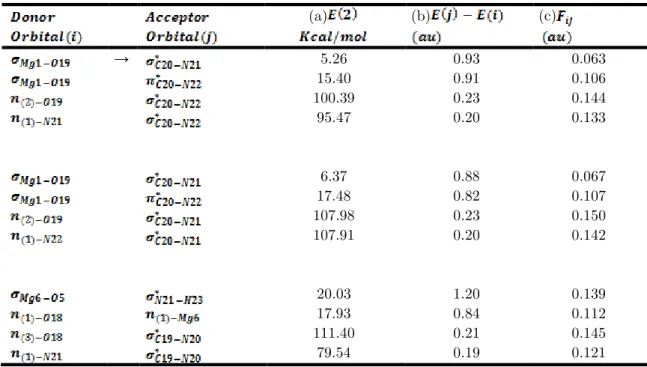
In Table 6 (values for the urea molecule adsorbed on the respective MgO
adsorption sites). In Mg3c-Urea system we get that
[E(2)=100.39kcal/mol, ΔEij=0.23au, Fij=0,144au] and
[E(2)=95.47kcal/mol), ΔEij=0.20au, Fij=0.133au], are the two of expressive values Donor→ Acceptor orbitals for stabilization energy E(2). There is, in Mg3c -Urea, the presence of n(1) differently from the isolated urea molecule. The trend of Mg3c-Urea continues towards Mg4c-Urea but in Mgvac-Urea there is the presence of
Table 6 NBO Analysis of Hyperconjugative Interaction in Mg3c-urea, Mg4c-urea and Mgvac -urea.
(a) (b) (c)
→ 5.26 0.93 0.063
15.40 0.91 0.106
100.39 0.23 0.144
95.47 0.20 0.133
6.37 0.88 0.067
17.48 0.82 0.107
107.98 0.23 0.150
107.91 0.20 0.142
20.03 1.20 0.139
17.93 0.84 0.112
111.40 0.21 0.145
79.54 0.19 0.121
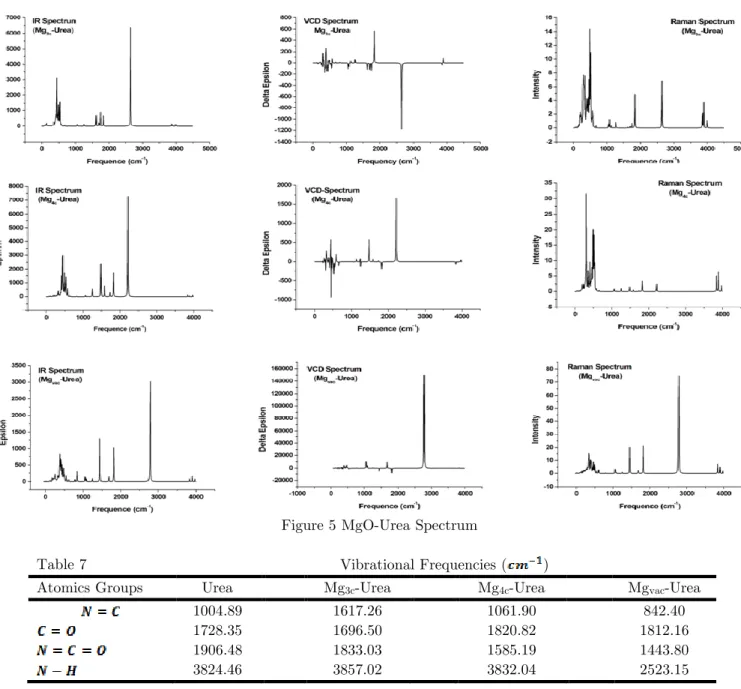
Figure 3 – Core MgO Spectrum
Figure 5 MgO-Urea Spectrum
Table 7 Vibrational Frequencies ( )
Atomics Groups Urea Mg3c-Urea Mg4c-Urea Mgvac-Urea
1004.89 1617.26 1061.90 842.40
1728.35 1696.50 1820.82 1812.16
1906.48 1833.03 1585.19 1443.80
3824.46 3857.02 3832.04 2523.15
In the adsorption systems MgO-urea we see that the cluster vibrates, without the urea molecule vibrating, in the frequency ranges: (1) Mg3c-urea [222.22-531.37]cm-1(2) Mg4c-urea [165.2—512.01]cm-1e (3) Mgvac-urea [16.47 -443.70]cm-1. We see that even under very little connection energy the specta undergoes expressive changes in the vibrational modes of the systems.
Conclusions
contained in the studied systems, since despite the small binding energy of the urea molecule with the cluster of MgO its geometric properties, reactivities etc, are changed considerably, The density functional theory has given us a chance to investigate global and local reactivity properties through Fukui functions, electron transfer transfers, and bonding energies that allow deeper and more accurate analysis of complex interacting systems. The studies and results obtained here show that the interaction of the urea molecule with the MgO cluster promotes charge variations and reactivities directly related to the new electronic configurations of the atoms of the urea molecule without electronic exchanges of the urea molecule with the Mg9O9 cluster.
Acknowledgments:
The authors thank to Universidade do Estado da Bahia (UNEB), Universidade de Brasília (UnB), Fundação de Amparo à Pesquisa do Estado Bahia (FAPESB), Fundação de Apoio à Pesquisa do Distrito Federal (FAPDF), Conselho Nacional de Desenvolvimento Científico e Tecnológico (CNPq), Fundação de Empreendimentos Científicos e Tecnológicos (FINATEC) and Coordenação de Aperfeiçoamento de Pessoal de Nível Superior (CAPES).
References:
[1] Kumar R, SharmaA, Kishore N (2013) Preparation and Characterization of MgO Nanoparticles by Co-Precipitation Method, Int J Eng Appl and Management Sci Paradigms 07: 66-70,
[2] Kaviyarasu K, Devarajan PA (2011) A versatile route to synthesize MgO nanocrystals by combustion technique, Der Pharma Chemica 3: 248-254,
[3] Eckert CA, Irwln RB, Graves CW (1984) Liquid Metal Solvent Selection: The MgO Reduction Reaction, Industrial & Engineering Chemistry Process Design and Development23: 210-217, [4] Ashok CH, Rao VK, Chakra S CH (2014) Structural Analysis of CuO Nanomaterials Prepared by
Novel Microwave Assisted Method, J Atoms and Molecules 4: 803-806,
[5] F, Gu, S, F,Wang, M, K, L¨u et al,, “Combustion synthesis and luminescence properties of Dy3+ -doped MgO nanocrystals,” Journal of Crystal Growth, vol, 260, no, 3-4, pp, 507–510, 2004, [6] V, R, Orante-Barrn, L, C, Oliveira, J, B, Kelly et al,, “Luminescence properties of MgO produced
by solution combustion synthesis and doped with lanthanides and Li,” Journal of Luminescence, vol, 131, no, 5, pp, 1058–1065, 2011,
[7] T, Mathews, R, Subasri, and O, M, Sreedharan, “A rapid combustion synthesis of MgO stabilized Sr- and Ba-𝛽-alumina and their microwave sintering,” Solid State Ionics, vol, 148, no, 1-2, pp, 135–143, 2002,
[8] N, C, S, Selvam, R, T, Kumar, L, J, Kennedy, and J, J, Vijaya, “Comparative study of microwave
and conventional methods for the preparation and optical properties of novel MgO-micro and nano-structures,” Journal of Alloys and Compounds, vol, 509, no, 41, pp, 9809–9815, 2011,
[9] L,C,Oliveira, E, D,Milliken, andE,G,Yukihara, “Development and characterization of MgO:Nd,Li
synthesized by solution combustion synthesis for 2D optically stimulated luminescence
dosimetry,” Journal of Luminescence, vol, 133, pp, 211–216, 2013,
[10] Nitrogen Fertilizer Management In Good Economic Times and Bad; Dept, of Agronomy Publication AGRY-01-01 (Ver, 2003),
[11] Wiitala, K, W,; Hoye, T, R,; Cramer, C, J, J, Chem, Theory, Comput,2006, 2, 1085, [12] Becke, A, D, Phys, ReV, A 1988, 38, 3098,
[13] Lee, C,; Yang, W,; Parr, R, G, Phys, ReV, B 1988, 37, 785,
J,; Stefanov, B, B,; Liu, G,; Liashenko, A,; Piskorz, P,; Komaromi, I,; Gomperts, R,; Martin, R, L,; Fox, D, J,; Keith, T,; Al-Laham, M, A,; Peng, C, Y,; Nanayakkara, A,; Challacombe, M,; Gill, P, M, W,; Johnson, B,; Chen, W,; Wong, M, W,; Andres, J, L,; Gonzalez, C,; Head-Gordon, M,; Replogle, E, S,; Pople, J, A, Gaussian 01, Development Version (Revision B,01); Gaussian, Inc,: Pittsburgh, PA, 2001,
[15] L, Padmaja, C, Ravikumar, D, Sajan, I, Hubert Joe, V,S, Jayakumar, G,R, Pettit, O,F, Nielsen, J, Raman Spectrosc,, 40 (2009) 419,
[16] C, Ravikumar, I, Hubbert Joe, V,S, Jayakumar, Chem, Phys, Lett,, 460 (2008) 552, [17] R, G, Parr and R, G, Pearson, J, Am, Chem,, 105 (1983) 7512,
[18] T, Koopmons, Physica,1 (1933) 104,
[19] Iczkowski, R, P,; Margrave, J, L, J, Am, Chem, Soc, 1961, 83, 3547, [20] R, G, Parr, L, von Szentpaly and S, Liu, J, Am, Chem, Soc,, 1999, 121, 1922–