77
PERFORMANCE ANALYSIS OF Z-SOURCE INVERTER FED
INDUCTION MOTOR DRIVE USING FUZZY LOGIC CONTROLLER
C.Pitchai (Assistant Professor) P.A.Prassath (Assistant Professor) Department of Electrical & Electronics Engineering Department of Electrical & Electronics Engineering A.S.L.Pauls College of Engineering and Technology A.S.L.Pauls College of Engineering and Technology Coimbatore, India Coimbatore, India
[email protected] [email protected]
ABSTRACT
This paper presents z-source inverter fed induction motor drive using fuzzy logic controller. The Z-source inverter is a recently invented a new power conversion concept mainly developed for fuel cell vehicular applications.
The Z source inverter system can boost the given input voltage by controlling the boost factor, to obtain the maximum voltage. PWM technique which is used as to given the gating pulse to the inverter switches. The four-switch inverter, having a lower number of insulated gate bipolar transistors (IGBTs), has been studied for the possibility of reducing the inverter cost.These inverters use a unique impedance network coupled between the power source and inverter circuit, to provide both voltage buck and boost properties, which cannot be achieved with conventional voltage source and current source inverters. It has single stage power conversion, high performance, minimal component count, increased efficiency, improved power factor and reduced cost. The obtained AC voltage must be pure sinusoidal but it can’t obtained because the harmonic content are highly present. Higher order harmonics are eliminated by with the help of filters. Here impedance network act as a filter to reduce the lower order harmonics. This paper describes the design of Fuzzy logic controller for Z-source inverter.
1.INTRODUCTION
Inverters are the dc to ac converters. The input dc supply is either in the form of voltage or current is converted in to variable output ac voltage. The output ac voltage can be controlled by varying input dc supply or by varying the gain of the inverter. In the late nineties, Fang Zheng Peng popularized the concept of the Z-Source Converters, which employ a unique impedance network (or circuit) to couple the Converter with the main circuit and then fed to the power source. They provide unique features that cannot be obtained in the traditional voltage-source and current-source converters which use capacitor and inductor, respectively. The conceptual and theoretical barriers and limitations of the traditional voltage-source converter and current-source converter are overcome by the Z-source converter providing a novel power conversion concept that can be applied to all dc-to-ac, ac to-dc, ac-to-ac, and dc-to-dc power conversion.
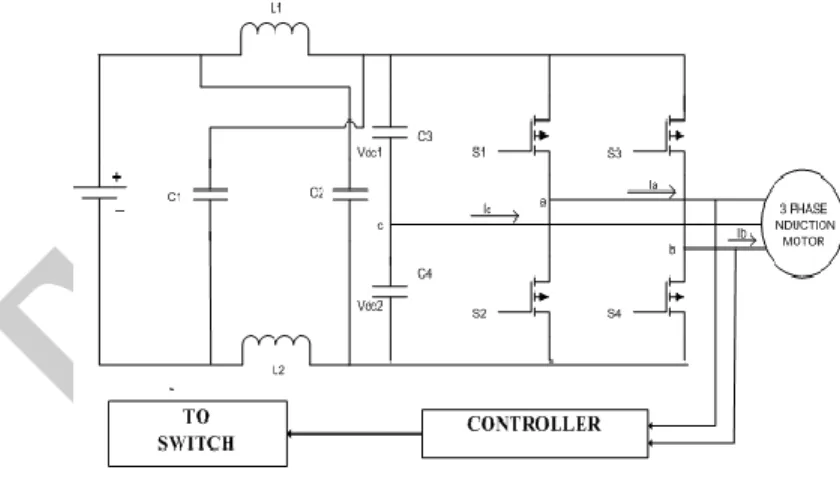
Fig. 1 Proposed Block Diagram
78 compared to the six-switch inverter.Fig.1 shows the proposed block diagram. Specifically, the peak phase voltage of the four-switch inverter is , while that of six-switch inverters is . On the other hand, capacitor center tap voltage is fluctuating, and it destroys the balance among the motor phase currents. The reason for this is that current flow through a capacitor either increases or decreases the voltage steadily for each half cycle. Therefore, the voltage fluctuation increases as the load torque becomes higher or the frequency becomes lower. The unbalanced motor current leads to an inverter failure and torque pulsation.
2
.
INVERTER
An inverter is an electric device that converts DC to AC, the converted AC can be at any required voltage and frequency with the use of switching device and control circuits. Solid state inverters have no moving parts and are used in a wide range and application, from small switching power supplies in computers, to large electric utility high voltage dc applications that transport bulk power. Inverters are commonly used to supply AC power from DC sources such as solar panel or batteries. Inverters are used in various applications such as induction motor drives, UPS, standby power supplies, induction heating etc. Normally they are used for high power applications.
A) Principle
The output voltage waveform of the inverter can be square wave, quasi-square wave or low distorted sine wave. The output voltage can be controlled (i.e. adjustable) with the help of drives of the switches.
The pulse width modulation (PWM) techniques are most commonly used to control the output voltage of inverters. Such inverters are called PWM inverters. The output voltage of the inverter contains harmonics whenever it is non-sinusoidal. These harmonics can be reduced by using proper control schemes.
The inverters can be classified as voltage source inverters or current source inverters. When input DC voltage remains constant, then it is called Voltage Source Inverter (VSI) or Voltage Fed Inverter (VFI).
When input current is maintained constant, then it is called Current Source Inverter (CSI) or Current Fed Inverter (CFI). Sometimes, the DC input voltage to the inverter is controlled to adjust the output. Such inverters are called variable DC link inverters.
B) Z Source Inverters
Z source inverter operated with the combination of VSI(Voltage Source Inverter) and the CSI(Current Source Inverter). Normally the traditional inverters convert the DC voltage in to AC voltage.
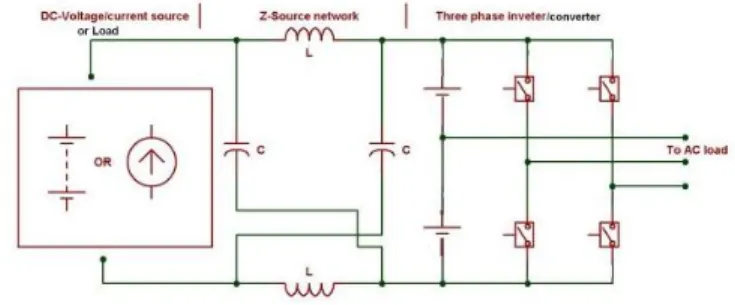
Fig 2.Basic circuit of Z source inverter
79 non shoot through switching state is possible. This shoot-through zero state provides the unique buck-boost feature to the inverter.
C) Inductor selection
During traditional operation mode, when there is no shoot-through, the capacitor voltage is always equal to the input voltage; therefore, there is no voltage across the inductor and only a pure dc current going through the inductors. The purpose of the inductor is to limit the current ripple through the devices during boost mode with shoot-through. The average current through the inductor is
I
L=P/V
inDuring shoot-though, the inductor current increases linearly, and the voltage across the inductor is equal to the voltage across the capacitor; during non-shoot-through modes (six active modes and the two traditional zero modes), the inductor current decreases linearly and the voltage across the inductor is the difference between the input voltage and the capacitor voltage.
L
1=L
2=f
swV
c/∆I
l D) Capacitor SelectionThe purpose of the capacitor is to absorb the current ripple and maintain a fairly constant voltage so as to keep the output voltage sinusoidal. During shoot-through, the capacitor charges the inductors, and the current through the capacitor equals the current through the inductor. Therefore, the voltage ripple across the capacitor can be roughly calculated by
C
1=C
2=I
avF
sw/∆V
l3. Z-SOURCE INVERTER
The new impedance-source power inverter has been recently invented, eliminates all problems of the traditional V-source and I-source inverters. It is being used in ac/dc power conversion applications. Fig.3 shows the general Z-source converter structure. The power source can be either voltage source or current source.
Fig. 3 Z-Source inverter structure
The Z-source inverter consists of a unique impedance network which couple the converter main circuit to the power source, load, or other converter, for providing unique features that cannot be observed in the traditional VSI and CSI inverters. The impedance network consists of two inductors and two capacitors connected to each other as shown in the figure forms the second order filter network. The values of both inductor and both capacitor are equal. The two inductors can be two separate inductors or two inductors inductively coupled to each other on a single core. For size and cost reduction film capacitors of desired value and voltage rating can be selected.
4. PWM TECHNIQUE
80 high performance (diagonal capacitor voltage), controllable range of ac output voltage, voltage stress across the switching devices and harmonic profile of the ac output parameters are purely based [9].
4.1Types Of PWM Techniques
There are number of control methods have been presented in recent years that include sinusoidal pulse that include
1. Sinusoidal Pulse Width Modulation Techniques 2. Modified Space Vector Modulation Techniques. The various PWM control algorithms are
1. Simple Boost Control (SBC) 2. Maximum Boost Control (MBC)
3. Maximum Constant Boost Control (MCBC) 4. Traditional Space Vector Modulation (TSVPWM)
5. Modified Space Vector Modulation (MSVPWM)[16]
A Z-source inverter is proposed, which can operate at wide range load (even no-load) with small inductor, eliminating the possibility of the dc-link voltage drops, and simplifying the inductor and controller design. The Z-source inverter is a buck–boost inverter that has a wide range of obtainable voltage. The traditional V- and I-source inverters cannot provide such feature. This shoot-through zero state is forbidden in the traditional V-source inverter, because it would cause a shoot through. The shoot-through zero state, which can be generated by seven different ways: shoot-through via any one phase leg, combinations of any two phase legs, and all three phase legs. The Z-source network makes the shoot-through zero state and non shoot shoot-through switching state is possible. This shoot-through zero state provides the unique buck-boost feature to the inverter.
5. FUZZY LOGIC CONTROLLER
The Fuzzy Logic Controller (FLC) requires that each control variables which define the control surface be expressed in fuzzy set notations using linguistic labels. The Fuzzy logic controller is appropriate for nonlinear control because it does not use complex mathematical equation. Fuzzy controller is a non-linear controller that does not require a precise mathematical model for its
design [12]. In essence, fuzzy controller is a linguistic-based controller that tries to emulate the way a human thinks in solving a particular problem. The basic fuzzy logic control system is composed of a set of input membership functions, a rule-based controller, and a defuzzification process.
The fuzzy logic input uses member functions to determine the fuzzy value of the input. There can be any number of inputs to a fuzzy system and each one of these inputs can have several membership functions. The set of membership functions for each input can be manipulated to add weight to different inputs. The output also has a set of membership functions. These membership functions define the possible responses and outputs of the system [15]. The fuzzy inference engine is the heart of the fuzzy logic control system. It is a rule based controller that uses If-Then statements to relate the input to the desired output [13].
The fuzzy inputs are combined based on these rules and the degree of membership in each function set. The output membership functions are then manipulated based on the controller for each rule. All of the output member functions are then combined into one aggregate topology. The defuzzification process then chooses the desired finite output from this aggregate fuzzy set. There are several ways to do this such as weighted averages, centroids, or bisectors. This produces the desired result for the output. FLC is the combination of various different processes which are shown above in the Fig.4.It means a fuzzy logic controller comprises of numbers of methods [14] which are described below in stepwise form. Here the processes are explained in general format as explained above are described in detail below:
81 A. Fuzzification
Fuzzy logic uses linguistic variables instead of numerical variables. In a control system, error between reference signal and output signal can be assigned as (for example) Negative Big (NB), Negative Medium (NM), Negative Small (NS), Zero (ZE), Positive small (PS), Positive Medium (PM), Positive Big (PB). The triangular membership function is used for fuzzifications. The process of fuzzification converts numerical variable (real number) to a linguistic variable (fuzzy number).
B. Rule Elevator
Conventional controllers like PI and PID have control gains which are numerical values. Fuzzy logic controller uses linguistic variables instead of the numerical values. The linguistic variables of error signal taken as input (en) and output is represented as in the form of degree of membership functions.
C. Defuzzification
The rules of fuzzy logic generate demanded output in a linguistic variable, according to real world requirements. Linguistic variables have to be transformed to crisp output. The choices available for defuzzification are numerous. So far the choice of strategy is a compromise between accuracy and computational intensity.
6. SIMULATION RESULTS
Simulation is performed using
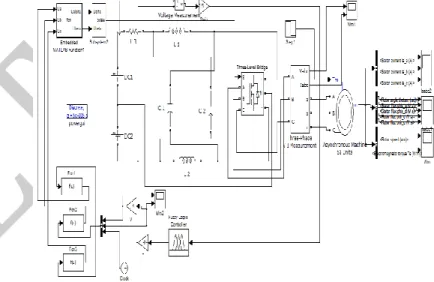
MATLAB/SIMULINK software. Simulink library files include inbuilt models of many electrical and electronics components and devices such as diodes, MOSFETS, capacitors, inductors, motors, power supplies and so on. The circuit components are connected as per design without error, parameters of all components are configured as per requirement and simulation is performed. Maximum constant boost control with third harmonic injection method is used for PWM generation and simulation. The complete simulation diagram is shown in the figure 5. The component values of Z-source inverter depends on switching frequency only. These component values are chosen as per design guidelines in [1] and [3]. For this circuit L1 = L2 = 4mH and C1 = C2
= 1000uF. The purpose of the system is to produce 230Vrms line to line voltage. For PWM generation the carrier frequency is set to 10 KHz and modulating reference signal frequency is set to 50Hz. The modulation index is 0.8 and the input DC voltage is 188V. Maximum constant boost PWM with third harmonic injection is generated using PWM generator and logic circuit. The PWM generator block generates normal three phase PWM waveforms for a given carrier frequency.
Using triangular function, comparator and adder repeated shoot-through pulses are generated. These shoot-through pulses are evenly spread in all the three phase PWM waveform using OR logic function. The detailed analysis is given below.
Fig. 5 Simulation configuration
The shoot-through duty ratio can be is calculated as T0/T = 0.308.
The boost factor = B = 2.593
Average dc link voltage = Vdcl = 337V
Peak dc link voltage = Vdcl = 2.593 * 188 = 487V Peak ac output voltage = Vacp = 0.8*2.593*188/2 = 194.5V
RMS ac output voltage Vac = 137.5V
82 Gain of inverter = G = 2.075
The voltage gain of inverter obtained in above analysis is 2.075. As we increase the shoot-through time interval (T0), the boost factor will increase and this will increase the inverter voltage gain. Thus inverter boost factor and voltage gain are depends on the shoot-through time. The simulation results with the same input voltage and carrier frequency are shown in following Figures, which agrees well with the analysis and theoretical results. For a traditional inverter, to obtain the output voltage of 230Vrms with modulation index of 0.8, 486V dc voltage is required this is undesirable since it will require additional voltage booster circuit. Figure 10 shows input dc voltage applied to Z-source inverter is 188V.
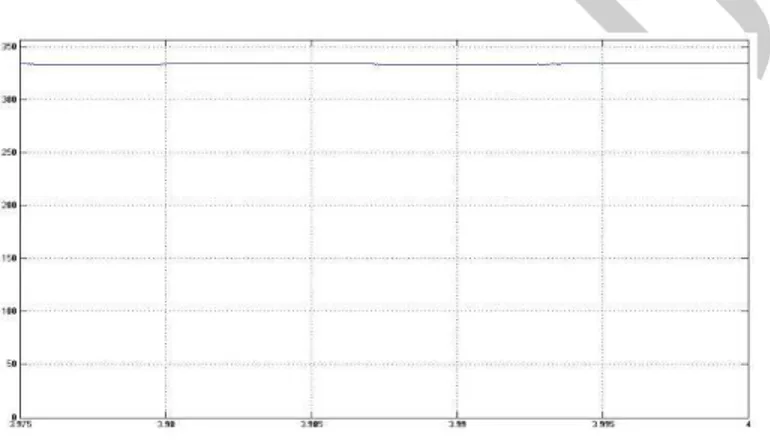
The capacitor voltage is the average dc link voltage remains almost constant about 337V as shown in figure 8. Thus the input voltage (188V) is boosted (337V) and applied as dc link voltage. The peak value of this dc link voltage appears as input voltage across the main inverter circuit. The output dc link voltage across Inverter Bridge appears as shown in the figure 9. The peak dc link voltage remains almost constant about 480V. It is observed that during shoot-through state dc link voltage becomes zero since all devices in main inverter are switched on simultaneously, short circuiting the dc link.
Fig. 6 Input DC voltage = 188V
Fig. 7 Capacitor voltage = 337V
Fig.8. Peak dc Link voltage across inverter Bridge = 480V
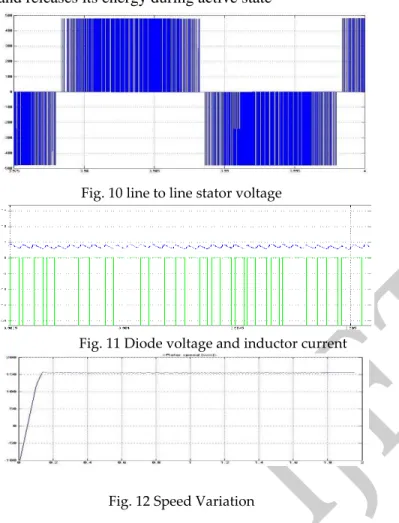
Three phase stator current waveforms and stator voltage for a given load condition is shown in the figure 9 and 10 respectively. Stator current waveforms are observed to be very smooth sinusoidal waveform as compared to the traditional PWM inverter.
Fig. 9 Three phase stator current
83 all the six switches are turned on, blocking the reverse flow of current. Also, we can see that during the shoot-through period, the capacitor voltage becomes equal to the inductor voltage. The capacitor charges the inductor so that the inductor current increases during this time and releases its energy during active state
Fig. 10 line to line stator voltage
Fig. 11 Diode voltage and inductor current
Fig. 12 Speed Variation
This is the basic property of the Z-source inverter. Due to this operational behavior, z-source inverter can boost the output voltage to any value greater than input voltage. The simulation result for speed variation of the induction motor is shown in the following figure 12. Initially speed of induction motor increase linearly where at that time the motor fetches more current so as to maintain the torque. Under steady state condition the maximum speed of induction motor is observed to be about 157rad/s. In terms of rpm the maximum speed is 1500rpm
7. CONCLUSION
The Z-source converter overcomes the conceptual and theoretical barriers and limitations of the traditional
voltage-source converter and current-source converter and provides an advanced power conversion concept. The Z-source inverter system can produce an output voltage greater than the dc input voltage by controlling the shoot-through duty ratio, which is impossible for the traditional ASD systems. In this work, described the operating principle, analyzed the circuit characteristics, and demonstrated its concept and superiority. Different PWM techniques and their comparison are presented. Maximum constant boost control method is more advantageous PWM control method among the other PWM control methods. Maximum constant boost with third harmonic injection PWM control method increases output voltage boost while minimizing voltage stresses across switching devices. It allows over-modulation where modulation index can be varied from 0.57 to 1.154. Z-Source inverter fed IM drive system is simulated using Simulink software using above described PWM method.
In future Performance Analysis of Z-Source fed induction motor using Nero Fuzzy, genetic algorithm, Renewable energy etc..,
8. REFERENCES
[1] Fang Zheng Peng, “Z- Source Inverter”, IEEE Transaction on Industry Applications. 39: 2003,2. Wuhan,China.
[2] Miaosen Shen, Jin Wang, Alan Joseph, Fang Zheng Peng, Leon M. Tolbert, and Donald J. adams, “Constant Boost Control of the Z-Source Inverter to Minimize Current Ripple and Voltage Stress”, IEEE Transactions on industry application vol. 42, no. 3, May/June 2006
[3] S. Rajakaruna, Member, IEEE and Y. R. L. Jayawickrama, “Designing Impedance Network of Z-Source Inverters” IEEE Transactions on industry application.
[4] G. Pandian and S. Rama Reddy, “Embedded Controlled Z Source Inverter Fed Induction Motor Drive” IEEE transaction on industrial application, vol.32, no.2, May/June 2010.
[5] K. Srinivasan and Dr. S. S. Das, “Performance Analysis of a Reduced Switch Z-Source Inverter fed IM Drives”, Journal of Power Electronics, Vol. 12, No. 2, May/June 2010
84 for Different ZSource Inverter Topologies” IEEE Transactions on industry application, May/June 2010 [7] K.Niraimathy, S.Krithiga, “A New Adjustable-Speed
Drives (ASD) System Based On High-Performance Z-Source Inverter”, 978-1-61284-379-7/11 2011 IEEE, 2011 1st International Conference on Electrical Energy Systems [8] Muhammad H. Rashid, “Power Electronics”, Second
Edition, Pearson Education.
[9] Sivaraman.P, A. Nirmalkumar, “Analysis of T-Source Inverter with Various PWM Schemes” in European
Journal of Scientific Research, Vol.71 No.2 , pp.
203-213,2012
[10] Omar Ellabban, Joeri Van Mierlo, and Philippe Lataire ,”Experimental Study of the Shoot-Through Boost Control Methods for the Z-Source nverter” in The department of Electrical Engineering and Energy Technology (ETEC), Vrije Universiteit Brussel (VUB), 1050 Brussels, Belgium [11]Sivaraman.P, A. Nirmalkumar, “ Modelling and
Simulation of Photovoltaic Array fed T-Source Inverter”
in International Conference on Sustainable Energy and
Intelligent System ,2011
[12]Wing-Chi So, Chi K. Tse, and Yim-Shu Lee, “Development of a Fuzzy Logic Controller for DC/DC Converters: Design, Computer Simulation, and Experimental Evaluation,” IEEE Trans. Power. Electron., vol. 11, NO. 1, pp. 24-32, 1996.
[13]Chuen Chien Lee, “Fuzzy Logic in Control Systems: Fuzzy Logic Controller-Part I” , IEEE transactions on Systems, Man and Cybernetics, Vol 20 ,No. 2,March/April 1990.
[14]Juhng-Perng Su, “A generic stable two-input single-output fuzzy control scheme for nonlinear systems”, Industrial Electronics and Applications, 2009. ICIEA 2009. 4th IEEE Conference May 2009.