A REVIEW OF RECENT PROGRESS ON NANO/MICRO SCALE
NUCLEATE BOILING FUNDAMENTALS
J.N. Chung
a,†a
Department of Mechanical and Aerospace Engineering, University of Florida, Gainesville, FL, 32611,USA
, Tailian Chen
b, Shalabh C. Maroo
cb
Department of Mechanical Engineering, Gonzaga University, Spokane, WA, 99258, USA
c
Department of Mechanical Engineering, Massachusetts Institute of Technology, Cambridge, MA, 02139, USA
ABSTRACT
Recent research progress in the area of nano/micro scale nucleate boiling is reviewed and an up-to-date summary is provided with a focus on the advances of fundamental boiling physics. This review examines nano/micro scale pool boiling experimental and theoretical/numerical work reported in the open literature. On the experimental side, the topics covered are moving contact line, critical heat flux, boiling curve, nucleation, single bubble boiling cycle, bubble coalescence boiling cycle, heater size effect, nanofluid, and nanoscale-structured heater surface. For the theoretical/numerical work, continuum mechanics modeling of the micro-region and molecular dynamics modeling of the nano-region are included.
Keywords: Nucleate boiling, nano/micro scale, critical heat flux, moving contact line, bubble coalescence
†
Corresponding author, Email : [email protected]
1. INTRODUCTION
Nucleate boiling has been recognized as one of the most efficient heat transfer mechanisms. In many engineering applications that require super-high heat transfer rates, nucleate boiling heat transfer is the mode of choice. Boiling heat transfer holds the potential advantage of facilitating the transfer of a large amount of energy over a relatively narrow temperature range with a small weight to power ratio.
For a secure energy future the energy conversion efficiency must be advanced. All types of advanced power devices and high-tech electronic systems ranging from heavy-vehicle engines, computer chips and advanced nuclear reactors depend on efficient thermal energy transport mechanisms to acquire heat input and to reject waste heat for the purpose of achieving higher power density and higher system efficiency. Higher cooling rates can increase energy conversion system efficiency, enable higher power density and also elevate system functionality (for example, higher throughput for rocket engines and higher power density for nuclear reactors). Furthermore, as advanced micro-mechanical, microelectronic, and photonic device technologies have led to ever smaller structures, heat dissipation has become an increasingly important problem that will limit the performance. In fact, due to the lack of a breakthrough in advanced cooling technology, the computer processor speed has reached its limit with conventional cooling and the future of tera-hertz computers is now in doubt.
Correspondingly, higher and higher system operating temperatures and power densities are becoming the goals of future energy systems. Accordingly, researchers are turning to untraditional and modern convective thermal energy transport mechanisms for solutions as the conventional convective heat transfer technologies have reached their limits. The fundamental research on nucleate boiling would unveil the
controlling boiling mechanisms such that the next breakthrough in cooling technology, for example using nano fluids and nano surface textures, can be realized. So, fundamental boiling research will directly benefit the high heat flux power and cooling industry, especially for the cooling of electronics and nuclear reactors, by providing new dimensions in modeling and simulation capabilities for engineering design and development.
Apart from the engineering importance, there are science issues. Even though the critical heat flux point is crucial to the safe operation of a boiling system, currently, a complete understanding of the physics on critical heat flux remains elusive. As a matter of fact controversies over the basic transport mechanisms of bubble coalescence and its effects on the roles of microlayer and macrolayer, liquid re-supply, and heater surface property continue to puzzle the research community. Boiling is also an extremely complex and illusive process. Although a very large number of investigators have worked on boiling heat transfer during the last half century, unfortunately for a variety of reasons, far fewer efforts have focused on the fundamental physics of boiling process. Most of the reported work have been tailored to meeting the needs of engineering applications and as a result have led to correlations involving several adjustable parameters and limited range of applications. The correlations provide quick input to design, performance and safety issues, hence they are attractive on a short term basis. However, the usefulness of the correlations diminishes very rapidly as parameters of interest start to lie outside the range for which the correlations were developed. With the advancement of nano/micro scale technologies and the availability of more powerful computers, researchers have been making both experimental findings and computational predictions that shed more lights towards unlocking the secrets of nucleate boiling and CHF. This paper is intended to provide a
Frontiers in Heat and Mass Transfer
review and summary on the recent progress in the fundamental understanding of nano/micro scale nucleate boiling phenomena.
2. BACKGROUND AND PHYSICS OF NUCLEATE BOILING
2.1 Basic Concepts
It has been widely accepted in the literature that the contact line at the base of the bubble in nucleate boiling can be divided into nano-, micro- and macro-regions. The micro region is the ultrathin liquid film between the solid surface and the evolving liquid-vapor interface. The macro region is the region occupied by vapor and liquid, except the microlayer. The micro-region can be subdivided into two additional regions. Thus the three regions, as shown in Fig. 1, are:
a) Non-evaporating thin-film region – liquid is adsorbed on the heater surface and forms a non-evaporating layer with molecular forces having controlling influence
b) Evaporating thin-film region – maximum evaporation and heat transfer occurs in this region and the liquid is fed from the bulk liquid through the intrinsic meniscus region
c) Intrinsic meniscus region – fluid mechanics in this region is governed by the conventional equation of capillarity
There is a region between the non-evaporating thin film region and the evaporation thin film region over which the film varies in thickness and curvature to accommodate the transition between the two regions. This is called the interline region and is the thinnest portion of the meniscus over which vaporization can occur. Since it is the thinnest, it is also the location where the evaporation rate is the highest.
Fig. 1 Schematic of bubble growth, (a) overall picture at macro-scale (shaded region depicts the area covered by non-evaporating thin film), and (b) zoomed in nano- and micro-scale regions at the three-phase contact line.
Boiling has been studied extensively during the last few decades which include experimental work, and theoretical models to predict the exact nature of boiling in various conditions. Since the boiling process is very complex, its complete understanding still poses significant challenges and researchers have not converged on a definite precise model. The past efforts can be categorized into three broad groups (Dhir 2006):
1) Empirical correlations – experimental data was obtained for boiling heat transfer as a function of several independent variable like heater size, heating method, heater thickness, system pressure, liquid temperature, flow conditions, etc. This
data was correlated by many researchers. Although the correlations have been helpful in application to practical situations, they serve their useful purpose only when applied in the range of the database used in developing the correlations. 2) Mechanism-based correlations – This involved studying some of
the individual subprocesses to develop mechanistic models for predicting heat fluxes as a function of wall superheat or other independent variables. An expression for partial nucleate boiling heat flux was written based on the contributions of three mechanisms by: transient conduction into the liquid during the waiting period over the region influenced by vapor bubbles, natural convection over the remaining regions of the heater and evaporative heat transfer from the microlayer underneath the bubble. The expression required the knowledge of three key parameters: number density of active sites, bubble diameter at departure and bubble release frequency. A number of attempts have been made to develop correlations or models for these parameters, but with limited success.
3) Numerical simulation – In order to have a credible predictive model of nucleate boiling, one must include all subprocesses which occur and not guess how one parameter influences the overall process. Thus, a complete numerical simulation of the process is asked for – a tool which has been developed only recently. The region of interest is divided into micro- and macro- regions as mentioned before. Lubrication theory has been widely used to solve for the radial variation of microlayer thickness, while complete conservation of mass, momentum and energy are solved for both phases in the macroregion.
2.2 Three-Phase Moving Contact Line
The moving contact line (MCL) is a three-phase phenomenon where immiscible vapor-liquid interface meets the solid surface. The dynamics and thermal transport along the contact line at the leading edge of the liquid film is of particular importance as it drives the entire boiling process. The physical understanding of these phenomena is crucial not just for boiling as they are present almost everywhere in nature and play a vital role in countless industrial and engineering processes such as thin film lubrication, coating of solids, tertiary oil recovery, soldering, spray droplet cooling, and evaporation and condensation in the form of a meniscus (heterogeneous boiling and condensation).
During nucleate boiling from a heated surface, vapor bubbles are nucleated and they start to grow owing to an infusion of vapor mass generated mainly from the MCL region. The MCL moves outward during bubble growth period while it retracts back during the bubble departure stage. At higher heat fluxes, bubble-bubble interaction and coalescence are the responsible mechanisms for achieving high heat transfer rates in heterogeneous nucleate boiling where MCL also plays an important role. Bubble-bubble coalescence creates strong disturbances to the fluid mechanics and heat transfer of the micro-layer and the MCL beneath the bubbles. Because of the complicated nature, the detailed physics and the effects of MCL on the single bubble dynamics and bubble-bubble interaction process have not been completely understood.
decades, it has been shown through molecular dynamic (MD) simulations that a near-complete slip indeed takes place at the MCL (Koplik et al. 1988, Thompson and Robbins 1989, and Thompson et al. 1993). This finding presented a challenge for the fluid mechanics community, due to a lack of viable solutions apart from ad hoc fixes that include analytical models (Phan et al. 2006, Qian et al. 2006, and Fuentes and Cerro 2007) and numerical models (Ding and Spelt 2007a,b). In the absence of a viable boundary condition which can re-produce the MD results, an accurate continuum description of the MCL flows at the micro- or nano-scale remains an elusive goal which may never be solved explicitly by continuum fluid mechanics.
2.3 Critical Heat Flux
The critical heat flux (CHF) on earth, which is the upper heat transfer limit in the nucleate boiling regime represents a state of momentum and mass balance. Because the buoyancy force strength is relatively constant on earth, for heat fluxes lower than the CHF, this force is more than that required for a complete removal of vapor bubbles formed on the heater surface. At the CHF, the buoyancy force is exactly equal to the force required for a total removal of the vapor bubbles. For heat fluxes greater than the CHF, the buoyancy force is unable to remove all the bubbles, thus resulting in the accumulation and merging of bubbles on the heater surface, which simultaneously leads to a total blanketing of the heater surface by a layer of superheated vapor. It is believed that bubble departure and vapor removal from the heater surface is dominated by vapor generation and bubble coalescence, both of which are hinged on the moving contact line dynamics, as a result, the MCL is closely related to the CHF. It is also the objective of many research efforts to find the relationship between the MCL dynamics of bubbles and the critical heat flux.
The boiling curve was first identified by Nukiyama (1934) more than sixty years ago. Since then the critical heat flux (CHF) has been the focus of boiling heat transfer research. A plethora of empirical correlations for the CHF are now available in the literature, although each is applicable to somewhat narrow ranges of experimental conditions and fluids. Recently a series of review articles (Lienhard 1988a,b, Dhir, 1990, Katto, 1994, Sadasivan et al., 1995, Kandlikar et al., 1999 and Kandlikar 2006) have been devoted to the discussion of progress made in the CHF research. There have been three mechanistic models suggested in the past : 1. vapor escape path instability model (Zuber, 1959, Lienhard and Dhir, 1973), 2. macrolayer dryout model (Haramura and Katto, 1983) and 3. vapor stem merging model (Dhir and Liaw, 1989). The consensus is that a satisfactory overall mechanistic description for the CHF in terrestrial gravity still remains elusive. The following are some perspectives on issues in CHF modeling elucidated in a recent review by Sadasivan et al. (1995).
• CHF is the limiting point of nucleate boiling and must be viewed as linked to high-heat-flux end of nucleate boiling region and not an independent pure hydrodynamic phenomenon. The experiments dealing with CHF will only be meaningful if measurements of the high heat-flux nucleate boiling region leading up to CHF are made together with the CHF measurement. This would help resolve the issue of the role of dry area formation and the second transition region on CHF. Simultaneous surface temperature measurements are necessary.
• An improved mechanistic explanation of CHF also requires that experimental efforts be directed towards making high resolution measurements of the heater surface temperature. Experiments designed to make transient local point measurements of surface temperature (temperature map) and near surface vapor content will help in developing a clearer picture of the characteristics of the macrolayer and elucidating the role of liquid supply to the heater surface.
• Identifying the heater surface physical characteristics such as
active nucleation site distribution, static versus dynamic contact angles, and advancing versus receding angles. These would help understand the heater surface rewetting behavior.
3. EXPERIMENTAL INVESTIGATIONS
3.1. Heat Transfer Mechanisms during Nucleate Boiling
The boiling curve first introduced by Nukiyama (1934) has been used to describe different regimes during saturated pool boiling. His work also inspired subsequent boiling heat transfer research to understand physical mechanisms responsible for the high heat transfer effectiveness during the boiling process, which established fundamental understanding of physical mechanisms during nucleate boiling process. Early work can be categorized into bubble-agitated enhancement and microlayer evaporation enhancement. The former is represented by many concepts (Rosenhow, 1952; Forster and Zuber, 1955; Forster and Grief, 1959; Tien, 1962; Zuber, 1963; Han and Griffith, 1965; Mikic et al., 1969) that proposed models assuming that bubble agitation and microconvection were the primary heat transfer mechanisms. Typical of these was the work by Mikic et al. (1969) who proposed the transient conduction model, which assumed a departing bubble scavenged away the superheated layer surrounding the bubble in an area twice the bubble departure diameter and allowed the colder bulk liquid to contact the surface. This model predicted a very large heat transfer rate immediately after the bubble departed from the surface over an area about twice the bubble departure diameter. The heat transfer during bubble growth and departure was negligible.
Sydney and Edwards (1956) proposed the existence of a microlayer (thin liquid layer) at the wall trapped by the growing bubble. This layer could evaporate and transfer a large amount of energy. Subsequent work by Moore and Mesler (1961) and Hendricks and Sharp (1964) found that the wall temperature decreased sharply during the bubble growth and supported Sydney and Edwards’s thin liquid layer theory. Moreover, Cooper and Lloyd (1969) found that an initial sharp drop in temperature as the microlayer evaporated with the wall temperature increasing somewhat after formation of a dry spot was followed by a small drop in temperature and subsequent recovery as the liquid re-wetted the surface during the bubble departure. The heat flux calculated from the temperature-time curves indicated a large heat transfer rate during the microlayer evaporation with a much smaller heat transfer rate during rewetting of the surface. The contact line heat transfer model was proposed by Stephan and Hammer (1994) who assumed that the evaporation of a thin liquid meniscus at the three-phase contact line is the main heat transfer mechanism during nucleate boiling heat transfer.
3.2. Coalescence of Bubbles
In the high-flux nucleate boiling regime, the heat transfer is much higher than other regimes, which explains why the nucleate boiling process is a highly effective heat transfer mode. The suggested theory is that as temperature of the heater surface increases from the onset of nucleate boiling, more nucleation sites are activated leading to more coalescence of bubbles on the heater surface, which further increases the heat flux until the critical heat flux point (CHF) is reached. Experimental observations of bubble coalescence were performed by Haddad and Cheung (1998) during nucleate boiling on a downward-facing hemispherical surface and by Ohnishi et al. (1999) in a low-gravity environment. Bonjour et al. (2000) reported a study of the coalescence phenomenon (merging of two or more bubbles into a single larger one) during pool boiling on a duraluminium (AU4G) vertical heated wall. They investigated various boiling curves characterizing boiling (with or without coalescence) for three artificial nucleation sites which are spaced at variable distances apart. In their experiment, the heat flux ranges from 100 to 900 W/cm2 and the wall superheat from 5 to 35 K. They pointed out that the coalescence of bubbles results in higher heat transfer coefficients than single-site boiling. They also showed that coalescence results in a decrease in the bubble departure frequency. It has been long thought that bubble–bubble coalescence plays an important, if not dominant, role in the high heat flux nucleate boiling regime and during the CHF condition as well. A mechanistic model based on the bubble coalescence in the wall bubble layer was proposed by Kwon and Chang (1999) to predict the critical heat flux over a wide range of operating conditions for the subcooled and low quality flow boiling. Comparison between the predictions from their model and the experimental CHF data shows a good agreement over a wide range of parameters. Sakashita and Kumada (1993) proposed that the CHF is produced by the dryout of a liquid layer formed on the heating surface. They also suggested that a liquid macrolayer is formed due to the coalescence of bubbles for most boiling systems, and that the dryout of the macrolayer is controlled by the hydrodynamic behavior of coalesced bubbles on the macrolayer. Based on these considerations, a new CHF model is proposed for saturated pool boiling at higher pressures. In the model, they suggest that a liquid macrolayer is formed due to the coalescence of secondary bubbles formed from the primary bubbles. The detachment of the tertiary bubbles formed from the secondary bubbles determines the frequency of the liquid macrolayer formation.
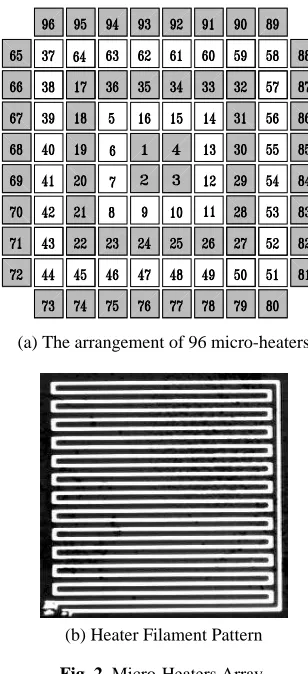
Because of the complicated flow and heat transfer mechanisms, the research on coalescence has not progressed very fast in both experimental and theoretical fronts. Coalescence of bubbles on a surface is a highly complicated process that involves a balance among surface tension, viscous and inertia forces. This phenomenon is intrinsically a fast transient event. Due to the above reasons, the research in bubble coalescence and its effect on boiling heat transfer have been rather limited. The microheater array system, based on MEMS technology, was first adopted by Rule and Kim (1999) for microscopic boiling heat transfer study. The system featured a square array of 96 micro-heaters as shown in Fig. 2(a). Each microheater with a size of 0.27 mm x 0.27 mm is independently controlled. Each microheater as shown in Fig. 2(b) is made of platinum filaments of 2 μm in width and submicron in thickness deposited on quartz substrate with a serpentine pattern. The control unit is capable of setting and maintaining either the constant temperature or the constant heat flux level for each microheater and then monitoring the other during the experiment. Because of the microscale infrastructure, the thermal inertia is negligibly small. With a sampling frequency up to 10,000 Hertz, the time and space resolved measured data are highly accurate.
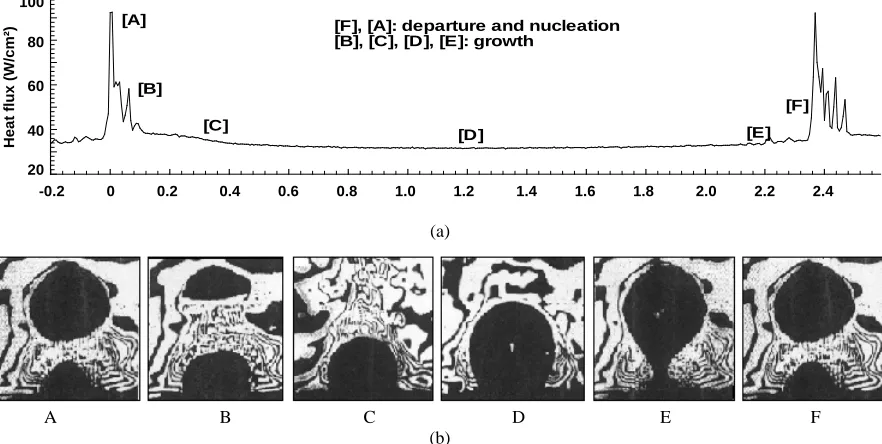
Chen and Chung (2002, 2003a) used a similar micro heater system to provide the first quantitative measurement of micro-scale boiling heat transfer characteristics for a single bubble and also for coalescing duel and multiple bubbles on the microheater array surface. As reported
(a) The arrangement of 96 micro-heaters
(b) Heater Filament Pattern
Fig. 2 Micro-Heaters Array.
[A]
[B]
[C]
[D] [E]
[F] [F], [A]: departure and nucleation
[B], [C], [D], [E]: growth
-0.2 0 0.2 0.4 0.6 0.8 1.0 1.2 1.4 1.6 1.8 2.0 2.2 2.4
100
80
60
40
20
H
e
a
t fl
u
x
(W
/c
m
²)
(a)
A B C D E F (b)
Fig. 3 Single Bubble Ebullition Cycle, (a) experimental data (Chen and Chung, 2003a) and (b) bubble ebullition image (Nordmann and Mayinger, 1981).
A B C D ~ E (a)
0 20 40 60 80 100 120
-0.2 0 0.2 0.4 0.6 0.8 1 1.2 1.4 1.6 1.8
H
e
a
t f
lu
x
(W
/c
m²)
Time (seconds)
Heat flux on a heater of a size 0.27 mm
[A] nucleation
[B]
[C] coalescence
[F] departing
[D]
[E]
next bubble
(b)
Fig. 4 (a) Visualization of coalescence of two bubbles generated on two heaters and (b) corresponding heat flux on one heater. In a numerical study, Yang et al. (2000) performed a numerical
study to investigate the characteristics of bubble growth, detachment and coalescence on vertical, horizontal, and inclined downward-facing surfaces. The FlowLab code, which is based on a lattice-Boltzmann model of two-phase flows, was employed. Macroscopic properties, such as surface tension and contact angle, were implemented through the fluid–fluid and fluid–solid interaction potentials. The model predicted a linear relationship between the macroscopic properties of surface tension and contact angle, and microscopic parameters. Hydrodynamic aspects of bubble coalescence are investigated by simulating the growth and detachment behavior of multiple bubbles generated on horizontal,
vertical, and inclined downward-facing surfaces. For the case of a horizontal surface, three distinctive regimes of bubble coalescence were represented in the lattice-Boltzmann simulation: lateral coalescence of bubbles situated on the surface, vertical coalescence of bubbles detached in a sequence from a site, and lateral coalescence of bubbles, detached from the surface. Multiple coalescences was predicted on the vertical surface as the bubble detached from a lower elevation merges with the bubble forming on a higher site.
regimes which are separated by a peak heat flux. It is suggested that in the lower superheat regime, the boiling is dominated by liquid rewetting and micro-layer evaporation, while in the higher superheat regime, conduction through the vapor film and micro-convection play the key heat transfer role as the heater is covered by vapor all the time. In general, boiling on microheaters is characterized by larger bubble departure sizes, smaller bubble growth rates due to the dryout of microlayer as the bubble grows, and higher bubble incipience superheat. As the heater size decreases, the boiling curve moves towards higher heat fluxes with corresponding higher superheats. The unique heat transfer processes associated with boiling on a microheater are considerably different from those typically observed during boiling on a macroscale heater.
3.3 Boiling on Mini Heaters and Effects of Heater Size
Immersion cooling of electronic devices sparks interests of boiling on small heaters. Baker (1973) studied boiling of R113 on heaters with sizes of 20×10 mm², 9.8×4.9 mm², and 4.6×2.3 mm². Their results showed that at a given superheat the heat flux increases with decreasing heater size. For example, at a superheat of 10 K, the heat fluxes are 2.8x10³, 1.9x10⁴ and 4.2x10⁴ W/m2 for heater sizes of 20×10 mm², 9.8×4.9 mm², and 4.6×2.3 mm², respectively. The effect of heater size on critical hat flux was later investigated by Gogonin and Kutaleladze (1977) and they did not observe any measurable effect of the heat size on critical heat flux when the boiling surface was placed to face upward. However, when the surface was placed to face downward, they found that the critical heat flux was measured to increase with decreasing heater size. This increase in critical heat flux was also observed by Ishigai et al. (1961) and Granovskii et al. (1994). Measurements by both Lienhard et al. (1973) and Saylor et al. (1989) showed that the critical heat flux remained relatively constant for heater sizes greater than a threshold value at which the critical heat flux increases with decreasing heat size for the upward-facing boiling surfaces. The effect of heater size on boiling performance prior to critical heat flux was investigated by Park and Bergles (1988); their results showed that boiling performance is not sensitive to heater size. Furthermore, boiling experiments of FC-72 on heaters of different sizes (25 cm2, 4 cm2, and 1 cm2) performed by Rainey and You (2001) and Chang and You (1996) showed that boiling heat transfer is only slightly inversely proportional to heater size. However, they found the boiling incipient superheats are 25-40K, 20-35K and 16-17K for heaters of 1 m2, 4 m2 and 25 m2, respectively. They also found the critical heat flux increases with decreasing heater size. Hijikata et al. (1997) investigated boiling on micro-scale heaters and found that the optimum thickness of the surface-deposited layer to enhance heat removal from the heater in order to obtain the best cooling effect for a semiconductor. The square heaters they used were 50 µm and 100 µm in size. They claimed that the conduction in the deposited layer dominates the heat transfer due to the small sizes of the heater area. They also presented the nucleate boiling curves for the two heater sizes and different deposited layer thicknesses. By using a temperature control scheme, Rule and Kim (1999) and Chen and Chung (2002, 2003a) performed boiling of FC-72 on constant temperature small heaters, respectively of sizes 2.7×2.7 mm² and 0.27×0.27 mm².
Chen and Chung (2003b) and Chen et al. (2004) further examined the effects of heater size on the boiling characteristics. They concluded that the boiling curve obtained from the microheater is composed of two regimes which are separated by a dividing wall superheat. It is suggested that in the lower superheat regime, the boiling is dominated by liquid rewetting and micro-layer evaporation, while in the higher superheat regime, conduction through the vapor film and micro-convection play the key heat transfer role as the heater is covered by vapor all the time. In general, boiling on microheaters is characterized by larger bubble departure sizes, smaller bubble growth rates due to the dryout of microlayer as the bubble grows, and higher bubble incipience superheat. As the heater size decreases, the boiling curve moves
towards higher heat fluxes with corresponding higher superheats. The unique heat transfer processes associated with boiling on a microheater are considerably different from those typically observed during boiling on a macroscale heater.
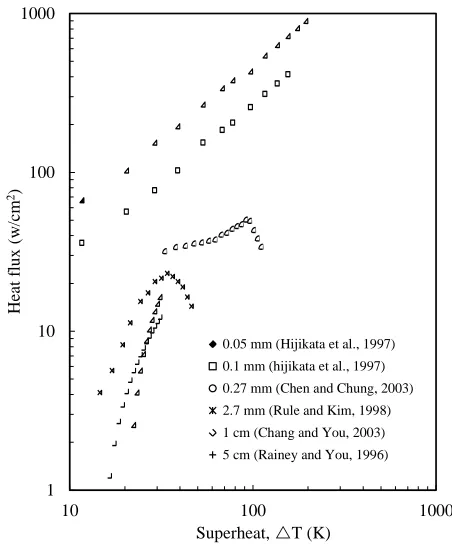
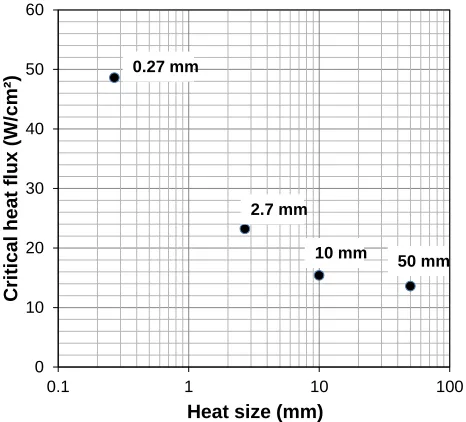
A comparison of boiling curves on different heater sizes given by Chen and Chung (2003a) is reproduced in Fig. 5. The effect of heater size on the critical heat flux is plotted in Fig. 6 with data from Chen and Chung (2003a), Rule and Kim (1999), Rainey and You (2001), and Chang and You (1996) for square heater sizes of 270 µm, 2700 µm, 1 cm and 5 cm, respectively. .
1 10 100 1000
10 100 1000
0.05 mm (Hijikata et al., 1997) 0.1 mm (hijikata et al., 1997) 0.27 mm (Chen and Chung, 2003) 2.7 mm (Rule and Kim, 1998) 1 cm (Chang and You, 2003) 5 cm (Rainey and You, 1996)
Superheat, T (K)
H
ea
t f
lu
x
(
w
/c
m
2)
Fig. 5 Boiling curves for boiling on different heat sizes (Chen and Chung, 2003a).
3.4 Nucleation on a Microheater
temperature measured at the bubble nucleation suggested the occurrence of homogeneous bubble nucleation in their experiment. Lin et al. (1998) used a 50 µm × 2 µm × 0.53 µm polysilicon resistance heater to produce microbubbles in Fluorinert liquids. Using a computational model and experimental measurements, they concluded that homogeneous nucleation occurs on the microline heater.
0 10 20 30 40 50 60
0.1 1 10 100
C
ri
ti
ca
l
h
e
a
t
fl
u
x
(W
/c
m
²)
Heat size (mm) 0.27 mm
2.7 mm
10 mm 50 mm
Fig. 6 Effect of heater size on boiling critical heat flux (Chen and Chung, 2003a).
Avedisian et al. (1999) performed experiments on a heater used in commercial thermal inkjet printers that comprises a mixture of tantalum and aluminum (64.5 µm × 64.5 µm × 0.2 µm) by applying voltage pulses of short durations. At extremely high heating rates (2.5 - 108 K/s), homogeneous nucleation at the heater surface was suggested as the mechanism for bubble formation, with the nucleation temperature increasing as the heating rate was increased. Zhao et al. (2000) used a similar thin-film microheater, 100 µm × 110 µm in size, to investigate the vapor explosion phenomenon. They placed the microheater on the underside of a layer of water and the surface temperature of the heater was rapidly raised (about 106 K/s) by electrical pulses of short durations. By measuring the acoustic emissions using a pressure transducer from an expanding volume of a vapor bubble, the dynamic growth of the vapor microlayer was reconstructed. The maximum pressure inside the vapor volume of 7 bar was calculated from the measured acoustic pressure. The heating rates in these studies (Iida et al., 1994; Lin et al., 1998; Avedisian et al., 1999; Zhao et al., 2000) were extremely high, and are believed to be important for the homogeneous nucleation process. Recently, Balss et al. (2005) investigated the effect of surface hydrophobicity on bubble incipience using a pulse-heated microheater and a novel laser strobe microscopy technique. Imaging rates of over 10 million frames/s were achieved. It was found that bubble nucleation requires a higher superheat and occurs at an earlier time for hydrophilic surfaces compared with those that are hydrophobic.
It should be noted that a constant temperature condition is useful for identifying the nature of boiling incipience because the degree of superheat is a controlling parameter. With a constant temperature microheater, bubble incipience on a very smooth microscale heater (approximately 10 nm rms of roughness) is further investigated by Chen et al. (2006) to establish that bubble incipience under these conditions is indeed a homogeneous process and to elucidate the mechanics of the process. The flow visualization under side and bottom views and the simultaneous heat flux measurement provide sufficient information to allow a clear identification of the highly transient bubble incipience process. The experiments have been
performed on a resistance heater of the size 0.27 by 0.27 mm, coated with silicon dioxide. The incipience process was visualized from the side and the bottom of the semi-transparent heater, and the transient heat transfer was simultaneously recorded.
3.5 Boiling Enhancement with Nanotechnologies
3.5.1 Nano-fluids
Nanofluids are heat transfer fluids mixed with nanoparticles that are uniformly and stably suspended in the host liquid. Addition of nanoscale solid particles in liquids such as water has been shown to substantially expand the cooling thresholds for phase-change heat transfer that has been the main mode of heat removal from nuclear reactor cores (Buongiorno, 2006; Buongiorno et al. 2008). It was reported that up to 200% enhancements of boiling critical heat flux at modest nanoparticle concentrations of less than 0.1% by volume (Buongiorno, 2006). Since the critical heat flux is the upper limit of nucleate boiling, such improvement offers a potential for a breakthrough in cooling capacity for power systems that have relied on boiling heat transfer for system operations such as advanced nuclear reactors. A study by Buongiorno et al. (2008) predicts that with just a 32% increase in the critical heat flux, the current nuclear reactor power density would go up by 20%. Therefore the enhancement potential for future advanced nuclear reactors could be much higher. The effect of nanoparticles on boiling heat transfer is thought to be due to a change in wetting characteristics by the nanofluids and the formation of a porous layer on the heating surface. Also, the relative size of the particle with respect to the surface roughness seems to be of significant importance.
The concept of nanofluids has been advanced remarkably by Choi (1995) who showed a potential for substantial augmentation of heat transport in suspensions of copper or aluminum nanoparticles in water or other liquids, which was found later to be attributed to the increase in the equivalent thermal conductivity of the base fluid (Lee et al., 1999; Choi et al., 2001; Eastman et al., 2001). By using the technique of molecular dynamics simulation, Sarkar and Selvam (2007) compared thermal conductivity of base fluids and nanofluids with nanoparticle loadings and showed that the increase in thermal conductivity was due to an increased motion of liquid atoms in the presence of nanoparticles. You et al. (2003) measured boiling heat transfer with nano-particles (Al2O3) and their results as shown in Fig. 7 showed that the critical heat
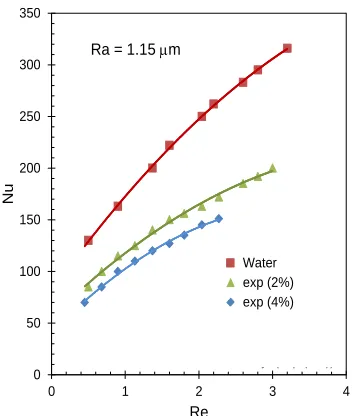
flux is increased dramatically, but there is no significant enhancement for boiling in the nucleate boiling regime reflected by the boiling curve. However, Das et al. (2003) observed that the presence of nano-particles deteriorates the boiling performance systematically with an increase in particle concentration as shown in Fig. 8, which was also observed by Kim et al. (2007). Das et al. (2008) later on commented that deterioration in heat transfer coefficient was mainly observed at higher particle concentrations (4–16% by weight) and enhancements mainly at lower particle concentrations (0.32–1.25% by weight). The experimental study of boiling of three different nanofluids (alumina, zirconia and silica nanoparticles with water being the base fluid) performed by Kim et al. (2007) indicated that the enhancement in critical heat flux (CHF) is achieved at modest nanoparticle concentrations (<0.1% by volume) that is attributed to buildup of a porous layer of nanoparticles on the heater surface occurred during nucleate boiling. This layer significantly improves the surface wettability, as shown by a reduction of the static contact angle on the nanofluid-boiled surfaces compared with the pure-water-boiled surfaces.
3.5.2 Nano-structured surfaces
Another potential heat transfer breakthrough could come from nano-structured boiling surfaces such as those coated with nano carbon tubes. These nano-surface textures have the potential to alter the surface properties such as wettability and thermal conductivity. Also they might provide more favorable nucleation sites for boiling and condensation initiations. Boiling heat transfer enhancement from surfaces of nano wires has been experimentally observed in recent studies by Chen et al. (2008, 2009). However, experimental results obtained by Launay et al. (2006) indicated that the use of the CNT-enabled, purely nano-structured interfaces appeared to improve boiling heat transfer only at very low superheats, compared with the smooth surfaces. Nano-structures only promote bubble nucleation, but not departure. At high heat fluxes, bubble departure characteristics may be degraded due to micro/nano structures. Thus no enhancement was observed at high heat fluxes. They also measured pool boiling of PF5060 and DI water on 3D micro-structured (staggered cross-meshing) surfaces, and obtained the maximum (not critical) heat fluxes of 27 and 130 W/cm2, respectively.
Ahn et al. (2009) and Sathyamurthi et al. (2009) reported experimental results of pool boiling in the PF5060 fluid on silicon heaters coated with vertically aligned, multi-walled carbon nanotubes (MWCNTs). Using NWCNTs of layer thicknesses of 9 μm (Type A) and 25 μm (Type B), they found that the critical heat flux was increased by 62% and 58%, respectively. With the Type B heater, the minimum heat flux at the Leidenfrost point was increased by 150%. There were no significant differences in the film boiling rates with both heater types. Carbon nanotubes would function as a nanoscale heat pipe and inside these tubes, nanoscale liquid films evaporate from one side of the channel and condense on the opposite side wall surfaces. It is believed that the nano-sized film evaporation contributes to the super-high heat flux transport rates.
While pool boiling on surfaces with nano-structures has been performed extensively, convective boiling on these surfaces has not received enough attention. Recently Hsieh and Lin (2010) reported subcooled convection boiling enhancement in microchannels coated with a 2 μm thick diamond film. The internal surfaces were implemented with structured cavities to promote nucleation. Nanofluids of FC-72 mixed with multi-walled carbon nanotubes were used as the coolant. The main results are the maximum heat transfer enhancement of 90% and more than an order of magnitude increase in the critical heat flux.
0 500 1000 1500 2000
0 20 40 60 80 100
q
" (k
W
/m
²)
∆Tsat(K)
CHF (pure water) = 540 CHF (0.001 g/l) = 670 CHF (0.01 g/l) = 1480
CHF (0.05 g/l) = 1590 CHF (0.025 g/l) = 1680
Fig. 7 Enhancement of critical heat flux during pool boiling (You et al. 2003).
0 50 100 150 200 250 300 350
0 1 2 3 4
Nu
Re
Water exp (2%) exp (4%) Poly. (Water) Poly. (exp (2%)) Poly. (exp (4%)) Ra = 1.15 µm
Fig.8 Boiling heat transfer deterioration (Das et al., 2003).
4. THEORETICAL/NUMERICAL DEVELOPMENT
Nucleate boiling process is a complex phenomenon which is multi-scale in nature. Owing to the dependency on various parameters, such as nucleation sites, bubble growth rates, bubble release frequency, temperature field in liquid/solid, etc., and their non-linear dependency on the boiling process, no universal model has been proposed which can predict nucleate boiling for any combinations of fluid and surface involved. Since the past few decades, empirical correlations have been introduced; however, predictions from these correlations are valid only for the limited range over which the supporting data have been obtained (Dhir, 2006). Since, empirical correlations do not provide fundamental physical understanding of nucleate boiling, it is essential to examine the underlying multi-scale nature of the process which gives rise to the macroscale phenomenon of boiling we observe. The multi-scale behavior occurs at the three-phase contact line of a bubble, as seen in Figure 1. The contact line region is comprised of non-evaporating thin film region, evaporating thin film region and intrinsic meniscus region. The non-evaporating region is on the length scale of nanometers, whereas the evaporating and intrinsic meniscus regions have the characteristic dimension of micrometers and higher. Thus, the contact line region can be divided into nano- and micro- regions as in Figure 1b. In the past decade, these two regions have been simulated separately; the micro- region using continuum mechanics, and the nano-region using molecular dynamics simulations. The following sections review the recent advancements in numerical simulations of these multi-scale regions.
4.1 Micro-region Modeling using Continuum Mechanics
vortex cells, induced in the vapor-liquid interface of the macrolayer due to the thermo-capillary driven flow, were shown to efficiently transfer heat away from the wall. Son (2001) proposed a numerical method based on a level set technique for capturing the phase interface which included the effect of phase change at the interface as well as to achieve mass conservation. The modified level set method was applied for numerical simulation of bubble rise and growth in a stationary liquid. Ye et al. (2001) developed a fixed-grid direct numerical simulation method for studying single bubble deformation and phase change. The mass, momentum, and energy balance conditions were satisfied at the interface, and the interface was considered to be sharp. The field equations were solved numerically using a finite volume method based on the fractional step method. The proposed algorithm was capable of accurately handling wide ranges of Re, We, Ja, Pe, and property jumps between phase boundaries. It was shown that for a stationary bubble growing in a superheated liquid, the growth rate approaches R(t) t1/2. The effect of bubble motion causes the growth rate to accelerate, and the density ratio becomes an important parameter as the vapor density drops below a certain level. Mukherjee and Dhir (2004) numerically studied bubble dynamics and associated wall heat transfer during lateral bubble merger. They solved the incompressible Navier-Stokes equation and captured the liquid-vapor interface using the level set formulation. Mergers of two bubbles, three bubbles in a line and three bubbles in a plane were simulated assuming axisymmetry. The contact angle between the wall and the bubble was taken to be constant throughout the simulation. The authors acknowledge the fact that the results are sensitive to contact angle. Liao et al. (2004) presented a physical model to predict the early stage bubble growth in saturated heterogeneous nucleate boiling. The microlayer was taken to be in the form of a wedge. The structure of the thin unsteady liquid thermal boundary layer is revealed by the asymptotic and numerical solutions. The authors find that in some cases, the heat transfer from the thin unsteady thermal boundary layer near the rapidly growing bubble can be larger than that from the microlayer. Shin et al. (2005) simulated the complex transport and coupled interface dynamics of nucleate boiling in three-dimensions using the Level Contour Reconstruction Method. The effect of nucleation site density was included in the numerical model by changing the surface area for a single nucleate bubble corresponding to the wall temperature. The three-dimensional simulations demonstrated more accurate agreement with published Nusselt number correlations than did the two-dimensional simulations. However, the simulation did not incorporate models for microlayer evaporation and contact line dynamics which are essential to the heat transfer mechanism. Tomar et al. (2005) used the coupled level-set and volume-of-fluid method to simulate bubble growth in water at near critical pressure for different degrees of superheat. The coupled algorithm was said to conserve mass and capture the complicated interfaces very accurately. The effect of superheat and saturation pressure on frequency of bubble formation was analyzed. Genske and Stephan (2006) modeled the macro-region by solving the Navier-Stokes equation for both vapor and liquid phase using finite element method. The micro region was wedge shaped and moving mesh was used for free surface simulation. Flow inside and around a growing bubble and its influence on the overall heat transfer was considered. Mukherjee and Kandlikar (2007) used a static contact angle and dynamic contact angle models based on the contact line velocity and the sign of contact line velocity to numerically study the growth and departure of single vapor bubbles from a heated wall. The liquid-vapor interface is simulated using the level-set technique. The effect of microlayer evaporation at the bubble base was neglected. The authors concluded that correct motion of the contact line can be simulated when the dynamic contact angle is represented as a function of interface velocity. Son and Dhir (2008) numerically studied nucleate boiling at high heat fluxes by solving the equations governing conservation of mass, momentum and energy in the liquid and vapor phases. The interface was captured by using the level set method based on a sharp-interface representation, and the evaporative heat flux from the liquid microlayer was incorporated. Bubble growth and release was
analyzed for both low and high wall superheats. A sample 3D calculations with a coarser grid was also performed which gave heat flux values about 40% lower than that for corresponding 2D case. Stephan and Fuchs (2009) developed a fully transient numerical model which allows describing the transient heat and fluid flow during the entire periodic cycle of a growing, detaching and rising bubble including the waiting time between two successive bubbles from a single nucleation site. The model contains a multiscale approach ranging from the nanometer to the millimeter scale for the detailed description of the relevant local phenomena. The authors concluded that the assumption of a constant and homogeneous wall surface temperature that is used in many modeling approaches does not hold for an accurate description, and that the capability of the wall and liquid to temporarily store energy is an important property of the boiling system that should be considered in numerical models as well as in boiling correlations.
Numerical simulation of heterogeneous boiling was recently done using the lattice Boltzmann method (Hazi and Markus, 2009). Simulation results demonstrated that the bubble departure diameter and bubble release frequency are proportional to g-1/2 and g3/4, respectively, where g is the gravitational acceleration. The bubble release frequency showed exponential decay with the static contact angle. Wu and Dhir (2010) employed a numerical procedure, coupling the level-set function with the moving mesh method, to simulate subcooled nucleate boiling under various gravity levels. The applied numerical procedure was validated by comparing the results of bubble-growth history including bubble departure diameter with data from experiments. The effect of subcooling on bubble size was found to be more pronounced under microgravity than under earth-normal gravity. The rate of heat transfer around the bubble decreased with reduction in gravity for a given subcooling due to stretching of length and time scales. Lee et al. (2010) performed analysis of bubble growth and formation during nucleate boiling on a horizontal surface with three types of cavities: truncated conical cavity, cylindrical and conical cavity. A numerical method was presented for this purpose where a sharp-interface level-set method for two-phase flows was modified to include the effect of phase change on the liquid–vapor interface and to treat the contact angle and microlayer heat flux on the immersed solid surface of microstructures. The simulation demonstrated that the cavity depth is one of the important parameters determining the existence of nucleate boiling and the truncated conical cavity was found to be more effective for bubble formation in nucleate boiling compared to the cylindrical and conical types of cavities.
4.2 Nano-region Modeling using Molecular Dynamics Simulations
confined in a nanochannel with emphasis on nucleation phenomenon. A metastable liquid confined in a nanochannel with an inlet driving force was simulated. Nano-sized bubbles were observed wider different conditions of solid-liquid interfacial wettability. The authors also found that the vapor pressure inside the nano-bubble disagrees with the macroscopic Young-Laplace equation. Park et al. (2001) formed a similar bubble using molecular dynamics with the liquid initially in metastable condition. No solid surfaces were included in this simulation. The surface tension of the bubble, calculated from the density profile and from the normal and transverse components of pressure tensor, was found to increase very slightly with decrease of bubble radius. Schoen et al. (2005) investigated the phase transition of a simple liquid bounded between two parallel walls a few nanometers apart with molecular dynamics simulation. The authors used the fact that since some fluids (argon in their case) thermally contract on cooling, the lower wall temperature was reduced to the extent that the fluid started to crystallize starting from the bottom surface creating a “frozen” bubble in crystallized state. It was found that the confining walls primarily affect the crystallization process. The authors also noted that vapor nucleation in a liquid confined in a nanochannel cannot be achieved by solely increasing the temperature of the wall.
The above studies modeled the formation of nano-cavities in liquid using molecular dynamics. This has provided significant insight in the formation of nano-bubbles in nanoscale thermal systems, like nanochannels. However, these do not simulate the formation of the non-evaporating region and the interline region which are key towards understanding the fundamentals of nano-region of the three-phase contact line of a bubble. The interline region lies between the non-evaporating thin film region and the evaporation thin film region over which the film varies in thickness and curvature to accommodate the transition between the two regions. This is the thinnest portion of the meniscus over which vaporization can occur, and since it is the thinnest, it is also the location where the evaporation rate is the highest (Carey, 1992). Recently, Maroo and Chung (2008, 2009, 2010a, 2010b, 2011) simulated the formation of the non-evaporating and interline regions for the first time in published literature.
4.2.1 Molecular dynamics simulation
The computational domains in the simulations consist of Argon (Ar) atoms as the fluid and a surface made from platinum (Pt) atoms. Pt atoms are arranged in fcc (111) structure to constitute the Pt wall. The atomic interaction is governed by the modified Lennard-Jones potential as defined by Stoddard and Ford (1973):
12
12 6
( ) 4 6
MLJ
cut
U r
r r r
σ σ σ
ε
= − +
6 2 12 6
3 7 4
cut cut cut cut
r
r r r r
σ σ σ
− − −
(1)
The above potential form is employed for both Ar-Ar and Ar-Pt interactions with the following values:
10
3.4 10 ,
Ar Ar m
σ −
− = × εAr Ar 1.67 1021J,
−
− = ×
10
3.085 10
,
Ar Pt
m
σ
−−
=
×
εAr Pt 0.894 1021J−
− = × .
The cutoff radius is
r
cut. The force of interaction can be calculated from the potential function as follows:F= −∇U. The argon atoms are subjected to six boundaries, two in each of the x, y and z directions. The boundaries in the x and y directions are periodic. The boundary conditions in the z direction can be periodic, mirror (i.e. elastic and adiabatic) boundary condition, or the presence of Pt wall(s) depending on the problem studied.Pressure computations are verified in a computational domain consisting of a liquid layer surrounded by vapor in z-direction (as shown in Fig. 9(a)) for six different temperature cases (Maroo and
Chung, 2009). Periodic boundary condition is applied to all six boundaries. Temperature-density, pressure-density and surface tension-temperature plots are shown in Figs. 9(b), 9(c) and 9(d) respectively, where the results from simulation are compared to experimental values from thermodynamic tables for argon. It can be seen that the values match well.
4.2.2 Thermal wall model
Many problems in the field of heat transfer require modeling the fluid-solid wall boundary condition across which the heat transfer takes place. Numerous models have been proposed and developed in literature to simulate wall-to-fluid heat transfer for molecular dynamics simulation; however, the biggest concern in these models is that the actual physics of the phase change heat transfer may not be properly depicted (Maroo and Chung, 2010a). Maroo and Chung (2008, 2010a) proposed a novel ‘fluid-wall thermal equilibrium model’ to simulate heat transfer from a surface to a fluid for molecular dynamics. The proposed model was verified by both state-dependent and time-dependent properties. For the state-time-dependent verification (Maroo and Chung, 2008), physical properties of thermal conductivity and change in internal energy of liquid argon between two Pt walls were computed in molecular dynamics simulation, and shown to match well with thermodynamic tabulated values. For the time-dependent verification (Maroo and Chung, 2010a), temperature gradient in liquid argon placed between two Pt walls (one wall was heated while the other was cooled) was evaluated with time, and compared to the 1-D heat equation; good agreement was found in this analysis. Hence, this proposed model was used to simulate the evaporation of a thin film of argon placed on a Pt surface.
4.2.3 Non-evaporating thin film region
The simulation domain is a cuboid of dimensions 8.011 nm×8.011 nm×18.961 nm. A thin liquid argon film of 2 nm thickness is placed on the Pt wall. The upper boundary in the z-direction is an imaginary adiabatic elastic wall. The remaining volume is occupied by argon vapor. Both liquid and vapor are initially at their respective saturation states at 90 K. The simulation domain initially comprises of 2645 liquid film argon atoms, 112 argon vapor atoms and 2929 Pt atoms. The time step is 5 fs. The Pt wall temperature is step-jumped from 90 K to 130 K at t=2000 ps.
The snapshots of Y-Z plane of the computational domain are shown at different time steps in Fig. 10. The Pt wall atoms are denoted by the triangular symbols in red, the argon atoms forming the liquid film are shown in dark grey and the argon atoms in the vapor phase in light grey. After gradual vaporization of the initial liquid film, a non-evaporating liquid film forms towards the end of the simulation. This is confirmed by the facts that a) the number of liquid atoms constituting the film remains constant after a period of time, and b) the average temperature of the non-evaporating film is higher than the average vapor temperature. A thin film can exist in equilibrium on a solid surface even when its vapor pressure in the surrounding gas is below the normal saturation pressure for the system temperature (Carey, 1992).
Fig. 9 Pressure verification with a liquid slab surrounded by vapor atoms, (a) 3-D snapshot of simulation domain, (b) Pressure-density plot, (c) Temperature-Pressure-density plot, (d) Surface tension-pressure plot (Maroo and Chung, 2009).
Fig. 10 Evaporation sequence of liquid film of argon on Pt wall in the Y-Z plane along the computational domain. The liquid film does not completely evaporate and a non-evaporating film is obtained (Maroo and Chung, 2008).
6 6
2 2 8 8
1
1
( )
12
(
)
30
30(
)
LJ
A
U
d
d
t
d
d
t
d
σ
σ
π
= −
−
−
+
+
+
(2)where, A is a Hamaker-constant parameter defined as
6 2
4 av av
Ar Pt
N N
A
M M
ρ ρ
ε σ π
=
, d is the gap between Ar and Pt slabs, t is the thickness of the Ar slab and U
LJ is the total interaction energy
between Ar-Pt slabs from molecular dynamics using LJ potential. The average value of A was obtained as 20
5.28 10× − J with a standard deviation of 7.68%.
In the previous simulation, the mirror boundary condition for the upper wall can introduce artifacts in the system. Thus, in order to remove such effects, thin film evaporation was simulated in an axisymmetric domain (Maroo and Chung, 2009). The simulation domain is now a nanochannel in the form of a cuboid as shown in Fig. 11. The x and y dimensions are 6.117 nm
×
6.117 nm respectively; z-direction represents the channel height. A thin liquid argon film of thickness tfilm is placed on each Pt wall. The remaining volume isoccupied by argon vapor. Both liquid and vapor are initially at their respective saturation states at 90 K, and then the temperature of both walls is step-jumped to 130 K to simulate evaporation. Nanochannel height h and initial film thickness tfilm are varied for different cases.
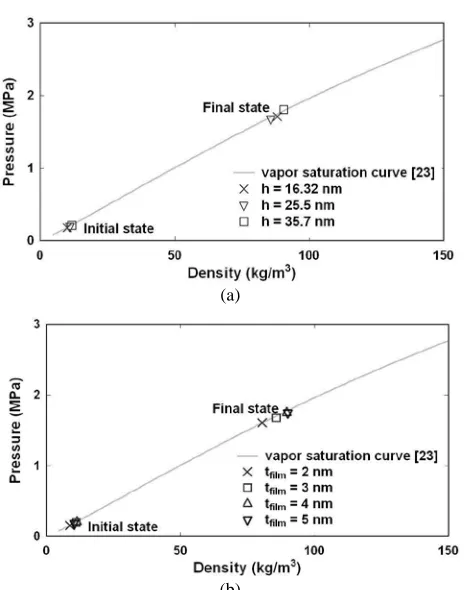
Non-evaporating film in obtained in all cases. The pressure-density plots of particular interest in these simulations.
The average initial and final vapor pressures and vapor densities were evaluated for the simulation runs. Vapor pressure vs. vapor density for initial and final state is plotted for varying nanochannel height h in Fig. 12(a), and for varying film thickness tflim in Fig. 12(b).
The plots show that the states lie on the saturation curve, which is obtained from thermodynamics table of argon, implying that the vapor is saturated. This further validates the existence of the non-evaporating thin film; even though the film is superheated compared to the vapor temperature, no additional evaporation from the film can occur since the final vapor state is saturated.
4.2.4 Interline region
Fig. 11 Evaporation of thin liquid argon films in a nanochannel, (a) 3-D view of nanochannel, (b) Snapshots of x-z plane at different time intervals. Non-evaporating films form on both Pt walls. (Maroo and Chung, 2009).
(a)
(b)
Fig. 12 (a) Vapor pressure-density plot of initial and final states for varying nanochannel height, (b) Vapor pressure-density plot of initial and final states for varying film thickness. Initial and final vapor states lie on the saturation curve. (Maroo and Chung, 2009).
Fig. 13 Liquid argon meniscus, surrounded by argon vapor, in an opening constructed of platinum wall atoms. (a) 2D view along the x-z plane depicting the boundary conditions and dimensions, and (b) 3D view of the simulation domain where the liquid-vapor interface can be clearly noticeable. Heat is transferred to the meniscus from the platinum wall region shown in red, while the region shown in blue is maintained at the lower initial temperature. (Maroo and Chung, 2010b). occupied by argon vapor. The domain consists of a total of 14172 argon atoms and 7776 platinum atoms. The total width, height and depth are 34 nm, 59.5 nm and 4.3 nm respectively. The width of the opening in the upper wall is 28.22 nm. The separation between the lower wall and the upper wall is 6.2 nm. The initial equilibrium temperature is 90 K. The time step is 5 fs. All the boundaries in x and y directions are periodic. The length of the boundary above the upper wall in the x-direction is restricted to the width of the opening. Any argon atom which goes above the upper wall does not interact with the wall atoms anymore. The top boundary in the z-direction is the mirror boundary condition. The temperature of part of the lower wall, which is directly underneath the opening (shown in red in Fig. 13a and 13b), is increased to 130 K, while the upper wall and the remainder of lower wall (shown in blue color) are kept at their initial value of 90 K during the heating period.
With continuous evaporation taking place, the thinnest part of the meniscus at the center continues to decrease in thickness (Fig. 14) until a uniform non-evaporating film forms. It is also shown that evaporation still occurs in the adjacent regions to the non-evaporating film, which are hence the interline region. Heat and evaporation fluxes are evaluated, and it is shown that ultra-high heat flux on the order of 100 MW/m2 and high evaporation rates on the order of 1000 kg/m2s are achievable from the nano-region of the three-phase contact line (Fig. 15).
4.2.5 Negative Liquid Pressure
Capillary forces are of main importance in micro- and macro- scale fluidic systems. However at nanoscale, disjoining forces can become extremely dominant. These disjoining forces can cause liquid films to be under high absolute negative pressures. A better insight into negative liquid pressures can be gained from the phase diagram of water, which shows the stable, metastable and unstable regions (Angell, 1988).
pressure in the liquid film is obtained using the augmented Young-Laplace equation:
L v c d
P
=
P
− −
P
P
, where PL is the liquid pressure, Pvis the vapor pressure, Pc is the capillary pressure and Pd is the disjoining
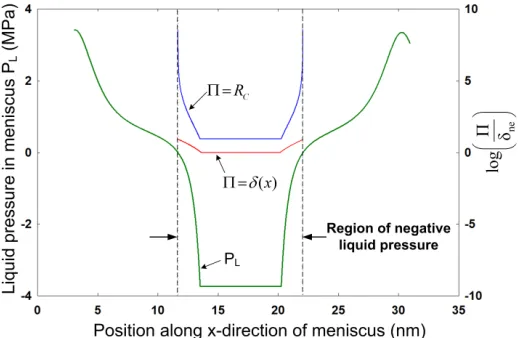
pressure. Due to high disjoining pressure values in the non-evaporation film region, and partially due to capillary forces in its adjacent regions, the liquid is found to be under deep negative pressure at the center of the meniscus. Usually, at macroscale, liquid regions subject to negative pressures cavitate and form bubbles. However, for the formation of a spherical vapor bubble, a critical radius of cavitation Rc (defined
as:Rc= −2γLV Pliquid) has to be achieved (Fisher, 1948). Thus, cavitation can be avoided if the critical cavitation radius is larger than the smallest characteristic dimension (Zhang et al., 2010). To verify this aspect in our work, a normalized function
log
(
)
ne
δ
Π
is plotted in the region of negative liquid pressure for 2C L
R γ P
Π = = − and Π =δ( )x ,
as shown in Fig. 16, where ne
δ
is the thickness of the attained non-evaporating film. The normalized function has higher values forC
R
Π = compared to Π =δ( )x , which signifies that the critical cavitation radius is larger than the meniscus height. Thus, the liquid meniscus region under high negative pressures can exist in metastable state.
We believe these molecular dynamics simulations provide valuable insight towards further understanding the physics that might be occurring at the contact line at the base of a bubble. We speculate that a stable negative liquid pressure exists in the non-evaporating film region which assists in the liquid flow from the intrinsic meniscus to the evaporating film region during bubble nucleation and growth.
5. FUTURE RESEARCH NEEDS
During the past two decades, nano/micro technologies have made unprecedented progress that has enabled the availability of more advanced diagnostic tools and more powerful computers. As a result, researchers will be able to explore deeper into the fundamental science of boiling in the future. We suggest the following for future research consideration:
1. Unlock the basic transport physics of the MCL associated with a bubble during its growth, coalescence and departure in nucleate boiling. Further more, determine the role of the MCL during the bubble-bubble coalescence and its effects on fluid mechanics and heat transfer in the micro- and macro-layers and then to develop a mechanistic model for this phenomenon.
2. Obtain a fundamental understanding on the physics of CHF and the relationship of single bubble dynamics and bubble-bubble coalescence to the transport mechanisms associated with the CHF phenomenon of Nucleate boiling.
3. Develop mechanistic models with no adjustable constants for nucleate boiling and critical heat flux.
More specifically, we suggest the delineation through simulation and analysis of the contributions of the key mechanisms to the total boiling heat transfer. This includes the MCL with micro/macro layer evaporation on single and merged bubbles attached to a heated wall, and heat transfer enhancement during coalescence of bubbles on the heater wall. It would be enlightening to provide answers to the following:
1. What mechanisms are at play during bubble growth and coalescence? In other words, how do the thermodynamic force, surface tension force, and hydrodynamic force that are associated with the MCL process balance one another?
Fig. 14 Snapshots of x-z plane at different time steps of evaporating nanoscale meniscus. Non-evaporating film is obtained at the center of the meniscus, while the interline region is present in the adjacent regions. (Maroo and Chung, 2010b).
Fig. 16 Variation in liquid pressure along the meniscus at t=2500 ps for the nanoscale meniscus. High negative pressure values are seen at the center of the meniscus. A normalized function
(
)
log Π δne is plotted in the region of negative liquid pressure for Π =RC= −2γ PLand Π =δ( )x , which nullifies the
possibility of cavitation in this region as the meniscus thickness is smaller than the critical cavitation radius. (Maroo and Chung, 2011).
2. What controls the bubble growth dynamics and departure from the heater surface in nucleate boiling when bubble coalescence is part of the process?
3. What are the controlling parameters for vaporization and heat transfer around the MCL ?
4. How does the heater surface superheating level affect the MCL bubble dynamics ?
5. What are the effects due to different system parameters such as the system pressure and surface characteristics on the bubble growth and coalescence dynamics?
6. What is the relationship of bubble growth and coalescence with the critical heat flux?
7. For nanofluids, what the fundamental heat transfer enhancement physics for a wide range of nano-particle materials and applicable coolants ?
6. CONCLUSION
In this review paper, based on nano/micro scale experimental and theoretical/numerical results reported in the open literature we have presented an up-to-date summary on the recent advances of fundamental nucleate boiling physics. For the heterogeneous nucleate boiling, the interaction between the bubble and the heat source (heater surface) is facilitated through a multiscale (nano, micro and macro regions) liquid layer that couples the bubble with the heater surface. The moving contact line (MCL) is the nanoscale and most inner region where the vapor-liquid-solid phases meet and this liquid layer is at its thinnest. The dynamics, and the heat and mass transfer characteristics around the MCL hold the key for bubble growth, detachment and departure. In the micro-heater experiment, bubble detachment and departure, and bubble-bubble coalescence have been found to induce heat flux spikes that boost the heat transfer rates. There is also evidence that bubble coalescence could be the main mechanism responsible for
the high heat flux nucleate boiling and also is connected to the critical heat flux.
In general, for miniature heaters the critical heat flux increases as the heater size decreases. The effect of heater size on boiling performance prior to the critical heat flux was found that boiling heat transfer is inversely proportional to heater size. Further more, boiling on microheaters is characterized by larger bubble departure sizes, smaller bubble growth rates due to the dryout of microlayer as the bubble grows, and higher bubble incipience superheat. As the heater size decreases, the boiling curve moves towards higher heat fluxes with corresponding higher superheats. The unique heat transfer processes associated with boiling on a microheater are considerably different from those typically observed during boiling on a macroscale heater. In many MEMS applications, small heaters are designed for super-high rates of heating in a confined space environment that usually results in explosive homogeneous nucleation such as those in bubble-actuated Microsystems.
Addition of nanoscale solid particles in liquids such as water has been shown to substantially expand the cooling thresholds for phase-change heat transfer. In general, nanofluids have been shown to drastically increase the critical heat fluxes while their effects on the nucleate boiling regime is not very significant. Some even reported that the nanofluids lowered the boiling heat transfer. For one theory, the effect of nanoparticles on boiling heat transfer is thought to be due to a change in wetting characteristics by the nanofluids and the formation of a porous layer on the heating surface. Another theory predicted that the improved heat transfer is due to an increase in thermal conductivity that results from an increased motion of liquid atoms in the presence of nanoparticles. However, many controversies still exist concerning the application of nano-fluids, fundamental research efforts are needed.
Heater surfaces manufactured with nanoscale textures have also been the subject of recent research activities. These nano-surface textures, mainly carbon nano tubes, have the potential to alter the surface properties such as wettability and thermal conductivity. Also they might provide more favorable nucleation sites for boiling and condensation initiations. Nano-surface textures have been shown to improve nucleate boiling mainly for lower heat fluxes as they enhance nucleation but do not promote bubble departure.