Energy Efficient Cluster Head Selection using
ABC with DCA in WSN
G.L.Soujanya, Chandra Mouli P V S
M.Tech (Computer Science), Dept. of CSE, VIT University, Vellore, India Professor, Dept. of CSE., VIT University, Vellore, India
ABSTRACT: Nowadays wireless sensor networks are using for security improvements. Since sensors are generally compel to energy supply, effective maintaining of the network is crucial to improve the life of sensors. Sensors energy cannot support for long communication to reach remote site and it requires many levels of hops or gateways to forward the data on behalf of sensors. Clustering is the effective technique to extend the lifetime of a sensor network. This work proposed a trust based cluster head selection in multi hop WSN using Artificial Bee Colony (ABC) Algorithm. However, the cluster head selection may lead to increase the overload. If few CH nodes are heavily loaded, will consume their energy soon. To get uniform energy utilization, load balancing is introduced over clusters. The work proposed Dynamic Channel Allocation (DCA) mechanism. The result of the proposed work is, it effectively maintains the load balancing within clustered network and predict the nodes with selfish behaviour and malicious nature to avoid participation in cluster head selection. The selection of CHs is based on the energy of each node which is communicated using ABC algorithm.
KEYWORDS: Energy efficient algorithm; WSN; total transmission energy; maximum number of hops; network
lifetime, Dynamic Channel Allocation
I. INTRODUCTION
Nowadays wireless sensor networks are popular research areas because of its usability and adaptability. These will collect the information from network area and provides information to the end users by a single hop or by multi hop. In WSN, sensor nodes have low-power wireless interfaces and CPU to conserve energy which is critical to improve the network life time as generally the power source cannot be restore. In a WSN, if a malicious node turns into a CH while the setup stage then it can do significant harm to the whole system by dominating important information and concentrate cryptographic data of the system [13]. For successful remote system operation all nodes need to coordinate by sending information in a resource environment. Participating nodes which are selfish may moderate energy by
ceasing it to save its resource which is leading to degradation [7].
In spite of the fact that selfish nodes are not malicious it influences the QoS of the network and decreases the system life time [9]. To protect WSN from malicious nodes we may have so many secure routing protocols but trust management is the effective solution to protect WSN. This trust and reputation mechanism is used to find malicious nodes and the Artificial Bees Colony algorithm is used to select effective cluster head selection [6]. The longevity of the sensor node will extend the lifetime of a WSN and this, in turn, will help in our critical application areas where other modes of communications are impossible [14].
II. RELATED WORK
Cluster algorithm and a-star with fuzzy approach for lifetime enhancement in wireless sensor networks [1]. This paper proposed a new routing method using fuzzy approach and A-star algorithm. This method determines an optimal routing path in aspect of minimum number of hops and minimum traffic loads. Energy-efficient and reliable transport
protocols for wireless sensor networks Stateof-art [2]. Recent researches present new transport protocols for wireless sensor networks providing various type of reliability and using new mechanisms for loss detection and recovery, and congestion control. An efficient cluster based approach for multi-source multicast routing protocol in mobile ad hoc networks [3]. The main objective of this work to compute the maximum performance of proposed routing protocol in various environments, and also it has been compared with Multicast Ad-hoc On-Demand Distance Vector (MAODV) and On-Demand Multicast Routing Protocol (ODMRP) to prove the performance of delivery ratio, control overhead and forwarding efficiency. Anomaly intrusion detection system in wireless sensor networks Security threats and existing approaches [4]. In this paper, they mentioned several attacks on WSN and we primarily focus only on the anomaly based intrusion detection system. Finally, we discuss about several existing approaches to describe how they have identified security threats and implemented their intrusion detection system. Performance comparison of single and multi-path routing protocol in MANET with selfish behaviors [5]. This paper discusses the performance analysis of
a very well-known MANET single-path (i.e. AODV) and multi-path (i.e. AOMDV) routing protocol, in the presence of selfish behaviors. Along with existing selfish behaviors, a new variation is also studied. Extensive simulations were carried out using ns-2 and the study concluded that the multi-path protocol (i.e. AOMDV) with link disjoint configuration outperforms the other two configurations. Trust-based cluster head selection algorithm for mobile ad hoc networks [6]. In this paper, they have proposed Cluster head(s) selection algorithm based on an efficient trust model. This algorithm aims to elect trustworthy stable cluster head(s) that can provide secure communication via cooperative nodes. Simulations were conducted to evaluate trusted Cluster head(s) in terms of clusters stability, longevity and throughput. Algorithms for Dynamic Channel Allocation In Cellular Networks [20]. This paper discussed the problem of channel allocation in cellular networks and analyse different channel allocation algorithms.
III.PROPOSED ALGORITHM
A. Trust and Reputation:
To protect WSNs from malicious and selfish behavior, lot of secure routing protocols have been proposed over the years. These protocols mainly depends on cryptographic primitives and authentication mechanisms which are not suitable for WSNs. Therefore, Trust management is a suitable solution for these issues. The main aim of this trust management schemes is to identify the malicious nodes and it provides prediction of node future behavior. So it uses trust as a measure of security for routing [5]. The trust evaluation results will help to select trust worthy next hop node to send data to sink node [12].
Since, the neighbour nodes play an important role in the sensor networks, this trust and reputation mechanism will help to improve the security of network [11]. For energy conservation in sensor networks, clustering techniques are used which involves cluster head selection. The main role of this cluster head is, it aggregates the data from its members and circulates it to remaining nodes. To make it as an easy technique, this trust mechanism can be used to identify selfish/malicious nodes and it makes the selfish nodes to not involve in CH formation process [4][8].
A WSN consists of nodes (N={n1,n2,……,nk}) in random positions. Node iis capable of communicating with node j
if they are within the transmission distance. A communication between node i and node j is stated to be successful only if ni cooperates with nj or vice versa. At time t, the successful cooperation between the two nodes is depicted in Eq. (1).
ttnij = (ctsij ,dtsij) (1)
Where the value of ctnij is the number of successful interaction (cooperation) of nj with ni, while dtnij is the number
Reputation mechanisms are modeled using Beta Distribution Probability Density Function (PDF) due to its simplicity and strong statistical foundation. The probability density function for beta distribution f(p|v,ω) can be
expressed using the gamma function Γ as in Eq. (2):
f
(
p
|
v
,ω)=
( )( ) ( )
p
v-1(1-
p
)
ω-1Where, 0≤P≤1, v>0, ω>0 ,Where, p≠0 if v<1 and p≠1 if ω<1.
The association between two nodes ni and nj can have a binary outcome of 0 or 1. Here 0 represents unsuccessful
interaction and 1 represents successful interaction.Ttnij from Eq. (1) will update total number of successful and
unsuccessful interactions. From Eq. (2), the expectation value for reputation based on the beta distribution is given in Eq. (3).
(3) Where p is the probability variable
.
(4)
For measuring trust, two parameters namely vindictiveness and energy are used.The trust value is computed using Eq. (5)
(5)
Initially, random nodes are picked to monitor its neighbors and then each node will transmit packets randomly across whole network. If the nearby node does not forward the message received by it, then the monitor who listens it can communicate the specific node which has dropped the packet. This step is completed in every consequent round where
the CH acts as the monitor. The values given by this rule are in Eq. (6).
(6) The energy metric is computed using Eq. (7).
(7)
Where Er is the remaining energy and Ei is the initial energy.The overall ranking of the node is given by Eq. (8)
(8)
All nodes greater than the threshold value can be called to become a CH by using any of the existing CH selection or election algorithms. In this work, Artificial Bee Colony (ABC) Algorithm is proposed for CH selection.
B. Cluster head selection using ABC:
To enhance the WSN, efficient energy among the nodes is important [10]. Best solution to overcome this is, creating right number of clusters with suitable cluster heads. Artificial Bee Colony (ABC) is used to elect the cluster heads in the cluster set-up phase based on minimizing the cluster’s consistency to efficiently maximize the network lifetime and to improve stability period [1][2].
The work starts by assuming a base station and multiple clusters are formed around the base station. This algorithm utilizes the centrally placed base station and generates the cluster head in the distributed manner. The proposed work selects the nodes by considering their respective distance from base station with reference to the multiple cluster heads
[3]. Every time the base finds the node with sufficient energy, it broadcasts the resulting data to remaining all nodes. The quality of network is calculated using fitness function.The fitness function is derived using Eq. (9)
Where Nhops = Number of hops to sink,
λout = Total number of traffic routed
Ereq = Energy required
Where Emem = sum of energy to receive data from all members, Eoch = sum of energy to receive data from other CH,
Et = Energy required to forward the aggregated data.
ABC is a population based approach which simulates the behavior of honey bees. Bees are categorized as employed bees, onlookers, and scouts.
1. Employed Bees Employed bee searches for nectar and get associated with the nectar source. It shares the information gathered with the onlooker bee through waggle dance.
2. Onlooker Bees These bees wait for employed bees in the dance area for getting the details of food source and make a decision on choosing the food source.
3. Scout Bees These bees carry out random searches near the good food sources. In effect they perform the local search.
In the initialization stage of the WSN, random sensor nodes are produced to form the initial food source (sensing data). The number of random nodes represents the size of the employed bee which consider as one cluster. The quality of the nectar (network) is evaluated using fitness function fiti .
where fm(xm) is the objective function value of xm.
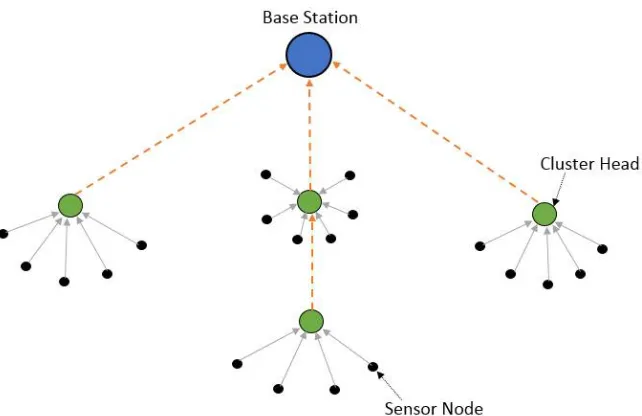
The clusters using ABC shown in figure1. Steps involved In ABC algorithm is
1. Initialize nodes
2. Evaluate fitness value for each node 3. Employed bee phase:
a. Produce new food source (sensing the data) b. Calculate the fit value
Calculate probability value for solution 4. Onlooker bee phase:
a. Chooses a food source depending on probability value (CH node) b. Produce new position
c. Calculate fit value 5. Scout bee phase:
a. If there is an employed bee become scout (loss of energy) b. Then replace it with a random position
Figure 1: Clusters based on ABC algorithm. C. Dynamic Channel Allocation:
While clustering few Cluster Head nodes may heavily loaded, then energy consumption will occur. To maintain uniform energy, load balancing is introduced over clusters. In proposed work Dynamic Channel Allocation is adopted to achieve this [20].
In each cluster is the base station that handles all data/information made within the cluster. The total available bandwidth is divided permanently into a number of channels [17]. Channels must then be allocated to clusters and to data packets made within the clusters without violating the channel reuse constraint. There are a great many ways to maintain reliability of making channels available to new data packets. If no channel is available for a new packet, the packet is lost, or blocked.
As WSN providing security, a huge number of nodes needed to make personal communication with limited spectral bandwidth. The increasing capacity of network system lead to the systematic channel reuse in space [18]. However, plan of channel reuse is impossible due to the network zone shape is highly deformed. To achieve this problem, Dynamic channel allocation is adopted in the proposed work [19].
1. In DCA, all channels are kept in a central pool. A channel is chosen randomly among all the available channels and are assigned dynamically to new calls as they arrive in the system.
2. The first available channel is chosen by linearly searching all the channels, starting from the first channel. This mechanism tends to use more channels with smaller indices, and thus provides a better reuse of used channels. 3. After each call is completed, the channel is returned to the central pool. It is fairly straightforward to select the most appropriate channel for any call based simply on current allocation and current traffic, with the aim of minimizing the interference.
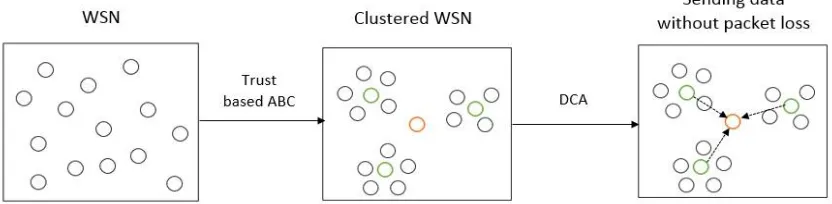
IV.ARCHITECTURE
Figure 2: Architecture of proposed work. V. SIMULATION RESULTS
This part presents the performance results of the clustered WSNs using ABC with the proposed dynamic channel allocation with ABC Algorithm. The performance is measured based on the jitter, delay, and the bandwidth.
The results are analyzed and evaluated in terms of, • Average delay
• Packet Delivery Ratio (PDR) • Throughput
• Residual Energy
The performance analysis is made over the Network Simulator NS 2. The size of the sensing network is chosen as 500x500 meters. The algorithm is implemented using 50 sensor nodes were randomly distributed in the network. Firstly every sensor node initiated with a definite amount of energy and the simulation is performed on every sensor nodes in the network have consumed their energy in whole. Here the whole work is performed in a single network setup. That is, the same number of nodes in the same position is examined in all the experiments presented here.
A. Average Delay:
Figure 3: Delays b/w ABC and ABC with DCA. B. Packet Delivery Ratio:
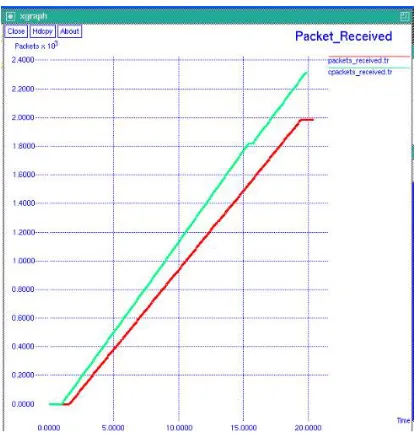
Packet delivery ratio of a WSN is defined as the fraction of the sum of the packet received by the network and the sum of packets transmitted by the network is known as. The transmission and reception of data packets from the nodes are evaluated to arrive a solution to prove the efficiency of the WSN. By the end of simulation, proposed algorithm received 2.3 ratio of packets as the existed ABC has received only 2.0 ratio of packets. The graphical illustration to show packet delivery ratios for ABC with DCA and ABC is provided in Figure 3.
Figure 4: Packet delivery ratios for ABC & ABC with DCA C. Throughput:
in the network. The results proved the proposed ABC with DCA to be greater to that of existing ABC system with values 2.3 and 2.05 respectively. The graphical illustration to show throughputs for ABC with DCA and ABC is provided in Figure 5.
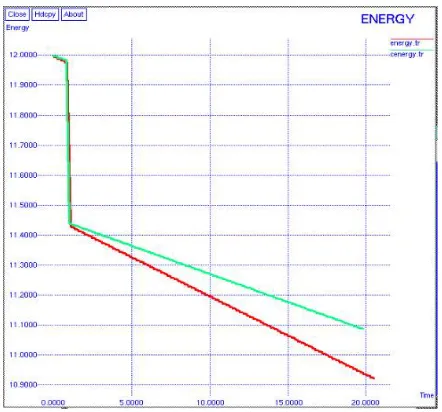
Figure 5: Throughputs for ABC with DCA and ABC D. Residual Energy:
Energy consumption is an important indicator of network performance.The ABC with dynamic channel allocation algorithm consumed the least while the ABC algorithm performed second best. At the end of the simulation proposed algorithm have the highest energy 11.1 whereas the existed has the least energy 10.95.The graphical illustration to show energy consumption for ABC with DCA and ABC is provided in Figure 6.
VI.CONCLUSION
In this work, an energy efficient ABC algorithm with DCA is provided for cluster based packet forwarding without any packet loss in a WSN. Mainly the proposed work need for right selection of cluster head and to maintain stable energy through load balancing on clusters. In the proposed scheme, the sensing nodes are formed into clusters with different roles as an employed node, onlooker node and as a scout node. The CH is selected based on the fitness value of a node. While sending data to the BS, this work avoids packet loss. The merits of the system include lower delay, higher throughput, prolonged network lifetime and hence greater energy efficiency.
REFERENCES
1. Yuan, Yali, et al. "CAF: Cluster algorithm and a-star with fuzzy approach for lifetime enhancement in wireless sensor networks." Abstract and Applied Analysis. Vol. 2014. Hindawi Publishing Corporation, 2014.
2. Ayadi, Ahmed. "Energy-efficient and reliable transport protocols for wireless sensor networks: state-of-art." Wireless Sensor Network 3.03 106 (2011)
3. Selvam, R. Pandi, and V. Palanisamy. "An efficient cluster based approach for multi-source multicast routing protocol in mobile ad hoc networks." International Journal of Computer Networks & Communications (IJCNC) Vol3 154-166 (2011).
4. Islam, MdSafiqul, and Syed Ashiqur Rahman. "Anomaly intrusion detection system in wireless sensor networks: security threats and existing approaches." International Journal of Advanced Science and Technology36.11-8 (2011).
5. Sangi, Abdur Rashid, Jianwei Liu, and Zhiping Liu. "Performance comparison of single and multi-path routing protocol in MANET with selfish behaviors." World Academy of Science, Engineering and Technology 41 828-832 (2010)
6. Ferdous, Raihana, VallipuramMuthukkumarasamy, and ElankayerSithirasenan. "Trust-based cluster head selection algorithm for mobile ad hoc networks." 2011IEEE 10th International Conference on Trust, Security and Privacy in Computing and Communications. IEEE, 2011. 7. Goyal, Deepak, and Malay Ranjan Tripathy. "Routing protocols in wireless sensor networks: a survey." Second International Conference on
Advanced Computing & Communication Technologies. IEEE, 2012.
8. Yu, Yanli, et al. "Trust mechanisms in wireless sensor networks: Attack analysis and countermeasures." Journal of Network and computer Applications 35.3 (2012)
9. Gupta, Shailender, C. K. Nagpal, and Charu Singla. "Impact of selfish node concentration in manets." International Journal of Wireless & Mobile Networks 3.2 (2011).
10. Nguyen, Dang, et al. "New findings on the complexity of cluster head selection algorithms." World of Wireless, Mobile and Multimedia Networks (WoWMoM), 2011 IEEE International Symposium on a. IEEE, 2011.
11. Crosby, Garth V., and Niki Pissinou. "Cluster-based reputation and trust for wireless sensor networks." Consumer communications and networking conference. 2007.
12. Zahariadis, Theodore, et al. "Trust management in wireless sensor networks." European Transactions on Telecommunications 21.4 386-395 (2010)
13. Li, Xin, et al. "Trust-based on-demand multipath routing in mobile ad hoc networks." IET information security 4.4212-232 (2010)
14. Zou, Wenping, et al. "A clustering approach using cooperative artificial bee colony algorithm." Discrete Dynamics in Nature and Society 2010 (2010).
15. Karaoglu, Bora, and Wendi Heinzelman. "Cooperative load balancing and dynamic channel allocation for cluster-based mobile ad hoc networks." IEEE transactions on mobile computing 14.5 951-963 (2015)
16. Kaur, Kiranpreet, and Harjit Singh. "Cluster head selection using honey bee optimization in wireless sensor network." International Journal of Advanced Research in Computer and Communication Engineering 4.5 716-721(2015)
17. Ghotekar, Rahul K., and Deepak C. Mehetre. "Load Balancing for Achieving the Network Lifetime in WSN-A Survey." (2014).
18. Wajgi, Dipak, and Nileshsingh V. Thakur. "Load balancing algorithms in wireless sensor network: A survey." International Journal of Computer Networks and Wireless Communications (IJCNWC) 2 456-460 (2012)
19. Gupta, Gaurav, and Mohamed Younis. "Load-balanced clustering of wireless sensor networks." Communications, 2003. ICC'03. IEEE International Conference on. Vol. 3. IEEE, 2003.
20. Sundararajan, Rekha, and Kripalini Gopal. "Algorithms for Dynamic Channel Allocation In Cellular Networks."Communications, 2002. ICC'03. IEEE International Conference on. Vol. 5. IEEE, 2002.
BIOGRAPHY