THE EFFECTS OF ‘BREAKTHROUGH’ MORPHINE ON
COGNITIVE FUNCTIONING IN CHRONIC OPIOID-USING
PATIENTS IN PALLIATIVE CARE
VOLUME 1
SUNJEEV KAMBOJ
D.CIin.Psy. 2003
ProQuest Number: 10011144
All rights reserved
INFORMATION TO ALL USERS
The quality of this reproduction is dependent upon the quality of the copy submitted.
In the unlikely event that the author did not send a complete manuscript and there are missing pages, these will be noted. Also, if material had to be removed,
a note will indicate the deletion.
uest.
ProQuest 10011144
Published by ProQuest LLC(2016). Copyright of the Dissertation is held by the Author.
All rights reserved.
This work is protected against unauthorized copying under Title 17, United States Code. Microform Edition © ProQuest LLC.
ProQuest LLC
789 East Eisenhower Parkway P.O. Box 1346
TABLE OF CONTENTS
PAGE
ABSTRACT vii
ACKNOWLEDGEMENTS ix
1. CHAPTER 1. INTRODUCTION p. 1
1.1. Layout of Chapter
1.2. The Use of Opioids in Pain Management 1.2.1. A Brief History Of Medical Opioid Use 1.3. Classification of Opioids and Their Receptors
1.3.1. The Neuropharmacology of Opioids: Different Types of Opioids 1.3.2. Opioid Neurotransmitter Receptors
1.4. The Use of Opioids in Pain Management in Palliative Care 1.4.1. The Scope of Opioid Use in Treating Chronic Pain
1.4.2. Classification of Patients in Palliative Care 1.5. Opioids and Cognition
1.5.1. Morphine-Like Opioids, Cognition and Psychomotor Functioning 1.5.2. Research on Healthy Volunteers
1.5.3. Research on Opioid Mi susers 1.5.4. Studies on Chronic Pain Patients
1.5.5. Summary of Research on Opioids and Cognition 1.6. Aims and Objectives of the Current Study
2. CHAPTER 2. METHODS p.33
2.1. The Research Setting 2.2. Ethical Approval 2.3. Participants 2.3.1. Recruitment
2.3.2. Inclusion and Exclusion Criteria 2.4. Procedure
2.5. Design
2. 6. Drug Preparation 2.7. Measures
2.7.1.1. Mood
2.7.1.2. Physical sensation: Mouth Dryness 2.7.1.3. Pain
2.7.1.4. Subjective drug effects 2.7.1.5. Guess on treatment
2.7.2. Assessments of psychomotor speed 2.7.3. Cognitive assessments
2.7.3.1. Episodic memory. 2.7.3.2. Digit span
2.7.3.3. Everyday attention. 2.7.3.4. Verbal fluency 2.7.3.5. Trail making task
2.7.3.6. Order of Test administration 2.8 Other information obtained 2.9 Statistical Analysis
3. CHAPTER 3. RESULTS p. 49
3.1. Sample Characteristics 3.1.1. Demographics
3.1.2. Relevant Medical Details 3.1.2.1. Drugs and Illness 3.1.2.2. Mobility
3.1.2.3. Neurological and Other Health Factors
3.1.3. Characteristics of Non-participants who met criteria but did not consent. 3.2. Experimental measures
3.2.1. The Mood Rating Scale (MRS)
3.2.2. The Hospital Anxiety and Depression Scale (HADS) 3.2.3. Pain
3.2.4. Other Subjective Treatment Effects 3.2.5. Physical sensation: Mouth dryness 3.2.6. ‘Guess’ on treatment
3.2.10. Verbal fluency
3.2.11. Test of Everyday Attention (TEA): Map Search 3.2.12. TEA: Telephone search
3.2.13. TEA: Elevator Counting Without and With Distraction 3.2.14. TEA: Telephone Search While Counting
3.2.15. Reitan’s Trails: Psychomotor Speed / Conceptual Flexibility 3.2.16. Digit Span
3.3. Correlations
4. CHAPTER 4. DISCUSSION p.
4.1. Layout of this Chapter 4.2. Key findings
4.3. Impaired Episodic Memory
4.3.1. Marginal Impairment on Immediate Recall 4.3.2. Significantly Impaired Delayed Recall 4.3.2.I. ‘Anterograde Amnesia’
4.3.2.I.I. Morphine-Induced Anterograde Amnesia: Previous Studies 4.3.2.2. ‘Retrograde Amnesia’
4.3.3. Impaired Episodic Memory: A Secondary Effect of Sedation? 4.3.4. The Neurochemisty of the Episodic Memory System.
4.4. Enhanced Psychomotor Speed: Improved Trials A Performance 4.5. Conceptual Flexibility / Set Shifting Impairment
4.6. Cognitive Assessments Apparently Unaffected by Breakthrough Morphine 4.6.1. Verbal Fluency
4.6.2. Forward Digit Span 4.6.3. Backward Span
4.6.4. Tests of everyday Attention
4.7. Subjective Measures and Guess on Treatment 4.7.1. Mood
4.7.2. VAS Measures 4.7.2.I. The MRS
4.7.2.2. Subjective Drug Effects 4.7.2.3. Pain
4.9. Strengths and Limitations of the Current Study 4.9.1. Strengths
4.9.2. Limitations and Suggestions for Future Research 4.9.2.1. Possible Variability in Patient Illness Severity 4.9.2. Sample size
4.10. Validity of the Study 4.10.1. External Validity
4.10.2. Generalizability: Age of Participants
4.11. Clinical Implications of Impairment Caused by Breakthrough-Morphine 4.12. Recommendations
4.13. Summary
REFERENCES APPENDICES
P. 92 P. 106
LIST OF TABLES
Table 1.1. The Classification of Opioids
Table 1.2. The milligram-equivalent dose of various morphine-like analgesics producing the same analgesia as 10 mg of injected morphine.
Table 3.1. MRS Mood Factor Values for the Four Measurement Intervals. Table 3.2. HADS Scores Under the Two Testing Conditions
Table 3.3. Pain Indices on the Four Measurement Intervals. Table 3.4. Subjective Treatment Effects
Table 3.5. Performance on Elevator Counting Without and With Distraction Table 3.6. Completion Times for Trails A and B, and B minus A
LIST OFHGURES
Figure 3.1. Pain Relief Following Treatment
Figure 3.2. Immediate recall during four testing occasions
ABREVIATIONS
BDZ Benzodiazepine DTU Day Therapy Unit
DSST Digit-Symbol Substitution Test MRS Mood Rating Scale
ABSTRACT
Patients with chronic (malignant and non-malignant) pain are increasingly being treated with powerful opioids. The trend in palliative care is to use morphine or similar opioids earlier in the natural course of illness. This increased use of morphine and its analogues has alerted physicians to possible adverse cognitive effects of these drugs, which had previously been neglected
Such cognitive impairment is most likely to occur when morphine-therapy is commenced, or when there is a significant increase in the patient’s morphine intake (dose escalation). However, there is no data on the ‘acute-on-chronic’ effects of morphine on subjective ratings, psychomotor performance or cognitive functioning in pain-patients receiving long-term, maintenance opioids.
The current study aimed to address this gap in the current knowledge by investigating the effects of acute - ‘breakthrough’ - morphine on psychomotor and cognitive functioning in patients who were also taking long-acting, ‘morphine-like’ opioids.
Using a double-blind cross-over design, 14 patients receiving palliative care were assessed on 2 occasions: once before and after their breakthrough morphine, and once before and after placebo.
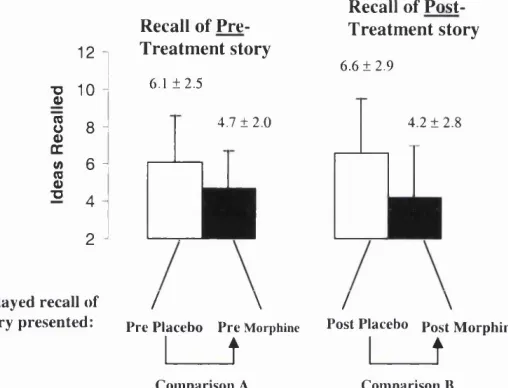
morphine recalled a story they heard before morphine. Evidence for executive function deficit was obtained on the Reitan’s Trials task.
Although breakthrough-morphine produced significantly more self-rated pain-relief than placebo, patients could not distinguish between the two treatments. Finally, patients did not seem to respond to the reinforcing effects of morphine and neither were they susceptible to changes in mood ratings following their breakthrough dose.
ACKNOWLEDGMENTS
This was an interesting and challenging project that could not have been completed without the co-operation and collaboration of a number of individuals.
I would firstly like to thank the patients and staff at Edenhall, Marie Curie Centre in Hampstead, London, for their help in completing this project. The dedication of the staff to patient care was a true inspiration. In addition however, they were always warm and
welcoming to visitors, such as myself, and were able to find the time to help with this study. In particular, I would like to thank Nicky Grundy, and Dr Karon Von Scharpen in the day therapy unit, and Drs Clare Turnbull, Fay Gishen and Fiona Rogers, the inpatient doctors, for helping to identify potential participants.
My greatest dept of gratitude is however, to the patients, who were generous with their time, and often showed amazing courage in the face of extreme suffering. Getting to know them - however briefly - was a profound experience: sometimes harrowing, but ultimately
enriching.
Professor H. Val Curran and Dr Adrian Tookman, my internal and external supervisors respectively, were very encouraging and helped tackle difficulties encountered at various stages of the project. Their help and support is very gratefully acknowledged. Val also read and commented on the chapters herein, and the resulting thesis is much improved due to her input. Thanks also go to Dr Pasco Fearon, who provided valuable advice on statistical analysis.
CHAPTER 1. INTRODUCTION
Chronic and debilitating pain is a fact of life for many millions of people around the world. In addition to the accompanying torment, chronic pain places severe limitations on social, psychological and occupational functioning.
The prolonged suffering of individuals with a variety of painful conditions is averted to some extent by the use of powerful pain-killing substances, in particular, the opioids. Opioid drugs have however, had a chequered history in clinical medicine, and it is only in the last decade or so that potent opioids have (re)gained wide acceptance in the medical community. This followed a period in the 1970s and 1980s when their therapeutic use was heavily restricted, mainly because of concerns about dependence and ‘addiction’ (especially in the USA). This has given way to a more realistic and humane approach to pain relief; it is now accepted that the risk of addiction is quite low (<1 %) in patients with chronic pain (Chapman & Hill, 1989).
On the other hand, the increased use of opioid analgesics has made patients and
These possible adverse reactions notwithstanding, opioid medications offer chronic pain patients a life line which may prevent their suffering becoming unbearable. In addition, it is possible that some such patients perform better in physical and cognitive activities when they are taking opioids than when they are not, as they may be less distracted by their pain. Other patients may choose, on balance, to forego higher levels of analgesia for increased levels of lucidity.
Overall then, patients and their doctors often need to carefully balance the degree of pain relief achieved with an acceptable level of mental alertness when determining the dose and frequency of opioid administration.
1.1. LAYOUT OF THIS CH APTER
This introductory chapter is divided into five main sections. The first will discuss the use of opioids in pain management from a historical perspective. The second section
1.2. TH E USE OF OPIOIDS IN PAIN M ANAGEM ENT 1.2.1. A BRIEF HISTORY OF MEDICAL OPIOID USE
A substantial pharmacopoeia of analgesics has been discovered (or manufactured) over the course of medical history. These have included folk-, herbal- or natural-remedies, and more recently, synthetic analogues of naturally occurring analgesics. Of these, the compounds derived from opium are the most potent.
Opium itself is a mixture of around two dozen active narcotic agents, and is derived from the simple flowering plant, Papaver somniferum, or the poppy. Unripe poppy seeds produce a milky liquid which when dried, produces a brown paste, and through further processing, yields opium powder.
The poppy is likely to have been used by Mankind since prehistoric times. A written reference to poppy juice appears in the third century BC. In the Middle Ages opium was used throughout Asia to control dysentery, and its use spread to Europe in the 16* Century where physicians began exploiting its pain killing properties (see Vertosick, 2000). In the medieval era, Laudanum - meaning “praiseworthy” - was discovered by the physician, Paracelsus when he mixed opium with ether. Many references to laudanum use (and misuse) subsequently appeared in Victorian literature.
In the nineteenth century two of the naturally occurring opium alkaloids (organic
available at that time. It was marketed variously as an anti-tusive, anti-diarrhoeal, a general elixir for the treatment of ‘nervous illnesses’, and as a pain killer (Shorter, 1997).
Although the use of opium as an analgesic is likely to have pre-dated its use by the physicians of ancient Greece by many millennia, a revolution in analgesic medicine took place when morphine became available for injecting into the blood stream. Indeed, one of the first uses of the hypodermic syringe by Alexander Wood, an Edinburgh physician in 1855, was to deliver morphine directly into the circulation (Shorter, 1997). In addition to the analgesic effect. Wood noted the effects of morphine on cognition.
He described the use of morphine in an elderly woman with chronic shoulder pain and agitation, thus:
"On November 2 8 ,1 visited her at 10 P.M. to give the opiate the benefit of the night. Having ascertained that the most tender spot was in her shoulder, I inserted the syringe.... and injected twenty drops of solution of murate of morphia.... she began to complain of giddiness and a confusion o f ideas" (quoted in Shorter, 1997; italics added).
More recently, extremely potent opioids, such as fentanyl and alfentanil, have been manufactured. These opioids may produce an equal level of analgesia to morphine, but at far smaller doses (see Table 1.2). In addition, developments in the pharmaceutics of opioids allows these drugs to be delivered into the body through a variety of routes.
1.3. CLASSIFICATION OF OPIOIDS AND THEIR RECEPTORS
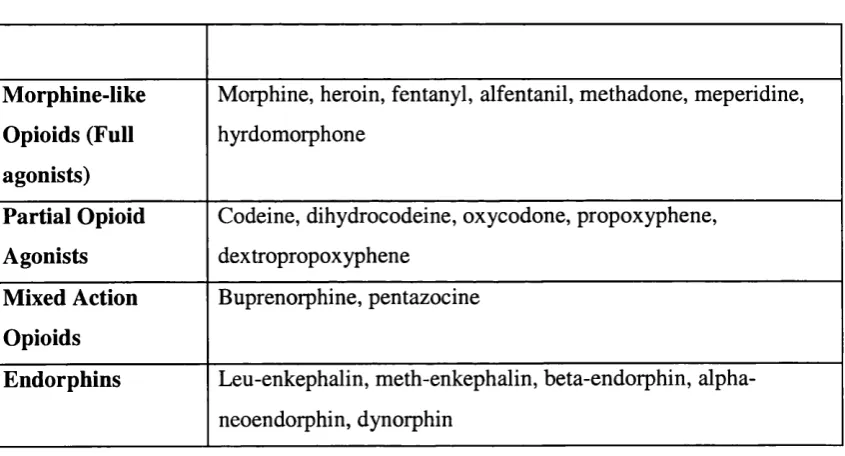
1.3.1. THE NEUROPHARMACOLOGY OF OPIOIDS: DIFFERENT TYPES OF OPIOIDS The term ‘opioid’ refers to drugs and endogenous hormones which activate the opioid neurotransmitter system. Opioid drugs are generally classified as [1] ‘morphine-like opioids’ (full agonists), [2] ‘partial agonists’ and [3] mixed agonists-antagonists (Jaffe and Martin, 1990). The main difference between these classes of drugs is the strength of the analgesia produced. The order of analgesic potency is [1] morphine-like (full-) agonists > [2] partial agonists > [3] mixed agonists-antagonists. A further distinction is the rate at which these drug classes produce tolerance, with the morphine-like opioids producing tolerance (to analgesic and euphoric effects) relatively rapidly compared with both partial agonists and mixed action drugs.
Thus, methadone can be given as a single oral dose once or twice daily, whereas heroin needs to be infused continuously to maintain analgesia.
In addition to the opioid drugs, naturally-occurring hormones - the endorphins
{endogenous morp/ime-like peptides) also activate the opioid receptors. Examples of the
different opioids (drugs and naturally occurring substances) are summarised in Table 1.1.
Table 1.1: The Classification of Opioids
Morphine-like Opioids (Full agonists)
Morphine, heroin, fentanyl, alfentanil, methadone, meperidine, hyrdomorphone
Partial Opioid Agonists
Codeine, dihydrocodeine, oxycodone, propoxyphene, dextropropoxyphene
Mixed Action Opioids
Buprenorphine, pentazocine
Endorphins Leu-enkephalin, meth-enkephalin, beta-endorphin, alpha- neoendorphin, dynorphin
the endorphins have wider effects in the CNS. For example, they may produce changes in arousal or cognitive ability in humans (see for example, Prudic et a l, 1999).
1.3.2. OPIOID NEUROTRANSMITTER RECEPTORS
Opioid receptors are widely distributed in the body. For example, peripherally, opioids act at sites close to tissue damage to reduce inflammation. In the central nervous system (CNS, i.e. the brain and spinal cord) they interact with sensory neurones to alter pain signalling to the brain, as well as affecting the actual perceptual experience of pain through direct effects on the brain (Kandel et al, 1991).
Opioids act on three distinct neurotransmitter receptor subtypes in the brain which have been defined on the basis of their drug binding properties. These receptors subtypes are classified as ‘mu’, ‘delta’ and ‘kappa’ receptors.
It is thought that while analgesia occurs through the activation of any of the three receptor subtypes, addiction is mediated primarily by the activation of mu receptors. Mu receptors are the receptor subtype which are most strongly activated by the morphine like opioids (Kandel et al., 1991). On the other hand, morphine-like opioids are weak agonists at delta and kappa receptors.
agonists at the delta and kappa receptor subtypes, but may act as antagonists at the mu receptor subtype (Jaffe and Martin, 1990).
Opioid receptors are concentrated in the anterior cingulate gyrus (ACG) where their activation is linked to pain perception. The ACG is thought to modulate attention to adverse internal stimuli. It is interesting to note that patients in pain often comment that although their pain is still ‘with them’, they are not as bothered by it after taking an opioid analgesic (Wall, 1999). It is as if their attention has been diverted away from the pain, an effect which may be mediated through opioid actions on the ACG. It is unclear if ‘externally directed’ attention is similarly mediated through the opioid system.
Although the ACG has a large concentration of opioid receptors, these receptors are in fact widely distributed in the CNS, and this suggests that their role extends beyond modulation of pain. Thus, opioids alter dopaminergic functioning in the ventral tagmental region and the nucleus accumbens (which function as the brain’s reward system). This may account for their addictive potential. Furthermore, opioids interact with the cholinergic system (Feuerstein et al., 1998) which has itself been implicated in modulating ‘declarative’ memory (see Drachman and Leavitt, 1974).
of the partial- or mixed-action compounds which, because they act through different receptor subtypes (kappa/ delta), may produce tolerance more slowly.
1.4. THE USE OF OPIOIDS IN PAIN MANAGEMENT IN PALLIATIVE CARE The term ‘palliative care’ ' refers to a treatment philosophy involving the active, and total care of patients whose disease is not responsive to curative treatment. As such, the principal aim is ‘symptom management’, and pain control plays a central role in this. Palliative care teams often treat severely painful conditions in the terminal stages of illness (usually cancer). However, they also treat patients who, despite their extreme pain, are not terminally ill. These patients include chronic back-pain sufferers and individuals with pain associated with multiple sclerosis.
Education and raised awareness among physicians has resulted in a trend in palliative care to commence opioid therapy earlier in the natural history of a disease, when the expectation of a ‘normal life’ are greatest (see Wood et al, 1998). Consequently, the cognitive and ‘neurotoxic’ effects of opioids have begun to attract increasing interest.
A variety of opioids is available to physicians. These compounds vary in terms of their efficacy in reducing pain, with morphine and the morphine-like opioids (such as methadone, diamorphine and fentanyl), generally reserved for the treatment of severe pain. These drugs can be delivered through a variety of routes (orally, subcutaneously, intramuscularly, intravenously and through trans-dermal patches) and have the
advantage that a great deal is known about their effects, side-effects, indications, contraindications and limitations. This makes them appealing to physicians, as they can relatively easily predict their effects on particular patients.
It is possible to switch between the different opioids (for example during ‘opioid- rotation’ ; see below) without interruption of pain relief. This is made possible through knowledge of the equianalgesic doses of various opioids relative to morphine (see Table
Table 1.2: The milligram-equivalent dose of various morphine-like analgesics producing the same analgesia as 10 mg of injected morphine (after Zacny, 1995).
Morphine-like agonist Opioid dose
Morphine IM, IV, SC 10.0
O 60.0
Hydromorphone IM, SC 1.3
O 7.5
Diamorphine IV, SC 5.0
Meperidine IV, IM 75.0
O 300.0
Fentanyl IV 0.1
Alfentanil IV 0.5
Methadone IM, SC 10.0
O 20.0
O = oral; IV = Intravenous; SC = subcutaneous; IM = intramuscular
More recently, opioids have increasingly been used to treat non-malignant chronic pain conditions (such as chronic and severe back pain), although this is a somewhat
controversial practice (see, Sjogren et al, 2000a).
Opioid management of chronic pain (malignant and non-malignant) often involves a two-pronged approach. The first is to prescribe a long-acting (maintenance) opioid preparation. The aim here is to maintain a fixed concentration of opioid in the
1.4.2. CLASSinCATION OF PATIENTS IN PALLIATIVE CARE
In palliative care settings, patients vary widely in terms of the amount of pain they experience and the amount of pain relief they request. Broadly however, two classes of patient may be discerned and classified as follows (A. Tookman, personal
communication) :
1) Patients requiring frequent breakthrough medication and as a result mav be susceptible to severe neurotoxic effects of opioids
A proportion of palliative care patients require frequent (more than twice a day) additional opioid pain-relief (on top of their maintenance, long acting, opioid
medication) in the form of a short-acting, breakthrough opioid. The standard practice is to use morphine sulphate (oramorph or sevredol) as the breakthrough medication, at a dose corresponding to roughly one-sixth of the total 'long-acting' (maintenance) dose, corrected for morphine equianalgesia^. The breakthrough dose may be adjusted upwards or downwards from the 1/6* level if inadequate analgesia or adverse reactions are experienced.
Although this is a heterogeneous population, they share a common difficulty, which is to try to obtain an acceptable level of pain relief while avoiding the more severe
‘neurotoxic’ side effects of morphine(particularly delirium and hallucinations).
^ For example, a patient on 1 mg o f fentanyl a day as maintenance medication (equianalgesic to 100 mg o f morphine; see Table 1.2), would be given 15 mg o f oral morphine as breakthrough, which is roughly
Their pain is often difficult to manage as, on the one hand, it becomes increasingly unresponsive to opioids due to tolerance, while on the other, excessive consumption of opioids can produce unwanted (non-analgesic) effects such as drowsiness, acute confusional states, psychomotor clumsiness, and in more extreme cases, psychotic symptoms.
Such patients are often limited in terms of the types of activities they can engage in. For example they are often advised against engaging in activities which require rapid
reaction times or tasks requiring the simultaneous use of several cognitive functions (e.g. executive function). Thus relatively ‘automatic’ tasks, such as driving, in addition to more complex reasoning and decision making skills, may be affected by opioid effects on cognition in these patients.
The dilemma facing physicians treating these patients has been summed up thus:
"'The most frequent complaint against physicians managing terminal pain is that they
are too stingy with narcotics. The common wisdom is that we are so afraid o f addiction
and abuse that we don’t give patients what they need. Although this is partly true, the
idea that narcotics are the answer to all our pain problems is false. There is no way
narcotics can provide what the public demands: pain-free lucidity. The doses required to
achieve freedom from pain are going to cause severe mental aberrations in most
patients."' (Vertosick, 2000, p249).
One way of reducing these mental and cognitive disturbances is to employ the practice of ‘opioid rotation’, whereby the main, long-acting opioid used by the patient is
frequently changed - or rotated - as tolerance develops to it (de Stoutz et al., 1995). This allows relatively smaller doses of an alternative opioid to be used, to reduce side effects, while maintaining the same level of pain relief. The initial dose of the alternative opioid is determined from ‘equianalgesia’ tables (see Table 1.2).
2) Patients using breakthrough medication infrequently who mav experience some
desree of cognitive impairment
Another group of chronic pain patients is maintained on long-acting opioids but only
infrequently require break-though medication (generally once a day or less). Again, this
to be terminally ill. These patients are said to be ‘stable’, both in terms of their pain, and the doses of opioid they require.
Some recent research and anecdotal reports suggest that these patients complain of ‘mental clouding’ following their dose of opioid which affects their ability to engage in, and enjoy daily activities and tasks (see Raja et al, 2002). For example, they may have difficulties in remembering the details of a passage of text which had just been read, or in following a television programme^. On the other hand, some patients in this category
may (legally) drive, and many continue to do limited work.
However, the existence of cognitive impairment in pain patients who take opioids is controversial and some researchers and clinicians insist that adverse cognitive reactions abate within days of commencing opioid therapy. For example, Patrick Wall, the
prominent pain researcher, was optimistic about the possibility of achieving pain control with minimal cognitive impairment:
By this [20th] century, it was finally realised that low doses [o f opium] had a purely
analgesic action while leaving the patient thinking in a clear fashion.... A cool, calm
analysis o f the effects o f narcotics showed that doses carefully titrated to bring pain to
a bearable level led to a patient in comfort with clear thinking (Wall, 1999, p ll5 ).
^ Such patients may fulfil D S M IV criteria for Cognitive D isorder N ot O therwise Specified (NOS),
Indeed, Dennis Potter, the television play write, was able to complete two plays in the final months of his life, while he was on morphine. In a poignant television interview with Melvyn Bragg (broadcast on 5* April, 1994; Channel 4) he related his difficulties in trying to balance work with the need to control his cancer pain using morphine. The interview had to be stopped on several occasions (although filming continued) while Potter swigged doses of oral morphine from a hip flask. He said:
“/my doctor]... has so gently and carefully led me to a balance between pain control and mental control, where I can work. H e ’s given me the liberty, and he's had the
intelligence to see that I can create a space to do ten pages a day, fla t out.''
However other anecdotal reports and research suggest that, while avoiding severe cognitive disturbances, patients who use maintenance opioids (with or without
breakthrough opioids), experience some level of cognitive impairment (e.g. Bruera et al,
1989; Sjogren et al, 2000 a and b). Impairment is especially likely when patients have either recently commenced opioids therapy, or have undergone a significant increase in their dose of opioid (Bruera et al, 1989; Zacny, 1995). However, the extent and severity of cognitive impairment has yet to be fully investigated. Furthermore, no literature exists on the effects of acute elevation of morphine dose, e.g. following breakthrough
medication.
1.5. OPIOIDS AND COGNITION
Drugs which have effects on the CNS may, a priori, be expected to produce effects on cognition through non-specific actions on arousal, especially when the drugs in question also produce sedation. Many psychoactive compounds (e.g. alcohol, benzodiazepines, antihistamines, anticholinergics, antipsychotics, tricyclic antidepressants) produce delirium-like confusional- and drowsiness-states when given in large doses (see Curran, 2000). However, at lower doses, more specific effects may emerge, as shown in studies on the benzodiazepines (such as valium) and anticholinergics (such as scopolamine) which impair performance on anterograde memory tasks while leaving other cognitive processes / functions relatively intact (see e.g. Curran, 1991).
On the other hand, an important limitation of human psychopharmacological studies in studying particular cognitive functions or processes (in comparison to
neuropsychological lesion studies) is that centrally acting drugs have a diffuse action, and tend to produce global changes in cognitive performance. In the case of ‘ecological’ studies (i.e. those that may have a greater bearing on everyday functioning), such as the present one, this lack of specificity on particular cognitive domains is less of a concern since the aim is not to investigate the ‘mechanisms’ or ‘processes’ of - for instance - memory {c.f. Weingartner et a l, 1995)
confused picture is the variety of doses and routes of administration used by different researchers. This makes comparisons between studies complicated.
The populations which have been studied in this field have included healthy volunteers with no history of opioid (mis)use (see for example, O ’Neill et al., 2000), patients on detoxification programs (typically former heroin misusers currently taking methadone; e.g. Curran, et al, 2001; Mintzer and Stitzer, 2002) and chronic pain patients (e.g. Bruera
et a l, 1989; Sjogren et al, 2000 a and b).
A review by Zacny (1995) cites a number of studies in which opioid effects on cognition and psychomotor functioning is documented in these various populations. Since that review, a number of further studies have been published which investigate the subjective, neuropsychological and psychomotor performance in these different populations (e.g. Adunsky, 2002; Bauer, 2002; Cleeland et a l, 1996; Curran, et a l,
2001; Hunt et a l, 1999; Lorenz et a l, 1997; Mintzer and Stitzer, 2002; O’Neill et a l,
2000; Prudic et a l, 1999; Raja et a l, 2002; Sjogren et a l, 2000 a and b).
1.5.1. MORPHINE-LIKE OPIOIDS AND THEIR EFFECTS ON COGNITION AND PSYCHOMOTOR FUNCTIONING
The types of measures used in the study of the effects of morphine-like opioids and cognitive / psychomotor functioning can be broadly defined as: [1]
psychophysical/perceptual/physiological, [2] simple reaction times [3] information processing, [4] sustained attention and [5] memory (immediate and delayed).
Given that there is a very limed literature on cognitive performance in pain-patients receiving opioids, it is perhaps appropriate to consider the wider literature (including that in healthy volunteers and opioid misusers) which may be of relevance to the current study, in order to document the types of tasks and measures used, and the effects found.
1.5.2. RESEARCH ON HEALTHY VOLUNTEERS
The majority of studies on morphine-like opioids and cognition have been conducted on healthy volunteers. Studies on this population have a number of advantages over similar investigations in clinical samples. In particular, they often (though not always) control for poly-drug use in participants, thus allowing the specific effects of opioids to be investigated. Also, because volunteers are not in pain, they are able to endure more lengthy testing on multiple occasions, allowing dose-response relationships to be investigated and for participants to act as their own controls (in within participant, cross over designs, e.g. O ’Neill et a l, 2000). Furthermore, pathological events and processes (e.g. pain, secondary brain tumours) do not contaminate neuropsychological
The aim of these studies may be to determine the neurochemical role of the opioid neurotransmitter system in specific cognitive processes. However, in addition to their theoretical interest, these studies may also have direct bearing on clinical practice (in terms of prescription of opioids to clinical samples) as opioids are increasingly being used in outpatient settings (e.g. minor surgery or dental procedures; see Vertosick, 2000).
In terms of psychophysical/perceptual/physiological functioning (e.g. saccadic eye movement, nystagmus, distance perception, critical flicker frequency (CFF)), studies on the morphine-like opioids (in particular, morphine, hydromorphone, heroin, methadone, fentanyl and alfentanil and meperidine) on the whole, show no change in performance in participants compared to control conditions (pre-drug or no-drug day or placebo group; reviewed in Zacny, 1995). Studies which measured simple reaction times have either showed no impairment following opioid (see Cleeland et a l, 1996), or improvements following morphine (Brooke et a l, 1998; Hanks et a l, 1995; O ’Neill et a l, 2000).
Typically, basic information processing performance has been measured using coding tasks. The results are again somewhat inconsistent. For example, performance on the Digit-Symbol Substitution Task (DSST) of the Wechsler Adult Intelligence Scale (WAIS) was been found to be either unaffected, or impaired, in two different studies using the same dose of intravenous morphine by the same research group (Zacny et al,
Several studies on sustained attention (using, for example, 10 or 20 minute choice reaction times or 10 minute letter cancellation) indicate no change in performance using meperidine, fentanyl, alfentanil and methadone over a range of morphine- equivalent doses (Smith et a l, 1962, cited in Zacny, 1995; Primac et al, 1957, cited in Zacny, 1995; Appel, 1982; Scanunan et a l, 1984). However, one study did show impairment on a 10 minute reaction time task using 10 mg of slowly infused morphine (Westerling et al,
1993). However the same study failed to show comparable impairment when morphine was delivered as an acutely acting, or as a controlled released oral preparation.
Memory studies in healthy volunteers have also produced varying results which may again, be attributed to the use of different morphine-like opioids, different routes of delivery, but also, the use of different tests to measure recall. Three studies investigating the effects of morphine on immediate verbal recall using digit span (Saddler et ah,
1985) and word recall (Cleeland et a l, 1996; O ’Neill et a l, 2000) showed no impairment following morphine. On the other hand, acute fentanyl produced a significant impairment in digit span (Ghoneim et ah, 1975).
In terms of delayed recall (of words or narrative), impairment has been found following intravenous morphine infusion (Kerr et ah, 1991) and oral morphine (Cleeland et ah,
1996; O ’Neill, 2000), but not with fentanyl (Ghoneim et ah, 1975; Scamman et al,
1984).
general) on cognitive performance. One seemingly consistent finding, however, is impairment in delayed recall following morphine.
1.5.3. RESEARCH ON OPIOID MISUSERS
Studies on opioid misusers are of particular clinical relevance to the current study, in that they investigate cognitive performance in a population which takes opioids
regularly, and whose everyday functioning may consequently be affected. A proportion of opioid misusers will be enrolled on methadone maintenance programs which attempt to introduce stability into their lives. The aim is to promote reintegration into
mainstream society, and perhaps to increase occupational functioning.
suffer from Axis I and II psychiatric disorders, and may also have a high prevalence of head injuries (Darke et a l, 2000).
Some of these difficulties can be overcome by using within-participant designs in inpatient detoxification settings, and measuring the acute effects of ‘therapeutic’
methadone (which is the drug of choice in heroin detoxification). However, such studies are very limited in number {cf. Curran et al., 2001). Other studies (using a between participant design) have attempted to control for socio-economic variables while screening for illicit drugs in outpatient heroin detoxification programs (e.g. Mintzer & Stitzer, 2002).
As might be expected, many of the studies of opioid misusers have indeed focused on the effects of methadone rather than other opioids (see Zacny, 1995; Darke et ah, 2000; Specka et ah, 2000; Curran et ah, 2001; Mintzer & Stitzer, 2002). One question which is of particular interest in these studies is the extent to which tolerance may have
developed to any cognitive effects of methadone following chronic use. This would be suggested by a lack of effect of methadone on a particular measure (issues of power and test sensitivity notwithstanding).
has also been found in three early studies (Gordon, 1970; Rothenberg et aL, 1977; Kelley et a l, 1978).
More recent studies, which have compared opioid abusers enrolled on methadone maintenance programs with matched controls (in terms of age, IQ and socio-economic status) found that various complex cognitive tasks were adversely affected in the methadone maintenance patients (Darke et a l, 2000; Specka et a l, 2000; Mintzer & Stitzer, 2002). The study by Mintzer and Stitzer (2002), for example, which carefully controlled for polydrug use, found impairment in psychomotor speed, working memory, decision making and metamemory. Measures of time estimation, conceptual flexibility and delayed recall were unaffected.
1.5.4. STUDIES ON CHRONIC PAIN PATIENTS
The aim of opioid-therapy in pain-patients (malignant and non-malignant) is to reduce pain symptoms, suffering, and environmental reinforcers of pain-inducing behaviours. Further aims include reducing dependence on health care services and, if possible, resumption of employment. These aims are often dependent on optimal cognitive and psychomotor performance, as well as adequate pain control.
As stated previously, the majority of previous studies suffer from methodological limitations which do not allow firm conclusions regarding the extent and severity of possible impairment to be made. Furthermore, few studies have attempted to assess cognitive functions that are relevant for daily function in this population (such as driving and operation of machinery, which requires the ability to concentrate, vigilance,
motivation, and intact memory).
For ethical and practical reasons, psychopharmacological studies in pain-patients have generally been restricted to patients who have just conunenced opioid therapy or who have undergone a ‘dose-escalation’. This research suggests that these patients experience some degree of cognitive impairment as a result of either beginning opioid-therapy or
undergoing a dose escalation. As mentioned previously, there is no literature to date on the ‘acute-on-chronic’ effects of breakthrough morphine in chronic-pain patients.
reliability and validity of the MMSE), and a tendency to use ‘clinical judgement’ as a basis for determining, or ‘diagnosing’ cognitive impairment (see Wood et aL, 1998 for a more detailed criticism of these approaches).
Given these difficulties, and the fact that cognitive impairment is often subtle in patients who are otherwise alert and ambulatory, it is possible that cognitive and psychomotor impairment may have been overlooked. This may also account for the belief among some clinicians that morphine-like opioids do not cause impairment (see quote by Wall, above; Wall, 1999).
Morphine-induced cognitive changes in pain patients are likely to interact with environmental, psychological, social and physiological factors (which are relevant to their experience of pain) in a complex ‘body-self matrix’ (Melzack, 1999). Thus, whereas in healthy volunteers it is assumed that performance is affected principally by the drug (other variables being controlled for), pain-patients’ cognitive performance is likely to be affected by the pain itself (with pain possibly acting as an ‘arousing’ stressor on the one hand, or a distressing and distracting influence, on the other). This clearly complicates research with this population and necessitates the use of patients whose pain is ‘stable’ in such research.
action of opioids), actually improves functioning. Indeed, one recent report showed that an index of information processing ability (the P300 component of auditory evoked potentials) was enhanced in 6 pain patients during an acute phase following the conunencement of morphine-therapy in chronic pain patients (Lorenz et aL, 1997).
The study by Lorenz and colleagues (Lorenz et a l, 1997) investigated acute effects of morphine in patients who had just commenced opioid therapy for non-malignant chronic pain. It may be that in these early phases of treatment, when morphine is most effective at ‘removing’ pain, there is a possibility of enhanced performance.
In another study, patients with chronic non-malignant pain maintained on a variety of (morphine-like and mixed action-) opioids tended to show impairment in measures of concentration / attention (choice reaction time) and basic psychomotor functioning (finger tapping speed) compared to age and sex matched controls (Sjogren et al, 2000a). However there was found to be a positive correlation between visual-analogue pain ratings and performance on a working memory task (Paced Auditory Serial Addition Test; PAS AT) in the patient group, suggesting enhanced performance in those with some residual (uncontrolled) pain.
was likely that performance on the PAS AT was influenced more strongly by pain than opioids.
When patients’ pain is not sufficiently well controlled by their maintenance dose of morphine, and frequent breakthrough doses continue to be required, ‘dose-escalation’ is often considered. This involves an immediate, 30% increase in the daily maintenance dose of morphine. In a widely cited study by Bruera et al (1989), patients undergoing dose escalation were impaired relative to matched controls in performance on reverse digit span, finger tapping (a measure of psychomotor performance), and visual memory (object recall). Interestingly, patients undergoing dose escalation did not report increased confusion (on a visual analogue scale), suggesting that they may be less aware of
cognitive impairment than of other adverse effects of opioids (e.g. nausea).
1.5.5. SUMMARY OF RESEARCH ON OPIOIDS AND COGNITION
The research outlined above suggests that pain patients are likely to experience cognitive impairment when they commence opioid therapy (based on data from opioid-naiVe, healthy volunteers), although there is also a possibility that there is some enhanced performance in the early phases of morphine administration. Also when there is a
significant escalation in morphine dose (-30% increase) in pain patients, impairment has been found relative to a previous stable dose of morphine (Bruera et aL, 1989). It is unclear at present if chronic opioid administration results in tolerance to the adverse cognitive effects of morphine, or whether patients experience long-term impairment while taking these compounds.
1.6 AIMS AND OBJECTIVES OF THE CURRENT STUDY
This specific investigation was undertaken to determine if:
1) there are indeed acute episodes of cognitive and psychomotor impairment following breakthrough morphine. Although anecdotal reports suggest that impairment does occur following acute-on-chronic morphine in pain patient, this has not formally been
investigated.
And if impairment does occur,
2) what is the range and severity of this impairment? Because there is little data on what neuropsychological tests might be most appropriate to use in this group, a wide range of measures are used in the present study. The choice of measures was guided by a concern for ecological validity, sensitivity and speed of administration (to avoid undue
stress/inconvenience to patients).
of participants in these studies (and hence their ‘power’), it may also obscure the specific effects (if any) of the different classes of opioid drugs.
CHAPTER 2. METHODS
2.1. THE RESEARCH SETTING
The current project was conducted at Edenhall, a Marie Curie (palliative care) Centre in Hampstead, London. The centre provides ongoing, outpatient care to chronic pain patients in a Day Therapy Unit (DTU), in addition to inpatient respite- and terminal-care for those whose disease (generally cancer) may have progressed to its end stages.
The approach to patient care is multidisciplinary, and encompasses specialist palliative- care physicians and nurses, physiotherapists, a psychotherapist, an art-therapist, and a social worker.
2.2. ETHICAL APPROVAL
Ethical approval for this project was obtained through the Royal Free Hospital ethical committee (see Appendix 1).
2.3. PARTICIPANTS
If they were interested, the researcher discussed the patient with the physician in charge of their care (or the clinical director of the centre) to ensure the patient was indeed suitable. An information sheet was then given to the patient. The researcher arranged to meet with the patient after they had read the information sheet to discuss the study and address any questions or concerns.
2.3.1. RECRUITMENT
Recruiting for this study proved to be unexpectedly challenging. An initial screening of
outpatients (carried out in March 2001) revealed that of 38 patients, 13 (34 %) were on
morphine-like opioids (6 on methadone and 7 on long-acting morphine) and all required some degree of breakthrough medication (all had used short acting morphine but 3 were using methadone as breakthrough at the time of the survey). Inpatient turnover was too rapid to determine any meaningful trend in the number of likely candidates for the study. However, the consensus among nursing and medical staff on the wards was that 1-2 patients per week would likely meet criteria.
Given these estimates, it was anticipated that an appropriate number of participants would be identified within a reasonable time frame (10 months). A study using similar patients in a similar setting required 8 months to select, recruit, and test patients (n=18 in 8 months; Wood et a l, 1998). However, despite efforts by the clinicians and the
1997, n=6; O ’Neill et a l, 2000, n=10; Zacny et a l, 1992, n=13; various references cited in Zacny, 1995).
All patients gave written, informed consent to participate in the study. Testing was performed at the Marie Curie Centre where there was full nursing and medical backup.
2.3.2. INCLUSION AND EXCLUSION CRITERIA
Very careful consideration was given to the inclusion and exclusion criteria for this study since it involved physically and psychologically vulnerable individuals, many of whom would have a diagnosis of terminal cancer. Further, some potential candidates were likely to experience severe pain, weakness, lethargy, as well as anxiety and depression.
Inclusion criteria: Aged >18 years
Out-patients or in-patients, receiving specialist palliative care services from Edenhall Marie Curie centre
Clinically stable (i.e. not those who were very unwell or in severe pain) On the same maintenance opioid dose for at least 48 hours
Receiving no more than two appropriate breakthrough doses of immediate release morphine sulphate per day in addition to their maintenance opiate
No contraindication for the prescription of morphine sulphate Good spoken English and basic literacy
No signs of dementia or gross cognitive impairment Willing and able to give informed consent to participate Good vision
Converse criteria applied for exclusion of potential participants.
1991), it was important to establish the frequency and timing of their use in order to reduce the effects of BDZ-induced impairment on performance. Thus, patients on BZDs (who either took their BDZ at bed time or in the morning and evening) were tested in the afternoons (at the same time on the two testing occasions). Other patients were tested in the morning or afternoon.
2.4. PROCEDURE
The procedure used in this study was informed by a combination of pragmatic and ethical concerns, and a need to maximise scientific validity of the study.
Patients were tested on two separate days, 2-7 days apart. They completed assessments before, and 45 minutes after a single oral dose of morphine or placebo. Test versions were counterbalanced across participants. Any patient who showed significant deterioration in clinical state or significant change in centrally-acting medication between the first and second test sessions would not have been asked to complete the
second test session.
2.5. DESIGN
A cross-over design was used to compare the effects of a single additional dose of immediate-release oral morphine with those of a matched placebo. Patients were randomly allocated to treatment order (placebo or morphine on the first test day), and received the alternative treatment on the second testing day. The allocation was
2.6. DRUG PREPARATION
Since the different patients required different breakthrough doses (range=5-100 mg; mean=21.4), capsules containing the morphine needed to be made up individually for each patient. This was done by a physician who held the ‘drug code’ for the study (which specified the occasion or 2"^) that a particular patient was to receive the morphine). This required a high degree of co-ordination and co-operation between the researcher and the physician responsible for making up the capsules. After a patient was identified, the researcher immediately informed this physician and provided her with a copy of the patient's drug chart from which their individual breakthrough dose
determined (with consent from the patient).
The capsules in which the short-acting morphine or placebo were ‘made up’ were opaque to ensure that the researcher remained blind to the treatment. However, the participant made a ‘guess on treatment’ at the beginning of the ‘post-capsule session’ to determine the extent to which ‘blindness’ was maintained.
The placebo capsules contained lactose powder.
2.7. MEASURES
A number of measures were used in this study, tapping a variety of subjective,
2.7.1. SUBJECTIVE MEASURES
A series of visual analogue scales (VAS) was used to measure subjective mood, pain, physical sensation and subjective drug effects (see Appendices 4 and 5). The VAS consisted of a series of 100 mm lines which the patient was asked to mark with a pen, according to how they felt at that particular time. Two versions of the VAS were used: one was administered before the capsule, and consisted of measures of mood, physical sensation and pain. The other version, administered after the capsule, also measured mood, physical sensation and pain, but in addition contained scales measuring subjective drug effects (see below and Appendices 4 and 5).
2.7.1.1. MOOD
The Mood Rating Scale (MRS, Bond and Lader, 1974) was used to assess subjective mood. This VAS consists of 16 dimensions, each denoting a mood state spectrum (e.g. drowsy - alert; withdrawn - gregarious etc.). This scale yields three mood factors: sedation, discontentedness and anxiety.
An additional measure of mood was the self-administered Hospital Anxiety and Depression Scale (HADS; Zigmond & Snaith, 1983) which provided a measure of current depression & anxiety. This contained 7 depression items and 7 anxiety items and each item was scored from 0 to 3. Thus each of the scales (anxiety and depression) has a maximum score of 21 (higher scores indicating greater severity). According to Zigmond and Snaith (1983), scores of 8-10 on either scale indicates possible clinical disorder and
2.7.1.2. PHYSICAL SENSATION: MOUTH DRYNESS
Morphine causes mouth dryness and this may serve as a cue to the patient as to whether or not they have received acute morphine. Therefore, patients were asked to make a subjective judgement on mouth-dryness (no dry mouth to extremely dry mouth) on a 100mm VAS scale.
2.7.1.3. PAIN
Patients rated their pain on VAS according to three qualities: intensity (no pain -
extremely intense pain), degree of distress (not distressing at all - extremely distressing) and degree of interference in functioning caused by the pain (doesn’t interfere at all - interferes with everything).
Patients were also asked to rate the degree of pain-relief they obtained (0-100 %) after each of the capsules.
2.7.1.4. SUBJECTIVE DRUG EFFECTS
In the post-treatment session on each of the two testing days, patients were asked to rate the subjective ‘effects’ of the capsule they had received (placebo/morphine; see e.g. McMillan & Gilmore-Thomas, 1996). Again this consisted of VAS which required judgements on (1) the amount of effect (I feel no effect - 1 feel a very strong effect), (2)
2.7.I.5. ‘GUESS’ ON TREATMENT
Patients have a range of physiological and subjective cues which they can use to guess whether they have had placebo or morphine (e.g. mouth dryness, reduced pain, euphoria, sedation, etc.). Therefore, each patient was asked to make a guess on the treatment they received (45 minutes after receiving their capsule) on the two testing days to determine the degree to which blindness was maintained.
2.7.2. ASSESSMENTS OF PSYCHOMOTOR SPEED
Tapping speed is an index of psychomotor sedation (Frith, 1967). It measures an individual’s capacity to rapidly execute simple repetitive manual operations. Patients were asked to press the space bar of a computer key board with the dominant hand as quickly as possible for 60 seconds. The number of key depressions made in one minute was the dependent variable.
2.7.3. COGNITIVE ASSESSMENTS
Various tests were used here. For clarity and convenience, the tests are listed below as tapping particular cognitive functions or processes. However, it is acknowledged that there is likely to be considerable overlap in the functions/processes which are engaged by a particular test and classification may depend on theoretical bias (see Lezak, 1995).
Furthermore, it was important that the entire test battery was as short as possible to avoid undue discomfort or distress to patients.
2.7.3.1 EPISODIC MEMORY.
To assess immediate and delayed episodic memory (and attentional function), the prose recall sub-test from the Rivermead Behavioural Memory Test (RBMT) was used. The RBMT was specifically designed to test performance on everyday memory tasks.
Four versions of this test are available, allowing performance to be measured pre- and post-treatment on two testing occasions, avoiding practice effects. Participants listened to a passage (like a ‘news bulletin’ on the radio) and were asked to recall it immediately in both the pre- and post-treatment assessment sessions. In the post-treatment session, the story presented post-treatment was again recalled after a 20 minute delay (during which the other tests were completed). Also, the story presented pre-treatment was recalled at this point (after a delay of -65 minutes).
2 .1 3 2 . DIGIT SPAN
Forward digit span may be considered a further measure of immediate verbal memory (as well as attention). Two test versions (for the two testing days) consisting of randomly generated lists of digits were used (Lezak, 1995).
Digits were presented one per second and participants were asked to immediately repeat the sequence. Following failure on two trials, testing was stopped and the maximum span (the one in which the patient correctly recalled at least one trial) was recorded.
Backward span was assessed, again using lists of random digits (Lezak, 1995). Digits were presented one per second and patients were asked to immediately repeat the sequences backwards. Again, the maximum backward span was recorded.
2 .1 3 3 . ‘EVERYDAY’ ATTENTION.
Several sub-tests from the Test of Everyday Attention (TEA) were used to assess attention. Two versions of each sub-test (versions A and B) were used, one on each testing occasion.
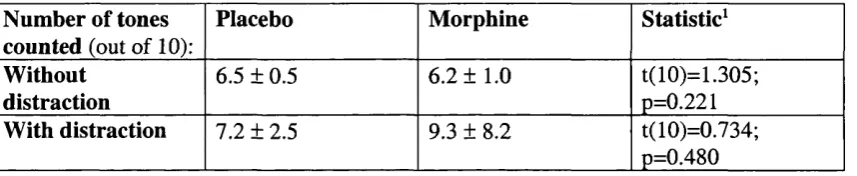
2) Elevator Counting taps sustained attention and requires the participant to imagine they are in an elevator which does not have a visual floor-indicator. They are required to count tones (played on a tape recorder) in order to determine which ‘floor’ they are on. There are 7 sets of tone sequences to be counted, varying from 3 to 14 tones within a series. A score of 7 (one point per series correctly counted) indicates ‘normal’ performance, where as 6 indicates 'possible abnormality’ and 5 indicates ‘abnormality’.
3) Elevator Counting with Distraction taps auditory selective attention. This task requires the participant to count low frequency tones while ignoring higher frequency ones. There are ten series of low and high tones containing between 2 and 14 target (low) tones. One point was awarded for each series when the correct number of target tones was counted.
5) Telephone Search While Counting gives a measure of divided attention. The procedure for the telephone search is the same as above. However, in addition to performing the visual search task, the participant is required simultaneously to count sequences of tones (14 sequences of varying lengths) and to tell the assessor how many tones they have counted when prompted. Again the time is recorded when the participant reaches the end of the forth column on the yellow pages task. The dependant variables was the ‘dual task decrement’ (which is a measure of a slowing down in performance in marking targets on the telephone search task when the dual task (counting) is simultaneously performed).
2.T.3.4. VERBAL FLUENCY
Phonetic fluency was tested using the letters B or M (balanced across testing occasions). These letters have a similar frequency of occurrence in the English Language (Oxford Pocket Dictionary). Participants were asked to generate as many words as they could in 1 minute using each letter, but were asked to avoid proper nouns and inflections of the same word.
To assess semantic fluency the categories of fruit and vegetable (counter balanced across testing occasions) were used. These categories have similar numbers of exemplars (Battig & Montagne, 1984)
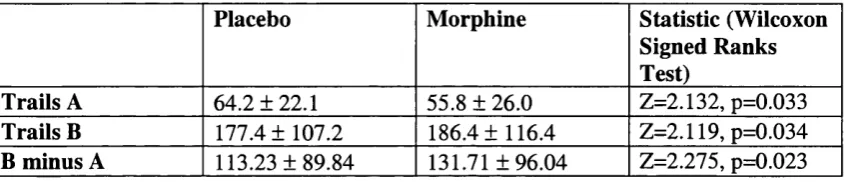
2.13.5. TRAIL MAKING TASK
2.7.3.6. ORDER OF TEST ADMINISTRATION
The tasks were administered in the following order on the two testing days. Pre Treatment Session
• VAS • HADS
• Immediate recall of prose from the RBMT (1®* story)
Post Treatment Session (45 minutes after ingestion of capsule) Guess on treatment
VAS
Finger tapping
Verbal fluency (B/M; Fruit/Vegetable)
Immediate recall of prose from the RBMT (2"^ story) Map Search (Version A or B; TEA)
Elevator counting (Version A or B; TEA)
Elevator counting with distraction (Version A or B; TEA) Telephone search (Version A or B; TEA)
Telephone search + counting (Version A or B; TEA) Delayed recall of prose from the RBMT (stories 1 and 2) Trail Making Task
2.8. ADDITIONAL INFORMATION GATHERED
Patients were asked to give brief demographic details, as well as their diagnosis. In addition, they were asked if they had any history of head injuries or accidents, as these may have an impact on cognitive functioning. Details of their current psychoactive drug- use were obtained from their drug charts.
2.9. STATISTICAL ANALYSIS
The data was analysed using the Statistical Package for Social Sciences (SPSS, Version 11). Since the direction of any effect could not easily be predicted, two-tailed tests were applied throughout. In all cases where parametric tests were used (i.e. Paired Samples
t-tests in the case of measure taken twice, and Repeated Measures ANOVAs for measures
taken four times), normality was tested first. When deviations from normality were not responsive to transformation, a non-parametric test was used (Wilcoxon signed ranks test).
3. RESULTS
3.1. SAMPLE CHARACTERISTICS 3.1.1. DEMOGRAPHICS
The mean age of participants was 65.2 ± 12. 2 years (mean ± S.D; range = 49-83). Seven
(50 %) were female. Participants had a mean number of years in education of 11.4 ± 3.3 (range=9-19 years). Eight participants left school between the ages of 14 and 15, two completed the equivalent of ‘O ’ levels, one had ‘A ’ Levels, two had undergraduate degrees and one had a post-graduate degree.
Two participants (14%) were currently in paid employment, while 7 (50%) were retired and 5 (36%) had given up work because of their illness. Prior to the onset of their illness, five (36 %) were ‘skilled professionals’, seven (50 %) were ‘semi-skilled’ and two (14 %) were ‘unskilled’.
3.1.2. RELEVANT MEDICAL DETAILS
The sample was drawn from in- and out-patients (n=9 (64%), n=5 (36%) respectively). In-patients were admitted either for symptom-management (e.g. under-controlled pain, nausea, breathlessness) or respite care. Their clinical condition was not thought to be more severe than that of out-patients at the time of participation.
3.1.2.1. DRUGS AND ILLNESS
All participants were taking a long-acting morphine-like opioid to manage pain
prostate, and 1 had visceral pain assumed to be due to cancer) or pain arising from complications of treatment (e.g. degeneration of vertebrae following radiotherapy; n=2). The participants took one of several long-acting opioids: heroin via a syringe driver (n=l), oral methadone (n=2), long-acting oral morphine (n=5) or fentanyl patch (n=6). The mean daily ‘equianalgesic’ morphine dose (of long acting opioid; see Table 1.2 in the Introduction) was 190.7 ± 266.6 mg (range 30-800 mg). This was typically divided into a morning and evening dose.
The average length of time for which participants had been taking long-acting morphine like opioids was 19.3 ± 16.7 months.
All patients required some degree of additional pain relief in the form of short-acting oral morphine, although they varied in how frequently they used it (the frequency of use also varied within the same individual according to how much day-to-day pain they experienced). At the time of the study, no participant required more than 2 breakthrough doses per day; 50% (n=7) required breakthrough once or twice a day and 50 % (n=7) required it less than once daily (range: once per 2 to 14 days). The mean breakthrough morphine dose was 21.4 ± 25.6 mg (range 5-100 mg).
compounds. Another 5 participants had benzodiazepines on their drug chart (diazepam or temazepam) but used them infrequently (e.g. for acute insomnia).
3.1.2.2. MOBILITY
The participants had varying levels of mobility. Eight could walk unaided, 3 used a wheel chair and 3 had walking aids.
3.1.2.3. NEUROLOGICAL AND OTHER HEALTH FACTORS
No participant had a known history of psychosis, substance misuse/alcoholism or head injury, although 3 had a history of accidental falls.
3.1.3. CHARACTERISTICS OF NON-PARTICIPANTS WHO MET CRITERIA BUT DID NOT CONSENT.
As stated in the Methods chapter (section 2.3.1), recruitment for this study proved to be unexpectedly difficult. Although the majority of eligible patients consented to
3.2. EXPERIMENTAL MEASURES 3.2.1 THE MOOD RATING SCALE (MRS)
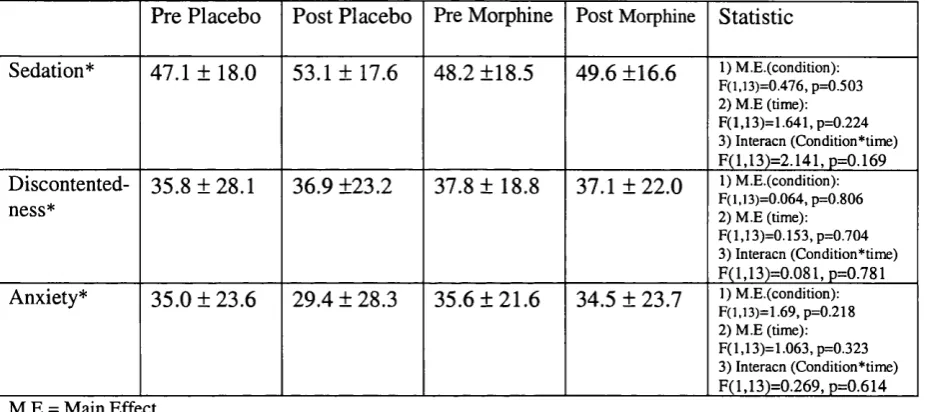
The MRS provides three mood factors which are summarised in Table 3.1.
Repeated measures ANOVAs were performed to investigate the effect of treatment (placebo v morphine) and time (pre v post) on the three mood factors.
Table 3.1. MRS Mood Factor Values for the Four Measurement Intervals.
Pre Placebo Post Placebo Pre Morphine Post Morphine Statistic Sedation* 47.1 ± 18.0 53.1 ± 17.6 48.2 ±18.5 49.6 ±16.6 1) M.E.(condition);
F(l,13)=0.476, p=0.503 2) M E (time): F(l,13)=1.641,p=0.224 3) Interacn (Condition*time) F(l,13)=2.I41,p=0.169
Discontented ness*
35.8 ±28.1 36.9 ±23.2 37.8 ± 18.8 37.1 ± 22.0 1) M.E.(condition): F(l,13)=0.064, p=0.806 2) M.E (time): F (l,13)=0.153,p=0.704 3) Interacn (Condition*time) F(l,13)=0.081,p=0.781
Anxiety* 35.0 ±23.6 29.4 ± 28.3 35.6 ± 21.6 34.5 ± 23.7 F(l,13)=1.69, p=0.218]) M.E.(condition):
2) M.E (time): F(l,13)=1.063,p=0.323 3) Interacn (Condition*time) F(l,13)=0.269,p=0.614
* Higher scores indicate greater levels o f sedation, discontentedness and anxiety.
3.2.2. THE HOSPITAL ANXIETY AND DEPRESSION SCALE (HAPS) The HADS scores are summarised below (Table 3.2).
Table 3.2. HADS Scores Under the Two Testing Conditions
Placebo Morphine Statistic
Anxiety 8.6 ± 4.3 8.0 ± 4.3 t(13)=1.170,
p=0.253
Depression 9.1 ± 5.3 8.7 ± 3.8 t(13)=0.543,
p=0.596
Neither the anxiety nor the depression scores differed significantly over the two testing conditions. Furthermore, the depression scores were highly correlated over the two testing occasions (r=0.84, p<0.001), as were the anxiety scores (r=0.91, p<0.001) suggesting that individual participants’ scores remained relatively stable between testing occasions.
There was no significant correlation between the anxiety and depression scores on either testing occasion (r=0.492, p=0.074 (placebo); r=0.365, p=0.199 (morphine)).
Although the mean anxiety and depression scores on both testing occasions were at levels indicating possible clinical disorder (i.e. >8), for 5 participants (36% fo the
On the placebo testing occasion, five participants scored > 11 on the depression scale,
and five scored >11 on the anxiety scale. On the testing day when breakthrough-
morphine was administered, five participants scored > 11 on the depression scale while
four scored >11 on the anxiety scale.
It should perhaps be noted that the depression-item in the HADS which relates to fatigue was endorsed at the highest level (i.e. a score of 3) by all but one participant on both testing occasions. If the score from this item is excluded (and the total depression score appropriately adjusted for a smaller total number of items, i.e. 6 instead of 7), the mean depression scores for placebo and morphine are 7.2 and 6.7 respectively, which are both below the cut-off for possible disorder. Furthermore, given this adjustment, only two participants (14% of the sample) exceeded the cut-off for probable disorder on the two testing occasions.
3.2.3. PAIN
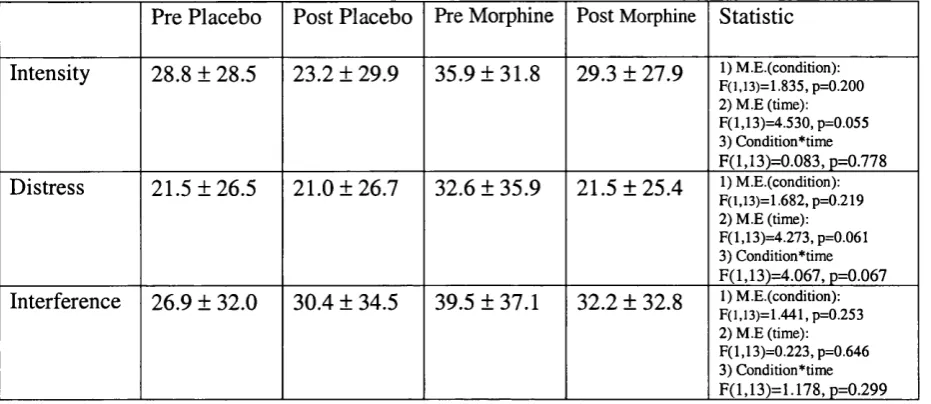
Table 3.3. Pain Indices on the Four Measurement Intervals.
Pre Placebo Post Placebo Pre Morphine Post Morphine Statistic Intensity 28.8 ± 28.5 23.2 ± 29.9 35.9 ±31.8 29.3 ± 27.9 1) M.E.(condition):
F (],1 3 )= 1 .8 3 5 ,p= 0 .2 0 0
2) M.E (time): F (l,13)=4.530, p=0.055 3) Condition*time F ( l,1 3 ) = 0 .0 8 3 ,p = 0 .7 7 8
Distress 21.5 ±26.5 21.0 ±26.7 32.6 ± 35.9 21.5 ± 25.4 1) M.E.(condition):
F(1,13)=1.6S2, p=0.219 2) M.E (time): F(l,13)=4.273,p=0.061 3) Condition*time F (l,1 3 ) = 4 .0 6 7 , p = 0 .0 6 7
Interference 26.9 ± 32.0 30.4 ± 34.5 39.5 ±37.1 32.2 ± 32.8 1) M.E.(condition): F(l,13)=1.441, p=0.253 2) M.E (time): F (l,13)=0.223,p=0.646 3) Condition*time F ( l,1 3 ) = 1 .1 7 8 ,p = 0 .2 9 9
For the pain-intensity rating there was a trend towards a significant main effect of time (pre versus post; F (1,13) =4.53, p=0.055) but no indication of an interaction between time and condition. A trend towards such an interaction was however found on the distress scale, possibly indicating less distress due to pain as a result of breakthough morphine (F (1,13) =4.067, p=0.067; Table 3.3). However, it is worth noting that pre morphine distress levels were higher than pre-placebo levels. No significant effects of conditions or time emerged on interference.