© 2015, IRJET.NET- All Rights Reserved
Page 285
ENERGY SAVING IN WIRELESS SENSOR NETWORK
WITH SPIN PROTOCOL
Kunal M Pattani
1, Palak J Chauhan
21
Professor,C.U.Shah College of Engineering and Technology Wadhwan City Gujarat, India.
2
M.E Student, Dept. of Electronics & Communication Engineering, C.U.Shah College of Engineering and
Technology Wadhwan City Gujarat, India.
---***---Abstract -
Data transmission is one of the majorchallenges in wireless sensor network (WSN). Different routing protocols have been proposed to save energy during data transmission in WSN. Routing protocols based on data-centric approach are suitable in this context that performs in-network aggregation of data to yield energy saving data dissemination. In this paper we introduced SPIN-I protocol and energy consumption in SPIN and SPIN-I.
Key Words:
Spin, SPIN-I, Energy,WSN.
INTRODUCTION
Wireless sensor network is a group of dense sensor nodes which sends and receives the important information from source to destination. Wireless sensor network is a family of number of small sensors which have some energy. These sensors are very small in size but have a very good sensing computation power.
Wireless sensor network is popularly increasing day by day. It has many applications such as in military, environment, home, health and industry etc. In a wireless sensor network if we have to increase the lifetime of the network then we should take care of battery life of nodes and its load balancing capabilities. For the past few decades a number of Routing protocols have been introduced, but very less number of protocols were up to the mark for energy constraint network. For example flooding is a technique in which one node broadcasts the data packet to all of its neighbors without gossiping with each other, this process repeats till the packet has reached to its destination. But this technique has some problems like implosion and collision.
In WSN [1] the routing protocol can be divided into different families of protocols like location based routing protocol, data centric based routing protocol and multipath
based routing protocol, etc. There are a number of data centric protocols [2] i.e. Directed diffusion, Rumor protocol, SPIN protocol etc. But In the data centric routing scheme, data are retrieved through querying. Querying of data is dependent upon the values of their attributes. SPIN (Sensor Protocol for Information via Negotiation) is the first data centric protocol [3] and if we compare the SPIN with Directed protocol then we can point out that they have almost similar characteristics [4] [5]. Its foremost work is to reduce Energy consumption and then Reduces redundancy of data. The data centric scheme is one of the different schemes for routing the data and of SPIN-I protocol. In section V described for simulation of energy for SPIN and SPIN-I protocol.
I. FAMILY OF SPIN PROTOCOL
The SPIN protocol is emerged with the help of many other conventional protocols such as flooding [7]. Flooding has some strength and some drawbacks for disseminating the data in sensor network. In flooding a source node sends data to all its neighbors. Upon receiving data, it saves a copy and sends a copy to its entire neighborhood. Flooding is a protocol, which spreads data very quickly all over the network. But it has some problems which are as follows:
Implosion: In this problem, nodes send the
messages to its neighbor nodes without bothering about whether it has already the same data or not.
Overlap: Sometimes nodes cover the same
geographic area for sending the data,this causes the overlapping of data and a lot of energy is wasted.
Resource Blindness: In this problem, nodes are
© 2015, IRJET.NET- All Rights Reserved
Page 286
conventional protocol never calculates thetotal energy in the sensor network.
Sensor Protocol for information via Negotiation Protocol (SPIN) can be categorized into four types: SPIN-PP, SPIN-EC, point to point network and SPIN-BC and SPIN-RL are used for a broadcast network. Three deficiencies (implosion, overlap and resource blindness) which occurred in simple protocols, are overcome by two main approaches i.e. negotiation and resource adaptation. Spin nodes use three types of messages to communicate.
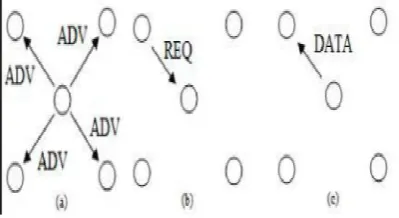
ADV - when a node has new data to advertise then it broadcasts ADV packet which contains Meta data.
REQ – when a node needs new data then it sends the REQ packet to get the real data. DATA – This is an actual data which has a
header named as Meta data.
Data messages are important and larger than the ADV and REQ packets. DATA packets contain real receiving the ADV message, the neighbor nodes check whether it has already received or requested the advertised data. If not, it sends an REQ message out to the original advertiser. On receiving the REQ message, the original advertiser responds positively with the actual data. Fig 1 [8] fully explains the SPIN-BC protocol. From the above mechanism ,we can conclude the eradication of redundant data.
Figure 1-SPIN – (a) Data advertisement (ADV), (b) request (REQ) and (c) transferring of original DATA.
Two Problems of SPIN Protocol [9], are Blind Forward Problem and Data Inaccessible Issue.
A. Blind Forward Problem
In this problem, source node sends its entire DATA packet to its neighbor that responds. In this process, those nodes who have already received the DATA broadcast ADV message to their neighbors and this process repeats again and again until the packet reaches to the sink. This whole scenario leads to the blind forward problem and consumes a lot of energy.
B. Data Unaccessible Problem
In the SPIN protocol, if sensor nodes collect new data that needs to be forwarded, they will directly broadcast ADV message to their neighbor nodes. In some cases, due to energy by itself, some more tasks and it is easy to run out of energy and fail. The problem above will result in data unaccessible in lossless network. In SPIN, the “blind forward” problem will waste energy and shorten the life cycle of the network, and reduce network performance. The “data unaccessible” problem will lead to a network that is unable to collect information, and make the WSN lose the meaning of application.
II . THE IMPROVEMENTS OF SPIN PROTOCOL
A. Network Model of SPIN Protocol from the interference of other nodes, and power is without any constraints and nodes remain stationary;
3) Assuming all nodes want to achieve the data, and are located on the path to reach sink nodes; 4) Wireless signals in all directions consume the
same energy.
© 2015, IRJET.NET- All Rights Reserved
Page 287
The working mechanism of SPIN-I is a negotiationprocess, which establishes a connection based on a three-way handshake.
1) Data broadcasting stage
When a sensor node (source node) has new data to send or forward, it first broadcasts ADV message to all its neighbors, and starts the timer. ADV message contains the metadata describing the data properties.
2) Data requesting stage
After the neighbors have received ADV message, they first determine if they have enough energy to complete the task of the three stages. If its energy value is below the threshold, it will not make any response; otherwise, it checks whether it already has the data. If it already has the broadcast data, then it sets the flag of REQ message to 1, and back its energy value to the source node by REQ message. In SPIN protocol, if the node has the data already, it won’t make any response. This point is also the biggest difference between SPIN-I and SPIN. If the neighbors do not have the data but their energy is enough, in order to request to send data, the flag of REQ message will be set to 0, and back to the source node together with its energy value using the REQ message.
3) Data transmission phase.
The source node updates its neighbor list according to the flag of REQ message it receives and energy values. In the threshold time, the source node judges nodes’ flag in its neighbor list, if the flag in the neighbor list are both 1 or 0, then filters the nodes whose flags are 0 and forwards data to the node who has the largest energy value; if there are the same energy value, it will randomly select a node to forward;
if all the flags of nodes are 0, chooses the node who has the largest energy value to forward the data. If the time is longer than threshold, and all the flags are 1, it is the point that “data unaccessible” problem appears, the source node selects a node who has the largest value from its neighbor list and forwards data mandatory, then removes nodes who do not send REQ message from the neighbor list.
C. Energy-Saving Analysis of SPIN-I Protocol
This paper compares the total energy, which is consumed by the process in which one node transmits the m bytes of data it receives to the neighbor node through adopting SPIN protocol and SPIN-I protocol. Assuming that both of ADV and REQ messages are L bytes, it needs to consume Em energy to sent a byte and Er energy to receive a byte. The network is distributed, no packet losses or queuing delay, and the average number of node’s neighbor is N. Any node in network will forward the m bytes of data it receives to the next hop node.
1) The steps of node B forwards the M byte of data in
the SPIN protocol are:
a. Send ADV messages, energy consumption is (N-1) LEm;
b. Receive the REQ message from N-1 nodes around it, the energy consumption is L (N-1) Er; c. Send Data + L bytes of data, consume (m + L) (N-1) Em energy;
2) The steps of node B receives m bytes of data in the
SPIN protocol are:
a. Receive ADV message, consume LEr energy; b. Send REQ message, the energy consumption is nodes is showed by the formal below:
ESPIN=Em(2NL+mN—m—L)+(NL+m+L)Er (1)
In accordance with the above assumptions of SPIN-I protocol, calculate energy consumption of transmitting the same m bytes data. As the byte of energy’s value and flag carried by REQ is very small, it can negligible.
3) The steps of node B forwards the M byte of data in
the SPIN-I are:
a. Send ADV messages, energy consumption is (N-1) LEm;
b. Receive the REQ message from N-1 nodes around it, the energy consumption is L (N-1) Er; c. Send Data+L bytes of data, consume (m+L) Em energy;
The steps and energy consumption values in the process that node B receives m bytes of data in the SPIN-I protocol are exactly the same with SPIN protocol’s. According to the above description, the node B receives the data and forwards the data to the next hop nodes, the minimum energy consumption in SPIN-I routing protocols is:
ESPIN-I=Em(NL+L+m)+(L+NL+m)Er (2)
Compared formula 1 with formula 2 we can see that the coefficient of Er is the same, so we only need to consider and compare the coefficients of Em, and get formula 3 by formula 1 minus formula 2:
ESPIN-I-ESPIN=2NL+mN-m-L-NL-L-m=(m+L)(N-2) (3)
© 2015, IRJET.NET- All Rights Reserved
Page 288
with formula 2. That is B node has two neighbors, aneighbor node sends data to B, B forwards data to the other neighbor node.
I. SIMULATION AND RESULT ANALYSIS
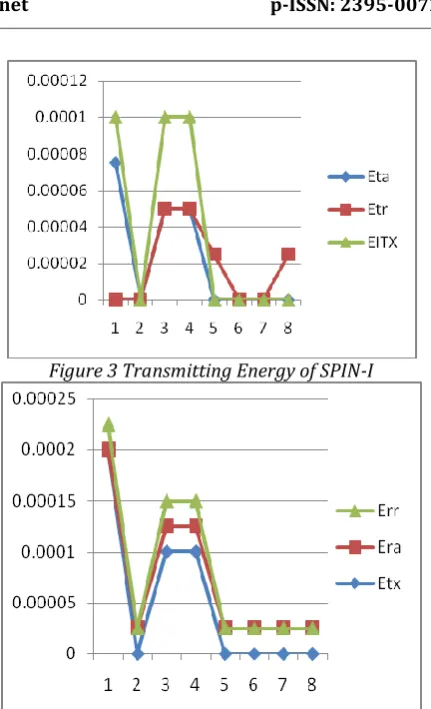
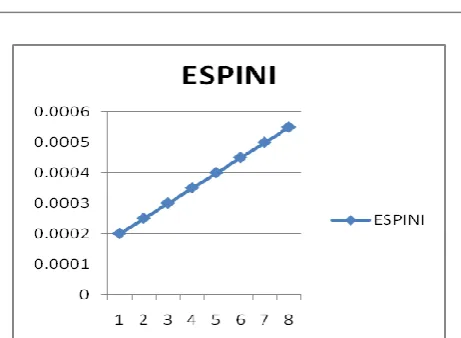
In this section we have seen the energy consumption in SPIN and SPIN-I. Figure 1 and figure 3 shows that the transmitting energy of the nodes which has contained energy consumption at the time of sending message ADV, REQ and DATA. Figure 2 and figure 4 shows that the receiving energy of the nodes which has contained energy consumption at the time of receiving message ADV, REQ and DATA. Figure 5 and figure 6 shows that the energy of the SPIN and SPIN-I.
Figure 1 Transmitting Energy of SPIN
Figure 2 Receiving Energy of SPIN
Figure 3 Transmitting Energy of SPIN-I
Figure 4 Receiving Energy of SPIN-I
© 2015, IRJET.NET- All Rights Reserved
Page 289
Figure 6 Energy of SPIN-ICONCLUSION
The primary goal of the WSN routing algorithm is to save energy and extend the network’s life cycle. Therefore, it is very important to study and improve the routing protocol in particular environments. On the basis of SPIN protocol, which is one of the plane routing protocols, this paper presented a new routing protocol, which is a very good solution to solve the “blind forward” and “data unreachable” problem. However, because the SPIN-I protocol is based on a more idealized situation, and transmission time is longer than SPIN, the solution of these problems needs further research.
REFERENCES
1) Shio Kumar Singh, M P Singh, and D K Singh,”Routing Protocols in Wireless Sensor Networks” –A Survey, International Journal of Computer Science & Engineering Survey (IJCSES) Vol.1, No.2, November 2010.
2) I. Akyidiz,W.Su,Y Sankarasubramaniam and E. Cayirici, :Wireless sensor network: A survey, “Computer Networks(Elsevier), vol 38, pp.393-422,2002
3) Azni, A.H., Madihah Mohd, S., Azreen, A., and Ariff Syah, J., (2009), “Performance Analysis of Routing Protocol for WSN Using Data Centric Approach”, World Academy of Science, Engineering and Technology, Vol. 53.
4) Jian Wu, Paul Havinga, “Reliable Cost-based Data Centric Routing Protocol for Wireless Sensor Networks”, Proceedings of Seventh ACIS International Conference on Software Engineering, Artificial Intelligence, Networking and Parallel/Distributed Computing(SNPD’06).
5) C. Intanagonwiwat, R. Govindan, and D. Estrin, “Directed Diffusion: A Scalable and Robust Communication Paradigm for Sensor Networks,” in the Proceedings of the Sixth Annual International
Conference on Mobile Computing and Networks (MobiCom’00), August 2000.
6) Jing, Luwei, Feng Liu, and Yuling Li. "Energy saving routing algorithm based on SPIN protocol in WSN." Image Analysis and Signal Processing (IASP), 2011 International Conference on. IEEE, 2011.
7) J. Kulik, W. Heinzelman, and H. Balakrishna, “Negotiation-based protocols for disseminating information in wireless sensor networks” Wireless Networks, vol. 8, pp.169-185, 2002.
BIOGRAPHIES
Assistant Professor (M.E. E.C) at C.U. Shah University. Interested research area is communication.
Student of M.Tech E.C. at C. U. Shah University. Interested
research area is
communication and