31st Pacific Asia Conference on Language, Information and Computation (PACLIC 31), pages 89–96 Cebu City, Philippines, November 16-18, 2017
Unsupervised Bilingual Segmentation using MDL for Machine Translation
Bin Shan, Hao Wang, Yves Lepage
Graduate School of Information, Production and Systems Waseda University
2-7 Hibikino, Wakamatsu-ku, Kitakyushu, Fukuoka, 808-0135, Japan {reynolds@fuji., oko ips@ruri., yves.lepage@}waseda.jp
Abstract
In statistical machine translation systems, a problem arises from the weak performance in alignment due to differences in word form or granularity across different languages. To address this problem, in this paper, we pro-pose a unsupervised bilingual segmentation method using the minimum description length (MDL) principle. Our work aims at improv-ing translation quality usimprov-ing a proper segmen-tation model (lexicon). For generating bilin-gual lexica, we implement a heuristic and it-erative algorithm. Each entry in this bilingual lexicon is required to hold a proper length and the ability to fit the data well. The results show that this bilingual segmentation signifi-cantly improved the translation quality on the Chinese–Japanese and Japanese–Chinese sub-tasks.
1 Introduction
Words are generally the smallest processing units in varieties of NLP tasks. However, there is no guarantee that such smallest processing units can fit any NLP tasks. Especially in bilingual tasks (e.g. statistical machine translation), different lan-guages have different writing systems or segmen-tation granularity. Such problem should be consid-ered as a critical factor of performance in transla-tion quality. For instance, in machine translatransla-tion experiments on 11 Europarl corpora (Koehn, 2005), Finnish has the lowest translation accuracy as eval-uated by BLEU scores when translated into En-glish. French–Spanish has the highest BLEU scores. Finnish is a non-Indo-European and agglutinative
language. French and Spanish have very similar grammar. Thus, the problem arising from different grammatical structure could lead a poor generaliza-tion when training SMT system uses such data. This is one aspect. Another aspect, there still exists some problem even segmenting language to generate sim-ilar vocabulary. In our view, we suppose that simi-lar units should have a proper size. If simisimi-lar units are too general, it will cause that size of model be-come too large and a over-fitting problem in model itself. Namely, too general similar units could not solve this problem indeed. Too general similar units problem also appears in (Virpioja et al., 2007) where they perform monolingual segmentation at the mor-phological level for Finnish-English translation and put the segmented data to a phrase-based statistical machine translation system. That paper indicates the segmented corpus has lower out-of-vocabulary rates and generates more refined phrases with better gen-eralization ability. However, the results of experi-ment show that they could not improve translation accuracy. In their method, the sentences already had similar units by morphological level segmentation. However, as we mentioned earlier, over-general sim-ilar units also go against on improving the transla-tion quality.
technology are discussed in section 2.1.
In this paper, we firstly introduce the main technol-ogy. Then we propose a bilingual model and an it-erative search algorithm to generate the best model. To evaluate our approach, we put the segmented cor-pus by our method into Moses (Koehn et al., 2007) and use BLEU score and NIST score as an evaluated measure.
2 MDL-based segmentation
2.1 Minimum description length
The Minimum Description Length was first intro-duced by (Rissanen, 1978). In our method, we sup-pose to use Crude MDL (Gr¨unwald, 2005), which has two parts.
M0= arg min
M DL
(D, M)
= arg min
M
DL(M) +DL(D|M) (1)
Where DL(.) denotes the description length. The DL(D|M) represents the description length of data
given by model or data cost. DL(M)is the
descrip-tion length of the model or model cost. The prin-ciple requires a minimum model, which can pro-duce a lowest description length of two parts. The DL(D|M) requires that the model has better abil-ity to fit the data. The DL(M) requires that the
model has simpler structure. As Gonz´alez-Rubio and Casacuberta (2015) said, the MDL provides a joint estimation of the structure and parameters (probability distribution) of the model. It naturally provides a mechanism against over-fitting or being too general by implementing two parts in this prin-ciple.
2.2 Related works
MDL has been used in common inductive infer-ence tasks (Gr¨unwald, 2005). In this section, we mainly introduce applications. De Marcken (1996) tries to infer the monolingual grammar structure us-ing MDL. Yu (2000) introduce unsupervised mono-lingual word induction approach using MDL. Ap-proximately, Hewlett and Cohen (2011) implement a heuristic search algorithm and use MDL as crite-rion to produce the best monolingual segmentation scheme. Zhikov et al. (2010) also employ an
MDL-based as criterion with a more efficient greedy algo-rithm. Chen (2013) proposes a compression-based method using MDL and improve the performance of monolingual segmentation. Argamon et al. (2004) use an efficient recursive method on morphologi-cal segmentation using MDL. Those early works fo-cus on exploiting MDL to achieve monolingual seg-mentation, and indicate that MDL-based method has an excellent performance on unsupervised monolin-gual segmentation. For bilinmonolin-gual NLP tasks using MDL, Saers et al. (2013) try to build an inversion transduction grammars with MDL. Gonz´alez-Rubio and Casacuberta (2015) try to improve the transla-tion quality by inferring a phrase-based model using MDL. Actually, those works focus on achieving dif-ferent NLP tasks using MDL.
Our work employs the same technologies as previ-ous works. However, we extend MDL-based mono-lingual model to bimono-lingual. In addition, previous works using MDL on bilingual tasks did not give the bilingual segmentation method. However, we focus on simultaneously segmenting bilingual data.
3 Methodology
3.1 Bilingual model
Our method builds a bilingual word segmentation scheme. Comparing with the monolingual mod-els, we propose the bilingual model. The bilingual modelM can be represented as a bilingual lexicon
(a set of unit pairs).
M ={ai |ai = (si, ti), si∈S, ti ∈T}
(si, ti) is the ith unit pair in M, and S and T
re-spectively belongs to source and target types sets.si
andti are source units and target units. Moreover,
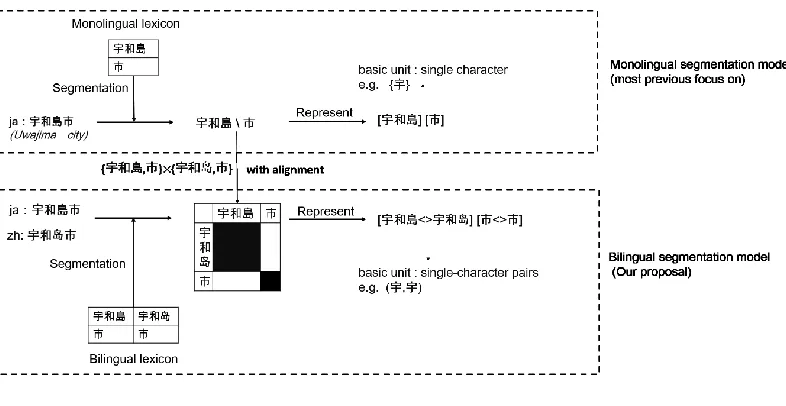
a single symbol is a basic unit in the monolingual setting. For the bilingual setting, we could extend to choose single symbol pairs as basic units. Thus, if the set only consisting of basic units, we call it basic set Mbasic. Figure 1 illustrates the
similari-ties and differences between units in the monolin-gual and bilinmonolin-gual. there are varieties of interpre-tations to MDL-model using different technologies. Our formula mainly is derived from Zhikov et al. (2010) and Yu (2000).
Figure 1: Monolingual and Bilingual
1. The essence of bilingual model is treatedthe Cartesian productas the set of source and target typeswith alignment. 2. A basic unit in a monolingual sentence is a single character / letter, which in a bilingual sentence should be a single
charac-ter/letter pair.
3. Any sentences can be represented as several units following the order according to the monolingual / bilingual lexicon. For representation, “[...]” represents a unit. “... <> ...” represents an alignment which is used to connect the source and target word.
model DL(D|M)is calculated using Shannon-Fano
code. For the data cost,
DL(D|M) =
M
X
i
−C(ai) logP(ai) (2)
WhereP(ai) = −logC(Nai) is the self-information
ofai. ai represents an alignment unit(si, ti).C(ai)
is a frequency ofai in dataD. Equation 2 gives the
total information contained in the data given by the modelM.
For the description length of model DL(M),
dif-ferent work pieces introduce difdif-ferent calculations. The common point in the calculation is the prod-uct of the length in character of units and an esti-mate of per-character entropy (Zhikov et al., 2010) (in the bilingual setting, “character” should be re-placed with “character pairs” or “basic unit pairs”). The estimate of every basic unit pairs entropy is not easy, Yu (2000) suggests to use average entropy as estimation. Using average entropy as estimation will improve the speed of implementing our following al-gorithm a lot. Namely, the calculation of model cost generally covert to count the size of model. How-ever, with this estimation, we could not capture the
probability distribution of basic units. Thus, at the precision perspective, we ignore the effects of sub-structure. So we calculate model cost using
DL(M) =
|M|
X
i
b×len(ai) (3)
Where len(ai) is the number of basic alignment
units inai. b=−log2|Mini|and which represents
binary code length of initial model. WhereMini is
the simplest bilingual lexicon (model) which has the lowest model cost and just includes basic unit pairs.
len(Mini)is the basic lexicon size. Thus,bis
con-stant when the data given.
For the basic modelMini , it should have the
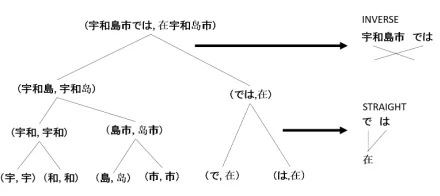
Figure 2: A efficient searching path by∆DL
1. In this binary tree, the leaves are the basic unit. Every node is an alignment unit. Every father node can be rep-resented by the child node.
2. Input the candidates can be represented as two child nodes.
3. Two child nodes should be combined into a father node with two ways: INVERSE and STRAIGHT.
3.2 Bilingual segmentation
As De Marcken (1996) showed, every sentence has a hierarchical structure and he calls the Viterbi rep-resentation for a sentence. He tries to search the best model by inputting possible candidates with two op-erations (add and delete). They represent candidates as a binary combination of two units which could be found in the current model. Likewise, Lardilleux et al. (2012) shows how to segment bilingual sentences by building the bilingual binary tree structure with a recursive binary splitting method. The same place in previous works, they all choose a binary combi-nation or split way to search the best model. Ac-tually, this measure is a common way to search the best model by using MDL principle. The binary rep-resentation brings an efficient path to search the best model. We just evaluate the changes in description length, when possible candidates are applied to the current model.
So our problems can be converted to evaluate the changes in description length after a new alignment unit is accepted by model. Every accepted candi-date will bring a∆DL, it can search the best model
by evaluating the changes (Figure 3.2). Another im-portant point, from those structures we can find that there exist two direction search algorithms. Those are bottom-to-top search method with binary com-bination and top-to-bottom with binary split.
3.3 Quantifying changes in description length The MDL-based method provide an evidence to de-fine the best model with the sum of data and model cost. Our method employs a heuristic algorithm to iteratively generate a new model from the current model. Due to our model is bilingual lexicon, we generate new model through adding possible candi-dates to current lexicon. For giving the evidence of possible candidates, every candidate should be eval-uated to a change∆DL in description length. When
the ∆DL can decrease the DL(D, M), the
candi-dates will be applied to the current model. For ex-ample, when we apply a candidate a1a2, it can be represented asa1anda2in current modelM. Considering the MDL-based methods generally con-sist of model and data cost, the changes are evalu-ated as:
∆DL(D, M) = ∆DL(M) + ∆DL(D|M)
For a candidatea1a2 to be feed into the model, we just evaluate the changes of two parts.
For the∆DL(D|M)with four parts:
∆DL(D|M) =δ1+δ2−δ3+δ4
δ1 = (C(a1)−C(a1a2)) logC(Na−1)C−(Ca(1aa12a)2) is
differ-ence ona1,
δ2 = (C(a2)−C(a1a2)) logC(Na−2)C−(Ca(1aa12a)2) is
differ-ence ona2,
δ3 = C(a1a2) logNC−(Ca(1aa12a)2) is difference on new
inputa1a2,
δ4 =KlogNN0 are changes on other alignment units, actually we can find the changes on other alignment units just are about the total number. K is the
num-ber of other alignment units. For the∆DL(M),
∆DL(M) =bloglen(a1) +len(a2)
len(a1a2)
=bδm
As shown in the above formula,bis a constant and
we just need to focus on changes of the total model length. As for changes on length of model, we just need to care about whether any inputs change the counts of old units in model to 0. Due to the counts change into 0, it should be removed from the model. We assignlen(a1)+len(a2)
1. When frequency ofa1 ora2 changes to 0 after input operation, theδm= 1
2. When frequency ofa1anda2changes to 0 after input operation, theδm= 0
3. When frequency ofa1 anda2 does not change in 0 after input operation, theδm = 2
By calculating the sum of changes on two parts, we can give the inputs an evidence about accepting or not.
3.4 Search Algorithm
The previous section introduced that we use the
∆DL to evaluate changes of possible candidates
on description length. However, the order of ap-plying a new alignment unit is also very impor-tant. Gonz´alez-Rubio and Casacuberta (2015) intro-duced that the order of inputting candidates should be sorted by the ascending of∆DL(D|M). In our
method, we take the following strategy:
1. Segment corpus to characters and use word alignment tools to get a character alignment re-sult as basic model.
2. Collect all the possible binary combination candidates from the data and model.
3. Run an iterative procedure to generate models.
4. Repeat the 2 to 3 until the description length will not reduce.
Algorithm 1 describes the processing of iterative generating model in step 3. First, we collect all possible candidates (line 2 to 3). Then we estimate the variation in description length when those can-didates are applied to model (line 4 to 9). Then we evaluate the changes in total description length and use those candidates to update the model (line 11 to 15). Finally, the whole loop will end until the de-scription length of the model could not reduce any more (line 17).
4 Experiment
Our method are evaluated through building Chinese–Japanese SMT experiments. For getting initial bilingual model, the extra alignment tool
Algorithm 1Iterative Generate Model
Input: M: Initial model consist of basic units
Output: M0: Generated model
1: while∆>0 do
2: Φ←collect(D, M)
3: candidates←ascending sort(Φ)
4: fors∈candidatesdo
5: delta=eval DL data(s)
6: ifdelta >0then
7: true candidates.append(s)
8: end if
9: end for
10: C ←ascending sort(true candidates)
11: fors∈Cdo
12: true delta←eval total DL(s)
13: iftrue delta >0then
14: M0 ←update(M, s)
15: end if
16: end for
17: end while
is used. The results obtained with the proposed method are compared the results obtained using
Kytea1as segmentation technologies.
4.1 Setup
In our experiment, we use ASPEC2 as experiment
corpus. Due to the low performance of the cur-rent word alignment tools for character alignment on Latin languages, we cannot perform our method with the letter to letter alignment on Latin languages. However, it works well for Chinese and Japanese. So we select the Chinese and Japanese as our ex-periment corpus. For word alignment tools, we use
MGiza++3to get character-based alignment results.
To avoid unnecessary processing (e.g. resulted from non-Chinese units in Chinese corpus), we in advance token the non-Chinese or non-Japanese letter and as one unit. For machine translation system, we use
Moses4. To benchmark our method, we choose data
segmented by Kytea as baseline. The reason we choose Kytea is that it always segments the corpus with a small degree (the most cases are
0.00 0.20 0.40 0.60 0.80 1.00 1.20 1.40 1.60 1.80 2.00
1 2 3 4 5 6 7 8 9
#
of
wo
rd
s
Length of words
MDL KYTEA
(a) Chinese
0.00 0.50 1.00 1.50 2.00 2.50 3.00
1 2 3 4 5 6 7 8 9
# of w
ords
Length of words
MDL KYTEA
(b) Japanese
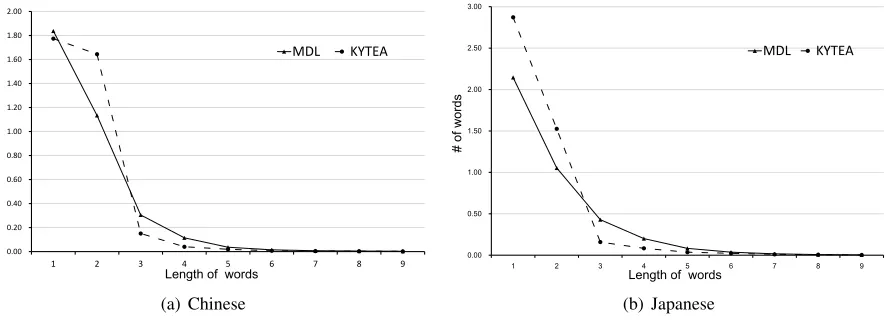
Figure 3: Frequency and length of words in corpus segmented by MDL and Kytea
1. Kytea (monolingual segmentation method) have different granularity of the segmentation in Chinese and Japanese. However, bilingual MDL-based method share similar granularity across both lan-guages.
2. Words segmented by Kytea have small granularity. However, our method (MDL-based segmentation) havesmoother distribution and larger segmentation granularity.
ical level). We suppose it could show the unbalance problem in Chinese and Japanese more clearly. Ta-ble 1 illustrates the data setting of SMT experiment.
4.2 Result and analysis
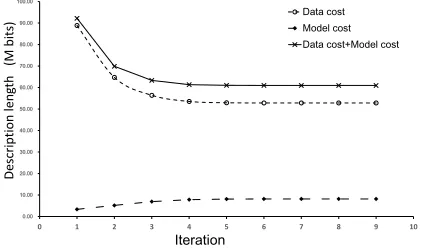
The total number of iterations of our algorithm are 8 times. Figure 4 illustrates changes of each iteration in data cost, model cost and total cost. We found that MDL principle provides any candidates an ev-idence through introducing a change in two parts cost. MDL principle would find a best balanced cost of model and data. Figure 3 illustrates the frequency distribution of different length of words. The granularity of segmentation given by Kytea and our method is different, and our method assign a smoother frequency distribution than kytea. We also can found such phenomenon shown in data setting of SMT system (Table 1). In Table 1, we found av-erage of length of words segmented by our method is longer than Kytea.
Due to different segmentation standards, we need to unify them in the evaluation step. Here, we eval-uate translation accuracy in characters. Likewise, non-Chinese and non-Japanese are tokenized as one unit. Table 4.2 shows that the BLEU (Papineni et al., 2002) scores have improved2.01%in Chinese
to Japanese. For NIST (Doddington, 2002) scores, we found that there are improvements in both trans-lating directions.
5 Conclusion and Future Work
5.1 Conclusion
We propose a bilingual segmentation method using MDL, which aims at improving translation quality. Our method could simultaneously segment bilin-gual corpus and generates corresponding bilinbilin-gual lexicon. Thus, our work also can be treated as a bilingual lexicon induction. Since our segmenta-tion method achieves a slightly better translasegmenta-tion result shown in Table 4.2, we conclude that our bilingual MDL-based segmentation method is more effective than previous monolingual segmentation method. Besides, we also found that MDL-based method could give more balanced trade-off between segmentation granularity and frequency. Differ with previous works using MDL-based method on monolingual segmentation, we extended the MDL-based method into bilingual segmentation and improved translation quality.
summa-Chinese Japanese Data Seg. Sent. Tokens Length Tokens Length
Kytea 3.66 M 10.82 4.74 M 11.33
Train MDL 135.0 k 3.46 M 11.82 3.98 M 12.27
Kytea 84.1k 7.71 108.1 k 8.28
Tune
MDL 3.0 k 79.4 k 8.36 90.4 k 9.03
Kytea 308.4 k 8.94 396.6 k 9.47
Test MDL 11.0 k 290.9 k 9.44 331.1 k 10.06
Table 1: Data setting
Length: average length of types in corpus; Tokens.: number of word tokens in corpus; Sent.: number of sentences in corpus;
Seg. BLEU p-value NIST p-value
Kytea 36.68±0.28 9.84±0.03 ja-zh MDL 38.69
±0.28 <0.01 10.24±0.04 <0.01
Kytea 40.46±0.28 9.81±0.03
zh-ja MDL 40.35
±0.28 0.1 10.08±0.03 <0.01
Table 2: Experiment result
1. BLEU and NIST: translation accuracy metrics (based on characters) 2. p-value<0.05 means the improvements are statistically significant different.
0.00 10.00 20.00 30.00 40.00 50.00 60.00 70.00 80.00 90.00 100.00
0 1 2 3 4 5 6 7 8 9 10
Descri
p
tion
len
gth
(M
bi
ts)
Iteration
Data cost Model cost Data cost+Model cost
Figure 4: The data and model cost with iteration
rized as in three folds. Firstly, we propose a bilin-gual segmentation method instead of the monolin-gual method as an initial step of machine translation. Secondly, we choose MDL as main technology in our segmentation. This technology could be prone to produce more balanced word pairs in segmenta-tion and gives a better inference on bilingual lexi-con. Thirdly, our method is an unsupervised method based on characters which is also can be applied to any other languages writing in CJK characters.
5.2 Future Work
References
Shlomo Argamon, Navot Akiva, Amihood Amir, and Oren Kapah. 2004. Efficient unsupervised recursive word segmentation using minimum description length. InProceedings of the 20th international conference on Computational Linguistics (COLING 2004), volume 2, pages 1058–1064, Gen`eve, August.
Ruey-Cheng Chen. 2013. An improved MDL-based compression algorithm for unsupervised word seg-mentation. InProceedings of the 51st Annual Meeting of the Association for Computational Linguistics (ACL 2013), volume 2, pages 166–170, Sofia, Bulgaria, Au-gust. Association for Computational Linguistics. Carl De Marcken. 1996.Unsupervised Language
Acqui-sition. Ph.D. thesis, Massachusetts Institute of Tech-nology.
George Doddington. 2002. Automatic evaluation of ma-chine translation quality using n-gram co-occurrence statistics. In Proceedings of the second interna-tional conference on Human Language Technology Research, pages 138–145. Morgan Kaufmann Publish-ers Inc.
Jes´us Gonz´alez-Rubio and Francisco Casacuberta. 2015. Improving the minimum description length inference of phrase-based translation models. In Proceedings of the Iberian Conference on Pattern Recognition and Image Analysis, pages 219–227. Springer.
Peter Gr¨unwald. 2005. A tutorial introduction to the minimum description length principle. In Advances in Minimum Description Length: Theory and Applica-tions. MIT Press.
Daniel Hewlett and Paul Cohen. 2011. Fully unsuper-vised word segmentation with bve and mdl. In Pro-ceedings of the 49th Annual Meeting of the Associa-tion for ComputaAssocia-tional Linguistics: Human Language Technologies (ACL-HLT 2011), pages 540–545. Asso-ciation for Computational Linguistics.
Philipp Koehn, Hieu Hoang, Alexandra Birch, Chris Callison-Burch, Marcello Federico, Nicola Bertoldi, Brooke Cowan, Wade Shen, Christine Moran, Richard Zens, et al. 2007. Moses: Open source toolkit for sta-tistical machine translation. InProceedings of the 45th annual meeting of the ACL-2007 on interactive poster and demonstration sessions, pages 177–180. Associa-tion for ComputaAssocia-tional Linguistics.
Philipp Koehn. 2005. Europarl: A parallel corpus for statistical machine translation. InProceedings of Ma-chine Translation Summit X (MT summit X), volume 5, pages 79–86.
Adrien Lardilleux, Franc¸ois Yvon, and Yves Lepage. 2012. Hierarchical sub-sentential alignment with any-malign. InProceedings of the 16th annual conference
of the European Association for Machine Translation (EAMT 2012), pages 279–286.
Kishore Papineni, Salim Roukos, Todd Ward, and Wei-Jing Zhu. 2002. Bleu: a method for automatic eval-uation of machine translation. InProceedings of the 40th annual meeting on association for computational linguistics, pages 311–318. Association for Computa-tional Linguistics.
Jorma Rissanen. 1978. Modeling by shortest data de-scription. Automatica, 14(5):465–471.
Markus Saers, Karteek Addanki, and Dekai Wu. 2013. Unsupervised transduction grammar induction via minimum description length. In Proceedings of the Second Workshop on Hybrid Approaches to Transla-tion (HyTra), pages 67–73.
Sami Virpioja, Jaakko J V¨ayrynen, Mathias Creutz, and Markus Sadeniemi. 2007. Morphology-aware statis-tical machine translation based on morphs induced in an unsupervised manner. InProceedings of Machine Translation Summit XI (MT Summit XI), pages 491– 498.
Hua Yu. 2000. Unsupervised word induction using mdl criterion. InProceedings of the International Sympo-sium of Chinese Spoken Language Processing (ISCSL 2000), Beijing.