Malware encryption schemes – rerandomizable ciphertexts
encrypted using environmental keys
∗Herman Galteland† and Kristian Gjøsteen
Department of Mathematical Sciences,
NTNU – Norwegian University of Science and Technology, Trondheim {herman.galteland, kristian.gjosteen}@ntnu.no
October 10, 2017
Abstract
Protecting malware using encryption prevents an analyst, defending some com-puter(s) in the network, from analyzing the malicious code and identifying the inten-tions of the malware author [4, 5]. We discuss malware encryption schemes that use environmental encryption keys [11], generated from some computer(s) the malware author intends to attack, and is able to rerandomize [2, 8] ciphertexts, to make each malware sample in the network indistinguishable.
We are interested in hiding the intentions and identity of the malware author, not in hiding the existence of malware.
Keywords. Malicious cryptography, environmental keys, rerandomization, provable security.
1
Introduction
Malwareis software maliciously installed on a computer designed to give functionality and behavior desired by themalware author, but not by the legitimate computer owner.
Our goal is to study malware propagation and how to protect propagating malware from analysis. We will not study the construction of computer viruses or any other types of malware, but rather at how to construct schemes designed to encrypt malware such that we can hide the intentions and the identity of the malware author.
1.1 Real world examples
BurnEye [13] is a tool designed to defend binary files and is an example on how to protect malware. The tool adds three layers of protection to a file: obfuscation, encryption, and a fingerprint layer. The fingerprint layer ensures that the files can only be executed on a specific computer that has the specifications stated by the fingerprint layer. The encryption layer uses a user-chosen password as the encryption key such that the file can only be executed (or analyzed) by someone with the proper password.
Gauss [10] is an example of sophisticated malware that uses encryption to protect certain payloads. Gauss uses environmental keys to decrypt these payloads, where an
∗
This is the extended version of [7]
†
S
T n
M N
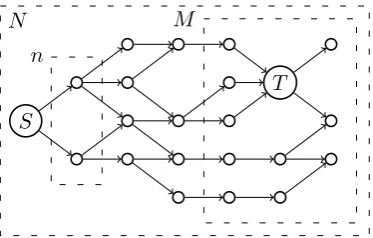
Figure 1: Example of malware propagating into an analyst’s network. The sourceSinfects
ninitial nodes. The analyst protects a network ifM nodes. There is at mostN malware samples in the universe.
environmental key is generated from locally available data. The malware gathers data on the infected computer and hashes it to create decryption keys, where the string of data that results in the correct key is selected by the malware author. The malicious code can only be executed when the correct key is produced, that is, when the malware infects the intended target. To our knowledge the contents of the encrypted payloads of Gauss are still unknown.
1.2 Malware propagation
Consider a malware author whose objective is to attack a specific location (or locations). The malware author’s goals is to hide his intentions and identity. The malware author’s opponent is an analyst observing and defending a network of nodes, which contains one (or more) of the malware author’s target(s). The goal of the analyst is to detect malware targeting any part of the network he is protecting and to discover the intentions and the identity of the malware author. Hiding the mere existence of malware from the analyst is a distinct problem and not one we consider in the current work.
1.2.1 Setup
We use the following model to describe malware propagation, see Figure 1. The source
S, the malware author, infectsn initial nodes with (different variations of) his malware. Released malware infects subsequent nodes by making similar copies of themselves and propagates throughout the network.
The analyst protects M nodes in the network from any possible malware threat. We assume he has full knowledge of the environment he is protecting. By observing the wider network the analyst can find at mostN malware samples.
Every direct link to the malware author increases the analyst’s chance to discover the author’s identity. So, to avoid identification, the malware author should perform as few initial infections as possible and use indirect paths to the target.
1.2.2 Encrypting the malware payload
Malware consist of a cleartext loader and an encrypted payload. When malware arrives on a new host the loader is executed and preforms the following steps:
1. The loader scans the host environment and determines the environmental data.
2. The loader hashes the environmental data to produce one or more keys.
3. The loader tries to decrypt the encrypted payload with each key.
4. If the decryption succeeds, the decrypted payload is executed.
5. The malware may also attempt to infect some other host, in which case the encrypted payload is rerandomized before it is transmitted to the new host.
Note that the malware author will certainly use some polymorphic engine and other standard malware techniques in order to provide a basic level of protection for the cleartext loader and the encrypted payload.
Figure 2: The malware attack process.
information is gathered from the target node and could consist of, for example, IP address, PATH variables, and/or any arbitrary time and date. This would either requires infor-mation about the target node, be guessed, or be general inforinfor-mation (to target several nodes).
An encrypted malware consist of theencrypted payload, containing the malicious code, and a cleartextloader that gathers environmental parameters to generate decryption keys. To initialize an encrypted malware the author chooses environmental data identifying the target node(s), hashes the data to create an encryption key, encrypts the payload using the key, and releases the encrypted malware. When malware infects a new node the cleartext loader determines the environmental data of the infected node, hashes the data to derive K ≥ 1 keys, and attempts to decrypt the payload using the K derived keys. If the decryption is a success can the malicious code be executed. Otherwise the loader creates copies of the malware to infect subsequent nodes.
The malware author can initialize at mostndistinct encrypted malware, one for each initial infection, which encrypts the same malicious code. Hence, there is at mostndistinct encrypted payloads among the samples collected by the analyst. Each sample is encrypted and has an unknown target. If the analyst wants to guarantee that none of thesensamples would attack a node in his network then he needs to do roughly K trial decryptions for each of hisM nodes. Hence, the analyst’s workload is at mostnM K.
1.2.3 Rerandomize the encrypted payload
Instead of making exact copies of the malware we want the loader torerandomize [2,8] the encrypted payload using techniques from asymmetric cryptography. The rerandomization process takes as input an encrypted payload and some uniformly random values to produce a new ciphertext that encrypts the same malicious code. Hence, the loader can produce several different-looking encrypted malware to infect subsequent nodes without knowledge of the secret key. The process is described in Figure 2.
We want the rerandomize process to produce the encrypted payloads such that any two malware samples are indistinguishable. If the analyst is unable to distinguish between malware samples then, essentially, there are N unique variations of the malware in the network. This means that the analyst need to do K trial decryptions for N samples for
M different nodes to ensure that none of the malware samples are targeting any of his nodes. This will increase the analyst’s workload toN M K.
Since the malware creates different variations of itself the malware author can choose
Path variation malware consist of a cleartext loader and an encrypted payload. When path variation malware arrives on a new host the loader is executed and preforms the following steps:
1. The loader scans the host environment and determines the environmental data.
2. The loader hashes the environmental data to produce one or more keys and a default key.
3. The loader check each key if they can decrypt the encrypted payload. – If a key is found use it to decrypt, if not use the default key to decrypt. 4. The loader checks if the decrypted payload could be executed.
5. The malware may also attempt to infect some other host, in which case the encrypted payload is rerandomized before it is transmitted to the new host.
Note that the malware author will certainly use some polymorphic engine and other standard malware techniques in order to provide a basic level of protection for the cleartext loader and the encrypted payload.
Figure 3: Path variation malware attack process.
1.2.4 Path variation
Instead of using a single encryption key we can choose to use several keys, derived from different nodes in the network, describing a path towards the target, see Figure 4. The last key is derived from environmental data identifying the target node, just as before, and the remaining keys, called default keys, are derived from environmental data that is available on all nodes in the path. This requires the malware author to investigate and gather the environmental data of each node in the path towards the target before malware can be encrypted. The difference between the path and the single key variations is that the path scheme willalways try to decrypt the payload using a key (a default key in most cases).
The path variation can only be decrypted if malware infect the nodes in the correct path toward the target. There is no difference between malware samples in the correct path and malware samples in a wrong path, hence, all samples needs to be treated as if they are both in the path and not in the path by the opponent. The only difference is when the malicious code has been executed and the opponent notices.
If the opponent only wants to know if a node in his network is targeted he has to check all possible paths between a node with a sample to all other nodes and see if the sample decrypt correctly. If the opponent finds the target node, either by analysis or by noticing that the malicious code was executed, then he can trace the correct path back towards the source, by using the algorithms in the malware, and possibly find information that could identify the malware author. However, this requires knowledge of the full network1, where the opponent only has knowledge over his network. This is an unwanted trait, but it seems to be unavoidable if we also wish to include the rerandomization. Without knowledge of the target node the opponent cannot trace back to the source by looking at the algorithms alone.
1.2.5 Limitations
The limitations of our schemes is that the analyst can always guess, or predict, the target of the malware author. Also, if the malware reaches its target, the payload will be decrypted and executed. If the analyst notices the attack he will be able to deduce the environmental key and thus be able to decrypt the payload. This seems impossible to avoid.
Once an analyst discovers the key used for one sample, he can easily discover all other samples corresponding to that key. However, the malware author will hope that different analysts are unwilling to reveal that they are under attack, they somehow consider this
1
S
kt kt−1
. . . k2 T k1
Figure 4: Location of keys on the path towards the target
fact sensitive, and that they therefore do not share discovered keys. This means that one analyst’s success may not make all the other analyst’s work easier.
For the path variant, if the analyst discover the target node then it is possible to find the source, as discussed previously. If the opponent finds the correct path back to the source then he can discover all the encryption keys. However, this is not enough to determine if another malware sample is encrypted under the same keys, especially if that sample has infected a node not in the path. The analyst has to find the sample’s infection path back to the source first, remove any decryption keys used (to restore the sample to its initial condition), and then check if the keys decrypt the payload. This would require knowledge of the full network.
1.2.6 Potential threat
Assuming there is more than one malware author, an analyst can not be certain of whether every new encrypted malware sample corresponds to one he has previously determined is no threat or a genuinely new piece of malware. That is, all malware samples created by different malware authors looks like the same encrypted malware. However, this requires all malware authors to agree on a malware encryption standard; use the same size, use the same loader, and otherwise look the same. This seems unlikely. If malware authors do not agree on a standard then the analysts can use these pieces of information to classify samples.
1.3 Related work
Traditionally cryptography has been developed and used as a defense against attackers. However, it is clear that cryptography can also be of use to the attackers.
Young and Yung where the first to raise the concern about malicious use of cryptog-raphy (cryptovirology) [15] and have several works related to malware construction and propagation. First, Young and Yung designed a virus capable of encrypting files on the victim’s computer and hold them for ransom [14]. Second, they describe how to utilize a mix network to mix programs and propagate malware [15]. Third, they designed a mobile program that carries a rerandomizable ciphertext, which enables anonymous communi-cation, where the program takes random walks through a network and rerandomize the ciphertext at each node, using system called Feralcore [16].
The mix network and the mobile program, by Young and Yung, use the idea of universal re-encryption, by Golle et al [8], to re-encrypt ciphertexts. The re-encryption process transforms the ciphertexts into a new ciphertext that encrypts the same message and do not require knowledge about the public key. Similar to universal re-encryption is the notion of rerandomization by Canetti et al. [2].
1.4 Overview
The rest of this paper contains the technical details of our schemes. The general cryp-tosystem designed to encrypt and rerandomize malware payload is described in Section 2.1.
The basic scheme, in Section 2.2, shows that malware encryption described in the introduction is possible in theory, however, the scheme is not practical because it requires short messages.
The extended scheme, in Section 2.4, is based on the basic scheme and can encrypt longer messages, making it more practical. The basic and extended schemes use the malware attack process described in Figure 2.
The path scheme, in Section 2.6, is the path variant of both the basic and the extended scheme and uses several encryption keys instead of one. The malware attack process for the path variation is described in Figure 3.
For each scheme we show that they are secure using games, where the opponent is asked to distinguish between ciphertexts encrypting the same message and ciphertexts encrypting two different messages. That is, we will simulate whether an analyst is able to distinguish malware samples. The security proof of the basic scheme is in Section 2.3, extended scheme in Section 2.5, and path scheme in Section 2.7. All three proofs are similar.
2
Rerandomizable malware encryption schemes
In this section we present three encryption schemes designed to encrypt and rerandomize malware payload. The first scheme is a basic proof of concept and the second is an extension of the basic scheme capable of encrypting larger payloads. The third scheme is the path variant of the first two. Further, we show that it is hard to distinguish between encrypted payload samples by using games.
As a simplification we denote payload as messages, encrypted payload as ciphertexts, replication of malware as rerandomization of ciphertexts, and environmentally derived keys as keys.
2.1 Preliminary
In each scheme we have an algorithm E encrypting messages, an algorithm D decrypt-ing ciphertexts, and an algorithm R rerandomizing ciphertexts. In the path variant of the extended scheme (in Section 2.6) we add a padding functionality to the rerandomize algorithm and rename it to a padding algorithmP.
Encryption For a message m and a key k the encryption algorithm E(k, m) outputs a ciphertext c.
Decryption For a ciphertext cand a keyk the decryption algorithmD(k, c) either out-puts a messagem or a special symbol⊥indicating decryption failure.
Rerandomization For a ciphertext c, encrypting a message m, the rerandomize algo-rithm R(c) outputs a ciphertext c0 encrypting the same message m.
The systems should be correct, we should almost always be able to decrypt all cipher-texts output by the encryption algorithm. Since the output distribution of the encryption and rerandomize algorithms are computationally indistinguishable, ciphertexts output by the rerandomize algorithm will also almost always be correct.
Correctness Ifcwas output fromE(k, m) thenD(k, c) will always outputmexcept with negligible probability.
Rerandomization Ifcwas output byE(k, m) then the output distribution ofR(c) should be computationally indistinguishable from the output distribution of E(k, m). We will not always be able to apply an arbitrary number of rerandomizations to a ciphertext without getting decryption errors, which we will see is the case in Section 2.4 and in Section 2.6.
The security requirements of our cryptosystems reflects the intentions of the malware author. It should be difficult to guess the malware author’s target, and it should be hard to determine if two ciphertexts are the encryption of the same message or not.
Key indistinguishability It should be hard to say something about which key a cipher-text has been encrypted under.
Indistinguishability It should be hard to decide if two ciphertexts, encrypted under the same key, decrypts to the same message or not.
2.2 Basic scheme
The basic scheme is based on the ElGamal cryptosystem over a group G of prime order
pgenerated byg. This scheme is essentially the same as the encryption scheme proposed by Golle et al [8].
Encryption For a message m∈Gand a keyk∈Z∗
p, let r, s r
←−Z∗
p and output
c= (x, y, z, w) = (gr, gkr, gs, gksm).
Decryption For a ciphertext c = (x, y, z, w) and a key k ∈ Z∗p check if xk =y. If it is
then output
m=z−kw.
Otherwise output ⊥.
Rerandomize For a ciphertextc= (x, y, z, w), letr0, s0 ←−r Z∗p and output
c0 = (x0, y0, z0, w0) = (xr0, yr0, zxs0, wys0).
Correctness Ifc= (x, y, z, w) was output by the encryption algorithm then there exists parametersr,s,k, and a messagem such that
c= (x, y, z, w) = (gr, gkr, gs, gksm).
With inputc the rerandomize algorithm will outputc0 = (x0, y0, z0, w0) where
x0=xr0 =grr0, y0=yr0 =gkrr0,
z0=zxs0 =gsgrs0 =gs+rs0,
That is,c0 = (grr0, gkrr0, gs+rs0, gk(s+rs0)m). Sincer 6= 0, we get that s+rs0 can take any value modulopexceptsand all values are equally probable. Hence, the output distribution of the encryption and rerandomize algorithms are computationally indistinguishable and has the same structure, that is,
c0 = (grˆ, gˆkrˆ, gsˆ, gkˆsˆm)
for some parameters ˆr, ˆs, ˆk, and a messagem.
For a ciphertext c = (x, y, z, w) and the correct key k we have that xk = (gr)k =
gkr = y, which is true for ciphertexts output by both the encryption and rerandomize algorithms. The messagemis retrieved by computing
z−kw= (gs)−kgksm=g−ks+ksm=m.
In other words, the decryption algorithm is correct.
Longer messages The limitation of the basic scheme is that the message size is rela-tively small. One option is to encrypt several messages under the same key. That is, a set of messages{m1, m2, . . . , mn} can be encrypted as
(gr, gkr, gs1, gks1m
1, gs2, gks2m2, . . . , gsn, gksnmn)
for some parameterss1, s2, . . . , sn,r, and keyk. However, this is not an efficient method.
In Section 2.4 we construct the extended scheme where we use techniques from symmetric cryptography to encrypt longer messages more efficiently.
2.3 Security of the basic scheme
The decryption key is derived from environmental data sampled by the loader from the infected computer. From the opponent’s perspective the collection of sampled data types can be considered as a probability space of possible decryption keys. We will denote this space by D. If the size ofD is large then the opponent is less likely to guess the correct decryption key, where the size ofD is determined by the number of different data types and combinations of the gathered data.
We show that the opponentOis unable to distinguish between ciphertexts and that his advantage is determined byD, that is, the probability of the opponent guessing the correct key. To prove this we use games [12]. In our games we start by simulating Experiment 1 where we ask the opponent to differentiate between the two cases; two ciphertexts encrypting different messages, and two ciphertexts encrypting the same message.
Experiment 1 Given two ciphertextc1 and c2, decide if
c1 =E(k1, m1)
c2 =E(k2, m2) or
c1=E(k1, m1)
c2 =R(c1)
for some messagesm1, m2 and keysk1, k2.
We show that the security of the scheme is based on the hardness of the Decisional Diffie-Hellman (DDH) problem [1] in the random oracle model. The DDH problem is to distinguish tuples of the form (g, ga, gb, gab) and tuples of the form (g, ga, gb, gc), for some
a, b, c∈Z∗p. Where the DDH assumption states that the DDH problem is hard to solve.
Algorithm 1Game 0 simulating Experiment 1 1: u1, u2
r
←−D,k1←H(u1),k2←H(u2),b
r ←− {0,1}
2: Getm1, m2fromO 3: if b= 0then
4: c1← E(k1, m1) 5: c2← E(k2, m2) 6: Sendc1, c2 toO 7: if b= 1then
8: c1← E(k1, m1) 9: c2← R(c1) 10: Sendc1, c2 toO 11: Getb0fromO
Game 0 Simulate Experiment 1. See Algorithm 1 for the detailed procedure. Let E0
be the event thatb=b0 in Game 0.
Game 1 Stop the game if the opponent queries eitheru1oru2 (guessed the correct key).
H outputsb0 ←− {r 0,1}. We denote this event byF1.
Let E1 be the event that b =b0 in Game 1. Unless event F1 occurs Game 1 behaves
just like Game 0. ThusE0∧ ¬F1 ⇐⇒ E1∧ ¬F1 and by the difference lemma we have
|Pr[E0]−Pr[E1]| ≤Pr[F1].
Game 2 Draw k1, k2
r
←−Z∗p and stop querying the oracle. (The opponent can still query
the oracle, hence we need to draw samples from D to check if the opponent is guessing the correct key(s).)
LetE2 be the event thatb=b0 in Game 2. The output ofH is indistinguishable from
uniform samples ofZ∗p, hence, Pr[E1] = Pr[E2].
Game 3 For uniform s, s0 ←−r Z∗p and keys k1, k2 precompute
(x, y, z, w) = (g, gk1, gs, gk1s), and (x0, y0, z0, w0) = (g, gk2, gs0, gk2s0)
before receiving messagem1 and m2.
LetE3be the event thatb=b0in Game 3. After encrypting both messages, or
encrypt-ing one and rerandomizencrypt-ing it, we get that the output of the encryption, and rerandomize, algorithms are exactly the same in Game 2 and Game 3. Thus, Pr[E2] = Pr[E3].
Game 4 Let (x, y, z, w) = (g, gk1, gs, gk1s) be the first tuple and
(x0, y0, z0, w0) = (x, xayc, zxb, wczaycbxab) = (g, ga+ck1, gb+s, g(a+ck1)(b+s))
be the second, for somea, b, c←−r Z∗p.
LetE4 be the event that b=b0 in Game 4. Since the tuples of Game 4 results in the
same output space as the tuples of Game 3 we get that Pr[E3] = Pr[E4].
Game 5 The output of the rerandomize algorithm is on the form
(grr0, gk1rr0, gs+rs0, gk1(s+rs0)m)
Algorithm 2Input: (x, y, z, w) 1: u1, u2
r
←−D,b←− {0r ,1}
2: a, b, c←−r Z∗
p
3: (x0, y0, z0, w0) = (x, xayc, zxb, wczaycbxab)
4: Getm1, m2fromO 5: if b= 0then
6: r, r0←−r
Z∗p
7: c1←(xr, yr, z, wm1)
8: c2←(x0r
0
, y0r0, z0, w0m
2) 9: Sendc1, c2 toO
10: if b= 1then
11: r, r0, s0,˜s←−r Z∗
p
12: c1←(xr, yr, z, wm1)
13: c2←(xrr
0
, yrr0, zxrs0+˜s, wyrs0+˜sm
1) 14: Sendc1, c2 toO
15: Getb0fromO
Change the rerandomization algorithm such that the second ciphertext (in case b= 1) is computed as
(grr0, gk1rr0, gs+rs0+˜s, gk1(s+rs0+˜s)m
1),
where ˜s←−r Z∗
p. The new sums+rs0+ ˜scan be any value inZ∗p and all values are equally
probable.
LetF5 be the event thats+rs0+ ˜s=sand letE5 be the event thatb=b0 in Game 5.
UnlessF5 occurs, Game 4 and Game 5 behaves the same, that is,E4∧ ¬F5 ⇐⇒ E5∧ ¬F5
and by the difference lemma we get that
|Pr[E4]−Pr[E5]| ≤Pr[F5] =
1
p.
Game 6 Change the first tuple into the form (g, ga0, gb0, gc0), for uniform elements
a0, b0, c0 ∈Z∗p. The second tuple will then look like
(g, ga+a0c, gb+b0, gab+ab0+a0bc+cc0).
Let E6 be the event that b = b0 in Game 6. Since we are using uniform elements in
the tuples the encryption and rerandomization algorithms are, essentially, one-time pads. Hence, Pr[E6] = 1/2.
We claim that |Pr[E5]−Pr[E6]| = Advind-cpaddh , where we will use Algorithm 2. The
input of the algorithm is a tuple (g, ga, gb, gc), for some a,b, andc, wherec can be equal toab. The algorithm simulates Game 5 if the input is on the form (g, ga, gb, gab) and
Pr[A2(g, ga, gb, gab) = 1|a, b←−r Z∗p] = Pr[E5].
If the input is on the form (g, ga, gb, gc) the algorithm proceed as in Game 6 and
Pr[A2(g, ga, gb, gc) = 1|a, b, c
r
←−Z∗p] = Pr[E6],
Summary From the games we bound the advantage of the opponentO.
Adv(O) =|Pr[E0]−1/2|
=|Pr[E0]−Pr[E1] + Pr[E1]−Pr[E2] + Pr[E2]−Pr[E3] + Pr[E3]
−Pr[E4] + Pr[E4]−Pr[E5] + Pr[E5]−Pr[E6] + Pr[E6]−1/2|
≤ |Pr[E0]−Pr[E1]|+|Pr[E4]−Pr[E5]|+|Pr[E5]−Pr[E6]|
≤Pr[F1] +
1
p+ Adv
ind-cpa ddh (O).
By the DDH assumption the DDH advantage is negligible and, for large enoughp, we get that the advantage of our opponent is determined by the probability that O guesses or predicts the correct key, that is, determined by the probability spaceD.
2.4 Extended scheme
In the extended scheme we represent messages as bit strings to allow longer messages to be encrypted. This change reduces the number of rerandomizations we can perform on a ciphertext and we need to relax the requirements of the cryptosystem.
Correctness If c was produced by iteratively applying R to the output of E(k, m) at mostntimes, thenD(k, c) will never output ⊥and outputmexcept with negligible probability.
We use a pseudorandom function f : G → {0,1}N mapping group elements to bit
strings of lengthN, for some largeN ∈N. We letfL denote the truncation of the output
toL bits, for L < N. We assume that group elements can be encoded as bit strings of length at mostl/2. The construction in this section is very similar to the hybrid scheme by Golle et al [8].
Encryption For a message m ∈ {0,1}L and a key k ∈
Z∗p, let r, s r
←− Z∗p, γ r
←− G and output
c=gr||gkr||gs||gksγ||fL+l(n+1)+1(γ)⊕(m||1||0l(n+1)).
Decryption For a ciphertextc=x||y||b00 and a keyk∈Z∗
p check ifxk=y. If not output
⊥. If it is let b00=z0||w0||b0 and compute
b01 =f|b0|(z
−k
0 w0)⊕b0.
If the resultb01ends inl0 ≥lzeros then the message is the result minus the tail of zeros and exactly one 1. Otherwise interpret b01 asz1||w1||b1 and repeat the procedure. If
this procedure is repeated n+ 1 times output ⊥.
Rerandomization For a ciphertext c = x||y||bm||bl, where bl is the last l bits. Let
r0, s0 ←−r Z∗p,γ0 r
←−G, and output
c0 =xr0||yr0||xs0||ys0γ0|| f|bm|(γ 0)⊕b
m
Correctness Before applying the rerandomize algorithm,bm looks like
gs||gksγ||fL+ln+1(γ)⊕(m||1||0ln)
for s ∈ Z∗
p, key k, and γ ∈ G. The l last bits we discard, bl, is an “encryption” of l
zeros. We can therefore only perform n rerandomizations on a ciphertext before we get decryption failure, that is, there are no tail of zeros left for the decryption algorithm to detect.
If c=x||y||b00 was output from the encryption algorithm, we have that xk =gkr=y.
Hence, we can writeb00 asz||w||b0, and compute
f|b0|(z
−kw)⊕b
0 =fL+l(n+1)+1(g−ksgksγ)⊕fL+l(n+1)+1(γ)⊕(m||1||0l(n+1))
= (m||1||0l(n+1)).
The result ends with a tail ofl0 ≥l zeros and the output message ism.
Let c be a ciphertext that was produced by iteratively applying the rerandomize al-gorithm to the output of E(k, m) t times, where 1 ≤ t ≤ n. Write c as x||y||b0t, where
x=gr1···rt+1,y=gk(r1···rt+1), andb0
t looks like
(gr1···rt)s0||(gk(r1···rt))s0γ
t|| fL+l(n+1−t)+1(γt)⊕b0t−1
fors0, r1, . . . , rt+1 ∈Z∗p, key k, and group elementγt∈G. Observe that for all 1≤t≤n
we have thatxk=y. Thus we can write b0t=zt||wt||bt and compute
f|bt|(z −k
t wt)⊕bt=fL+l(n+1−t)+1(g−ks
0(r
1···rt)gks0(r1···rt)γ
t)⊕fL+l(n+1−t)+1(γt)⊕b0t−1
=b0t−1
whereb0t−1does not end with a tail ofl0 ≥lzeros (except with negligible probability), since the ciphertext is also encrypted once using with the encryption algorithm (in addition to thetrerandomizations). Let b0t−1 =zt−1||wt−1||bt−1 and repeat the processt more times.
In the last iteration we perform the decryption on the bit stringz0||w0||b0, whereb0 looks
like
fL+l(n+1−t)+1(γ0)⊕(m||1||0l(n+1−t)).
We know this decrypts to the messagemand the decryption algorithm is correct.
2.5 Security of the extended scheme
Similar to the security proof of the basic scheme, we show that the opponent is unable to distinguish between encrypted ciphertexts and that his advantage is determined byDthe probability of guessing the correct key. As in the proof of the basic scheme, we use games to simulate Experiment 1.
Game 0 Simulate Experiment 1. The full procedure can be seen in Algorithm 1. Let
E0 be the event thatb=b0 in Game 0.
Game 1 Similar to the basic Game 1, where we get |Pr[E0]−Pr[E1]| ≤Pr[F1].
Game 2 Similar to the basic Game 2, where we get Pr[E1] = Pr[E2].
Algorithm 3Input: (x, y, z, w) 1: u1, u2
r
←−D,b←− {0r ,1}
2: a, b, c←−r Z∗
p
3: (x0, y0, z0, w0) = (x, xayc, zxb, wczaycbxab)
4: Getm1, m2fromO 5: if b= 0then
6: r, r0γ, γ0←−r
Z∗p
7: c1←xr||yr||z||wγ|| fL+l(n+1)+1(γ)⊕(m1||1||0l(n+1))
8: c2←x0r
0
||y0r0||z0||w0γ0|| f
L+l(n+1)+1(γ0)⊕(m2||1||0l(n+1))
9: Sendc1, c2 toO 10: if b= 1then
11: r, r0s0, γ, γ0←−r Z∗p
12: c1←xr||yr||z||wγ|| fL+l(n+1)+1(γ)⊕(m1||1||0l(n+1))
13: Letc1=xr||yr||bm||bl, whereblis the lastlbits
14: c2←xrr
0
||yrr0||xrs0||yrs0γ0|| f |bm|(γ
0)⊕b
m
15: Sendc1, c2 toO 16: Getb0fromO
Game 4 Similar to the basic Game 4, where we get Pr[E3] = Pr[E4].
Game 5 Similar to the basic Game 6, except we use Algorithm 3 instead. We get that
|Pr[E4]−Pr[E5]|= Advind-cpaddh .
Game 6 Sample a functionhfrom a family Γ of all functions fromGto{0,1}N instead
of using the functionf. We denotehL as the truncation of the output ofhtoLbits. The
pseudorandom function (PRF) advantage is defined to the opponent’s ability to distin-guishingf from any functionh sampled from Γ. The PRF-advantage is negligible if f is pseudorandom.
LetE6 be the eventb=b0 in Game 6. We use an arbitrary functionh, with a random
group elementγ, to encrypt the messagem, hence, the output ciphertexts of the encryption and rerandomization algorithms can be any random bit string. Thus Pr[E6] = 1/2.
We claim that|Pr[E5]−Pr[E6]|is equal to the PRF-advantage, where we use Algorithm
4. The algorithm draws a functionh from the family Γ, which may be equal to f. The PRF-advantage is
Pr[A4(x, y, z, w) = 1|f ←Γ]−Pr[A4(x, y, z, w) = 1|h←Γ]
which is equal to|Pr[E5]−Pr[E6]|.
Summary From the games we bound the advantage of the opponentO.
Adv(O) =|Pr[E0]−1/2|
=|Pr[E0]−Pr[E1] + Pr[E1]−Pr[E2] + Pr[E2]−Pr[E3] + Pr[E3]
−Pr[E4] + Pr[E4]−Pr[E5] + Pr[E5]−Pr[E6] + Pr[E6]−1/2|
≤ |Pr[E0]−Pr[E1]|+|Pr[E4]−Pr[E5]|+|Pr[E5]−Pr[E6]|
≤Pr[F1] + Advind-cpaddh (O) + Advprf(O).
Algorithm 4Input: (x, y, z, w) 1: u1, u2
r
←− D,b←− {0r ,1},h←Γ
2: a, b, c←−r Z∗
p
3: (x0, y0, z0, w0) = (x, xayc, zxb, wczaycbxab)
4: Getm1, m2fromO 5: if b= 0then
6: r, r0, γ, γ0←−r
Z∗p
7: c1←xr||yr||z||wγ|| hL+l(n+1)+1(γ)⊕(m1||1||0l(n+1))
8: c2←x0r
0
||y0r0||z0||w0γ0|| h
L+l(n+1)+1(γ0)⊕(m2||1||0l(n+1))
9: Sendc1, c2 toO 10: if b= 1then
11: r, r0, s0, γ, γ0←−r Z∗p
12: c1←xr||yr||z||wγ|| hL+l(n+1)+1(γ)⊕(m1||1||0l(n+1))
13: Letc1=xr||yr||bm||bl, whereblis the lastlbits
14: c2←xrr
0
||yrr0||xrs0||yrs0γ0|| h |bm|(γ
0)⊕b
m
15: Sendc1, c2 toO 16: Getb0fromO
2.6 Path scheme
The path variation scheme encrypts malware under several keys and encrypted malware will be correctly decrypted if it travels on the correct path in the network toward the target. If a malware sample infects a node not in the path then it can no longer be correctly decrypt, except with negligible probability.
The scheme uses several encryption keys, where each key is generated from environ-mental data gathered from a node in the path. The malware author selects the path and, hence, needs some environmental information about each nodes in the path to generate the encryption keys.
When encrypted malware infects a node the loader samples local environmental data to generate a set of keys and a default key, checks if one of the non-default keys can be used for decryption, if not then it will use the default key in the decryption algorithm. If the node is in the correct path a key will be removed from the encrypted malware. If it is not in the correct path then the attempted decryption introduces a new random value to the ciphertext, which will not be removed on any subsequent node except for a negligible probability.
Malware payload will be encrypted using a set of keys kt, . . . , k2, k1, where kt, . . . , k2
are default keys associated to a node in the path andk1 is a specific key associated to the
target node, see Figure 4.
2.6.1 Based on the basic scheme
Creating a path variant of the basic scheme is straight forward. We use the same algorithms except for the following. The encryption algorithm encrypts the malware under the sum of the keys, instead of a single key, and the decryption algorithm will always try to decrypt using a key. The algorithms are as follows.
Encryption For a message m∈Gand keys k1, k2, . . . , kt∈Z∗p, letr, s r
←−Z∗p and output
c= (x, y, z, w) = (gr, gr(k1+k2+···+kt), gs, gs(k1+k2+···+kt)m).
Decryption For a ciphertextc= (x, y, z, w) check if any of the non-default keys ˆksatisfies
xˆk=y, if so let k= ˆkif not let kbe the default key. Output
Algorithm 5Extended path variation attack process. 1: computect← E((k1, . . . , kt), m)
2: fori= 1, . . . , ndo
3: computec0
t← P(ct) and use it to infect a nodes in the network .must infect a path node
4: whilea node is infected with malware payloadc0ido .performed on all infected node
5: computeci← D(k, c0i)
6: if result is executablethen
7: run malware
8: else
9: computec0i−1← P(ci) and use it to infect a new node
Rerandomize For a ciphertextc= (x, y, z, w), letr0, s0 ←−r Z∗p and output
c0 = (x0, y0, z0, w0) = (xr0, yr0, zxs0, wys0).
2.6.2 Based on the extended scheme
The path variant of the extended scheme utilize an onion type encryption [3], where each onion layer is encrypted under one of the keys. This is because we need to completely remove a key from the ciphertext when we use it in a decryption. However, the rerandomize algorithm hides keys inside the ciphertext using a PRF and locks it using a group element, hence, if we encrypt each layer using one key we can remove a layer by only using a key.
Since we encrypt in layers we need a padding algorithm, P, to pad the ciphertexts such they have the same default length, denoted LD. The scheme pads the ciphertext
after an encryption or a decryption. Note that the encryption algorithm no longer add any zeros when encrypting. The padding algorithm also rerandomize the ciphertexts, hence, it replaces the rerandomize algorithm.
Padding For a ciphertextc, encrypting a messagem, the padding algorithmP(c) outputs a ciphertext c0, encrypting the same message m, with a defined length.
See Algorithm 5 for the malware algorithm, which is specific for the extended path variation. Note that the decryption algorithm will be correct only if the malware attack process is preformed as showed in the algorithm. Thus we need a specific correctness requirement for the path version of the extended scheme. We also need a requirement for the padding algorithm, since it replaces the rerandomization algorithm.
Correctness If c0i was output from P(E(ki, ci−1)) or P(D(ki+1, ci+1)) then D(ki, c0i) will
always outputci−1 except with negligible probability.
Padding If c was output by E(k, m) then the output distribution of P(c) should be computationally indistinguishable from the output distribution of E(k, m).
The algorithms of the extended path scheme are as follows.
Encryption For a message m ∈ {0,1}L, keys k
1, k2, . . . , kt ∈ Z∗p, {ri, si}ti=1
r
←− Z∗
p, and
{γi}ti=1
r
←−G. Encrypt the message in layers where
c1 =gr1||gr1k1||gs1||gs1k1γ1||(fL(γ1)⊕m)
and
ci =gri||griki||gsi||gsikiγi|| fL+2(i−1)l(γi)⊕ci−1
Padding For a ciphertext c. If |c|=LD let c =x||y||bm||bl, where bl is the last l bits,
otherwise let c=x||y||bm.
P(c) =xr0||yr0||xs0||ys0γ0|| f|bm|+N+1(γ 0)⊕(b
m||1||0N
.
where N =LD− |bm| −2l−1.2
Decryption For a ciphertextc=x0||y0||b00check if any of the non-default keys ˆksatisfies
xˆk0 = y0, if so let k = ˆk if not let k be the default key. Let b00 = z0||w0||b0 and
compute
b01 =f|b0|(z
−k
0 w0)⊕b0,
interpret b01 asz1||w1||b1||1||0N
0
, where N0∈N.3 Compute
b02 =f|b1|(z
−k
1 w1)⊕b1
and check if b02 is an executable malware. If it is then the attack was successful, if not pad b02.
2.7 Security of the path scheme
2.7.1 Based on the basic scheme
The proof is as the basic proof, given in Section 2.3, except that:
– the probability spaceD is replaced withD1× · · · ×Dt,
– use vectors of samples u1 and u2 instead ofu1 and u2, and
– use vectors of keys k1 and k2 instead ofk1 and k2.
The opponent’s advantage is bounded by
Adv(O)≤Pr[F1] +
1
p + Adv
ind-cpa ddh (O).
That is, the advantage is bounded by the opponent’s ability to guess or predict the correct keys and is determined by the probability spaceD1× · · · ×Dt.
2.7.2 Based on the extended scheme
The proof is as the extended proof, given in Section 2.5, except that:
– replace the rerandomize algorithm with the padding algorithm in Experiment 1,
– the probability spaceD is replaced withD1× · · · ×Dt,
– use vectors of samples u1 and u2 instead ofu1 and u2,
– use vectors of keys k1 and k2 instead ofk1 and k2,
– precompute 2ttuples of the form
{(xj, yj, zj, wj)}tj=1 =
n
g, gk1,j, gsj, gsjk1,j ot
j=1
and
x0j, yj0, zj0, wj0 jt=1=ng, gk2,j, gs0j, gs
0
jk2,jot
j=1
instead of precomputing two tuples, and
2
N is a multiple ofl. 3N0
– from the first tuple, (x, y, z, w), create an additional 2t−1 tuples, instead of one, by uniformly sample {aj, bj, cj}2jt=1−1 and compute
n
x, xajycj, zxbj, wcjzajycjbjxajbj o2t−1
j=1 .
The opponent’s advantage is bounded by
Adv(O)≤Pr[F1] + Advddhind-cpa(O) + Advprf(O).
That is, the advantage is bounded by the opponent’s ability to guess or predict the correct keys and is determined by the probability spaceD1× · · · ×Dt.
Acknowledgments
We would like to thank Adam Young for helpful discussions and comments. We would also like to thank the anonymous reviewers for helpful comments.
References
[1] Dan Boneh. Algorithmic Number Theory: Third International Symposiun, ANTS-III Portland, Oregon, USA, June 21–25, 1998 Proceedings, chapter The Decision Diffie-Hellman problem, pages 48–63. Springer Berlin Heidelberg, Berlin, Heidelberg, 1998.
[2] Ran Canetti, Hugo Krawczyk, and Jesper Nielsen. Relaxing chosen-ciphertext secu-rity. Cryptology ePrint Archive, Report 2003/174, 2003. http://eprint.iacr.org/.
[3] Roger Dingledine, Nick Mathewson, and Paul Syverson. Tor: The second-generation onion router. InProceedings of the 13th Conference on USENIX Security Symposium - Volume 13, SSYM’04, pages 21–21, Berkeley, CA, USA, 2004. USENIX Association.
[4] Eric Filiol. Strong Cryptography Armoured Computer Viruses Forbidding Code Anal-ysis: the bradley virus. Research Report RR-5250, INRIA, 2004.
[5] Eric Filiol. Malicious cryptography techniques for unreversable (malicious or not) binaries. CoRR, abs/1009.4000, 2010.
[6] Ariel Futoransky, Emiliano Kargieman, Carlos Sarraute, and Ariel Waissbein. Foun-dations and applications for secure triggers. Cryptology ePrint Archive, Report 2005/284, 2005. http://eprint.iacr.org/.
[7] Herman Galteland and Kristian Gjøsteen. Malware, Encryption, and Rerandomiza-tion – Everything Is Under Attack, pages 233–251. Springer International Publishing, Cham, 2017.
[8] Philippe Golle, Markus Jakobsson, Ari Juels, and Paul Syverson. Universal Re-encryption for Mixnets, pages 163–178. Springer Berlin Heidelberg, Berlin, Heidel-berg, 2004.
[10] Kaspersky Lab Global Research and Analysis Team. Gauss: Abnormal distribu-tion. In-depth research analysis report, KasperSky Lab, August 9th 2012. se-curelist.com/en/analysis/204792238/gauss abnormal distribution.
[11] James Riordan and Bruce Schneier. Environmental key generation towards clueless agents. In Giovanni Vigna, editor,Mobile Agents and Security, volume 1419 ofLecture Notes in Computer Science, pages 15–24. Springer Berlin Heidelberg, 1998.
[12] Victor Shoup. Sequences of games: a tool for taming complexity in security proofs. Cryptology ePrint Archive, Report 2004/332, 2004.
[13] Ed Skoudis and Lenny Zeltser. Malware: Fighting Malicious Code. Prentice Hall PTR, Upper Saddle River, NJ, USA, 2003.
[14] Adam Young and Moti Yung. Cryptovirology: extortion-based security threats and countermeasures. InSecurity and Privacy, 1996. Proceedings., 1996 IEEE Symposium on, pages 129–140, May 1996.
[15] Adam Young and Moti Yung.Malicious Cryptography: Exposing Cryptovirology. John Wiley & Sons, 2004.