An Effective Clustering Algorithm for
Transaction Databases Based on K-Mean
Dingrong Yuan
College of Computer Science and Information Technology, Guangxi Normal University, Guilin, China Faculty of Information Technology, University of Technology, Sydney, P.O. Box 123, Broadway NSW 2007, Australia
E-mail: [email protected]
Yuwei Cuan and Yaqiong Liu
College of Computer Science and Information Technology, Guangxi Normal University, Guilin, China E-mail: [email protected]; [email protected]
Abstract—Clustering is an important technique in machine learning, which has been successfully applied in many applications such as text and webpage classifications, but less in transaction database classification. A large organization usually has many branches and accumulates a huge amount of data in their branch databases called databases. At present, the best way of mining multi-databases is, first, to classify them into different classes. In this paper, we redefine related concepts of transaction database clustering, and then in connection to the traditional clustering method, we propose a strategy of clustering transaction databases based on the k-mean. To prove that our strategy is effective and efficient, we implement the proposed algorithms. The results showed that the method of clustering transaction databases based on the k-mean is better than present methods.
Index Terms—transaction databases, database clustering, k-mean, multi-database
I. INTRODUCTION
With the development of networks and database technology, large datasets have accumulated in various industries. The manner of acquisition of knowledge from these datasets has become a popular topic, while multiple source database mining has been considered as a challenging subject in data mining. So far, many studies had been conducted, including Wu and Zhang who advocated an approach for identifying interesting patterns hidden in multi-databases by weighting [1]. Liu et al. proposed a multi-database mining technique that can search relevant databases [2]. The multiple-database mining mode is divided into local, high votes, and exception modes. Zhang et al. recommended this model in their paper [3].
Clustering techniques mainly include hierarchical and
classificatory clustering. Cohesion and k-mean algorithms are representations of two clustering methods [4], and these techniques have been successfully applied to cluster numeric and text databases, among others.
Unlike text and webpages, the value of attributes in transaction databases is Boolean, such as in transaction records of supermarkets or banks. The traditional clustering approach may lose its effectiveness or may be incorrect when applied to transaction databases. Therefore, Wu et al. proposed a transaction database classification method based on similarity [5]. Animesh Adhikari et al. and Yuan et al. subsequently investigated the problem further [6, 7]. They respectively introduced different strategies for transaction database classification. After comparing and analyzing these studies, we find that their strategies are effective but inefficient. In this paper, we propose a new strategy for classifying transaction databases.
The rest of this paper is organized as follows. In Section II, we introduce the related concepts of transaction database classification. Section III proposes a clustering strategy based on the k-mean, and then the related algorithm is designed. In Section IV, we conduct a number of experiments to validate our strategy. The summary is presented in Section V.
II. PROBLEM DESCRIPTION
Let D = {Di | i=1,2,...,n} be a transaction database set
called a multi-database. I (Di)={Ij | j=1,2,...,k} is the item
set of Di. To cluster databases in D, several classes are
clustered according to a strategy.
For example, let D={D1,D2,D3,D4,D5} be a transaction
database set, which is composed of five different databases: D1={a, b, c, d}, D2={b, c, d}, D3={e}, D4={f, h}, and D5={f, g, h}. The five databases can be clustered
into three classes as cluster(D)={{D1,D2},{D3},{D4,D5}}.
Clustering transaction databases is one of the techniques in multi-database classification. The related concepts are as follows.
Definition 1: Let I(Di)={Ij | j=1,2,...,k} be the item sets
of database Di. The support of Ij is sup(Ij). Under the Manuscript received May 15, 2013; revised September 28, 2013;
supporting threshold α, the definition of frequent item sets of Di is as follows:
( )i { |j j ( ),sup( )i j }, [0,1]
FI D α= I I ∈I D I ≥α α∈
To illustrate, the given databases are shown in TABLE I.
If α is 0.5,
FI(D1)0.5={a:0.5,b:1.0,(a, b):0.5}, FI(D2)0.5={a:0.6,c:0.6},
FI(D3)0.5={a:0.7,b:0.5,c:0.7,d:0.5,(a, c):0.7}.
Definition 2: Let D={D1, D2 ,..., Dn} be a set of
transaction databases. Under the supporting threshold α, the definition of distance between D1 and D2 is:
1 2 1 2 1 2 { ( ) ( ) } 1 2 1 2 { ( ) ( ) }
mininum{sup( , ),sup( , )} ( , ) 1
maxinum{sup( , ),sup( , )} X FI D FI D
X FI D FI D
X D X D
dis D D
X D X D
α α α α α ∈ ∈ = −
∑
∑
∩ ∪where ∩ and ∪ denote the intersection and union of two sets, respectively.
If X does not belong to Di, then sup(X, Di) = 0.
As an example, in TABLE I, we have dis(D1,D2)0.5=1-0.185=0.815 dis(D1,D3)0.5=1-0.243=0.757
III. TRANSACTION DATABASE CLUSTERING
In this section, we define the related concepts of transaction database clustering, and then propose a clustering strategy for transaction databases based on the k-mean. The related algorithm is also designed in this section.
A. Related Concepts
The purpose of database clustering is to classify transaction databases into different classes. First, we define the related concepts as follows.
Definition 3: Let D={D1 ,D2 ,..., Dn} be a set of
transaction databases. Under the supporting threshold α, the definition of a class in D is defined as:
} |
{ )
(D D D D
class = i i∈
For example, let D={D1,D2,D3,D4,D5} be a set of
transaction databases. D1,D2,D5 can then be clustered as a
class, which is denoted as class(D)={D1,D2,D5}. Thus, class(D) is a class of multi-database set D.
Definition 4: Let D={D1, D2, ..., Dn} be a set of
transaction databases. Under the supporting threshold α, an m-cluster of D is defined as follows:
( )m { ( ) | 1, 2,..., } , [1, ]
k
cluster D = class D k= m m∈ n
which satisfies
1 2
(1) ( ) ( ) ... ( )
(2) ( ) ( ) , , {1, 2,... }
m
i j
class D class D class D D
class D class D i j m
=
= ∅ ∈
∪ ∪ ∪
∩
From the above formula, the total number of clustering can be deduced as
( ) 1 /1! 2 / 2! ...n n n/ !
total number D− = + + +m m
where n=|D| and m is the number of classes after clustering.
In all these classes, the best classification should be selected as the final classification of the multi-database. Consequently, we define the measurement of the best complete classification as follows.
Definition 5: Let D={D1, D2, ..., Dn} be a set of
transaction databases and clusterm(D)={class 1(D), class2(D), ..., classm(D)} be an m-cluster of D. The inner
distance of the classification is defined as follows:
, ,
( )
( , ) | | (| | 1) / 2 innerDis( ( ))
p i q i p q m
i
p q D class D class D D
class cluster D i i m
dis D D
class class cluster D m ∈ ∈ ≠ ∈ ⋅ − =
∑
∑
where |classi| denotes the number of database in classi.
Inner class distance reflects the average cohesion degree of a classification. Cohesion is the mean distance between databases in one class.
Definition 6: Let D={D1, D2, ..., Dn} be a set of
transaction databases, and clusterm(D)={class 1(D), class2(D), ..., classm(D)} be an m-cluster of D. The outer
distance of the clustering is defined as follows:
,
, ( )
( , )
| | | |
outerDis( ( ))
( 1) / 2 p i q j m
i j
p q D class D class
class class cluster D i j m
dis D D
class class cluster D m m ∈ ∈ ∈ ⋅ = −
∑
∑
where |classi| and |classj| denote the number of item
sets of classi and classj, respectively. Outer distance
reflects the average coupling degree of a classification. Coupling is the mean distance between databases in different classes.
Usually, we consider a classification with smaller innerDis and larger outterDis as a better one. In light of this, we evaluate a classification based on its cohesion and coupling.
Definition 7: Let D={D1, D2, ..., Dn} be a set of
transaction databases, and clusterm(D)={class 1(D), class2(D), ..., classm(D)} be an m-cluster of D. The
goodness of the clustering is defined as follows:
goodness(cluster Dm( )) outerDis(cluster Dm( )) innerDis(cluster Dm( )) m
n
= − −
The discussion above illustrates that the best clustering holds the highest value of goodness.
For example, consider a database set D={D1, D2, D3, D4}, as shown in TABLE II.
TABLEI. DATABASE SET
database I(Di) and sup(Ij)
D1: {(a,b),(b)} a:0.5, b:1.0, (a,b):0.5
D2: {(b,c),(a,c),(a)} a:0.6, b:0.3, c:0.6, (a,b):0.0, (b,c):0.3, (a,c):0.3, (a,b,c):0.0
D3:
{(a,b,c),(a,c),(b,d),(a,c,d)}
We can obtain the distance matrix based on Definition 2.
According to Definition 4, the m-cluster of D will be cluster4(D)={{D
1}, {D2}, {D3}, {D4}} cluster3(D)={{D
1}, {D3}, {D2,D4}} cluster2(D)={{D
1,D2,D4}, {D3}} cluster1(D)={{D
1,D2,D3,D4}}
The goodness of each clustering is 4
3
2 1
2 4
( ( )) (0.526 1 0.826 1 0.733 0.731) 0
4 3 4
0.197
2 1 0.526 0.826 1 0.731 1 0.733 3
( ( )) ( ) ( )
3 2 1 2 2 3 1 4
0.147
( ( )) 0.063, ( ( )) 1.053
goodness cluster D
goodness cluster D
goodness cluster D goodness cluster D
= ⋅ + + + + + − −
× = −
+ +
= + + − −
× = −
= = −
As we have seen, cluster2(D)={{D
1,D2,D4}, {D3}} is
the best clustering because it has the highest goodness value.
B. K-mean Clustering Model
We define the mean distance between a database and a class as follows.
Definition 8: Let D={D1, D2, ..., Dn} be a set of
transaction databases, and clusterm(D)={class 1(D), class2(D), ..., classm(D)} be an m-cluster of D. The
definition of the mean distance between Dk and classi is
1
( , ) ( , )
| | q i
k i k q
D class i
dis D class dis D D
class ∈
= ⋅
∑
We construct a clustering model based on the k-mean as follows:
We classify the databases into m classes. For any database in one class, if the average distance between the database and any other class is the minimum, then we redistribute the database into the class, until no database remains to be redistributed. In our model, we can obtain the best m-cluster by reallocating each database to the nearest class.
Given a database set D={D1, D2,..., Dn}, we can obtain
the best clustering of D based on the goodness of all different m-clusters.
Definition 9: Let D={D1, D2, ..., Dn} be a set of
transaction databases. The best clustering of D is defined as follows:
( ) arg[mininum{ ( m( ))]
endCluster D = goodness bestCluster D
where bestClassm(D) denotes the best m-cluster in D, m=1,2,...,n.
In Section C, the process and the algorithms of clustering transaction databases are described.
C. Clustering Algorithm Based on the K-Mean
A two-step approach is proposed in this section to identify the best clustering from the given transaction databases. In the first step, a procedure to generate the best m-cluster is designed. In the second step, an algorithm to search for the best clustering is developed.
Given the set of databases D1, D2, ... Dn, suppose the
number of classes is m, the best m-cluster can be obtained by redistributing each database into the nearest class. The procedure meanCluster for generating the best m-cluster is designed as Procedure 1.
Procedure1 meanCluster
Input: Di(1≤i≤n): databases, m: number of classes;
Output: bestCluseterm: best m-cluster of databases;
begin
(1) construct the distance matrix DIS[n][n] by computing the distance between different databases, Di and Dj;
let clusterList[m]←Ø; for i:=0 to n do{
create random integer k(k<=m); add i to clusterList[k];
}
(2) while flag:=true and count<100 do{ let flag←false;
for i:=0 to n do{ for k=0 to m do{
if(clusterList[k] contains i and size of clusterList[k] >1)
{
find mininum distance between Di and
clusterList[t] in all clusterList; if(t!=k){
remove i from clusterList[k]; add i to clusterList[t]; let flag←true; }
break; }
} }
let count←count+1; }
(3) let bestClusterm←{clusterList[0],cluserList[1],...,
clusterList[m-1]}; return bestClusterm;
end
TABLEII. DATABASE SET
database FI(D)0.5
D1:{a, b, c, (a,c), (b, d), (a,b,c),
(a,c,d), (a,b,c,d)}
{a:0.625, b:0.500, c:0.625, (a,c):0.500}
D2:{b, c, (b,c), (d,c)} {b:0.500, c:0.750}
D3:{b, e, g, (e,g), (a,e,g), (b,e,g)} {e:0.666, g:0.666, (e,g):0.500}
D4:{d, e, g, (b,c), (c,e), (d,e,g),
Figure 1. Goodness of Best Clustering by different Methods
Step (1) initializes clustering, and the time complexity is O(mn2/8-n/8+mn). Step (2) updates the clustering
result based on the k-mean. Step (3) returns the best m-cluster. The time complexity of the algorithm is O(mn2).
We design an algorithm to search for the best clustering, as shown below.
Procedure2 bestCluster
Input: Di(1≤i≤n): databases;
Output: endCluseter: best clustering of databases; begin
construct the array goodness[n+1] to store different goodness of different best m-cluster;
for m:=0 to n do{
compute bestClustermby Procedure 1; let goodness[m]←goodness(bestClusterm);
}
Search maximum goodness[k] in goodness[n]; let endCluseter=bestClusterk;
return endCluseter; end
The time complexity of computing for the best m-cluster in Procedure 2 is O(mn2).
Section IV details the experiments conducted to prove the effectiveness of our algorithms.
IV. EXPERIMENT
We carried out several experiments to demonstrate the efficiency of the approach. One is to investigate the result of clustering transaction databases with our method, using the strategy of Zhang and Animesh Adhikari. The other experiment is to examine the time complexity of these algorithms. The experiments are implemented on a 1.6GHz Pentium processor with 2GB of memory. The Java Edition 6 platform is used as the development tool. A. Dataset Preparation
We use the same datasets as those in [6], namely, synthetic two datasets T10I4D100K and T40I10D100K, which are derived from the IBM Almaden Quest research
group. The attribute tables of the two datasets are shown in TABLE III.
NT is the number of transactions. ALT denotes the average length of a transaction. NI and AFI are the number of items and the average frequency of an item, respectively.
B. The Results of the Clustering Transaction Databases First, we divided T10I4D100K into 10 different sub-datasets as our transaction database. We then mined the frequent items from these databases, with different threshold α separately. Finally, the items were clustered according to the three methods. The results are shown in Figure 1.
In the figure, the horizontal axis denotes different threshold α. The vertical axis is the goodness of the best clustering. The column stands for the results of the clustering by the three methods.
The figure also shows that our method can obtain better results than those with using the strategies of Wu and Animesh Adhikari because the value of our goodness is largest under the same threshold α. The result of the study by Adhikari is better than that of Wu in some cases, such as α=0.0054. In our experiment, we found that the result obtained by the method by Wu can achieve complete classification with zero coupling.
C. The Result of Time Complexity
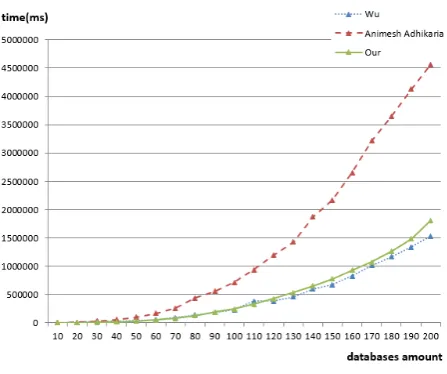
In this experiment, we divided the T40I4D100K into different sub-datasets as our transaction database, and then mined the frequent items from these databases under the given threshold α=0.054. At varying numbers of transaction databases, the time consumption of the different algorithms is obtained, as shown in Figure 2.
In the figure, the horizontal axis denotes the number of transaction databases. The vertical axis is the time consumption, and the curve represents the results of time consumption variation along with the number of databases.
Figure 2 also shows that the time consumption is amplified with the increasing number of databases. In terms of time consumption, when the number of databases increases, the results of our method become
TABLEIII. ATTRIBUTE TABLE OF DATASET
Dataset NT ALT NI AFI
Figure 2. Time Consumption of Different Methods
similar to those obtained by the method of Wu, whereas those by the method of Adhikari rapidly increase.
Obviously, the method by Wu and our method are more appropriate for large multi-databases (i.e., when a multi-database contains many classes) than the strategy proposed by Adhikari.
Consequently, the clustering result of our method is better than that of the others, and the time complexity achieved by our method is satisfactory.
V. CONCLUSION
Clustering transaction databases is a valuable topic in the area of multi-database mining. Based on previous studies, we proposed a k-mean clustering method. We can obtain ideal classification results according to the mean distance between a database and a class. The experiments demonstrated that our method is more effective and efficient than other present clustering algorithm for transaction databases.
ACKNOWLEDGMENT
This work was supported in part by a grant from the BaGui scholar team project“Multi-source data mining and information security” , partially supported by the Guangxi innovation team project under grant GA060004, universities science and technology key research projects. The authors would like to thank the anonymous reviewers for their constructive comments, and also thank the editors for their checking on the final version of this paper.
REFERENCES
[1] X. Wu, S. Zhang. Synthesizing high-frequency rules from different data sources. Knowledge and Data Engineering, IEEE Transactions on,15(2), pp.353-367, 2003.
[2] H. Liu, H. Lu, J. Yao. Identifying relevant databases for multidatabase mining. Research and Development in Knowledge Discovery and Data Mining, pp.210–221, 1998. [3] S. Zhang,X. Wu,C. Zhang.Multi database mining[J]. IEEE
Computational Intelligence Bulletin, 2(1), pp.5213, 2003. [4] Duda, R.O., Hart, P.E. Pattern Classification and Scene
Analysis. John Wiley & Sons (1973).
[5] X. Wu, C. Zhang, S. Zhang, Database classification for multidatabase mining, Information Systems,30(1), pp.71– 88,2005.
[6] Animesh Adhikaria, P.R. Rao. Efficient clustering of databases induced by local patterns. Decision Support Systems, 44, pp.925 – 943, 2008.
[7] D. Yuan, H. Fu, Z. Li, H. Wu. An application-independent database classification method based on high cohesion and low coupling. Journal of Information & Computational Science ,7(1), pp.1-6,2012.
[8] Frequent itemset mining dataset repository, http://fimi.cs.h-elsinki. fi/data.
[9] H. Jiang, J. Gu, Y. Liu, et al. Study of Clustering Algorithm based on Fuzzy C-Means and Immunological Partheno Genetic[J]. Journal of Software, 8(1), pp.134-141, 2013.
[10]X. Li. A New Text Clustering Algorithm Based on Improved K_means[J]. Journal of Software, 7(1), pp.95-101, 2012.
[11]Q. Niu, X. Huang. An improved fuzzy C-means clustering algorithm based on PSO[J]. Journal of Software, 6(5), pp.873-879, 2011.
Dingrong Yuan is a Professor in the
College of Computer Science and Information Technology, Guangxi Normal University, Guilin, China. He received his Ph.D. in Computer Science from the Beijing University of Technology, Beijing, China. His recent research interests include database classification, data analysis, and data mining.
Yuwei Cuan is a master’s degree student
in the College of Computer Science and Information Technology, Guangxi Normal University, Guilin, China. His recent research interests include database classification, data analysis, and data mining.
Yaqiong Liu is a master’s degree