e-ISSN: 2278-067X, p-ISSN: 2278-800X, www.ijerd.com
Volume 6, Issue 8 (April 2013), PP. 81-87
Study of Cutting Forces & Surface Finish in End Milling
Gangavarapu. Chinna Gangarao
1, Tippa Bhimasankara Rao
21PG Student, Department of Mechanical Engineering, Nimra Institute of Science and Technology
2Department of Mechanical Engineering, Nimra Institute of Science and Technology, Vijayawada, AP, INDIA
Abstract:- Faced with intense global competition and to enhance customer expectation in terms of
accuracy and precision, various manufacturing firms are considering the adoption of automated systems in order to achieve manufacturing excellence. Automated systems are highly useful to maximize production and to achieve better safety and health requirements of the present day industry. Hence computer aided monitoring of various operations are essential which may be fed to a computer interfaced machine for getting the best results. The effect of various process parameters like speed, feed and depth of cut on the cutting forces and surface finish of Aluminum and Brass in End milling process on a Universal Milling Machine was investigated by using Factorial Technique. The coefficients were calculated by using regression analysis and the model is constructed. The model is tested for its adequacy by using Fisher‟s test at 95 % confidence level. By using the mathematical model the main and interaction effect of various process parameters on milling cutting forces and surface finish was studied.
Key words:- End Milling, Surface Finish, Factorial Technique.
I.
INTRODUCTION
Surface finish produced on machined surface plays an important role in production. The surface roughness has a vital influence on most important functional properties such as wear resistance, fatigue strength, corrosion resistance and power losses due to friction. Poor surface roughness will lead to the rupture of oil films on the peaks of the micro irregularities which lead to a state approaching dry friction and results in decisive wear of rubbing surface. Therefore finishing processes are employed in machining the surface of many critical components to obtain a very high surface finish.
Process Variables
Surface roughness in End Milling depends on spindle rpm, feed, depth of cut, Helix angle. Mainly surface finish depends on spindle rpm, feed and depth of cut.
Factorial Technique
Factorial technique is a combination of Mathematical and statistical techniques. It is useful for the modeling and analysis of problems in which a response of interest is influenced by several variables and the objective is to optimize the response.
II.
INTRODUCTION TO MILLING MACHINE
A milling machine is a machine tool that removes unwanted metal on the work piece as the work is fed against a rotating multipoint cutter. The cutter rotates at a high speed and because of the multiple cutting edges it removes metal at a very fast rate. The machine can also hold one or more number of cutters at a time. This is why a milling machine finds wide application in production work. This is superior to other machines as regards accuracy and better surface finish, and is designed for machining a variety of tool room work.The first milling machine came into existence in about 1770 and was of French origin. The milling cutter was first developed by Jacques de Vasucanson in the year 1782. The first successful plain milling machine was designed by Eli Whitney in the year 1818. Joseph R Brown a member of Brown & Sharpe Company invented the first Universal milling machine in the year 1861.
III.
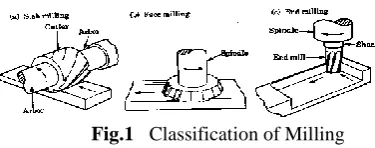
CLASSIFICATION OF MILLING
Peripheral Milling
Fig.1 Classification of Milling
Face Milling
In face milling, the cutter is mounted on a spindle having an axis of rotation perpendicular to the work piece surface. The milled surface results from the action of cutting edges located on the periphery and face other cutter.
End Milling
The cutter in end milling generally rotates on an axis vertical to the work piece. It can be tilted to machine tapered surfaces. Cutting teeth are located on both the end face of the cutter and the periphery of the cutter body.Methods of milling
Up Milling
Up milling is also referred to as conventional milling. The direction of the cutter rotation opposes the feed motion. For example, if the cutter rotates clockwise, the work piece is fed to the right in up milling.
Down Milling
Down milling is also referred to as climb milling. The direction of cutter rotation is same as the feed motion. For example, if the cutter rotates counter clockwise, the work piece is fed to the right in down milling.
Fig.2 Up Milling Fig.3 Down Milling
IV.
EXPREIMENTAL SETUP
Description of Universal Milling Machine
A universal milling machine is so named because it may be adapted to a very wide range of milling operations. A universal milling machine can be distinguished from a plain milling machine in that the table of a universal milling machine is mounted on a circular swiveling base which has degree graduations, and the table can be swiveled to any angle upto 45° on either side of the normal position. The table can be swiveled about a vertical axis and set at an angle other than right angles to the spindle. Thus in a universal milling machine, in addition to three movements as incorporated in a plain milling machine, the table may have a fourth movement when it is fed at an angle to the milling cutter. This additional feature enables it to perform helical milling operation which cannot be done on a plain milling machine unless a spiral milling attachment is used. The capacity of a universal milling machine is considerably increased by the use of special attachments such as dividing head or index head, vertical milling attachment. Rotary attachment, slotting attachment, etc. The machine can produce spur, spiral, bevel gears, twist drills, reamers, milling cutters, etc.
Universal Milling Machine Specifications
Table Size 300 x 1330mm Number of Spindles 8
Fig.4 Universal Milling Machine Front View and Right side View
V.
SURFACE FINISH INDICATOR
average height of the surface roughness or the depth of the surface from the reference line. For accurate determination of the surface finish the indicator must first be calibrated by setting it to a precision reference surface on a block calibrated to ASA standards.
Principle of Talysurf
The Talysurf is all electronics instrument working on carrier modulating principle. This instrument gives the information more rapidly and accurately. This instrument records the static displacement of the stylus. The measuring head of this instrument record the static displacement of the stylus. The measuring head of this instrument record consists of a diamond stylus of about 0.002 mm tip radius and which is drawn across the surface by means of motorized driving unit, which provides the motorized speed giving reading. The arm carrying the stylus forms an armature which pivots about the centre piece of e-shaped stamping on two coils with other two resistances‟s from an oscillator. As the armature is pivoted about the central leg, any movement if the stylus covers the air gap to vary and this the amplitude of the original A.C. current flowing in the coils is modulated. This is further demodulated so that the current flow in directly proportional to the vertical displacement of the stylus only.
Fig.5 Surface Finish Indicator (Talysurfe)
Procedure for to measure the surface finish with a surface Finish Indicator
Turn the switch on and allow the instrument to warm for approximately 3 minutes.
Check the machine calibration by moving the stylus over the test block.
If necessary, adjust the calibration control so that the instrument registers the range as the test book.
Thoroughly clean the surface to be measured to ensure accurate readings and reduce wear on the rider cap protecting the stylus.
Now the stylus moves on the work piece smoothly to the specified cut off length and the value is displayed in micrometers.
VI.
TOOL MATERIAL
High Speed Tool Steel
High speed steels (HSS) are carbon steels with alloying elements such as Tungsten (W), Chromium (cr), Vanadium (V), Molybdenum (Mo) and Cobalt (Co).
These are normally grouped into three classes:
Class – I: 18-4-1 HSS: 18% W, 4% Cr, 1%V.
This type is called Tungsten type HSS and is well known for air and heat resistance.
Class – II: 6-6-4-2: 6%W, 6%Mo, 4%Cr, 2%V. This type is called Molybdenum type HSS and is well known for wear and impact resistance.
Class – III: Super HSS: 2 to 15% Co additionally to increase cutting efficiency for heavier cut imparting higher temperatures.
VII.
WORK PIECE MATERIAL
Aluminum
The best known characteristic of aluminum is its light weight, the density being about one third that of steel or copper alloy. Aluminum has good malleability and formability, high corrosion resistance and high electrical and thermal conductivity. Aluminum in nontoxic, nonmagnetic, and no sparking. Pure aluminum has a tensile strength of about 13000 PSI. However, substantial increases in strength are obtained by sold working or allying some alloys, properly heat – treated, approach tensile strength of 100,000 PSI.One of the most important characteristics of aluminum in its mach inability and workability commercially pure aluminum, 11000 alloy (99.0 +%Al) is suitable for applications where good formability or very good resistance corrosion are revised and where high strength is not necessary.
Brass is any alloy of copper and zinc. The proportions of zinc and copper can be varied to create a range of brasses with varying properties. In comparison, In organ pipes designed as "reed" pipes, brass strips are used as the "reeds”. Brass has higher malleability than copper or zinc. The relatively low melting point of brass (900 to 940°C, depending on composition) and its flow characteristics make it a relatively easy material to cast. By varying the proportions of copper and zinc, the properties of the brass can be changed, allowing hard and soft brasses. The density of brass is approximately 8400 to 8730 kilograms per cubic meter (equivalent to 8.4 to 8.73 grams per cubic centimeter).
Fig.6 Work Piece Material-Aluminum Fig.7 Work Piece Material-Brass
VIII.
EXPERIMENTAL DETAILS OF ALUMINIUM FOR SURFACE FINISH
Table.1 Experimental values of surface finish for Aluminum Table.2 Calculated Fisher‟s values of surface
finish for Aluminum
Multiple Linear Regression Equation: Y1= 1.9113-0.013X1-0.0813X2-0.0038X3
Product of Multiple Linear Regression Equation:
Y1= 1.9113-0.013X1-0.0813X2-0.0038X3-0.2413X1X2+0.1638X2X3-0.475X1X3 –0.0738X1X2X3
Checking the adequacy using Fishers Table
The F values obtained for Aluminum are tabulated in the above table and the values are cross checking in the Fishers table and found within the limit.
IX.
EXPERIMENTAL DETAILS OF ALUMINUM FOR CUTTING FORCES
Table.3 Experimental values of Resultant force for Aluminum Table.4 Calculated Fisher‟s values of Resultant
force for Aluminum
Product of Multiple Linear Regression Equation:
FA = 6.125+0.375X1+0.625X2-2.37X3-1.12X1X2-1.87X2X3-0.62X1X3+0.375X1X2X3
Checking the adequacy using Fishers Table
The F values obtained for Aluminum are tabulated in the above table and the values are cross checking in the Fishers table and found within the limit.
X.
EXPERIMENTAL DETAILS OF BRASS
Table.5 Experimental values of surface finish for Brass Table.6 Calculated Fisher‟s values of surface finish
for Brass
Multiple Linear Regression Equation: Y2=1.205+0.1775X1+0.1025X2-0.14255X3
Product of Multiple Linear Regression Equation:
Y2=1.205+0.1775X1+0.1025X2-0.14255X3-0.0775X1X2-0.1925X2X3-0.3125X1X3-
0.18X1X2X3
Checking the adequacy using Fishers Table
The F values obtained for Brass are tabulated in the above table and the values are cross checking in the Fishers table and found within the limit.
XI.
EXPERIMENTAL DETAILS OF BRASS FOR CUTTING FORCES
Table.7 Experimental values of Resultant force for Brass Table.8 Fisher‟s values of Resultant force for Brass
Product of Multiple Linear Regression Equation:
FB = 4.125+0.125X1-0.62X2-1.75X3+0.875X1X2-0.125X2X3 +0.125X1X3-
0.625X1X2X3
XII.
VARIATION OF MILLING PARAMETERS ON SURFACE FINISH
The effect of milling parameters (speed, feed and depth of cut) on surface roughness is presented in Fig.8,Fig.9,Fig.10. It is understood that surface roughness increases with feed keeping other parameters constant, Surface roughness decreases with spindle speed keeping other parameters constant , Surface roughness increases with spindle speed keeping other parameters constant.
From the comparison table(table.3,table 4) of experimental, multi linear and product of multi linear, it is understood that the values obtained experimentally are close to the predicted values.
Fig.8 Feed Vs Surface Roughness Fig.9 Spindle Speed Vs Surface Roughness Fig.10 Depth of cut Vs
Surface Roughness
Fig.11 Comparision Chart For Aluminum Fig.12 Comparision Chart For Aluminum
XIII.
VARIATION OF MILLING PARAMETERS ON CUTTING FORCES
The effect of milling parameters (speed, feed and depth of cut) on cutting forces is presented in Fig.13 ,Fig.14,Fig.15.It is understood that Cutting forces increases with feed keeping other parameters constant,Cutting forces decreases with spindle speed keeping other parameters constant,Cutting forces increases with spindle speed keeping other parameters constant.From the comparison table(table.7,table 8) of experimental, multi linear and product of multi linear, it is understood that the values obtained experimentally are close to the predicted values.
Fig.13 Feed Vs Resultent Force Fig.14 Spindle Speed Vs Resultent Force Fig.15 Depth of cut Vs
Fig.16 Comparision Chart For Aluminum Fig.17 Comparision Chart For Brass
XIV.
CONCLUSION
Factorial Method is convenient to predict the main effects and the interaction effects of different influential combination of End Milling process parameters within the range of investigations on surface finish.
The developed model can be used to predict the surface finish and cutting forces in terms of machining process parameters within the range of variables studied. Alternately it also helps to choose the influential process parameters so that desired value of surface finish and cutting forces can be obtained.
Factorial Method is easy and accurate method for developing mathematical models for predicting the surface finish and cutting forces within the working region of the process variables. The developed model can be used in automatic and semi-automatic Milling machines in the form of a program for obtaining the desired quality.
REFERENCES
[1]. PATEL K.P, “Experimental analysis on surface roughness of CNC end milling process using taguchi design method”, International Journal of Engineering Science and Technology
(IJEST), Vol. 4 No.02 February 2012.
[2]. A. Antoniadis, C. Savakis, N. Bilalis and A. Balouktsis, „Prediction of Surface Topomorphy and Roughness in Ball-End Milling‟ Int J Adv Manuf Technol (2003) 21:965–971.
[3]. yang yang, xinyu li, ping jiang, liping zhang. „Prediction of surface roughness in end milling with gene Expression programming‟. Proceedings of the 41st international conference on computers & industrial engineering 441.
[4]. Mahesh. G, Muthu. S, Devadasan. “ S. R, A Review of Optimization Techniques, Effect of Process Parameter with Reference to Vibration in End Milling Processes”. European Journal of Scientific Research ISSN 1450-216X Vol.76 No.2 (2012), pp.226-239.
[5]. Mr. John L. Yang & Dr. Joseph C. Chen; „A Systematic Approach for Identifying Optimum Surface Roughness Performance in End-Milling Operations‟. Journal of Industrial Technology, Volume 17, Number 2-February 2001 to April 2001.
[6]. Abdel Badie Sharkawy, “Prediction of Surface Roughness in End Milling Process Using
[7]. Intelligent Systems”: A Comparative StudyHindawi Publishing Corporation Applied Computational Intelligence and Soft Computing Volume 2011, Article ID 183764, 18 pages.
[8]. Abbas Fadhel Ibraheem, Saad Kareem Shather & Kasim A. Khalaf, “Prediction of Cutting Forces by using Machine Parameters in end Milling Process”, Eng.&Tech. Vol.26.No.11, 2008.
[9]. S. Abainia, M. Bey, N. Moussaoui and S. Gouasmia.” Prediction of Milling Forces by Integrating a Geometric and a Mechanistic Model”, Proceedings of the World Congress on Engineering 2012 Vol III WCE 2012, July 4 - 6, 2012, London, U.K.
[10]. Md. Anayet u patwari, a.k.m. nurul amin, waleed f. Faris, „prediction of tangential cutting force in end milling of Medium carbon steel by coupling design of experiment and Response surface methodology‟. Journal of mechanical engineering, vol. Me 40, no. 2, December 2009 Transaction of the mech. Eng. Div., the institution of engineers, Bangladesh.
[11]. Smaoui, M.; Bouaziz,z. &Zghal,A., „Simulation of cutting forces for complex surfaces in Ball-End milling‟, Int j simul model 7(2008) 2,93-105.