Visual Cryptography with Layered Morphing
Vijaya Pinjarkar1, Vivek Singh2, Aditya Thakker3, Parita Todai4
Assistant Professor, Department of Information Technology, K.J. Somaiya Institute of Engineering and Information
Technology, Sion, Mumbai, Maharashtra, India 1
Bachelor of Information Technology, Department of Information Technology, K.J. Somaiya Institute of Engineering
and Information Technology, Sion, Mumbai, Maharashtra, India 2,3,4
ABSTRACT: Data sharing is an important concept and is the need of modern day development and research process.It has helped the researchers of different technical and non technical fields to develop new findings which will be beneficial for that particular field. Image is one the important medium which is used for data sharing .Sharing of important and highly confidential data becomes a difficult and tedious job. It becomes important to protect the confidential data available on a system from intruders. Visual cryptography is one of the most commonly used technique to provide protection to the images .Morphing is another aspect which plays an important role in information hiding. We propose a tool which uses the concept of Visual cryptography along with Morphing to provide extra security to the confidential data. The morphing technique is enhanced to Layered Morphing which will provide a higher level of security and will increase the overall efficiency of the system. The tool will also accept a secret passkey from the user which will be encrypted in the original image thus providing a additional layer of security. The tool will intake the original image and this image will be divided into 4 component images . These component images are the encrypted and the morphed layers of the original image. On re-entering the passkey the user will be able to regain the original image.
KEYWORDS: Visual Cryptography, Image Morphing, Pixels, Layered Morphing.
I. INTRODUCTION
In the present era, the data transfers using internet is rapidly increasing because it is convenient as well as fast to transfer the data to destination. But sharing of such data without storing it, becomes tedious job to retain for further use. Here security is an important concern[12]. Since many of the individuals and business people use to transfer organizational documents, supreme information using internet, it is necessary to maintain the confidentiality. There is a risk of any unauthorized individual hacking the data if he knows the location.
Visual Cryptography is a crypto logical technique that permits visual data (pictures, text, etc.) to be encrypted in such some way that coding becomes a mechanical operation that doesn't need a pc or hard-coreprogramming [2]. one among the known techniques has been attributable to Moni Naor and Adi Shamir, World Health Organization developed it in 1994[9].They expressed a visible secret sharing theme, wherever a picture was variable into n shares so solely somebody with all n shares might decode the image, whereas any n − one shares discovered no data regarding the first
image. every share was written on a separate transparency, and coding was performed by overlaying the shares. Once all n shares were overlaid, the first image would seem[10].
II. RELATED WORK
Based on report and investigation on existing system, this system has additional feature than previous one.Previously the recovered image had a degraded quality as the compression ratio was large. This led to a decreased contrast between the white and black pixels. The existing system does not provide a friendly environment to encrypt or decrypt the data.The system supports only one kind of format. A basic a pair of-out- of-2 or (2; 2) visualcryptographythemeproduces 2 share pictures from a resourceful image and should stack each shares to breed the initial image. Typically, a (k; n) theme produces n shares, however solely needs combining k shares to recover the key image. [9]
To preserve the ratio for the recovered secret image for a (a pair) theme every element within the original image will be replaced within the share pictures by a pair of X 2 block of subpixels. If the initial element is white, one in all six combos of share pixels is randomly created. Once stacking the shares with white clear and black opaque, the initial secret image are discovered. Stacking will be viewed as mathematically ORing, wherever white depicts “0” and black depicts “1”. Note that the ensuing share pictures and also the recovered secret image contain four times additional elements than the initial image (since every pixel of the initial image was mapped to four subpixels). Note that the recovered image includes degradation in visual since a recovered white element has 4 subpixels (2 black, 2 white) whereas a black element also has 4 subpixels(All black).
III.PROPOSED ALGORITHM
The system proposed by us improves the overall efficiency of the system earlier used. The earlier system supported only black and white images however the system proposed by us performs the Visual Cryptography scheme in coloured images along with the technique of Layered Morphing for which the format will be jpeg and jpg. The system created by us will accept a image from the user . The user will upload the data which he wants to hide from intruder. The system will then ask the user to enter the passkey. This passkey will be used by the system to encrypt the image. The system will then morph the original image and divide it into 4 layers. The 4 layers will be distinct from the original image and will be impossible for any random user to identify the original image looking at the component images. The 4 layer will be converted into 4 component images and will be stored at the location of the original image. From this location the component layers can be moved to any location as per the users desire. For decryption process the user needs to know the location of all the 4 component images formed during the layered morphing process. The user will have to enter the password initially entered by him during the encryption process, without the passkey the encryption process is not possible. Thus the usage of passkey provides an extra layer of security .The images thus formed will retain the quality of the original image.
Encoding of pixels:
Original Pixel
Layer1
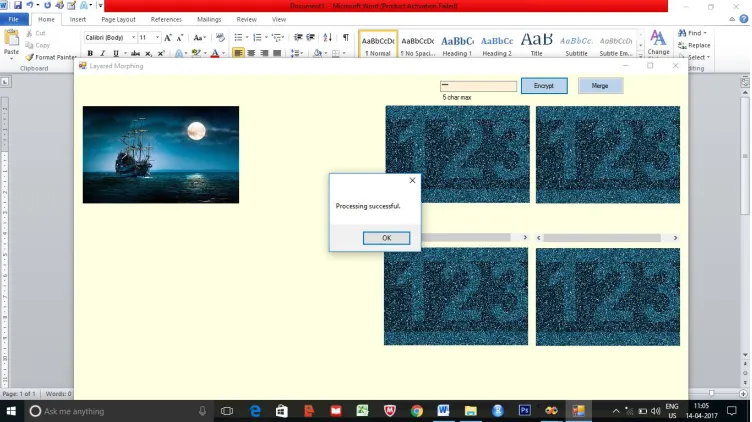
Implementation snapshots :
Fig. Encryption and Morphing
IV.ARCHITECTUREOFPROPOSEDSYSTEM
The architecture of the complete system consist of two parts: 1.) Encryption 2.) Decryption
Encryption:
The encryption part consists of the usage of a original image by the legitimate user to protect the sensitive data. The user uploads a coloured image which he wants to use to secure the information. The image uploaded by the user is either in .jpeg or .png format. The main aim of the encryption part is to divide the image in to layers so that it becomes difficult for the unauthorised user to identify the image using those parts. The image uploaded by the user gets divided in to 4 parts using the X-OR technique. The image is thus morphed and forms part.
The parts thus formed does not visually denote the original image and it becomes impossible for any user to identify the original image by the formed layers .The layers thus formed are stored in to different locations so that it becomes difficult for the user to trace the parts required to form the original image.
Decryption :
The encryption part thus states that the authenticated user has set used an image to protect the data along with the concept of layered morphing . The new user will have to decrypt this technique sued by the original user to protect the data .The user will now have to provide the location of all the parts that are set by the original user . The new user who is not aurthorised will not be able to determine the location of the layers by just looking at the images . The new user will arrange all the parts and thus the original image will be retrieved . The user will also have to enter the password set by the original authenticated user in order to access the data .
V. SIMULATIONANDRESULTS
COMPARISON OF EXISTING SYSTEM AND PROPOSED SYSTEM
VI.CONCLUSIONANDFUTUREWORK
The proposed system aims to simplify the complex and tedious process with the flexible and simple process. The proposed system is being developed as an attempt to overcome the difficulties of the existing system. The following are the highlights of the proposed system
1) It provides two levels of security to the information being transmitted. That is the intruders cannot easily break the
Existing system Proposed system
Each pixel of original image has 4 pixels of the mapped image, 2 white and 2 black subpixels for 1 original white pixel , and 4 black subpixels for original black pixel
Each component image has a pair of pixels for every pixel in the original image.
White gets transparent (0 of binary), and black gets opaque (1 of binary)
Original black gets dark grey as the component images must be complementary,while Original white gets light grey , as the component images should match.
Recovered image is degraded as it is 4 times the original image
Recovered image is much better in quality as the local ratio of pixels of color images is much close to the ratio of original image.
Security is weak , since the original image has a poor contrast of black and white
2) This application can be used to increase the security on highly sensitive data. The user will be asked to provide the password even if he finds the location of images and is able to decrypt it. It can be used as advancement over the existing option to input the security phrase.
3) In the case of a secret file being encrypted the morphed layers can be kept inside a local directory or dive .This secret file can be stored in the normal way. In case of layered streams part of image can be sent in each location. This will increase the security of the system, however the time consumption will increase in this case.
The future scope of the system is :
1.)The proposed system can be used along with cloud computing for Networking purposes. 2.)Similar system can be generated for different multimedia like video, animation, etc.
ACKNOWLEDGEMENTS
We wish to express our sincere gratitude to Prof. Mrs. Vijaya Pinjarkar, Project Guide for providing us an opportunity to do our project work in security domain. We sincerely thank Mr. Uday Rote, HOD of IT Department and Mr. Harsh Bhor, Project Coordinator for their guidance and encouragement in carrying out this project work. We also wish to express our gratitude to the officials and other staff members of K.J Somaiya Institute of Engineering and Information Technology, who rendered their help during the period of our project work.
REFERENCES
[1] G. Wolberg, Recent advances in image morphing, EProc. Computer Graphics International (CGIE6), pp. 64-71, 1996.
[2] M. Steyvers, Morphing techniques for manipulating face images, Behavior Research Methods, Instruments, and Computers, Vol. 31, No.2, pp. 359-369, 1999.
[3] S. Kondo and Q. F. Zhao, ”A novel steganographic technique based on image morphing,” Proc. International Conference on Ubiquitous Intelligence and Computing (UIC06), Wuhan and Three Gorges, China, pp. 806-815, Sept. 2006 (Lecture Notes in Computer Science 4159, Springer).
[4] S. Katzenbeisser and F. A. P. Peticolas, Information hiding: techniques for steganography and digital watermarking, Artech House, 2000 [5] T. Lewellen, ”BREACH vulnerability in compressed HTTPS”, http://www.kb.cert.org/vuls/id/987798, Vulnerability Notes Database,2013. [6] Visual Cryptography and Secret Image Sharing by Stelvio Cimato, Ching-Nung Yang
[7]Visual Cryptography and its Applications by J.P. Weir,Weiqi Yan. [8]Investigators guide to stegnography by Gregory Kipper .
[9] M. Naor and A. Shamir, “Visual Cryptography” in EUROCRYPT ’94,Berlin,1995,Vol LNCS 950,pp 1-12,Springer-Verlag.
[10] Verheul, E.R. and H.C.A.van Tilborg. Constructions and properties of k out of n visual secret sharing schemes. Design Codes and Cryptography, 11(2):179–196, 1997.
[11]Ryota Hanyu and Kazuki Murakami ,Verification of an image morphing based technology for improving the security in cloud storage services ,978-1-4799-4476-7.