A Mapreducing Based on Skytree and SVM
Classification for Big Data Using Hadoop
Environment
Dr.K.Selvaraj, N.Geetha
Head of the Department, Arignar Anna Goverment Arts College, Attur, India
Department of Computer Science, Arignar Anna Goverment Arts College, Attur, India
ABSTRACT: In big data retrieval a cooperative-based database caching system for large datasets and the heart of the system catch submitted queries to database. In data caches, node that already request a caches in the queries are used as indices to 1retrieval the data. Based on the external database and caching systems are formed for requested data to retrieve from distributed file system in cloud. Hadoop having different limitations is a very low-level implementation to analyze the requirements like Map Reducing, extensive knowledge for developer to operate different SVM. The user’s queries turn into Hadoop jobs automatically, and create an abstraction layer if anyone can exploit to reduce and manage datasets stored in the Hadoop that related to SVM. To analyze the Hamlet framework allows the users to take caching decision system for content and then retrieve from the large datasets. We focus on sky tree to analyze a machine learning language and data analytics platform focused on handling the Big Data.
KEYWORDS: Hadoop, Big Data Retrieval, Hamlet framework, Sky Tree, Multi node Clustering
I. INTRODUCTION
Big data describe any large storage of digital information for different online catalog information; it can store data or different streams directly connected from the source. To provide collection of data in big data such as accessible, cleaned, analyzed in help of Hadoop tool. The semantic contexts are unstructured and deploy the Hadoop cluster in cloud; it provides the reliable data storage with distributed File System and Map Reducing Model to analyze and process the different storage system. Hadoop are uses different components to store, retrieve the data to configure manually and many advantages like high availability, reliability, Efficiency, Cost is low and reliable data storage. In this work to analysis resource like machine learning using sky trees, to store and retrieval of data’s using a SVM, retrieve from large data set using Hamlet Framework and Multimode clustering these proposed works are related to Big Data. In hamlet Framework use Hadoop MapReducing to process big data set in key value for different schemes to utilize resource management to scheduling and monitoring in separate entities. Another generation in MapReducing for retrieves and stored data in the framework, in that next generation having Yarn for resource management and scheduling the different process in the cloud storage. The data stream subspace clustering subspace is to find clusters in subspace in rational time accuracy and in existing data stream to find the accuracy of subspace stream clustering Algorithm for new traditional data for fast clustering. The characteristics of big data about the size of data and it also includes the data variety and data storage for different streaming of machine learning algorithm in the form of attribute based problem to overcome by using algorithm called SkyTree and SVM.
In Hadoop Machine Learning are built with inexpensive computers. The faults in Machine learning algorithm to overcome using SkyTrees Algorithm and SVM Algorithm can continue to operate without losing data or interrupt the data for redistributing the another machine learning algorithm into Hadoop Distributed File System manages storage on the machine learning by breaking the files into small blocks and storing files as duplicate copy across the different nodes.
The storage across the machine Learning algorithm, how the data sets used to store an information in a different techniques for entire Hadoop Distributed File System for MapReduce across the efficient ways of data processing. The SkyTree and SVM algorithm for data processing in MapReduce programming paradigm that involves the Hadoop Distributed File Systems across a multiple node running in a parallel mapping function to reduce the complexity.
II. LITERATURE SURVEY
A Data Stream Subspace Clustering Algorithm described by Xiang Yu et. al., [1], the data stream subspace clustering is to find clusters in subspace in rational time correctly. By using parameters, the subspace clustering algorithms of existing data stream are greatly inclined. Due to the flaws of traditional subspace clustering algorithms of data stream, in this reference they proposed SCRP, a new data stream subspace clustering algorithm. SCRP being insensitive to outliers and it has the advantages of fast clustering. By using the data structure named Region-tree while the changes of data stream, the changes will be recorded and the corresponding statistics information will be restructured. Further SCRP can control results of clustering in time when changes of data stream. According to the experiments on real datasets and datasets of synthetic, SCRP is superior to the existing data stream subspace clustering algorithms on both clustering precision and speed of clustering, and it has good scalability to the number of clusters and dimensions.
Using Memory in the Right Way to Accelerate Big Data Processing described by Yan D et. al., [2], big data processing is becoming data center computation standout part. Nevertheless, latest research has denoted that big data workloads cannot make full use of modern memory systems. They found that the dramatic inefficiency of the big data processing is from the enormous amount of cache misses and stalls of the depended accesses of memory. In this reference, to tackle these problems they introduced two optimizations. The first optimization is the strategies of slice-and-merge, which decreases the sort procedure cache miss rate. The second optimization is access of direct memory, which reclaims the data structure used in storage of key/value. These optimizations are evaluated with both micro-benchmarks and the HiBench of real-world benchmark. The micro-micro-benchmarks results clearly demonstrate the effectiveness of our optimizations in terms of hardware event counts; and the additional results of HiBench demonstrate the 1.21X speedup of average on the application-level. These results show that careful hardware/software co-design will improve the big data processing memory efficiency. Their work has already been integrated into Intel distribution for Apache Hadoop.
Tupleware: “Big Data”, Big Analytics, Small Clusters described by Andrew Crotty et. al., [3], is a fundamental discrepancy between the targeted and actual users of current analytics frameworks. Most systems are designed for the challenges of the Google and Facebook of the world processing petabytes of data distributed across large cloud deployments consisting of thousands of cheap commodity machines. Yet, the vast majority of users analyze relatively small datasets of up to several terabytes in size, perform primarily compute-intensive operations, and operate clusters ranging from only a few to a few dozen nodes. Targeting these users fundamentally changes the way we should build analytics systems. This paper describes our vision for the TUPLEWARE design, a new system specifically aimed at complex analytics on small clusters. TUPLEWARE’s architecture brings together ideas from the database and compiler communities to create a powerful end-to-end solution for data analysis that compiles workflows of user-defined functions into distributed programs. Our preliminary results show performance improvements of up to three orders of magnitude over alternative systems.
activation-spread process and ensure the accuracy of the search results. They proposed an incremental SA algorithm to search different types of information nodes gradually in the spatial ontology knowledge space. Some examples and a prototype are discussed in the paper. We trust that this work will contribute to the improvement of the SA algorithm in associative retrieval of spatial big data.
Watershed on Vector Quantization for Clustering of Big Data described by S. V. Mitsyn et. al., [5], a method for clustering of large amounts of data is presented which is a sequenced composition of two algorithms: the former builds a partition of input space into Voronoi regions and the latter divides them. A model of clusters as high-density regions in input space is introduced, and then it is exposed how a Voronoi partition and its topological map (a) can be built and (b) used as a low complexity approximation of the input space. During the (b) step, the usage of “watershed” algorithm is presented which has been previously used for segmentation of image, but it is its first application to a data space partition.
From Big Data to Big Data Mining: Challenges, Issues, and Opportunities described by DunrenChe et. al., [6], while “big data” has become a highlighted buzzword since last year, “big data mining”, i.e., mining from big data, has almost immediately followed up as an emerging, interrelated research area. This paper provides an overview of big data mining and discusses the related challenges and the new opportunities. It includes a review of state-of-the-art frameworks and platforms for processing and managing big data as well as the efforts expected on big data mining. To address broad issues related to big data and/or big data mining, and point out opportunities and research topics as they shall duly flesh out. Big data discloses the limitations of existing data mining techniques, in a series of new challenges related to big data mining. Big data mining, in spite of the limited work done on big data mining that much required to overcome its challenges related to heterogeneity, scalability, speed, accuracy, trust, provenance, privacy, and instructiveness. This paper also provides an overview (though limited due to space limit) of state-of-art frameworks/platforms for processing and managing big data as well as platforms and libraries for mining big data. To analyze the risk of privacy crisis which is deteriorated by big data and big data mining and first time proposed and formulated garbage mining, a critical issue in the big data era that has not been realized.
In Data clustering: algorithms and applications described by Berlin Heidelberg et. al., [7], Clustering tends to be fragmented across the recognition of pattern, data mining, database, and learning communities of machine. Using the unified way the problems will be addressed. Data Clustering: Algorithms and Applications provides complete coverage of the clustering entire area, from basic methods to more refined and complex data clustering approaches. Methods, for clustering describing key techniques are commonly used, such as feature selection, agglomerative clustering, partitioned clustering, probabilistic clustering, density-based clustering, clustering of spectral, nonnegative matrix factorization and grid-based clustering.
SVM Algorithm
SVM Algorithm that turn’s the user’s queries into Hadoop jobs automatically to create an abstraction layer in anyone can exploit, simplify and organize the datasets to store in Hadoop. In real time for a graphical user interface use a SVM’S software with open source software framework to develop Apache Hadoop, when a user queries in a datasets to deliver the product, existing use From Big Data to Big Projects: a Step-by-step Roadmap described by Hajar Mousanif et. al., [26]. To filter the drag and drop fields to create graphs, overlays for visualization for a data to a corporate data analyst. The MapReducing for requiring the extensive needs developer knowledge to operate the Hadoop, but SVM having the very low-level implementation in a different platform.
Algorithm
Input: User query
Output: document or video or audio If (owl files = “filename.owl”) {
Go to: “WordNet extraction” WordNet input =”Student university” Save (bin/ file name.txt/WordNet);
{
Calculate: B &S Total = α*S + β*LMS Total = temp;
Temp= preliminary result [j]; }
Between testing and running, a full cycle can take a minute to eliminate the interactivity for users in a SVM user’s queries into Hadoop automatically create in abstract layers also datasets can be stored in Hadoop.
Steps for proposed SVM method for mapping and reducing the distributed file system for sensor data sets are as follows:
Initialize the node randomly
Choose the best node
While t<Maximum Generation or Stop criteria to select randomly and generate the new solution
Divide the values into Data sets
Evaluate its storage and worker node
To analysis the mapping and reduce phase
Rank the solutions and find the best solutions
Post proposed result, solution and visualization
To Store the data in partition nodes and Retrieve the partition data
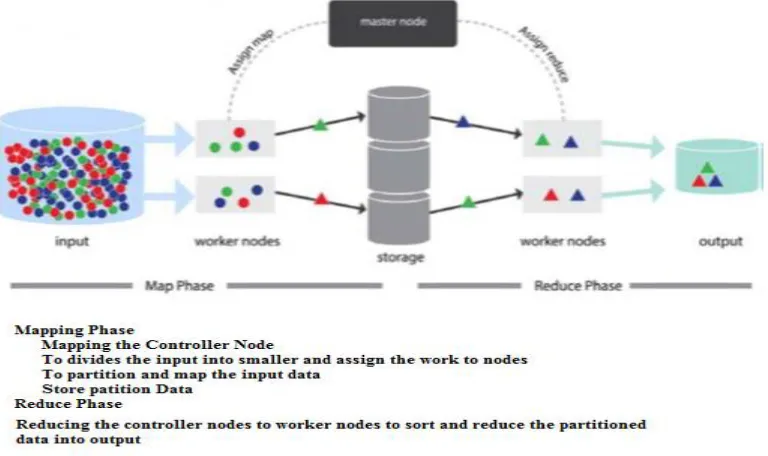
The SVM, for native big data analytics platform for Hadoop also introduced a solution for Internet of Things that enables the user to manage the machine learning and sensor data to scale. To create a data analytics the new services to enable the visual analytics for Machine learning and sensor data sets for deep behavior analysis given below shows in figure 2.
Fig 2 Mapping and Reduce the Controller Node for Distributed File System
IV. RESULT EVALUATION
To obtain the result from the experiment and brief discussions are presented in this section. The ST, PA, LSAMLA and HF are a proposed method of Cooperative based database caching system having experimental result to analysis the different datasets. To evaluate the result with performance, accuracy, time consumption and data retrieval with Framework Lichen Zhang et al.,[13], Skytree Brings Machine Learning Gray [15], SVM Algorithm Singh D [20] and Large Scale Adaptive Machine Learning Algorithm Najafabadi MM et al.,[18] to compute the classification of document, audio, video, images.
Cooperative Caching System Description
The Spark the Large Scale Adaptive Machine Leaning Algorithm for deep learning based on performance retrieval of data is calculated in this paper Learning Algortihm Najafabadi MM et al.,[18] and Data Driven Information M. Chithik Raja et al.,[25]. In this paper, to calculate the caching performance of data retrieval descriptions are given in the table 1.
Name of the Learning Back Propagation Multiple Back
Propagation Learning Algorithm 4569 9856 Data driven Information 25943 58383
Table 1: Deep Learning description Format to Store Data Sets
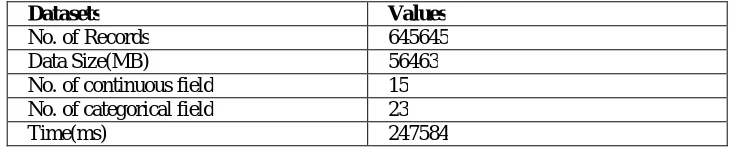
In big data, to Store Data in datasets for large scale volume of data then processes the structured and unstructured data. The large scale uses multiple petabyte of data store in server information’s like number of records, size, time and field. The different data format we use ORC format to store the data effectively analysis in our algorithm it combines desirable features and performance. The Hadoop Distributed file System to build the data storage can be divided into name node and data nodes, to maintain the track of Meta data across the physical Hadoop instance for name node which actually stores the data for data nodes. In Table 2 describes how large volumes of data stored in ORC format:
Datasets Values
No. of Records 645645
Data Size(MB) 56463
No. of continuous field 15 No. of categorical field 23
Time(ms) 247584
Table 2: Store Values in Datasets
Evaluate Document, Audio, Video and Image in Different Technique
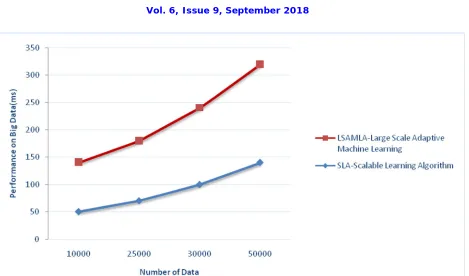
Fig 3 Performance Classification between Large Scale Adaptive Machine Learning Algorithm and Scalable Learning Algorithm
The figure 3 shows the performance of big data algorithms to classify the datasets and proposed a high-performance algorithm called Large Scale Adaptive Machine Learning. The high-performance to compare existing Scalable Learning Algorithm and we proposed a LSAML Algorithm, when the number of data is increased by using deep learning. The maximum performance is attained by proposed LSAML is 76.7% for number of data as 300 and the minimum performance is attained by Scalable Learning Algorithm is 65% for number of data as 5000. The average performance of the proposed LSAML, Scalable Machine Learning and Apriori Enhancement Algorithm are 76.6%, 65% and 68.7% respectively. The performance clearly shows that the proposed LSAML algorithm outperformed than the existing scalable learning algorithm and Apriori Enhancement Algorithm.
Fig 4: Accuracy Classification between SVM Algorithm and Apriori Enhancement Algorithm
The above figure 4 represents the running time of SVM algorithm and proposed Apriori Enhancement algorithm for the dataset. The format of datasets having number of records, Data Size by analyzing the above table 2, when the number of data given for MapReducing is increased, the required running time of the Hadoop process also increased gradually for every Apriori Enhancement algorithm as used for evaluation. In accuracy, the minimum process is achieve by proposed AE algorithm is 63% for MapReducing process is 350 data is given and the maximum process is achieve by proposed AE Algorithm is 81% for the MapReducing process is 4000 for number of data is given. The accuracy level between existing and proposed algorithm achieve the performance to increase accuracy of Apriori Enhancement algorithm.
Fig 5:The Efficient data retrieval analysis between existing and proposed systems shows the learning as Sky Tree like documents, images, audios and videos to compare the proposed algorithm for big data level analysis and classification of different data is low compare to proposed Algorithm. The efficient data retrieval can compared in X axis and Y axis for different classification is given below shows in figure 5.The better selection for classification and future to achieved performance and accuracy in different algorithm. In that the classification and feature selection are achieved in a better manner compare to existing and proposed.
Fig 5: Data Retrieval Classification between Sky Tree and Horizontal Grouping Attribute 0 20 40 60 80 100 120
20 40 60 80
Ef fi ci e n t D at a R e tr ie va l B ig D at a( % )
Number of data
Horizontal Grouping Attributes ST-Sky Tree 0 50 100 150 200 250 300 350
1000 2000 3000 4000
A cc u ra cy o n B ig D at a( % )
Number of Data
AEA-Apriori Enhancement Algorithm
Compared to existing Horizontal Grouping Attributes, the proposed SkyTrees has the high data retrieval. In the SkyTree, the retrieval data can be increased using the Distributed Hadoop File system. The average time of data retrieving keeps on decreasing when data input is constant or increasing in Hadoop Distribute File System. The server takes seconds to read a particular data from 100000 MB size of data which has been stored in the Hadoop Distributed File System where the data are kept constant. The number of servers to increase 10 - 60 servers for better performance retrieving of data from Hadoop Distributed File System, the average time taken for retrieval of data in Hadoop Distributed File System by server is shown in Figure 5 and is 22 %, 17 %s, 14.1 % and 18% from 100000MB data size where data are kept constant and servers are increasing.
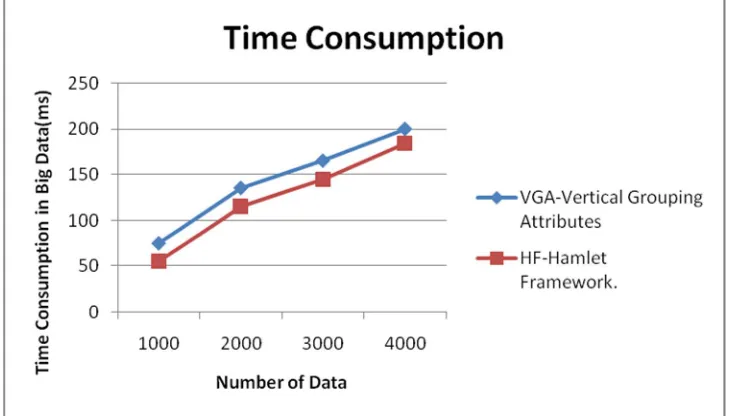
Fig 6: The Time Consumption analysis between existing systems and proposed system shows the learning as Hamlet Framework. The documents, images, audios and videos compare the proposed algorithm for big data level analysis and classification of different data for proposed Algorithm. The Time Consumption can compared in X axis and Y axis for different classification is given below shows in figure 6.
Fig 6: Time Consumption Classification between Hamlet Framework and Vertical Grouping Attributes
The time consumption of proposed hamlet framework is low compared to vertical Grouping Attributes, therefore, it can reduce the data delay transmission. The retrieval of data can be checked by calculating the data delivery, data replication and storage capacity to compute the cache time for information in particular time. The proposed system will give the better performance having minimum time is 2146ms and maximum time is 3438ms than the existing algorithm because of low time consumption having minimum time is 1323 and maximum time is 2183ms.
V. CONCLUSION
system for content and then retrieved from the large datasets. We focus on sky tree to analyze a machine learning language and data analytics platform focused on handling the Big Data.
REFERENCES
1. Xiang Yu, Xiandong Xu, and Liandong Lin, Springer-Verlag Berlin Heidelberg 2015, “A Data Stream Subspace Clustering Algorithm”, pp. 334–343, Mar 2015.
2. Yan D, Xu-Sen Yin, Cheng Lian and Xiang Zhong, Journal of Computer Science and Technology, “Using Memory in the Right Way to Accelerate Big Data Processing”, pp. 30–41, Jan. 2015.
3. Andrew Crotty, Alex Galakatos, Kayhan Dursun and Tim Kraska,, 7th Biennial Conference on Innovative Data Systems Research,“ Tupleware Big Data, Big Analytics, Small Clusters”, pp. 19-27, Feb 2015.
4. Shengtao Sun, Jibing Gong, Jijun He and Siwei Peng, Springer Science and Business Media New York, “A spreading activation algorithm of spatial big data retrieval based on the spatial ontology model”, pp. 1-19, Dec 2015.
5. S. V. Mitsyn and G. A. Ososkov, Journal of Joint institute for Nuclear Research, “Watershed on Vector Quantization for Clustering of Big Data” , Vol. 12, No. 1, pp. 170–172, Jan 2015.
6. DunrenChe, Mejdl Safran, and Zhiyong Peng, Springer Publishing, “From Big Data to Big Data Mining: Challenges, Issues, and Opportunities”, pp. 1–15, Jul 2013.
7. Berlin Heidelberg, Journal of Big Data, “Data clustering: algorithms and applications”, pp. 24-27, Jan 2015.
8. Xindong Wu, Xingquan Zhu, Gong-Qing Wu and Wei Ding, IEEE Transactions on Knowledge and Data Engineering, “Data Mining with Big Data”, VOL. 26, NO. 1, JANUARY 2014.
9. Verena Kantere, International Congress on Big Data, “A Holistic Framework for Big Scientific Data Management”, pp. 220-226, Aug 2014. 10. Shweta Pandey and Dr.Vrinda Tokekar, Fourth International Conference on Communication Systems and Network Technologies,
“Prominence of MapReduce in BIG DATA Processing”, pp.555-560, Jan 2014.
11. Katarina Grolinger, Michael Hayes, Wilson A. Higashino and Alexandra L'Heureux, 10th World Congress on Services, “Challenges for MapReduce in Big Data”, pp.182-189, Sep 2014.
12. Yuri Demchenko, Emanuel Gruengard and Sander Klous, International Conference on Cloud Computing Technology and Science, “Instructional Model for Building effective Big Data Curricula for Online and Campus Education”, pp. 146-155, Jun 2014.
13. Lichen Zhang, International Conference on Automation & Computing, “A Framework to Model Big Data Driven Complex Cyber Physical Control Systems”, pp.19-24, ICAC Sep 2014.