TABLE OF CONTENTS:
Vol. 40, No. 6, November 1967
ARTICLESInvited Synthesis Paper
482 Decision-Analysis Approach to Brush Management Planning: Ramifications for Integrated Range Resources Management by Charles J. Scifres
Forage 491 493
502
506
509
Digestibility of an Arboreal Lichen by Mule Deer by Charles T. Robbins
Digestive Physiology of Steers Grazing Fertilized and Nonfertilized Blue Grama Rangeland by L.J. Krysl, M.L. Galyean, M.B. Judkins, M.E. Branine, and R.E. Estell
Seasonal Dynamics of Minerals in Forages at the Texas Experimental Ranch by L.W. Greene, W.E. Pinchak, and R.K. Heitschmidt
Potential for Hydrocyanic Acid Poisoning of Livestock by Indiangrass by K.P. Vogel, F.A. Haskins, and H.J. Gorz
Factors Affecting Dietary Preferences for Genotypes of a Hybrid Wheatgrass by Doreen R. Truscott and Pat 0. Currie
Plant Establishment 514
520
524
530
534
Interplanting Crested Wheatgrass with Shrubs and Alfalfa: Effects of Competition and Preferential Clipping by Bruce M. Pendery and Frederick D. Provenza Use of New Rangeland Seedings by Black-tailed Jackrabbits by J. Kent McAdoo, William S. Longland, Greg J. Cluff, and Donald A. Klebenow
Drilling Versus Imprinting for Establishing Crested Wheatgrass in the Sagebrush- Bunchgrass Steppe by M.R. Haferkamp, D.C. Ganskopp, R.F. Miller, and F.A. Sneva
Germination Rate at Low Temperature: Rubber Rabbitbrush Population Differ- ences by E. Durant McArthur, Susan E. Meyer, and Darrel J. Weber
Germination of Downy Brome from Southern Kansas, Central Oklahoma, and North Texas by T.H. Milby and Forrest L. Johnson
Sampling Methods
537 Evaluation of a Single Probe Capacitance Meter for Estimating Herbage Yield by Pat 0. Currie, Thomas 0. Hilken, and Richard S. White
Plant Management
542 Ecology and Management of Kermes Oak (Quercus coccifera L.) Shrublands in Greece: A Review by Constantinos N. Tsiouvaras
547 Selective Control of Annual Bromes in Perennial Grass Stands by P.O. Currie, J.D. Volesky, T.O. Hilken, and R.S. White
551 Seasonal Diets of Herded Sheep Grazing Douglas-fir Plantations by Wayne C. Leininger and Steven H. Sharrow
555 Optimal Economic Timing of Range Improvement Alternatives: Southern High Plains by D.E. Ethridge, R.D. Pettit, R.G. Sudderth, and A.L. Stoecker
Grazing
Published bimonthly-January, March, May, July, September, November
Copyright 1987 by the Society for Range Manage ment
INDIVIDUALSUBSCRIPTION isbymembershipin INSTITUTIONAL SUBSCRIPTIONS on a calendar year basis are $56.00 for the United States postpaid and the Society for Range Management.
LIBRARY or other $66.00 for other countries, post- paid. Payment from outside the United States should be remitted in US dollars by international money order or draft on a New York bank.
BUSINESS CORRESPONDENCE, concerningsub- scriptions, advertising, reprints, back issues, and related matters, should be addressed to the Manag- ing Editor, 1639 York Street, Denver, Colo. 60206. EDlTORlALCORRESPONDENCE,concerningmanu- scripts orothereditorial matters, should beaddressed to the Editor, 1839 York Street 80206.
INSTRUCTIONS FOR AUTHORS appear on the inside back cover of each issue. A Style Manual is also available from the Society for Range Manage ment at the above address @$1.25 for single copies; $1.00 each for 2 or more.
THE JOURNAL OF RANGE MANAGEMENT (ISSN 0022-409X) is published six times yearly for $56.00 per year by the Society for Range Management, 1839 York Street, Denver, Cola. 80206. SECOND CLASS POSTAGE paid at Denver, Colo. POSTMASTER: Return entlre journal wlth address change-RETURN POSTAGE GUARANTEED-to Society for Range Management, 1839 York Street, Denver, Colo. 80206.
The Journal of Range Management serves as a forum for the presentation and discussion of facts, ideas, and philosophies pertaining to the study, management, and use of range- lands and their several resources. Accord- ingly, all material published herein is signed and reflects the individual views of the authors and is not necessarily an official position of the Society. Manuscripts from any source- nonmembers as well as members-are wel- come and will be given every consideration by the editors. Submissions need not be of a technical nature, but should be germane to the broad field of range management. Editor- ial comment by an individual is also welcome and subject to acceptance by the editor, will be published as a “Viewpoint.”
Managing Edltor PETER V. JACKSON Ill
1839 York Street Denver, Colorado 86266
Edltor
PATRICIA G. SMITH
Society for Range Management 1839 York Street
Denver, Colorado 86206 Book Revbw Edltor GRANT A. HARRIS
Forestry and Range Management Washington State University Pullman, Washington 991646410
BOOK REVIEWS
565568 574
Die Wanderviehwirtschaft im gebirgigen Western der USA and ihre Auswirkungen im Naturraum Gisbert Rinschede; Wild Horses of the Great &sin: Social Competi- tion and Population Size. Joel Berger; Genera Graminum, Grasses of the World. W.D. Clayton and S.A. Renvoize; Be Ecology of Natural Disturbance and Patch Dynamics. edited by S.T.A. Pickett and P.S. White; Big Game Ranching in the United States. Ronald J. White; and Livestock Development in Subsaharan Africa: Constraints. J.R. Simpson and P. Evangelou eds.
Index
Table of Contents
ASSOCIATE EDITORS G. FRED GIFFORD
Dept. of Range Wildlife, and Forestry University of Nevada
Reno, Nev. 89506 THOMAS A. HANLEY
Forestry Sciences Lab. Box 20909
Juneau, Alaska 99802 RICHARD H. HART
USDA-ARS 8468 Hildreth Rd. Cheyenne, Wyoming 82009 N. THOMPSON HOBBS
Colorado Div. of Wildlife 317 W. Prospect
Fort Collins, Colorado 80526 W.K. LAUENROTH
Department of Range Science Colorado State University Fort Collins, Colorado 80523 HOWARD MORTON
2ooO E. Allen Road Tucson, Arizona 85719
BRUCE ROUNDY 325 Biological Sciences East Building, Univ. Arizona Tucson, AZ 85721 NEIL E. WEST
Range Science Department Utah State University UMC 52 Logan, Utah 84322
LARRY M. WHITE USDA ARS
S. Plains Range Research Station 2ooO 18th St.
Woodward, Oklahoma 73801 RICHARDS. WHITE
KSU Extension Center Colby, Kansas 67701 STEVE WHISENANT
401 Widtsoe Buildino Brigham Young Uni;. Provo, Utah 84662 JAMES YOUNG
USDA ARS
Invitational Synthesis Paper
Papers published by the Journal
of Range Management
for many years have been almost entirely reports of results from focused studies designed to test specific hypotheses or to fulfill specific objectives. While this is entirely appropriate for a scientific journal, the Editor and Associate Editors realized the genuine need to publish articles that synthesize results from focused studies into a more general fabric of knowledge, providing greater insight than the sum of information reviewed. It was agreed during 198687 that distinguished scientists should be invited to prepare synthesis pap- ers, and a goal was set to publish one synthesis paper in each volume of the Journal. The Editor and Associate Editors were pleased that Dr. Charles J. Scifres accentedtheir invitation to write the first such paper.
DR. CHARLES J. SCIFRES is Professor and Head of the Department of Agronomy at Oklahoma State University in Stillwater, Okla- homa. Before coming to Stillwater in mid- September 1987, he had taught and conducted research in the Range Science Department at Texas A&M University since 1968. Hisresearch there involved range improvements, with cm- phasis on brush management, shrub ecology, range economics, and integrated brush man- agement systems. He developed graduate cour- ses in herbicides and the range ccosvstem. fire ecology, range improvcment~practicks, a& re- search methods.
Scifres was born June 1, 1941, near Duncan, Oklahoma, and grew up on a stockfarm near Duncan. He received his B.S. degree in 1963 and his M.S. degree in 1965 from Oklahoma State Univer- sity and his Ph.D. degree in 1968 from the University of Nebraska.
He received the Faculty Distinguished Achievement Award in 1980 and the Distinguished Performance Award for Team Re- search in 1985 at Texas A&M University. He was the first Thomas M. O%onner Endowed Professor in the Range Science Depart- ment at Texas A&M University and held the position from 1982 through 1987. He received the Outstanding Achievement Award from the Societv for Ranec Manaeement aq well as the Outstand-
ing C&tribution to Range Management Award from the Texas Section of the Society for Range Management in 1985.
Scifrcs has served on the editorial board of the Journal
of
Range Managemenr and as Associate Editor for WeedScienceand is on the Editorial Board of Agroecosysrems and Envi- ronment. He is a member of the Society for Range Management, the Weed Science Society of America, the Ecological Society of America, the American Society of Agronomy, South- western Association of Naturalists, and the Council for Agricultural Science and Tcchnol- OgY.Heisauthororco-authorof 112joumalarti- cles, 52 Experiment Station publications, one book, three chapters in books, and about 300 progress reports, abstracts, and popular arti- ClCS.
Scifres and his wife Julia have two children and a granddaughter.
Decision-Analysis Approach to Brush
Planning: Ramifications for Integrated Range
Management
Resourc& Management
CHARLES .I. SClFRES
Abstract
Simulation, optimization, and other modeling pandigms for systems ecology nnd economics have not been broadly applied to development of models for range resource management in real- world settings. The lag in emergence of applicable mnnqement models may be attributed to the lack of a conceptual context for their application. Recent appreciation of the decision-analysis approach to natural resource management and the general nvnila- bility of high-speed computing capabilities have provided viable bases for using increasingly sophisticated analytical tools to solve management problems. Decision models may be used to generate proforma contrasts of selected management alternatives for multi- enterprise firms and implementation protocols for the selected management program(s). Such models, operating from a eomputer-
482
managed infommtion base, become decision-support systems (DSS)for approaching specific mnnngement problems; Integrated Brush Management Systems (IBMS) is one example. These DSS are proposed at the first step toward creating comprehensive decision-making models for total resource management (i.e. Inte- grated Range Resource Management or Integated Range Resource Analysis). The next generation of models will link qualitative informntionnndrules-of-thumb (heuristics) with hnrd(experimen- tally derived) data. These knowledge-based or expert systems, one facet of the growing field of nrtilieinl intelligence, hold great prom- ise ps vehicles for achieving Integrated Range Resource mannge- mat. Bringing Integrated Range Resource Management Systems to fruition can be expedited by interdisciplinary research and educntionnl programs for potential user groups.
Key Words: computer decision aIds, expert systems, integrated brush mnnngement systems, knowledgrbnsed systems
Range resource managers act daily in decision-making envi- ronments that require understanding the biological and economic interactions among management practices and habitats of domcs- tic and wild animals. Solutions to such complex ecological- management problems first require adoption of long-term strate-
gies which provide goals or constraints for tactical decision analy- appropriate solution. An expert or knowledged-basedsystem can sis (Walters and Hillbom 1978). However, traditional research be viewed as a model of the expertise of the best practitioners in the in brush management has emphasized development and improve- particular field of inquiry (Harmon and King 1985). Knowledge ment of methods and associated technologies for tactical purposes systems interact with a user much the same as a consultant would, with relatively little consideration for their strategic potential, and provide advice along with the underlying rationale (a more especially in relation to the economic outcome of brush manage- detailed discussion of knowledge-based systems is given in a later
ment practices. section).
Fundamental to the traditional research approach has been the tacit premise that no 2 firm-level decision-making environments are exactly the same. Ostensibly, the best that could be offered resource managers has been a general assessment of efficacy for individual technologies. As a general and unfortunate rule, it has been left to the manager to adapt technologies and orchestrate their implementation to meet specific strategic goals. Thus arises a major deficiency in technology dissemination: most technologies cannot be directly “transferred” to producers without first being tailored to meet specific needs (Horton 1986). Walker et al. (1978) suggested that the gap between research and management may be bridged by development of simple decision rules which help resource managers choose appropriate strategies and effectively implement them.
Evolution of the Brush Management Conctwt
As aptly proposed by Norton and Walker (1985), “If research programmes in applied ecology are to have the greatest chance of improving management, they must be designed with the resource manager’s problems in mind. It is suggested that the adoption of a decision-analysis approach can achieve this objective and increase the relevance of ecological research.” They earlier argued that application of ecological principles has been constrained by lack of a conceptual, problem-oriented (management) framework that outlines specific rquirements for ecological information (Norton and Walker 1982). These arguments provided the impetus for directing recent research toward developing the conceptual frame- work for identifying best management alternatives within the broad context of firm level, decision-making environments. As a result, a new generation of decision models and systems has been created for rangelands (Wight 1987).
Since the chronology of the changing philosophy concerning brush and its management has been detailed (Sciires 1980; S&es et al. 1983, 1985). only the salient points will be presented. The changing attitude from brush eradication to brush control implied understanding that there exists a threshold of economic advantage beyond which an incremental increase in cost does not generate a significant increase in benefits from woody plant control. How- ever, eradication still appears in the popular literature, and “brush control” still connotes the desire to kill all woody plants in the targeted stand. “Brush management” first appeared in the litera- ture in 1965 when Box and Powell (1965) espoused the idea that forage values of certain otherwise troublesome woody species could be improved by selected manipulations. The idea was subse- quently expanded and utilities of the concept presented in a broader context, ‘management and manipulation of stands of brush to achieve specific management objectives” (Scifres 1980). This approach embraces the potential values of certain quantitites of woody plants for an array of purposes in range management (Scifres et al. 1983), but wildlife habitat remains as one of the primary foci (Beasom and Scifres 1977, Whitson et al. 1977, Tanner et al. 1978, Beasom et al. 1982, Scifres and Koerth 1986). The view was explicitly stated by Jacob’s (1987) objective for sagebrush (Artemisia spp.) ecosystems, “Maintaining vegetation to sustain the optimum level of livestock and wildlife consistent with other uses of rangeland.”
The objective of this paper is to propose, from an applied biolo- gist’s viewpoint (and one who certainly is not a systems scientist), the potential for broader applications of systems logic, decision analysis, and eventually expert systems to range resource and ranch firm management. Involvement of natural resource scient- ists and managers in systems research and application is a natural extension of their traditional roles as integrators of resource use. Evolution and potential of a planning model, Integrated Brush Management Systems (IBMS), will be used as the central theme on the premise that the underlying concepts and ideas have applica- tion to range resource management in the broader context.
The idea of Integrated Brush Management Systems (IBMS) was catalyzed by the awareness that no single brush control method normally is sufficient to meet resource goals. The pervasive limita- tion facing resource managers considering use of available brush control technologies as single treatments was, and still is, lack of positive economic performance. Given cost of treatment, available methods too often do not provide the necessary level of efficacy, and life of effective control is often inadequate to compete with alternative investments of capital. This reality provided the impe- tus for focusing research on application of methods in a logical sequence. Each method in the sequence initially was chosen to complement other method(s) (e.g., broaden the spectrum of species suppression, increase the effective life of an initial costly method).
Terms
This research indicated that the potential interactions of treat- The word system is used in relation to a broad array of pheno-mena and activities and has various meanings to range scientists and managers depending on context of use. The definition, “...a group of elements, either physical or nonphysical in nature, that exhibit a set of interrelations among themselves and interact together toward one or more goals, objectives, or ends” (Mittra 1986), is adopted for the purposes of this discussion. In this con- text, model is defined as any representation or abstraction of a system or process which helps us (1) define problems, (2) organize thoughts, (3) understand data, (4) communicate and test that understanding, and (5) make predictions (Starfield and Bleloch 1986, Williams 1979). A decision-analysis aid is any model that helps the user arrive at a feasible solution to a specific problem given available information. A decision-support system (DSS) is a computer-based information system that helps a manager make key decisions, thereby enhancing the effectiveness of the problem- solving process (Mittra 1986). Logically, then, a computerized decision-analysis aid becomes a DSS as it provides information from a data base which enhances the user’s ability to arrive at an
ments in sequence, expressed in terms of efficacy, may produce predictable outcomes. For example, herbicide application and prescribed burning in sequence may be additive (i.e., response to the treatment sequence is as expected based on performance of the treatments applied singly, [see Scifres 1975, S&es et al. 19831); synergistic (positive results from treatment sequence greater than expected based on performance of individual treatments, [see Gordon et al. 1982; Ueckert and Whisenant 198Oa, 1980b; Mayeux and Hamilton 1983, Dow Chemical U.S.A.]); or antagonistic (results from treatment sequence less than from the most effective treatment in the sequence [see Ueckert et al. 19831).
The potential interactions among brush control methods and the need to design brush management to best fit multicnterprise ranch firms gave rise to the development of IBMS: “a rational decision- making process that seeks to optimize sustained yield of all range- land products’* (Scifres 1986). Theoretically, yield optimization should maximize sustainable economic returns over a predeter- mined planning horizon.
Genenlized Decision Models
Decision-analysis models are designed to aid the user in selecting the course of management action which best fits the management environment and addresses his/ her specific management goals. Generalized decision models, such as that of Norton and Mumford (1984) for pest management, provide a decision-analysis frame- work driven by 3 major variables: perceptions of problems, percep tions of options, and management objectives (Fig. 1). “In this
Management
h
optionsManager’s
t-J
perceptionsAction
1
Outcome
Fig. 1. Generaiired decision model adapted by Norton and Walker (1985) from Norton and Mumford (1984) for pest control.
model, and in reality, a decision problem only exists where there is a physical problem and a range of control options to deal with” (Norton and Mumford 1984). If the decision-maker’s objectives are satisfied by a standard operating procedure (e.g., routine spray- ing for a given pest), a decision model is of little use. Decision problems arise because of the introduction of new pests which the standard practice will not control or because a new option has emerged (e.g., newly developed pesticide).
Although the Norton-Mumford model was developed for agro- nomic settings, its driving logic can be directly applied to range resource management. Standard operating procedure(s) for brush management is(are) normally used by range resource managen until a new option emerges (e.g., new herbicide, prescribed bum- ing) or a new brush problem develops (e.g., increase in species resistant to the herbicide previously used), a commonly used herbi- cide is withdrawn from the marketplace, herbicide costs increase significantly, and/ or livestock prices decline seriously. In any case, the decision environment has generally been informal and the problem-solving mentality largely reactive environments. Greatest benefits from decision-making processes are accrued when the user employs them in a proactive fashion (which invokes, at least to a certain degree, formality). Proactive planning is especially ger- mane to the long-term planning required to effectively manage natural resources.
The IBMS model (Fig. 2) decomposes the generalized decision model of Norton and Mumford (1984) into the series of functions necessary for brush management planning. A major difference in models for natural resource management and those for manage- ment of agronomic systems is the longer planning profile dictated
Norton- Mumford (1984) Mod.1
IBMS Deck&xi Model
Set Gonerallzad
Assess Rasouroe Potwtlal
/ Charactwtze Technological AlternatIves
f&q
+-__lp
i-
AHsrnatlvesjManager’s
A I
I
Pw-formonce of Altematlv*s
23
OutcomeFig. 2. Parallels between the generalized Norton and Walker (1985) and IBMS (Scifes et al. 1985) decision models.
by the former. Natural resource management decisions may affect the outcomes of subsequent actions for 5 to 20 years in contrast to decisions for agronomic systems, which may be altered signifi- cantly on an annual basis with shorter-term impacts of previous decisions. Because outcome of previous actions forms a new decision-making environment, long-term planning for natural resource management requires dynamic, iterative models which can take advantage of new technologies as they emerge (Fig. 2).
The ultimate effectiveness of any brush management program hinges largely on the effectiveness of other ranch management practices (e.g., grazing management, livestock herd management, wildlife management and merchandising strategies, and recrea- tional uses). Management ability (i.e., managerial intelligence, experience, skill and effort [Walker et al. 19781) is critical to the outcome of any management plan. The potential unique interac- tions of these elements in a multi-enterprise firm setting justify a planning process that develops a long-term strategy to meet spe- cific management goals (Scifres et al. 1985), and one that allows adjustments in strategy to meet changes in goals through time. The idea was recently presented by Mendoza et al. (1986) as Multiple Objective Programming. Norton and Walker (1982) referred to this approach as Integrated Resource Analysis and proposed it as an operational framework on a national basis. Certainly, the decision-analysis approach has considerable merit for discerning optimal approaches to policy development (e.g., Bonnicksen 1980,
1981, 1985; Bonnicksen and Becker 1983; Bonnicksen and Lee 1982) as well as to resource allocation and planning at the ranch firm level. Resource allocation can be determined at 3 levels of decision-making: planning (strategic); design (tactical); and man-
agement (operational) decisions (Norton and Walker 1982, Mittra 1986).
To effectively work for the user, a decision model must be: (1) presented in a format understandable and applicable to a
given planning environment;
(2) based on systems logic (ideally biases are imposed only by user, and all biases and their sources are identified as such), and
(3) dynamic and iterative to accommodate progressive tem- poral changes in state of the firm.
For specified land management programs such as brush manage- ment, an effective decision-analysis model must meet certain cri- teria and perform several primary functions:
(1) require statements of working objectives for land (resource) use on a management unit-by-unit basis;
(2) project potential change(s) in production level that can be achieved by management action (i.e., evaluate present state and assess production capabilities) under alternative man- agement schemes;
(3) allow selection of applicable alternative technologies first based on objective performance criteria (projected degree to which production capability can be achieved), then allow screening based on user preferences and/ or specific applica- tion constraints (the technologies may include primary and/ or secondary technologies with information relative to the implementation);
(4) allow periodic incorporation of new knowledge;
(5) allow assessment and restatement of objectives, and restart the technology selection loop if technology is inadequate to meet stated goals;
(6) isolate and quantify key interactions among land uses in a multi-enterprise setting that might result from employing specific technologies;
(7) objectively contrast selected alternatives based on economic criteria, clearly identifying compromises among enterprises (and assigning value lost), then subject output to user scru- tiny for final selection;
(8) provide the framework for developing an implementation/- monitoring plan, and,
(9) provide a mechanism for reviewing plan and updating as necessary.
Objective Setting
Decision-analysis protocols such as employed by the IBMS model require setting of goals within the constraints of production potential of the resource (Fig. 2). Setting of goals for brush man- agement must occur at several levels. The first level is vested in those who discern the overall goals for the firm. The pervasive goal may be as simple as “staying in the ranching business,“and can be decomposed into a hierarchy:
I. Stay in the ranching business
A. Optimize returns to the firm from selected enterprises on A. management unit basis.
1. Optimize returns from cow-calf and lease-hunting enterprises in Venado Grande pasture.
2. Etc....
As straightforward as this management-by-objective approach seems, it too often is not formalized. Lack of such formal guidance may result in brush management becoming the end rather than the means for attaining stated objectives.
Evaluating Resource Potential
Effective decision-analysis requires that management goals be commensurate with production potential of the resource. In this regard, land is viewed as one production input by the IBMS planning process. Projected potential productivity is a function of the specific investment and management inputs that are combined
with land capability (Norton and Walker 1982). This stage of the planning process provides information critical to each subsequent step in the analysis. The analysis requires that projected levels of annual production be quantiBed (e.g., as forage production or carrying capacity) for the management unit. These projections must contrast anticipated change following implementation of brush management and expected production without treatment. Recently published procedures for estimating forage production in relating to anticipated variations in precipitation are extremely useful in this regard (Hamilton et al. 1986).
Evaluation of Alternative Technologies
Decision-analysis models should first present the array of tech- nological alternatives known to be effective, then use management preference as the criterion to select a subset for further considera- tion (Scifres et al. 1985). The subset of preferred technologies can then be evaluated based on expected levels of performance pro- jected through a planning profile. Planning profiles of 15 to 20
years are appropriate for most range improvement projects (Sci- fres et al. 1985).
It is critical that all available options be equitably screened. This prevents placing unwarranted emphasis on new methods unless dictated explicitly by the user. Decision-analysis aids, such as if-then treatment selection routines (Fig. 3), are useful formats for technology evaluation. Once applicable methods are identified, they are screened for limitations to implementation (e.g., aerial spraying might be omitted from the list of potential alternatives because of the proximity of susceptible crops). Once evaluation of the initial (primary) technology is completed, followup technolo- gies may be evaluated by the same process but in the context of projected alterations resulting from deployment of the primary method (i.e., the analysis must be conducted on each complete treatment set).
A general decision-analysis model, to be functional, must allow partitioning the management problem into a hierarchy of simpler problems [see Walters and Hillbom (1978) for discussion]. Details for the IBMS model are not illustrated in Figure 2; however, the model is structured such that it may be decomposed into a series of functions. Such models may be enlarged to encompass range resource management in the broadest sense (in that case, critical functions become modules in the hierarchy). The economic com- ponent serves as an example of such a module.
Economic Analysis
The greatest limitation to development of effective management models has been lack of information adequate to estimate produc- tion changes resulting from application of the technology. Often, lack of quantitative data necessitates use of expert opinion (Fig. 4). The Whitson-S&es (1980) model (Fig. 5) was effectively verified using expert opinion (Scifres et al. 1985). Biologists often initially shy away from the prospect of allowing opinion rather than “hard data”to be used in a model (although their opinions typically flow freely through informal interactions with information users). However, this approach is being progressively accepted as neces- sary if significant progress in development of management models is to be made. Where information is urgently required, the use of Delphi and other techniques aimed at obtaining quick, best esti- mates from expert opinion can be usefully employed (Norton and Mumford 1984). “Educated guessing: this approach may be quite formalised...referred to as multidisciplinary judgments...involving a round-table workshop of limited duration with selected experts...” (paraphrased from Norton and Walker 1982). The usefulmss of such judgments can be further relined by attaching a confidence level (0 to 1) to each.
Economic analysis in the IBMS process is based on refinement of the generalized response curve of Workman et al. (1965) (Fig. 5). Although still in need of refinement [e.g., inclusion of a function
/- PRlWEM CHAFIACTERWCS _I+
I--.-- SECIJNOARV TECHNOLOW --+ t.It&WP&MYs
MIA1 TECHNOLOGV -{ t
Fig.3. LJecision-analysis aids such as this if-then rrearment selection routine for Macartney rose (Rosa bracteata) management are usefulformatsfor brush management system impkmentation (taken from Scifes et al. 1985).
which assesses the change in production over time if brush man- agement is not employed (note static P. function, Fig. 5)], the model provides a mechanism for comparison of alternative methods and strategies in pecuniary terms. Utilization of the model for analysis of experimental results (Scifres 1987), empirical data (Garoian et al. 1984), and expert opinion (Whitson and Scifres 1980) clearly establishes the economic superiority of a welldefined brush management strategy and the need to consider that strategy in the overall context of range resource management. The general economic model has also been used for evaluation of projects such as spraying of sagebrush rangelands (Jacobs 1987). It is based on little or no change in forage production the year after treatment of brush, then an increase to the maximum production the year after treatment of brush, then an increase to the maximum production value (Pm=) which is sustained for a period of years. Thereafter, forage production gradually declines to the original level at which time treatment life (TL) has expired.
One of the simplest approaches to quantifying the importance of forage released by treatment is to assign it a lease value. However, there are several sources of production change (e.g., increased calving percentages and weaning weights) in addition to increased carrying capacity for cow-calf enterprises (Fig. 6). Also, there are several costs normally associated with a brush control treatment (e.g., additional breeding animals to take advantage of increased forage and associated variable costs, and potential reduced revenues for other enterprises such as lease hunting) in addition to treatment application costs.
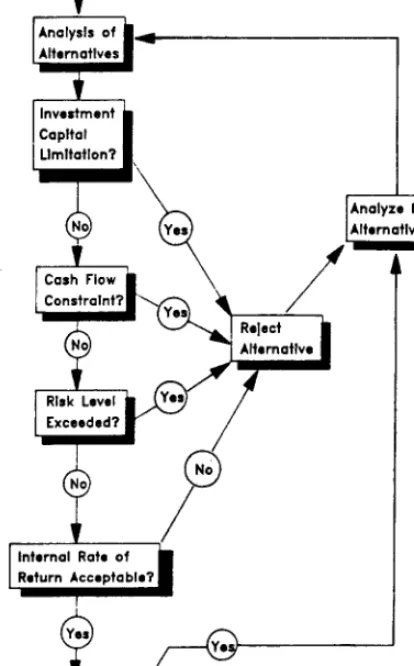
The cost/return information may be used to create partial budgets for a series of selected alternatives. Subsequent net present-value analyses facilitate scrutiny of alternatives on finan-
486
cial (magnitude of investment, timing of investments, cash flow), economic (internal rates of return, net-present value) and risk preference criteria (Fig. 7) (S&es et al. 1985).
Knowledge-based Systems: Toward Comprehensive
Decision-Analysis at the Ranch Firm Level
Decision models were intentionally presented herein in the most simplistic form, but they are prototypes for more comprehensive models which effectively encompass all significant management elements for multicnterprise firms. Such models cannot be com- pletely driven by experimentally derived information (much of which is informative but not easily applied porton and Walker 19821). Development of decision-analysis models and supporting subroutines require 4 categories of input: historical, real-time, forecast and fundamental information (Norton and Walker 1985).
Historical information is most heavily used as input at the resource potential assessment stage with the IBMS process (Fig. 2). Real-time information is generated through the continuum from the point of resource potential assessment to completion of eco- nomic assessment of alternatives. Forecast or predictive informa- tion is derived from the other 3 types of information, generated as output by each subroutine, and then finally forms the interactive result of the system.
Fundamental data are generated from basic research by tradi- tional experimentation. The impetus for the experiments often is information gaps which invariably emerge during the decision- analysis process. For example, additional research may be required to characterize the interactive nature of selected alternatives (e.g., grazing management X brush management; wildlife habitat X grazing management X brush management), and to develop more
I
Develop Alternatives~7
Requlrwnents and -
Contrast Economic Performance of Alternatives
Fig. 4. Process subroutine for selection of alternative technologies using generalizedprocesses in Figure 2. This stepwise procedurefor developing estimates of resource requirements and production impacts is used to satisfy information needed to construct response curves (Figure 5). Where information is inadequate, the option for using expert opinion may be exercised.
c
Tr TP,,.
lime (years)
Fig. 5. Function for estimating livestock production response to brush management. (Tr represents time from treatment application to maxi- mum response: TP,- is the timeperiodduring which maximumproduc-
rion is realized; P,,,.. is maximum expectedproduction level; TE, is time at which production following treatment is expected to equal PO, initial production level; TL is estimated treatment life.) (Takenfrom Sctfres et al. 1985).
effective alternatives and/ or refine existing brush management alternatives. However, until such time that experimentally derived data are available, expert opinion will be required for the models to function (see Fig. 4).
The use of opinion and experience (heuristics, rules-of-thumb) is the mainstay of any successful natural resource manager. “Deci-
PO Original produchon P,.. Maximum productlon TL Treatment life a Initial treatment applied b Mamtenance treatment applied
&<&.Q b$@&&._ b dw
d . . . . .i::::i:i#i:j::j~:::~~~~~~::::::::.:.:.:.:.:.~.:.:.:.:.:.:.:
‘Q’...‘.‘.:.:.:.:.: ::::::::::::::::::::::::::::::::::::::::.~:.:.:.:.:.:.:.:.:.:.:.:.:.:.:.:.:.:.:.:.:.:.:.:.:.:.:.:.:.:.: . . . . ._...: . . . ..A. i... :.:.:.:.):.:.:.:.:.:.:.:.:.:.:.:.:.:.:.:.:.:.:.:.:.:.:.:.:.:.:. ::::::::::::::::i:::::::::~:~:~~~~:~:~:~:~~~:~:~:~:~:~:~:~:~~:~~~~~~.:~:~:~~~
::::::::::::::::::::::::::::::::::::::::::::::::::::::::::::::::::::::::::::::: :.:.:.:.:::i:.::::~.:::::::::::::::::.:::::::::.:.:.:.:::::.:.:.:.:::.:.:.:.:.:
2 4 6 8 10 12 14 16 16 20 Years
11I111111111I1111111
I Partial budget analysis for each year
I
Net Present ValueInternal Rate of Return I
Fig. 6. Information inputs on cow-calfenterprise (Courtesy W. T Hamilton).
sions in ecological management are often made in practice on the basis of qualitative data and an individual’s accumulated expe- rience”(Starfield and Bleloch 1983). Expert systems or knowledge- based consultation systems offer promise in developing explicit links between hard data and final management decisions. Rule- based diagnostic expert systems have been developed in various fields and there is growing interest in their applications to ecologi- cal problem-solving (Loehle 1987). These systems incorporate opinions of practitioners as well as those of scientific experts with source of information determined solely by problem context.
Interactive decision-analysis aids can be considered to be one form of expert system within the general field of artificial intelli- gence (AI). Research in AI has been conducted largely in computer science and cognitive psychology with applications to natural resource management explored only recently (Coulson et al. 1987). The formal definition of expert systems by the British Computer Society (from Naylor 1983) is:
An expert system is regarded as the embodiment within a computer of knowledge-based component from an expert skill in such a form that the system can offer INTELLIGENT ADVICE or make an INTELLIGENT DECISION about a processing function. A desir- able additional characteristic, which many would consider funda- mental, is the capability of the system, on demand, to JUSTIFY ITS OWN LINE OF REASONING in a manner directly intelligible to the enquirer. The style adopted to attain these characteristics is RULE-BASED PROGRAMMING.
Harmon and King (1985) elaborate on Feigenbaum’s (undated) definition of an expert system:
. ..an intelligent computer program that uses knowledge and infer- ence procedures to solve problems that are difficult enough to
Anolysls of
I
Altrmatlves 4p[Inwstment
0
CapltolUmltatlon? \
\
__) Contlnur Program --_)
Fig. 1. Expanded decision-analysis procedure (generalized as “contrast economic performance of alternatives” in Figure 2) for screening alternative brush management technologies and systems based on economic criteria.
require significant human expertise for their solution. Knowledge necessary to perform at such a level, plus the inference procedures used, can be thought of as a model of the expertise of the best practitioners of the field.
The knowledge of an expert system consists of facts and heuris- tics. The ‘facts’ constitute a body of information that is widely shared, publicly available, and generally agreed upon by experts in a field. The ‘heuristics’ are mostly private, little discussed rules of good judgment (rules of plausible reasoning, rules of good guessing) that characterize expert-level decision making in the field. The performance level of an expert system is primarily a function of the size and quality of a knowledge base it possesses.
Harmon and King (1985) use the term knowledge systems in lieu of the more widely used expert systems. Knowledge systems inter- act with the user much as a consultant interacts with a client [i.e. knowledge-based consultation system (Starfield and Bleloch 1983)], so that knowledge engineers (persons who create knowledge-based systems) employ facts and heuristics as employed by an expert in the field. Such systems are composed of a knowledge base, an inference engine and a user interface (Fig. 8).
Some general working properties of rule-based knowledge sys- tems (i.e. diagnostic expert systems are:
1. Knowledge-based systems may function as consultation sys- tems. They may be highly interactive with the user, use a computer framework for organizing information (both qual- itative and quantitative), and investigate the rationale behind decision-making in the specific domain of inquiry (Starfield and Bleloch 1983). The system holds an apparent intelligent
0
User4
Expert or Knowledge Englneer
Fig. 8. Components of generalized knowledge-basedsystem ahptedfrom Harmon and King (1985).
conversation with user by asking questions (the order and nature of which depend on answers to previous questions). System logic is based on decision rules. Simple knowledge- based systems may be formed around straightforward if-then rule bases. For example, a system could be built around the Macartney rose problem featured in Figure 3 by developing the appropriate decision rules [see Starfield and Bleloch (1986), Harmon and King (1985), Naylor (1983), and Sell (1985) for discussion of rule development].
Knowledge-based systems may vary widely in complexity. The complexity of the systems should be a direct function of anticipated use; as with most problem-solving tools, the simpler the better [Starfield and Louw (1986); also see the straightforward system presented by Starfield and Bleloch (1983)]. However, knowledge-based systems may not be necessary to solve many problems. When the rule base becomes so small that an inference engine is not needed, branching conditional statements may be adequate to reach a feasible solution (as illustrated in Figure 3). Performance of the system is largely a function of the size of the knowledge base used by the system.
The rule base for a simple expert system to determine the best approach to managing a Macartney rose stand can be developed from the decision tree in Figure 3 and the following knowledge: Rule 1. If the Macartney rose is an undisturbed (most plants Z2 m
tall), dense (1 60% canopy cover) stand, then broadcast mechanical or chemical methods should be employed. Rule 2. If the Macartney rose. is a stand of dense (r 60% canopy
cover) regrowth with most plants 1 m or taller, then broadcast chemical methods should be used.
Rule 3. If the Macartney rose stand is regrowth on small areas with light to moderate canopy cover (r lO%, <60%) and most plants are 1 m or taller, then prescribed burning should be considered as the initial treatment.
Rule 4. If the Macartney rose stand occurs as scattered plants or as isolated clumps, then prescribed burning should be consi- dered as the initial treatment.
Rule 5. Etc...
Given this sample set of generalized rules, the system can then be developed to interact with the user by querying for information that will allow step-by-step movement through the decision tree. Such a question/answer session might follow .the format:
Selected portion of theoretical knowledge-based system designed to assist in designing Macartney rose management strategy.
1 .O System’s question Users response
1.0
2.0
3.0
Has the management unit or pasture in question been treated previously to con- trol Macartney rose?
1.1
Does the Macartney rose cover exceed 60% of the area on the management unit or pasture in question?
2.1
Does te Macartney rose cover exceed 10% of the area on the management unit or pasture in question?
3.1 Does the Macartney rose occur as scattered patches or more or less uniformly over the management unit? 3. la. Is the area small enough to
warrant spraying with ground equipment?
System Andysis. The most effective control mea-
sure is to aerially spray with 2,4,-D, 24-D + piclo- ram or picloram. Would you like to review specific treatment recommendations?
(Screen displays recommendations for each alternative herbicide including rate(s) of application, carrier, season of treatment, use precautions, etc.]. Would you like to review current treatment costs?
{Screen displays most current costs for her- bicide and application listing sources and dates of estimates.). Would you like to review expected results from application of the alternatives?
{Screen displays expected results including canopy reduction, proportion of plants killed, impacts on herbage production (anticipated reduction in forb production, grass response etc.)) Would you like to choose a treatment
Yes
No
Yes
Uniformly
No
Yes
Yes
Yes
JOURNAL OF RANGE MANAGEMENT 40(6), November 1987 489
and conduct proforma economic analysis? [N = no, D = 2,4,-D, D+P = 24-D + picloram;
P = picloram] D+P
{System branches to economic analysis pro- gram and begins new round of queries to build production response function.] -
The economic subroutine will query the user as to present pro- duction level (carrying capacity, calving percentage, bulkcow ratio, weaning weights, etc.); will ask the user to select a selling price, anticipated cost of additional cows and bulls (ii needed), variable costs/ AU and other information necessary for the analy- sis. The system will then construct an expected response curve, create a partial budget and display upon request the results of a net present-value analysis. Upon completion of the analysis, the pro- gram will query the user:
Do you w&h to evaluntc another alternative?
Do you wish to evaluate followup (secondary) control practices?
These knowledge-based systems can be updated as new tech-
nologies emerge and certainly are not limited to brush control. Rule-based systems can be built for grazing management systems, supplemental feeding, wildlife management strategies, livestock herd management and other elements essential to decision-making in multiznterprise environments.
Role of Interdisciplinary Research
Natural resources research traditionally has followed strictly defined disciplinary boundaries, often with areas of study further isolated within disciplines. As examples, studies of livestock reproductive efficiency and herd improvement often are not con- ducted in, and therefore may not be relevant to, the rangeland environment; research on game animals and wildlife habitat have largely been pursued independent of range management in the real-world- context; and, grazing management studies have been isolated from brush management research. This mode of research is being universally questioned [e.g. Tainton’s (1986) plea for an interdisciplinary approach to grassland-animal research].
Application of decision models at the firm level depends on successful functioning of 4 processes: information generation, syn- thesis, dissemination, and reception (Norton and Mumford 1984). Given the complexity of decision-making at the ranch firm level, decision model development and delivery of the technology cannot be accomplished by any given discipline. The overall task requires focusing of the coordinated expertise of representatives from the appropriate plant, animal, and social-economic sciences on the common goal. Organization and function of such an effort within the traditional decentralized educational system pose various problems for sponsoring organizations as well as for disciplines with organizations (see Swanson 1979 for discussion). Thus, criti- cal barriers to interdisciplinary research arise from impairment of communication induced by scientific specialization (Horton 1986) and institutional barriers (Tainton 1986). The systems approach is of interest to many scientists, however, because it also allows synthesis of their individual pieces of research information in the context of the larger production problems. As this interest becomes more pervasive in academic environments, barriers to interdisciplinary research will hopefully be reduced or eliminated.
discipline-based approaches. Thus, the systems approach is robust relative to problem-solving potential in education and research. and holds promise for creating working Integrated Range Resource Management Systems for application in production systems. The time is appropriate for development of these comprehensive man- agement systems.
Literature Cited
Bawden, R.J., R.D. Macadam, and R.J. Packbarn. 1984. Systems thinking and practices in the education of agricuhuralists. Agr. Systems 13:295-225. Beaaom, S.L., 8nd C.J. S&es. 1977. Population reactions of selected game
species to aerial herbicide applications in south Texas. J. Range Manage. 30~138-142.
Bwsom, S.L., J.M. In8Us. and C.J. sritres. 1982. Vegetation and whitc- tailed deer responses to herbicide treatment of a mesquite drainage habitat type. J. Range Manage. 35790-794.
Bormicksen, T.M. 1988. Computer simulation of the cumulative effects of brushland fire-management policies. Environ. Manage. 4~35-47. Bonnicksen, T.M. 1981. Brushland fire-management policies: A cross-
impact simulation of southern California. Environ. Manage. 5521-529. Bonnicksen, T.M. 1985. Initial decision analysis (IDA): A participatory
approach for developing resource policies. Environ. Manage. 9:379-392. Bonnicksen, T.M., and R.H. Becker. 1983. Environmental impact studies: An interdisciplinary approach for assigning priorities. Environ. Manage. 7:109-117.
Botmicksen, T.M., and R.G. Lee. 1982. Biosocial systems analysis: An approach for assessing theconsequences of resource policies. J. Environ. Manage. 15:47-61.
Box, T.W., and J. PowcU. 1965. Brush management techniques for improved forage values in South Texas. Trans. North Amer. Wildl. and Natur. Resour. Conf. 38:285-294.
Co&on, R.N., L.J. Folae, and D.K. Loh. 1987. Artificial intelligence and natural resource management. Science 237:262-267.
Dow Chemical U.S.A. 1986. Fastest way to good pear control: prescribed bum, then herbicide. P. 3 In: Rangelands Pricklypear Control Newslet- ter, Fall 1986. Dow Chemical U.S.A., Dallas, Texas.
Garotn, L., J.R. Conner, and C.J. BeUrea. 19tI4. Economic evaluation of fire-based improvement systems for Macartney rose. J. Range Manage. 37:111-115.
Gordon, R.A., CJ. Scifres, and J.L. Muta. 1982. Integration of burning and picloram pellets for Macartney rose control. J. Range Manage. 35~427-430.
Hamilton, WJ., J.R. Conner, J.W. Stutb, G.L. McBryde, and AJ. Vep. 1986. Incorporating precipitation-induced variation in annual forage production into economic analyses of range improvement practices. Texas Agr. Exp. Sta. Bull. 1519.
Harmon, P., and D. lCin8.1985. Artificial Intelligence in Business: Expert Systems. John Wiley and Sons. New York.
Horton, D. 19%. Farming systems research: Twelve lessons from the Mantaro Valley project, Agr. Admin. 23:93-107.
Jaeohe, J.J. 1987. Time and data needs in the economic analysis of range management decisions. P. 49-55 In: Integrated Pest Management on Rangeland. State of the Art in the Sagebrush Ecosystem. USDA Agr. Res. Serv. ARS-50.
Loehk, C. 1987. Applying artificial intelligence techniques to ecological modeling. Ecol. Modelling 35:(In press).
Mayeux. H.S.. Jr., and W.T. HamIlton. 1983. Response of common nol- d&w&d (Isocoma coronopifolia) and buffelgnus (Cenchrus cilia&> to tire and soil aoolied herbicides. Weed Sci. 3 I :355-360.
Mendoaa, G.A.~‘E.G.Campbell, and G.L. RoIfe. 1986. Multiple objective programming: An approach to planning and evaluation of agroforestry systems-Part 1: Model description and development. Agr. Systems 22:243-253.
Mb&a, S.S. 1986. Decision Support Systems. Tools and techniques. John Wiley and Sons. New York.
Naylor, C. 1983. Build Your Own Expert System. Halsted Press, John Wiley and Sons, New York.
Norton, G.A., and J.D. Mumford. 1984. Decision-making in pest control. Adv. Appl. Biol. 8:87-l 19.
Norton, G.A., and B.H. WaIker. 1982. Applied ecology: Towards a positive approach I. The contexts of applied ecology. J. Environ. Manage.
14309-324.
Norton, G.A., and B.H. WaBter, 1985. A decision+nalysis approach to savanna management. J. Environ. Manage. 21:15-31.
Scifm, CJ. 1975. Systems for improving Macartney rose-infested coastal prairie tangeland. Texas Agr. Exp. Sta. Misc. Pub. 1225.
ScIfm, CJ. 1988. Brush Management. Principles and practices for Texas and the Southwest. Texas A&M Univ. Press, College Station. S&es, CJ. 1986. Integrated management systems for improvement of
rangeland. P. 227-260 In: Sprague, M.A. and G.B. Triplett (eds). No- Tillage and Surface-Tillage Agriculture. John Wiley & Sons, Inc. New York.
SrIfres, CJ. 1987. Economic assessment of tebuthiuron-fire systems for brush management. Weed Technol. 1:22-28.
Scifres, C.J., and B.H. Koerth. 19%. Habitat alterations in mixed brush from variable rate herbicide applications. Bull. Wildlife Sot. 14345-356. Se&s, CJ., J.L. Mutz, G.A. Rasmuaaen, and R.P. Smith. 1983. Inte- grated brush management systems (IBMS): Concepts and potential technologies for running mesquite and whitebrush. Texas Agr. Exp. Sta. Bull. 1450.
Scifra, CJ., W.T. HamBton, J.R. Comer, J.M. ln8Iis, G.A. Rasmussen, R.P. Smitb, J.W. Stutb, and T.G. Welch. 1985. Development and implementation of integrated brush management systems (IBMS) for south Texas. Texas Agr. Exp. Sta. Bull. 1493.
Sell, P.S. 1985. Expert Systems-A Practical Introduction. Halsted Press, John Wiley and Sons, New York.
StarfIeld, A.M., and A.L. Blelocb. 1986. Building Models for Conservation and Management of Wildlife. Macmillan Pub. Co., New York. StarfIeld, A.M., and A.L. Bleloch. 1983. Expert systems: An approach to
problems in ecological management that are difficult to quantify. J. Environ. Manage. 16:261-268.
StarfIeld, A.M., and N.J. Louw. 1986. Small expert systems: as perceived by a scientist with a computer rather than a computer scientist. S. African J. Sci. 82552-555.
Swanson, E.R. 1979. Working with other disciplines. Amer. J. Agr. Econ. (Dec.):849-859.
Tabrton. N.M. 19%. Education and research in animal and grassland production. S. Afr. J. Anim. Sci. 16:134-136.
Tanner. G.W.. J.M. InuBs. and L.H. BIankensbie. 1978. Acute imnacts of , I * strip treatment on iixed-brush white-tailed deer habitat on northern Rio Grande Plain. J. Range Manage. 3 I :386-391.
Ueckert, D.N., and S.G. Whirrunt. 198th. Susceptibility of honey mes- quite and pricklypear to burning/ herbicide control system. P. 26 In: D.N. Ueckert and J.E. Huston (eds). Rangeland resources research. Texas Agr. Exp. Sta. Consol. Prog. Rep. 3665.
Ueckert, D.N., and S.G. Whircnant. 1988b. Chaining/prescribed burning system for improvement of rangeland infested with mesquite and other undesirable plants. P. 25 In: D.N. Ueckert and J.E. Huston (ads). Range- land resources research. Texas Agr. Exp. Sta. Consol. Prog. Rep. 3664. Ueekert, D.N., S.G. Wbiaenant, and G.W. SuItemeia. 1983. Control of rayless goldenrod (Isocomo wrighriijwith soil-applied herbicides. Weed Sci. 31:143-147.
WaIker, B.H., G.A. Norton, G.R. Conway, H.N. Comins, and M. Birley. 1978. A procedure for multidisciplinary ecosystem research: With refer- ence to the South African Ecosystem Project. J. Appl. Ecol. 15481502. Walters, CJ., and R. HiUbom. 1978. Ecological optimization and adaptive
management. Annu. Rev. Ecol. Syst. 9:157-188.
Wbitson, R.E., and CJ. Scifm. 19gO. Economic comparison of altema- tives for improving honey mesquite-infested rangeland. Texas Agr. Exp. Sta. Bull. 1307.
Wbitson, R.E., S.L. Beasom, and CJ. Sclfres. 1977. Economic evaluation of cattle and white-tailed deer response to aerial spraying of mixed brush. J. Range Manage. 30~214-217.
WI8bt, J.R. 1987. Rangeland modelling. P. 56-59. In: Integrated Pest Management on Rangeland. State of the Art in the Sagebrush Ecosys- tem. USDA Agr. Res. Serv. ARS-50.
WBBams, H.P. 1979. Model building in mathematical programming. John Wiley and Sons. New York.
Workman, D.R., K.R. TefertBler, and C.L. Lebrweber. 1965. Profitability of aerial spraying to control mesquite. Texas Agr. Exp. Sta. Misc. Pub. 425.