Unsupervised Resource Creation for Textual Inference Applications
Jeremy Bensley and Andrew Hickl
Language Computer Corporation 1701 North Collins Boulevard Suite 2000
Richardson, Texas USA
{jeremy,andy}@languagecomputer.com
Abstract
This paper explores how a battery of unsupervised techniques can be used in order to create large, high-quality corpora for textual inference applications, such as systems for recognizing textual entailment (TE) and textual contradiction (TC). We show that it is possible to automatically generate sets of positive and negative instances of textual entailment and contradiction from textual corpora with greater than 90% precision. We describe how we generated more than 1 million TE pairs – and a corresponding set of 500,000 TC pairs – from the documents found in the 2 GB AQUAINT-2 newswire corpus.
1. Introduction
The emergence of robust, machine learning-based ap-proaches to the recognition oftextual entailmentandtextual
contradictionhas underscored the need for large sources of
training data which can be used to construct accurate mod-els for recognizing textual inference.
First described in (Glickman and Dagan, 2005), the task of recognizing textual entailment (RTE) requires systems to determine whether a short statement (conventionally known
as ahypothesis(orh)) can be conventionally inferred from
a longer passage (known as atext(ort)). (Figure 1 presents both a positive and negative instance of TE.1)
TE Example
YES Text:Indian firm Tata Steel has won the battle to take over Anglo-Dutch steelmaker Corus.
Hypothesis:Tata Steel bought Corus.
NO Text:Dynamite Nobel is formed by the fusion of Nobel’s Ital-ian and Swiss companies.
Hypothesis:Alfred Nobel is the inventor of dynamite.
Table 1: Examples of Textual Entailment
Following the success of the PASCAL RTE evalua-tions (Dagan et al., 2005; Bar-Haim et al., 2006; Giampic-colo et al., 2007), (Harabagiu et al., 2006) introduced a complementary form of inference, known as textual
con-tradiction(TC). In (Harabagiu et al., 2006)’s framework, a
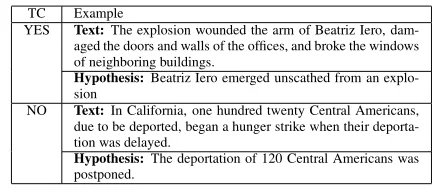
tis considered to textually contradict ahif there exists any proposition inferable fromtwhich could lead to the refuta-tion ofh. (Figure 2 presents positive and negative instances of textual contradiction.)
TC Example
YES Text:The explosion wounded the arm of Beatriz Iero, dam-aged the doors and walls of the offices, and broke the windows of neighboring buildings.
Hypothesis:Beatriz Iero emerged unscathed from an explo-sion
NO Text:In California, one hundred twenty Central Americans, due to be deported, began a hunger strike when their deporta-tion was delayed.
Hypothesis:The deportation of 120 Central Americans was postponed.
Table 2: Examples of Textual Contradiction The recognition of forms of textual inference such as TE and TC has traditionally been considered the domain of
1Both examples are taken from the PASCAL RTE-3 Test
Set. For more information on the PASCAL RTE Challenges, see http://www.pascal-network.org/Challenges/.
formal, logic-based methods (such as automatic theorem proving- (Tatu et al., 2006)) or model-based approaches (such as model building or model checking (Blackburn and Bos, 2005)). However, a considerable amount of recent work – including many of the top-performing systems at the past PASCAL RTE Challenges (Hickl and Bensley, 2007; Hickl et al., 2006; Haghighi et al., 2005) – has demon-strated the effectiveness of using “shallow” statistical clas-sifiers in order to recognize TE (or TC) relations. While individual systems have exploited a wide range of differ-ent types of features in order to perform this classification (including syntactic heuristics (Vanderwende et al., 2006), graph matching techniques (Raina et al., 2005), or output from model checking (Bos and Markert, 2006) or para-phrasing (Hickl et al., 2006) applications), access to sources of training data has continued to be a limiting factor. This paper follows initial work done by (Burger and Ferro, 2005; Brockett and Dolan, 2005; Dolan and Quirk, 2004) in exploring how a battery of unsupervised techniques can be used in order to create large, high-quality corpora for textual inference applications. We show that it is possible to automatically generate sets of positive and negative in-stances of textual entailment and contradiction from textual corpora with greater than 90% precision. In our work, we describe how we generated more than 1 million TE pairs – and a corresponding set of and 500,000 TC pairs – from the documents found in the 2 GB AQUAINT-2 newswire corpus.
clas-sifiers for recognizing textual entailment or textual contra-diction.
The rest of this paper is organized in the following way. Section 2 provides an overview of the general learning-based framework for recognizing instances of textual en-tailment and textual contradiction previously described in (Hickl and Bensley, 2007; Harabagiu et al., 2006; Hickl et al., 2006). Sections 3 and 4 presents the techniques we used to create training corpora for our RTE and RTC systems: Section 3 discusses how we extended extraction-based techniques (similar to those first proposed in (Burger and Ferro, 2005)) for this task, while Section 4 examines how a generative approach can be used to create training pairs which can be used with either a textual entailment or textual contradiction system. Section 5 explores the im-pact of these sources of training data on the performance of state-of-the-art RTE and RTC systems, while Section 6 presents our conclusions.
2. Learning Textual Inference Relationships
Recognizing whether the information expressed in ahcan be inferred from – or contradicted by the information ex-pressed in atcan be cast either as (1) a classification prob-lem or (2) a formal textual inference probprob-lem, performed either by theorem proving or model checking. While these approaches apply radically different solutions to the same problem, both methods involve the translation of natural language into some sort of suitable meaning representation, such as real-valued features (in the case of classification), or axioms or models (in the case of formal methods). We argue that performing this translation necessarily re-quires systems to acquire forms of (linguistic and/or real-world) knowledge which may not be derivable from the sur-face form of atorh. In order to acquire forms of linguistic knowledge for recognizing textual entailment and textual contradiction, we have developed a novel framework which depends on the extraction ofdiscourse commitmentsfrom a text-hypothesis pair. Following (Gunlogson, 2001; Stal-naker, 1979), we assume discourse commitments represent the set of propositions which can necessarily be inferred to be true given a conventional reading of a text. Formally, we assume that given a commitment set{ct}consisting of the
set of discourse commitments inferable from a text t and a hypothesish, we define the task of recognizing forms of textual inference as a search for the commitmentc∈ {ct}
which maximizes the likelihood thatcparticipates in a par-ticular textual inference relationship withh. (Examples of commitments that can be extracted from a positive instance of TE are presented in Figure 2.)
In our architecture (illustrated in Figure 1), discourse commitments are first extracted from both the t and the h using the approach described in (Hickl and Bensley, 2007).2 Commitments are extracted from each t and h
using an implementation of the probabilistic finite-state transducer (FST)-based extraction framework described in (Eisner, 2002; Eisner, 2003). Given a syntactically and
2Full details of our framework for recognizing instances of TE can be found in (Hickl and Bensley, 2007). Full details of our sys-tem for recognizing TC can be found in (Harabagiu et al., 2006).
semantically-parsed input string, our system returns a se-ries of output representations which can be mapped (given a set of generation heuristics) to natural language sentences which represent each of the individual commitments which can be extracted from that string. Commitments were extracted using a series of weighted regular expressions; weights were learned for each regular expression using our implementation of (Eisner, 2002). After each candidate commitment was processed by the FST, the natural lan-guage form of each returned commitment was then resub-mitted to the FST for additional round(s) of extraction until no additional commitments could be extracted from the in-put string.
Once commitment sets have been extracted for thetand the h, we then use acommitment selectionmodule in order to perform a term-based alignment of each commitment ex-tracted from thetagainst each commitment extracted from theh. We assume that the alignment of two discourse com-mitments can be cast as a maximum weighted matching problem in which each pair of words (ti,hj) in an commit-ment pair (ct,ch) is assigned a scoresij(t, h)corresponding
to the likelihood thattiis aligned tohj. As with (Taskar et al., 2005b), we use the large-margin structured prediction model introduced in (Taskar et al., 2005a) in order to com-pute a set of parametersw(computed with respect to a set of featuresf) which maximize the number of correct align-ment predictions (yi) made given a set of training examples¯
(xi).
The top-ranked pair of commitments (cti, chi) is then sent
to an inference computationmodule which estimates the likelihood that the selectedcti textually entails (or
contra-dicts) the chi (and by extension, the likelihood thatt
tex-tually entails/contradictsh). Commitment pairs are consid-ered in ranked order until a positive judgment is returned, or until no more commitments above a threshold remain. Following work done by many participants in the PASCAL RTE Challenges, we used a decision tree (C5.0 (Quinlan, 1998)) to estimate the likelihood that a commitment pair represented a valid instance of textual entailment or textual contradiction.
In previous work (Hickl et al., 2006), we showed that per-formance on the RTE task could be increased by more than 10% when a baseline classification-based system was al-lowed to train on more than 200,000 examples of textual en-tailment that were heuristically extracted from documents downloaded from the Internet. Although this was an en-couraging result, later work revealed that performance de-graded significantly on the PASCAL RTE Test Set when the system was trained on “smaller” datasets consisting of between 800 and 2400 examples, roughly the size of the manually-constructed training corpora made available by the PASCAL RTE organizers.
In our current work, we plan to explore how automatic tech-niques can be leveraged in order to provide sources of train-ing data for RTE and RTC systems which are as good – if not better than – the manually-created sources of training data provided by the PASCAL RTE organizers or by the authors of (Harabagiu et al., 2006)3. It is our expectation
Positive Instance of Textual Entailment
Hypothesis: King Albert II of Belgium is the father of Prince Laurent of Belgium.
Text:Prince Laurent of Belgium, the youngest son of King Albert II of Belgium, has been questioned by the Federal police and is attending today’s court session in Hasselt in a marine fraud case that has gripped Belgian media since last December.
T1. Prince Laurent [is from] Belgium.
T2. Prince Laurent is the youngest son of King Albert II. T3. King Albert II [is from] Belgium.
T5. Prince Laurent [is one of multiple] sons. T4. King Albert II [has multiple] sons.
T7. Prince Laurent is the son of King Albert II.
T8. Prince Laurent has been questioned by the Federal police. T9. Prince Laurent is attending a court session in Hasselt. T10. Prince Laurent [is in] Hasselt today.
T11. Prince Laurent [is involved] in a marine fraud case.
T12. Today’s court session in Hasselt [is on] a marine fraud case.
T14. [There is a] marine fraud case in Hasselt. T13. [There is a] court in Hasselt.
T15. A marine fraud case has gripped Belgian media since last December. T16. Belgium [has a] media.
T17. Belgium [has a] King. T18. Belgium [has a] Prince. T6. King Albert II [is the father of] Prince Laurent.
H1. King Albert II [is from] Belgium. H2. Prince Laurent [is from] Belgium. H3. King Albert II is the father of Prince Laurent.
Text Commitments
Hypothesis Commitments
Figure 2: Commitments Extracted from a Positive Instance of TE.
named entity recognition, and syntactic dependency pars-ing. Keywords extracted and expanded from these prepro-cessed texts by methods described in (Hickl et al., 2007) were used to retrieve passages from the 2 GB AQUAINT-2 newswire collection. Passages were then ranked based on the density of keywords and submitted to asentence
de-compositionmodule, which uses a set of heuristics to
trans-form complex sentences containing subordination, relative clauses, lists, and coordination into sets of well-formed simple sentences. We then passed the passages to a
com-mitment extraction module which used a series of
extrac-tion heuristics (described below) to enumerate some of the publicly-held beliefs – or discourse commitments – that could be inferred from a text passage.
We focused on generating the following five different types of commitments from retrieved passages.
Propositional Content: To capture assertions encoded by predicates and predicate nominals, we use semantic depen-dency information to generate ”simplified” commitments for each possible combination of their optional and obliga-tory arguments.
Supplemental Expressions:Rules to extract supplemental expressions, including appositives, as-clauses, parentheti-cals, non-restrictive relative clauses, and epithets were im-plemented in our weighted FST algorithm and used to cre-ate new sentences which specify the conventional implica-ture (CI) conveyed by the expression.
Relation Extraction:We used an in-house relation extrac-tion system to recognize six types of semantic relaextrac-tions, in-cludingartifact,general affiliation,organization affiliation,
part-whole,social affiliation, andphysical location, from
which we can build simple attribute commitments.
Coreference Resolution:We used an in-house coreference resolution (based on (Nicolae and Nicolae, 2006) module to resolve instances of pronominal and nominal coreference in order to expand the number of commitments available to the system.
Paraphrasing: A lightweight, knowledge-lean paraphras-ing approach (Hickl et al., 2006) was used in order to ex-pand the set of commitments considered by the system. Each extracted commitment was then paired with its cor-responding passage; commitments were presumed to be
hypotheses, while passages were considered to be texts.
We also assembled inference pairs using extracted commit-ments and any of the PASCAL RTEtexts that were used to retrieve passages from the corpus: commitments that
re-ceived a sufficiently high similarity score with respect to a
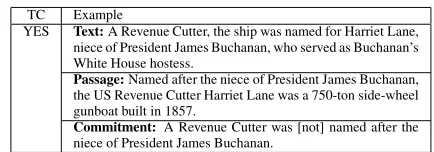
textwere also assembled into an inference pair. (An exam-ple of an original text, a retrieved passage, and an extracted commitment are presented in Table 6.)
TE Example
YES Text:A Revenue Cutter, the ship was named for Harriet Lane, niece of President James Buchanan, who served as Buchanan’s White House hostess.
Passage:Named after the niece of President James Buchanan, the US Revenue Cutter Harriet Lane was a 750-ton side-wheel gunboat built in 1857.
Commitment: A Revenue Cutter was named after the niece of President James Buchanan.
Table 6: Using Commitments to Assemble TE Pairs We used a similar approach to generate training examples for an RTC system as well. After anhhas been generated from a retrieved passage, we use the negation processing heuristics from (Harabagiu et al., 2006) to reverse the po-larity of the predicate included in the h. (An example is provided in Table 7).
TC Example
YES Text:A Revenue Cutter, the ship was named for Harriet Lane, niece of President James Buchanan, who served as Buchanan’s White House hostess.
Passage:Named after the niece of President James Buchanan, the US Revenue Cutter Harriet Lane was a 750-ton side-wheel gunboat built in 1857.
Commitment: A Revenue Cutter was [not] named after the niece of President James Buchanan.
Table 7: Using Commitments to Assemble TC Pairs
5. Evaluation
In this section, we present results from experiments which demonstrate the impact that automatically-created sources of training data can have on the end-to-end performance of state-of-the-art systems for recognizing TE and TC.
5.1. Validating Inference Pairs
After extracting an initial set of candidate TE and TC pairs an analysis was performed by validating samples with hu-man annotators. For each of the techniques a random, fixed-size sampling was pulled from the generated pairs. A team of 8 annotators partitioned the data into three equal-sized sets of entailment pairs for evaluation. Each subset was ex-amined by at least two annotators to judge the correctness of the generated pairs, and discrepancies were noted and resolved in conference by the annotators.
en-gine, we built rules to deal with the most error-prone lan-guage constructs in each of the construction methods. As shown in Table 8, this filtering process reduces the overall error rate by an average of 5.8% across the 4 methods.
Set Error Before Filtering Error After Filtering Extraction Method 1 8.2% 5.3% Extraction Method 2 5.8% 3.1% Extraction Method 3 14.5% 6.4% Generative Method 17.1% 8.3%
Table 8: Generation Errors Before and After Filtering.
Although desirable to achieve perfect error filtering on these training samples, we found most of the remaining sources of error are difficult issues of semantics and world knowledge that we have not yet been able to resolve. Even though imperfect filtering results in some slightly noisy training data, the resilience of our machine learning frame-work is able to overcome this discrepancy, such that there is a net benefit to the tasks of classifying TE and TC pairs.
5.2. Impact on Existing TE and TC Systems
Following the example of the PASCAL RTE evaluations, we evaluated the performance of our RTE and RTC sys-tems along two dimensions: accuracy and average preci-sion. We defineaccuracyas the percentage of inference pairs correctly classified by an RTE/RTC system. Average
precision, is defined by (Glickman and Dagan, 2005) as:
1 n×
Pn i=1
Pi
j=1(correctj)
i :correctj ∈0,1
This scoring metric assumes a sorted output based on
con-fidence weights, with the highest confidence judgments
ap-pearing at the top of the sorted order.
Our first evaluation compared the impact of data generated using the various methods against a TE system trained just using the 2400-pair RTE development set. For the purposes of TE evaluation, data generated to provide contradiction pairs are considered negative entailment pairs.
Development Set Accuracy Average Precision PASCAL Dev 0.6900 0.7152 Extraction Method 1 0.5428 0.5520 Extraction Method 2 0.5814 0.6186 Extraction Method 3 0.5303 0.5291 Generative Method 0.6649 0.6475
Table 9: Comparison of Training Corpora for Textual En-tailment.
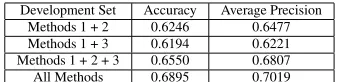
Since each extraction method is designed to create pairs of a specific polarity (e.g. method 1 generates only YES pairs), the methods acting in isolation actually perform worse than the baseline system trained only on the PASCAL Develop-ment Set. By taking combinations of data constructed from the various methods, however, we can achieve results com-parable to a system trained on the PASCAL Development Set as demonstrated in Table 10.
Development Set Accuracy Average Precision Methods 1 + 2 0.6246 0.6477 Methods 1 + 3 0.6194 0.6221 Methods 1 + 2 + 3 0.6550 0.6807 All Methods 0.6895 0.7019
Table 10: Combinations of Training Corpora Data.
Having established that the automatically generated data compares favorably against the manually built development
0.68 0.7 0.72 0.74 0.76 0.78 0.8 0.82 0.84
0 100000 200000 300000 400000 500000 600000 700000 800000 900000 1e+06
Percent
Training Samples
Accuracy Avg. Precision
Figure 3: Entailment Scores with Increasing Training Data
0.72 0.74 0.76 0.78 0.8 0.82 0.84
0 50000 100000 150000 200000 250000 300000 350000 400000 450000 500000
Percent
Training Samples
Accuracy Avg. Precision
Figure 4: Contradiction Scores with Increasing Training Data
set for a fixed number of examples, we then examined the impact of increasing amounts of training data in the TE and TC systems. As shown in Figure 3 and Figure 4, larger amounts of training data provided significant performance boosts for both TE and TC classification, confirming the hypothesis suggested in (Hickl et al., 2006).
6. Conclusions
In this paper, we demonstrated how a battery of un-supervised techniques could be used in order to create large, high-quality corpora for textual inference applica-tions, such as systems for recognizing textual entailment and recognizing textual contradiction. We described how more than 1 million pairs of training examples could be generated from the documents found in a 2 GB English newswire corpus.
textual inference.
Finally, our results confirm the hypothesis (first sug-gested in (Hickl et al., 2006)) that the performance of classification-based systems for RTE increases with the amount of available training data. In our experiments, in-creases in accuracy are observed when training on as many as 500,000 inference pairs; performance remains constant (or suffers slight degradation) with larger training corpora.
7. Acknowledgments
This material is based upon work funded in whole or in part by the U.S. Government. Any opinions, findings, conclu-sions, or recommendations expressed in this material are those of the authors and do not reflect the views of the U.S. Government.
8. References
Roy Bar-Haim, Ido Dagan, Bill Dolan, Lisa Ferro, Danilo Gi-ampiccolo, Bernardo Magnini, and Idan Szpektor. 2006. The Second PASCAL Recognising Textual Entailment Challenge. InProceedings of the Second PASCAL Challenges Workshop. P. Blackburn and J. Bos. 2005. Representation and inference for
natural language : a first course in computational semantics.
Center for the Study of Language and Information, Stanford, Calif.
Johan Bos and Katya Markert. 2006. When logical inference helps in determining textual entailment (and when it doesn’t). InProceedings of the Second PASCAL Recognizing Textual En-tailment Conference, Venice, Italy.
Chris Brockett and William Dolan. 2005. Support Vector Ma-chines for Paraphrase Identification and Corpus Construction. InProceedings of the Third International Workshop on Para-phrasing, Jeju, Korea.
John Burger and Lisa Ferro. 2005. Generating an Entailment
Cor-pus from News Headlines. InProceedings of the ACL
Work-shop on Empirical Modeling of Semantic Equivalence and En-tailment, pages 49–54.
Ido Dagan, Oren Glickman, and Bernardo Magnini. 2005. The
PASCAL Recognizing Textual Entailment Challenge. In
Pro-ceedings of the PASCAL Challenges Workshop.
William Dolan and Chris Quirk. 2004. Unsupervised Construc-tion of Large Paraphrase Corpora: Exploiting Massively
Paral-lel News Sources. InProceedings of COLING 2004, Geneva,
Switzerland.
Danilo Giampiccolo, Bernardo Magnini, Ido Dagan, and Bill Dolan. 2007. The third pascal recognizing textual entailment
challenge. InProceedings of the ACL-PASCAL Workshop on
Textual Entailment and Paraphrasing, pages 1–9, Prague, June. Association for Computational Linguistics.
Oren Glickman and Ido Dagan. 2005. A Probabilistic Setting and
Lexical Co-occurrence Model for Textual Entailment. In
Pro-ceedings of the ACL Workshop on Empirical Modeling of Se-mantic Equivalence and Entailment, Ann Arbor, USA.
Christine Gunlogson. 2001. True to Form: Rising and Falling
Declaratives as Questions in English. Ph.D. thesis, University of California, Santa Cruz.
Aria Haghighi, Andrew Ng, and Christopher Manning. 2005.
Robust textual inference via graph matching. InProceedings
of Human Language Technology Conference and Conference on Empirical Methods in Natural Language Processing, pages 387–394.
Sanda M. Harabagiu, Andrew Hickl, and Finley Lacatusu. 2006. Negation, contrast and contradiction in text processing. In
Pro-ceedings, The Twenty-First National Conference on Artificial Intelligence (AAAI-2006).
Andrew Hickl and Jeremy Bensley. 2007. Recognizing Textual
Entailment with LCC’s Groundhog System. InProceedings of
the Third PASCAL Challenges Workshop (to appear). Andrew Hickl, John Williams, Jeremy Bensley, Kirk Roberts,
Bryan Rink, and Ying Shi. 2006. Recognizing Textual
Entail-ment with LCC’s Groundhog System. InProceedings of the
Second PASCAL Challenges Workshop.
Andrew Hickl, Kirk Roberts, Bryan Rink, Jeremy Bensely, Tobias Jungen, Ying Shi, and John Williams. 2007. Question
Answer-ing with LCC’s Chaucer-2 at TREC 2007. InProceedings of
the Sixteenth Text REtrieval Conference.
R. Quinlan. 1998. C5.0: An Informal Tutorial. RuleQuest. Rajat Raina, Andrew Y. Ng, and Chris Manning. 2005. Robust
textual inference via learning and abductive reasoning. In Pro-ceedings of the Twentieth National Conference on Artificial In-telligence (AAAI).
Robert Stalnaker, 1979.Assertion, volume 9, pages 315–332. Ben Taskar, Simone Lacoste-Julien, and Michael Jordan. 2005a.
Structured prediction via the extragradient method. In
Pro-ceedings of Neural Information Processing Systems.
Ben Taskar, Simone Lacoste-Julien, and Dan Klein. 2005b. A discriminative matching approach to word alignment. In
Proceedings of Human Language Technology Conference and Empirical Methods in Natural Language Processing (HLT/EMNLP 2005).
Marta Tatu, Brandon Iles, John Slavick, Adrian Novischi, and Dan Moldovan. 2006. COGEX at the Second Recognizing Textual
Entailment Challenge. InProceedings of the Second PASCAL
Challenges Workshop.
Lucy Vanderwende, Arul Menezes, and Rion Snow. 2006. Mi-crosoft Research at RTE-2: Syntactic Contributions in the
En-tailment Task: an implementation. InProceedings of the