ABSTRACT
TIWARI, DEVESH. Analyzing and Accelerating Runtime Systems on Multicore Architecture. (Under the direction of Yan Solihin.)
Technology scaling has made multicore architectures commercially prevalent. However, exploiting multicore parallelism for performance remains challenging for programmers, because of side-effects of parallel programming such as concurrency management, data-races, deadlocks etc. Therefore, there is a need for solutions that can exploit the computational power of multicore platform without burdening the programmers with concurrency management. In this dissertation, we use two specific runtime systems (dynamic memory management runtime system and shared memory MapReduce runtime system) as a vehicle to demonstrate that runtime systems, that can exploit the multicore parallelism transparently, can be part of the solution.
First, we show how to reduce the overhead of dynamic memory management runtime system by parallelizing it on a multicore architecture. However, traditionally dynamic memory management run-time systems execute sequentially and hence, cannot take advantage of multicore platform. Moreover, tasks such asmallocandfreeare often very small, and hence, executing them in parallel on a sep-arate core may even degrade the performance due to high communication and synchronization cost. We use dynamic memory management runtime system as an example to show how to efficiently ex-ploit the fine-grained parallelism in dynamic memory management. We also show the design of such a system that exploits the fine-grained parallelism in the runtime library while remaining transparent to the application and memory allocation library without modifying any of those.
Second, we focus on analyzing and optimizing shared memory MapReduce runtime system. Shared memory MapReduce runtime systems allow programmers to express parallelism at a higher level, and provide automatic management of concurrency. However, due to high level of abstraction programmers are often not aware of performance bottlenecks of such runtime systems. Hence, they may achieve only suboptimal performance gains. To address this, we build a new analytical model to analyze key performance factors of shared memory MapReduce runtime libraries and discover several previously unknown and non-intuitive performance trends. Findings and insights from our analytical model can help both programmers and system designers in understanding and explaining the performance bottlenecks of these runtime systems.
Analyzing and Accelerating Runtime Systems on Multicore Architecture
by Devesh Tiwari
A dissertation submitted to the Graduate Faculty of North Carolina State University
in partial fulfillment of the requirements for the Degree of
Doctor of Philosophy
Computer Engineering
Raleigh, North Carolina 2013
APPROVED BY:
James Tuck Eric Rotenberg
Xiaosong Ma Yan Solihin
DEDICATION
To my family,
BIOGRAPHY
Devesh was born to Damodar and Malti Tiwari, and did his schooling in Allahabad, UP, India. He graduated with a bachelors degree in Computer Science and Engineering from Indian Institute of Technology (IIT) Kanpur. Following that, he joined PhD program in Electrical and Computer Engi-neering Department at NC State University.
Devesh is broadly interested in computer systems performance modeling and analysis. He has published his research at various publication venues, including USENIX FAST, HotPower, IPDPS, HPCA and ISPASS. One of his papers was nominated for the best paper award at IPDPS 2012, and received best talk award at IBM’s Student Workshop on Frontiers of Cloud Computing organized by IBM Thomas J. Watson research center. He has also spent brief research stints at Oak Ridge National Lab, National University of Singapore, and Seoul National University, South Korea. He is religiously passionate about teaching and developing technology for under-developed societies. Besides research and teaching, he likes to understand and discuss philosophical issues, e.g. justice, motivation, learning, policy-making, etc.
ACKNOWLEDGEMENTS
Doctor:“Mrs. and Mr. Tiwari, as nerve system on the left part of his body is not functioning normally due to complications at birth. He will suffer from severe developmental delays. He is not likely to walk on his own and his intellectual abilities may be 5-10 years behind his age-group. It would be very hard for you both as parents to raise this physically challenged kid, in a society where physically disability is torturous both for the parents and the kid. You might want to seriously reconsider your intentions of keeping him with you."
My parents:“When he was born, he was declared born-dead. It took a while for doctors to realize that he had life in him. He definitely seems to have something in destiny to survive against all odds. Now, that he has made this far (a little more than one year). We will make him proud and capable of whatever he has got."
Doctor:“I am afraid he has not got enough, just the right side of the brain, hand and leg!"
My parents had the courage to act against doctor’s recommendation. But, definitely the act itself was never going to be easy. Just the thought that their third baby may never walk on his own and be 5-10 years mentally behind his age-group was frightening. As I am told, there were multiple nights when they would lock themselves up in the kitchen to cry over it. I give up imagining how much of trouble my elder sister and brother had to go through because of all this. But, my sister and brother made me feel that the whole world revolved around me, and were never insecure about their needs being overlooked. Every night, my family would gather after dinner, make me stand up and hope that I would walk on my own against all odds. They would spent countless number of hours on physical exercise, hoping one night things would change; while in the daytime "the cruel world" would tell them they had only two kids. One evening, the miracle indeed happened. My brother did what all of them were hoping for very long: I did take a few steps on my own. That day was so precious to them, that it has become more important than my birthday.
But that was only a start. As a "walking" child, I was far from being easy. I always had my own plans and ways about how things should be done, how much time should be devoted to my demands and so on. In hindsight, this personality trait proved to be beneficial as it has helped me immensely in my research, and I am glad that my parent encouraged and rightly-balanced this aptitude. But, definitely it was not easy on them. My siblings missed countless dinner/lunch because of my tantrums. Then, the fear of how would I do in school? My parents/siblings would have tears in their eyes as I received all the awards for academic excellence. I feel bad for my brother and sister that my academic achievements were celebrated so much that probably theirs got overlooked at times.
It was really difficult for my family to first, accept God’s wish to have a physically challenged kid, and second, to raise me in a society where something like that was looked down with pity and fun (ironically). My family has put so many hours in physical exercise that people now hardly notice it, and think it’s a minor issue. Reality is that because of them I really feel proud of this challenge. In fact, sometimes we joke about what doctors had said earlier. We wonder how much more would I have achieved if everything was normal. I am afraid it would have been only less.
Papa, Mammi, Didi, and Bhaiyya: We all often fall short of telling what we felt about something. So, I wrote it like a short story. Because it really means a lot to me. As those who know me well – I am someone who cares the least about what people perceive about me. But, in this case, I want it to be known to everybody, including you all, that your efforts and sacrifices means a lot to me, more than anything else. I want to believe in second life because I want to be born exactly like this, raised exactly like this. Because I want to do it all over again with you four.
My family can thank God for all the courage they had on the way, I can thank them because they are what God is to everyone – knows everything, does all the miracles, but doesn’t expect a thing in return.
My parents have always been extremely selfless and encouraging; they showed it again when it came to my marriage. Arranged marriage is a big part of Indian culture, at least in my generation and my extended family. Just like any other mom in India, my mom had always dreamed of choosing "the one" for me. But, when I proposed my choice, She accepted it happily, and has treated my wife as if she is her own choice. Executing this marriage plan was a very hard task for my parents as this was the first not-arranged marriage in our family of over 300 people. They had to do a lot of work on their front to get everyone happily involved and socially accept it. It may seem easy, or even laughable, but it was impossible given the social and cultural boundaries of my family. My parents made it possible without letting me even feel the heat. Also, I have come to appreciate my mom’s analytical aptitude and her diverse interests/opinions more in last 6 years as we talked long hours on phone, of course, without dad’s expert interruptions. I have been truly enlightened more often than I expected. I would like to thank my extended family, my uncles, aunts and cousins, for their support.
My brother did all the professional and personal sacrifices so that I could live a better life. Somehow he had mastery of all the tricks needed to nurture a "challenged" kid like me, since even when he was very young. He sometimes let me win "crucial" cricket matches that we played in our backyard, just so my morale remained high. But, he beat me often and enough that I realized the value of quality and competition. He was punished in school because I used to hide his drawings the night before, but he didn’t utter a word, let alone scolding. Instead, he taught me how to color a drawing so that I could keep my copy for myself. He took me along in all the things he did; age difference was never apparent. Whether it was studying, sports or even clay-molding. He did what he always does the best: made me believe that I could do anything and to the perfection.
showed up in my mail-box and all I had to do was be on-time for flights/trains. He had even backup tickets in case I missed a connecting train and pulled up all nighters to make sure that I traveled smoothly. During every visit, he hand-picked everything for next three months that I may need before I left his house. I still keep his sweet and encouraging snail mails that he used to send, esp. for me, during his IIT-Delhi days. They were in English so that I could get some exposure to communication in English. My parents didn’t have enough money to get us educated in English-medium schools, but to make-up for that he saved enough from his pocket-money to send me those English cards, letters, magazines etc. I get goosebumps just thinking about his pure intent and how much he has done for me.
Bhaiyya: This thesis is especially dedicated to you. You are the one I look upto. You are my only inspiration. You are what Ram is to Hanuman.
Kaustubh and Bhavya, my sister’s son and daughter, get the most special mention for bringing joy in our lives. It has been a delight to watch them grow, and entertain us more and more. I hope one day they read this note, and value the importance of knowledge and gratitude. They will understand the importance of sacrifice that their mom had to make, so that I could reach this point. I hope they will be able to imagine her contributions in my success and their own. My sister (Mrs. Archana Mishra) has been very supportive of my actions and decisions, sometimes even more than my parents. My sister’s family has been extremely nice to me. My brother in-law made sure that my travel plan and stay was smooth whenever I visited them. His mom has always sent me back with enough pickles of my choice.
Didi: I am humbled with your faith in me. I hope not to disappoint you ever. Kaustubh and Bhavya are as close to my heart as yours, if not more.
I am thankful to PhD for giving me just the right amount of free time to woo the most lovely lady in this world, Richa. I am sure my PhD is, in turn, thankful to Richa that she shaped it beautifully afterward, with minimum delay in graduation. Our relationship has mostly been long-distance, ever since its inception. When we started, I neither knew how to drive nor I had a car. Consequently, I have mostly relied on Greyhound bus services to see her. So, a BIG thanks to Greyhound and Richa’s old Mitsubishi Gallant car. While I may have contributed significantly toward Greyhound’s revenue, it’s not a big surprise that Greyhound buses are still farthest from being comfortable, esp. given the schedule for my bus: 3:00am to 9:00am journey, with 1 hour stop at 5:00am right when I would start to get some sleep in my small seat, you can imagine what happens to my sleep cycle on the following day (same with the return journey). I have done this continuously over past three years, almost every other weekend with a graduate student’s salary. This is a small proof of what Richa means to me – someone who used to become uncomfortable just outside his cozy couch/bed has found new ways to enjoy Greyhound rides. I have done this because her pure, selfless, undemanding, loving, forgiving and academically-curious nature has been the source of my happiness for past three years.
sure everything is perfect, at least become much better. She can do this 24x7, even on her "relatively more gloomy research" days. But what amazes me the most: her desire to make a real-world impact in the field of human genetics, helping people with genetic disorders and making a difference in their lives. As she often keeps reiterating: her motivation to do science and earn a PhD degree is to make a real-world impact and spread the knowledge, and not just focus on gaining academic reputation by doing more "paper" research. This attitude has always inspired me and helped me remain grounded with my own research ideas and plans. Also, Richa’s parents, to their credit, have placed a lot of faith in me by marrying her in a significantly different culture than their own (Kashmiri). Neither did they know much about my culture/traditions nor about me at the time of marriage, but they did a com-mendable job in making sure that everything went smooth.
Gudia: I consider myself blessed to have such a partner who challenges me academically and comforts me personally. While you may not appreciate the technical details of this dissertation, it is as much yours as mine, if not more.
For a kid like me, a lot could have gone wrong in school, as often it does for challenged kids in India. But, my teachers were the game-changers; I always felt like I was their top-most priority and my progress mattered to them a lot. They made sure that I was not overly involved in activities where I would be uncomfortable or other kids will have a go at me. Very much like my family, they identified my strengths within and outside academics, and pushed my limits on those fronts. I excelled in academics with their teaching style, while they made sure I was equally good at other fronts where I had potential to excel, e.g. leadership roles, debate competitions, etc. I am highly indebted to my elementary school teachers: Govind Srivastava, Rama Pandey, Anand Srivastava, Vineeta Srivastava. I truly believe that had it not been these four teachers, I would have been no-where and would have restored to home-schooling. I fondly remember my insistence to go to Rama madam’s house and have snacks at my choice of time. Kripanand Tiwari, Ashutosh Kumar, Kakoli Bhattacharya, Santosh Srivastava and Rahul Shukla: I am thankful to all of you for the immense amount of faith you instilled in my abilities. I regret that I have not been able to know your where-abouts in last couple of years.
I am thankful to Harish Chandra Saxena (fondly known as Mamu Sir) for teaching my brother and me most of the concepts in Physics and Mathematics. If you could read it from heavens: we, as a whole family, are highly indebted to your teaching that has brought us so much enlightenment and satisfac-tion over past 15 years or more. I am thankful to teachers during my undergrad, Bikramjit Basu: for inspiring and teaching me how to do quality research; Debabrata Goswami: for guiding me through my final year; Rahul Verman, Amman Madan, Pinaki Gupta-Bhaya: for your excellent teaching skills. You all showed me that teaching is the most satisfying job and it has that magical power to influence anyone’s thinking process.
extremely well. Yan had more belief in my capabilities than I did at times. He backed me up even when my papers were repeatedly getting rejected. As an advisee, you can’t ask for a better advisor on those afternoons. Yan was very quick to judge my personality and working style. He provided me a challenging environment to do research, but he set me free to pursue my ideas. He trained me diligently during my first project, but let me explore and navigate through most of my future projects. Yan makes sure that his students do not have to worry about financial support, no matter how bad is the financial situation in the country or funding prospects with NSF. As he often says: "Your job is to do good research work, focus on that, excel there. I will take care of the rest. Do not distract yourself". While others may not realize, Yan puts a lot of effort towards that. University had stopped supporting me after five years, but I didn’t face any heat because Yan was there. I was teaching in that semester and working on a FAST conference submission along with a project related to my dissertation. Yan knew that with so much load, I wouldn’t be super productive. So, it may not have been the best idea for him to support me. But, he paid a big amount of money out-of-pocket (funding) to continue supporting me for next two semesters. He valued that I always wanted to teach and have teaching experience under my belt, and gain more research maturity with these projects. Yan’s commitment to my professional goals has been excellent.
Yan played "devil’s advocate role" in weekly meetings whenever I proposed new ideas, solutions, and paper drafts. Like a true mentor, he also steered me in the right direction whenever needed. In hindsight, I think I benefited greatly from this approach as he made sure that I rehearsed a real re-searcher’s life-at-work on multiple projects before I graduated. Thank you, Yan! I hope to emulate your research skills in future, that would be an achievement for me. I regret not being a "true" computer-architect PhD graduate as I did not work on hard-core computer-architecture topics, but rather focused more on analytical performance modeling. Consequently, I didn’t submit what we learned from our projects to the traditional architecture conferences: ISCA, HPCA, MICRO, ASPLOS. I will always feel bad about that.
I learned a lot from other faculty at NC State. I was a rebellious student, a student everyone would turn to see if I had any question at the end of all the presentations and meetings; faculty here at NC State have welcomed that, and helped me become a better researcher. As I threw numerous random research ideas, they have given constructive suggestions and shown that they valued it. When I came to NC State, my English writing skills were pedestrian at the best, largely due to my Hindi-medium schooling. But I am proud to have improved that significantly and write decent papers on my own as shown by some of the paper reviews, I am thankful to my advisor, faculty at NC State and various other people (including Richa) who gave me constant feedback on my writing.
of geeky jokes. Whenever I have interacted with him, I couldn’t keep track of time. You come out of the meeting thinking: compiler will save us from all the challenges in multi-core era. Though he never says and claims that directly or indirectly. I am thankful to Xiaosong Ma for agreeing to serve on my PhD committee and collaborating on Active Flash project. Her suggestions have been very helpful and constructive. I would specially like to mention that her teaching style is very helpful, esp. for new graduate students. I took a parallel systems class with her, early in my graduate studies, and learned a lot from her lectures. She listens to her students very patiently. Even during our Active Flash project, she was always patient as we submitted a FAST paper while I had teaching commitments too. She understood my high teaching load that comes with first-time teaching responsibility, and was cooperative.
During my internship at Oak Ridge National Lab, I worked with Sudharshan Vazhkudai and Youngjae Kim. Sudharshan and Youngjae have been very helpful. They both have been very under-standing and encouraging. They treated me like a colleague from day-one, and that had a very positive effect on my productivity. I liked my intern-experience so much that I regret not coming to ORNL for my earlier summers; Sudharshan always keeps saying the same. Sudharshan has been very helpful otherwise as well, he has helped me grow professionally and notjust ask me to write a few papers. Sudharshan has been very honest and truthful about all the matters, this has only helped me have more faith in him. I couldn’t have asked for a better internship adviser. Thank you, Sudharshan! I am thankful to Simona Boboila and Peter Desnoyers for our productive collaboration on Active Flash project.
Like many other PhD students, initially I struggled in my research work, then started liking it, loved it and then become passionate about it. And right when I was almost certain that this was the pinnacle of joy in graduate school, I took on a new commitment: teaching a class. And, I was proved wrong. Teaching a class was the pinnacle of joy.I taught the same the course that I TA-ed in my first semester at NC State, I taught in the same classroom in which I took my first class at NC state. So, it was a conspired fitting finale. But, it would have not been possible without Greg Byrd and all the students. Thank you, Cheryl Alderman, for taking care of all the administrative issues for my other section (UNC Ashville distance education section). Thank you all the students for encouraging feedback and pleasant experience. You made me feel a void in my busy schedule on Tuesday and Thursday from 1250 to 1405 hrs in the following semester in which I had just enough time to write the dissertation and hunt for a job. I secretly regret not being able to throw a party after the final exam.
interacted with him more than one can imagine to interact with a teaching mentor, simply because he was always ready to help. I learned the art of teaching and designing exam papers from him.. I would feel satisfied, if I could emulate even a bit of him in my future teaching endeavors. Thank you! I regret making him proctor in my two exams, as he admits proctoring an exam is as boring as it can get.
While one may not realize easily, helping a PhD student to graduate takes a toll on departmental and university administrative staff. We, graduate students, "schedule" all the administrative tasks when nothing is going right in our research. When the whole world looks gloomy, we show up at graduate office and want everything to be done in minutes. I was the farthest from exception in this case. Not to mention, it takes only single missing digit on I-94 card of a student with F1-visa to raise "red alert" everywhere in the system, and risk his "legal" employment status in USA. It’s administrative staff who catch and resolve issues like these for a F1-student for no fault or responsibility of their own (a bug in immigration officer’s computer software in this case). Sandy Bronson, Elaine Hardin, Linda Fontes, Kendal Del Rio, Jennifer Raab, Katy Wilson, Terri Martin-Moss and OIS staff: I can not thank you all enough. I regret not being able to prove how much I valued your assistance.
During my six years, I have put countless requests to ECE Tech help. My work was real-system oriented and involved experimenting with many system libraries and tools, that had several sys-tem/admin issues before I could get them working. I could sleep in night because I knew ECE Tech help desk keeps our servers running. Dan Green, Mike Belangia and Manpreet Singh: Thanks for your super-fast and helpful responses for all of weirdest requests. I regret not being able to say thank you enough.
My PhD thesis acknowledgment is incomplete without mentioning Cricket and Indian music.Cricket and Indian music has greatly influenced my way of thinking and life over time. I have followed my role models in these fields frantically, got inspired from their performances, learned from their lifestyles and mistakes etc.
I am thankful to "truly timeless" and "the God of Cricket" Sachin Tendulkar for making three (probably four?) generations of India to "dare to dream and believe". I am thankful to Sachin Tendulkar for showing us the value of persistence – that you may be the best batsman in the world, but to win the world-championship as a team of eleven, you may have to wait for "twenty two" years, play six world-cup tournaments and keep giving your best without blaming how poorly your team members may be doing at crucial times.
When Sachin Tendulkar walks out to bat, one billion people and thirty three million Gods in India switch OFF their lives, and switch ON their television sets. Whenever I feel pressured because I am supposed to meet certain expectations set by others, I remind myself that these expectation pale away in comparison to those of one billion people that Sachin has faced every fifth day on an average, for last twenty five years. And, the pressure inside my mind melts away in nanoseconds.
people were not sad or clapped for his efforts, but instead clapped for Sachin Tendulkar who used walked in to bat next. It is tough being Dravid. I am thankful to Amol Muzumdar (even many cricket fans do not know him, please look up) for telling me that you can be as good as the best, but that are few things that are out of your control. I am thankful to MS Dhoni for showing that calm mind is the most dangerous mind. This piece from Siddhartha Vaidyanathan seems to perfectly summarize him: "There was a time when Indian fans turned off the TV when Tendulkar got out (and Dhoni too has admitted to having done the same when he watched the 2003 World Cup final). But the thinking these days seems to have been turned on its head, almost to a point where fans tune into a game when their captain walks in."
I am thankful to AR Rahman for all the music that he has produced. He has never disappointed, fromRojatoRaanjhanaa. As he says, creative works are God’s impression on you, so it’s not really your work. This way we can remain detached from both success and failure, and only focus on doing good work. I feel bad that he got two Oscar prizes for Slumdog Millionaire – a work far from the best by his standards. I wonder how much would he have achieved if he was born in USA? I have also taken a lot of inspiration from Mani Ratnam’s movies, who should have won Oscar by now as well. They inspire me because I always tell myself that music and movie directors have only one chance, while I have multiple chances to submit the same work. A music album once rejected is always rejected, so I have got a much easier deal than Rahman or Mani Ratnam.
One unique thing about my PhD is that I didn’t have a car to drive during the entire time, and I ate outside everyday as I never enjoyed/cared enough to start cooking. I am thankful for this decision, because looking back I think it made me manage my time more wisely and plan for the adverse in advance.So, thanks to all the restaurants near-by and sorry, Gas stations!
My six years at NC State have been wonderful largely because of the wonderful company of friends. No order is perfect, but mentioning them in the order I got introduced to them is the least controversial, so I will go with that for a change. Siddhartha Chabbra’s crystal clear concepts were very helpful, esp. in my early years when my knowledge in architecture area was pedestrian. Also, he helped me a lot in pacing my research work, discussing ideas, preparing for meetings, etc. I am thankful to Lavanya Palakshareddy, esp. for making delicious food during my first year at NC State. Company of Salil Pant and Alison Holmes Pant was arguably the greatest source of entertainment outside work. Every evening, Salil dragged me to Cup-A-Joe coffee shop, where he paid $1.25 for regular coffee and kept getting refills, while I paid $3.65 for my signature drink: "tall double vanilla latte". Perhaps, Allison’s witty nature was enough to get her free drinks? I still feel guilty about our Wahington DC trip, where they drove me to a conference and while coming back my only job was to keep them awake while driving as they were tired. I crashed in the back seat, despite two red-bulls.
when I hardly knew how to drive (Sandeep), etc. RajeshwarVanka picked up where Salil and Allison left, always up for a coffee and philosophical chat; no matter how much work was at hand, he never said "NO" to coffee outings. This was as impressive as his generous dinner invitations almost every second day during our last year at NC State. He graduated, left for Boston; then, I felt the void and scheduled my defense date.
Elliot Forbes has been partner-in-crime for my teaching endeavors. He has been kind to enlighten me with his experience. Saurabh Gupta is the most humble person I have met at NC State. He also has this gifted quality of quickly coming up with solutions to the toughest task-scheduling problems in day-to-day life. Also, given his aptitude with mechanical systems, I often think the world has missed on a fine mechanical engineer, since his academic training is in electrical engineering – which he does not seem to be making much use of, anyway. Aditya Deorha’s Colgate-smile is infectious, though I have picked on him more often than not. To his credit, he has been the most sporty character against all odds (my sarcastic comments).
I am thankful to Richa’s adviser, Anand Srivastava and her wife, Fatima, for throwing the best reception party when we returned back from India after our marriage. I am thankful to Alka Chaubey for enlightening me with her own experiences and caring deeply about Richa and me. Thank you, Gaurav, Shruti and Greenwood Fan club, for inviting us to dinner so frequently. I was awestruck by Julianne Collins’s passion for research in human genetics as she was battling with cancer for her life. She lost, but she inspired many!
I am thankful to many other for keeping me sane over last six years (in no particular order): Avik Juneja, Sahil Sabharwal, Siddhartha Sharma, Arpit Gupta, Rahul Ramasubramanian, Raj, Sabina Grover, Sangyeol Kim, Andrew and William Spencer, Amit Gupta, Gaurav Bawa, Pradeep, Aakarshit Dhingra, Adithya, Ankit Jain, Fang Liu, Brian Rogers, Xiaowei Jiang, Yi Yang, Sanghoon Lee, Naser, Abhik Sarkar, Amro Awad and Rami Al-Sheikh. I truly cherish your friendship and help with numer-ous things over the course of last six years.
It was an honor to notice that there were no seats left in the conference room during my defense, I have never witnessed or heard of anything similar to that in any defense at NC State in last six years. So, thank you for your exceptional support!
TABLE OF
CONTENTS
LIST OF TABLES . . . xv
LIST OF FIGURES . . . xvi
Chapter 1 Introduction . . . 1
1.1 Exploiting Fine-Grained Parallelism in Dynamic Memory Management . . . 3
1.2 Modeling and Analyzing Key Performance Factors of Shared Memory MapReduce . . . 6
1.3 Reusing Computation in an In-Memory MapReduce System . . . 8
1.4 Organization of the Dissertation . . . 9
Chapter 2 Exploiting Fine-Grained Parallelism in Dynamic Memory Management . . . 10
2.1 MMT Approach and Design . . . 10
2.1.1 MMT Approach . . . 10
2.1.2 Basic MMT Design . . . 12
2.1.3 Speculative Memory Allocation . . . 13
2.1.4 Bulk Memory Allocation and Deallocation . . . 14
2.1.5 MMT Synchronization Mechanism . . . 18
2.1.6 Putting it All Together . . . 19
2.2 Experimental Methodology . . . 20
2.2.1 Basic MMT Design Performance . . . 22
2.2.2 Task Partitioning and Synchronization . . . 23
2.2.3 Bulk Preallocation and Deallocation . . . 24
2.2.4 Safe Memory Management using MMT . . . 27
2.2.5 Sensitivity Analysis . . . 28
2.2.6 Memory Footprint . . . 28
2.3 Related Work . . . 28
Chapter 3 Modeling and Analyzing Key Performance Factors of Shared-Memory MapReduce 30 3.1 Background . . . 30
3.1.1 MapReduce Programming Model . . . 30
3.1.2 Shared Memory MapReduce . . . 31
3.2 Analytical Model Formulation . . . 32
3.2.1 Assumptions and Scope . . . 32
3.2.2 Modeling Approach . . . 33
3.2.3 Map Phase . . . 33
3.2.4 Reduce Phase . . . 38
3.3 Model-Driven Study . . . 39
3.3.1 Asymptotic Analysis . . . 39
3.3.2 Quantitative Analysis . . . 40
3.4 Experimental Environment . . . 43
3.5 Experimental Evaluation . . . 43
3.5.1 Microbenchmark and Validation Results . . . 43
3.5.2 Empirical Results for Real Applications . . . 48
3.6 Application Classification . . . 52
3.7 Related Work . . . 53
Chapter 4 MapReuse : Reusing Computation in an In-Memory MapReduce System . . . 54
4.1 Background . . . 54
4.1.2 In-Memory MapReduce . . . 55
4.2 MapReuse Design . . . 56
4.2.1 Design Overview . . . 56
4.2.2 Granularity Choices . . . 58
4.2.3 Computing the Differential Input . . . 58
4.2.4 Determining the Deleted Input . . . 63
4.2.5 The Merging Engine . . . 64
4.3 Evaluation and Analysis . . . 65
4.3.1 Modeling the MapReuse System . . . 66
4.3.2 Model-Driven Results . . . 69
4.3.3 Experimental Results . . . 71
4.4 Related Work . . . 75
Chapter 5 Conclusion . . . 77
LIST OF TABLES
Table 2.1 Latency of Pthread vs. minimalist synchronization primitives, refer Section 2.2 for
machine configuration details. . . 18
Table 2.2 The benchmarks used for evaluation . . . 21
Table 3.1 Parameters used in the model. . . 33
Table 3.2 Comparing asymptotic complexity of various phases. . . 39
LIST OF FIGURES
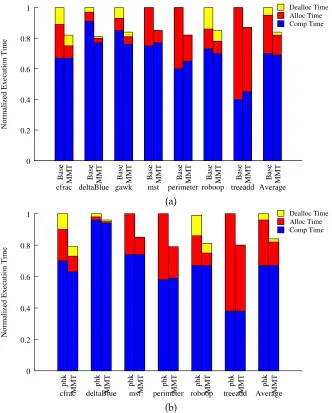
Figure 1.1 Fraction of execution time spent in dynamic memory management routines, on
an Intel Core2 Quad-Core platform. . . 3
Figure 1.2 Latencies of synchronization primitives vs. average memory allocation and time between consecutive allocation and deallocation requests. . . 5
Figure 1.3 Execution time of word count for various inputs, normalized to input A. . . 6
Figure 1.4 Speedups for word count normalized to the single thread case for each respective input . . . 7
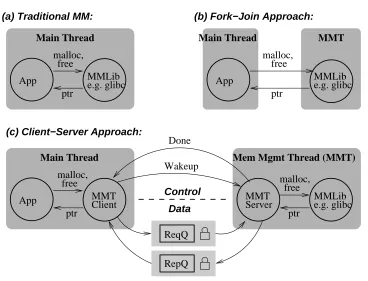
Figure 2.1 Traditional Memory Management (a), Fork-join MMT (b), versus Client-Server MMT approach (c). . . 11
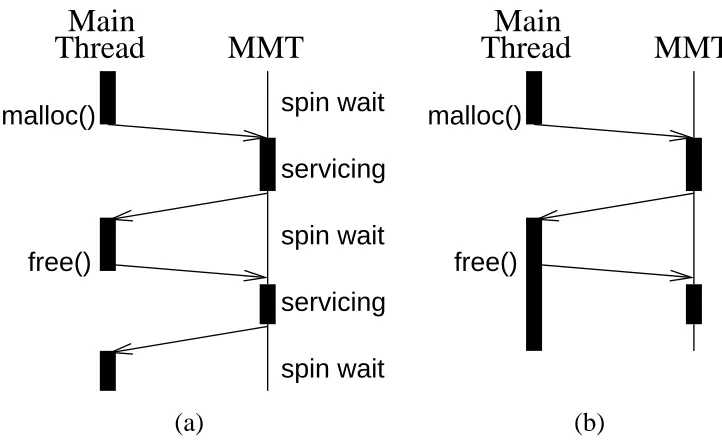
Figure 2.2 Protocol for MMT to perform synchronous allocation and deallocation (a), and for MMT to perform synchronous allocation but asynchronous deallocation (b). . 12
Figure 2.3 Preallocation and bulk deallocation (a) conservative preallocation (b) aggressive preallocation. . . 16
Figure 2.4 Illustration and pseudo-code of our lockless protocol. . . 19
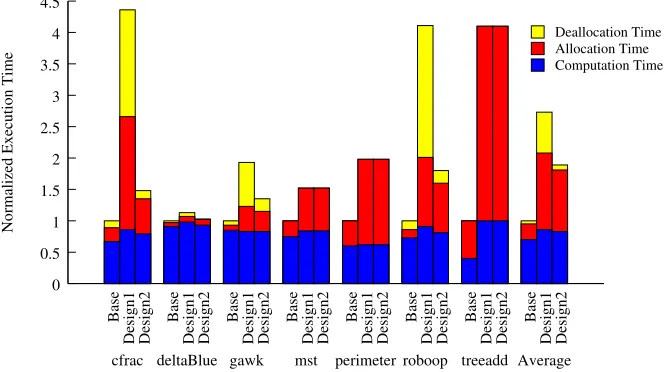
Figure 2.5 The performance of basic MMT design. . . 22
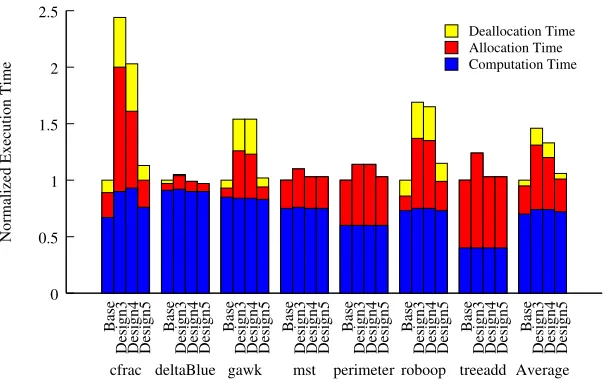
Figure 2.6 Performance of task partitioning and synchronization implementation. . . 24
Figure 2.7 Performance of the final MMT design on Doug Lea’s allocator (a), and PHKmal-loc alPHKmal-locator (b). . . 25
Figure 2.8 Last level Cache and TLB Misses (Base: Doug Lea allocator). . . 26
Figure 2.9 Security overhead using MMT approach (Base: PHKmalloc allocator) . . . 27
Figure 3.1 Overall design of shared-memory MapReduce runtime system. . . 31
Figure 3.2 Markov model for map-output time. . . 34
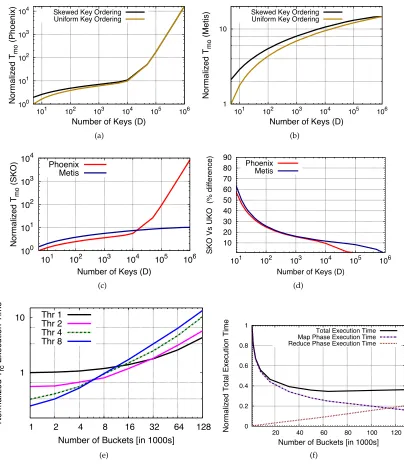
Figure 3.3 Normalized map-output time for 106 intermediate output pairs in Phoenix and Metis (a), UKO vs. SKO in Phoenix (b) and Metis (c), % difference of map-output time of SKO vs. UKO (d), reduce-comp time for various number of threads and buckets (e), and Map vs. Reduce time under SKO with 1 million pairs, 250,000 distinct keys, and 8 threads (f). . . 41
Figure 3.4 Empirically-derived values ofw1,w2,w3,w4, andw5(map-phase). . . 45
Figure 3.5 Empirically-derived values ofw6,w7, andw8(reduce phase). . . 46
Figure 3.6 Map and Reduce time for randomly generated word-count document with 20 million pairs . . . 47
Figure 3.7 Map-output time for WC with varying number of keys for Phoenix vs. Metis (a), and UKO vs. SKO on Phoenix (b) and Metis (c). . . 48
Figure 3.8 Map-output time for various number of threads and hash buckets Phoenix (a), and Metis (b) . . . 49
Figure 3.9 Reduce phase execution time for various number of threads and hash buckets Phoenix (a), and Metis (b) . . . 50
Figure 3.10 Breakdown of execution time with various number of buckets and 8 threads for Phoenix (a), and Metis(b). . . 51
Figure 3.11 Classification of MapReduce Applications. Not drawn to scale. . . 52
Figure 4.1 Overall design of in-memory MapReduce system. . . 55
Figure 4.2 High level diagram of MapReuse. . . 57
Figure 4.3 A potential problem with fixed size chunking. . . 58
Figure 4.5 Weight values of MapReuse specific parameters. . . 68 Figure 4.6 How the fraction of difference in inputs affect run time for 64K map tasks (a) vs.
for 256K tasks (b). . . 69 Figure 4.7 How the fraction of difference in inputs affect execution time SKO (a) vs. UKO (b). 69 Figure 4.8 The effect of the number of MapReuse threads on performance under uniform
key distribution for P/D=1 (a) and for P/D=1000 (b). . . 70 Figure 4.9 The effect of the number of MapReuse threads on performance under skewed
key distribution for P/D=1 (a) and for P/D=1000 (b). . . 71 Figure 4.10 Normalized execution time as affected by various fraction of changes to the
orig-inal input. . . 72 Figure 4.11 Speedups of MapReuse with various number of threads vs. IMMR running with
eight threads. . . 73 Figure 4.12 Speedups of MapReuse with various number of threads vs. IMMR running with
four threads. . . 74 Figure 4.13 Breakdown of execution time for Freq. Count input A (left) and B (right), for
IMMR using 8 threads and MapReuse using 1, 2, 4, and 8 threads, assuming 25% fraction of input difference. . . 75 Figure 4.14 Breakdown of MapReuse overheads, P =107, P/D ratio = 1000, when running
Chapter
1
Introduction
Technology scaling has made multicore architectures commercially prevalent [10]. However, exploiting multicore parallelism for performance remains challenging for programmers. This is primarily because programmers often find managing concurrency a daunting task due to data races, deadlocks and other side effects [23, 29, 60]. Therefore, there is a need for solutions that can exploit the computational power of multicore platform without burdening the programmers with concurrency management. We believe that runtime systems are a part of the solution. Runtime systems can take advantage of multicore architecture while hiding the complexity of concurrency management from programmers.
However, there are several challenges in making the runtime systems efficient and easy to use on multicore platforms. First, traditionally runtime systems are sequential in nature and hence, they cannot readily take advantage of multicore architecture. Second, parallelizing traditionally sequential runtime systems may break the legacy code, require compiler hints and changes to the source code or hardware. Third, programmers may not be aware of performance bottlenecks of a runtime system and hence, may gain only suboptimal performance. This dissertation aims to address some of these challenges. In this dissertation, we use two specific runtime systems as a vehicle to demonstrate the value of our proposed techniques. Two runtime systems used in this study are : 1) dynamic memory management library [71, 74], 2) shared memory MapReduce runtime library for parallel program-ming [41, 51].
The first part of this dissertation aims at reducing the overhead of dynamic memory manage-ment runtime system by parallelizing it on a multicore architecture. Dynamic memory managemanage-ment runtime system is responsible for memory management tasks such asmalloc()andfree(). How-ever, traditionally this runtime library [71, 74] executes sequentially with respect to the application. Hence, it has not taken advantage of the multicore platform. Moreover, tasks such as malloc and
application and memory allocation library without modifying any of those. Section 1.1 provides an overview of this work [19, 18].
The second and third part of this dissertation focus on analytical performance modeling and optimizing shared memory MapReduce runtime library. Shared memory MapReduce runtime li-brary [41, 51] is an effort for making parallel programming easier and more deterministic. Shared memory MapReduce or in-memory MapReduce (IMMR) runtime systems1 allow programmers to express parallelism at a higher level, and provide automatic management of concurrency. Program-mers are attracted to MapReduce due to increased programmer productivity, high level programming abstraction, the lack of data races and deadlocks, automatic management of threads, synchroniza-tion, and fault tolerance. However, due to the high level of abstracsynchroniza-tion, programmers are often not aware of performance bottlenecks in the runtime systems. Hence, they may achieve only suboptimal performance gains. Secondly, runtime system designers may not know the key factors that affect per-formance for different workloads. Therefore, there is a need for solutions that can provide deeper understanding of the key performance factors that affect these runtime systems.
Therefore, in the second part of this dissertation, we build a new analytical model to analyze key performance factors of shared memory MapReduce runtime libraries. Section 1.2 provides an overview of this work [17]. In the third part of this dissertation, we design and implement a new in-memory MapReduce runtime system that exploits an observation that programs are often run multiple times with either identical or slightly-changed input [1, 33], which creates a significant opportunity for computation reuse. We propose a novel technique for computation reuse in IMMR, which we refer to as MapReuse. MapReuse detects input similarity by comparing their signatures. It skips re-computing output from a repeated portion of the input, computes output from a new portion of input, and removes output that corresponds to a deleted portion of the input. MapReuse is built on top of an existing IMMR system, leaving it largely unmodified. We found that MapReuse significantly speeds up IMMR, even when the new input differs by 25% compared to the original input. Section 1.3 provides an overview of this study.
While the two case studies we selected (dynamic memory management and shared memory MapReduce) do not represent the entire spectrum of runtime systems running on the multicore plat-form, some of the issues that we investigate are likely relevant to other runtime systems. For exam-ple, issues we face in offloading memory management to a separate thread include the high cost of thread synchronization, communication overheads, and small task granularities. Such issues are likely present in other systems when programmers want to offload small and frequently executed tasks from the main application to a separate thread through a runtime library. Another example is the analytical modeling that we perform for MapReduce. While the model is specific to shared memory MapReduce runtime systems, the approach for modeling that starts from identifying key factors and their weights, and expressing their relationship mathematically, then deriving the values of those weights through micro-benchmarking, is likely applicable for other runtime systems. While we have not mapped how exactly our approach can be generalized for other runtime systems, we believe that this dissertation presents interesting case studies that programmers and architects can find useful.
1We use shared memory MapReduce runtime system and in-memory MapReduce (IMMR) runtime system interchangeably
1.1
Exploiting Fine-Grained Parallelism in Dynamic Memory
Man-agement
Dynamic memory management is one of the most expensive but ubiquitous operations in many C/C++ applications. Many applications, such as factorization algorithms, language processing and translation, object-oriented databases, object-oriented robotics, dataflow constraint solvers, and mini-mum spanning tree, are highly heap allocation intensive. Previous studies show that some C programs spend up to one third of their execution time in dynamic memory management routines such as
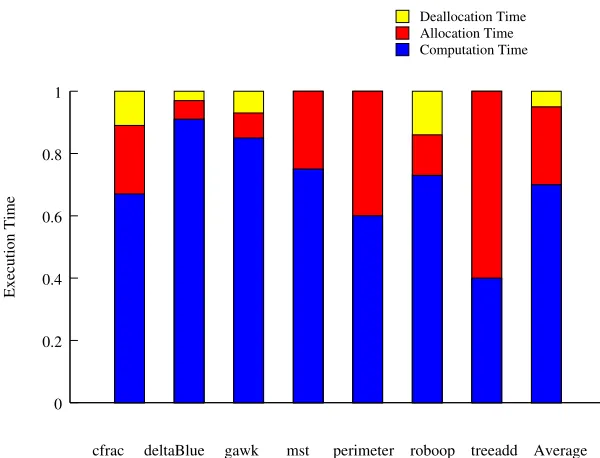
mallocandfree[7, 75, 86, 89]. While object oriented programming style improves software reusabil-ity and extensibilreusabil-ity, it has also made applications more heap allocation intensive. For example, some studies reported that C++ programs may use significantly more dynamic memory allocations com-pared to C programs [12, 16]. Figure 1.1 shows that for heap intensive C/C++ benchmarks that we study, on average 30% of their execution time is spent in dynamic memory management when using GNU C library.
Deallocation Time Allocation Time Computation Time
0 0.2 0.4 0.6 0.8 1
Execution Time
cfrac deltaBlue gawk mst perimeter roboop treeadd Average
Figure 1.1: Fraction of execution time spent in dynamic memory management routines, on an Intel Core2 Quad-Core platform.
widely used PHKmalloc allocator [71] with extra sanity checks, the benchmarks we tested suffer from an average of 21% execution time overhead.
At the same time, continuing progress in process technology enables the integration of multiple processor cores on a single chip, creating a platform that allows threads of an application to run in parallel on different cores. Considering the high overheads of dynamic memory management, it is important to explore the possibility of reducing dynamic memory management cost on a multi-core architecture, especially forsequential applications which cannot easily benefit from the multicore architecture otherwise.
Therefore, we would like to explore a new approach to hide the high cost of dynamic memory management by offloading all dynamic memory allocation and deallocation requests to a dedicated
memory management thread(MMT) thread.
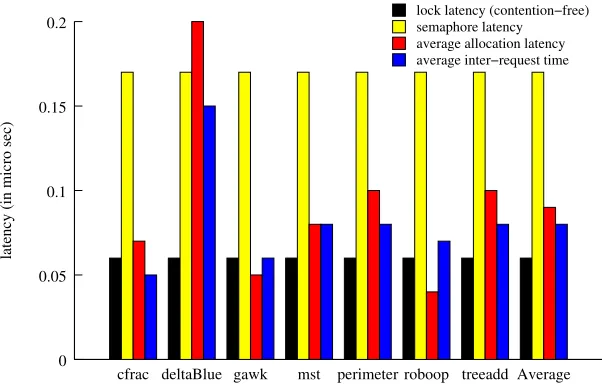
However, translating the potential parallelism of the MMT approach into performance improve-ment is challenging. First, memory allocation and deallocation are very fine-grained tasks, compared to thread synchronization primitives available in current systems. Figure 1.2 shows the latency of a pair of Posix thread lock acquisition and release, and a pair of semaphore signal and wait, com-pared to the average latency for memory allocation, and average time between two consecutive al-location/deallocation requests, for various benchmarks running on an Intel Core 2 Quad system. The figure shows that the latency of lock (uncontended) is roughly the same as the time to perform memory allocation, while the latency of a semaphore is roughly twice as much. Considering that one communication roundtrip between two threads typically involves a pair of semaphores and possibly lock acquisition and release, the overhead of synchronization is multiple times higher than the ac-tual work (memory allocation and deallocation). To make it worse, synchronization latencies are also higher than the time between two consecutive allocation/deallocation requests. Thus, unless these overheads can be reduced significantly, the parallelism from MMT will not offset the overheads to produce a net positive performance benefit.
Assuming we can overcome the performance challenge, the second challenge is whether the ap-plication and memory allocation library can benefit from MMTtransparently, i.e. without requiring source code modification, hints from programmer, compiler support, library modification, or special hardware support. Achieving such transparency is attractive since the application and the memory allocation library do not need to be redesigned or reprogrammed to enjoy parallelism that MMT provides on a multicore architecture. MMT can be applied, updated, patched, or changed without affecting the application or library code.
Thus, the goal of this work is to explore how MMT approach can (1) provide performance benefits by exploiting parallelism between main application thread and the dedicated memory management thread, and overcoming the fine-grain task granularity and synchronization overheads, and (2) deliver the speedups transparently from the application and memory management library. This work makes the following contributions:
lock latency (contention−free) semaphore latency average allocation latency average inter−request time
0 0.05 0.1 0.15 0.2
Average treeadd roboop perimeter mst
gawk deltaBlue cfrac
latency (in micro sec)
Figure 1.2: Latencies of synchronization primitives vs. average memory allocation and time be-tween consecutive allocation and deallocation requests.
using these techniques, the techniques combined together deliver a speedup ratio of 1.19×, for a set of heap allocation intensive benchmarks running on an Intel Core 2 Quad system.
Secondly, we show that MMT can be designed to be transparent to the application and mem-ory allocation library without modifying any of those. Furthermore, we design MMT to be agnostic to the underlying dynamic memory management library, i.e. MMT does not exploit algorithm or data-structures used by the underlying dynamic memory management library to gain performance improvements. To demonstrate these goals, we use both memory allocation library implemented in GNU C and PHKmalloc library implemented in FreeBSD systems [71]. These two libraries are unre-lated, and use significantly different algorithms and data structures. For the same set of benchmarks, MMT delivers an average speedup of 1.19×for both GNU C and PHKmalloc libraries.
Thirdly, we enable security checks in PHKmalloc library that has been useful in detecting many errors related to dynamically allocated objects in many applications like fsck, ypserv, cvs, mountd,and inetd, [82]. Without MMT, these checks incur on average 21% run time overheads. MMT approach reduces such high overheads to just 1% on average, withno overhead in most of the benchmarks.
Finally, in the process of designing an efficient MMT approach, we balance many different trade-offs and design choices that have strong implications on the MMT design. Due to the fine-grain task nature of MMT, we believe that such discussion may be useful for other researchers in consid-ering what design issues are important for exploiting fine-grain function parallelism. For example, we show how to design contention-resistant data structures and mechanisms, and avoid using locks while exploiting fine-grain task parallelism, where even “lightweight" Posix thread synchronization mechanism might be too expensive.
1.2
Modeling and Analyzing Key Performance Factors of Shared
Memory MapReduce
MapReduce, originally proposed by Google for cluster computing, has enjoyed a widespread com-mercial adoption by various companies, including Amazon, Facebook, and Yahoo [6, 20, 69]. With MapReduce runtime systems, programmers provide two functions:map()andreduce(), which are executed as separate phases. During the map phase, the map function accepts input data to produce intermediate output in the form of a list of<key,value>pairs. In the reduce phase, the list of key-value pairs are read by the reduce function, and all values having the same key are aggregated. Program-mers are attracted to MapReduce programming model due to increased programmer productivity, low barrier to entry, high level programming abstraction, the lack of data races and deadlocks, automatic management of threads, synchronization, and fault tolerance. Recently, IMMR has been shown to be effective in alleviating the I/O bottleneck in peta-scale scientific data analysis and management [64].
67x
44x
WC
1-thread
WC
8-threads
0
2
4
Normalized to WC Input A
Input A
Input B
Input C
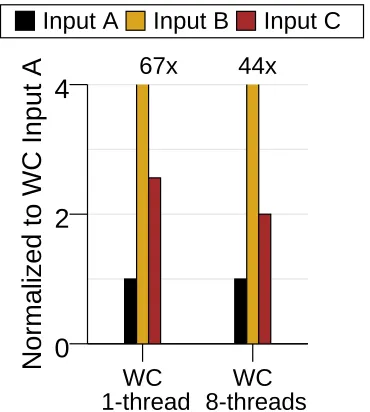
Figure 1.3: Execution time of word count for various inputs, normalized to input A.
signifi-WC-MR
Input A
WC-MR
Input B
WC-MR
Input C
0
1
2
3
4
5
6
7
Speedup
Thr 1
Thr 2
Thr 4
Thr 8
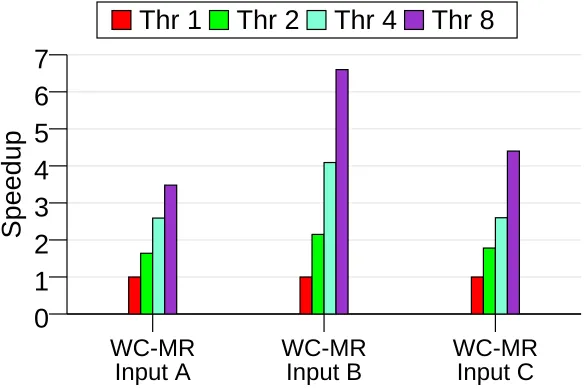
Figure 1.4: Speedups for word count normalized to the single thread case for each respective input
cantly [26, 36]. Therefore, it is possible that future MapReduce programs may use a hybrid approach, e.g. in-memory version in a shared memory node, and disk-based version across shared memory nodes. This work focuses on shared memory MapReduce.
Shared memory MapReduce’s scalability has been demonstrated for a range of applications [41, 51]. However, the general understanding of what factors affect performance and what performance bottlenecks exist for shared memory MapReduce programs is still at a rudimentary level. Little is understood beyond an observation that computation that can naturally be expressed using key-value pairs tends to perform well [28, 51]. Indeed, there are factors that are not identified yet that signifi-cantly affect performance.
Figure 1.3 shows the execution time of word count (WC) application for three equally-sized inputs on an Intel Xeon system using Metis [41], a shared memory MapReduce system. The input text docu-ments contain identical words (Input A), all distinct words (Input B), and mixed (Input C). The figure shows that the execution time of the application hugely varies depending on the input content. WC takes up to 67×longer with Input B compared to with Input A. Figure 1.4 shows the speedup of WC for up to eight threads, normalized to each input’s single thread case. The figure shows that scalability of the application is also affected by the input content.
To reach our goal, we develop a simple yet powerful parametric analytical performance model to establish mathematical relationship among key performance factors of shared memory MapReduce. The model relies on a mixture of Markov process and algorithm complexity analysis, augmented with empirically-derived parameters. The model is validated against results from real applications running on a real system. To the best of our knowledge, this is the first analytical model for understanding shared memory MapReduce performance. Our study discovers several important findings, among them are:
• Shared memory MapReduce performance is highly affected by the number of intermediate out-put key-value pairs relative to the number of distinct keys. Our model also discovers that the order in which keys are encountered during the Map phase affects execution time significantly. Inputs of which the content differs in these metrics produce significantly different performance, captured quantitatively by our model.
• Execution time of reduce phase is highly affected by task queue overhead, and this overhead may offset the benefit from increasing the number of reduce worker threads.
• The size and choice of data structure for storing intermediate output affects map and reduce phases differently, and sometimes affecting map phase positively while affecting reduce phase negatively. Our model enables us to quantify this interesting behavior. Furthermore, we show that different input content favors different choices for data structure and algorithms in the map phase, sometimes favoring non-intuitive choices.
Our model quantifies the relative contribution of different components/bottlenecks in the map and reduce phases, and how they are affected by program characteristics and input content. Finally, we propose an application classification framework that can be used to predict likely performance bottlenecks of applications. Given the knowledge about the program and input characteristics, such bottleneck analysis can be performed even prior to coding in some cases.
With the increasing prevalence of multicore systems and increasing adoption of MapReduce pro-gramming model, understanding the key factors affecting shared memory MapReduce will become increasingly critical for programmers, performance tuners, and system designers. We believe that our study is an important contribution towards that goal.
1.3
Reusing Computation in an In-Memory MapReduce System
to find the most frequently read news over the past week. Such a job would share 85% of the input from the previous job. There exists a tremendous opportunity to improve performance from avoiding redundant computation.
Recognizing the opportunity, researchers have proposed techniques to reuse computation in disk-based MapReduce [46, 34, 22, 47, 40, 45]. However, we are not aware of any study to apply computation reuse in IMMR. The challenges to reuse computation in IMMR are fundamentally different than in disk-based MapReduce. IMMR deals with the main memory, hence any metadata required for compu-tation reuse must be implemented in data structures, rather than the file system. The main memory is also space-restricted, thus any computation reuse in IMMR must be space efficient. Finally, the latency for detecting input similarity is fully exposed in IMMR, whereas in disk-based MapReduce it can be hidden and overlapped with the (much higher) disk access time, making it imperative to implement very efficient input similarity detection in IMMR.
In this dissertation, we propose a novel technique for computation reuse in IMMR, which we refer to asMapReuse. MapReuse detects input similarity at the granularity of map tasks by comparing their signatures. It skips re-computing output from repeated map tasks, computes output from new map tasks, and removes output that corresponds to deleted map tasks. MapReuse is built on top of an existing IMMR system, leaving it largely unmodified. It does not modify the APIs, hence program-mers’ abstraction is unchanged. This makes it possible to change the IMMR system independently of MapReuse, and allows MapReuse to be optimized transparently.
We evaluate MapReuse in two ways. We use an analytical model to understand key factors affect-ing MapReuse performance, and to stress test MapReuse under a wide range of scenarios. We use empirical evaluation on a multi-core system using benchmark applications such as frequency count-ing, regular expression matchcount-ing, and fingerprinting. We found that MapReuse significantly speeds up IMMR. The harmonic mean of speedup ratios of MapReuse over IMMR running with eight threads are 1.3×, 1.7×, 2.0×, and 2.2×, on 1, 2, 4, 8 threads, respectively, assuming the new input differs by 5% from the original input. Even when the new input differs by 25%, MapReduce speeds up IMMR by 1.3×on 8 threads.
1.4
Organization of the Dissertation
Chapter
2
Exploiting Fine-Grained Parallelism in
Dynamic Memory Management
This chapter is organized as follows: Section 2.1 discusses MMT design issues. Section 2.2 gives details about our experimental methodology. Section 2.2 presents the evaluation results. Section 2.3 describes related work.
2.1
MMT Approach and Design
In this section, we will describe our MMT approach, its basic design, and how it achieves the trans-parency goal. Then, we discuss how we exploit fine-grained parallelism between main application thread and MMT by performing speculative memory management and delaying some memory man-agement tasks to perform them during idle MMT cycles, hiding the cost of such requests from the main application thread, while keeping the MMT design contention resistant and completely agnostic to underlying memory management library implementation. Later, we illustrate how to effectively reduce communication and synchronization costs while offloading fine-grain tasks.
2.1.1
MMT Approach
are dispatched cannot be changed. Furthermore, the library thread can only be reactive, and perform allocation and deallocation only when requested, instead of being proactive.
Control
Data Done
Wakeup
RepQ ReqQ free
malloc,
ptr
Main Thread
MMLib e.g. glibc
App App
Main Thread
e.g. glibc MMLib
MMT
free
ptr malloc,
free malloc,
ptr
Main Thread
App
free malloc,
ptr
MMLib e.g. glibc MMT
Server Client
MMT
Mem Mgmt Thread (MMT) (a) Traditional MM:
(c) Client−Server Approach:
(b) Fork−Join Approach:
Figure 2.1: Traditional Memory Management (a), Fork-join MMT (b), versus Client-Server MMT approach (c).
In order to avoid all the limitations above and achieve the transparency goal of MMT, we propose a client-server model instead, as illustrated in Figure 2.1(c). The figure shows that MMT functionalities are split into the client side and the server side. The MMT client, located at the main thread, acts like a memory management library to the application, accepting regular memory allocation and deallocation requests. On a separate thread, the MMT server acts like the application program, generating calls to memory allocation and deallocation routines of the memory management library. The MMT client and server communicate and synchronize to coordinate which requests should be passed on to the library. With this client-server approach, both the application and the memory management library are completely unmodified and are oblivious to the fact that they run on two different threads. Hence, the application can enjoy the parallelism while using a regular memory management library. In addition, the library can be upgraded, patched, or replaced without affecting the way MMT works.
even delay some management tasks to be performed out of the critical path of the main application thread to hide dynamic memory management costs from main thread.
2.1.2
Basic MMT Design
As shown in Figure 2.1(c), an MMT client places memory allocation and deallocation requests into a
request queue, and uses awakeupsignal to tell the MMT server that there is a request to serve. The MMT server performs the request, and places the reply in areply queue, and uses adonesignal to tell the main thread of the completion of the work. The reply may contain a pointer to a newly allocated chunk in the case of memory allocation, or no reply in the case of memory deallocation. This is illustrated in Figure 2.2(a).
Thread
Main
Thread
Main
MMT
free()
malloc()
MMT
free()
malloc()
spin wait
servicing
spin wait
servicing
spin wait
(b)
(a)
Figure 2.2: Protocol for MMT to perform synchronous allocation and deallocation (a), and for MMT to perform synchronous allocation but asynchronous deallocation (b).
This basic design uses a semaphore to signal the MMT server to service a request, and another to signal the MMT client of the completion of the request. In Figure 2.2(a), both allocation and deal-location calls aresynchronous, i.e. the main thread is stalled until MMT finishes serving the request. However, since memory deallocation does not return a value to the main thread, it does not need to be synchronous. We can take advantage of this fact by making all memory deallocation calls asyn-chronous, as shown in Figure 2.2(b).Asynchronous deallocationhelps in hiding the cost of deallocation by overlapping it with the main thread and hence, exploiting the parallelism between MMT and main application thread.
than speeds up, applications by 1.9× on average (Section 2.2.1). One fundamental reason for this is that the latency of communication and synchronization relative to the time to perform memory allo-cation or dealloallo-cation is very high. For example, since alloallo-cation is synchronous, the main thread is delayed by the round-trip communication latencies between itself and MMT, which include semaphore signal/wait, and queue entry insertion and deletion latencies. As shown in Figure 1.2, communica-tion and synchronizacommunica-tion latencies exceed the latency of the actual work (allocacommunica-tion and deallocacommunica-tion). Therefore, we need to reduce communication and synchronization costs, and at the same time, look for further opportunities to exploit parallelism between main thread and MMT as asynchronous deal-location alone is not sufficient to achieve any performance benefits.
2.1.3
Speculative Memory Allocation
One way to reduce the high communication and synchronization costs is to avoid offloading alloca-tion requests since they are synchronous and incur most of the communicaalloca-tion and synchronizaalloca-tion costs. If allocation requests are performed at the main thread (by the MMT client), we can avoid the communication and synchronization overheads associated with dispatching them to the MMT. Unfortunately, this scheme results in a new type of synchronization overhead. Since allocation and deallocation requests are performed by different threads, the threads can potentially modify the un-derlying dynamic memory management data structures (e.g. free lists) simultaneously. For example, while the main thread attempts to recycle a free chunk from the free list, the MMT may be adding newly freed chunks to the free list. Therefore, the free list now needs to be protected by a lock, and this causes extra lock synchronization overheads. Contention for the free list lock can be quite severe be-cause asynchronous deallocation calls at MMT compete for locks with synchronous allocation requests performed at main thread. Moreover, such a fine grain task partitioning might potentially reduce the cache locality because dynamic memory management data structures are shared and modified by two different threads. Finally, requiring accesses to the free lists to be wrapped by lock acquisitions and releases breaks the transparency goal of MMT, since the memory management library code must now be modified.
In order to deal with the communication overheads problem without breaking the MMT trans-parency goal and causing additional synchronization overheads, we go back to letting the MMT to perform not only deallocations, but also allocations. However, to hide the latency of communication and the actual allocation work, MMT alsospeculatively preallocatesheap chunks proactively, in anticipa-tion of the actual allocaanticipa-tion requests by the applicaanticipa-tion, during the MMT’sidlecycles. The key to how preallocation can succeed is our observation that applications tend to allocate many objects of the same size. Therefore, MMT can dynamicallypreallocatean object before the main thread places the allocation request of the object’s size, and hence, extract more parallelism between MMT and main application thread in addition to asynchronous deallocation. Done correctly, preallocation can completely hide the allocation latency, hide some part of the communication and synchronization overheads, and reduce MMT contention as preallocation is performed during the MMT’s idle cycles.
object is returned to the main thread. If the prediction is incorrect (the size mismatches), the MMT has incurred a fragmentation equals to the size of the preallocated object. However, as long as in the future the predicted size is requested, the fragmentation is only temporary. Thus, in general, the MMT does not need to undo its preallocation when it mispredicts the next allocation size during preallocation.
There are several key design questions that need to be addressed in preallocation:(1) what size of dynamic objects should be pre-allocated at MMT? and (2) when should the MMT preallocate an object?
To answer the first question, we profiled allocation size distribution for allocation-intensive bench-marks. We found that most dynamically allocated objects are of small size (less than 512 bytes). This observation has an important implication on our preallocation scheme design. Small allocation re-quests (≤ 512 bytes) are not only common, but are also repeated many times. On the other hand, large requests (>512 bytes) are rare, less repeated, less predictable, and pre-allocating them result in a higher space fragmentation. Thus, we only preallocate for small allocation request sizes.
To answer the next question of when to preallocate for a particular allocation size, there are several possible approaches that we can consider. In the first approach, preallocation can be triggered conser-vatively when the MMT has seen a high number of allocation requests for a particular size. Such a conservative approach tries to keep unnecessary preallocations to a minimum. However, the approach may not be an optimal choice because (1) keeping track of the number of allocation requests to dif-ferent size incurs extra occupancy at the MMT, making MMT contention more likely, (2) the cost of miss-speculation is a small amount of fragmentation if preallocation is only made for small request sizes, and (3) the loss of preallocation opportunities during the learning period.
The second approach is moreaggressive. Rather than waiting until a pattern is established, we start preallocating for a given size the very first time an allocation request for that size is seen. Since the cost of miss-speculation for small chunks is very small, the aggressive approach avoids the cost of employing a learning algorithm and avoids missing performance opportunities to preallocate. Thus, we choose the latter approach for the MMT design.
2.1.4
Bulk Memory Allocation and Deallocation
Bulk Deallocation
Asynchronous deallocation exploits parallelism between MMT and main thread, but to reduce high communication and synchronization frequencies, we aggregate multiple deallocation requests and dispatch them to the MMT server as a single request. We refer to this scheme asbulk deallocation. To support bulk deallocation, we design the request queue such that while one part of it still sends a request to the MMT server on each allocation, another part allows deallocation requests to be accu-mulated and sent to the MMT server as a single request when they fill up the part of the queue.
The number of chunks that are deallocated in one go (thebucket size) is an important determinant of performance. Recall that deallocation latency is hidden by MMT because it is performed asyn-chronously during the time period in which the MMT server would otherwise be idle, so it tempting to set the bucket size large. But idle cycles are scattered as holes located between synchronous al-location requests made by the main thread and bulk dealal-location may take too long to fit in any contiguous idle cycles. If an allocation request arrives while the MMT is busy performing bulk deal-location (a collision), the allocation request must be delayed until the bulk deallocation completes, which directly exposes the deallocation latency to the main thread. While a too-small deallocation bucket size does not reduce communication and synchronization frequencies sufficiently, a too-large deallocation bucket size exposes deallocation latency. Hence, choosing a good preallocation bucket size is important for optimum performance. Through experiments, we found that, a bucket size of 200 provides a good balance between the competing goals of reducing communication and synchroniza-tion frequencies and keeping deallocasynchroniza-tion latency hidden, across all applicasynchroniza-tions (more discussion in Section 2.2.5).
Bulk Speculative Allocation
The principle of aggregating requests cannot be applied directly to allocation requests because they are synchronous. However, we can apply them to preallocation since it is performed speculatively. To achieve that, MMT can preallocate a bucket of chunks of a particular size in parallel with main application thread rather than preallocating one chunk at a time. Furthermore, this group of preallo-cated chunks can be sent directly to the MMT client, which will store them locally. When an allocation request of a particular size occurs, and the MMT client has a preallocation bucket for the size, it re-trieves one chunk from the bucket and returns it to the application,without involving any communication or synchronization with the MMT server. If the bucket of a particular size is empty, the MMT client sends an allocation request to the MMT server.
In designing bulk speculative preallocation, there are several important issues to consider, such as
(1) when preallocation should be initiated, (2) how many buckets there should be, and (3) what preallocation bucket size is appropriate for each bucket. We will discuss each of the issue in more details next.
preallocation bucket to the MMT client. From this point on, the main thread will start to consume chunks from the bucket residing on MMT client until the bucket becomes empty. During this time, the MMT server can take one of the following actions. In aconservativeapproach, after half of chunks in the preallocation bucket are used up, the MMT client sends aresume-preallocatesignal to the MMT server so that it can start preallocating the next bucket ofNchunks. Hopefully by the time the main thread has used up all chunks in the current bucket, the MMT server has finished preparing the next bucket. This conservative preallocation is illustrated in Figure 2.3(a). An alternative is to use a more
aggressiveapproach. The MMT can proactively preallocate the nextNchunks immediately after giving a preallocation bucket to the main thread, as shown in Figure 2.3(b).