DNA SEQUENCE ANALYSIS OF MUTAGENICITY AND
SITE SPECIFICITY OF ETHYL METHANESULFONATE IN
UVR+ AND UVRB- STRAINS OF ESCHERICHIA COLI
PHILIP A. BURNS,' FRANCES L. ALLEN AND BARRY W. GLICKMAN Department of Biology, York University, 4700 Keele Street, Toronto, Ontario, M3J l P 3 Canada
Manuscript received December 11, 1985 Revised copy accepted April 26, 1986
ABSTRACT
EMS-induced mutations within a 180 base pair region of the lacl gene of E. coli were cloned and sequenced. In total, 105 and 79 EMS-induced mutations from a Uvr+ and a UvrB- strain, respectively, were sequenced. T h e specificity of EMS-induced mutagenesis was very similar in the two strians; G:C + A:T transitions accounted for all but three of the mutants. T h e overall frequency of induced mutation was fivefold higher in the UvrB- strain compared t o the Uvr+ strain. This demonstrates, at the DNA sequence level, that the presumed pre- mutagenic lesion, 06-ethylguanine, is subject to repair by the uvrABC excision repair system of E. coli. An analysis of mutation frequencies with respect t o neighboring base sequence, in the two strains, shows that 06-ethylguanine lesions adjacent to A:T base pairs present better targets for the excision repair machin- ery than those not adjacent t o A:T base pairs.
UTATIONAL spectra produced by mutagens in various repair back-
M
grounds can provide important information about the role of different premutagenic lesions and repair systems in the mutagenic process. Until re- cently, such studies have involved the characterization of comparatively small numbers of mutants or reversion analyses at relatively few sites. In the system used here, large numbers of E. coli lacZ forward mutations can be readily collected (MILLER 1972), cloned by in vitro recombination onto a bacteriophage M 13 vector (SCHAAPER, DANFORTH and GLICKMAN 1985) and then sequenced by the chain termination method (SANGER et al. 1980). In this paper, we investigate the mutational spectra produced by EMS in excision-proficient and excision-deficient strains of E. coli. We focused our attention on mutations affecting a 180 base pair (bp) region of the ZacZ gene that codes for the DNA- binding domain of the protein. This permitted the accumulation of data ofsufficient density so that site-to-site differences could be deemed significant. EMS is a member of an important class of mutagenic and carcinogenic agents known as alkylating agents. Studies of alkylating agents have revealed a large
Abbreviations: EMS, ethyl methanesulfonate; Pgal, phenyl-beta-mgalactopyranoside; Xgal, 5-bromc-4-chloro-
i To whom correspondence should be addressed.
3-indolyl-beta-mgalactoside.
812 P. A. BURNS, F. L. ALLEN AND B. W. GLICKMAN
number of potential sites within DNA at which these compounds can form lesions, including most of the nitrogens and all of the oxygens (SINGER and
KUSMIEREK 1982). T h e most important of these lesions with respect to muta- genesis appear to be the alkylated oxygens. Studies have shown that the 06- alkylguanine lesion is able to mispair with thymine and hence give rise to G:C + A:T transitions, both in vitro (ABBOT and SAFFHILL 1979) and in vivo (LOE- CHLER, GREEN and ESSIGMANN 1984). Other studies have demonstrated the miscoding potential of 02-alkylthymine and 04-alkylthymine (HALL and
SAFFHILL 1983; SINGER, SACI and KUSMIEREK 1983). Most attention with re- spect to mutagenesis has tended to focus on the 06-alkylguanine lesion, as good correlations have been found between the amount of 06-alkylguanine damage and the extent of its repair and mutagenicity (SCHENDEL et al. 1978; NEWBOLD et al. 1980; BERANEK et al. 1983).
Several pathways exist by which E. coli can repair alkylation damage (LIN-
DAHL 1982). At least two distinct repair processes are induced as part of the
adaptive response to alkylation treatment (SAMSON and CAIRNS 1977). One enzyme induced in response to alkylation damage is 3-methyladenine-DNA glycosylase 11, which is capable of removing potentially lethal N3-methyladen- ine, N7-methyladenine, N3-methylguanine and N7-methylguanine lesions (KAR-
RAN, HJELMGREN and LINDAHL 1982), and the potentially mutagenic 02-meth-
ylthymine lesion (MCCARTHY, KARRAN and LINDAHL 1984) from the DNA. A second inducible enzyme, 06-alkylguanine-DNA transferase, is able to dealky- late the potentially mutagenic 06-alkylguanine and 04-alkylthymine lesions (MCCARTHY, KARRAN and LINDAHL 1984). Although methylating agents read- ily induce the adaptive response, ethylating agents are relatively poor inducers, and ethylation damage is less efficiently repaired by the adaptive enzymes
(SEDGWICK and LINDAHL 1982). In contrast, the uvrABC-dependent excision repair pathway is able to remove 06-ethylguanine, but not 06-methylguanine, from DNA (WARREN and LAWLEY 1980; TODD, BROUWER and GLICKMAN 198 1).
In previous studies of EMS mutagenic specificity, a marked preference for the induction of G:C + A:T transitions has been observed (COULONDRE and
MILLER 1977; PRAKASH and SHERMAN 1973). These observations are consistent with a predominant role for the 06-ethylguanine lesion in EMS mutagenesis. However, these studies revealed little about the site-specificity of alkylation- induced mutagenesis. T h e aim of this study was to investigate the spectrum of mutations induced by EMS in a system that can screen for all classes of mu- tation, and to examine the role of excision repair in the processing of EMS-
induced lesions.
MATERIALS AND METHODS
Strains and media: The strains used in these studies were NR3835: F' lac-pro, A(pro- lac), ara-, thi-, trpE 9777; and NR395 1 : NR3835 A(bio-uvrB). Media were as described by MILLER (1972), and COULONDRE and MILLER (1977).
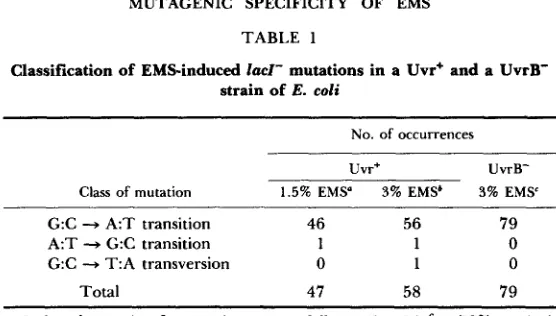
TABLE 1
Classification of EMS-induced ZacZ- mutations in a Uvr' and a UvrB- strain of E. coli
No. of occurrences
Uvr+ UvrB-
Class of mutation 1.5% EMS" 3% EMS' 3% EMSc
G:C + A:T transition 46 56 79
A:T + G:C transition 1 1 0
G:C --f T:A transversion 0 1 0
Total 47 58 79
Induced mutation frequencies were as follows: "9 X loe6 at 72% survival; at 2% survival; compared with 0.2 *14 X
x without treatment. at 51% survival; '67 X
spread on plates containing Pgal (Bachem Fine Chemicals) as the sole carbon source, for the selection of forward l a d - mutations, and LB agar and minimal medium plates, for survival. Pgal is a substrate for &galactosidase, but does not induce synthesis of the enzyme. When supplied as a sole carbon source, only cells that synthesize @-galactosidase constitutively ( l a d - or lacO' mutations) will form colonies. Mutations mapping to the early part of the gene (approximately 180 bp) can be selected using a simple comple- mentation test (MILLER 1972).
Cloning and sequencing: The l a d - mutations were cloned by in vivo recombination using a specially constructed bacteriophage M 13 strain that carries lacP-lacZ- se- quences. Following infection of Lad- bacteria, recombinant laci--lacZ+ M 13 progeny were selected as blue plaques on an indicator bacterial strain on plates containing Xgal (Research Organics Inc.). Following plaque purification, DNA preparations were made from the recombinant M13 phage carrying the l a d - mutations, and these were then sequenced using the dideoxy method of SANCER et al. (1980) and a 15-mer, kindly supplied by S. GILLAM (Vancouver), as a primer. The method is described in detail by
SCHAAPER, DANFORTH and GLICKMAN (1 985).
RESULTS
Within the 180-bp target sequence used in this study, there a r e 88 known base substitution mutations that will produce a LacI- phenotype (B. W. GLICK-
MAN, unpublished results). This total is made u p of 25 G:C + A:T and 14 A:T
-
G:C transitions, plus 11 G:C + C:G, 12 G:C 3 T:A, 15 A:T + T:A a n d 11 A:T + C:G transversions.T h e results of sequencing 105 and 79 EMS-induced lacl- mutations isolated in the Uvr+ a n d UvrB- strains, respectively, are presented in Table 1. All but
three of the mutants a r e G:C 3 A:T transitions. The three exceptions were
recovered in the Uvr+ strain a n d included two A:T + G:C transitions (at positions 117 and 162) and a G:C + T : A transversion (at position 49).
814 P. A. BURNS, F. L. ALLEN AND B. W. GLICKMAN
TABLE 2
Induced frequencies of G C -.+ A:T transitions at potential G C + A T mutant sites" in Uvr+ and UvrB- strains following 3% EMS treatment
Position 42 53 56 57 75 80 84 90 92 93 95 104 113 120 129 140 174 179 185 186 188 191 198 20 1 206 Total Sequence*
C G T
TGT
T G C AGA TGA GGT GGA CGC CGG CGC
T G G TGG C G T
AGA C G T AGT GGG CGG CGC T G C
TGT TGT
CGC GGC
TGT
Frequency (X 1 0 3
In Uvr+ In UvrB-
UvrB- Uvr+
-
1.0 (4)' 0 2.3 (9) 0.3 (1)0.5 (2) 0.3 (1)
0.5 (2) 0.8 (3)
1.3 (5) 1.0 (4) 0 0.3 (1)
0 0 0
1.6 (6) 0 2.3 (9) 0.3 (1)
0
0
0.3 (1) 0 14 x
1.0 (4)
0.8 (3)
1.7 (2) 0 2.5 (3) 5.9 (7)
8.4 (10) 3.4 (4)
5.1 (6)
1.7 (2) 9.3 (1 1)
5.1 (6) 0.8 (1) 0.8 (1)
3.4 (4) 0
0 4.2 (5)
0
0
2.5 (3) 2.5 (3)
0 3.4 (4)
3.4 (4)
0.8 (1)
1.7 (2) 67 X
1.7 1.1 19.7 16.8 11.3 6.4 3.4 7.2 5.1 2.7 4.2 1.5 8.3 4.3 2.7 4.8
AI1 known sites from unpublished spectra and MILLER (1984). The mutated G:C base pair is underlined.
' The number of mutants recovered at each site are in parentheses.
31% of the characterized mutants. These two hotspots involve a G:C + A:T transition within the sequence G-T-C/G-G-C-A-C/G-A (where the mutated G is underlined). Of the 16 sites where mutations were recovered, ten involve changes within runs of three or more G:C base pairs.
T h e distribution of G:C
*
A:T transitions induced by EMS in the UvrB- strain, and the mutation frequencies at those sites, are shown in Figure 1 and Table 2, respectively. Nineteen individual sites of mutation were recovered in this spectrum, and induction frequencies vary up to 11-fold from site to site.T w o of the sites account for 27% of the mutants (positions 75 and 92), but do not correspond to the two Uvr+ hotspot sites. Ten of the 19 sites of mutation involve changes within runs of three or more G:C base pairs.
A comparison of the two spectra in Table 2 shows that there are 15 sites of G:C + A:T transition in common. Four sites of mutation in the UvrB- EMS-
A U v r ' above A
A UvrB- below
A A
T A
T A T
40 T 50 A 60 70 T T 88
i T AT I
I
T T T IGTGAAAc ~ A ~ ~ ~ ~ ~ ~ T T ~ ~ A ~ ~ ~ ~ ~ T ~ C C A C A C ~ A T G ~ ~ ~ G T G T ~ ~ ~ ~ ~ ~ ~ ~ ~ ~ ~ ~ ~ ~ ~ ~
AT T T T
T
T AT T T T
AT T T T
T T T T
T T T
T T T
T T
T
T T
TA T A
TA A
T TA 100 110 120 1 3 0 A 145
T TA T
I
AT C C ~ ~ C ~ T G ~ ~ O A A C C A G G ~ ~ ~ ~ ~ ~ ~ ~ G T T T C T G ~ ~ A A A A ~ ~ ~ ~ ~ ~ ~ ~ ~ ~ ~ ~ ~ ~ ~ ~ ~ ~ ~ ~
T TA A T T A
T TA T A
TA T A
TA T A
TA A
TA
T A
T A
T A
T T A
T T A
T A
T A T
150 160 170 T 180 A T 195 205
I T AT T ! A
~ C G ~ T ~ ~ C G G ~ O C T ~ A A T T A C ~ T T ~ ~ ~ A A ~ ~ O ~ ~ T G ~ ~ ~ ~ ~ ~ ~ ~ ~ ~ ~ ~ ~ ~ ~ ~ ~ ~ ~ ~ ~ ~ ~ ~
AT T T A T
AT T T T
AT T T
A T
FIGURE 1.-Spectra of G:C + A:T transitions in the first 180 bp of the lac1 gene induced by EMS in Uvr+ and UvrB- strains. The asterisks indicate sites of G:C -+ A:T transition that are known to produce a LacI- phenotype from other studies (data not shown).
Uvr+ spectrum is not seen in the UvrB- spectrum. There are five known sites of G:C A:T transition that produce a Lad- phenotype but at which no mutations were recovered in either spectrum.
816 P. A. BURNS, F. t. ALLEN A N D B. W. GLICKMAN
TABLE 3
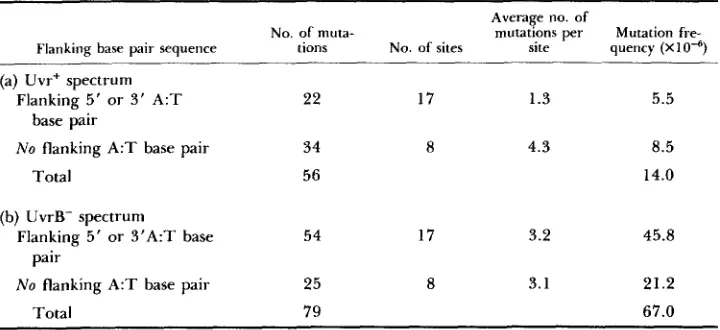
Effect of neighboring base sequence on mutation at G C sites in the Uvr+ and UvrB- spectra
Average no. of
No. of muta- mutations per Mutation fre- Flanking base pair sequence tions No. of sites site quency (X 1 P )
(a) Uvr+ spectrum
base pair
Flanking 5’ or 3’ A : T 22 17 1.3 5.5
No flanking A:T base pair 34 8 4.3 8.5
Total 56 14.0
(b) UvrB- spectrum
Flanking 5’ or 3’A:T base 54 17 3.2 45.8
N o flanking A : T base pair 25 8 3.1 21.2
pair
Total 79 67.0
DISCUSSION
Examination of the EMS-induced mutational spectra (Table 1) reveals that the prevalent mutagenic alterations in both the UvrB- and Uvr+ strains are G:C + A:T transitions. Out of 25 known sites of G:C 4 A:T transition, 20
were found to mutate in this study and accounted for 181 of the 184 char- acterized mutations. Of the 63 known sites of other types of base substitution, only three were found to mutate (in the Uvrf spectra) and accounted for only three of the mutants. These findings confirm and extend the results of pre- vious studies by COULONDRE and MILLER (1977) and PRAKASH and SHERMAN
(1973), who showed EMS to have a clear preference for the induction of G:C
4 A:T transitions. T h e induced mutation frequency, however, is nearly five-
fold greater in the UvrB- strain. This indicates that the excision repair system of E. coli is able to remove those lesions responsible for the G:C 3 A:T
transitions. Studies by TODD, BROUWER and GLICKMAN (1 98 1) have previously suggested a role for excision repair in the error-free repair of ethylation dam- age to DNA. This observation was correlated with the demonstrated ability of the excision repair system to remove 06-ethylguanine lesions from the DNA. T h e results of this study, therefore, strongly support the notion that the 06- ethylguanine lesion is largely responsible for EMS mutagenesis.
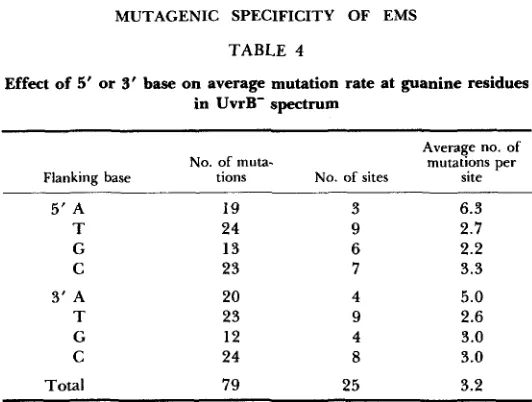
TABLE 4
Effect of 5' or 3' base on average mutation rate at guanine residues in UvrB- spectrum
Average no. of No. of muta- mutations per Flanking base tions No. of sites site
5' A I9 3 6.3
T 24 9 2.7
G 13 6 2.2
C 23 7 3.3
3' A 20 4 5.0
T 23 9 2.6
G 12 4 3.0
C 24 8 3.0
Total 79 25 3.2
G:C base pair this increase is less than threefold (Table 3). This trend can be seen in its most extreme form at base pair positions 56 and 75. At position 56 (CGC) the G:C + A:T transition is induced at almost the same frequency in both strains, whereas at position 75 (AGA) the induction frequency is in- creased almost l'i-fold in the UvrB- strain (Table 2). It is also worth noting that the four sites of G:C + A:T transition unique to the UvrB- spectrum (positions 95, 120, 188 and 206) each have a flanking A:T base pair, and the one site unique to the Uvr+ spectrum (position 174) is flanked by G:C base pairs. T h e disappearance of a hotspot at position 120 (AGA), and the appear- ance of a hotspot at position 174 (GGG) in the Uvr+ spectrum are striking examples of the shift in site specificity resulting from the apparent excision repair bias.
These results suggest that 06-ethylguanine lesions adjacent to A:T base pairs are more susceptible to the excision repair system than those flanked on either side by G:C base pairs. Greater distortion of the helix by an 06-ethylguanine residue in the vicinity of a weak A:T hydrogen bond might make such sites better targets for the excision repair machinery.
It is clear from our studies that very subtle differences in the sequence environment of an 0'-ethylguanine lesion can have a profound influence on the repairability of that lesion. A similar analysis of the effect of neighboring base sequence on mutability of guanine residues is not possible from the results of COULONDRE and MILLER (1977) as all the available transition sites are ad- jacent to A:T base pairs.
In the absence of excision repair, variation in mutation levels may reflect differences in EMS damage distribution, rather than differential methyltrans- ferase activity. EMS is a poor inducer of the adaptive response, and 06-ethyl- guanine lesions are removed relatively inefficiently by the methyltransferase, e.g., about ten times more slowly than 06-methylguanine lesions (SEDGWICK
818 P. A. BURNS, F. L. ALLEN AND B. W. GLICKMAN
by altering the topology of the DNA, especially with respect to the major groove into which the O 6 position protrudes. In the UvrB- spectrum, guanine residues that are within the same trinucleotide sequence vary in mutation frequency by a maximum of fourfold
(CJ:
185 and 201, Table 2), compared to a maximum 1 1-fold variation between sites of differing sequence. This obser- vation is an indication of a role for neighboring DNA sequence in the deter- mination of the mutability of a particular site. An analysis of the influence of flanking bases on the mutability of guanine residues is shown in Table 4. In the UvrB- spectrum, guanine residues appear more prone to mutation if flanked by an adeine residue. We suggest that this may reflect a greater op- portunity for ethylation at such sites. An analysis of mutability with respect to longer stretches of neighboring base sequence revealed no evidence of a role for wider sequence context in EMS mutagenesis.This investigation was supported by grant A2814 and strategic grant (31598 from the National Science and Engineering Research Council of Canada.
LITERATURE CITED
ABBOT, P. J. and R. SAFFHILL, 1979 DNA synthesis with methylated poly(dC-dG) templates: evidence for a competitive nature to miscoding by 06-methylguanine. Biochim. Biophys. Acta
BERANEK, D. T., R. H. HEFLICH, R. L. KODELL, S. M. MORRIS and D. A. CASCIANO, 1983 Correlation between specific DNA-methylation products and mutation induction at the H G P R T locus in Chinese hamster ovary cells. Mutat. Res. 110: 171-180.
COUMNDRE, C. and J. H. MILLER, 1977 Genetic studies of the lac repressor, IV. Mutagenic specificity in the lacl gene of Escherichia coli. J. Mol. Biol. 117: 577-606.
HALL, J. A. and R. SAFFHILL, 1983 T h e incorporation of 0'-methyldeoxyguanosine and 04-
methyldeoxythymidine monophosphates into DNA by DNA polymerases I and alpha. Nucleic Acids Res. 11: 4185-4193.
Induction of a DNA glycosylase for N-
methylated purines is part of the adaptive response to alkylating agents. Nature 2 9 6 770- 773.
562: 51-61.
KARRAN, P., T. HJELMCREN and T. LINDAHL, 1982
LINDAHL, T., 1982
LOECHLER, E. L., C. L. GREEN and .I. M. ~ I G M A N N , 1984
DNA repair enzymes. Annu. Rev. Biochem. 51: 61-87.
In vdvo mutagenesis by 06-methyl- guanine built into a unique site-in a viral genome. Proc. Natl. Acad.-Sci. USA 81: 6271- 6275.
MCCARTHY, T . V., P. KARRAN and T. LINDAHL, 1984 Inducible repair of 0-alkylated DNA pyrimidines in Escherichia coli. EMBO J. 3: 545-550.
MILLER, J. H., 1972 Experiments in molecular genetics. Cold Spring Harbor Laboratory, Cold Spring Harbor, New York.
MILLER, J. H., 1984 Genetic studies of the lac repressor, XII. Amino acid replacements in the DNA binding domain of the Escherichia coli lac repressor. J. Mol. Biol. 1 8 0 205-212.
NEWBOLD, R. F., W. WARREN, A. S. C. METCALF and J. AMOS, 1980 Mutagenicity of carcinogenic methylating agents is associated with a specific DNA modification. Nature 283: 596-599. PRAKASH, L. and F. SHERMAN, 1973 Mutagenic specificity: reversion of iso-I-cytochrome c mu-
tants of yeast. J. Mol. Biol. 79: 65-82.
SAMSON, L. and J. CAIRNS, 1977 A new pathway for DNA repair in Escherichia coli. Nature 267:
SANGER, F., A. R. COULSON, B. G . BARRELL, A. J. H. SMITH and B. A. ROE, 1980
SCHAAPER, R. M., B. N. DANFORTH and B. W. GLICKMAN, 1985
SCHENDEL, P. F., M. DEFAIS, P. JEGCO, L. SAMSON and J. CAIRNS, 1978
Cloning in single-stranded bacteriophage as a n aid to rapid DNA sequencing. J. Mol. Biol. 143: 161-178.
Rapid repeated cloning of mutant
lac repressor genes. Gene 39: 181-189.
Pathways of mutagenesis and repair in Escherichia coli exposed to low levels of simple alkylating agents. J. Bacteriol.
SEDGWICK, B. and T. LINDAHL, 1982 A common mechanism for repair of @-methylguanine and
SINGER, B. and J. T. KUSMIEREK, 1982 Chemical mutagenesis. Annu. Rev. Biochem. 52: 655-
SINGER, B., J. SACI and J. T. KUSMIEREK, 1983 Escherichia coli polymerase I can use O*-methylde- oxythymidine or 0'-methyldeoxythymidine in place of deoxythymidine in primed poly(dA- dT). poly(dA-dT) synthesis. Proc. Natl. Acad. Sci. USA 8 0 4884-4888.
TODD, P. A., J. BROUWER and B. W. GLICKMAN, 1981 Influence of DNA repair deficiencies on MMS- and EMS-induced mutagenesis in Escherichia coli K12. Mutat. Res. 82: 239-250.
WARREN, W. and P. D. LAWLEY, 1980 T h e removal of alkylation products from the DNA of
Escherichia coli cells treated with the carcinogens N-ethyl-N-nitrosourea and N '-methyl-N-nitro- sourea; influence of growth conditions and DNA repair defects. Carcinogenesis 1: 67-78.
Communicating editor: J. ROTH
135: 466-475.
06-ethylguanine in DNA. J. Mol. Biol. 154: 169-175.