Solution Oriented School Improvement
Programme: Does it do what it says on
the tin?
MARGARET JEAN EVANS
A thesis submitted in partial fulfilment of the requirements of the University of East London
for the degree of Professional Doctorate in Applied Educational and Child Psychology
University of East London
School of Psychology
Doctorate in Applied Educational and Child Psychology
Declaration
This work has not previously been accepted for any degree and it is not being
concurrently submitted for any degree.
This research is being submitted in partial fulfilment of the requirements of the
Doctorate in Applied Educational and Child Psychology.
This dissertation is the result of my own work and investigation, except where
otherwise stated. Other sources are acknowledged by explicit references in the text.
A full reference list is appended.
I hereby give my permission for my dissertation, if accepted, to be available for
photocopying and for inter-library loans, and for the title and summary to be made
available to outside organisations.
Name (please print) ...
ACKNOWLEDGEMENTS
I gratefully acknowledge the contributions of my partner Richard who gave up his
time to give me the opportunity and encouragement to succeed. Also, all my tutors
at UEL, especially Dr Naina Cowell for all her enthusiasm, time and patience, and
my external consultant Dr. Sarah Lewis for her expertise and support. Additional
support has been received from Ros Somerville and Paul Edwards in obtaining
records and all school staff and pupils who contributed to this research. Last but not
least, my son Ricky for all his meticulous data formatting and my son Leo for his
ABSTRACT
The effectiveness of school improvement programmes has been investigated
primarily with a focus on children’s academic attainments. Research on school
improvement programmes acknowledges the importance of stakeholder inclusion in
organisational change. The views and experience of school personnel were sought
in order to triangulate this information with improvement indicators of school
performance. The Solution Oriented Schools (SOS) Programme is a
strengths-based school improvement programme which builds on school capacity and
inclusive practices. The outcomes of the SOS Programme’s improvement criteria
were monitored in 26 schools over one year using a mixed methodology design.
Data on improvement indicators such as pupil and staff attendance, fixed-term
exclusions and staff turnover was used. Average rates before and after SOS
implementation were compared to identify and investigate any improvement in these
indicators in line with SOS programme claims. Using a Friedman test, decreases in
fixed-term exclusion reached significance. (p< 0.001). The rate of authorised pupil
absences, staff absences and turnover decreased but not significantly and
unauthorised pupil absences significantly increased (p<0.05). The self-esteem of
316 pupils aged between 4 and11 was measured using the LAWSEQ scale before
and after SOS programme implementation and a significant increase was found
(p<0.001). Staff self-esteem, measured using the Rosenberg scale also increased
significantly (p<0.05) and provided a significant indicator of Programme sustainability
Thematic analysis of seventeen interviews undertaken with staff led to a proposed
model of school improvement. This model demonstrated that the extent of the
effectiveness of school improvement programmes rested on the preparation of staff
in terms of capacity, perceptions of change and stability of the school before
implementation of the programme. Goal Attainment Scales were significantly
correlated with fidelity of Programme participation (p< 0.05). The SOS Programme
was useful in enabling schools to achieve these goals. Feedback on the process of
change necessary for the success of the SOS programme indicated that there was
TABLE OF CONTENTS
DECLARATION ... I
ACKNOWLEDGEMENTS ... II
ABSTRACT ... III
TABLE OF CONTENTS ... V
LIST OF TABLES ... X
LIST OF FIGURES ... XI
CHAPTER ONE: INTRODUCTION ... 1
1. Overview of the chapter ... 1
1.1 Context of the study ... 3
1.2.Origins and genesis of the study ... 4
1.3 A description of the SOS Programme and its introduction within a Local Authority ... 5
1.4 The aims of the research ... 13
1.5 Premise of the study ... 17
1.5.1. The origins and nature of Solution Oriented Schools Programme ... 19
1.5.2. Content and Claims of the Solution Oriented Schools Programme (SOS) ... 21
1.6 Distinctive Contribution and Relevance to Professional Practice... 23
1.7 Epistemological position ... 26
1.8 Reflexive thinking ... 28
1.9 Summary of chapter... 33
CHAPTER TWO: LITERATURE REVIEW ON SCHOOL IMPROVEMENT EFFECTIVENESS AND EVALUATION OF SCHOOL PROGRAMMES... 34
2.1 Overview of the chapter ... 34
2.2 Search procedure ... 35
2.3 Introduction to school improvement and effectiveness ... 39
2.4 The theoretical link between school improvement and school culture ... 42
2.5.2 Research into school effectiveness models in Europe ... 47
2.5.3 Research into the influence of external inspections on school improvement ... 50
2.5.4 Putting self-evaluation to the test in Europe ... 53
2.5.5 Research into school improvement evaluation ... 56
2.6 Evaluating the evaluators ... 58
2.7 Improvement programmes: illusion or reality? ... 60
2.8 Summary of chapter... 63
CHAPTER THREE: LITERATURE REVIEW ON THE USE OF A SOLUTION-FOCUSED APPROACH IN SCHOOLS ... 64
3.1 Overview of chapter ... 64
3.2 Solution Oriented or solution-focused? ... 65
3.3 Research into major reviews of solution-focused working with young people ... 68
3.4 Additional research on solution-focused work undertaken in schools ... 71
3.5 Educational psychologists (EPs) working in schools with SFBT ... 75
3.6 The use of Solution Oriented working in schools... 77
3.7 Pilot evaluation of the Solution Oriented School Programme ... 80
3.8 Conclusion from literature review of the use of solution-focused approaches in schools ... 81
3.9 Summary of the critique ... 83
3.10 Implications for this study ... 83
CHAPTER FOUR: METHODOLOGY ... 86
4.1 Introduction ... 86
4.2 The research questions ... 86
4.3 Research Paradigm and Design ... 88
4.3.1 Ontological considerations ... 88
4.3.2 Variables and threats to validity ... 90
4.3.3 Comparison groups and threats to reliability ... 91
4.3.4 Critical Realism and Mixed Methodology ... 93
4.3.5 Overcoming the complexity of Mixed Method data collection ... 96
4.4 Evaluation design selected for the SOS Programme ... 98
4.5 The research questions and their relationship to data collection and analysis ... 103
4. 6 Context and Location for Study ... 106
4.8.1 Qualitative method of data collection ... 110
4.8.2 Quantitative methods of data collection ... 113
4.8.3 Validity and reliability of Rosenberg Scale and LAWSEQ ... 115
4.9 Procedure for data collection and data collection points ... 117
4.9.1. LA recorded data ... 118
4.9.2. Pupil self-esteem data collection ... 118
4.9.3. Collection of Staff self-esteem ... 120
4.9.4 Semi-structured Interviews... 120
4.10 Ethical Considerations ... 125
4.11 Data coding and analysis ... 127
4.11.1Thematic Analysis ... 127
4.11.2 Statistical analysis of self-esteem ... 131
4.11.3.Logistical regression using categorical data ... 133
4.11.4. Statistical analysis using correlation between GAS and Levels of SOS participation ... 133
4.11.5 Statistical analysis and graphs of Key Stage 1 and 2 data ... 134
4.11.6 Statistical analysis and graphs for pupil absences, exclusion, staff absences and turnover. ... 135
4.12 Summary of chapter ... 136
CHAPTER FIVE: QUANTITATIVE RESULTS ... 138
5.1.Overview of chapter ... 138
5.2 Context of participants in schools ... 139
5.3 Levels of participation – information gained through semi-structured interviews and analysis of missing data ... 140
5.4. Missing data for self-esteem analysis ... 140
5.5 Analysis of pupil fixed-term exclusions, absenteeism, staff sickness and turnover in SOS schools ... 142
5.5.1 Pupil fixed-term exclusions ... 142
5.5.2 Analysis of Pupil authorised absences ... 144
5.5.3 Analysis of pupil unauthorised absences ... 146
5.5.4 Analysis of Staff absences ... 148
5.5.6 Analysis of Staff turnover ... 150
5.5.7 Summary of findings ... 152
5.6 Analysis of SOS schools’ goals, academic attainments and pupil and staff self-esteem ... 154
5.6.1 Identification of SOS Participating Schools Goal Attainment Scores ... 155
5. 6. 2 Analysis of pupils’ self-esteem ... 158
5.6.3. Analysis of self-esteem measures of the staff ... 161
5.6.4 Analysis of Standard Attainment Tests (SATs) Attainments at Key Stage 1 and 2 ... 163
5.7 Summary of findings for pupil and teacher self–esteem and pupil attainment ... 169
5.8 A model to predict the likelihood of remaining on the Programme ... 170
5.9 Overall Summary on the effect of the SOS programme ... 171
6.2 Data Collection... 174
6.3 Data Collection and Analysis Procedure ... 175
6.4 Reliability ... 181
6.5 Findings... 182
6.5.1 Core Theme One: Perception of school improvement ... 185
6.5.2 Sub-theme One - Internal perceptions of improvement ... 186
6.5.3 Sub-theme two: External influences on anxiety ... 188
6.6 Core Theme Two: Stability of the school ... 189
6.6.1 Sub-theme One: Staff factors affecting stability ... 190
6.6.2 Sub-theme Two: External factors affecting stability ... 191
6.7 Core theme three: Adaptability to initiate SOS systemic changes ... 192
6.7.1 Sub-theme one: School elements that affected initiating SOS ... 193
6.7.2 Sub-theme two: Staff elements that affected initiating SOS ... 194
6.7.3 Sub-theme three: Systemic Elements that affected initiating SOS ... 195
6.7.4 Sub-theme Four: Time elements that affected initiating SOS ... 196
6.8 Core theme four: Aspects affecting the sustainability of the Programme ... 198
6.8.1 Sub-theme one: Goal setting ... 199
6.8.2 Sub-theme two: Value of Programme ... 200
6.8.3 Sub-theme three: Programme resources ... 202
6.8.4 Sub-theme four: Emotional responses ... 203
6.9 Core theme five: Programme progression requisites ... 204
6.9.1 Sub-theme one: Support from trainers, Head teachers and others ... 205
6.10. Core theme six: Solution Oriented activity by school (inputs) ... 207
6.10.1 Sub-theme one: Solution Oriented thinking focusing on SOS principles ... 208
6.10.2 Sub-theme two: Solution Oriented thinking focusing on the solution ... 208
6.10.3 Sub-theme three: Solution Oriented thinking using SOS language ... 209
6.10.4 Sub-theme four: Delegation by Head through inclusion of stakeholders ... 210
6.10.5 Sub-theme five: Delegation through whole staff involvement ... 211
6.10.6 Sub-theme six: Delegation through F teams and Solution Oriented meetings ... 211
6.11 Core theme 7: Solution Oriented activity by school (outcomes) ... 212
6.11.1 Sub-theme one: SOS claims in relation to reducing and increasing factors ... 213
6.11.2 Sub-theme two: SOS systems ... 214
6.11.3 Sub-theme three: Changes to staff activity ... 215
6.11.4 Sub-theme four: Changes to pupil outcomes ... 218
6.12 Summary of chapter ... 220
CHAPTER SEVEN: DISCUSSION, CONCLUSIONS AND RECOMMENDATIONS ... 222
7.1 Overview of chapter ... 222
7.2 Research questions ... 223
7.3 Summary of the findings ... 224
7.3.1. Quantitative ... 224
7.4 Limitations of the study ... 241
7.5 Implications for theory and practice ... 242
7.6 Suggestions for future research ... 246
7.7 Self-reflection: clear understanding of research position in relation to study ... 246
7.8 Application to Educational Psychology ... 250
7.9 School improvement model: the future ... 252
7.10 Conclusion ... 253
7.11 Summary of chapter ... 257
REFERENCES ... 259
TABLE OF APPENDICES ... 279
APPENDIX 1: ETHICAL CONSENT LETTERS ... 280
APPENDIX 2: SOLUTION ORIENTED PROGRAMME MATERIALS AND PROCEDURES ... 297
APPENDIX 3: EXPLANATION OF KEY STAGE 1 AND 2 AND SATS PROCEDURE .... 302
APPENDIX 4: LITERATURE REVIEW RESEARCH TABLES ... 305
APPENDIX 5: QUESTIONNAIRES USED ... 320
APPENDIX 6: INTERVIEW SCHEDULES ... 328
APPENDIX 7: THEMES AND TRANSCRIPTIONS... 333
LIST OF TABLES
Table 2.2 Literature review criteria adapted from checklists by Fink (2005) ... 36
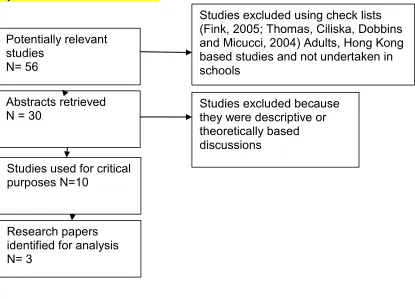
Table 2.2.1 QUORAM flowchart for research literature selection for school improvement and evaluation. ... 38
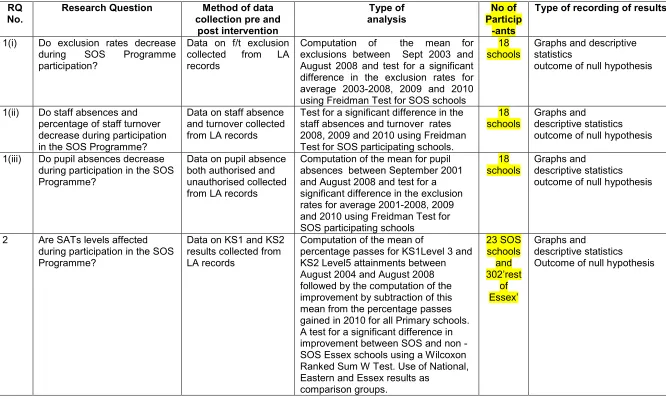
Table 4.5 – Relationship between research questions, method of data collection and type of analysis ... 104
Table 4.6. The pupil profile figures recorded by Essex Local Authority in 2010 ... 107
Table 5.5.1 Descriptive statistics for fixed-term exclusions for schools remaining on the SOS Programme ... 143
Table 5.5.2 Descriptive statistics for pupil authorised absences on the SOS Programme . 146 Table 5.5.3 Descriptive statistics for pupil unauthorised absences ... 148
Table 5.5.4 Descriptive statistics for three data points for Staff absence for three categories of Levels of Participation which are ‘still on Programme’ ... 150
Table 5.5.5 Descriptive statistics for staff turnover for SOS programme participating schools ... 151
Table 5.5.7 Summary of findings ... 152
Table 5.6.1 Scoring mechanism for Goal Attainment Scaling ... 156
Table 5.6.1.1 Results of Goal Attainment by each school ... 157
Table 5.6.2 Descriptive statistics for pupil self-esteem pre and post-Programme participation ... 159
Table 5.6.3. Staff self-esteem descriptive data Pre and post-Programme participation ... 162
Table 5.6.4 Rank Mean ranks for SOS participating schools and the rest of Essex Primary schools for pre and post data points ... 164
Table 5.8 Model of predictors ... 171
Table 7.2 Recap of SOS Programme claims, research questions and research hypotheses. ... 223
Table 7.3.1 Summary of findings ... 230
Table 7.3.2. SOS Claims and outcomes for schools following the Programme as designed ... 232
Table 1.5 (Appendix 2a) The ten principles of the SOS Programme ... 298
Table 3.1 (Appendix 4a). Analysis based on: The Effective Public Health Practice Project Quality Assessment Tool for Quantitative Studies. Thomas, Ciliska, Dobbins, & Micucci (2004) ... 306
Table:3.3a (Appendix 4b) Externalising Behaviour Outcome Results for studies which included young people solely as participants (adapted from Kim 2008) ... 309
Table 3.3b (Appendix 4b) Internalising Behaviour Outcome Results for studies which included young people solely as participants (adapted from Kim 2008) ... 310
Table 3.3.1 SFBT studies in schools 2000-2008 (Kim and Franklin 2009)... 311
Table 2.5.2 (Appendix 4d) Testing the Comprehensive Model of Educational Effectiveness (Creemers 1994); Overview of the methods used in the six reviewed studies by Kyriakides (2008) ... 315
Table 2.5.4 (Appendix 4e) The response scales ... 318
Table 6.4.1. (Appendix 7d) The Ofsted inspection criteria (Ofsted, 2009) which mirror the SOS Programme improvement claims. ... 378
Table 5.6.4 (Appendix 8a) Mann-Whitney results for 2 independent groups ... 380
Table 5.8 (Appendix 8a) Model prediction for staying on the SOS Programme ... 381 Please note all tables (including those in the appendices) are numbered by the
LIST OF FIGURES
Figure 1.3.1: SOS Programme Overview ... 6
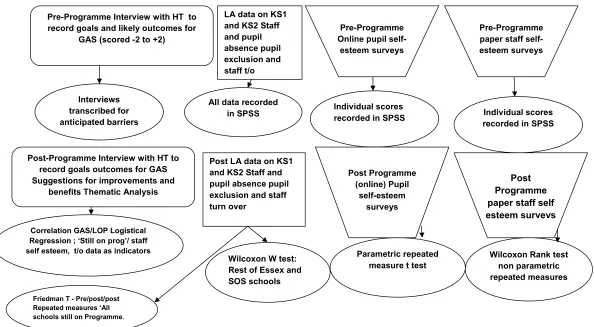
Figure 4.3.4 Data Collection and qualitative and quantitative analyses ... 95
Figure 4.4.1 Criteria measured to indicate success of SOS Programme claims .... 101
Figure 4. 8 An example of Goal Attainment Scaling (Kiresuk, Smith & Cardillo, 1994) ... 113
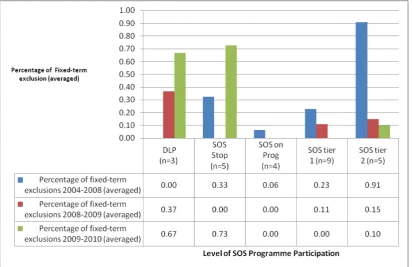
Figure 5.5.1 Fixed-term exclusion Comparison Pre and Post-Programme Intervention ... 143
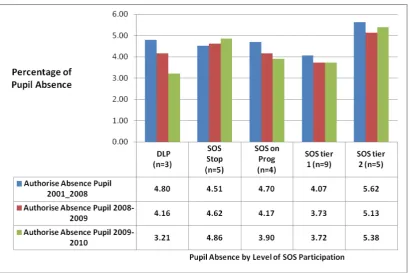
Figure 5.5.2 Pupil Authorised Absences comparison Pre, During and Post SOS Programme Intervention by Level of Particiaption. ... 145
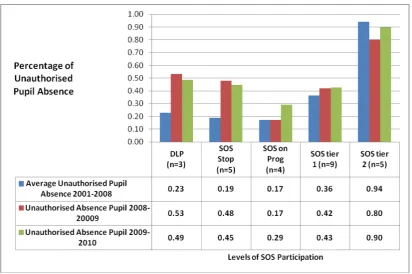
Figure 5.5.3 Pupil Unauthorised Absence by SOS Level of Participation... 147
Figure 5.5.4 Comparison between Staff Full-time Equivalent Absence between 2007- 2010 by Level of SOS Participation ... 149
Figure 5.5.5 Comparison between Full-Time Equivalent Staff Turnover and SOS Level of Participation ... 151
Figure 5.6 2.Box plots showing pre and post pupil self-esteem ... 159
Figure 5.6.2.1 The pupil distribution curve for self-esteem before SOS involvement as measured by the LAWSEQ ... 160
Figure 5.6.2.2 The pupil distribution curve for self-esteem after SOS involvement as measured by the LAWSEQ ... 160
Figure 5.6.3 The distribution of staff self-esteem measures before and after SOS Programme participation ... 162
Figure 5.6.4 Comparison between SOS schools and non-SOS Essex Primary schools KS3 Level 3 percentage gains/losses between 2008 and 2010 ... 164
Figure 5.6.4.1 Comparison between KS1 Level 3 percentage gains/losses between 2008 and 2010 by SOS Level of Participation in SOS Programme ... 165
Figure5.6.4.2 Pupil percentage passes in reading at Key Stage 1 ... 166
a.Reading Level 2B+ ... 166
b.Reading Level 3 ... 166
Figure 5.6.4.3 Key Stage 1 Attainments in reading at Level 2B+ and Level 3 at National and Eastern level ... 166
Figure5.6.4.4 Pupil percentage passes in writing at Key Stage 1 ... 167
a.Writing Level 2B+ ... 167
b.Writing Level 3 ... 167
Figure 5.6.4.5 Key Stage 1 Attainments in writing at Level 2B+ and Level 3 at National and Eastern level ... 167
Figure5.6.4.6 Pupil percentage passes in maths at Key Stage 1 ... 168
a.Maths Level 2B+ ... 168
b.Maths Level 3 ... 168
Figure 5.6.4.7 Key Stage 1 Attainments in maths at Level 2B+ and Level 3 at National and Eastern level ... 168
Figure5.6.4.8 Pupil percentage passes in science at Key Stage 1 ... 169
a.Science Level 2B... 169
b.Science Level 3 ... 169
Figure 6.5. The relationship between the seven core themes and accompanying sub-themes ... 184 Figure 7.3.2.1 Model of school improvement ... 238 Figure 8.1 Key Stage 2 L4+English results for SOS schools by level of participation
and the rest of Essex primary schools ... 382 Figure 8.2 Key Stage L5 English results for SOS schools by level of participation and
the rest of Essex primary schools ... 383
Figure 8.3 Eastern and National levels of Key Stage 2 results for English ... 384
Figure 8.4 Key Stage 2 L4+ Maths results for SOS schools by level of participation and the rest of Essex primary schools ... 385 Figure 8.5 Key Stage L5 Maths results for SOS schools by level of participation and
the rest of Essex primary schools ... 386 Figure 8.6 Eastern and National percentage pass rates for Key Stage 2 Levels 4+
and 5 Maths ... 387
TABLE OF APPENDICES
Appendix 1a: Consent letter to Head teachers ... 281
Appendix 1b: Consent letter for parents ... 284
Appendix 1c: Consent letter to interview school staff ... 287
Appendix 1d: Consent letter for school staff – self-esteem questionnaire ... 293
Appendix 2a: The ten principles of SOS ... 298
Appendix 2b: A selection of skills required by SOS facilitators ... 299
Appendix 2c: SOS tier system ... 300
Appendix 3: Explanation of Key Stage 1 and 2 and SATs procedure ... 303
Appendix 4a: Table of analysed papers in chapters two and three. ... 306
Appendix 4b: Systematic review of the effectiveness of SFBT (Kim 2008) ... 309
Appendix 4c: SFBT studies in schools 2000-2008 (Kim and Franklin 2009) ... 311
Appendix 4d: Overview of the methods used in the six reviewed studies by Kyriakides (2008) ... 315
Appendix 4e: The conceptual use of ZEBO (based on a theory by Weiss 1998) and the instrumental use.(Rossi, Freedman, Lipsey 1999) ... 318
Appendix 4f: Research design deficits for evaluation (Crowley and Hauser 2007) 319 Appendix 5a: LAWSEQ questionnaire... 321
Appendix 5b: Rosenberg Self-Esteem Scale (1965) ... 325
Appendix 6a Interview schedules Pre SOS Programme participation ... 329
Appendix 6b: Interview schedule Post SOS Programme participation ... 331
Appendix 7a: Core themes and sub-themes with codes from which they were generated ... 334
Appendix 7b: Extracts from transcribed interviews/emails mapped on to Core themes and sub-themes ... 343
Appendix 7c: Diagrams of 7 Core themes with sub-themes and codes ... 371
Appendix 7d: Ofsted Inspection Criteria (Ofsted, 2009) ... 378
Appendix 8a: Statistical tables for chapter 5 ... 380
Appendix 8b: Key Stage 2 Level 4+ and Level 5 English and Maths ... 382
Appendix 8c: Research data for SOS schools ... 388
Appendix 8d: Data for Staff self-esteem ... 410
TABLE OF ABBREVIATIONS USED
Abbreviation
Definition
BPS British Psychological Society
CPD Continuing Professional Development
CPP Core Professional Purpose (Mission Statement)
DENI Department of Educational, Northern Ireland
DLP Do not like the SOS Programme
EP Educational Psychologist
ESTYN Office of her Majesty’s Inspectorate for Education and
Training in Wales
FINE PrODUCT Acronym for 10 SOS principles
FTE Full time equivalent
GAS Goal Attainment Scale
HMI Her Majesty’s Inspectorate of Education (Scotland)
HPC Health Professionals Council
HT Head Teacher
HPC Health Professionals Council
ICT Information and Communication Technology
ISERP The International School Effectiveness Research
Project 2002
ISIP The International School Improvement Project 1985
KS1 Key Stage 1
KS2 Key Stage 2
LAWSEQ Lawrence Self-Esteem Questionnaire (1982)
LSA Learning Support Assistant
LOP Levels of Participation
L2B+, L3, L4+ L5 KS1 descriptors of ability, L2B+ (average), L3 (high).
KS2 descriptors of ability L4+ (average) and L5 (high)
MDA Mid-day Assistant
NQT Newly Qualified Teacher
Ofsted The Office for Standards in Education, Children’s
Services and Skills
PDF Portable Document Format
QCA Qualifications and Curriculum Authority
RE Religious education
RQ Research question
SAT Standard Attainment Tests
SEF Self Evaluation Framework
SEN Special Educational Needs
SFBT Solution Focused Brief Therapy
SIP School Improvement Programmes/Partner
SMART Specific, Measurable, Achievable, Relevant and Time
related
SMT Senior Management Team
SO Solution Oriented
SOL Solution Oriented Levels (tiers)
Abbreviation
Definition
SPSS Statistical Package for the Social Sciences
SYCOL The company who owns the copyright of SOS
Tier 1, Tier 2 SOS level1, 2, see Appendix 2
T/O Turnover
UEL University of East London
U K United Kingdom
US United States
CHAPTER ONE: Introduction
1. Overview of the chapter
“It is not the strongest species that survive, nor the most intelligent, but
the ones who are most responsive to change”.
This quote has been attributed to the famous nineteenth century English
naturalist, Charles Darwin, although some such as the Cambridge historian Van
Wyhe (2002) have cast doubts about the provenance of this quote. The claims
about change and survival are particularly applicable to the field of education in
these current times of world recession and budgetary constraints. Research
supports claims about the ability to adapt for change. This is in marked contrast
to the paucity of research for similar claims made by the Solution Oriented
Schools Programme (SOS) which too is concerned with the ability to adapt to
change.
School improvement is a topic which engages governments internationally. The
concept of what constitutes improvement and how it can be measured varies not
only between countries but also across Local Authorities in the United Kingdom.
Some Local Authorities allow schools to choose programmes suited to their
individual needs while others impose schemes upon schools, particularly if they
have failed a formal school inspection. Therefore research which informs the
improvement can provide Local Authorities and educationalists with insights into
what is feasible.
The school improvement programme chosen for evaluation in this research is the
Solution Oriented Schools Programme (SOS). The Solution Oriented School
Improvement Programme was chosen because Essex LA was running the
Programme in several schools and was keen for it to be evaluated. The
researcher used solution focused approaches in her everyday work with
individual children and was intrigued to find out how a whole school staff could
become facilitators of this approach to problem solving. The researcher was also
interested to see whether school staff felt the approach was effective. Therefore
the Solution Oriented Improvement Programme was chosen as a focus for
research into the process of school improvement. The researcher was interested
in the topic of school improvement because she felt Educational Psychologists
had the complex skill set necessary to facilitate school improvement. The
researcher also appreciated how difficult it was to implement systemic changes
in busy organisations where the staff often feel overwhelmed with work and often
lacked the capacity to adopt large-scale changes in practice.
The chapter begins by describing the context of the research within the
international drive for school improvement. A description of the SOS Programme
and the aims of the research and the research questions are stated along with
SOS Programme claims. The distinct contributions of this research to the
educational knowledge on school improvement are discussed. The
epistemological position of the researcher and the importance given to reflexivity
is addressed at some length.
1.1 Context of the study
In the course of her career, the researcher had observed that some schools were
more engaged in the process of change than others. This appeared to be very
dependent on staff and pupil ethos in relation to the school and the motivation to
accept advice. It was this observation which sparked interest in this research
topic. In the light of a plethora of school improvement programmes, the
researcher was interested in explaining whether it was the programme or the
programme implementers that brought about school improvement. In other
words, was it the actual ability to engage in the process which indicates school
improvement as well as the outcomes?
This study was undertaken in the County of Essex. The County covers a very
large geographical area within the United Kingdom, with a mixture of urban and
rural areas and economic and social diversity reflected within its population.
Local authorities regularly set priority targets and in 2008, the Essex Joint Area
Review (Self-Assessment) stipulated the reduction of exclusions as a key priority
improvement programme which encompassed an improvement in pupil well-
being, decreased exclusions and improved attendance was sought by Essex
Schools, Families and Children Directorate to address several priorities at once.
The programme chosen was ‘The Solution Oriented Schools Programme’ (SOS).
All Essex Primary schools were invited to hear about the details of SOS in May
2008. Head teachers were asked to consider applying for a licence for SOS
which would necessitate 3 days of training for designated staff. The funds were
used to train school staff once they had purchased the licence. It was decided
that the SOS Programme would need to be evaluated in terms of its impact for
children in Essex. This presented an opportunity for the researcher to explore
school improvement with support from the Local Authority.
1.2.Origins and genesis of the study
School Improvement has been a UK Governmental priority for all political parties,
and between 1988 and 1997 the UK Government introduced legislation to set
schools up as separate units which were largely self-governing. The School
Inspections Act 1996, set out how inspection was to be undertaken and that the
duty of a registered inspector was to inspect the quality of education provided by
the school and the standards achieved.
The educational standards are measured by assessments undertaken nationally
There are also inspection criteria which encompass how financial resources are
managed as well as the spiritual, moral, social and cultural development of
pupils. Accountability was also, and still is assured through a National
Curriculum and regular inspections by Ofsted (Office for Standards in
Educational, Children’s Services and Skills) with league tables of test and
examination results. Therefore, schools are judged to be successful if these
nationally recognised measures of success are met and exceeded (i.e. Key
Stage results) and these are published each year in league tables (see Appendix
3).
The Education and Inspections Act (2006) established a duty upon schools to
promote the well-being of pupils, and indicators were published as additional
criteria of school inspection. The current process of self-evaluation of schools
plays an important part in inspections and all schools are provided with an
interactive online self-evaluation form (SEF). Therefore, school improvement is
the goal of all schools.
1.3 A description of the SOS Programme and its introduction within a Local Authority
In 2005, Ioan Rees the director of SYCOL1
Ltd. (established 1999) and designer
of the Solution Oriented Schools Programme (copyright 2007) was invited by the
Principal Educational Psychologist of the Local Authority to train all the
The Solution Oriented School Programme provides the framework as set out in
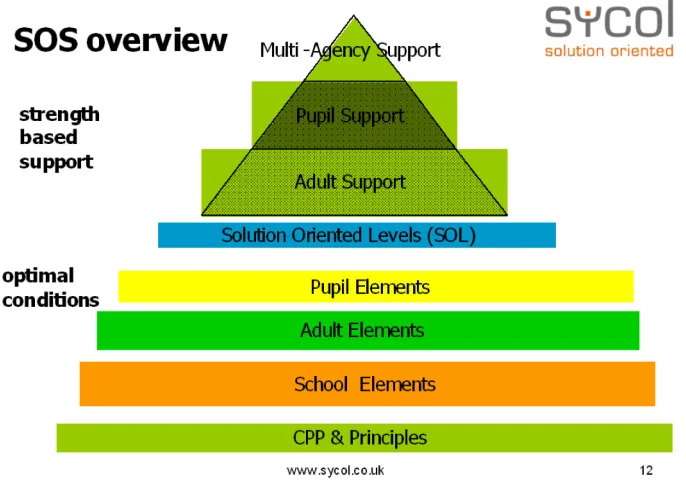
Figure 1.3.1 below. The programme progresses through three tiers over three
years which are described in Appendix 2c
Figure 1.3.1: SOS Programme Overview
The foundation of the ‘pyramid is based on the Core Professional Purpose and
Principles. The next stages describe the optimal conditions and the top layer
illustrates the types of support needed to find solutions to difficulties. These
layers progress from teacher coaching through to a multi-agency approach. SOS
innovation areas which map on to Ofsted inspections were explicitly stated as
being: ‘ethos’, ‘behaviour’,’ teaching’ and ‘leadership’ and therefore schools
which are not solely concerned with improving their academic results would be
A school that chooses to adopt SOS would need to redesign the ‘Mission
Statement’ and call it the ‘Core Professional Purpose’ (CPP). This statement
might include a reference to being a ‘fully inclusive school’. The school would
then need to illustrate the meaning of the CPP by devising the principles which
underpin the statement. These might include a principle of ‘all areas of the
school can be accessed by every pupil’. A school would need to make all staff
aware of the components of the optimal conditions which fall into three
categories. These provide guiding points for all staff so they can ensure these
are occurring within school when the staff are putting their Core Professional
Purpose and operating principles into practice. The second purpose they provide
is that of an auditing tool to monitor current practice and for building on the
strengths, skills and resources within the school. Checklists are provided and
detailed records must be kept.
A model of SOS implementation would involve several stages. The first would be
the presentation and launch of SOS to the governors and parents. The key
message would be the focus on the culture and ethos of the school, the Core
Professional Purpose and operating principles. Then a discussion about the
CPP, principles and optimal conditions with all school staff, Governors and
stakeholders, which would encourage a solution based way of working to reduce
difficulties within school. The CPP and Operating Principles should permeate
through the school and be reflected in all the school systems. The trained
members of school staff. Therefore, ideally the school staff would need to be
made aware of the manual supplied to schools which gives eighteen step by step
guides to formulating the CPP, principles and optimal conditions. The facilitators
plan the implementation of the programme. The SOS school should display the
CPP and principles in the reception area.
The next stage for model implementation of SOS would include the
disseminating of the procedures for bringing difficulties to the attention of the
school managements, and would need to be fully understood by all school staff.
Three stages of intervention are described by the Programme and these take
place sequentially, and at each stage the difficulty and proposed solution are
reviewed. These stages are called SOL1-SOL3.
SOL1-SOL3 incorporates twenty-six steps. These steps at SOL1 level include
the initial request from the teacher for support, filling in a formal request, pupil
competency-profiling and finishing with an action plan. The steps at SOL2 and
SOL3 include a meeting, action plan, interventions and plan review, finishing with
a further plan. The review may indicate the case needs to progress from SOL2
to SOL3. At SOL3 new action plans are formulated and reviewed until the
difficulty is resolved. Schematic diagrams are included at each SOL. For each
SOL there are facilitator checklists and planners and other prompts from which
the facilitator can maintain consistency when using the skill techniques
The model implementation of the SOS Programme would require the use of
strategies to provide ‘Strength based support’. One element of this support
would take the form of teacher to teacher coaching. An SOS school would need
to provide a course of continuing professional development for staff and ideally
given to families. Another technique SO schools would need to roll-out would be
Solution oriented meetings. These are used as a means of looking for solutions
to the expected and unexpected multiple issues that arise within school life. The
meetings follow a structure that begins with voiced concerns and are followed by
the exploration of actions based on the strengths of the participants.
Throughout the three day training of school facilitators, (which preferably includes
at least one member of the Senior Management team), the introduction and
demonstration of key skills (hearing the story, goaling, competency-profiling and
constructive feedback) take place. The SOS facilitators should introduce these
skills to the rest of the school staff. These skills are then rehearsed and are
applied routinely when engaged in the process of adult and pupil coaching, and
solution oriented meetings.
A model of SOS implementation would involve the activities which are advocated
by the Solution Oriented Approach:
• focusing on the core professional purpose and vision
• developing solutions
• running solution orientated meetings
• solution orientated intervention strategies
• coaching techniques
• effective solution oriented multi-disciplinary work
These activities are delivered by SOS Programme schools by using Solution
Oriented Brief Therapy. (SOBT); reflective teams; development of solution
oriented teacher practice; solution oriented classrooms and playgrounds and
working closely with parent partnerships.
SOS schools need to promote the philosophy of the SOS Programme. This is
that the major resource with any school is the staff, and therefore there must be a
focus on staff training. The SOS philosophy suggests that by developing staff
and pupil competencies and skills, schools can utilise these strengths to bring
about positive change for their pupils and for themselves as effective
practitioners. This approach supports staff in identifying their own skills,
strengths and resources, which builds capacity within the school to manage
without resorting to outside agencies.
The supplied materials are comprehensive and describe the Sycol School Tier
System which was devised in order for schools to monitor progress and set new
goals at a pace which they can manage.
The Tier System intends to:
2. Guarantee Solution Oriented School Programme sustainability
3. Provide clear progress targets for the whole school community
4. Provide networking opportunities between SOS schools that are working toward similar targets
5. Guarantee quality control.
In 2009 an updated list of techniques, applications and strategies was supplied
by Sycol which included some further advice with attractive diagrams. These
materials described the Facilitator (F) teams, suggested innovation categories
and system audit and planning sheets.
SOS schools need to make time available to the Facilitator teams. The members
of the teams are volunteers and work autonomously in most SOS schools.
Budgets are set where necessary and given to the Head teacher. In an ideal
scenario the F-teams would meet and decide which areas of the school would
benefit from improvement strategies. These are devised and planned by the
F-teams who review progress regularly. The Programme designers do not
stipulate how this should be achieved but encourage schools to be solution
oriented in order to achieve this requirement. Examples of the innovation areas
included teaching and learning, behaviour, leadership, environment and
well-being. The tier system time frame suggested a time frame of three years to
The researcher’s interest and enthusiasm for Solution Oriented practice began
with this training. The Local Authority implemented the programme in 2007.
Participating schools were selected on the basis of those ‘causing concern’.
However, after one year of SOS, several schools had withdrawn and the
remaining schools were not progressing through the tiered structure of the
Programme. This situation was in stark contrast to the results in Scotland where
the schools had continued with SOS, with external support.
The researcher sought to explore the effect of staff self-esteem as a contributory
factor to the successful completion of the programme. Self-esteem was chosen
as a measure because there is a strong link between self-esteem, stress and
absence from the workplace. Research carried out by Clarke and Cooper (2003)
found teaching to be one of the most stressful jobs in Britain. Adler and
Matthews (1994) consider stress and high self-esteem determinants of mental
health. Wilson (2002) suggested that staff absenteeism is a proxy measure of
stress. Deci (1982) found that when teachers were being more controlling in the
classroom rather than allowing autonomy amongst their students, the students
displayed lowered self-esteem. McCormick (1997) argues that higher stress
perceptions can result in avoidance and withdrawal. Bowers and McIver (2000)
found teachers who believed that their contributions were valued and that the
organisation cared about their well-being tended to be absent less than others.
Baumeister (2011) states that people with high self-esteem are more able to act
operates like a treasury of positive emotions which support a sense of well-being.
This feel good factor can boost confidence and serve as a means of managing
and coping with misfortune. Therefore as esteem is associated with
self-appraisal of motivation and self-efficacy, self-esteem was used as an indicator of
wellbeing both for staff and pupils and as a measure of its impact on attendance
and Programme engagement.
It was decided to obtain a baseline measure of the self-esteem of the school staff
and pupils from the schools who had enrolled on the training programme. The
levels of self-esteem pre and post-programme intervention could then be
compared and also any effects of staff self-esteem on the chosen improvement
criteria outcomes.
1.4 The aims of the research
The main aim of the research was to evaluate the Solution Oriented School
Programme (SOS) in terms of positive outcomes. An additional research aim
was to go beyond that which was already known about the Programme by using
qualitative enquiry (Bryman, 1988). All aims would be accomplished by including
recommendations for improvement or adaptation of the Programme from the
view point of participating schools. Robson (2000) describes this type of
evaluative study as being summative because it is like an end-of-term report.
what it claimed, and what mechanisms drove the process for the resulting
changes.
Successive Governments have used improvement of standard school attainment
results at KS1 and KS2 as an indicator of improvement in learning. Since these
indicators are published, it was decided that these would be a valid criteria to use
for this research.
An extensive literature search revealed thatmorale is a cognitive, emotional and
motivational concept which is usually discussed in terms of groups with a
common purpose. People with low morale tend to see obstacles as potential
chances to fail whereas those with high morale see the same difficulties as
challenges (Ramsey, 2000). Verdugo, Greenberg, Henderson, Uribe and
Schneider, (1997, p 55) state that, “the closer schools come to developing a
community, the greater will be teachers’ job satisfaction”. Hicks (2003) reports
that new teachers often look for a change of direction after three to five years and
experienced teachers with low morale are retiring early or leaving the profession.
In schools, Young (2000) suggested that teacher morale is maintained by role
clarity, recognition, decision making, work load, effective disciplinary policies,
successful students, a coherent curriculum and professional growth
opportunities. They suggest that there must be some existing level of high
morale for group-level interventions to succeed. Self-esteem can be defined as
perception of self-worth or value’ (Leary, 1999a, 1999b; Mruk, 1995; Bednar, Wells & Peterson, 1989). Therefore, the level of esteem is the result of
self-evaluative affective processes. This means that when people perceive that they
are succeeding they feel good about themselves. Deal and Peterson (1999)
suggest terms such as ethos and climate are used interchangeably, but that the
term culture refers most accurately to the school’s unwritten rules, norms and
expectations, and that culture is the foundation upon which day to day school life
is built. Therefore, there is a strong link between culture, ethos, morale and
self-esteem, staff retention and absences.
Self-esteem was chosen as one outward indicator of improved ethos and morale,
and so significant differences pre and post- programme intervention would be
sought. Other pre and post differences selected for investigation were mapped
on to the Programme success criteria and included; staff turnover, pupil and staff
attendance and pupil exclusion rates. Research also suggests that these
contribute to the culture and ethos of the school. (Fullan,1991, 1996; Standaerd,
2000; Reezigt, 2001; Ehren & Visscher, 2008).
The questions in this sequential study are listed above the proposed hypotheses.
The first three questions address the outcomes of the intervention using stated
criteria. The remaining four questions explore the benefits of participating in the
programme as reported by school staff. The claims of the Programme were
criteria were divided into those which should increase or decrease according to
programme claims. The seven research questions (RQ) and accompanying
hypotheses are provided below:
RQ1: Do exclusion rates, staff absence, staff turnover and pupil absences
decrease after SOS Programme participation?
H1 - Schools participating in the SOS Programme will record a significant
decrease in all of the following after one year’s experience:
• Exclusions
• Pupil absenteeism
• reported days lost through staff sickness
• staff turnover
RQ2: Are SATs levels affected after participation in the SOS programme?
RQ3: Does the self-esteem of pupils and staff significantly improve after one
year’s completion of the SOS Programme?
H2 - Schools participating in the SOS Programme will record a significant
increase in all of the following after one year’s experience:
• Academic attainments
• The attainment of all goals set by the Head Teachers which would
contribute to school improvement.
The researcher wished to explore any perceived benefit by school staff from
participation in the SOS Programme. The following research questions were
used to explore this further:
RQ4: What do participating schools want to gain from participation in the SOS
Programme?
RQ5: How successful are the schools in meeting these aims after one year?
RQ6: How could the SOS Programme be improved to increase the range of
benefits to the school?
RQ7: Are there any additional benefits not anticipated at the beginning of the
SOS Programme and how could these be measured?
1.5 Premise of the study
The SOS Programme is not evidence based as there is no published research to
date which validates the claims made by the Programme designers. There is also
no evidence of exploration of the process undertaken by the schools who have
been involved in the Programme.
Research evidence to date shows that the success of improvement
commitment by school staff to the Programme (Reezigt, 2001). Research also
shows that staff members need to feel they are valued and able to cope, in
order to commit to organisational change (Harding, 2004). Adherence to the
SOS Programme requires the solution-oriented philosophy to be adopted by all
staff and this requires training, monitoring and reviewing. SOS requires that
staff work ‘on their school’ and not just ‘in their school’. In order to provide a
visual representation encapsulating the ten core principles of the SOS
Programme, the researcher devised an acronym, FINE PrODUCT (see
Appendix 2a).
Research to date demonstrates that traditional school improvement evaluation
criteria are usually based on academic achievements by pupils. Rutter,
Maughan, Mortimer and Ouston, (1979) suggested that good behaviour and
attendance levels are correlated to academic levels. Therefore, a school
improvement programme which claims to not only improve academic
achievement but pupil attendance levels and behaviour, thereby positively
affecting school staff self-esteem, consistency and attendance, would be valued
by schools which are underperforming in a range of areas. Research which
measured all these factors and compared pre and post-programme intervention
would make a unique contribution to the existing body of literature concerning
school improvement programme outcomes. The claims of the SOS Programme
are wide ranging and the researcher was interested in exploring whether all
contributory factors within differing school contexts. The next section describes
the origins and nature of the SOS Programme.
1.5.1. The origins and nature of Solution Oriented Schools Programme
The SOS Programme is based on theory and research which are recognised in
other models of school improvement. Hopkins (2001) identified principles of
authentic school improvement which included empowering staff through
aspiration, being context specific and being capacity building in nature. SOS
can best be summed up as a strengths-based school improvement programme
which builds on school capacity and inclusive practice. It helps schools to think
about how to develop systems and deliver the vision of the school. The
Programme operates throughout the school facilitated by a small number of
staff who receive in-depth training. It claims to support schools in their
development, particularly when facing challenging situations. It requires agents
to provide clear, coherent and consistent messages that are delivered via a
unified work philosophy. Adopting the Solution Oriented Principles to
administer effective support services to pupils, staff and parents encourages
inclusion, emotional well-being and as a consequence brings about school
improvement.
The programme was developed during 2003 by members of the SOS team at
Moray Council (Bruce, Cavalcante, Mackintosh & Rees), three of whom were
intervention programme to target the types of behaviour in schools which cause
teachers the most concern. The Programme consists of staged interventions,
underpinned by the core principles of Solution Oriented theory. (O’Hanlon &
Weiner-Davis, 1989) and was launched as a pilot in April 2004. Moray Council
consequently promoted the introduction of SOS to seventeen authorities which
they advertised on their website as ‘Innovative Approach for Improving
Educational Attainment and Behaviour’. The following endorsement was
advertised on Moray Council website:
‘The SOS programme has already attracted interest beyond Scotland and the UK among leading educationalists. Professor John Murphy, University
of Central Arkansas, visited Moray recently to learn about the programme
and was impressed by the progress made so far. He commented that the
programme “provides a powerful set of principles and strategies that can
transform schools into places of possibility with vision, compassion and
success for pupils and school personnel alike. The SOS programme
provides user-friendly, step-by-step guidelines for creating respectful and
effective learning environments”. (Moray Council 2004)
A more recent testimonial to the effectiveness of the programme published in the
Times Educational Supplement, noted that:
‘John Paul Academy, in the north of the city, which has seen a 95 per cent
Solution Oriented Schools programme to improve school relations’ (Buie,
2009, p 1).
1.5.2. Content and Claims of the Solution Oriented Schools Programme (SOS
)
The SOS designers describe the Programme as a ‘system and strengths
programme to raise standards across whole schools’. It does this by:
• Improving the quality of learning
• Improving the quality of teaching
• Improving inclusion
• Reducing exclusions
• Improve attendance
• Galvanising staff (capacity building)
• Enhancing wellbeing (pupil and staff)
• Improving relations & ethos
• Improving behaviour (pupil and staff) (Rees, 2005)
The Programme takes the school through three Solution Oriented Levels
(SOL1,2 and 3). Following the SOS three day training of three school staff
members, the SOS Programme needs to be launched because all school staff
and governors need to be made aware of the SOS principles and practices.
The key skills which are taught during the training need to include; ‘pocketing
effective goaling (see Appendix 2b). By using these techniques the focus
should shift from problems to solutions. In addition the positive ethos and
positive learning environment and staff collaborative skills should be enhanced.
This will then support the school with self-evaluation requirements.
The generation of a new Core Professional Purpose (CPP) with accompanying
operating principles underpinning the CPP requires contributions from school
staff. Therefore the approach and status of Continuing Professional
Development (CPD) affects the ability of staff to lead school improvement
(Ofsted, 2006; Bubb & Earley, 2009). Caprara, Barbaranelli, Borgogni, Steca
and Malone (2006) suggest that teachers' self-efficacy beliefs play a pivotal role
in their commitment to school and therefore their satisfaction with their
employment.
The next part of the SOS Programme is for the SOS facilitators to form
‘F-Teams’ to work on the school to contribute to the provision of optimal conditions (i.e. the prevention of potential difficulties by creating systems for
providing strength based support for staff and pupils). Solution Oriented
meeting format is recommended and goals are set and their success monitored
using the principle ‘if it works do more of it’. The SOS manual takes the schools
through a series of check lists (see Appendix 2c) after which Level certificates
1.6 Distinctive Contribution and Relevance to Professional Practice
To date no substantive research has been undertaken to identify the claims of
the Programme in terms of significant changes to rates of exclusion and
absences (staff and pupils), academic achievements or self-esteem of pupils and
staff. The Local Authority commissioned this research in order to explore
whether there had been measurable school improvement after one year of
Programme participation. Interviews revealed other positive benefits of
Programme participation which were not officially recorded by schools or the
individual indicators schools set for improvement. Patterns of responses and
themes would assist with informing future participants and help them to decide
whether to invest in the Programme. The implications of the findings for
educational psychology practice will be that understanding the SOS Programme
in its current or modified form, could provide a valuable contribution to the nature
of school capacity building both locally and nationally. The research would
identify refinements to the Programme which could prolong the duration of
successful involvement, and enhance the existing identified improvements in
schools by broadening the range of these benefits.
Recent research into ‘school improvement/development’ has used academic
attainment as the outcome measure (Creemers, 1994; Creemers & Kyriakides,
2006; Kyriakides & Creemers, 2008). A limitation of using academic
achievement in England as an outcome measure, is that it is too narrow a
effectiveness of schools. Some school improvement research has highlighted
the effect of culture on school improvement which is defined as:
" The set of shared meanings, collective norms and views on interaction
and collaboration. As such, culture is considered of great importance in
providing the normative glue that holds the organisation together”.
(Scheerens & Bosker,1997, p 17)
The SOS programme delivers a set of shared meanings by suggesting that
school staff collectively promote a ‘vision’ which is stated in their ‘Core
Professional Purpose’. This is clarified by the use of operating principles and the
creation of systems which produce the ‘vision’ which should be reflected
throughout the school and delivered by pupils, staff and governors. Other school
improvement programmes have been reviewed but no published evaluation has
been located which includes first hand reports on the process of change, or the
effect of staff self-esteem on school improvement criteria.
Ofsted inspection requirements include the assessment of emotional well-being
and this has therefore acquired great importance in schools within England.
Wales, Northern Ireland and Scotland have completely different systems which
will not be discussed. However, their inspection systems ESTYN, DENI and HMI
are accessible online. Psychological research suggests that when people are
organisational changes can only occur effectively if key members of staff are
included in the decision making process which gives them a sense of ownership
(Schein, 1999). Motivation and resilience are both key to school morale. There
is no published evaluation of the SOS Programme but there are a number of
endorsements published by the designers of SOS and Moray Council in the SOS
Programme manual suggesting the programme is successful in its aims.
“Ioan Rees and his colleagues have created a practical and empowering
program in S.O.S. It is both simple to implement and profound in its effects
on schools. There is a wave that is washing over education towards
collaboration, accountability and competence. S.O.S. provides a clear way
to get out in front of the wave and become a leader and model in the
educational field”.
(O’Hanlon, 2009, p1)
However, this research sought to include opinions which may suggest limitations
and improvements to the programme. This study investigated the view that by
increasing staff self-esteem it is more likely that effective systems can be
developed within schools and improvement can be sustained through the
systems which become less reliant on personalities. Before change, learning
needs to take place and so it is also useful to look at organisational change
theories. Morgan (1998) uses several metaphors in order to describe different
This image uses an evolutionary approach which is useful because it
emphasises the need for organisations to adapt and survive in a changing
environment. Since learning needs to take place before change, the SOS staff
training programme encompassesorganisational change theories.
In summary, the main contribution of this research was to substantiate the claims
made by the designers of the SOS programme by measuring and comparing a
range of measures before and after Programme participation. In addition, views
of staff were elicited about the benefits and drawbacks of Programme
involvement. This would assist with providing some insights into Programme
improvement and the necessary factors to bring about Programme completion.
All these aspects will contribute further to the field of school improvement
effectiveness. The next section addresses the epistemological basis of this
study.
1.7 Epistemological position
Realism is the ontological position which postulates that realities exist outside of
the mind. Reality for the purpose of this research takes two forms; that which
can be measured and that which has an individual meaning. The researcher
took the view that reality of school improvement can also be constructed and
guided by the language used, and based on human perception to describe it.
Thus the subjective opinions of participants were collected and their goals were
interpretation of subjective data was deemed to be of equal importance to
measured data and would add a rich dimension giving this research a unique and
relevant contribution. The research took the philosophical position of critical
realism using a mixed methods approach.
This epistemological position does not rely on cause and effect but instead tries
to understand ongoing processes that have a relationship which is not
necessarily falsifiable. Critical realists believe that there are many mechanisms
which take place unperceived, or are not activated at a particular time, and that
not being able to observe them through the senses does not mean they do not
exist. Critical realism works on the premise that the human world needs to be
studied using different methods from studying the physical world. It is the nature
of the human world to change more rapidly and frequently than the physical
world. This epistemology does not rely on discrete independent variables to
cause the same change in dependent variables. The critical realist approach
takes the view that any changes after an intervention are worth documenting.
Critical realism allows for human agency which with the ability to reflect, can
change actions and may depend on certain social structures being in place.
Using a mixed method design allowed the adoption of a critical realist
epistemology with assumptions and different forms of data collection and
analysis. The theoretical underpinnings of the study draw upon theories about
(Kyriakides & Creemers, 2008) and espousing the solution oriented model
(O’Hanlon & Weiner-Davis, 1989). The view adopted in this study was that the
theoretical framework and methods matched what the researcher wanted to
know and that these were the most important decisions.
1.8 Reflexive thinking
Reflexive thinking refers to the process of analysing thoughts or actions and
making judgements about what has already happened. Reflexive thinking is an
active process that takes into account the researcher’s own perceptions and
possible biases and prejudices, and tries to address these when conducting
research. This process is vital when collecting data and reporting on its
interpretation. Reflexive thinking was required throughout the research process
when it was necessary to understand what was already known and to decide
what was still required to be learned. At every stage of the design a reflective
approach was necessary.
Studying the social world is complex. Information changes and reflexive thinking
allow the researcher to alter direction in response to these changes and
problem-solve in a different way. ‘Rethinking’ a strategy to get to an accurate
interpretation of interview data can enable the researcher to continue even when
data collected was not as predicted. Reflexive thinking is sometimes known as
‘meta cognition’ (knowing what one knows) which is a ‘higher-order’ thinking skill.
contextualise their own opinions. It was necessary to put these aside in order to
get to the essence of the meaning of the situation to the participants, rather than
foist a meaning on to the data. Morgan (1997) suggested that reflective
researchers invest time and consider many alternatives, working through the
problems that present systematically, in contrast to searching for immediate
answers.
When formulating the semi-structured interview questions, it was important not to
use leading questions which reflected the researcher’s own expectations.
Questions were not value-laden and accurately addressed the requirements of
the research questions. In order to be reflexive during the semi-structured
interviews, a reflective log was kept in which notes about personal bias and
expectation from respondents were recorded. Headings suggested by Silverman
(2005) formed an integral part of the study from the design stage to the
discussion.
Silverman (2005) suggests keeping a research diary so the researcher can
remain reflective throughout the research process. The first of the six headings
suggested contained the research activities and dates. This was detailed in the
research proposal and updated at each annual review undertaken by the
research committee of the graduate school during the duration of the research. It
was important to keep to the time span envisaged and plan around important
time each month to allow for other unforeseen events. The researcher’s previous
experience of research led to setting timescales that were realistic. The
researcher found it helpful to have a list of priorities each month and to substitute
the second for the first on the list when deadlines could not be met due the
schedules of others involved in the research.
Another heading used to support a reflective approach was related to the
selection and appraisal of the literature. A table was created with the name of
the resource and its location and date. Notes were made about the main tenets
of the argument and the reflections of the researcher. These reflections included
personal views about the trustworthiness of the findings and whether the general
approach by the author was in agreement or at odds with the experiences of the
researcher. These notes revealed many assumptions made by the researcher
and these were also used to support a reflexive approach. This stage of
reflection guided the literature which was chosen for the literature review. The
researcher learned a great deal about herself as a researcher and a great deal
about the complexities of school improvement.
‘Reflections on data collection’ was another heading suggested by Silverman
and used to support a reflexive approach. The researcher reflected on the
meaning of ‘exclusions’ and whether these were useful data measures. Different
schools would have different thresholds for exclusion and some schools might
that these figures were in the public domain and the SOS Programme did not
provide caveats when making the claims. Other reflections included whether
staff data should be included in the analysis. However, strict confidentiality was
felt to be important in anonymising information provided by staff so as not to be
identified by the school. The researcher had to reflect on how to protect against
‘Demand Characteristics’ (Orne 1962) where participants guess what the
purpose of the task may be. There was also the ‘experimenter effect’ (Rosenthal
1966) where participants might choose a response rather than give their own.
Reflections on the possible effects and measures to counteract these led to the
use of ‘Survey Monkey’ and short questionnaires. Other reflexive approaches
involved choosing of presentation style and not ‘power dressing’. These
reflections were about how the process of research can shape the outcomes,
particularly for the schools. The researcher also reflected on her role as an EP
and her previous experience of SOS training and how that might bias her
approach or alter the way the schools responded to her continued interest in
them.
In order to carry out thematic analysis on the interview data it was important to
reflect on personal interpretation of the language used by the interviewee and not
to substitute the researcher’s own thoughts. Consideration was given to how
personal experiences, such as the researcher’s professional, personal and