A Comparison of the Use of Pyrolysis Oils in Diesel Engine
C. Wongkhorsub, N. Chindaprasert
Department of Mechanical Engineering, Faculty of Engineering, Rajamangala University of Technology Phra Nakhon, Bangkok, Thailand
Email: [email protected], [email protected]
Received March, 2013
ABSTRACT
Creating a sustainable energy and environment, alternative energy is needed to be developed instead of using fossil fu-els. This research describe a comparison of the use of pyrolysis oils which are the tire pyrolysis oil, plastic pyrolysis oil and diesel oil in the assessment of engine performance, and feasibility analysis. Pyrolysis oils from waste tire and waste plastic are studied to apply with one cylinder multipurpose agriculture diesel engine. It is found that without engine modification, the tire pyrolysis offers better engine performance whereas the heating value of the plastic pyrolysis oil is higher. The plastic pyrolysis oil could improve performance by modifying engine. The economic analysis shows that the pyrolysis oil is able to replace diesel in terms of engine performance and energy output if the price of pyrolysis oil is not greater than 85% of diesel oil.
Keywords: Pyrolysis; Pyrolysis Oil; Engine Performance; Feasibility Study
1. Introduction
Due to the fossil fuel crisis in past decade, mankind has to focus on developing the alternate energy sources such as biomass, hydropower, geothermal energy, wind en-ergy, solar enen-ergy, and nuclear energy. The developing of alternative-fuel technologies are investigated to de-liver the replacement of fossil fuel. The focused tech-nologies are bio-ethanol, bio-diesel lipid derived biofuel, waste oil recycling, pyrolysis, gasification, dimethyl ether, and biogas [1]. On the other hand, appropriate waste management strategy is another important aspect of sustainable development since waste problem is con-cerned in every city.
The waste to energy technology is investigated to process the potential materials in waste which are plastic, biomass and rubber tire to be oil. Pyrolysis process be-comes an option of waste-to-energy technology to deliver bio-fuel to replace fossil fuel. Waste plastic and waste tire are investigated in this research as they are the available technology. The advantage of the pyrolysis process is its ability to handle unsort and dirty plastic. The pre-treatment of the material is easy. Tire is needed to be shredded while plastic is needed to be sorted and dried. Pyrolysis is also no toxic or environmental harmful emission unlike incineration [2].
The tire pyrolysis oil and plastic pyrolysis oil have been investigated and found that they both are able to run in diesel engine and the fuel properties of the oils are comparable to diesel oil [3,4]. Both pyrolysis oils are a
complex mixture of C5-C20 organic compounds. The tire pyrolysis oil contains a great proportion of aromatics and up to 1.4% sulfur content whereas the plastic pyrolysis oil is able to occur high chlorine content if the plastic is unsorted [5,6]. The assessment in terms of chemical process, production and feasibility study of both pyroly-sis oils are done in previous researches [7-9]. There is no research about the use of the oil in terms of cost analysis and potential of fossil fuel replacement.
This research describes a comparison of the use of py-rolysis oils which are the tire pypy-rolysis oil and plastic pyrolysis oil in the assessment of engine performance, environmental impact, and feasibility analysis. The oils are researched and applied with DI Diesel engine. The sensitivity analysis of the oil price subjected to the oil performance is also distinguished in the research. The oil characteristic and financial data are studied from a com-mercial plastic pyrolysis and a comcom-mercial tire pyrolysis plant in Thailand.
2. Pyrolysis Oil
waste plastics are collected from scavenger, MSW sort-ing plant, and landfill area. The weakness of the plastic is the character of the plastic, which is mainly from plastic bag, is small high impurity and bulky. Soring and clean-ing is required for plastic process. However, as the pur-pose of the process is turning waste to energy, the pyro-lysis process of tire and plastic is distinguished and compared in this research. Physical and chemical analy-sis properties of both oils are studied and compared in order to ensure to usage of the oil in diesel engine.
2.1. Plastic Pyrolysis Oil
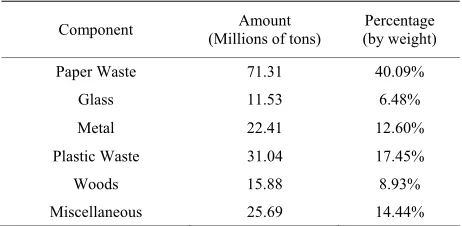
In the USA, plastic waste approximately 31 million of tons was generated in 2010 which is about 17.45% of total waste by weight as shown in Table 1 [10]. The
percentage of the plastic waste is also similar in Thailand and around the world. As known that plastic is a non- degradable petroleum based product. The old landfill area is found that degradable product is composted, be-come soil while plastic is still exist. This problem is solved by converting waste plastic to energy by pyrolysis process.
[image:2.595.56.287.621.734.2]As the petroleum based plastic is the polymeric mate-rial, the plastic pyrolysis process is the thermal de-po- lymerization process in the absence of oxygen which is able to convert plastic into gasoline-range hydrocarbons [11]. The waste plastic used in pyrolysis process is needed to be sorted and cleaned. The Polyethylene (PE) and Polypropylene (PP) which are the main component of the plastic in municipal solid waste are used in the process in order to prevent the contamination of chlorine in the oil [6]. The classified waste plastic is processed from an autoclave pyrolysis reactor. In general, product yields from pyrolysis are varied with temperature. The plastic pyrolysis oil used in this research is processed at 300-500°C at atmospheric pressure for 3 hours. The product output consists of 60-80% pyrolysis oil, 5-10% residue and the rest is pyrolysis gas on weight basis. The plastic pyrolysis oil used in this research is processed from a commercial waste plastic pyrolysis plant in Thai-land.
Table 1. Contents of municipal solid waste in the USA year 2010.
Component (Millions of tons) Amount (by weight) Percentage
Paper Waste 71.31 40.09%
Glass 11.53 6.48%
Metal 22.41 12.60%
Plastic Waste 31.04 17.45%
Woods 15.88 8.93%
Miscellaneous 25.69 14.44%
2.2. Tire Pyrolysis Oil
In the USA, about 303.2 million of waste tires were dis-carded in year 2007, while about 60 million of waste tires in Thailand year 2011. Not to mention about the cumula-tive waste tire in landfill, the problem of tire disposal will be increasing gradually due to the expanding of vehicle market. The tire pyrolysis process converts waste tires into potentially recyclable materials such as flammable gas, pyrolysis oil and carbon black [12]. Although the amount of waste tire is less than the waste plastic, the option of the waste tire conversion is limited.
Tire pyrolysis oil plant has been established around the world in order to produce the substitute liquid fuel for heating purpose as found that the tire pyrolysis oil have a high gross calorific value (GCV) of around 41-44 MJ/kg [13]. Waste tire is needed to be shredded before process. The desulphurization is required in the pyrolysis system to eliminate the sulfur. It was determined that the oil production yield of tire pyrolysis process has a maximum at 350°C and decomposes rapidly above 400°C [13]. The plastic pyrolysis oil used in this research is processed at 300-500°C at atmospheric pressure for 3 hours. The tire pyrolysis oil used in this research is processed from a commercial waste tire pyrolysis plant in Thailand. The product output consists of 35% pyrolysis oil, 56% resi-due and the rest is pyrolysis gas on weight basis. The amount of the residue is tire wire scrap and carbon black.
2.3. Characteristic of Pyrolysis Oil
Pyrolysis is a complex series of chemical and thermal reactions to decompose or depolymerize organic material under oxygen-free conditions. The products of pyrolysis include oils, gases and char. The pyrolysis oil products in this research are from tire and plastic which are dissimi-lar in physical properties and chemical properties. The appearance of the tire pyrolysis oil is thick-liquid and dark colour oil whereas the appearance of the plastic py-rolysis oil is grease oil liked and dark colour oil at 30°C (room temperature). They all strong smell due to the high aromatic substance.
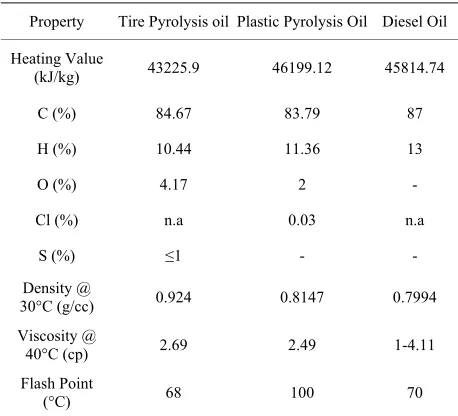
As the comparison usage of this research is in diesel engine, the pyrolysis oil from process is a mixture of carbon composition which are C5-C20 in tire pyrolysis oil and C10-C30 in plastic pyrolysis oil. The oil requires dis-tillation process to differentiate the diesel-like oil from other compounds. The distillation temperature applied in this research is 180°C. The substance that evaporates before 180°C is taken out. The remaining is analyzed and tested in one cylinder multipurpose agriculture diesel engine. The properties comparison of plastic oil, tire oil and diesel oil is analyzed as shown in Table 2.
(carbon, hydrogen, nitrogen and sulfur content) are ana-lyzed by a CHNS Elementary Analyzer. The chlorine content of PVC was determined by improved oxygen bomb combustion – ion chromatography method which is based on the standard method in ASTM D 4208-02. The heating value of all the samples was measured using bomb calorimeter.
The heating value and the flash point of plastic pyro-lysis oil is the highest while the other properties are comparable. As the plastic pyrolysis oil is wax form in room temperature, the oil requires pre-heating process before input to diesel engine.
3. Engine Performance Analysis
Engine performance indicates the effects of a fuel in the engine. It shows the trend and possibility of using pyro-lysis oil to replace diesel oil without any engine modifi-cation. It is necessary to determine break torque (T),
en-gine break power (P), break specific fuel consumption
(bsfc), and break thermal efficiency ( th). These several parameters can be obtained by measuring air and fuel consumption, torque and speed of the engine, and heating value of the oil. The performance parameters can be cal-culated by equations as followed [14].
3.1. Break Torque
Torque is an indicator of the function of break torque calculated by the moment of engine arm connected to weight scale as:
T Fd (1)
where T is break torque in Nm, F is force of engine arm
applied to the load in N, and d is the distance of engine
[image:3.595.57.286.528.736.2]arm from center of the rotor to the load.
Table 2. Properties of pyrolysis oil.
Property Tire Pyrolysis oil Plastic Pyrolysis Oil Diesel Oil
Heating Value
(kJ/kg) 43225.9 46199.12 45814.74
C (%) 84.67 83.79 87
H (%) 10.44 11.36 13
O (%) 4.17 2 -
Cl (%) n.a 0.03 n.a
S (%) ≤1 - -
Density @
30°C (g/cc) 0.924 0.8147 0.7994
Viscosity @
40°C (cp) 2.69 2.49 1-4.11
Flash Point
(°C) 68 100 70
3.2. Engine Break Power
Engine break power (P) is delivered by engine and
ab-sorbed load. It is the product of torque and angular en-gine speed where P is engine break power in kW, N is
angular speed of the engine in rpm as: 2
60 1000
NT P
(2)
3.3. Break Specific Fuel Consumption
Break specific fuel consumption (bsfc) is the comparison of engine to show the efficiency of the engine against with fuel consumption of the engine in g/kW-hr where mf is the fuel consumption rate in g/hr as:
mf bsfc
P
(3)
3.4. Break Thermal Efficiency
The percentage of break thermal efficiency of the engine (th) is related to engine break power (P) and the total energy input to the engine which is QLHV lower heating value of fuel in kJ/kg applied to the fuel consumption rate as:
1000
100 3600
P
th m Q
LHV f
(4)
3.5. Experimental Detail
The characteristics of an engine used this experiment which is a multi-purpose agricultural direct injection di-esel engine (Kubota ET-70) are shown in Table 3.
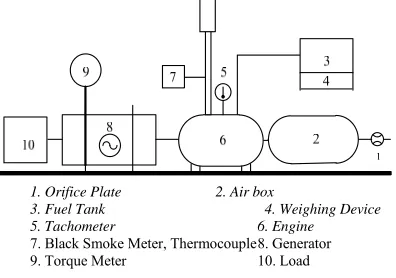
Schematic of the experimental set up is shown in
Fig-ure 1. The engine equipped with measuring elements
[image:3.595.315.532.615.737.2]including weighing device, manometer, orifice plate, tachometer, thermocouple and black smoke meter at the exhaust. As the experiment was run in constant speed, the torque output from the experiment is measured by the breaking force absorbed by the load. The absorbed load is maximum 7 kW. The pure distilled plastic pyrolysis oil,
Table 3. Engine specification.
Engine Specification Kubota ET70
Bore X Stroke 78 mm. X 84 mm.
Swept Volume /Cylinder 401 cc.
Compression Ratio 23.5:1
Max.Torque @1800 rpm 22.56 Nm
Max. Output, HP/rpm 7 (5.15)/2200
distilled tire pyrolysis oil and diesel oil were tested in this experiment.
The experiments were conducted by starting engine with the blended testing fuel. The operating conditions were set at a rated engine speed 1500 rpm. Loads were applied from 500 W and stepped up until reached the maximum load. The air box and orifice plate flow meter are applied for air flow measurement. Fuel consumption is measured from the differential of the fuel in time. A chromel-alumel thermocouple was installed to measure the exhaust gas temperature. The engine was run for 5 minutes to reach the steady state of test condition before collecting data. At the end of the test, the engine was run with diesel fuel for sometime to flush out from the en-gine.
1. Orifice Plate 2. Air box
3. Fuel Tank 4. Weighing Device 5. Tachometer 6. Engine
[image:4.595.311.537.88.225.2]7. Black Smoke Meter, Thermocouple 8. Generator 9. Torque Meter 10. Load
Figure 1. Schematic of the experimental setup.
3.6. Engine Performance Result
The experimental result of the engine performance shows the opportunity of using pyrolysis oil in diesel engine. The variation of the break thermal efficiency with the break power shows that the trend of thermal efficiency performance of the tire pyrolysis oil and plastic pyrolysis oil are comparable to diesel oil. The tire pyrolysis oil offers higher efficiency in the medium load while the plastic pyrolysis offers slightly lower efficiency. The maximum load production from plastic pyrolysis oil is the lowest which is 3,064 W where as the tire pyrolysis oil produces 3,282 W and diesel produces 3,500 W as shown in Figure 2. The trend lines of the plastic
pyroly-sis oil and diesel oil are similar in linear line unlike the tire pyrolysis oil which is in parabolic curve.
It shows that the tire pyrolysis oil consists of aromatics and complex compound which reflected in high effi-ciency in the medium load. The variation of the break specific fuel consumption with the break power in
Fig-ure 3 is also shown that both of the pyrolysis oil is
ap-plicable to use in diesel engine. The plastic pyrolysis oil offer the lowest break specific fuel consumption at 294 g/kW-hr with maximum break power at 3,064 W. As diesel engine is designated to apply with diesel oil, some
0 5 10 15 20 25 30 35
500 1000 1500 2000 2500 3000 3500 4000 Diesel Tire Oil Plastic Oil
Figure 2. The variation of the break thermal efficiency with the break power.
250 270 290 310 330 350 370 390 410 430 450
[image:4.595.312.536.270.395.2]500 1000 1500 2000 2500 3000 3500 4000 Diesel Tire Oil Plastic Oil
Figure 3. The variation of the break specific fuel consump-tion with the break power.
properties in tire pyrolysis and plastic pyrolysis such as density and viscosity might cause the less efficiency and the limitation in combustion condition.
The engine exhaust gas temperature for plastic pyroly-sis oil varies from 120℃ at low load to 225℃ at full load where in case of tire pyrolysis oil varies from 119℃ at low load to 295℃ at full load and in case of diesel oil varies from 119℃ at low load to 312℃ at full load. The experiment shows the combustion of diesel oil deliver higher heating rate due to the ignition delay condition. However, the performance of the use of plastic pyrolysis oil could be enhanced by modifying the injection timing of the engine [15].
[image:4.595.75.273.279.418.2]4. Economic Analysis
Comparison of the use of two types of pyrolysis oils are cannot be completed if the economic analysis concerning the cost and sensitivity. Fuel costs are estimated regard-ing the information from pyrolysis plant in Thailand. The currency unit used in this research is in Thai Baht.
4.1. Fuel Production Cost Analysis
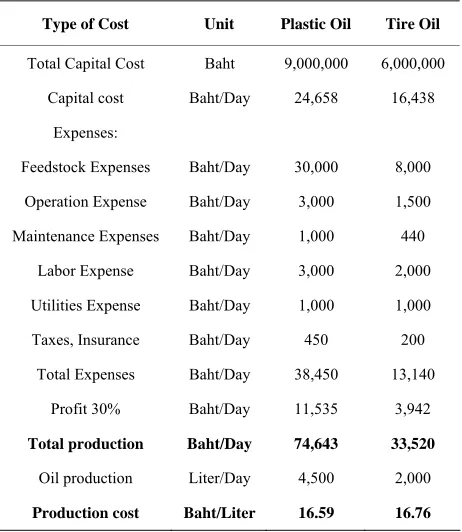
The investment and expenses of these two pyrolysis plants are concerned and analyzed to estimate the pro-duction cost of respectively oil as shown in Table 4.
Though the core technology of each plant is similar, the characteristics of feedstock and product are slightly dif-ferent. It is assumed that the feedstock input is 6 tons per day. Plastic used is waste plastic from landfill site and tire used is collected from garages.
Sorting system of plastic pyrolysis plant carry out higher capital cost and feedstock expense but in return, the amount of oil production is higher. The tire pyrolysis plant require only shredding process but in return, it produce less amount of oil compare to the same amount of feedstock as the tire contains tire wire and high carbon residue. The cost of plastic oil is slightly lower than tire oil due to the production amount.
4.2. Energy Cost and Sensitivity Analysis
[image:5.595.56.287.468.734.2]The fuel cost analysis is done under financial assumption which is not concerning about efficiency output of oil.
Table 4. Pyrolysis oils cost estimation.
Type of Cost Unit Plastic Oil Tire Oil
Total Capital Cost Baht 9,000,000 6,000,000
Capital cost Baht/Day 24,658 16,438
Expenses:
Feedstock Expenses Baht/Day 30,000 8,000
Operation Expense Baht/Day 3,000 1,500
Maintenance Expenses Baht/Day 1,000 440
Labor Expense Baht/Day 3,000 2,000
Utilities Expense Baht/Day 1,000 1,000
Taxes, Insurance Baht/Day 450 200
Total Expenses Baht/Day 38,450 13,140
Profit 30% Baht/Day 11,535 3,942
Total production Baht/Day 74,643 33,520
Oil production Liter/Day 4,500 2,000
Production cost Baht/Liter 16.59 16.76
The cost might not applicable to all situations as the en-gine performance result shows the diverse of efficiency. Therefore, the indicator that is applicable to all situations to predict the use of oil in terms of economic analysis should be energy cost consumption per power output as:
PO
E
PO
bsfc
Cost
(5)
where E is the cost of energy consumption per power output in Baht/kW-hr, PO is the density of calculating oil. Equation (6) shows the cost of energy compared regard-ing to the efficiency.
The energy consumption cost indicates that the use of both tire pyrolysis oil and plastic pyrolysis oil is eco-nomically comparable to diesel oil. Though the engine performance is lower, the cost of fuel is significantly lower as shown in Figure 4.
However, the sensitivity analysis of the fuel cost is done and it is found that the both pyrolysis oil is suitable to use as diesel replacement in terms of engine perform-ance and economic analysis as long as the price of pyro-lysis is less than 85% of diesel oil price.
5. Conclusions
The use of plastic pyrolysis oil and tire pyrolysis oil in diesel engine in the aspect of technical and economical is compared and found that both of the oils are able to re-place the diesel oil.
Though the plastic pyrolysis oil offers lower engine performance, the plastic waste amount is enormous and it needed to be process to reduce the environmental prob-lems. Moreover, the engine can be modify follow the combustion condition of plastic pyrolysis oil. The waste plastic used in the process must be PE or PP in order to protect the contamination of chlorine in the oil.
Tire pyrolysis offers comparable efficiency to diesel oil in medium to high load but it has been question on the desulfurization process. Therefore, the development of the tire pyrolysis oil is depending on the cost of desulfu-rization process. Although the tire pyrolysis oil offer
0 2 4 6 8 10 12 14
500 1000 1500 2000 2500 3000 3500 4000 Diesel Tire Oil Plastic Oil
[image:5.595.308.535.587.707.2]better quality than plastic pyrolysis oil, the amount of waste tire is minimal compare to plastic waste and the oil production is less. Additionally, by product of the tire pyrolysis plant carbon residue and tire wire from waste tire, the plant entrepreneur need to find an opportunity to process these by products due to the amount of the by product is correspondent to the oil product.
Turning waste to energy is not only financial profit-able but it also environmental friendly business which the government should offer a strong policy to encourage the entrepreneur to invest in the waste to energy busi-ness.
6. Acknowledgements
The authors would like to acknowledge a tire pyrolysis plant and a plastic pyrolysis plant to sponsor us the oils. The authors are also grateful for the laboratory support of Energy Technology Department, Thailand Institute of Scientific and Technological Research. The research was conducted by researchers in the pyrolysis research group, in support of Rajamangala University of Technology Phra Nakhon.
REFERENCES
[1] D. Rutz, and R. Janssen, “Biofuel Technology Hand-book,” WIP Renewable Energies, 2007.
[2] J. Scheirs and W. Kaminsky, “Feedstock Recycling and Pyrolysis of Waste Plastics: Converting Waste Plastics into Diesel and Other Fuels,” John Wiley & Sons Ltd., Chichester, 2006. doi:10.1002/0470021543
[3] S. Murugan, M. C. Ramaswamy and G. Narajan, “Per-formance, Emission and Combustion Studies of a DI Di-esel Engine Using Distilled Tyre Pyrolysis Oil-DiDi-esel Blends,” Fuel Processing Technology, Vol. 89, 2008, pp. 152-159.doi:10.1016/j.fuproc.2007.08.005
[4] M. Mani and G. Nagarajan, “Influence of Injection Tim-ing on Performance, Emission and Combustion Charac-teristics of a DI Diesel Engine running on Waste Plastic Oil,” Energy, Vol. 34, 2009, pp. 1617-1623.
doi:10.1016/j.energy.2009.07.010
[5] M. Mani, C. Subash and G. Nagarajan, “Performance, Emission and Combustion Characteristics of a DI Diesel Engine Using Waste Plastic Oil,” Applied Thermal
Engi-neering, Vol. 29, 2009, pp. 2738-2744.
doi:10.1016/j.applthermaleng.2009.01.007
[6] A. Demirbas, “Pyrolysis of Municipal Plastic Wastes for
Recovery of Gasoline-Range Hydrocarbons,” Journal of
Analytical and Applied Pyrolysis, Vol. 72, 2004, pp.
97-102.doi:10.1016/j.jaap.2004.03.001
[7] J. G. Rogers and J. G. Brammer, “Estimation of the Pro-duction Cost of Fast Pyrolysis Bio-Oil,” Biomass and
Bioenergy, Vol. 36, 2012, pp.208-217.
doi:10.1016/j.biombioe.2011.10.028
[8] R. W. J. Westerhout, M. P. Van Koningbruggen, A. G. J. Van Der Ham, J. A. M. Kuipers and W. P. M. Van Swaaij, “Techno-Economic Evaluation of High Temperature Py-rolysis Processesfor Mixed Plastic Waste,” Trans IChemE,
Vol. 76, Part A, March 1998, pp. 427-439.
[9] M. R. Islam, M. U. H. Joardder, S. M. Hasan, K. Takai and H. Haniu, “Feasibility Study of Thermal Treatment of Solid Tire Wastes in Bangladesh by Using Pyrolysis Technology,” Waste Management, Vol. 31, 2011, pp.
2142-2149.doi:10.1016/j.wasman.2011.04.017
[10] U.S.EPA: Municipal Solid Waste Generation, Recycling, and Disposal in the United States Tables and Figures for 2010, http://www.epa.gov/osw/nonhaz/municipal/pubs/ 2010_MSW_Tables_and_Figures_508.pdf,Accessed January 2013.
[11] E. A. Williams and P. T. Williams, “Analysis of Products Derived from the Fast Pyrolysis of Plastic Waste,”
Jour-nal of AJour-nalytical and Applied Pyrolysis, Vol. 40-41, 1997,
pp. 347-363.doi:10.1016/S0165-2370(97)00048-X [12] Miltner, W. Wukovits, T. Pröll and A. Friedl,
“Renew-able Hydrogen Production: A Technical Evaluation Based on Process Simulation,” Journal of Cleaner Production,
Vol. 18, 2010, pp. 551-562. doi:10.1016/j.jclepro.2010.05.024
[13] Y. M. Chang, “On Pyrolysis of Waste Tire: Degradation Rate and Product Yields,” Resources, Conservation and
Recycling, Vol. 17, 1996, pp.125-139.
doi:10.1016/0921-3449(96)01059-2
[14] O. Arpa, R. Yumrutas and Z. Argunhan, “Experimental Investigation of the Effects of Diesel-like Fuel Obtained from Waste Lubrication Oil on Engine Performance and Exhaust Emission,” Fuel Process Technology, Vol. 91,
2010, pp.1241-1249.doi:10.1016/j.fuproc.2010.04.004 [15] M. Mani, G. Nagarajan and S. Sampath, “Characterisation
and Effect of Using Waste Plastic Oil and Diesel Fuel Blends in Compression Ignition Engine,” Energy, Vol. 36,
2011, pp. 212-219.
[16] Isabel de Marco Rodriquez, M. F. Laresgoiti, M. A. Ca-brero, A. Torres, M. J. Chomon and B. Caballero, “Pyro-lysis of Scrap Tyres,” Fuel Processing Technology, Vol.