Methods for large-scale Microbiome
Analysis using MEGAN
Dissertation
der Mathematisch-Naturwissenschaftlichen Fakult¨at der Eberhard Karls Universit¨at T¨ubingen
zur Erlangung des Grades eines Doktors der Naturwissenschaften
(Dr. rer. nat.) vorgelegt von Dipl.-Inform (Bioinformatik) HANS-JOACHIM RUSCHEWEYH aus Dettelbach T¨ubingen 2014
2
Gedruckt mit Genehmigung der Mathematisch-Naturwissenschaftlichen Fakult¨at der Eberhard Karls Universit¨at T¨ubingen.
Tag der m¨undlichen Qualifikation: 22.10.2014
Dekan: Prof. Dr. Wolfgang Rosenstiel
1. Berichterstatter Prof. Dr. Daniel Huson
i
Abstract
The capability of next generation sequencers of emitting enormous volumes of data at a moderate cost has changed the field of sequence based research areas, such as metagenomics or studies estimating microbial diversity by using the 16S rRNA gene. While early studies investigated relatively small samples in isolation, cur-rent studies effectively target questions that require deeper sequencing of a larger number of samples. As a consequence of this development it becomes increasingly difficult to perform the computational component of the analysis on a desktop computer. As a matter of fact, even if the computationally intensive parts are outsourced to a more powerful environment, users still face datasets outgrowing the size of their home computers.
This development disagrees with the policy of MEGAN - a widely accepted, powerful and user-friendly tool for metagenomics - to perform qualitative
anal-ysis on local data files. To overcome this limitation, we developed
MEGAN-Server. MEGANServer allows bioinformaticians to retain data files on a server with sufficient resources. Furthermore, we extended MEGAN to communicate with MEGANServer and by that enable researchers to perform their analysis on
a home computer regardless the actual data size. Moreover, to overcome the
complexity introduced by the growing number of samples, selection of datasets of interest is automated by metadata-based grouping. In addition, following the analysis strategy of the 16S rRNA studies, datasets can be opened applying dif-ferent strategies, for instance as merged data, in order to provide a deeper insight on taxonomic and/or functional distribution.
Furthermore, and as a consequence of a development in which metagenomics and 16S rRNA studies are converging, we extended MEGAN to also deal with sequences that stem from a targeted approach. More precisely, we have developed a pipeline that covers the entire workflow, starting from pre-processing and, in a final step, allowing qualitative analysis using MEGAN. For that, we took ad-vantage of a novel aligner, namely MALT, that in combination with a placement algorithm, namely the Majority Vote LCA, introduced recently in MEGAN, is not only capable of assigning more than 99% of reads to the correct genus, but lowers the rate of false positives to a value close to 0%.
ii
We believe that, by the additional utilization of the different data access strate-gies implemented in MEGANServer, MEGAN in combination with MALT and the Majority Vote algorithm is now fully capable of serving as a powerful, yet user-friendly analysis tool for 16S rRNA sequencing data.
Acknowledgements
My first and foremost gratitude goes to my supervisor Prof. Dr. Daniel Huson, for accepting me as a member of his group, for the constant support and for giving me the freedom to explore. Using this freedom with all its facets was, at first, challenging but in retrospective I can say that this was probably the most valuable lesson you taught me.
I also extend my thanks to my collaborators Prof. Dr. Julia-Stefanie Frick, Prof. Dr. Barbara Stecher and Isabell Flade for the chance to take part in your exciting projects. Thank you for helping me with all the biology-related questions and for the discussions we had.
I also acknowledge the Bildungsministerium f¨ur Bildung und Forschung for the funding.
The time at the office is most valuable if shared with great people. I was really lucky to be part of a fun and stimulating environment here at the Algorithms in Bioinformatics group. Of my colleagues one person most certainly stands out. Cuong, thank you for the past two years and all the discussions we had. I wish you all the best for your future.
I’m also grateful to all my friends from T¨ubingen, Volkach and all around the world. You are probably not aware of this but each of you has contributed with a small fraction to my work.
But most of all I have to thank my family. Thank you for believing in me and all the encouragement and support throughout the years.
iv
In accordance with the standard scientific protocol, I will use the personal pronoun we to indicate the reader and the writer, or my scientific collaborators and myself.
Contents
1 Introduction 2
I
Sequencing and Sequence Analysis
4
2 Next Generation Sequencing 6
3 Metagenomics & 16S rRNA Analysis 9
3.1 Introduction . . . 9
3.2 Sampling . . . 10
3.3 Analysis Goals . . . 11
3.4 Computational Aspects . . . 12
II
Software for Metagenomic Analysis
15
4 MEGAN 17 4.1 Introduction . . . 17 4.2 Data Structures . . . 18 4.2.1 Header . . . 18 4.2.2 Read . . . 20 4.2.3 Match . . . 20 4.3 Use Cases . . . 20 4.3.1 Taxonomic Overview . . . 21 4.3.2 Inspector . . . 23 4.3.3 (Re)calculation of Classifications . . . 25 4.3.4 Alignment Viewer . . . 25 4.4 Conclusion . . . 26 vCONTENTS vi
5 MEGANServer 28
5.1 Introduction . . . 28
5.2 Ideas & Goals . . . 29
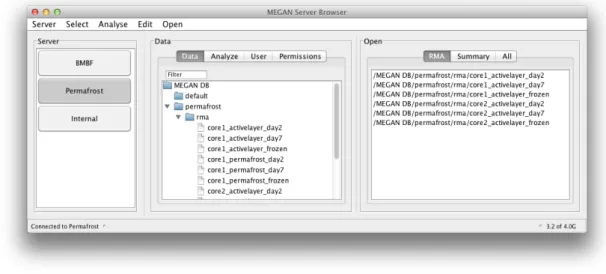
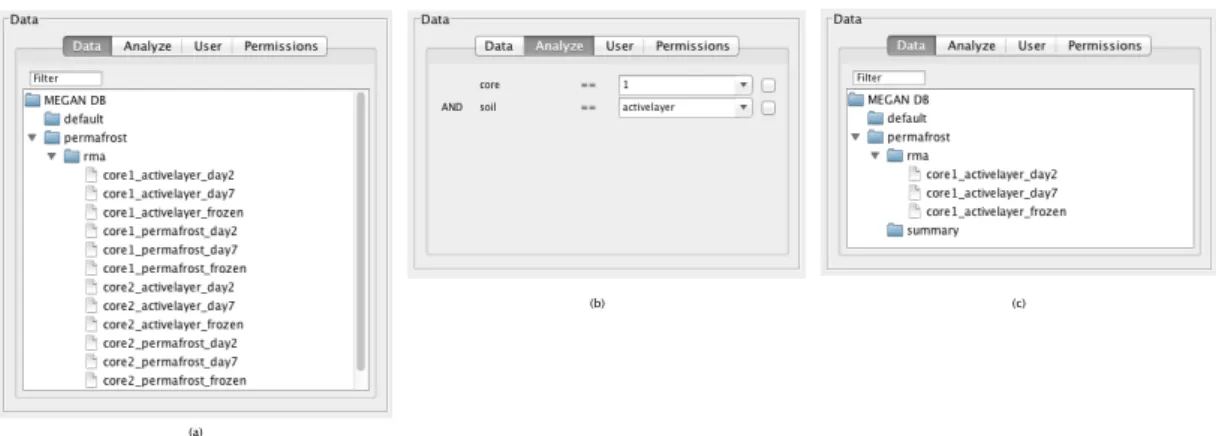
5.3 Planning Phase . . . 31 5.3.1 Requirements . . . 31 5.3.2 Specification . . . 32 5.4 Design . . . 38 5.5 Using MEGANServer . . . 42 5.5.1 Uploading . . . 42 5.5.2 ServerBrowser . . . 44
5.6 Big Data - Challenging Software Design . . . 48
5.7 Conclusion . . . 49
III
MEGAN for Targeted Sequencing
50
6 16S rRNA Pre-processing 52 7 16S rRNA Analysis using MEGAN 58 7.1 Introduction . . . 587.2 Material & Methods . . . 60
7.2.1 Input Data & Databases . . . 60
7.2.2 Taxonomical Classification of the Full-Length Reference Sequences 61 7.2.3 Inferring the Correct Taxonomic Distribution . . . 61
7.2.4 Taxonomical Classification of the Trimmed Reference Database . . 64
7.2.5 Taxonomic Identity of Reference Sequences . . . 66
7.2.6 Alignment of Sequencing Data against Silva . . . 66
7.2.7 Alignment of Dereplicated Sequences . . . 66
7.2.8 Comparing LCA against Majority Vote LCA . . . 67
7.2.9 β-Diversity using QIIME and MEGAN . . . 67
7.3 Results & Discussion . . . 70
7.3.1 Not Under-representation but False Positives influence Taxonomic Analysis using Alignments . . . 70
7.3.2 Deriving “true” Taxonomic Distribution: Alignment of 454-Sequences against the Reference Database . . . 71
CONTENTS vii
7.3.3 Taxonomic Assignment using MALT and MEGAN - Accurate and
Free of False Positives . . . 74
7.3.4 Alignment of 16S rRNA Sequences - Semi-Global Outperforms Local and Global . . . 78
7.3.5 Accurately estimating β-Diversity using MEGAN . . . 79
7.3.6 Computational and Algorithmic Challenges of 16S rRNA Analysis 81 7.4 Conclusion . . . 82
IV
Building Blocks, Falling into Place
84
8 Accurate Analysis of a Large-Scale 16S rRNA Project Using MEGAN and MEGANServer 86 8.1 Introduction . . . 868.2 Study Background . . . 87
8.3 Experimental Setup & Sequencing Data . . . 88
8.4 16S rRNA Analysis Pipeline . . . 88
8.5 MEGANServer for 16S rRNA analysis . . . 90
8.6 Conclusion . . . 93
V
Conclusion
94
VI
Appendix
97
A Contributions 98 B Publications 99 B.1 Publications . . . 99 B.2 Publications in Preparation . . . 99 C Supplements 100 C.1 16S rRNA Analysis using MEGAN . . . 100C.1.1 Material & Methods Flowchart . . . 100
C.1.2 Taxonomic Assignment of Full-Length Reference Sequences . . . . 102
C.1.3 Taxonomic Assignment of Trimmed Reference Sequences . . . 106
CONTENTS 1
Chapter 1
Introduction
MEGAN is a widely accepted, powerful and user-friendly tool which allows users to perform metagenomic analysis even on a home computer. First released in 2007 [Huson et al., 2007] in order to facilitate taxonomic analysis of ancient mammoth bones [Poinar et al., 2006], it is now available in its fifth version [Huson, 2014b]. In the past years, the function pool was continuously expanded, so much so that the latest version not only supports taxonomical but also functional analysis using the SEED [Overbeek et al., 2005], KEGG [Kanehisa and Goto, 2000] and COG [Muller et al., 2010] classifications [Mitra et al., 2011a]. Furthermore, and as a result of the rapid development of sequencing technologies, reflected in plummeting prices and growing number of emitted sequences, one can determine a change in the study layout. While early metagenomic studies investigated single samples in isolation, in recent studies the focus is on collecting greater number of samples in order to identify differences or similarities among their taxonomic of functional distribution. To cope with the need of researchers, MEGAN introduced functions that support several comparison strategies [Mitra et al., 2010; Huson et al., 2009; Mitra et al., 2009].
The possibility to generate more and larger samples allows researchers to investigate metagenomic datasets at a previously inaccessible depth, but also lead to data sizes which outgrow the capacity of desktop computers of the researchers. For example, an average sized study of 12 permafrost soil samples (see [Mackelprang et al., 2011]) includes 250 million reads and requires, after alignment, 165GB of disk space. As a consequence of the growing sizes sharing of datasets with colleagues also becomes increasingly cumber-some. In order to allow researchers to perform their analysis, regardless the data sizes, on a desktop computer using MEGAN, in this thesis we present MEGANServer. With
CHAPTER 1. INTRODUCTION 3
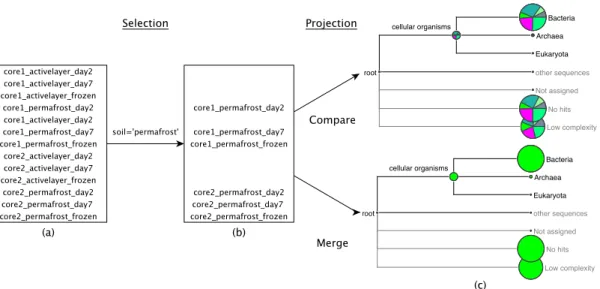
MEGANServer one outsources the storage of metagenomic datasets to a different com-puter and accesses their content via MEGAN. Furthermore, driven by the accumulated fashion in which datasets are stored on MEGANServer, we will introduce new functions to MEGAN. This includes the extensive usage of metadata to identify datasets of in-terest, and using boolean expressions and different strategies to open datasets such as merging, splitting or extracting. The development of MEGANServer is covered in Part II.
Besides the study of metagenomics, MEGAN can also be used for studies that assess microbial diversity by analyzing sequences originating from the bacterial 16S rRNA gene [Mitra et al., 2011b, 2013]. The importance of supporting both study types is underlined by the fact that ever since the Human Microbiome Project both fields are converging. As a result, not only MEGAN but other tools that were initially developed for one field extended their workflows to bundle both analysis types (see MG-RAST and QIIME [Meyer et al., 2008; QIIME, 2014]) in one analysis framework.
In this thesis we will adopt the idea of Mitra et al. [2011b] of using MEGAN for visual analysis of 16S rRNA data. However, we will develop a new pipeline that covers the entire analysis process. For that undertaking, we first describe a routine for pre-processing of sequencing data in Chapter 6. Then we introduce a novel approach of accurate taxonomic placement using alignment in Chapter 7.
Additionally, and due to the nature of studies performed on sequences originating from the 16S rRNA gene which often lead to large numbers of samples, we will show in Part IV how analysis of 16S rRNA samples can profit from the accumulated fashion in which datasets are stored on MEGANServer.
Before we discuss the development of MEGANServer, we will present some back-ground information on next generation sequencing as well as introduce the field of metagenomics in Part I.
Part I
Sequencing and Sequence
Analysis
5
Sequencing and sequence analysis are the backbone for any metagenomic or 16S rRNA study. In this chapter we will briefly discuss sequencing technologies as well as introduce the goals behind metagenomics and 16S rRNA studies.
Chapter 2
Next Generation Sequencing
The advent of next generation sequencing (NGS) led to progress in metagenomics and other previously sequencing independent fields. Contrary to automated Sanger se-quencers, the dropping prices and the enormous volumes of data generated by NGS sequencers allow researchers to address questions that quantitatively assess the impact of bacterial communities in terms of diversity and functional content.
The term next generation sequencing is intrinsically tied to pyrosequencing, a tech-nique using bioluminescence to detect nucleotide incorporation during DNA synthesis. This methodology dates back to 1986 [Walker et al., 2007; Nyr´en, 2001; Ronaghi et al., 1998] and was taken up in 2005 [Margulies et al., 2005] marking a milestone for massive parallel sequencing techniques. This approach was then made commercially available by 454 Life Sciences. A concept that also takes advantage of the emission of light as a signal for nucleotide incorporation is based on reversible dye-terminators and was made commercially available in 2004 by Solexa [Bennett, 2004] (today Illumina).
Even though Illumina and 454 are both based on a similar concept, their techniques and the results of sequencing vastly differ. As a consequence, Illumina is capable of emitting large volumes of short sequences1 and is therefore the first choice for metage-nomic studies. A 454 run, on the other hand, produces only a fraction of that data but outperforms Illumina in terms of quality and length. As a consequence, 454 sequencers are the first choice for amplicon sequencing.
Because later chapters will present in detail the pre-processing and an analysis pipeline exclusively designed for data emitted by 454 sequencers, in the following we
1Illumina announced the 1 Terabase run for this year. For further information, see
http: //www.illumina.com/products/hiseq-sbs-kit-v4.ilmn
CHAPTER 2. NEXT GENERATION SEQUENCING 7
would like to briefly summarize the methodology and work-flow preceding the actual sequencing.
Emulsion PCR As a sequencing-by-synthesis platform, 454 depends on a measurable light signal as a result of a nucleotide being incorporated. Since single fluorescence events remain undetected by the imaging system used, amplification of templates is required. To do so, 454 employs the emPCR [Mardis, 2008; Dressman et al., 2003] technique. First, a single template sequence is ligated to a bead. The bead is subsequently enclosed in an emulsion, and the amplification of the template sequence can be conducted, resulting in a loaded bead with approximately ten million identical sequences [Sciences, 2014]. This process is performed for the entire library in parallel, resulting in ∼1-1.6 million loaded beads2.
Loading the PicoTiterPlateTM The loaded beads are placed on a PicoTiterPlate.
The plate contains 1.6 million wells, which are designed in such a way that exactly one bead fits in a single well.
Sequencing & Imaging Besides the beads, each well is equipped with the necessary reagents for synthesis, except for the nucleotides. They are not added because they would interfere with the synchronous fashion of incorporating one specific nucleotide and measuring the signal sequencing process. The method of sequencing is separated in 800-1,000 flows, where at each flow a new nucleotide is added to the PicoTiterPlate. Some of these nucleotides are incorporated; the unbound ones are washed away. Incorporated nucleotides trigger a biochemical process resulting in emission of light. The intensity of the light signal is stronger if, in a homopolymeric region, several nucleotides are incorporated during a single flow.
Errors It is known that homopolymeric regions increase the strength of the emitted signal in a linear fashion only when 6 or less nucleotides are incorporated [Margulies et al., 2005; Balzer et al., 2010]. Therefore, longer homopolymeric stretches would introduce an accuracy bias. Nevertheless, the main source of error is introduced as a side effect of the emPCR. The synthesis among identical sequences attached to a single bead loses its synchrony with increasing read length, influencing light signals and results in uncertain base-calls. This leads to a drop of accuracy at ∼400bp [Margulies et al., 2005]. To
CHAPTER 2. NEXT GENERATION SEQUENCING 8
overcome this bias, by the end of 2013, Roche introduced an improved flow cycle, with the goal to further extend sequence length.
Chapter 3
Metagenomics & 16S rRNA
Analysis
3.1
Introduction
Microbes are essential to all life. Microbes on and inside our body outnumber the number of cells we have [Berg, 1996]. Besides covering all that is living, microbes also cover the entire surface of the earth as well [Whitman et al., 1998]. Microbes, even though found everywhere, are highly specialized to the environmental factors of their ecological niche [Xie et al., 2011]. While microbes inhabiting the surface of deep-sea vents are fueled by sulfur oxidation [Sievert et al., 2008], microbes living in the human gut take a different role, express different genes and react differently to changes in the environment [Arumugam et al., 2011; Ley et al., 2006; Qin et al., 2010]. What all microbes have in common is a relatively tight relationship with their environment, other microbes and, for example, in the human gut, with the human host [Peterson et al., 2009].
The field of traditional genomics is dependent on the ability to isolate a single organ-ism, and to culture such an organism in the absence of other microbes. This approach may conflicts and eventually presents a problem when considering the tight environmen-tal relationship these microbes need to survive. Most microbes will not grow in isolation [Rapp´e and Giovannoni, 2003] and, therefore, their genomic content is not accessible. Quantitatively, this means, that more than 99% of microbes cannot be cultured with current methods and stay beyond the reach of traditional genomic research. Nowadays, the endeavors in research address not onlytruebiodiversity, but also interaction patterns
CHAPTER 3. METAGENOMICS & 16S RRNA ANALYSIS 10
between microbes - issues which cannot be fully answered by genomics.
Metagenomics, on the other hand, explores the genomic content of an entire microbial community. Being culture independent, metagenomics enables one to grasp some of the 99% of the microbes not being covered by genomics, resulting in findings of new genes and species. For instance, one of the first large-scale metagenomics studies, conducted by the Global Ocean Survey, led to finding six million genes. New protein families were detected at a linear rate [Yooseph et al., 2007], implying that a deeper sequencing would have lead to discovery of many more new families.
Another aspect of metagenomics is to unravel community dynamics at various levels. For example, during the Human Microbiome Project, metagenomic samples have been taken from 242 individuals from 15 different body sites to find a link between our health and the microbiome. One of the findings of theHuman Microbiome Projectindicates that there is no single human microbiome at the taxonomic level. However, at functional level similarities across individuals were found [The Human Microbiome Project Consortium, 2012b].
Therefore, the aim of metagenomics is to study uncultured organisms in order to draw conclusions about the true diversity of microbial communities, and to explore their functional potential, their inter-community cooperation and their reaction to induced environmental change.
The study of microbial diversity using the 16S rRNA gene follows, for the most part, the same principles as metagenomics and attempts to answer similar questions. In contrary to metagenomics, for which sequences originate from the entire genome, for this approach, sequences only from the 16S rRNA gene are sequenced and used for downstream analysis. Consequently, 16S rRNA analysis is generally considered to be the first choice for taxonomic analysis, and, due to the lower costs, also used in studies where the functional content is not of interest.
In this chapter we will describe the analysis of both study types from three view-points. First, we will discuss typical sources of samples. Secondly, we will describe analysis goals of both fields. Finally, we will elaborate on computational aspects of analysis.
3.2
Sampling
Considering the spread of microbial life, an extensive number of different sources of samples are investigated in current studies. In order to find answers to a diverse set of
CHAPTER 3. METAGENOMICS & 16S RRNA ANALYSIS 11
questions such as the role of microbiota in carbon fixation in permafrost [Mackelprang et al., 2011], discovery of efficient biofuels [Hess et al., 2011], unraveling the evolutional development of pathogens [Schuenemann et al., 2013], or the role of the human micro-biome in disease development [The Human Micromicro-biome Project Consortium, 2012a], a great diversity of samples - soil, water, ancient bones, extreme environments - in combi-nation with medical models, are studied.
However, the first step in all these studies is the retrieval of a single or a number of samples from a particular environment. This step is followed by the extraction of DNA. Subsequently, one of the sequencing methods, predominantly Illumina for metagenomics and 454 for 16S rRNA, is applied. The resulting sequences serve as input for downstream analysis.
Metadata Collection While early studies performed metagenomics or 16S rRNA studies on single or small number of samples, there is now an increasing number of projects that involve multiple samples collected systematically [Turnbaugh et al., 2007]. Moreover, greater attention is being paid to the general problem of recording relevant environmental parameters (so-called metadata). The importance of metadata is under-lined by the fact that the Genomics Standards Consortium (GSC) was established in 2005 and published a minimal set of metadata (MiMS, MiGS, MIMARKS) to be collected for every experiment [Yilmaz et al., 2011]. Today, all major resources for metagenomic studies and data have implementations to store metadata compliant with the conditions of the GSC1.
However, from a researcher’s point of view, the main objective of metadata collection is the enhanced analysis potential, especially in studies that aim at comparing a larger number of samples. As a result one can correlate taxonomic and functional properties such as abundance shifts between datasets with environmental factors.
3.3
Analysis Goals
Despite the variety of problems addressed by metagenomics and 16S rRNA studies, and the differences between samples, one can condense their analysis goals to three questions. 1A positive side effect of metadata collection is to store datasets of former studies in a reusable
CHAPTER 3. METAGENOMICS & 16S RRNA ANALYSIS 12
Who is out there? For the most part and with regard to the DNA extraction from a whole community, the microbial diversity in a sample is unknown. Thus, the first task is to quantitatively identify all species present in a sample.
What are they doing? The Human Microbiome Project concluded that, even though individuals’ microbiota significantly differs at the taxonomic level, the func-tional content seems to be stable. Hence, the second question addresses the funcfunc-tional content of a sample. Due to the nature of targeted sequencing in 16S rRNA studies, this question can only be answered by metagenomics.
How do they compare? Studies, in particular those with a medical background, are not designed to observe samples in isolation. Instead, the focus is to identify differences on the taxonomic and functional level in samples retrieved from, for example, both experimental and control groups.
3.4
Computational Aspects
The advances in sequencing and thus the growing read counts in datasets lead to a variety of strategies and computational approaches to tackle the three analysis goals. Despite algorithmic differences, the intention is to find the correct taxonomic and functional identity for every read. To do so, most methods use a database guided approach, taking advantage of publicly available databases such as NCBI-NR or NCBI-NT [Benson et al., 2006] or REFSEQ [Pruitt et al., 2007] for metagenomics and Silva [Yilmaz et al., 2013] or Greengenes [McDonald et al., 2012] for 16S rRNA studies.
The main idea on which most methods are based is defined as follows: two sequences that share a common ancestor will be more similar when compared to an alignment of two sequences that do not share common ancestry. Therefore, tools usually compare reads against a reference database to find thebest possible match. To keep in pace with the continuously growing datasets as well as reference databases it is computationally not feasible to search for theoptimal match. For this reason, new algorithms apply different steps to lower the computation time. BLAST [Altschul et al., 1990], the gold stan-dard for pairwise alignment for more than a decade, for example, applies a pre-filtering step to consecutively perform an alignment on the pre-filtered reference sequences only. Modern techniques such as Bowtie2 [Langmead and Salzberg, 2012] take advantage of the Burrows Wheeler Transformation. The transformation supports fast identification
CHAPTER 3. METAGENOMICS & 16S RRNA ANALYSIS 13
of high identity matches. Hence, these methods improve runtime significantly but lack sensitivity2. An alternative approach takes advantage of machine learning techniques to detect species specific patterns such as GC-content or k-mer frequencies. Two imple-mentations that fall in the machine learning category are the Naive Bayesian Classifier [Rosen et al., 2011] for metagenomics data and the RDP classifier [Wang et al., 2007] for 16S rRNA data. Both methods perform reasonably fast but lack specificity. For example, the RDP classifier fails to assign reads to the species level. To overcome the setbacks of BLAST and NBC, namely runtime and accuracy, Nico Weber proposed a hybrid approach [Weber, 2013]. Since the performance of BLAST partly depends on the size of the reference database, it is possible to use NBC to assign reads to phylum level and consecutively run BLAST on the smaller reference databases in parallel.
At the time BLAST was developed, the limiting factor was, even though reference databases were considerably small, the main memory. Therefore, one of the main goals was to develop software that would minimize the memory footprint. Surprisingly, even though in the following years the memory prices dropped, alignment software developers still paid too much attention to minimizing the memory footprint and thereby, artifi-cially lowered the performance of their tools in terms of speed and/or accuracy3. In combination with spaced-seeds techniques and using a reduced alphabet, modern map-ping algorithms such as PAUDA [Huson and Xie, 2014], DIAMOND [Buchfink et al., 2014], MALT [Huson, 2014a] and to some extent Rapsearch2 [Zhao et al., 2012] perform at a reasonable speed combined with high accuracy.
In combination with tools, such as MEGAN [Huson et al., 2011], which are capable of extracting significant information from the results of the methods introduced above, one can identify the taxonomical and functional content and, thereby, find answers for the first two analysis goals.
The third question, on the other hand, is concerned with the problem of detect-ing differences between samples. Dependdetect-ing on the task, possible approaches include comparing the abundances of taxonomic and functional content (MEGAN) or apply-ing phylogenetic methods to create principal component analysis (MEGAN, R packages such as ade4 [Dray and Dufour, 2007] or vegan [Dixon, 2003]). A relatively new method, LEfSE [Segata et al., 2011], applies statistical tests in combination with metadata on the taxonomic or functional content of a number of datasets determining the taxa or
2Bowtie2 can be tweaked to be more sensitive. The runtime will increase accordingly. 3The alignment problem can be described an tradeoff between accuracy, runtime and memory
CHAPTER 3. METAGENOMICS & 16S RRNA ANALYSIS 14
Part II
Software for Metagenomic
Analysis
16
This part focusses on the design ideas and implementation of MEGANServer. MEGANServer is a web application created with the purpose to store, analyze, filter and manage datasets used by the metagenomic analysis tool MEGAN. To do so, we first introduce MEGAN and the features important to MEGANServer and run through use cases. The use cases impact and drive the design process for the MEGANServer software. Finally, we discuss the implementation and how to use MEGANServer for metagenomic data.
Chapter 4
MEGAN
In this chapter we will briefly introduce MEGAN. We will walk through use cases in order to derive data access patterns. These help to design the MEGANServer software.
4.1
Introduction
MEGAN, short for MEtaGenome ANalyzer, is software developed to provide answers to the three metagenomic questions: Who is out there? What are they doing? and How do they compare? The first version of MEGAN, initially developed to analyze DNA from an ancient mammoth bone [Poinar et al., 2006], was released in 2007 [Huson et al., 2007] and is now available in its fifth version [Huson, 2014b]. MEGAN is devel-oped with the intention of providing an user-friendly stand-alone tool for metagenomics, metaproteomics, metatransscriptomics and up to some degree, also targeted sequencing analysis.
To do so MEGAN supports four classifications, namely NCBI Taxonomy [Federhen, 2012], SEED [Overbeek et al., 2005], KEGG [Kanehisa and Goto, 2000] and COG [Muller et al., 2010]. MEGAN uses precomputed alignments from e.g. a SAM file, BLAST output or a CSV file to map reads to nodes of a classification tree. This information is used to grasp the taxonomical and functional potential of a metagenomic dataset. Furthermore and concerning the third metagenomic question, additional features of MEGAN support comparison between datasets either with regard to abundances within classifications or by applying β-Diversity measures. To provide these features MEGAN currently stores dataset specific information in a binary file, namely read-match-archive (RMA).
In this chapter we introduce MEGAN from the data access perspective with the
CHAPTER 4. MEGAN 18
goal to identify access patterns which help to design the MEGANServer software. The RMA file, as the current data backend, is reviewed in Section 4.2. The focus is to derive important information such as to distinguish static from dynamic data or to discover interactions between internal data structures. We then discuss common use cases in order to infer data access patterns.
4.2
Data Structures
The quality of software design depends significantly on the knowledge about data objects and the connections among them. In this section we introduce the main data structures of MEGAN.
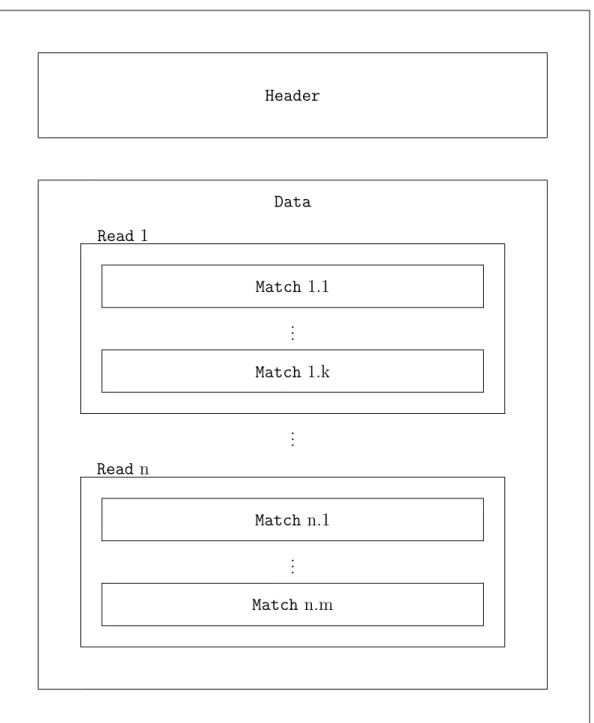
The backbone of a metagenomic dataset is built up from a set of sequences and an associated set of alignments. In a step performed prior to analysis, MEGAN scans the content of every alignment with the intention of identifying correlated taxa and genes. All data extracted from a single alignment forms a match. A read incorporates a number of associated matches and taxonomical as well as functional identifiers. Besides reads and matches the third data structure is the header. It contains a variety of additional information such as metadata and global information about the dataset. Figure 4.1 depicts a sketch of the main data structures and their relations with each other.
4.2.1
Header
The header section embodies all information which is not directly associated to a match or a read. Its main task is to store global information such as the name of the dataset, the number of reads, the number of matches and store the metadata. Additionally, data concerning visualization, such as which nodes are visible and which are collapsed is included. The content of a header is highly dynamic1, so that subsets change continu-ously. There is exactly one header per dataset and the size is limited to a few kilobytes. Therefore, the impact of any modification to this data object on the performance, is negligible.
1The content of dynamic data objects can be changed while using MEGAN. On the other
CHAPTER 4. MEGAN 19 Data Read n Match n.m Match n.1 .. . .. . Read1 Match 1.k Match 1.1 .. . Header
Figure 4.1: Overview of data structures: A set of matches is assigned to one read. All reads form the data section. General information on the dataset is provided by the header section.
CHAPTER 4. MEGAN 20
4.2.2
Read
A read incorporates all information gathered to represent a single sequence. This includes the sequence itself, its classification identifiers, a reference to the paired sequence (if present) and a set of associated matches as shown in Listing 4.1 and Figure 4.1. Most fields are static and do not undergo any change after the enclosing read has been created. The classification identifiers may be changed in the process of classification recalculation (see Section 4.3.3).
Listing 4.1: Conceptual structure of a read
1 l o n g uid ; // U n i q u e id of the r e a d 2 S t r i n g r e a d H e a d e r ; // S e q u e n c e n a m e 3 S t r i n g r e a d S e q u e n c e ; // S e q u e n c e 4 5 int t a x o n I d ; // N C B I - t a x o n o m i c a l id 6 int s e e d I d ; // S u b s y s t e m s - f u n c t i o n a l id 7 int c o g I d ; // Cog / E g g n o g - f u n c t i o n a l id 8 int k e g g I d ; // K e g g - f u n c t i o n a l id 9 10 int r e a d W e i g h t ; // R e a d w e i g h t 11 l o n g m a t e R e a d U I d ; // P a i r e d end i n f o r m a t i o n 12 b y t e m a t e T y p e ; // P a i r e d end i n f o r m a t i o n 13 f l o a t c o m p l e x i t y ; // S e q u e n c e c o m p l e x i t y 14 15 M a t c h [] m a t c h e s ; // M a t c h e s
4.2.3
Match
A match contains all information extracted from a single alignment and is associated with exactly one read. The fields mainly span classification identifiers and scores that estimate the quality and significance of a match. All variables, as shown in Listing 4.2, are static. Hence, they will never undergo any change after being initially created.
4.3
Use Cases
Understanding how MEGAN is being used and which data is being accessed at which time is critical information when designing a data backend. This applies especially for software dealing with large volumes of data, e.g. MEGAN datasets can easily exceed 50GB.
CHAPTER 4. MEGAN 21
Listing 4.2: Conceptual structure of a match
1 l o n g uid ; // U n i q u e id of the m a t c h 2 S t r i n g a l i g n m e n t ; // A l i g n m e n t t e x t 3 4 int t a x o n I d ; // N C B I - t a x o n o m i c a l id 5 int s e e d I d ; // S u b s y s t e m s - f u n c t i o n a l id 6 int c o g I d ; // Cog / E g g n o g - f u n c t i o n a l id 7 int k e g g I d ; // K e g g - f u n c t i o n a l id 8 9 f l o a t b i t S c o r e ; // Q u a l i t y m e a s u r e 10 f l o a t e x p e c t e d ;; // Q u a l i t y m e a s u r e 11 S t r i n g r e f S e q I d ; // Id of the r e f S e q d a t a b a s e 12 f l o a t p e r c e n t I d e n t i t y ; // A l i g n m e n t c o v e r a g e
To do so the first step in software design is to analyze typical use cases for data access patterns, for example. Use cases help to untangle what seems to be uncoordinated access to the file system and reveal patterns. Patterns are very important in terms of prediction of later data access. For example, with the knowledge that a data object will be requested shortly after its first usage, it is beneficial to the overall performance to apply caching in order to avoid a second, potentially slow, file access.
We will go through a number of typical use cases with the goal of identifying hidden data access patterns. Additionally, for every use case in which the result size is not predetermined, we will discuss the performance impact if the result sizes are arbitrary large.
4.3.1
Taxonomic Overview
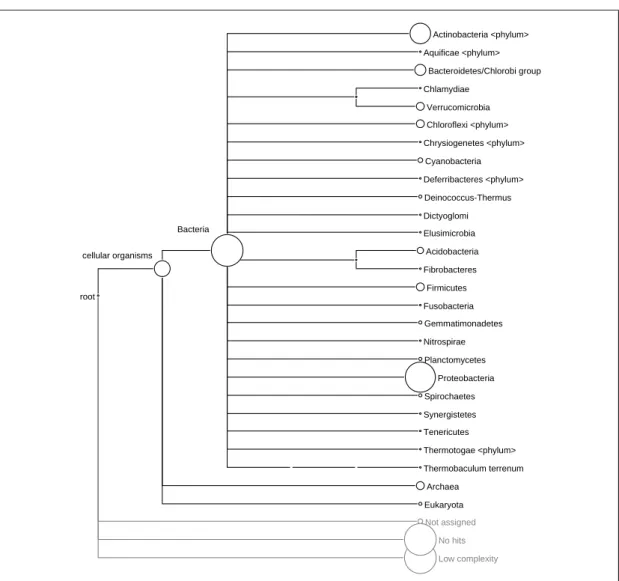
As discussed in the introduction of this chapter, the main visualization of MEGAN is built of a tree derived from one of the four classifications (COG, NCBI, SEED and KEGG). For example, Figure 4.2 depicts the distribution of reads among taxa for a permafrost dataset [Mackelprang et al., 2011] collapsed at phylum level2. The size of the node correlates with the number of reads assigned. For this view, MEGAN supports typical tree operations such as collapsing and expanding of nodes to explore abundances at different levels.
The view is composed of two data objects. First, there is the raw tree structure, not 2There are no differences among classifications at the data access level. Therefore, and for
brevity, when we discuss examples from the taxonomic point of view, the same statements apply also to the three other classifications.
CHAPTER 4. MEGAN 22 Low complexity No hits Not assigned Eukaryota Archaea Thermobaculum terrenum Thermotogae <phylum> Tenericutes Synergistetes Spirochaetes Proteobacteria Planctomycetes Nitrospirae Gemmatimonadetes Fusobacteria Firmicutes Fibrobacteres Acidobacteria Elusimicrobia Dictyoglomi Deinococcus-Thermus Deferribacteres <phylum> Cyanobacteria Chrysiogenetes <phylum> Chloroflexi <phylum> Verrucomicrobia Chlamydiae Bacteroidetes/Chlorobi group Aquificae <phylum> Actinobacteria <phylum> Bacteria cellular organisms root
Figure 4.2: Tree representation of reads on the NCBI taxonomy on the phylum level. The size of each node indicates the number of reads assigned. Nodes may be collapsed or expanded to different taxonomic levels.
specific to the dataset but specific to a classification. Therefore, the tree is stored in a file other than the actual dataset and is not of further interest.
The second object reflects the taxonomic composition of a single sample. It is com-posed of the taxonomical information of all reads and represents the number of reads assigned to a node (taxon). The generic structure is shown in Equation 4.1. Equation 4.2 and 4.3 depict the mapping forActinobacteria and Chlamydiae from the permafrost
CHAPTER 4. MEGAN 23
dataset depicted in Figure 4.2.
Node→Number of reads assigned (4.1) Actinobacteria→190,092 (4.2)
Chlamydiae→1,735 (4.3)
MEGAN requests the mapping when opening a data file. Considering the relatively small number of taxa present in a sample (rarely more than 1,000), the size of the mapping rarely exceeds a few kilobytes. On the other hand considering the large number of reads incorporated in metagenomic datasets, it is a computationally expensive step to access the taxonomical information of all reads in order to create this mapping.
4.3.2
Inspector
The representation as a tree allows one to explore the taxonomic composition of a sample in an aggregated fashion, omitting all read and match specific information. To explore the content of reads and matches in a more detailed way, MEGAN provides an additional visualization, the Inspector. After selecting a taxon, one can explore the content of assigned reads, as seen in Figure 4.3. The structure of the view divides data access in a sequence of three steps:
• As shown in Figure 4.3a, the initial view incorporates the read names in combi-nation with the number of associated matches, assigned to a specific taxon, here Arcanobacterium haemolyticum.
• On read selection all associated matches are uncollapsed and presented by the taxon name (see Figure 4.3b).
• Finally, Figure 4.3c shows the lowest level of data access. After selecting a single match, its alignment text is displayed.
Even though MEGAN handles these three steps as independent data requests, one can immediately recognize a pattern. Reads are accessed and matches being counted in a first step. A subset of these matches is accessed a second time when exploring their taxonomic identity and individual matches are requested a third time in order to inspect their alignment. It is beneficial to the performance to store matches, which have been accessed in the second step, in a cache to avoid one expensive I/O request.
CHAPTER 4. MEGAN 24
(a) Reads (b) Matches
(c) Alignment
Figure 4.3: Inspection of Arcanobacterium haemolyticum: 59 reads have been assigned to the Arcanobacterium taxon. (a) The names of the 59 reads are listed below the taxon name. Read ‘488:2:108:1281:222’ has 13 matches. The taxon names of the matches are listed in (b). The alignment for one match is shown together with the read sequence in (c).
CHAPTER 4. MEGAN 25
4.3.3
(Re)calculation of Classifications
The ultimate goal of MEGAN is to find the correct taxonomic and functional identity for every read as the quality of downstream analysis greatly profits from an accurate assignment. To do so, MEGAN applies a two step algorithm. First, the initial taxo-nomic and functional identity is based on the taxa and genes found in its matches. The matches are pre-filtered by quality, so that only significant alignments will be taken to consideration. In the second step, reads assigned to rare taxa are considered to be noise, and are reassigned to more frequent but related taxa. Finally, the resulting taxonomic and functional assignments for each read are written back to the data file.
Within the scope of MEGAN, this is the most resource intensive workflow, not only in terms of main memory consumption but also in terms of runtime.
First, MEGAN retrieves all reads one by one and fetches the classification informa-tion of their associated matches. Even though matches are pre-filtered beforehand and therefore reduce the quantity of data to be transferred, in software design one has to consider the worst case in which all matches have to be retrieved. After finishing the calculation one has to update the classification identifiers in all reads.
The runtime of this task can be greatly reduced by accessing data inside reads and matches in a selective way and only transmitting data that is needed for that specific task. For the recalculation of classifications, only the taxonomical and functional identifiers of each match are required. Therefore, transmitting the alignment text does not give any additional information, but only inflates the data to be transferred.
4.3.4
Alignment Viewer
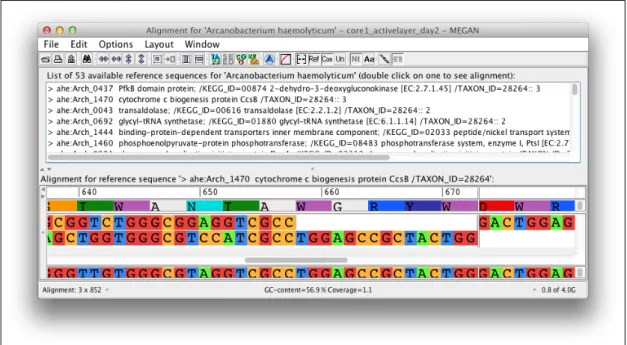
With the release version of 5, a new feature introduced to MEGAN allows one to explore alignments in a more elaborate manner, when compared to the traditional Inspector window (see Figure 4.3c). The Alignment Viewer is capable of visually aligning multiple sequences to a number of references. References and sequences are extracted from reads and their associated matches.
Similar to the routine which uses the Inspector window, reads from a taxon are re-quested, together with a set of quality-filtered matches. Alignment text is extracted from matches used as a reference and the read sequences are aligned against this reference.
In contrast to the previous use cases where alignment text was accessed in a selective fashion (Inspector, see Section 4.3.2) or completely omitted (Recalculation of classifica-tions: see Section 4.3.3), the Alignment Viewer requests and accesses alignment text for
CHAPTER 4. MEGAN 26
all matches.
Figure 4.4: Alignment Viewer for Arcanobacterium haemolyticum. Sequences are ex-tracted from reads and aligned against references.
4.4
Conclusion
In this chapter we discussed a subset of MEGAN’s functionality with the focus on the I/O. While programs that handle a small amount of data do not need to focus on data access, in the case of metagenomics, considering rapidly growing read counts, efficient I/O handling is crucial to the performance of software. With regard to the ultimate goal of designing software capable of storing and accessing MEGAN’s datasets in an efficient manner, we summarize lessons learned in this chapter:
Ordered vs. unordered Reads are not expected to be sorted. The order in which they are sent to MEGAN can be arbitrary. The matches, on the other hand, must be ordered by decreasing quality.
Aggregate The Main Viewer requires an aggregated mapping of the taxonomic iden-tity of all reads. We expect that the performance boost of a pre-calculated mapping outweighs the rise in complexity to maintain the mapping at an up-to-date status.
CHAPTER 4. MEGAN 27
Selectivity One paradigm when handling large quantities of data is to be as selective as possible in order to avoid overhead. When MEGAN requests a match only to extract the taxonomical identifier, it is not beneficial to the performance to transmit also the alignment text. Only access and transmit data which is requested.
Caching I/O costs, even to fast database instances are expensive. The access pattern of the Inspector shows that MEGANServer can profit from caching of previously loaded reads and matches.
Chapter 5
MEGANServer
In this chapter we will introduce MEGANServer, an add-on to MEGAN that is capable of outsourcing the often very large metagenomic datasets on to a web server environment.
5.1
Introduction
The main focus, when implementing the metagenomic analysis tool MEGAN, is on the usability. Every user, tech savvy or not, should be capable of downloading, installing and running the software within a couple of minutes. The same principle applies to the implementation of the graphical user interface. Additionally and in contrary to other tools that promise great functionality but lack usability, MEGAN is able to close the gap between functionality and being user-friendly.
Driven by the huge success of next generation sequencing technologies leading to large volumes of data at moderate costs, it has become a trend to apply metagenomic sequencing to a large range of research areas (see ReviewMetagenomics Research Review, [Illumina, 2012]). While an analysis pipeline could be carried to execute on a normal home computer before, nowadays these pipelines need to be executed on hardware with larger computing power, such as servers or clusters. As a result, plenty of metagenomic pipelines such as MG-RAST [Meyer et al., 2008] or Camera [Seshadri et al., 2007], to name the most popular ones, have emerged in the past few years that offer researchers the possibility to upload their data files and perform one click begin-to-end analysis.
MEGAN, on the other hand, follows a different strategy. Analysis pipelines should be flexible and data should remain the researcher’s property. Hence, the traditional approach of how MEGAN handles metagenomic datasets is to perform analysis on a
CHAPTER 5. MEGANSERVER 29
home computer and store data files locally. Local access is easy to implement, relatively fault safe and enables fast access. But, there are obvious disadvantages. One has to store and organize large datasets, often spanning several gigabytes, locally, and is forced to duplicate data in order to share the analysis with colleagues. It is only a matter of time, till metagenomic datasets will outgrow the researcher’s desktop computer.
To overcome this setback we introduce an add-on to MEGAN, namely MEGAN-Server. The goal of MEGANServer is to allow users to move their datasets from their hard drive to a web server environment without losing the comfort of accessing their datasets in the same way as when they would be stored locally. This approach works well, considering that, even though the average size of metagenomic data easily exceeds several gigabytes, the actual data requests of MEGAN span between a few kilobytes to a few megabytes.
This chapter is divided in four sections. First, we explain the ideas and the goals behind the MEGANServer project. Secondly, we define the specifications and require-ments. Next, we describe the design of the MEGANServer software. Finally, we show how MEGANServer can be used as a MEGAN data backend and also, how it extends the current functionality.
5.2
Ideas & Goals
Handling metagenomic datasets in times in which not only the number of sequences per sample but also the number of samples are growing is challenging. To cope with the raw quantity of data, MEGAN introduced already three data formats, each of them replacing the biases of the former one but facing new challenges. The first version, using cleartext as storage solution, reached its limits very early. The second version, and the first variant of the so called read-match-archive (RMA), used compression techniques and changed the format from cleartext to binary. The files shrunk to smaller sizes but the file structure made updates computationally costly. For example, the recalculation of the classifications required major reorganization of the file structure and therefore, performed poorly in terms of runtime. The third version, the RMA2 format, removed this bias by differentiating between static and dynamic content. Yet the performance, in terms of creation, cannot keep up with the speed in which new aligners e.g. DIAMOND [Buchfink et al., 2014] emit results. RMA3 is currently under development.
As a result of this development, in 2010 we started working on different strategies to handle metagenomic datasets. In the diploma thesis (see [Ruscheweyh, 2010]) we
CHAPTER 5. MEGANSERVER 30
presented an alternative approach using relational databases with the goal of replacing the conventional file structure. As shown in the thesis, relational databases outperform conventional file structures, but only under the condition that the data is relational and dynamic. This applies only to a subset of MEGAN’s data. While the classification identifiers, for example, profit from their relational nature, accelerating access and in-troducing new features to MEGAN, the static data such as parts of the read object and all data of a match object inflate the database and therefore introduce a lot of negative side effects.
Even though the software worked on a local computer, we faced numerous problems when setting up the program on a computer cluster. For example, the lack of multi-user functionality and the fact that the implementation lacked performance, due to complex-ity, using ssh for remote access were major setbacks. With that in mind, we launched the MEGANServer project. The goal was to develop software capable of storing and orga-nizing metagenomic datasets remotely and which are exclusively accessible via MEGAN. The performance should be comparable to that of local access. Access should be based on modern web service technology to overcome remote access problems. MEGANServer must be capable of handling multiple users and support some basic level of security.
Additionally, a previously unseen aspect became increasingly relevant. Metagenomic sequencing and analysis underwent a shift from exploring single datasets in isolation to analyzing communities over a period of time or before and after a medical treatment. Researchers weren’t looking at individual samples anymore but rather were trying to identify the key taxa or genes in certain scenarios. “How do the samples from the sick individuals compare against the healthy ones?”, “Can we identify the taxa which drive disease development?” Rare taxa or genes considered to be noise in individual samples would be lifted above the detection limit if similar samples could be pooled.
Considering the accumulated fashion in which datasets are stored on MEGANServer using relational database technology, merging, pooling, splitting or simply searching would be computationally feasible. As a consequence, we decided to update the project goal. Information collected along with the actual sequencing sample, so called metadata, would be incorporated in MEGAN datasets. This data could consequently be used to search for datasets of interest or applied to differentiate between different groups, subsequently merged and then compared in MEGAN.
CHAPTER 5. MEGANSERVER 31
5.3
Planning Phase
It is known that the quality of software depends on the time invested in the planning phase. Even though there are approaches such as extreme programming which follow different paradigms, the traditional strategy in software development reserves a maxi-mum of one third of project time for coding [Brown, 2013; Anderson et al., 2010]. For the two thirds dedicated to planning, the field of software engineering has developed a wide range of strategies such as the prototype, the incremental model and scrum [Schwaber, 1997]. For the development of MEGANServer we decided to follow the ‘Big Design Up Front’ (BDUF) strategy [Brown, 2013]. In contrast to other software development mod-els, BDUF follows the principle of creating complete and well designed software all at one go rather than starting off with a small prototype and then extending the function-ality step by step. The obvious disadvantage of the model is the static character of the software, and the fact that the development process causes belated deployment. On the other hand, if the BDUF strategy is based on a working prototype, like in our case, these biases are mostly removed.
The BDUF principle splits software development in six blocks, namely requirements, specification, design, implementation, verification and maintenance. The two last blocks are omitted for brevity. Since a discussion on the implementation would go beyond the scope of this thesis, we will cover only the essentials in the design block.
5.3.1
Requirements
The purpose of the MEGANServer project is to liberate MEGAN users from the need to store large datasets on their local computer. Data should be stored at a web server and accessed through MEGAN. The development process starts off by defining hard and soft criteria the software has to meet.
Accessibility & Performance MEGANServer has to grant easy and fast access to incorporated datasets. It should not matter to the user whether the current sample is stored on the local filesystem or it is accessed through a web service. The performance of standard commands executed against a remote dataset must be comparable to commands executed locally. In order to avoid firewall or proxy problems, traffic has to follow the demands of a standard protocol and should be routed through a standard port.
CHAPTER 5. MEGANSERVER 32
Functionality All functions implemented in MEGAN and supported by local storage must be supported by MEGANServer as well. Additionally, due to the accumulated fashion in which datasets are stored, new functions can be introduced. An interface to store and utilize metadata has to be included. Merging of datasets should be supported.
Security Datasets managed by a MEGANServer instance must be secured to prohibit unwanted access. Only dataset owners can access and/or grant access to their data.
Extendibility The program MEGAN is under ongoing development. New visualiza-tions and analysis tools are continuously being added. MEGANServer must be extend-able to support continuing development without large changes in design.
Fault Proof If MEGAN loses the connection to MEGANServer in the process of transmitting data, MEGANServer should recognize the disconnection to free memory and close connections to databases.
ACID MeganServer must be capable of handling access from multiple users. Updates of one user should not be allowed to affect reads of other users. In computer science the different flavors of data security are described as the ACID (Atomicity, Consis-tency, Isolation and Durability) criteria. The first three criteria must be supported by MEGANServer, or in other words, MEGANServer must be transactional. The fourth criteria is the task of a database management system.
Uploading - Bypass Web services are not designed to support fast upload of large quantities of data. To handle the sheer size of metagenomic datasets, we require an alternative approach for the upload of datasets to a MEGANServer instance.
5.3.2
Specification
‘Don’t repeat yourself’ is one of the fundamental rules in software development. If the result of another software project publishes a solution to a problem you are facing, why not take advantage of that piece of software? The rule is so fundamental that entire frameworks are wrapped around that idea, such as Ruby on Rails1. Java, undoubtably one of the most used programming languages [TIOBE, 2014], comes with a whole variety
1
CHAPTER 5. MEGANSERVER 33
of public software packages which are free for use. For example, in the central Maven Repository, a database that curates software packages build with Apache’s Maven2, one can find source code from over 70,000 unique software projects [Sonatype, 2014].
In this section we will introduce a number of different libraries and frameworks which will be used throughout the entire implementation process.
Spring Framework
One idea behind the Java language development was to take the pain out of certain fields of software development and furthermore to create programs that would run, even if precompiled, everywhere. Nowadays, Java runs on over 8 billion devices [Oracle, 2014] e.g. the wrapper of the Android operating system3 is entirely written in Java. Unfortu-nately, in the context of enterprise technology, Java offers with JavaEE4 a solution that is considered to be rather poor:
“The projects using JavaEE technology have to place more emphasis on sat-isfying specific API’s rather than developing actual business logic.”
[Wolff, 2010] (translation mine)
The Spring Framework5, first introduced in 2002 [Johnson, 2004], is one of the ap-proaches which combine enterprise computing and Java. The primary concern is to be both comprehensive and modular. Spring handles source code that is not part of the logic as well as it offers standardized interfaces for all important business purposes e.g. security, data access, cloud computing, integration.
We will take advantage of the Spring Framework throughout the entire implementa-tion. However, the nature of Spring is that it serves its purpose best when it is invisible to the actual logic, not implementing its own features but bringing many technologies together. Even though all components we will introduce will be managed by Spring, we will discuss its impact only where necessary.
2 http://maven.apache.org/ 3 http://www.android.com/ 4http://www.oracle.com/technetwork/java/javaee/overview/index.html 5http://spring.io/projects
CHAPTER 5. MEGANSERVER 34
Servlet Container
Figure 5.1: Tomcat The nature of Java web applications imposes the necessity
to launch these in a so-called servlet container. For this purpose we chose Tomcat6. There are Tomcat installers for all operating systems and the configuration process is rela-tively simple. We want that MEGANServer can be installed by most users. Tomcat seems to offer suitable features to support this goal.
Storage
Since early versions relying on relational databases only proved to violate our perfor-mance requirement, we decided to divide objects in a dataset in two groups. The first group, mainly classification data, would remain in the relational database. The static content of reads (see Section 4.2.2) and matches (see Section 4.2.3), on the other hand, should be stored in a more appropriate data format.
Figure 5.2: PostgreSQL PostgreSQL As a relational database management
system we chose PostgreSQL7. PostgreSQL is an open source project with contributions from a huge and helpful community. It has also proven to be a suitable solution to store and manage large data by supporting a wide range of tweaking parameters. For ease of use we also tried Java database management systems, such as H28, which incorpo-rate all logic in a Java archive thereby omitting the entire installation process. Unfortunately, even though the devel-opers claim differently, H2 does not seem to be designed for
large data as there is a significant drop in performance when facing the size of metage-nomic data.
6
http://tomcat.apache.org/
7http://www.postgresql.org/
CHAPTER 5. MEGANSERVER 35
Figure 5.3: CouchDB CouchDB We decided to use CouchDB9 as a
stor-age solution for the static content of reads and matches. Additionally, we will use lightcouch10 as the Java interface. CouchDB is a simple document orientated NoSQL database management system. Each document, for example, a match or a read, is transformed in JSON and subsequently stored in a tag value manner. The tag, in our case either the read or the match identifier, serve as input for a B+ tree index which is used to provide ultra fast access to single documents.
Queuing
One of the main goals of MEGANServer is to provide fast access to reads and matches. Normally, for example, following the Alignment Viewer use case (see Section 4.3.4), one does not know the number of reads a request will return. If only a small number of reads is requested, one can load all reads from the databases, package them in a single object and transfer this package to MEGAN. This strategy, applied to a request that delivers a large number of reads, has the potential to stall MEGAN and introduce memory leaks in MEGANServer. A naive solution would be to apply streaming techniques on both sides, transferring read by read. This conflicts with the non-negligible overhead of serializing Java objects in order to transfer them via a web connection. The optimal solution incorporates both approaches, supports streaming on chunks of reads.
We solved this issue by implementing an additional software, namely the JobQueue. The input of the JobQueue is a request of MEGAN, asking for an indefinite number of reads. The JobQueue hands out tickets under which MEGAN iteratively requests small chunks of the reads, therefore solving both, the stalling and the memory prob-lem. Unused tickets, for example, when a MEGAN client crashes during access, will be automatically invalidated and the memory freed.
Metadata
MEGANServer allows to gather a larger number of datasets in one repository. Search methods need to be installed to provide users functionality to identify datasets of interest. Besides basic text search on names or metadata of datasets, we decided that our software
9
http://couchdb.apache.org/
10
CHAPTER 5. MEGANSERVER 36
would profit from a feature that allows the selection of all datasets that fall in a certain scenario. For example, if one is interested in including all datasets that originate from patients that are both, female and sick, one has to apply a boolean expression such as:
‘Gender’=‘Female’ AND ‘Health Status’=‘Sick’ (5.1)
For the purpose of parsing and evaluating a boolean expression we chose the Mozilla Rhino11 library which is a Javascript engine entirely written in Java.
Web Service
Since MEGANServer and MEGAN run on different virtual machines we need to estab-lish inter-process communication in order to transfer data between both JVMs. Java is shipped with an inbuilt solution for that task, namely remote method invocation (RMI)12. Using the Java serializer and its own protocol, RMI is capable of fast data transfer at a relatively low overhead. However, RMI is not an option because it uses its own protocol and not a standard protocol such as http. Therefore RMI is most certainly blocked by any sensitive firewall or proxy. We believe that the traditional web services based on the SOAP [Curbera et al., 2002] or REST [Fielding and Taylor, 2002] speci-fications such as Axis213 or Jersey14 are no options either. Cleartext serializers would create large overhead and thereby throttle the speed. Since the communication will be between two Java programs, the optimal solution is to use a web service that relies on a Java serializer (size and speed) and uses the http protocol (accessibility). Potential candidates include Hessian215, Burlap16 and the HttpInvoker17. As seen in tests (see [Miquel, 2014], [wuqingren2316, 2014]), the HttpInvoker achieves a performance compa-rable to RMI, even for larger objects. The main reason seems to be that HttpInvoker relies on the Spring Java serializer in comparison to the other two implementations that take advantage of the standard Java serializer. Hessian2 and Burlap perform well trans-mitting small objects but fail to efficiently serialize large objects. Therefore, we chose
11 https://developer.mozilla.org/en-US/docs/Mozilla/Projects/Rhino 12 http://www.oracle.com/technetwork/java/javase/tech/index-jsp-138781.html 13 http://axis.apache.org/axis2/java/core/ 14http://jersey.java.net/ 15https://github.com/takafan/hessian2 16http://www.caucho.com/resin-3.0/protocols/burlap.xtp 17http://docs.spring.io/spring/docs/4.0.5.RELEASE/spring-framework-reference/ html/remoting.html#remoting-httpinvoker
CHAPTER 5. MEGANSERVER 37
to use the HttpInvoker for our web service.
Security
The consequence of offering a service located on a web server is the exposure of data and functionality to the internet. Access control such as authentication is essential. Additionally, in order to support different types of permission, such as read/write or read only access, an authorization process has to be employed. Spring Security18 offers a solution to both authentication and authorization, and supports simple configuration via annotations.
We will use Spring Security for authentication and authorization in combination with digest authentication so that passwords are not sent in cleartext over the network.
Caching
One can significantly improve performance by caching reads and matches (see use case: Inspector 4.3.2). There are highly advanced implementations such as Redis19, Java Caching System20, EhCache21 or MemCached22. However, even though all of these implementations offer striking performance, the increase of complexity these packages would cause in our software is undesirable. We chose a simple cache implementation distributed along with the Google Guava package23.
Transactions
The essence of server software is rooted in the idea of offering services and data to a larger number of users. In comparison to single user software, one has to employ additional data safety strategies. Data can be invalid and inconsistent at certain points of its lifespan. For example, a dataset which is currently under update has an invalid state. Parts of the dataset still carry old values whereas other parts might represent the updated values. And what happens if the update fails? For example, blocking access to inconsistent data or automated rollback are two aspects of transactional behavior24.
18 http://projects.spring.io/spring-security/ 19 http://redis.io/ 20 http://commons.apache.org/proper/commons-jcs/ 21 http://ehcache.org/ 22 http://memcached.org/ 23 https://code.google.com/p/guava-libraries/ 24
CHAPTER 5. MEGANSERVER 38
For that matter we will use Spring’s own implementation, the TransactionManager25.
Additional Packages
In contrast to client software, which in case it crashes can be restarted by a user, a server software is required to be self-governing. MEGANServer should be ideally fault tolerant, self updating and memory consistent. Both Java and Spring ship with libraries which support the criteria stated before. We will take advantage of aspect oriented programming (AOP) [Kiczales et al., 1997] to apply timer functions, exception handling and logging support without adding any line of source code.
The timer manages the caches and keeps the JobQueue free from abandoned requests and triggers a function to frequently scan the database for recently uploaded datasets. For logging we use the generic interface, Simple Logging Facade for Java (SLF4J)26 primarily because incorporated packages do not use a standardized logging library. Every exception will be caught, logged and processed using the interception framework in Spring’s AOP implementation.
5.4
Design
The process in which software packages are systematically plugged in together in such a way that they meet the requirements, in which interfaces are defined and, scopes and the modular structure of the software are discussed, is the design stage.
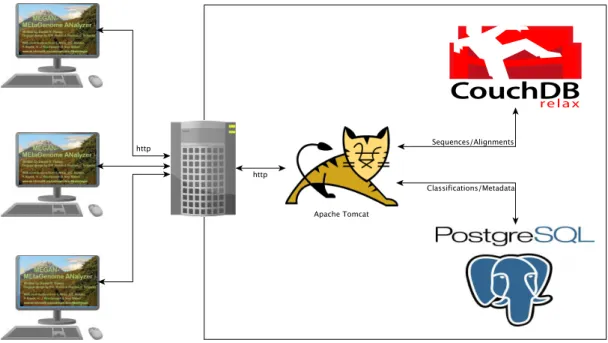
Figure 5.4 depicts the conceptual design of the MEGANServer environment. A num-ber of MEGAN clients access a web server hosting a MEGANServer instance. Tomcat is used as the runtime environment for MEGANServer. Communication with CouchDB and PostgreSQL is established using additional protocols.
On a level closer to the actual implementation (see Figure 5.5) one can see the mod-ular composition in which the software is designed. There are five programmatically independent areas. Authentication is located at the outermost position. The creden-tials of an incoming request are verified using information stored in the user database. A successful request is routed to the Dispatcher. TheDispatcher evaluates the request type and determines a suitable handler. Requests, resulting in data of undetermined size, are forwarded to the Large Data Handler. Data requests that result in data
25http://docs.spring.io/spring/docs/4.0.5.RELEASE/spring-framework-reference/
html/transaction.html
CHAPTER 5. MEGANSERVER 39
sizes transmittable in a single chunk are transferred to the Small Data Handler. Re-quests that affect user entries, such as changing credentials, adding or removing users are transmitted to the User Data Handler. Programmatically speaking, each handler is the implementation of a simple interface, using the Spring Framework, translated in an HttpInvoker servlet. All three handlers implement methods to either retrieve or write data. To do so, all methods access theData Access Object. Large data requests
are detoured through the JobQueue which is capable of breaking large data requests to smaller chunks to speed up transfer without losing streaming behavior. The Data
Access Object determines the type of data and requests information either from the
PostgreSQL or from the CouchDB instance. Similar behavior is implemented in the
UserServiceusing the UserDB as a data backend. Caches and transaction support are
omitted for brevity but belong in theData Access Object
Figure 5.4: The MEGANServer Environment: The MEGANServer software is embedded in the Tomcat servlet engine. Data is stored in CouchDB or PostgreSQL. A number of MEGAN clients communicate with the web server of MEGANServer via http.
CHAPTER 5. MEGANSERVER 40 Figur e 5.5: Design of M EGANServer : A uthentic ation : Cr edentials for inc oming conne ctions being validate d. Servlet-s/Disp atching : The disp atcher parses the re ques t and routes it to the corr ect servlet. The hand lers take advantage of the HttpInvoker interfac e to unwr ap http re quests to Java classes and to communic ate with the data ac cess obje ct. Jobs : The JobQueue tr anslates lar ge data re quests to smal ler chunks and hands out tickets under which data can be ac cesse d. Data A c c ess : T ransactional data ac cess to datab ases. Caching is implemente d for re ads matches and he ader data. Datab ases : R aw data ac cess either via JDBC, REST or dir ect file ac cess. Not Shown : A uthorization, Caching, Exc eption Hand ling.