MULTIVARIATE SHORT-TERM TRAFFIC FLOW
FORECASTING USING TIME-SERIES ANALYSIS
Bidisha Ghosh, Biswajit Basu, and Margaret O’Mahony
Department of Civil, Structural and Environmental Engineering
Trinity College, Dublin
ABSTRACT: (156 words)
The existing time series models used for short-term traffic condition forecasting are
mostly univariate in nature. Generally the extension of the existing univariate
time-series models to a multivariate regime involves huge computational complexities. A
different class of time-series model called structural time-series model (STM) (in its
multivariate form) has been introduced in this paper to develop a parsimonious and
computationally simple multivariate short-term traffic condition forecasting
algorithm. The different components of a time-series dataset such as the trend,
seasonal, cyclical and calendar variations can be modelled separately in STM
methodology. A case study in Dublin city centre with serious congestion is performed
to test the effectiveness of the forecasting strategy. The results indicate that the
proposed forecasting algorithm is an effective approach to predict the real-time traffic
flow at multiple junctions within an urban transport network where the junctions are
INTRODUCTION
Implementation of Intelligent Transportation Systems (ITS) to provide dynamic
traffic control requires continuous forecasting of traffic conditions in near (short-term
or less than 1 hour, (Smith et al., 2002)) future. Short-term traffic forecasting is an
important tool to follow evolution of traffic conditions over time in a transport
network. This type of advanced forecasting methodologies having a time horizon of
15 minute or less (Smith et al., 2002) can provide information to support short-range
operational modifications to improve the efficiency of the network at a finer scale.
With the increasing need to develop more adaptive (site and time specific) traffic
management systems, considerable research attention has been focussed on short-term
traffic forecasting.
The well-known short-term forecasting algorithms can broadly be classified into
univariate and multivariate approaches. The univariate approach is based on
modelling traffic condition related variables (such as speed, flow or occupancy etc.)
utilising observations from any single site, whereas developing a single model
considering several sites for input and output is termed a multivariate approach.
Unlike univariate models, these models are capable of capturing the temporal as well
as the spatial evolution of traffic conditions over time in a transportation network.
But due to ease of computation, univariate models are more common in short-term
traffic forecasting literature (Kamarianakis and Prastacos, 2003).
Both multivariate and univariate models can be developed using different empirical
(non-parametric and (non-parametric) employ a fairly standard statistical methodology and/or a
heuristic method for traffic flow forecasting without referring to the actual traffic
dynamics. The non-parametric techniques include non-parametric regressions (e.g.
Davis and Nihan, 1991) and neural networks (e.g. Smith and Demetsky, 1994;
Vlahogianni et al., 2005). Due to an intrinsic multi-input nature neural network
models are often favoured in the space-time or multivariate models (Zhang et al.,
1998). The parametric techniques include different time-series models such as, linear
and non-linear regression, historical average algorithms (e.g. Smith and Demetsky,
1997), smoothing techniques (e.g. Smith and Demetsky, 1997; Williams et al., 1998)
and autoregressive linear processes (Ahmed and Cook, 1979; Levin and Tsao, 1980;
Hamed et al., 1995; Williams et al., 1998; Williams, 2003). Of all autoregressive
linear processes, seasonal auto regressive integrated moving average (SARIMA)
models (e.g. Williams et al., 2003 and Ghosh et al., 2005) perform better than other
time-series techniques (Chung and Rosalion, 2001; Smith et al. 2002).
With a few exceptions (Whittaker et al., 1997; Kamarianakis and Prastacos, 2002;
Williams, 2003; Kamarianakis and Prastacos, 2003) most of the literature in
short-term traffic forecasting focus on univariate. The available multivariate empirical
models in the short-term traffic forecasting literature are mainly multivariate
variations on the existing univariate parametric statistical models, e.g. the multivariate
ARIMA model (Kamarianakis and Prastacos, 2003), space-time ARIMA model
(Kamarianakis and Prastacos, 2002). These models can account for the dimension of
space in a transport network. But the models are computationally demanding as the
time-series models based on state-space methodology were introduced as a short-term
traffic forecasting technique by Stathopoulos and Karlaftis (2003).
In this paper, for the first time in traffic flow related studies, multivariate structural
time-series (MST) models are applied to model traffic flow observations from
multiple intersections within an urban signalized transport network. In a structural
time-series model (STM), the evolution of different components of time-series data
such as the trend, seasonal, cyclical and calendar variations with time can be modelled
separately. Classical time-series analysis using the ARMA (SARIMA, ARIMAX)
class of models is based on the theory of stationary stochastic processes. Hence the
time-series dataset to be modelled using the SARIMA technique is always required to
be checked for its stationarity. If the dataset is not stationary, then transformations are
required to be performed to achieve weak stationarity. As STM is not based on this
theory, no such transformations or checks are required for the application of this
methodology. The MST models are computationally inexpensive as compared to
other multivariate time-series models. Missing observations and inclusion of
exogenous variables like traffic flow observations of other upstream junctions can be
incorporated comparatively easily in the MST model (Harvey, 1989; West and
Harrison, 1997; Durbin and Koopman, 2001).
THEORETICAL BACKGROUND
The STM methodology is a particular time-series analysis technique which is set up in
terms of components which have a direct physical interpretation (Harvey, 1989). The
cyclical and calendar variation together with the effect of explanatory variables and
interventions (outlier and structural breaks). The basic principle behind a STM is
similar to that of the Holt Winters Exponential Smoothing (HWES) model, but more
complex. Multivariate STMs are straightforward extension of the univariate STMs
and involve less computational complexities than the other existing multivariate
time-series techniques. An overview of the univariate and multivariate STM model
definitions is given in this section. A detailed discussion on this subject is available in
Harvey (1989) and Durbin and Koopman (2001). A software package called STAMP
6.0 (Structural Time-Series Analyser, Modeller and Predictor) is used in this study for
modelling traffic flow observations using STM.
Univariate STM Methodology
A univariate structural time-series model is formulated based on the unobserved
components which have a direct interpretation in terms of the temporal variability of a
time series dataset. Consequently the evolution of the components such as trend or
seasonality over time and their contribution to the final predictions can be observed
clearly. A univariate STM for a time series dataset y can be described by the
following general equation involving all possible types of temporal components in its
form:
2
,
NID (0, )
t t t t t t
t y
where, t is the trend, t is the seasonal, t is the cycle, t is the first-order AR
component and t is the irregular or the random error. For the purpose of traffic flow
modelling, the univariate and multivariate STM are considered to be comprised of
three components; stochastic trend, seasonality and irregular. Hence, the equation 1
reduces to the following form:
2
,
NID (0, )
t t t t
t y (2)
The stochastic trend component (t) represents the long-term movement in a
time-series which can be extrapolated into the future. In the case of traffic flow
observations over a few weeks from a developed urban transport network, this
long-term movement does not show any significant gradient and should be modelled for
the local fluctuations. A Markov model of the stochastic trend can be considered in
this purpose.
1
2
NID (0, )
t t t
t
(Change of slope is not considered) (3)
The irregular disturbance/variance2 and the stochastic trend (level) variance2 are
mutually uncorrelated. The t process collapses to a linear trend if 2
0
. The
trigonometric specification of the seasonal component as this ensures smooth changes
in the seasonal as observed in traffic flow time-series data.
[ / 2] , 1
s
t j t
j
(4),
, , 1 ,
* * *
, , 1 ,
where each is generated by
cos sin 1,...,
2
, ,
sin cos 1,..., ,
j t
j t j j j t j t
j t j j j t j t
s j t T (5)
Where, j 2 j
s
is the frequency, in radians, and the seasonal disturbances
* and
t t
are mutually uncorrelated random normal disturbances with zero mean and
common variance 2. When s is even, the equation 5 at
2 s
j collapses to
, cos , 1 ,
j t j j t j t
(6)
Equations 1 to 5 define the STM used in this study. The disturbances of the individual
components of the STM (2,2 and2) mentioned in these equations are all
mutually uncorrelated. The variances 2,2 and2 denote the extent to which the
individual components, such as the trend or seasonal component will vary with time
The equations 1 to 5 are generally solved in state-space form using Kalman filter
based algorithms (Kalman, 1960; Harvey, 1989). The hyperparameters and the
components are estimated using maximum likelihood estimation method.
In some cases, the time series observations to be modelled have dynamic relationships
with some other independent variables. They are called explanatory or exogenous
variables and inclusion of these variables in STM, may improve the forecasting
precision of the models. The inclusions of the explanatory variables change the first
part of equation 1 to the following form:
, 1 0
q k
t t t t t i i t t
i
y x
(7)where, xi t, is an exogenous variable, k is the total number of exogenous variables,
is the time lag and i is a set of unknown constants. The significance of is that
in some cases, the lagged value of the dependent variable can be considered as an
exogenous variable in STM.
Multivariate STM Methodology
Multivariate time-series data can be chiefly classified into two distinct types, Panel
data and interactive data (Harvey, 1989). In the case of panel data, the time-series
variables are subjected to the same or similar influences but the individual elements
do not interact with each other. As the variables follow a similar temporal nature, they
of a set of variables which have some behavioural relationships among themselves
and interact dynamically with each other. This distinction is important to find out the
suitable type of multivariate structural time-series analysis technique. The
multivariate traffic flow observations (i.e. observations from different stations in the
same transport network) modelled in this paper are considered to be subjected to
similar influences but not to have any dynamic interaction (detailed explanation in
next section) and are modelled as panel data.
The panel data can be modelled by a multivariate structural time-series (MST)
technique where the various components of the different time-series variables are
allowed to be contemporaneously correlated. Such a type of MST model is referred to
as, seemingly unrelated time-series equations (SUTSE) (Harvey, 1989). The
univariate equations described in the previous subsections can easily be extended to
SUTSE model.
,
NID (0, )
t t t t
t
y
t = 1,…., T (8)
where, yt is a vector of N1time-series observations which depends on the
unobserved trend component , t seasonal component t and irregular component t
which are also vectors. is the NN variance matrix of the irregular disturbances.
In multivariate regime, the equations 3, 4, 5 and 6 change in a similar manner as in the
become vectors in the MST model and the disturbances of these components become
NN variance matrices.
The inclusion of explanatory variables in the MST model is simple and similar to the
univariate approach described in equation 7.
0
q
t t t t t
y x (9)
where, xt is a vector of K1explanatory variables. Elements of the unknown
parameter matrix can be specified to be zero, thereby excluding certain
explanatory variables from particular equations.
A vector process yt is said to be homogenous if all linear combinations of its N
elements have the same stochastic properties. In a multivariate homogenous system,
the disturbance matrices are required to satisfy the following equation:
*
*
and
k qk
h
(10)
where, qk, k = 1,……, g and h are non-negative scalars and * is an NN matrix.
In these ?? cases possible assumption of homogeneity in a SUTSE model decreases
One of the major advantages of STM methodology is its transparency (Durbin and
Koopman, 2001). In STM, the different components which make up the time-series
are modelled separately unlike the SARIMA methodology (e.g. Williams and Hoel,
2003 and Ghosh et al., 2005) where the trend and seasonal components are eliminated
by differencing. Hence, in STM it is easy to understand the evolution and contribution
of each of the components in the final results. In a multivariate regime, MST models
are straightforward vector extensions of the univariate STM. The SUTSE models do
not involve estimation of huge co-variance matrices as Vector ARMA (VARMA)
models. Due to the recursive nature of the STM models any known structural change
over time is easy to implement, whereas SARIMA models cannot include such
structural changes since they are homogenous and stationary in form. Treatment for
missing values in a time-series is also very simple in STM equations. Explanatory
variables, outliers, structural breaks etc. can also be easily modelled in a STM
framework as described before. Introduction of the same variables in SARIMA
models require tedious computational efforts. STM is more general, flexible and can
be easily transferred from a univariate to multivariate regime than the ARIMA class
of models.
METHODOLOGY
A multi-input multi-output (where the number of input intersections are more than
number of output intersections) short-term traffic flow simulation and forecasting
model is proposed in this study for efficient modelling of traffic in a congested urban
traffic volume observations from different approaches and different intersections of
the transport network.
Unlike the previous multivariate traffic flow models developed for urban transport
networks (Stathopoulos and Karlaftis, 2003; Kamarianakis and Prastacos, 2002), the
locations of the sites of data collection within the transport network are not required to
be considered in the proposed methodology. The aim of this approach is to develop a
multivariate traffic flow simulation and forecasting model for multiple intersections
within a transport network which may not be situated on the same route. As the
intersections or stations of observations are not situated on the same route it is highly
unlikely that the same platoon of vehicles will pass through different intersections at
different time instants. Hence, information about the directions of traffic flow is not
essential. A SUTSE model is ideal for modelling such multivariate time-series
observations as the behavioural relationship among the variables are not considered.
As an improvement to the panel data modelling methodology a spatial dimension is
introduced to the proposed multivariate traffic flow model. The traffic flow
observations from the nearest available upstream intersection of each of the modelled
data collection stations are included as explanatory variables to the MST model
equations. This ensures that the effect of any abrupt change occurring in the upstream
junction can be accounted for in the model.
APPLICATION OF THE PROPOSED MST MODEL
The proposed multivariate traffic flow forecasting methodology is applied to a
congested urban transportation network in the city centre of Dublin to test the
effectiveness of the forecasting strategy. A small network of ten intersections within
the transport network is chosen for this purpose.
The time interval of traffic flow observation data collection is unique to the data
collection system of the existing urban traffic control system of any city. The data
interval can vary from a few seconds to one hour. Short-term forecasting algorithms
applicable to a traffic management system should have a prediction horizon of 15
minutes or less (Smith and Demetsky, 1997). The univariate traffic flow observations
obtained over each 15 minute interval from the inductive loop-detectors situated at
these ten intersections and their nearest available upstream junctions are modelled
using the proposed multivariate traffic flow model. There are two important points
which are required to be checked before applying the proposed methodology.
1. The location and the distance of the sites can be chosen at random. The only
criteria for the choice is that the average travel time between two sites on the
same route within the network should not be more than 15 minutes.
Considering a 30 km/hr free flow speed within a congested urban transport
network, the radius of the simulation network should not be more than 7.5
km.
2. The second and the most important point is that the univariate traffic flow
observations from different data-collection sites should not have behavioural
multivariate traffic flow observations behave as a panel data set, the SUTSE
model can be applied.
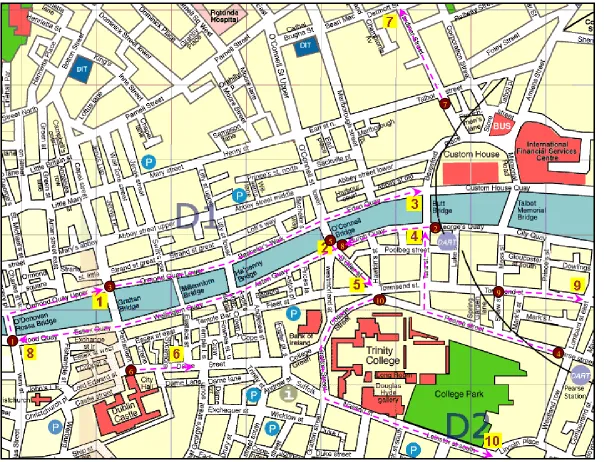
In figure 1, a map of the chosen urban transport network at the city-centre of Dublin is
given. The ten junctions where the multivariate time-series model is applied for
short-term traffic volume simulation and prediction are shown with numbered yellow
squares in the map. In the figure, the direction of the univariate traffic movement at
each intersection is shown with a pink arrow. The origin of the pink arrow is marked
with a numbered dark brown circle which signifies the nearest upstream junction to
each intersection from which traffic volume data can be obtained. The length of the
pink arrow signifies the distance between an intersection and its nearest available
upstream junctions. If this distance is considerably high then it is possible that the
changes in traffic flow at the upstream junction may not directly influence the traffic
flow at the downstream intersection.
It is evident from the figure, that the choice of the site locations at which 15 minute
traffic volume is modelled is random. The chosen intersections are not on the same
route within the transport network and none of the two stations what are the stations?
have a distance of more than 7.5 km between them?. Hence, the chosen network of
ten intersections conforms to the conditions mentioned in point one. The ten
intersections at which the proposed multivariate short-term traffic flow model is
applied for simulation and forecasting are termed as output intersections in the rest of
The traffic flow observations used for modelling from all the chosen intersections
were recorded from 3rd November 2003 6:30 a.m. to 26th November 2003 6:30a.m.,
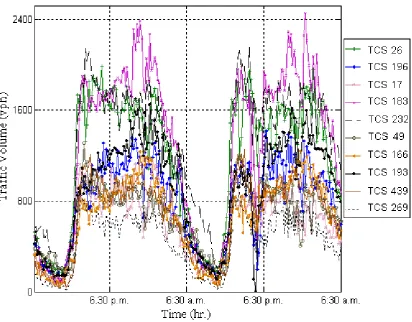
excluding the weekends. A cross-section time-series plot of the traffic flow
observations from the ten output intersections during 4th and 5th of November in 2003
is given in figure 2. The plot shows that there is a definite temporal similarity among
the curves. The output junctions at which the direction of the univariate traffic flow
fall on the routes towards the city-centre have high traffic volumes during the
morning peak hours whereas the junctions for which the same fall on the routes away
from the city-centre have higher traffic volumes during evening peak hours than the
morning peak. Consequently, the peak hourly volumes from all these ten output
junctions may not have high positive correlations, but the time of occurrence of the
maximum traffic volumes passing through the junctions are very similar. Considering
this contemporaneous correlation among the ten output traffic volume time-series
datasets, they can be modelled as panel data using SUTSE models.
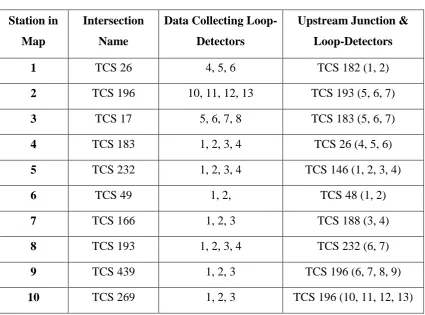
In table 1 further details about the ten output intersections are given along with the
name of the nearest upstream intersections at which traffic flow observations are
available. The 15 minute aggregate univariate traffic volumes from the mentioned
loop-detectors in the upstream junctions are used as explanatory variables in the
SUTSE model equations. In equation 5.9, the elements of the matrix are so chosen
that the forecasts from each intersection is affected only by the changes at its
upstream junction and not by the changes at other upstream intersections.
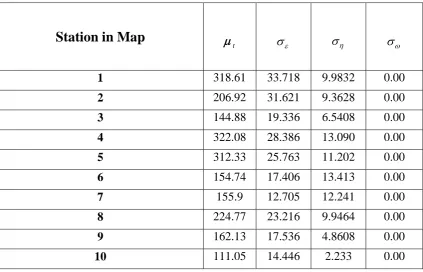
All of the ten series of traffic flow observations are modelled using homogenous
SUTSE models with equation 9 and equations 3, 4, 5 and 6 in their vector forms. The
estimated values of the trend/level component and the standard deviations of the
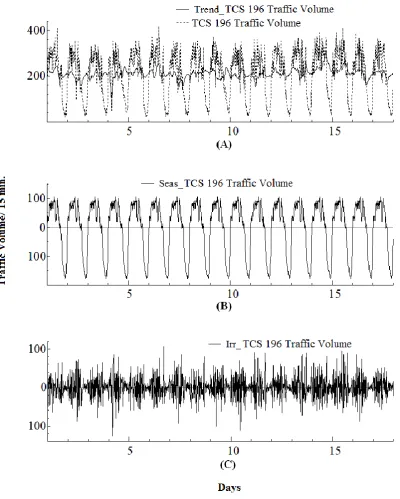
disturbances of the components are provided in table 2. The elegance of the STM lies
in the meaningful depiction of the components as shown in figure 3. In the figure,
trend, seasonality and the random error components (obtained from the traffic flow
observations collected from output station 2, as an example) are shown individually in
three different subplots. The subplot (A) shows the original traffic flow data series
along with a ? trend component as simulated and predicted from the proposed
multivariate model. The subplots (B) and (C) of the figure individually show the
seasonal and the irregular components respectively, simulated and predicted from the
MST model. The hyperparameter estimates (table 2) and the plot of the seasonal
component show that the seasonality is deterministic in nature. On the other hand the
trend component is stochastic and depicts the within-day local fluctuations in the data.
The trend component varies about a zero mean value validating the assumption that
there is no slope component latent within the traffic flow dataset.
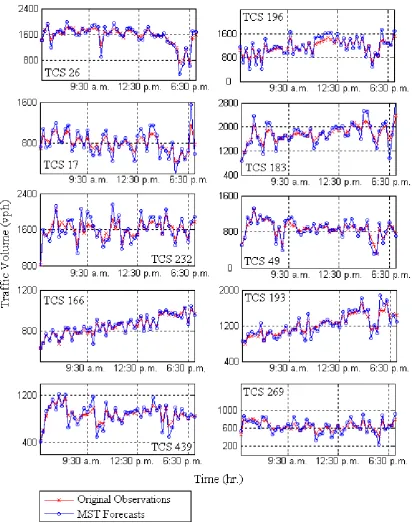
For all of the ten output junctions, 50 points in the future are forecasted (figure 4).
The traffic flow data obtained on the 26th November 2003 from 6:30 a.m. to 8:00
p.m., i.e. the data collected in the next 12.5 hours (50x15 = 750minute = 12.5hours)
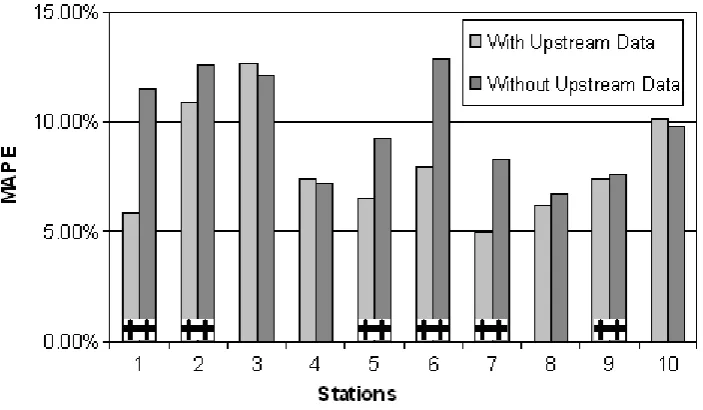
are compared with these forecasts. The forecasting precision (MAPE) from the
proposed SUTSE model for each of the ten output junctions with and without
considering the influence of upstream junctions are given in figure 5 in the form of a
bar diagram. Among the ten output intersections the upstream junction is situated
indicated in the bar diagram by a coupling sign shown on the bars. It is observed
from figures 4 and 5 that the MAPE values for the forecasts at these output stations
improve significantly when the traffic flow observations from the nearest available
upstream junctions are incorporated in the SUTSE model as explanatory variables.
The forecasting precision for the remaining four output junctions do not improve
when the traffic flow observations from the nearest available upstream junction are
incorporated in the model. These are the junctions not having any upstream junction
nearby from where the loop-detector observations can be available. In such cases, the
traffic flow at the nearest upstream junction do not directly influence the traffic at the
output station due to the presence of excessive merging and diverging manoeuvres in
between the upstream and the output junction. Hence, the inclusion of the traffic flow
at far away upstream junctions as exogenous variables in the proposed model
negatively affects the performance of the model. Thus it is preferable to ignore the
influence of the traffic volume changes at an upstream junction if it is not located at
an immediate vicinity of the output station. I think it would be important to try to
justify why this is.
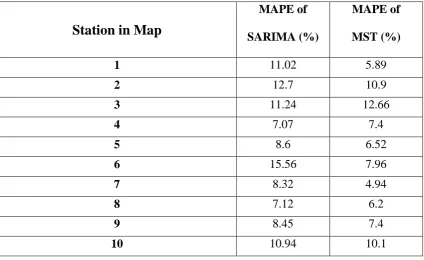
The MAPE values from the univariate SARIMA (2,0,1)(0,1,1)96 (Ghosh et al. 2005)
model for the traffic flow observations at the ten output intersections is shown in table
3 in comparison to the MAPE values from the proposed MST model for the same
junction. In most of the cases, the proposed multivariate traffic flow time-series model
prove to be more accurate than the ordinary univariate SARIMA model for short-term
simulation and forecasting of traffic volume in a congested urban network.
In this paper a structural time-series methodology is applied to develop a multivariate
short-term traffic flow forecasting model for an urban signalized transport network.
This is the first instance of applying STM to short-term traffic condition related
studies. I think you would need to include how the results from STM might compare
with other models here as the reader will be looking for comparisons. This will help
justify the use of this technique and its advantages. The model developed in the paper
is observed to have achieved some distinct advantages over the existing well-known
univariate SARIMA time-series model. These are:
The model is capable of simultaneous simulation and modelling of traffic
conditions at multiple intersections in an urban signalized transport network
where it is difficult to model the existing paths and turning movements.
The multivariate short-term traffic condition forecasting model developed here
is computationally much simpler and performs more accurately than the most
of the existing multivariate models.
In structural time-series model the evolution of each individual component
(trend, seasonality etc.) of the traffic flow data over time can be traced
separately. Consequently, the deterministic nature of the seasonal component
of the traffic volume observations from junctions at urban signalized arterials
The MST model can include the effect of changes in traffic conditions at one
or more immediate upstream junctions to improve the predictions at the
downstream output junction.
The distance of the nearest available upstream junction from the output
intersection influences the forecasting precision to a certain extent. Consequently,
for developing comparatively more efficient and robust multivariate short-term
traffic flow forecasting algorithms further studies can be performed to incorporate
the movement of traffic between the upstream junctions and the forecasting sites.
REFERENCES
Ahmed, M. S. and Cook, A. R. (1979) Analysis of freeway traffic time-series data by using Box–Jenkins techniques. Transportation Research Record: Journal of the
Transportation Research Board, No.722, pp.1–9.
Chung, E. and Rosalion, N. (2001) Short Term Traffic Flow Prediction. Proceedings
of the 24th Australian Transportation Research Forum, Hobart, Tasmania.
Davis, G. and Nihan, N. (1991) Nonparametric Regression and Short-Term Freeway Traffic Forecasting. Journal of Transportation Engineering, ASCE, Vol. 117, pp. 178-188.
Durbin, J. and Koopman S. J. (2001) Time Series Analysis by State Space Methods. Oxford Statistical Science Series, Oxford University Press.
Ghosh, B., Basu, B. and O’Mahony, M. M. (2005) Time-Series Modelling for Forecasting Vehicular Traffic Flow in Dublin. 84th Annual Meeting of Transportation
Hamed, M. M., Al-Masaeid, H. R. and Bani Said, Z.M. (1995) Short-Term Prediction of Traffic Volume in Urban Arterials. Journal of Transportation Engineering, ASCE, Vol. 121(3), pp. 249–254.
Harvey, A. C. (1989) Forecasting, Structural Time Series Models and the Kalman
Filter. Cambridge: Cambridge University Press.
Kalman, R. E. (1960) A New Approach to Linear Prediction And Filtering Problems.
Transactions of the ASME - Journal of Basic Engineering, Vol. 82, pp. 35-45.
Kamarianakis, Y. and Prastacos, P. (2002) Space-Time Modelling Of Traffic Flow.
European Regional Science Association Conference. Available from
www.ersa2002.org.
Kamarianakis, Y. and Prastakos, P. (2003) Forecasting traffic flow conditions in an urban network: comparison of multivariate and univariate approaches. 82nd Annual
Meeting of Transportation Research Board, (CD-ROM), TRB, Washington, D. C.
Kirby, H. R., Watson, S. M. and Dougherty, M. S. (1997) Should We Use Neural Network Or Statistical Models For Short-Term Motorway Traffic Forecasting?
International Journal of Forecasting, Vol.13, pp. 43-50.
Koopman, S. J., Harvey, A.C., Doornik, J.A. and Shephard, N. (1999a) Structural
Time Series Analysis, Modelling and Prediction Using STAMP. London: Timberlake
consultants Press.
Koopman, S. J., Shephard, N. and Doornik, J.A. (1999b) Statistical Algorithms for
Models in State Spaceusing SsfPack 2.2 (with discussion). Econometrics Journal,
Vol. 2, pp.113-166.
Lenten, L.J.A. and Moosa, I.A. (2003) An Empirical Investigation into Long-term Climate Change in Australia. Environmental Modelling and Software, Vol. 18, pp.59-70.
Levin, M., Tsao and Y. D., (1980) On Forecasting Freeway Occupancies and Volumes. Transportation Research Record: Journal of the Transportation Research Board, No. 773, pp. 47–49.
Lingras, P., Mountford, P. (2001) Time Delay Neural Networks Designed Using Genetic Algorithms For Short-Term Inter-City Traffic Forecasting. IEA/AIE 2001, LNAI 2070, pp. 290–299.
McQueen, B. and McQueen, J. (1999) Intelligent Transportation Systems
Architecture. Artech House Publishers, Inc., U.S.A.
Smith, B. L., Demetsky, M. J. (1994) Short-Term Traffic Flow Prediction: Neural Network Approach. Transportation Research Record: Journal of the Transportation
Research Board, No. 1453, pp. 98–104.
Smith, B. L. and Demetsky, M. J. (1997) Traffic Flow Forecasting: Comparison of Modelling Approaches. Journal of Transportation Engineering, Vol. 123(4), pp. 261– 266.
Smith, B. L., Williams, B. M., and Oswald, R. K. (2002) Comparison of Parametric And Nonparametric Models for Traffic Flow Forecasting. Transportation Research,
Part C: Emerging Technologies, Vol. 10 (4), pp. 257–321.
Stathopoulos, A., Karlaftis, M. G. (2003) A Multivariate State-Space Approach for Urban Traffic Flow Modeling and Prediction. Transportation Research Part C:
Van Arem, B., Kirby, H. R., Van Der Vlist, M. J. M. and Whittaker, J. C. (1997) Recent Advances and Applications in the Field of Short-Term Traffic Forecasting.
International Journal of Forecasting, Vol.13, pp.1-12.
Vlahogianni, E. I., Golias, J. C. and Karlaftis, M. G. (2004) Short-Term Forecasting: Overview of Objectives and Methods. Transport Reviews, Vol. 24 (5), pp. 533-557.
Vlahogianni, E. I., Karlaftis, M. G. and Golias, J. C. (2005) Optimized and Meta-Optimized Neural Networks for Short-Term Traffic Flow Prediction: A Genetic Approach, Transportation Research Part C: Emerging Technologies, Vol. 13(2), pp. 211–234.
Vythoulkas, P. C. (1993) Alternative Approaches to Short-Term Traffic Forecasting for Use in Driver Information Systems. Transportation and Traffic Theory, Proceedings of the 12th International Symposium on Traffic Flow Theory and
Transportation.
West, M. and Harrison, P. J. (1997) Bayesian forecasting and dynamic models. Srpinger, New York.
Williams, B. M., Durvasula, P. K. and Brown, D. E. (1998) Urban Traffic Flow Prediction: Application of Seasonal Autoregressive Integrated Moving Average and Exponential Smoothing Models. Transportation Research Record: Journal of the
Transportation Research Board, No. 1644, pp.132–144.
Williams, B. M. and Hoel, L. A. (2003) Modelling and Forecasting Vehicular Traffic Flow as a Seasonal ARIMA Process: Theoretical Basis and Empirical Results.
Journal of Transportation Engineering, ASCE, Vol. 129(6), pp. 664-672.
Yin, H. B, Wong, S. C., Xu, J. M. and Wong, C. K. (2002) Urban Traffic Flow Prediction Using a Fuzzy-Neural Approach. Transportation Research Part C:
LIST OF FIGURES
1. Map of the Chosen Transport Network
2. Plot of Two day Traffic volumes from Ten Output Intersections
3. Plot of Individual Components of STM Model
4. Forecasts from Ten Output Intersections from the SUTSE model
Figure 1 Map of the chosen Transport Network.
1
6
5
3
4 8
9 10
7
LIST OF TABLES
1. Details of the Ten Output Sites
2. Estimates of Parameters and Hyperparameters
4.
Station in Map
Intersection Name
Data Collecting Loop-Detectors
Upstream Junction & Loop-Detectors
1 TCS 26 4, 5, 6 TCS 182 (1, 2)
2 TCS 196 10, 11, 12, 13 TCS 193 (5, 6, 7)
3 TCS 17 5, 6, 7, 8 TCS 183 (5, 6, 7)
4 TCS 183 1, 2, 3, 4 TCS 26 (4, 5, 6)
5 TCS 232 1, 2, 3, 4 TCS 146 (1, 2, 3, 4)
6 TCS 49 1, 2, TCS 48 (1, 2)
7 TCS 166 1, 2, 3 TCS 188 (3, 4)
8 TCS 193 1, 2, 3, 4 TCS 232 (6, 7)
9 TCS 439 1, 2, 3 TCS 196 (6, 7, 8, 9)
[image:31.595.86.512.90.405.2]10 TCS 269 1, 2, 3 TCS 196 (10, 11, 12, 13)
Table 2 Estimates of Parameters and Hyperparameters.
Station in Map
t
1 318.61 33.718 9.9832 0.00
2 206.92 31.621 9.3628 0.00
3 144.88 19.336 6.5408 0.00
4 322.08 28.386 13.090 0.00
5 312.33 25.763 11.202 0.00
6 154.74 17.406 13.413 0.00
7 155.9 12.705 12.241 0.00
8 224.77 23.216 9.9464 0.00
9 162.13 17.536 4.8608 0.00
Table 3 Comparison of Univariate SARIMA and MST model.
Station in Map
MAPE of
SARIMA (%)
MAPE of
MST (%)
1 11.02 5.89
2 12.7 10.9
3 11.24 12.66
4 7.07 7.4
5 8.6 6.52
6 15.56 7.96
7 8.32 4.94
8 7.12 6.2
9 8.45 7.4