© 2019, IRJET | Impact Factor value: 7.211 | ISO 9001:2008 Certified Journal
| Page 5259
SMART SOLID AND LIQUID WASTE MANAGEMENT SYSTEM
USING WIRELESS TECHNOLOGY
A. Riyas
1, S. Saranraj
2, E. Poovarasan
3, Prof. M. Vasantha Kumar
41,2,3
UG Scholar, Department of ECE, AVS Engineering College, Salem, Tamilnadu, India
4
Assistant Professor, Department of ECE, AVS Engineering College, Salem, Tamilnadu, India
---***---Abstract
-
An embedded system is a computer system with a
dedicated function within a larger mechanical or electrical system, often with real-time computing constraints. It is embedded as part of a complete device often including hardware and mechanical parts. This triggers the idea of reuse and recycling of waste water. This paper presents the need for waste water treatment and also gives the brief description of various stages of waste water treatment. The waste water treatment plan works optimally only under certain parameters. A smart city is incomplete without a Smart Waste Management System and in this paper we have presented and Integrated Platform for Waste Management where smart bins are equipped with a network of sensors and they transmit real time data indicating the fill percentage of the bin. Depending on the status of the bin route optimization can be performed which indeed increases efficiency of fuel and time. A common standard class of dedicated processors is the digital signal processor. In this project present the medical waste management system that identifies fullness of wastage. The system is designed to collect data and to deliver the data through wireless mesh network. Through the test bed, we collected data and applied sense-making methods to obtain litter bin utilization and litter bin daily seasonality information. With such information, wastage system providers and cleaning contractors are able to make better decision to increase productivity. The ultimate motive behind this paper is to encourage and inspire people to do further research related to Smart Waste Management. The waste water and provides a solution for automation of the waste water treatment plant.
Key Words
:
Arduino Mega, RFID, IR Sensor, Ultrasonic Sensor, Water Sensor, GAS Sensor, LED, GSM modem, UART, Buzzer.
1.
INTRODUCTION
A Smart City is a city development to manage multiple information and communication technology (ICT) in order to make a solution for any problem in the city. Smart city includes much information such as, local department information system, schools, libraries, transportation system, hospital, power plants, law, traffic system, waste management, and others city services. The goal of a smart city is to improve an efficiency of services and connect all information into one system. Nowadays, development of ICT especially internet of things (IoT) allow the city to be
developed into a smart city. The aforementioned concept is being realized through the use of real-time systems and sensors, where (a) data are collected from citizens and objects (things), then (b) processed in real-time and finally (c) the gathered information and related extracted knowledge are becoming the keys to tackling inefficiency.
In this context, waste management involves numerous waste bins that exhibit significant filling variations (over days and seasons or location) and diverse requirements for emptying, from sporadic (a few times within a week) to very frequent (several times a day). On the other hand, other waste forms (i.e. agricultural, biomedical, chemical, electronic, mineral, organic/inorganic, and radioactive, etc.) are characterized by specific collection points, uniform and predictable production, and equal, usually long, filling periods. The detection of the fill-level for urban solid-waste-bins presents many difficulties due to the various irregularities of the waste-bin filling process, such as the irregular shape and the variety of the included materials. Efficient data aggregation from a large number of bins, as the harsh environmental conditions (e.g., humidity, temperature, and dust) can significantly affect the sensor measurement accuracy and reliability, while on the other hand these conditions constitute parameters that one should also take into account for a holistic waste management process.
2.
EXISTING SYSTEM
Traditionally, wastage bins are emptied at certain intervals by cleaners. This method has several drawbacks such as some wastage bins fill up much faster than the rate of emptying and they are full before the next scheduled time for collection. There are special periods (e.g. festivals, weekends, and public holidays) when certain wastage bins fill up very quickly and there is a need for increased collection intervals. This leads to overflowing of rubbish bin and poses hygiene risks. It is a challenge to maintain a clean city. It involves several factors such as different stakeholders, financial / economical, collection & transport, etc.
© 2019, IRJET | Impact Factor value: 7.211 | ISO 9001:2008 Certified Journal
| Page 5260
[image:2.595.313.558.57.222.2]3.
PROPOSED SYSTEM
Figure 1: Block Diagram
A sensor node is installed in every Smart bin. It senses bin fullness and report readings and sensor statuses by using GSM Module. The bin IR which is used to detect the object nearby to the smart bin. The ultrasonic sensor used fullness of the smart bin. Whenever liquid waste falls occurs the smart bin will detected Gas sensor will detect hazardous gases on the dustbin due to some chemical waste and bio-waste. The GSM will be used to update the status of the bin whether is full or not through internet. The buzzer which gives alert when abnormal activity from the smart bin. The bin is full means red led will glow and green led will glow when bin is not full. The Information will be maintained via wireless application.
4.
HARDWARE REQUIREMENT
4.1
Arduino Mega Microcontroller
[image:2.595.40.277.102.317.2]The Arduino Mega 2560 is a microcontroller board based on the ATmega2560 (datasheet). It has 54 digital input/output pins (of which 14 can be used as PWM outputs), 16 analogy inputs, 4 UARTs (hardware serial ports), a 16 MHz crystal oscillator, a USB connection, a power jack, an ICSP header, and a reset button. It contains everything needed to support the microcontroller; simply connect it to a computer with a USB cable or power it with a AC-to-DC adapter or battery to get started. The Mega is compatible with most shields designed for the Arduino Duemilanove or Diecimila.
Figure 2:Arduino Mega Microcontroller
4.2
IR Sensor
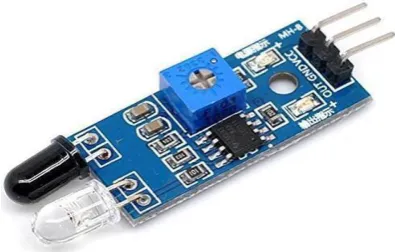
An infrared sensor is an electronic device that emits in order to sense some aspects of the surroundings. An IR sensor can measure the heat of an object as well as detects the motion. This sensor is analogous to human’s visionary senses, which can be used to detect obstacles and it is one the common applications in real time.
Figure 3:
IR Sensor4.3
RFID tag and reader
[image:2.595.333.531.368.494.2]© 2019, IRJET | Impact Factor value: 7.211 | ISO 9001:2008 Certified Journal
| Page 5261
Figure 4:
RFID tag and reader4.4
HC-SR04 ULTRASONIC SENSOR
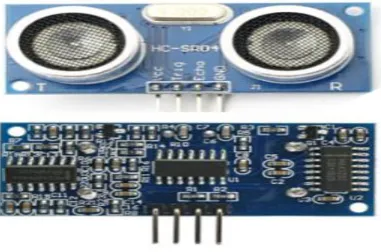
[image:3.595.46.561.46.230.2]Ultrasonic transmitter emitted an ultrasonic wave in one direction, and started timing when it launched. Ultrasonic spread in the air. At last, the ultrasonic receiver would stop timing when it received the reflected wave. The principle of ultrasonic distance measurement used the already-known air spreading velocity, measuring the time from launch to reflection when it encountered obstacle, and then calculate the distance between the transmitter and the obstacle according to the time and the velocity.
Figure 5: Ultrasonic Sensor
4.5
GAS Sensor
GAS sensor is a chemical optical sensor utilizing the acidic nature of GAS for detection. It consists of a gas-permeable membrane in which a pH-sensitive luminescence dye is immobilized together with a buffer and an inert reference luminescent dye. GAS permeating into the membrane changes the internal pH of the buffer. With this changes the luminescence of the pH-sensitive dye. Together with the inert reference dye internal referencing is made for detection of the luminescence lifetime of the sensor. The measurement signal detected by the pGAS mini correlates to the partial pressure of GAS ambient.
Figure 6:
GAS Sensor4.6
UART
[image:3.595.342.524.378.443.2]The Universal Asynchronous Receiver/Transmitter (UART) controller is the key component of the serial communications subsystem of a computer. UART is also a common integrated feature in most microcontrollers. The UART takes bytes of data and transmits the individual bits in a sequential fashion. At the destination, a second UART re-assembles the bits into complete bytes.
Figure 7:UART
4.7
GSM MODEM
[image:3.595.67.258.415.541.2]© 2019, IRJET | Impact Factor value: 7.211 | ISO 9001:2008 Certified Journal
| Page 5262
Figure 8:GSM Modem4.8
Water Sensor
[image:4.595.37.497.45.254.2]Water level detection sensor works on the basic principle of conduction through the water. It can be used for water level detection, rainfall detection, water leakage detection, etc. The sensor has been divided into two parts, a sensing module also known as brick and a circuit module.
Figure 9:Water Sensor
4.9
LED
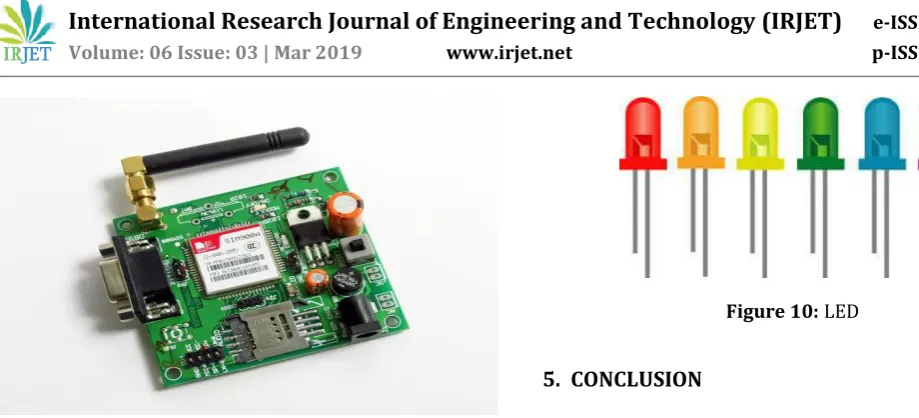
Light Emitting Diodes (LEDs) are the most widely used semiconductor diodes among all the different types of semiconductor diodes available today. Light emitting diodes emit either visible light or invisible infrared light when forward biased. The LEDs which emit invisible infrared light are used for remote controls. A light Emitting Diode (LED) is an optical semiconductor device that emits light when voltage is applied. In other words, LED is an optical semiconductor device that converts electrical energy into light energy.
Figure 10:LED
5.
CONCLUSION
In this project we have developed the model of Smart solid and liquid waste management system using wireless technology with the help of ARDUINO MEGA microcontroller connected to it. Moreover that waste management is another sector need to be maintained properly. So monitoring the use of sensors. It’s a possible way to monitor and clean the dustbin and more efficient system than the current existing. The watages bin worked smartly as expected. The solid and liquid are connected to UART is transfer to the GSM module to execute the message for control unit. Than cleaning the wastages are cleaners need to take. Than providing a smart technology for waste management system, by this reducing human time and effort. This system has a lot of advantages such as simple structure, low power consumption, low cost and stable and healthy environment system to design the wastage bins. The designed system is very portable so as to make it easy to access, configure, run and maintain. By smart waste management system biggest challenges of waste management security for smart cities can be solved.
REFERENCES
[1] A. P. J. G. a. S. K. Dimitris Karadimas, "An integrated node for Smart- City applications based on active RFID tags; Use case on waste-bins," in Emerging Technologies and Factory Automation (ETFA), 2016 IEEE 21st International Conference on, Berlin, 2016.
[2] D. K. J. G. A. G. V. A. Papalambrou, "A Versatile Scalable Smart Wastebin System based on Resource-limited Embedded Devices," in Emerging Technologies & Factory Automation (ETFA), 2015 IEEE 20th Conference on, Luxemburg, 2015.
[3] Y. S. L. W. L. Y. Fachmin Folianto, "Smartbin: Smart Waste Management System," in 2015 IEEE Tenth International Conference on Intelligent Sensors, Sensor Networks and Information Processing (ISSNIP), Singapore, 2015.
[4] M. I. W. D. O. D. L. B. a. C. R. Santi Phithakkitnukoon, "TrackingTrash," IEEE Pervasive Computing, vol. 12, no. 2, pp. 38-48, 2013.
[image:4.595.40.282.376.489.2]© 2019, IRJET | Impact Factor value: 7.211 | ISO 9001:2008 Certified Journal
| Page 5263
Renewable Energy Technologies (PGSRET), Islamabad,2015.
[6] N. N. K. Tan Jui Ang, "Innovative of mechanical top clamp fixture calibration through load cell methodology," in Electronics Manufacturing Technology (IEMT) & 18th Electronics Materials and Packaging (EMAP) Conference, 2016 IEEE 37th International, George Town, Malaysia, 2016.
[7] M. A. H. A. H. Md. Abdulla Al Mamun, "Real Time Solid Waste Bin Monitoring System Framework Using Wireless Sensor Network," in Electronics, Information and Communications (ICEIC), 2014 International Conference on, Kinibalu, Malaysia, 2014.
[8] B. Humoreanu and I. Nascu, ”Wastewater treatment plant SCADA application,” Proceedings of 2012 IEEE International Conference on Automation, Quality and Testing, Robotics, Cluj-Napoca, 2012, pp. 575-580. doi: 10.1109/AQTR.2012.6237776
[9] S. Grieu, A. Traore and M. Polit, ”Fault detection in a wastewater treatment plant,” ETFA 2001. 8th International Conference on Emerging Technologies and Factory Automation. Proceedings (Cat.No.01TH8597), Antibes-Juan les Pins, France, 2001, pp. 399-402 vol.1. doi:10.1109/ETFA.2001.996394
[10] F. M. Sanchez, A. Filgueira, M. A. Seijo, M. E. Munoz and E. Munoz,”Energy audit model for a waste water treatment plant,” 2009 International Conference on Clean Electrical Power, Capri, 2009, pp. 550-554. doi:10.1109/ICCEP.2009.5211984
[11] L. Fan, K. Boshnakov and J. Lv, ”Integrated control for the urban waste water treatment system based on multivariable regulator,” Proceedings of the 29th Chinese Control Conference, Beijing, 2010, pp. 4975-4980.
[12] A. Kumar, B. Maurya and D. Chandra, ”Dimension reduction and controller design for a waste water treatment plant,” 2015 International Conference on Power and Advanced Control Engineering (ICPACE),
Bangalore, 2015, pp. 413-417.
doi:10.1109/ICPACE.2015.7274983
BIOGRAPHIES
Mr. A. Riyas
Pursuing B.E in Electronics and Communication Engineering final year from AVS Engineering College, Salem (DT), Tamil Nadu, India.
Mr. S. Saranraj
Pursuing B.E in Electronics and Communication Engineering final year from AVS Engineering College, Salem (DT), Tamil Nadu, India.
Mr. E. Poovarasan
Pursuing B.E in Electronics and Communication Engineering final year from AVS Engineering College, Salem (DT), Tamil Nadu, India.
Prof. Mr. M. Vasantha Kumar ME, MBA,