warwick.ac.uk/lib-publications
Original citation:
Pham, Thinh H., Fahmy, Suhaib A. and McLoughlin, Ian V. (2016) Efficient integer frequency
offset estimation architecture for enhanced OFDM synchronization. IEEE Transactions on
Very Large Scale Integration (VLSI) Systems, 24 (4). pp. 1412-1420.
Permanent WRAP URL:
http://wrap.warwick.ac.uk/77878
Copyright and reuse:
The Warwick Research Archive Portal (WRAP) makes this work by researchers of the
University of Warwick available open access under the following conditions. Copyright ©
and all moral rights to the version of the paper presented here belong to the individual
author(s) and/or other copyright owners. To the extent reasonable and practicable the
material made available in WRAP has been checked for eligibility before being made
available.
Copies of full items can be used for personal research or study, educational, or not-for profit
purposes without prior permission or charge. Provided that the authors, title and full
bibliographic details are credited, a hyperlink and/or URL is given for the original metadata
page and the content is not changed in any way.
Publisher’s statement:
“© 2016 IEEE. Personal use of this material is permitted. Permission from IEEE must be
obtained for all other uses, in any current or future media, including reprinting
/republishing this material for advertising or promotional purposes, creating new collective
works, for resale or redistribution to servers or lists, or reuse of any copyrighted component
of this work in other works.”
A note on versions:
The version presented here may differ from the published version or, version of record, if
you wish to cite this item you are advised to consult the publisher’s version. Please see the
‘permanent WRAP url’ above for details on accessing the published version and note that
access may require a subscription.
Efficient Integer Frequency Offset Estimation
Architecture for Enhanced OFDM Synchronization
Thinh Hung Pham,
Student Member, IEEE,
Suhaib A. Fahmy,
Senior Member, IEEE
and Ian Vince McLoughlin,
Senior Member, IEEE
Abstract—In orthogonal frequency-division multiplexing (OFDM) systems, integer frequency offset (IFO) causes a circular shift of the sub-carrier indices in the frequency domain. IFO can be mitigated through strict RF front-end design, which tends to be expensive, or by strictly limiting mobility and channel agility, which constrains operating scenarios. IFO is therefore often estimated and removed at baseband, allowing implementations to benefit from relaxed RF front-end specifications and be tolerant to both Doppler shift and multi-standard channel selection. This paper proposes a novel architecture for IFO estimation which achieves reduced power consumption and lower computational cost than contemporary methods, while achieving excellent estimation performance, close to theoretically achievable bounds. A pilot subsampling technique enables four-fold resource sharing to reduce computational cost, while multiplierless computation yields further power reduction. Performance exceeds that of conventional techniques, while being much more efficient. When implemented on FPGA for IEEE 802.16-2009, dynamic power reductions of 78% are achieved. The architecture and method is applicable to other OFDM standards including IEEE 802.11 and IEEE 802.22.
Index Terms—OFDM, digital signal processing, field pro-grammable gate arrays.
I. INTRODUCTION ANDRELATEDWORK
OFDM has been widely adopted for both wired and wireless communication systems due to its well-document robustness to multipath and spectral efficiency. However, it is sensitive to receiver synchronisation errors such as carrier frequency offset (CFO) which causes inter-carrier interference (ICI), and which is exacerbated by issues such as motion-induced Doppler shifts and local oscillator instability [1]. Large CFO is split into fractional (FFO) and integer (IFO) offsets for estimation [2], [3], [4], [5], [6]. IFO causes a circular shift of the subcarrier in the frequency domain while FFO results in ICI due to lost orthogonality between subcarriers. In many published works on OFDM synchronisation, the CFO is split into coarse- and fine frequency offset estimation processes, which determine IFO and FFO respectively [7].
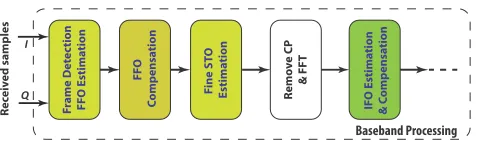
Fig. 1 illustrates the typical FFO and IFO estimation process for OFDM. Nogami’s method [8] estimates IFO by searching for a correlation maxima between the known preamble symbol and a cyclically shifted version of the received preamble symbol in the frequency domain. The technique is simple, but its performance degrades significantly in frequency selective channels. Maximum Likelihood Estimation (MLE) has been
T. H. Pham and S. A. Fahmy are with the School of Computer Engineering, Nanyang Technological University, Singapore (email: [email protected])
[image:2.612.312.552.181.254.2]I. V. McLoughlin is with the School Computing, University of Kent, UK.
Fig. 1. Baseband processing block diagram.
used to estimate IFO [5], [6], based upon the observation of pilots from two consecutive OFDM symbols. A reduced complexity alternative is to only compute over one preamble OFDM symbol, using differential encoding among adjacent subcarriers and correlation estimation [2], [3]. Li et al. [9] proposed a method using a cross ambiguity function based on an energy-detection metric, which can be computed in the time domain. This provides high accuracy and gives a full range estimation of the IFO in the presence of frequency selective fading, but requires an exhaustive search. Although there has been significant research on IFO estimation methods, this has primarily been restricted to studies in simulation.
novel method achieves very accurate IFO estimation on low-power FPGAs with minimal hardware cost, at significantly lower power than existing solutions. Implementation of this technique in a radio system can allow relaxed front end design constraints, potentially lowering design cost, as well as enabling greater robustness in high mobility applications.
This paper is organized as follows: Section II describes the signal model for IFO estimation while Section III introduced the proposed method in comparison to previous work. Section IV details simulations used to evaluate the method against conventional approaches. Section V presents the implemention on FPGA and discusses resource requirements and power consumption issues. Section VI concludes the paper.
II. INTEGERFREQUENCYOFFSETESTIMATION
We consider a signalx(n)of an OFDM system with inverse fast Fourier transform (IFFT) length N. Assuming the signal is transmitted over a frequency selective channel with impulse response (CIR) hand length,Lh, corrupted by additive white
Gaussian noise (AWGN), the received signal, with frequency offset and timing offset, is expressed in the time domain as
y(n) = Lh−1
X
l=0
h(l)x(n−τ−l)ei(2πξn−Nτ+φ0)+w(n) (1)
where w(n) denotes AWGN in the time domain, τ, φ0 are residual timing offset (RTO) and error phase, respectively, and ξ is the normalised CFO that can be divided in to a fractional (FFO) partλand integer (IFO) partasξ=λ+. This paper focuses on IFO estimation, with FFO assumed to be compensated by earlier stages of synchronisation, as investigated in detail elsewhere [20], [4].
The received preamble symbol at FFT output is
Y(k) =ei(φ0−2πτ kN)H(k−)X(k−) +W(n) (2)
whereW(k)andH(k)are the frequency domain representa-tions of AWGN and CIR, respectively. As mentioned previ-ously, IFO results in a cyclic shift in the frequency domain. By contrast, RTO causes a linear phase rotation on samples in the frequency domain. Based on a differential demodulation of the FFT output, the IFO can be conventionally determined with robustness to frequency selective channel and RTO using the correlation function [2] expressed by:
ˆ
= argmax
˜
N
X
k=1
Y∗(k−1)Y(k)X∗(k−˜)X(k−1−˜)
where (.)∗ denotes complex conjugation, ˆ, ˜ are estimated
and trial values of , respectively,Y(k)andX(k)denote the
kth frequency symbol index of the received symbol and the known transmitted preamble, respectively, and the symbol size
N is equal to the FFT size.
IFO can be estimated with high precision using cross-correlation in the frequency domain, however implementing this involves a significant hardware overhead, with a multiplier for each element. Sign-bit cross-correlation [21] is a widely adopted approach to reducing correlation complexity by using
only the most significant bit (MSB) of signed numbers for the computation. Complexity is reduced at the cost of performance degradation. Even using such methods, cross-correlation re-mains computationally expensive, especially when dealing with a large FFT size. It should be noted here that several IFO estimation methods have been published which claim robustness to frequency selective channels and RTO. However published FPGA implementations of these methods are lacking to date, possibly because the hardware costs are considerable – even for sign-bit cross-correlation.
III. PROPOSEDIFO ESTIMATIONMETHOD
We save hardware resources and reduce power consumption by exploiting redundancy in the IFO computation to enable an efficient resource sharing folded architecture. Furthermore, adjusting the precision of individual correlation computations within this novel architecture allows a fine degree of control of the trade-off between performance and power consumption. Thanks to the significant hardware cost reduction achieved, this IFO estimator can be feasibly implemented on a low-power, limited-resource FPGA, while simultaneously ensuring synchronisation performance is maintained by adjusting the trade off between accuracy and hardware cost.
In [22], the authors investigated multiplierless correlation based on a conventional transpose form structure and similarly demonstrated a trade-off between cost and accuracy for OFDM timing synchronisation. The authors extended this in [20], to a method for OFDM timing synchronisation plus FFO estimation. The synchronisation method performed well with large CFO, however IFO was neither estimated nor corrected. Note also that these previous papers performed computations in the time domain, before the FFT. However, in order to implement an OFDM system that can tolerate larger CFO, IFO estimation needs to be implemented after the FFT, in the frequency domain. Thus, this paper develops an algorithm and architecture for efficient IFO estimation (in the frequency domain), achieving excellent performance at lower hardware cost and lower power than existing methods. It is applicable to 802.11, 802.22 and 802.16 (and potentially to other OFDM standards). Due to space limitations, we will present a single case study using the long preamble of IEEE 802.16-2009 [23].
A. Proposed Algorithm
Firstly, we assume that the RF front end can provide CFO stability in a range,RCFO, from−14to+18sub-carrier
employed for FFO estimation in recent standard systems. It is computed on the short preamble, consisting of periodic durations with length D [20]:
M(n) = D−1
X
m=0
{s∗(n+m)s(d+m+D)}
= ej2πξDN
D−1
X
m=0
|x(n+m)|2, (3)
wheres(n)denotes the received signal with carrier frequency offsetξwith respect tox(n). The two parts ofξare estimated based on the angle of M (6 M):
ˆ
ξ= ˆλ+ ˆ= 6 M + 2πz
2πD/N , (4)
where z is an integer. The FFO is estimated as λˆ = N6 M
2πD .
The remaining part after FFO is corrected is the IFO, denoted as ˆ = zN
D. 6 M is within the range−π to π and for many
standards (including IEEE 802.11, 802.16, and 802.22), ND = 4. Hence, FFO is estimated in the range −2 to2 sub-carrier spacings, and IFO can be expressed as ˆ = 4z ∈ RCFO. Hence, there are 8 possible values for the IFO after correcting FFO, assuming the given CFO range. Possible IFO values are denoted SIFO ={−12,−8,−4,0,4,8,12,16}.
Referring to the OFDM symbol sequence in Fig. 2(a), if ˆ > 0, data symbols are rotated left by a few places. Compensation is performed using small buffer (of size 4 symbols for the example of ˆ = 4). However, if ˆ < 0, the starting data symbol is circular shifted right, wrapping around to be among the final last symbols. Compensation now requires a buffer to store all intervening symbols. For the example whereˆ=−4, N-4 symbols will require buffering. This long buffer is shown in Fig. 2(b), where N=256 for IEEE 802.16. To significantly reduce buffer requirements, we delay computation of the IFO by 12 symbols, so that the compensation shift is always positive: S0IFO = {0 : 4 : 28}. This means that received symbols will only ever need to be shifted right to compensate IFO, with a maximum shift of 28 rather than 255, hence reducing buffer memory requirements, as shown in Fig. 2.
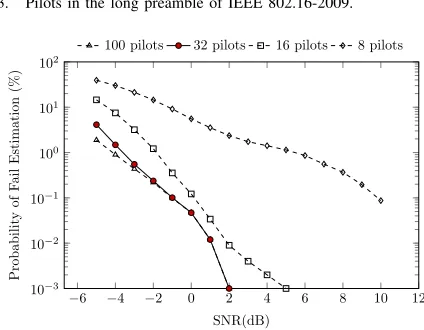
A second efficiency gain is achieved by creating a resource sharing folded architecture. Conventional IFO estimation is computed across all pilots in the preamble. This results in considerable hardware overhead, especially with a large num-ber of pilots. IEEE 802.16-2009 includesN p= 100pilots in the long preamble, as illustrated in Fig. 3, distributed with 50 pilots per side at even sub-carrier spacings from 2 to 100 and from 156 to 254. The remaining sub-carriers are null. A trade off is possible by reducing hardware cost through using only a subset of pilots for the computation, at the expense of reduced noise robustness. Detailed simulations can help us explore the impact of using a reduced pilot set on performance. Fig. 4 plots the common probability of fail estimation (POFE, see Section IV) measure against signal to noise ratio (SNR) when using different numbers of pilots, revealing that there is very little performance difference between using the full 100 pilots and a subset of 32 pilots above about -2 dB SNR.
(a) Rotated data symbols caused by IFO
[image:4.612.324.548.50.247.2](b) Conventional approach (c) Proposed method
Fig. 2. IFO Correction for example scenarios of no IFO (ˆ= 0), as well asˆ=−4andˆ= 4(top). The conventional and proposed approaches are shown (below) forˆ=−4.
We therefore propose making use of only a subset of pilots for offset estimation – enough to maintain accuracy, but by carefully selecting the chosen pilots in the frequency domain as multiples of 4, we are able to specify a four-fold resource sharing design. Hence, the IFO estimation can be expressed as:
ˆ
= argmax
˜
∈S0
IF O
|V˜|,
V˜ = N p/4
X
k=1
P(4k)A1˜(k) +P(L+ 4k)A2˜(k), (5)
whereV˜is the cross-correlation between received pilots and pre-rotated known pilots and P(4k) = Y∗(4k −2)Y(4k)
denotes the correlation of two consecutive received pilots. Since the pilots of the long preamble are distributed on two
Fig. 3. Pilots in the long preamble of IEEE 802.16-2009.
−6 −4 −2 0 2 4 6 8 10 12 10−3
10−2 10−1 100 101 102
SNR(dB)
Probabilit
y
of
F
ail
Estimation
(%)
100 pilots 32 pilots 16 pilots 8 pilots
[image:4.612.329.541.553.718.2]sides of the OFDM symbol in the frequency domain, at even sub-carrier spacings, L denotes the index of the first pilots in the second half. A1˜(k) = X∗(4k−2−˜)X(4k−˜),
A2˜(k) = X∗(L+ 4k−2 −˜)X(L+ 4k−˜) denote the correlation of two consecutive pre-rotated known pilots of the first side and second side, respectively, of the preamble symbol corresponding to one IFO value (˜). Let A˜ be a known coefficient set as A˜ = {A1˜, A2˜}. Let Si denote
the set of used pilot indices for the proposed method (i.e.
Si ={(4:4:N p2 ), (L:4:N)}) we present Algorithm 1 to con-currently compute the cross-correlations, where the received pilots whose indices are inSiare employed to computeP4k.
Algorithm 1 IFO correlation computation algorithm.
Init: k= 0; n= 0 repeat
Every 4cycles
if4k∈Sithen
Calculate P4k
forEach˜∈S10IF O ={0,4,8,12}do
V˜ + =P4kA˜(n)
end for
forEach˜∈S20IF O ={16,20,24,28}do
V˜ + =P4kA˜(n)
end for
n + = 1 end if
k + = 1 untilk > N p/2
Assuming that the data symbols are received from the FFT in sequence, the duration between the employed pilots is four clock cycles. For each value ˜ in S10
IFO, and S20IFO,
the corresponding V˜ can be computed separately at every
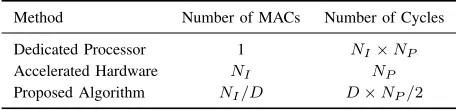
[image:5.612.50.302.220.382.2]clock cycle using two multiply-accumulate blocks with the corresponding known coefficients. Hence, 8 cross-correlations can be computed in the duration between two employed pilots. Table I compares this in terms of time-area complexity to the conventional method implemented in a dedicated processor or using accelerated hardware. NI is the number of possible
IFO values andDdenotes the duration between two employed pilots (NI=8 and D=4 for the 802.16 case study). The figures
are specified using single-cycle multiply accumulate (MAC) operations, and clearly show the two common trade-off points of maximum sequential operation and maximum parallelism, with the proposed method lying between the two: however it uses D times less hardware than the latter, but completes in
D/2 more cycles. Similarly, it uses NI/D more MACs than
the former but completes D/2NI cycles quicker. Note the
factor of two improvement over a straight-line interpolation between the extreme trade-offs. Moreover, IFO estimation is
TABLE I
COMPUTATION TIME FOR DIFFERENT APPROACHES.
Method Number of MACs Number of Cycles
Dedicated Processor 1 NI×NP
Accelerated Hardware NI NP
Proposed Algorithm NI/D D×NP/2
computed in parallel with receiving the OFDM packet. It takes
N (i.e. 256 for 802.16) cycles to receive the OFDM packet stream, whereas IFO estimation takes D× N P2 (i.e. 200 for 802.16) cycles. IFO estimation can be done immediately after the preamable packet is received and does not add latency to the OFDM packet stream. The next subsection will determine a method able to achieve this resource sharing for computing
V˜ as well as in storing the pilots.
In addition, we will use multiplierless correlation with adjustable wordlength to further expand the per-formance/complexity trade off. Although sign-bit cross-correlation is often used in conventional implementations to reduce computational complexity [4], [21], it leads to reduced precision and hence reduced estimation performance, espe-cially in frequency selective channels. By contrast, multipli-erless correlation allows a fine degree of control to enhance accuracy over a sign-bit approach, while still allowing a reduction in complexity over a full calculation. In [22], the authors demonstrated a trade-off between cost and accuracy for multiplierless correlation in the case of OFDMtiming syn-chronisation, based on a conventional transpose form structure. We now apply a similar approach to this new IFOfrequency
estimation architecture, exploring the performance, area and power consumption effects of changing the wordlength used to representP4k, in Section IV-B.
B. Proposed Architecture
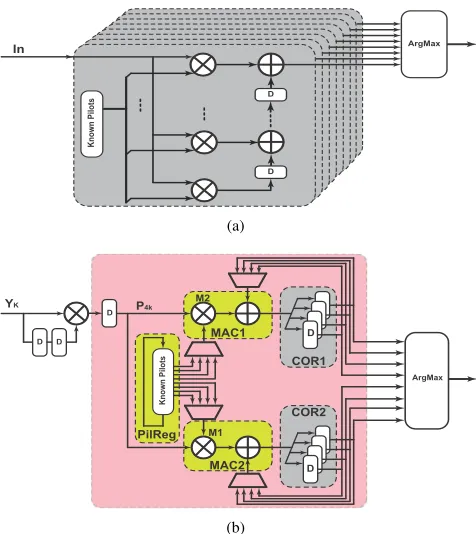
Fig. 5(a) shows a conventional architecture for computing the IFO estimation, while Fig. 5(b) shows the proposed resource sharing architecture. Cross-correlators compute the values of V˜ while the ArgMax module finds the maximum
of the V˜ values in order to identify the corresponding IFO
estimate. The conventional approach in Fig. 5(a) employs separate cross-correlators to calculate each V˜ result. This
requires significant resources, including a large number of multipliers which may be not available on a limited-resource FPGA. The novel architecture comprises two parts:
Sharing stored pilot memory: There are 8 sets of A˜
corresponding to 8 possible IFOs. These sets of A˜ are
pre-computed and stored separately in a dual-port register file. Thanks to the spreading of the computed pilots, the A˜
sets have many identical pilots. This naturally allows sharing between pre-rotated pilot sets. Therefore, the PilReg block requires only 64 shared memory locations for the 8 sets instead of 400; an 84% reduction. Fig. 6 illustrates the A˜ sets and
circuitry for combining allA˜ sets in thePilRegblock.
[image:5.612.60.288.692.747.2](a)
[image:6.612.55.293.49.316.2](b)
[image:6.612.331.534.51.209.2]Fig. 5. Architectures of IFO estimators: (a) conventional approach, and (b) proposed method.
Fig. 6. Circuit of known pilots shift register.
subsampling ofPk, taking a subset of the most significant bits
from Pk every four cycles to perform the cross-correlation.
Two multiply accumulate blocks,MAC1andMAC2, are used to compute the values of 8 cross-correlations in parallel. Each multiplier performs multiplications sequentially between
P4k and the corresponding transmitted pilots in 4 sets of
A˜. The products are accumulated to the values of V˜. The
values of the correlation operations are stored separately in the corresponding buffers in the COR1,COR2 blocks. When the correlation computation is complete, the maximum operation,
argmax|V|, is performed on 8V˜values to estimate the IFO.
To obtain further resource savings, MAC1 and MAC2 are implemented using multiplierless techniques. V˜ in Eqn.
(5) is mathematically manipulated into what is effectively a multiply-accumulate form. When one received sample is received,V˜ can be expressed as an accumulation:
V˜ = A˜P4k+V˜,
= (<{U} −i={U})(<{P4k}+i={P4k}) +
(<{V˜}+i={V˜}), (6)
[image:6.612.48.299.355.439.2]where <{.} and ={.} denote the real and imaginary parts, respectively.A˜are normalized toUwhose real and imaginary
Fig. 7. Resource sharing approach for computingV˜.
parts have values in {-1, 0, 1}, and the wordlength of P4k
and V˜ in fixed point format can be adjusted to trade off
between estimation accuracy and hardware resource. The real and imaginary parts of V˜ are computed as follows:
<{V˜} = <{U}<{P4k}+={U}={P4k}+<{V˜},
={V˜} = <{U}={P4k} − ={U}<{P4k}+={V˜} (7)
In the next section we will demonstrate through simula-tion on different channels that the algorithm and architecture optimisations mentioned above retain competitive estimation accuracy compared to conventional approaches, while offering significant reductions in hardware resource. This makes it possible to implement a high-performance OFDM receiver on a low-power FPGA that has a limited number of DSP blocks.
IV. SIMULATION
Many variants of the proposed method were simu-lated in MATLAB using different channel models with the IEEE 802.16-2009 downlink preamble parameter set. Perfor-mance was compared to the theoretical perforPerfor-mance of some state of the art methods in terms of POFE with respect to channel SNR. POFE [2], [3], [5], measures the number of failed estimations divided by the total number of IFO esti-mations. Overall, 100,000 IFO estimations were simulated in AWGN and Stanford University Interim (SUI) [24] frequency selective channels. IFO estimation is performed with non-ideal FFO compensation, and FFO is determined and compensated using the method of Kim and Park [4]. The simulation also verifies the performance of the proposed method under the effect of residual timing offset (RTO) caused by imperfect STO estimation (assuming that STO estimation is still within the CP and does not cause ISI). In addition, a randomly generated amount of STO is added in the range from 0 toNCP−Lh−1
(i.e. the RTO is in range from 0 toNCP −Lh−1).
one training block with 100 pilots, plus two state of the art methods: The first is metric SY from [3] as defined by,
µSY(˜) =<
N/2
X
k=1
Y(2∗k−2)Y(2k)X(2∗k−˜)X(2k−2−˜)
whereˆ= argmax
˜
∈SIF O
{µ(˜)}. Second, metric MMfrom [5],
µM M(˜) =<
eiπ4 N/2
X
k=1
Y(2∗k−2)Y(2k)X(2∗k−˜)X(2k−2−˜)
where <{.} denotes the real part. The very large hardware requirement of these metrics does not lend them to feasible implementation on a low cost, low power FPGA (unlike our proposed method). As a result, the authors are unaware of any published circuits for these methods.
A. Performance Comparison
The performance of the proposed method, denoted Prop, is evaluated in comparison to the theoretical performance of state of the art methods by Park et. al. [2], Shim and You [3] and Morelli and Moretti [5], denoted PCH, SY and
MM, respectively in the previous subsection. The theoretical performance is computed with full precision using a full pilot set (100 pilots). However, it must be noted that implementing this directly in hardware would be prohibitive due to the large number of high precision multiplication operations required. Instead, hardware implementation would conventionally use sign-bit correlation instead of full precision, as mentioned previously. Thus the full multiplication results shown here are undoubtedly better than those achievable in practice, and should be considered as upper theoretical bounds. For more realistic comparisons, we provide results from sign-bit correlation versions of each, denoted PCH sb, SY sb, and MM sb respectively. The method in [4] employs sign-bit correlation to implement a joint STO and IFO estimator by performing a long cross correlation in the time domain for STO estimation, plus an exhaustive search across a large potential CFO range. This results in larger hardware usage compared to the frequency domain methods of [5], [2], [3], and is not therefore not included in the comparison.
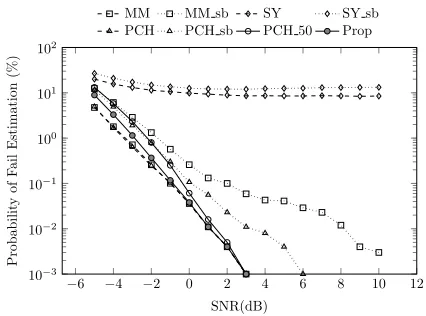
The proposed method uses 50 spread pilots with indices that are multiples of 4. For the sake of fair comparison, we include an additional implementation of PCH which uses 50 pilots like the proposed method, spaced continuously. This is denoted PCH 50. Figs. 8 plots performance results for all methods in an AWGN channel with RTO and reveals that the proposed method generally performs well, especially at higher SNRs. A more realistic SUI1 channel model is used for Fig. 9, again reveals good performance, particularly at positive SNRs (performance is similarly good in SUI2 which is not plotted for space reasons).
Under these experimental conditions, PCHandSY achieve equivalent performance in AWGN without RTO and in the SUI1 channel. In general SY appears to be very sensitive to large RTO, while MM and PCH exhibit better robustness to
−6 −4 −2 0 2 4 6 8 10 12 10−3
10−2 10−1 100 101 102
SNR(dB)
Probabilit
y
of
F
ail
Estimation
(%)
[image:7.612.330.543.52.210.2]PCH PCH sb PCH 50 Prop
Fig. 8. Fail rate of IFO estimation methods in AWGN channel with RTO.
−6 −4 −2 0 2 4 6 8 10 12 10−3
10−2 10−1 100 101 102
SNR(dB)
Probabilit
y
of
F
ail
Estimation
(%)
[image:7.612.330.540.243.398.2]MM MM sb SY SY sb PCH PCH sb PCH 50 Prop
Fig. 9. Fail rate of IFO estimation methods in SUI1 channel.
RTO. The accuracy ofMMis slightly lower than that ofPCH
at SNRs below 0 dB, while performance is very similar at larger SNRs. Also note the performance of the conventional approach implementations, PCH sb, SY sb, MM sb which degrade significantly with SNR, especially in the SUI chan-nels. Recall that these represent the typical implementation of estimators, with expensive multipliers replaced by sign-bit correlation.
Apart from at very low SNRs, the proposed method,Prop, achieves almost identical performance to the simulated upper bound PCH, even in the presence of RTO. It should be noted that Prop achieves this while allowing the use of resource sharing through sparse pilot computation, achieving a significant hardware saving. The results also show thatProp, with its spread pilots, is more accurate thanPCH 50using the same number of pilots spread continuously.
B. Wordlength Optimisation
Since sign-bit correlation degrades IFO estimation perfor-mance, especially in frequency selective channels, we instead explore the use of different word length multiplierless correla-tion to trade off between hardware resource and estimacorrela-tion per-formance. We again compared against the theoretical bound,
PCH, and against a conventional sign-bit implementation,
−6 −4 −2 0 2 4 6 10−3
10−2 10−1 100 101
SNR(dB)
Probabilit
y
of
F
ail
E
sti
m
ation
(%)
[image:8.612.68.284.53.215.2]PCH PCH sb Prop 15b Prop 7b Prop 2b Prop 1b
Fig. 10. Fail rate for different wordlengths in AWGN channel with RTO.
−6 −4 −2 0 2 4 6
10−3 10−2 10−1 100 101
SNR(dB)
Probabilit
y
of
F
ail
E
stimation
(%)
PCH PCH sb Prop 15b Prop 7b Prop 2b Prop 1b
Fig. 11. Fail rate for different wordlengths in an SUI1 channel.
meaning a single integer bit andf fractional bits. Evaluations are performed for f ={1,2,7 & 15}bits with results plotted using the labels Prop 1b,Prop 2b, Prop 7b, and Prop 15b, respectively. Figs. 10 plots the performance in AWGN with RTO for all tested wordlengths. The proposed method per-forms comparably toPCH(and is better thanPCH sbat SNRs exceeding about 2 dB). Fig. 11 show the results when using the more realistic SUI1 channel models. Performance in SUI2 is similar, but not reproduced for space reasons.
It can be seen that each of the tested wordlengths achieves much better performance and exhibits greater robustness to frequency selective channels than the sign-bit conventional realisation, PCH sb. Additionally, these realisations of the proposed method do not suffer as much degradation in the presence of RTO. Moreover, it is possible to improve low SNR performance by adopting a longer wordlength with the proposed method, at a cost of increased hardware complexity. Increasing wordlength yields decreasing returns: moving from 1 to 2 bits yields a significant gain whereas increasing from 2 to 7 or from 7 to 15 bits has less impact. In general,Prop 2b
achieves an estimation accuracy close to that of the theoretical performance bound, PCH, at intermediate and higher SNRs, even though it involves computation with fewer bits, and can hence be implemented more efficiently.
V. FPGA IMPLEMENTATION
The analysis in Section IV suggests that the proposed method offers comparable estimation performance to existing methods in the literature. As a result of the simplifications inherent in the proposed approach, this should be achievable at a reduced hardware cost. This section now quantifies this hardware cost for an FPGA-based implementation. It is important to note that these hardware savings are accessible for a number of target implementation devices, although we are interested primarily in FPGA implementation as part of our work on leveraging FPGA reconfigurability for cognitive radios.
A. Conventional Approach
To obtain the theoretical performance previously discussed in Section IV and denoted as PCH, the computation of the estimation metric in [2], using 100 pilots, would require about 200 complex multipliers, resulting in the use of over 600 DSP blocks. This exceeds the available resources on small devices, and would leave insufficient resources for other tasks on larger devices. As the number of multiplications required for a full implementation is prohibitive, the conventional solution, as we have discussed, is to adopt sign-bit correlation [4]. Thus the conventional implementation uses all 100 pilots in the long preamble and sign-bit correlation, with multiply adds eliminated at taps where the pilots of the long preamble are zero or not used. This implementation mirrors the PCH sb
in Section IV, and allows us to quantify the benefits of our proposed approach against a known reference benchmark.
B. Proposed Approach
The proposed architecture implemented with several differ-ent wordlengths ofP4k andV˜ in (6) are compared, to allow
us to explore the hardware costs associated with the respec-tive implementations. Four fixed point formats for P4k, are
investigated: Q1.1, Q1.2, Q1.7, and Q1.15. V˜is represented correspondingly in formats of Q7.1, Q7.2, Q7.7, and Q7.15 to avoid overflow.
In order to obtain a comprehensive optimised implementa-tion, these circuits are each implemented using two different structures. The first uses only logic elements (LE) for compu-tation, while the second uses Xilinx DSP48A1 [25] primitives. Considering (7), <{V˜},={V˜} can be computed effectively
using two DSP blocks as 3-input adders, instead of 4 blocks as would be usual. Fig. 12 illustrates how this is done for
<{V˜}, and={V˜}is similar. Note that the solution presented
[image:8.612.67.283.251.412.2]Fig. 12. DSP block based 3-input adder for correlation.
C. Implementation Results
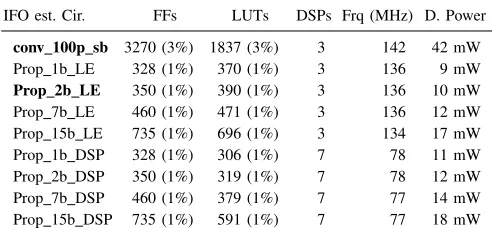
The circuits were synthesised and fully implemented using Xilinx ISE 13.2, targeting the low-power Xilinx Spartan-6 XC6SLX75T FPGA. The results are reported in terms of the number of flip-flops (FFs), look-up tables (LUTs), and DSP blocks, along with dynamic power consumption, as summarised in Table II.
TABLE II
RESOURCE UTILISATION AND DYNAMIC POWER CONSUMPTION.
IFO est. Cir. FFs LUTs DSPs Frq (MHz) D. Power
conv 100p sb 3270 (3%) 1837 (3%) 3 142 42 mW
Prop 1b LE 328 (1%) 370 (1%) 3 136 9 mW
Prop 2b LE 350 (1%) 390 (1%) 3 136 10 mW
Prop 7b LE 460 (1%) 471 (1%) 3 136 12 mW Prop 15b LE 735 (1%) 696 (1%) 3 134 17 mW Prop 1b DSP 328 (1%) 306 (1%) 7 78 11 mW Prop 2b DSP 350 (1%) 319 (1%) 7 78 12 mW Prop 7b DSP 460 (1%) 379 (1%) 7 77 14 mW Prop 15b DSP 735 (1%) 591 (1%) 7 77 18 mW
conv 100p sb refers to the conventional approach, imple-mented using sign-bit correlation over 100 pilots.Prop fb LE,
Prop fb DSP, in which f = 1, 2, 7 and 15 (correspond-ing to received sample format Q1.f), denote the circuits of corresponding wordlengths implemented using logic elements (LE) and DSP blocks, respectively. Table II reveals that the proposed implementation achieves a significant reduction in resource usage and dynamic power consumption.
The hardware resources used by Prop fb LE and
Prop fb DSP increase gradually, in terms of FFs and LUTs as the wordlength increases. The number of FFs used in
Prop fb DSP andProp fb LE is equal, while Prop fb DSP
uses fewer LUTs since the DSP blocks are used for the 3-input additions. TheProp fb LE implementations use 3 DSP blocks to compute P4k, while Prop fb DSP require an
addi-tional 4 DSP blocks to perform the correlation. Prop fb LE,
Prop fb DSP both consume far fewer LUTs and FFs than the conventional conv 100p sb sign-bit implementation. For
Prop 2b LE, the number of FFs and LUTs is reduced by 90% and 79% respectively compared to the conventional
conv 100 sb approach.
The maximum circuit frequencies, reported after place and route, are 142 MHz, 136 MHz and 78 MHz for the conven-tional sign bit-based and proposed LE- and the proposed DSP-based circuits, respectively, comfortably exceed the timing
requirements for most OFDM-based systems, particularly for 802.16 whose sampling frequency is below 25 MHz.
A post-place-and-route simulation was used to estimate the power consumption of the system at a clock rate of 50 MHz using the Xilinx XPower tool – also shown in Table II – re-vealing thatProp fb LEimplementations consume less power than the equivalentProp fb DSPimplementations. All imple-mentations of the proposed method consume significantly less power than the conventional implementation. For example,
Prop 2b LE consumes just 22% of the power required for
conv 100p sb.
Section IV established thatProp 2b LEeasily outperforms the conventional approach in terms of estimation accuracy. Now we can see that it does so with a significant hardware resource saving, as well as significantly reduced power con-sumption. In fact, the estimation performance ofProp 2b LE, in AWGN and SUI channels (except at very low SNR), is close to the theoretical bound of PCH, which would demand a significant amount of the FPGAs resources if it were imple-mented conventionally. Meanwhile,Prop 2b LEis extremely efficient, consuming less than 1% of the resources available on a low-power Spartan-6 XC6SLX75 FPGA.
VI. CONCLUSION
This paper has investigated IFO estimation in OFDM-based systems such as IEEE 802.16. A technique is proposed for efficient implementation of IFO estimation, which aims in particular for a low-power and low-resource utilisation. Since IFO estimation can contribute significantly to the complexity of a robust OFDM synchroniser design, this work is important for multi-standard radios, as well as applications such as mo-bile radios where significant frequency variation is expected. Robust IFO estimation can also allow for a relaxation of analogue RF constraints at the radio front end, potentially leading to a reduced cost implementation.
A novel timing algorithm was proposed that is allied with pilot sub-sampling to enable a four-fold resource sharing archi-tecture to reduce both hardware complexity as well as power consumption. Meanwhile, multiplierless correlation with opti-mised wordlengths is explored to improve estimation accuracy over a conventional implementation using sign-bit correlation. The proposed algorithm and architecture have been evaluated theoretically, in simulation (to determine system-level IFO estimation performance), through synthesis and post place-and-route implementation (to determine detailed resource util-isation and power consumption figures). The proposed method estimation performance matches current state-of-the-art meth-ods that employ multiplier-based correlation, yet achieves a significant reduction in hardware requirements. Dynamic power consumption of the proposed method is reduced by 78% over even an efficient sign-bit version of the conventional approach, yet offers much better estimation performance in both AWGN and frequency selective channels.
REFERENCES
[1] M. Morelli, A. D’Andrea, and U. Mengali, “Frequency ambiguity resolution in OFDM systems,”IEEE Communications Letters, vol. 4, no. 4, pp. 134–136, Apr. 2000.
[2] M. Park, N. Cho, J. Cho, and D. Hong, “Robust integer frequency offset estimator with ambiguity of symbol timing offset for OFDM systems,”
inProc. Vehic. Techn. Conf. (VTC), 2002, pp. 2116–2120.
[3] E.-S. Shim and Y.-H. You, “OFDM integer frequency offset estimator in rapidly time-varying channels,” inAsia-Pacific Conf. on Commun., 2006, pp. 1–4.
[4] T.-H. Kim and I.-C. Park, “Low-power and high-accurate synchroniza-tion for IEEE 802.16d systems,” IEEE Trans. on Very Large Scale
Integration (VLSI) Systems, vol. 16, no. 12, pp. 1620–1630, Dec. 2008.
[5] M. Morelli and M. Moretti, “Integer frequency offset recovery in OFDM transmissions over selective channels,”IEEE Transactions on Wireless
Communications, vol. 7, no. 12, pp. 5220–5226, Dec. 2008.
[6] D. Toumpakaris, J. Lee, and H.-L. Lou, “Estimation of integer carrier frequency offset in OFDM systems based on the maximum likelihood principle,”IEEE Trans. on Broadcasting, vol. 55, no. 1, pp. 95–108, Mar. 2009.
[7] C. Shahriar, M. La Pan, M. Lichtman, T. Clancy, R. McGwier, R. Tan-don, S. Sodagari, and J. Reed, “PHY-Layer Resiliency in OFDM Communications: A Tutorial,”IEEE Communications Surveys Tutorials, vol. 17, no. 1, pp. 292–314, 2015.
[8] H. Nogami and T. Nagashima, “A frequency and timing period acqui-sition technique for OFDM systems,” inSixth IEEE Inter. Symp. on
Personal, Indoor and Mobile Radio Communications (PIMRC), vol. 3,
Sep. 1995.
[9] D. Li, Y. Li, H. Zhang, L. Cimini, and Y. Fang, “Integer frequency offset estimation for OFDM systems with residual timing offset over frequency selective fading channels,”IEEE Trans. on Vehicular
Tech-nology, vol. 61, no. 6, pp. 2848–2853, Jul. 2012.
[10] M. Cummings and S. Haruyama, “FPGA in the software radio,”IEEE
Communications Magazine, vol. 37, no. 2, pp. 108–112, Feb. 1999.
[11] J. Guffey, A. Wyglinski, and G. Minden, “Agile radio implementation of OFDM physical layer for dynamic spectrum access research,” inIEEE
Global Telecommunications Conf (GLOBECOM), Nov. 2007, pp. 4051–
4055.
[12] A. Troya, K. Maharatna, M. Krstic, E. Grass, U. Jagdhold, and R. Krae-mer, “Low-Power VLSI Implementation of the Inner Receiver for OFDM-Based WLAN Systems,”IEEE Trans. on Circuits and Systems
I: Regular Papers, vol. 55, no. 2, pp. 672–686, Mar. 2008.
[13] S. J. Hwang, Y. Han, S. W. Kim, J. Park, and B. G. Min, “Resource efficient implementation of low power MB-OFDM PHY baseband modem with highly parallel architecture,”IEEE Trans. on Very Large
Scale Integration (VLSI) Systems, vol. 20, pp. 1248–1261, Jul. 2012.
[14] W. Fan and C.-S. Choy, “Robust, low-complexity, and energy efficient downlink baseband receiver design for MB-OFDM UWB system,”IEEE
Trans. on Circuits and Systems I: Regular Papers, vol. 59, no. 2, pp.
399–408, Feb. 2012.
[15] T. Pham, S. Fahmy, and I. McLoughlin, “Efficient multi-standard cognitive radios on FPGAs,” in International Conference on Field
Programmable Logic and Applications (FPL), Sept. 2014.
[16] Y. Zhang, J. Mueller, B. Mohr, and S. Heinen, “A Power Low-Complexity Multi-Standard Digital Receiver for Joint Clock Recovery and Carrier Frequency Offset Calibration,”IEEE Transactions on
Cir-cuits and Systems I: Regular Papers, vol. 61, no. 12, pp. 3478–3486,
Dec. 2014.
[17] M. Morelli, L. Marchetti, and M. Moretti, “Maximum Likelihood Frequency Estimation and Preamble Identification in OFDMA-based WiMAX Systems,” IEEE Transactions on Wireless Communications, vol. 13, no. 3, pp. 1582–1592, March 2014.
[18] ——, “Integer frequency offset estimation and preamble identification in WiMAX systems,” inIEEE International Conference on
Communi-cations (ICC), June 2014, pp. 5610–5615.
[19] Z. Zhang, L. Ge, F. Tian, F. Zeng, and G. Xuan, “Carrier frequency offset estimation of OFDM systems based on complementary sequence,”
inIEEE International Congress on Image and Signal Processing (CISP),
Oct. 2014, pp. 1012–1016.
[20] T. H. Pham, I. V. McLoughlin, and S. A. Fahmy, “Robust and Efficient OFDM Synchronisation for FPGA-Based Radios,” Circuits, Systems,
and Signal Processing, vol. 33, no. 8, pp. 2475–2493, Aug. 2014,
Springer.
[21] L. Schwoerer, “VLSI suitable synchronization algorithms and architec-ture for IEEE 802.11a physical layer,” inIEEE Inter. Symp. on Circuits
and Systems (ISCAS), vol. 5, 2002, pp. 721–724.
[22] T. H. Pham, S. A. Fahmy, and I. V. McLoughlin, “Low-Power Correla-tion for IEEE 802.16 OFDM SynchronizaCorrela-tion on FPGA,”IEEE Trans.
on Very Large Scale Integration (VLSI) Systems, vol. 21, no. 8, pp.
1549–1553, Aug. 2013.
[23] IEEE Standard for Local and Metropolitan Area Networks Part16:
Air Interface for Fixed Broadband Wireless Access Systems, IEEE
std.802.16-2009.
[24] V. Erceg, K. V. S. Hari, and M. S. Smith, “Channel models for fixed wireless applications,”Tech. Rep. IEEE 802.16a-03/01, Jul. 2003.
[25] UG389: Spartan-6 FPGA DSP48A1 Slice, Xilinx Inc., August 2009.
Pham Hung Thinh(S’13) received his B.S. degree
in Electrical and Electronic Engineering from Ho Chi Minh City University of Technology, Vietnam, and the M.Sc. degree in Embedded Systems Engi-neering from the University of Leeds, U.K., in 2007 and 2010, respectively. He is completing his Ph.D. in the joint Nanyang Technological University-Technische Universit¨at M¨unchen program in Sin-gapore in 2015 and is now a Research Associate at the TUM CREATE Centre for Electromobility, Singapore.
Suhaib A. Fahmy (M’01, SM’13) received the
M.Eng. degree in information systems engineering and the Ph.D. degree in electrical and electronic engineering from Imperial College London, UK, in 2003 and 2007, respectively.
From 2007 to 2009, he was a Research Fellow at Trinity College Dublin, and a Visiting Research Engineer with Xilinx Research Labs, Dublin. Since 2009, he has been an Assistant Professor with the School of Computer Engineering at Nanyang Technological University, Singapore. His research interests include reconfigurable computing, high-level system design, and computational acceleration of complex algorithms.
Dr. Fahmy was a recipient of the Best Paper Award at the IEEE Conference on Field Programmable Technology in 2012, the IBM Faculty Award in 2013, and is also a senior member of the ACM.
Ian Vince McLoughlin split his career between