Multilingual Multi-Document Summarization with POLY
2Marina Litvak
Department of Software Engineering Shamoon College of Engineering
Beer Sheva, Israel [email protected]
Natalia Vanetik
Department of Software Engineering Shamoon College of Engineering
Beer Sheva, Israel [email protected]
Abstract
In this paper we present a linear model for the problem of text summarization, where a summary preserves the information cov-erage as much as possible in comparison to the original document set. We reduce the problem of finding the best summary to the problem of finding the point on a convex polytope closest to the given hy-perplane, and solve it efficiently with the help of fractional linear programming. We supply here an overview of our system, ti-tled POLY2, that participated in the Multi-Ling contest at ACL 2013.
1 Introduction
Automated text summarization is an active field of research in various communities like Informa-tion Retrieval (IR), Natural Language Processing (NLP), and Text Mining (TM).
Some authors reduce summarization to the maximum coverage problem (Takamura and Oku-mura, 2009; Gillick and Favre, 2009) that, de-spite a great performance, is known as NP-hard (Khuller et al., 1999). Linear Program-ming helps to find an accurate approximated so-lution to this problem and became very popular in summarization field in the last years (Gillick and Favre, 2009; Woodsend and Lapata, 2010; Hi-toshi Nishikawa and Kikui, 2010; Makino et al., 2011). However, most mentioned works use expo-nential number of constraints.
Trying to solve a trade-off between summary quality and time complexity, we propose a novel summarization model solving the approximated maximum coverage problem by linear program-ming in polynomial time. We measure informa-tion coverage by terms1and strive to obtain a sum-mary that preserves the optimal value of the
cho-1normalized meaningful words
sen objective function as much as possible in com-parison to the original document. Various objec-tive functions combining different parameters like term’s position and its frequency are introduced and evaluated.
Our method ranks and extracts significant sen-tences into a summary and it can be generalized for both single-document and multi-document summarization. Also, it can be easily adapted to cross-lingual/multilingual summarization.
Formally speaking, in this paper we introduce (1) a novel text representation model expanding a classic Vector Space Model (Salton et al., 1975) to Hyperplane and Half-spaces, (2) re-formulated extractive summarization problem as an optimiza-tion task and (3) its soluoptimiza-tion using linear program-ming. The main challenge of this paper is a new text representation model making possible to rep-resent an exponential number of extracts without computing them explicitly, and finding the opti-mal one by simple minimizing a distance function in polynomial time.
2 Our Method
2.1 Definitions
We are given a set of sentencesS1, ..., Snderived from a document or a cluster of related documents. Meaningful words in these sentences are entirely described by termsT1, ..., Tm. Our goal is to find a subset Si1, ..., Sik consisting of sentences such
that (1) there are at most N terms in these sen-tences, (2) term frequency is preserved as much as possible w.r.t. the original sentence set, (3) re-dundant information among kselected sentences is minimized.
We use the standard sentence-term matrix,A= (aij)of sizem×n, for initial data representation, whereaij = kif termTi appears in the sentence
Sj preciselyktimes.
Our goal is to find subset i1, ..., ik of A’s
columns so that the chosen submatrix represents the best possible summary under some constraints. Since it is hard to determine what is the best summary mathematically (this task is usually left to human experts), we wish to express summary quality as a linear function of the underlying ma-trix. We strive to find a summary that gives an op-timal value once the function in question has been determined.
Basic text preprocessing includes sentence splitting and tokenization. Also, additional steps like stopwords removal, stemming, synonym res-olution, etc. may be performed for resource-rich languages.
2.2 Polytope as a document representation
We represent every sentence by a hyperplane and the lower half-space of that hyperplane. In a way, the hyperplane bounding each half-space is the sentence itself, and a half-space below it is an approximation of that sentence. An intersection of lower half-spaces in Euclidean space forms a convex polyhedron, and in our case the faces of this polyhedron are intersections of hyperplanes bounding lower half-spaces that stand for docu-ment sentences. We add trivial constraints so that the polyhedron representing the entire document is bounded, i.e. is apolytope. All possible extracts from the document can be represented by hyper-plane intersections. Thus the boundary of the re-sulting polytope is a good approximation for ex-tracts that can be generated from the given docu-ment.
We view every column of the sentence-term ma-trix as a linear constraint representing a lower half-space in Rmn. An occurrence of term ti in sentence Sj is represented by variable xij. The maximality constraint on the number of terms in the summary can be easily expressed as a con-straint on the sum of these variables. Note that each sentence constraint uses its n unique vari-ables, thus making sure that the intersection of ev-ery subset of sentence hyperplane is not empty and is well-defined.
Every sentence Sj in our document is a lower half-space of a hyperlane in Rmn, defined with
columns of A and variables x1j, . . . , xmj repre-senting the terms in this sentence:
A[][j] = [a1j, . . . , amj]
xj = [x1j, . . . , xmj]for all1≤j≤n
We define a system of linear inequalities
A[][j]·xTj =Pm
i=1aijxij ≤
≤A[][j]·1T =Pm
i=1aij
(1)
Every inequality of this form defines a lower half-space of a hyperplane
Hi := (A[][j]·xjT =A[][j]·1T)
To say that every term is either present or absent from the chosen extract, we add constraints 0 ≤ xij ≤1. Intuitively, the entire hyperplaneHi and therefore every pointp ∈ Hi represents sentence
Si. Then a subset ofrsentences is represented by intersection ofrhyperplanes.
2.3 Summary constraints
We express summarization constraints in the form of linear inequalities. Maximality constraint on the number of terms in the summary can be eas-ily expressed as a constraint on the sum of all term variables xij, and the same goes for minimality constraint.
2.4 The polytope model
Having defined linear inequalities that describe each sentence in a document separately and the total number of terms in sentence subset, we can now look at them together as a system:
Pm
i=1ai1xi1 ≤Pmi=1ai1
. . . Pm
i=1ainxin≤
Pm
i=1ain
Tmin≤Pmi=1
Pn
j=1xij ≤Tmax
Wmin≤Pmi=1Pjn=1aijxij ≤Wmax
0≤xij ≤1
(2)
Firstninequalities describe sentencesS1, . . . , Sn, the next two inequalities describes constraints on the total number of terms and words in a summary, and the final constraint determines upper and lower boundaries for all sentence-term variables. Intersections ofS1, . . . , Snare well-defined, since every pair of sentences is described by a linear constraints on differentn-tuple of variablesxijout of totalmnvariables. Since every inequality in the system (2) is linear, the entire system describes a convex polyhedron, which we denote byP.
2.5 Objectives and summary extraction
We assume here that the surface of the polyhedron
Function Formula Description Maximal Weighted max Pm
i=1witi, Maximizes the information coverage as a weighted term sum.
Term Sum (OBJ1) ti=Pnj=1xji We used the following types of term weightswi.
(1) POS EQ, wherewi= 1for alli;
(2) POS F, wherewi= app1(i) andapp(i)is the index of a sentence
in the document where the termTifirst appeared;
(3) POS B, wherewi= max{app1(i),n−app1(i)+1};
(4) TF, wherewi= tf(i)andtf(i)is the term frequency of termTi;
(5) TFISF, wherewi= tf(i)∗isf(i)
andisf(i)is the inverse sentence frequency ofTi
Distance Function min Pm
i=1(bti−pi)2, Minimizes the Eucledian distance between termst= (t1, . . . , tm)
(OBJ2) (1)bti=ti=Pnj=1xji (a point on the polytopePrepresenting a generated summary)
and∀i pi= 1, or and the vectorp= (p1, . . . , pm)(expressing document properties
(2)bti=Pmti
j=1tj we wish to preserve and representing the ”ideal” summary).
andpi= tf(i) We used the following options fortandprepresentation.
(1) MTC, wheretis a summary term count vector andpcontains all the terms precisely once, thus minimizing repetition but increasing terms coverage.
(2) MTF, wheretcontains term frequency of terms in a summary andpcontains term frequency for terms in documents.
Sentence Overlap min Pn j=1
Pn
k=j+1ovljk, Minimizes the Jaccard similarity between sentences in a summary
(OBJ3) ovljk=
|Sj∩Sk|
|Sj∪Sk| = (denoted byovljkforSjandSk).
=
Pm
i=1w(aij,aik)(xij+xik)
Pm
i=1(aij+aik) w(aij, aik)is1if the termTiis present in both sentencesSjandSk
and is0otherwise.
Maximal Bigram max P
i,jbiij, Maximizes the information coverage as a bigram sum.
[image:3.595.71.534.62.356.2]Sum (OBJ4) where∀i, j0≤biij≤1 Variablebiijis defined for every bigram(Ti, Tj)in the text.
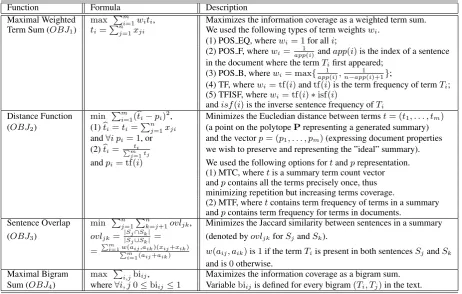
Table 1: Objective functions for summarization using polytope model.
sentence subsets. Fortunately, we do not need to scan the whole set ofP’s surfaces but rather to find the point onPthat optimizes the chosen objective function. Table 1 contains four different objective functions that we used for summarization, along with descriptions of the changes in the model that were required for each function.
Since fractional LP method not only finds the optimal value of objective function but also presents an evidence to that optimality in the form of a pointx= (xij), we use the point’s data to find what sentences belong to the chosen summary. The point x may satisfy several of the sentence inequalities as equalities, while other inequalities may not turn into equalities. If sentence inequality is turned into equality byx, the sentence necessar-ily belongs to the chosen summary. Otherwise, the pointx that optimizes the chosen objective func-tion represents a summary that does not contain sufficient number of words or terms. In this case we add additional sentences to the summary and we choose these sentences on the basis of their distance from the pointx. Sentence hyperplanes that are the nearest to the pointx are chosen in a greedy manner and added to the summary. This test is straightforward and takesO(mn)time.
3 POLY2: system description
We title our system POLY2 as a double POLY occured in ”POLYnomial Summarization using POLYtope model”. POLY2 is implemented in Java and it uses lp-solve software (Berkelaar, 1999) in order to perform Linear Programming. The input for our system is initial collection of texts to be summarized. Four main parts of POLY2 are: preprocessing, linear program generation, lin-ear program application and testing. Data flow of the system is depicted in Figure 1.
gener-Figure 1: Data flow of the POLY2system.
Figure 2: Linear program generated by POLY2 system.
ated during preprocessing are text files.
The main part of POLY2 is linear program generation. The system allows to select document matrix files and auxiliary files and objective func-tion and generates a system of linear inequalities together with an objective function in format ac-ceptable by lp-solve software. Figure 2 shows a sample LP file contents. Note that file generation for every one of our objective function takes only seconds for a single documents.
The next step is torun linear programand ex-tract its results. We use lp-solve Java API to per-form this task and extract coordinates of point x
that optimizes the chosen objective function. In order to construct the summary, we measure the normalized distance from pointxto every one of the sentence hyperplanes. Since this information is readily available through lp-solve API, the task requires sorting ofnreal numbers, wherenis the number of sentences in all of the documents
to-gether. Hyperplanes whose distance toxis mini-mal represent the sentences participating in the fi-nal summary. Running time of this step for a sin-gle file does not exceed three seconds.
The final (optional) step is to verify gener-ated summaries, that can be performed with the help of any evaluation system. In our case, the ROUGE (Lin, 2004) system has been used.
4 Conclusions and Future Work
In this paper we present an extractive summariza-tion system POLY2 based on a linear program-ming model. We represent the document as a set of intersecting hyperplanes. Every possible sum-mary of a document is represented as the inter-section of two or more hyperlanes. We consider the summary to be the best if the optimal value of objective function is preserved during summariza-tion, and translate the summarization problem into a problem of finding a point on a convex polytope which is the closest to the hyperplane describing the ”ideal” summary. We introduce multiple ob-jective functions describing the distance between a summary (a point on a convex polytope) and the best summary (the hyperplane). Since the in-troduced objectives behaves differently on differ-ent languages, only two of them were indicated as primary systems and evaluated by MultiLing 2013 organizers–OBJ1P OS F andOBJ3–denoted by ID5 and ID51.
Below we summarize the results of automated evaluations in MultiLing 2013 (ROUGE-1,2,3,4 and three N-gram graph methods) for POLY2 in three languages.
English: 7th place in all ROUGE metrics (stemmed) and AutoSummENG, and8thplace in MeMoG and NPowER (out of 10 systems);
Hebrew: 3rd place in ROUGE-1,5th place in ROUGE-2 and MeMoG, 4th rank in ROUGE-3 and ROUGE-4, and only6th rank in terms of Au-toSummENG and NPowER (out of 9 participants); Arabic: 7thrank in ROUGE-1,2 and all NGG metrics, 6th rank in terms of ROUGE-3, and5th
place in ROUGE-4 (out of 10 summarizers). As it can be seen, the best performance for POLY2 has been achieved on the dataset of He-brew documents.
[image:4.595.77.295.61.272.2]Acknowledgments
Authors thank Igor Vinokur for the software main-tenance and running of experiments.
References
Michel Berkelaar. 1999. lp-solve free soft-ware. http://lpsolve.sourceforge. net/5.5/.
Dan Gillick and Benoit Favre. 2009. A Scalable Global Model for Summarization. InProceedings of the NAACL HLT Workshop on Integer Linear
Pro-gramming for Natural Language Processing, pages
10–18.
Yoshihiro Matsuo Hitoshi Nishikawa, Takaaki Hasegawa and Genichiro Kikui. 2010. Opinion Summarization with Integer Linear Pro-gramming Formulation for Sentence Extraction and Ordering. In Coling 2010: Poster Volume, pages 910–918.
N. Karmarkar. 1984. New polynomial-time algorithm for linear programming. Combinatorica, 4:373– 395.
L. G. Khachiyan and M. J. Todd. 1993. On the com-plexity of approximating the maximal inscribed el-lipsoid for a polytope. Mathematical Programming, 61:137–159.
L. G. Khachiyan. 1996. Rounding of polytopes in the real number model of computation. Mathematics of
Operations Research, 21:307–320.
Samir Khuller, Anna Moss, and Joseph (Seffi) Naor. 1999. The budgeted maximum coverage problem.
Information Precessing Letters, 70(1):39–45.
Chin-Yew Lin. 2004. Rouge: a package for auto-matic evaluation of summaries. In Workshop on Text Summarization Branches Out, Post-Conference
Workshop of ACL 2004, pages 25–26.
Takuya Makino, Hiroya Takamura, and Manabu Oku-mura. 2011. Balanced coverage of aspects for text summarization. In TAC ’11: Proceedings of Text Analysis Conference.
G. Salton, C. Yang, and A. Wong. 1975. A vector-space model for information retrieval. Communica-tions of the ACM, 18.
Hiroya Takamura and Manabu Okumura. 2009. Text summarization model based on maximum coverage problem and its variant. In EACL ’09: Proceed-ings of the 12th Conference of the European Chap-ter of the Association for Computational Linguistics, pages 781–789.