R E S E A R C H
Open Access
Predicate encryption against master-key
tampering attacks
Yuejun Liu
1,2, Rui Zhang
1,2and Yongbin Zhou
1,2*Abstract
Many real world attacks often target the implementation of a cryptographic scheme, rather than the algorithm itself, and a system designer has to consider new models that can capture these attacks. For example, if the key can be tampered by physical attacks on the device, the security of the scheme becomes totally unclear. In this work, we investigate predicate encryption (PE), a powerful encryption primitive, in the setting of tampering attacks. First, we show that many existing frameworks to construct PE are vulnerable to tampering attacks. Then we present a new security notion to capture such attacks. Finally, we take Attrapadung’s framework in Eurocrypt’14 as an example to show how to “compile" these frameworks to tampering resilient ones. Moreover, our method is compatible with the original pair encoding schemes without introducing any redundancy.
Keywords: Tampering resilience, Predicate encryption, Pair encoding, Dual system encryption
Introduction
Predicate Encryption (PE) (Lewko et al. 2010; Okamoto and Takashima2009,2010,2012; Lewko and Waters2010; Katz et al.2008) is a new paradigm of public-key encryp-tion that supports fine-grained access control policy. In PE, secret keys are associated with parametersX, cipher-texts are associated with parametersY and a secret key can decrypt the ciphertext if and only if R(X,Y) = 1, whereRis a predicate forXandY. Identity-based encryp-tion (IBE) is the simplest kind of PE whereRis a equality predicate. PE is powerful and broadly applicable, however, constructing PE schemes and proving their security are complex. Especially, constructing fully secure PE schemes for complex predicates such as for regular languages is a big challenge.
Wee (2014) and Attrapadung (2014) proposed generic frameworks to construct PE schemes with new primi-tives called predicate encodings or pair encodings respec-tively (Here we focus on pair encodings, which are more general) and proved the full security utilizing the power-ful tool— dual system encryption introduced by Waters Waters (2009) in composite-order groups. Limited by the
*Correspondence:[email protected]
1State Key Laboratory of Information Security, Institute of Information Engineering, Chinese Academy of Sciences, Beijing 100093, China
2School of Cyber Security, University of Chinese Academy of Sciences, Beijing 100049, China
inefficiency, Attrapadung (2016) and Agrawal and Chase (2016) presented a similar generic framework in prime-order groups. By far, constructing pair encoding schemes instead of PE schemes for new predicates has significantly simplified the process of designing and analyzing fully secure PE schemes.
The traditional security requirement for PE — full secu-rity (or called IND-CPA) assumes that the adversary only has black-box access to the system and thus the master key and secret keys are completely hidden from the adver-sary. However, such assumption may not always hold in practice. Many real world attacks often target the imple-mentation of a cryptographic scheme, rather than the algorithm itself, and a system designer has to consider new models that can capture these attacks. For example, if the key can be leaked via leakage attacks (Kocher1996; Kocher et al. 1999) or modified via tampering attacks (Biham and Shamir1997; Boneh et al.1997; Agrawal et al. 2003) on the device, the security of the scheme becomes totally unclear. In this work, we only focus on the latter. The key could be a signing key of a signature scheme, a decryption key of an encryption scheme, or the master key of a PE scheme. In PE, the privacy of the master key is the cornerstone of the PE security and it is fatal when the master key is tampered.
Tampering resilience (i.e., tampering attack security)1 was initiated by Bellare and Kohno (2003), whose tar-gets were pseudorandom permutation (PRP) and pseudo-random function (PRF). Later, Bellare, Cash, and Miller (2011) generalized the concept to other cryptographic primitives, including PKE, signature and IBE. Roughly speaking, the tampering attacks allow the adversary to modify the key of a cryptographic scheme and observe the output under the falsified key. However, except IBE (PE with a simple equality predicate), tampering attacks were not considered for the complicated primitive, PE. In this work, we try to investigate the problem, namely, PE against tampering attacks.
Overall, from the practical perspective, our work can be seen a stepping stone towards the practicality of PE, in which tampering attacks are unavoidable. From the the-oretical perspective, we show how to achieve tampering resilience for more complicated primitives than previously known.
Our Contributions. In this work, we focus on the security of PE when the master key is tam-pered and construct a generic fully secure PE frame-work against tampering attacks. Our contributions are three-fold.
First, we find that the existing generic PE frame-works (Attrapadung2014; 2016; Wee2014; Agrawal and Chase 2016; Chen et al. 2015) are vulnerable to tam-pering attacks. Note that tamtam-pering attacks are out of the scope of these work, so we did not disprove any of the previous results. However, we’d like to show that tampering attacks are powerful and one should consider countermeasures.
Recall that the crux of constructing PE schemes in these frameworks is designing appropriate encoding schemes. One property of the encoding scheme is linearity, which is important to the security proof but also can be a use-ful tool to threaten the security of PE in the tampering attack. Concretely, with the help of linearity, the adversary is able to recover the secret key by choosing appropriate tampering functions. Since these frameworks cover most of the existing PE constructions, these PE schemes are vulnerable to tampering attacks.
Second, we extend the full security notion for PE to the setting of tampering attacks. We model tampering attacks by providing the adversary with access a tamper-ing oracle: the adversary is allowed to submit a tampertamper-ing function2φand receives secret keys generated under the falsified master keyφ(msk). The adversary can query the tampering oracle adaptively and repeatedly. If all tamper-ing functions appeared in the tampertamper-ing oracle are the
1Tampering resilience is equivalent to related-key attacks (RKA) security
defined in earlier work (Bellare and Kohno2003).
2A tampering function is also called a related-key derivation (RKD) function
(Bellare and Kohno2003).
identity function, our definition is exactly the standard model of full security.
Note that restrictions on tampering functions are nec-essary, otherwise there are trivial tampering attacks. For instance, if we allow the adversary to make any polyno-mial of arbitrary tampering queries, the master key can be recovered bit-by-bit, as shown by Gennaro et al. (2004). Therefore, we need to either limit the type of tamper-ing functions or limit the number of tampertamper-ing queries to bypass the impossibility of unrestricted tampering. And since our attacks on existing PE frameworks are given with linear functions, constant functions and affine func-tions, here we confine tampering functions are algebraic but allow any polynomial of tampering queries.
Finally, we present a generic, fully secure and tampering resilient PE framework and prove its security within the methodology of dual system encryption. Our main tool is a new primitive called Tampering Resilient Function (TRF). Intuitively, a function H is a tampering resilient function if H(x) is random even given the output of H applied to related inputs φ(x) where φ(x) = x. We take Attrapadung’s framework (Attrapadung2014) as an example to explain how to construct secure PE schemes against tampering attacks. And, significantly, our costs are comparable to those of the original framework.
We also give concrete constructions of TRF. Obviously, the random oracle is a simple TRF. Whereas these frame-works (Attrapadung 2014; 2016; Wee 2014; Agrawal and Chase2016; Chen et al.2015) are proposed to con-struct fully secure PE schemes in the standard model, we expect to instantiate TRF without the random oracle. With the help of other primitives such as the Non-Malleable Key Derivation Function (NM-KDF), the con-tinuous Non-Malleable Key Derivation Function (cNM-KDF), the Tampering Resilient Pseudorandom Function (TR-PRF)3and the Correlated Input Secure Hash (CISH) function, we obtain instantiations of TRF in the standard model.
Our Technique.The reason why the existing PE frame-works are insecure against tampering attacks is the key malleability caused by the linearity of the underling pair encoding schemes and it is nature to construct tamper-ing resilient PE schemes by breaktamper-ing the property. More specifically, in the model of full security, secret keys SKX
forXthat can decrypt the challenge ciphertext associated Y∗are forbidden to query. However, the adversary in our new security model can obtain secret keys SKXfor suchX under the falsified master key except SKXgenerated under
the original master key. Using key malleability, a valid SKX
can be generated from SKX. Hence, we expect that SKX are independent from SKX so that they are useless for the
adversary to break PE schemes.
Due to the above observation, we define a new primitive TRF and utilize it mapping the master key before gen-erating secret keys to achieve tampering resilience. The property of TRF that the output H(x) is random even given H(φ(x))as long asφ(x)=xensures that the adver-sary cannot utilize SKXto obtain the additional advantage. In other words, the adversary cannot generate a prop-erly distributed SKXcorrectly without the original master
key. Meanwhile, without the key malleability, we cannot reduce the security of the modified PE schemes to the original ones and need to prove using the dual system encryption techniques.
Related Work.Since the seminal work of Bellare and Kohno (2003), a lot of tampering resilient symmetric and asymmetric cryptographic primitives were proposed (Bellare and Cash 2010; Bellare et al. 2011, 2012, 2014; Kalai et al.2011; Liu and Lysyanskaya 2012; Wee 2012; Damgård et al. 2013, 2015; Fujisaki and Xagawa 2016; Faonio and Venturi 2016; Qin et al. 2015). Gennaro et al. (2004) proved that it is impossible to construct secure cryptographic primitives when the tampering functions are arbitrary and the number of tampering queries is unbounded. Hence, the key to construct secure schemes is how to circumvent these restrictions.
One way is considering restricted tampering. By speci-fying the type of tampering functions, there existed secure PRF, PRP, PKE, symmetric encryption (SE) and signature resilient to linear functions (Bellare and Cash2010; Bel-lare et al. 2011; Wee 2012), IBE resilient to affine and polynomial functions (Bellare et al. 2012), IBE resilient to invertible functions (Fujisaki and Xagawa 2015). By restricting the number of tampering queries the adversary is allowed to make, Damgård et al. (2013) proposed secure PKE schemes and signatures resilient to arbitrary tamper-ing functions. In addition, with the bounded tampertamper-ing resilient model, Faonio and Venturi (2016) gave the first signature construction in the standard model and the first CCA-secure PKE without NIZK.
Another way to bypass the impossibility is taking advan-tage of extra mechanisms, such as key-updating mech-anisms and self-destruct mechmech-anisms (Kalai et al. 2011; Gennaro et al.2004; Fujisaki and Xagawa2016).
Most of above work focused on SE and PKE except the one by Bellare et al. (2012). They proposed similar tam-pering attacks on Boneh-Franklin IBE scheme (Boneh and Franklin2001) and Waters IBE scheme (Waters2005) but repaired IBE schemes in a different way from ours. To an extent, the reason for such tampering attacks on PE or IBE is due to the key malleability property of the origi-nal schemes. Bellare et al. (2012) employed the property together with a component called collision resistant iden-tity renaming to reduce tampering resilience of the new schemes to the base ones in the black-box way. How-ever, the way no longer works in the standard model. Our
strategy is to destroy the key malleability property directly to prove tampering resilience of new schemes. Moreover, the master public key of modified PE schemes (Bellare et al.2012) depends on the tampering function form. If tampering functions are complex, such as high-degree polynomials, the master public key is huge. However in our work, we only add a function to map the master key without bringing any redundant elements to the original schemes. Finally, our framework can apply to PE schemes more than IBE schemes.
Preliminary
In this section, we present some basic notations and definitions that are used in our construction.
Notations.IfSis a set, let|S|denote the number of its elements, andx ←−$ S denotes that x is uniformly sam-pled fromS. LetUndenote the uniform distribution over {0, 1}n. Denote [n] the set {1, 2,. . .,n}. A bold face
let-ter represents a vector (e.g. a), and an uppercase letter represents a matrix (e.g.A). For vectorsa = (a1,. . .,an)
andb = (b1,. . .,bn), we denote dot product asa·b =
(a1b1,. . .,anbn). Letga be the vector
ga1,. . .,gan. We denotenegl(λ)a negligible function ofλ.
Tampering resilient function
In this section, we introduce a new primitive called Tam-pering Resilient Function (TRF), which will be used as a main tool of our tampering resilient PE schemes. Intu-itively, a function H is a tampering resilient function if the output H(x)is still random even if the adversary obtains outputs of H(φ(x))with someφ(x)=x.
Definition 1(Tampering Resilient Function)LetF = {φ|φ:{0, 1}n→ {0, 1}n} be any family of functions. Say
H = H|H :{0, 1}n→ {0, 1}k is a family of tamper-ing resilient functions if for ∀x ←−$ Un,φ ←−$ F, H ←−$
H,φ(x) = x, the following two distributions are indistin-guishable:
{H(x), H(φ(x))} and {y, H(φ(x))} where y←−$ Uk.
Composite order bilinear groups
Let (G,GT) be cyclic groups of composite order N =
p1p2p3, where p1,p2,p3 are distinct primes. A bilinear group generator G takes as input a security parameter λ and outputs a description(G,GT,e,N) where e is an
efficiently computable bilinear map. Let Gpi denote the subgroup ofGof orderpi andgi denote a random
gen-erator of Gpi. Each element h ∈ G can be written as
h = g1ag2bg3c. The bilinear map e satisfies the following properties:
• Bilinear: For alla,b∈ZN,e
ga,gb=e(g,g)ab. • Orthogonality: Forg∈Gpi,h∈Gpjwherei=j,
e(g,h)=1∈GT.
We will take advantage of the following three Subgroup Decision (SD) Assumptions (Waters 2009; Lewko and Waters2010) to prove the security of our construction.
Definition 2(SD1) The SD1 problem is to guessβ ∈ {0, 1}, givenparamG,g1,g3,Tβ, where
GSD1
β (λ):paramG=(G,GT,N,e) $ ←−G(λ),
u,v←−$ ZN,g1 $ ←−Gp1,g2
$ ←−Gp2,g3
$ ←−Gp3, T0=g1u,T1=gu1gv2,
returnD=paramG,g1,g3,Tβ.
Definition 3(SD2) The SD2 problem is to guessβ ∈ {0, 1}, givenparamG,g1,g3,gu1gz2,g2vg3ρ,Tβ
, where
GSD2
β (λ):paramG=(G,GT,N,e)←−$ G(λ), u,v,z,ρ,w,κ,δ←−$ ZN,g1←−$ Gp1,g2
$
←−Gp2,g3
$
←−Gp3,
T0=g1wgδ3,T1=gw1g2κg3δ,
returnD=paramG,g1,g3,g1ugz2,g2vg3ρ,Tβ
.
Definition 4(SD3) The SD3 problem is to guessβ ∈ {0, 1}, givenparamG,g1,g2,g3,g1αg2u,g1sgv2,Tβ
, where
GSD3
β (λ):paramG=(G,GT,N,e)←−$ G(λ), u,v,s,α←−$ ZN,g1←−$ Gp1,g2
$
←−Gp2,g3
$
←−Gp3,
T0=e(g1,g1)αs,T1←−$ GT,
returnD=paramG,g1,g2,g3,g1αg2u,g1sg2v,Tβ
.
To construct the tampering resilient PE framework, we additional define a variant ofSD3, which is called TRF-SD3, to handle tampering queries in the security proof. Let H : {0, 1}n → ZN be a tampering resilient function
andφi:ZN →ZNbe an algebraic tampering function.
Definition 5 (TRF-SD3)The TRF-SD3 problem is to guess β ∈ {0, 1}, given paramG,g1,g2,g3,g1H(φi(α))gu2,
g1H(α)gu2,g1sg2v,Tβ, where
GSD3
β (λ):paramG=(G,GT,N,e)←−$ G(λ), u,v,s,α←−$ ZN,g1←−$ Gp1,g2←−$ Gp2,g3←−$ Gp3,
T0=e(g1,g1)H(α)s,T1←−$ GT,
returnD=paramG,g1,g2,g3,g1H(φi(α))g2u,g1H(α)g2u,g1sg2v,Tβ
.
Due to the property of TRF, H(φi(α)) is
indepen-dent from H(α). Thus, if SD3 holds in G, so does TRF-SD3.
Dual system predicate encryption
We consider the predicate familyR= {Rκ}κ∈Ncfor some constantc, whereRκ :X×Y→ {0, 1}is a predicate map-ping a key parameterX ∈ X and a ciphertext parameter Y ∈ Y to{0, 1}. The family indexκ = (n1,n2, ...) speci-fies the description of a predicate ofRκ ∈ Rand the first entryn1inκspecifies the domain. In this work, we omitκ and writeRNfor simplicity when its domain isZN. We say
thatRis domain-transferable4if forpthat dividesN, then there exist two mapsf1 : XN → Xp,f2 : YN → Ypsuch
that for allX∈XN,Y∈YN:
• Completeness.IfRN(X,Y)=1thenRp(f1(X), f2(Y))=1.
• Soundness.IfRN(X,Y)=0, thenRp(f1(X), f2(Y))=0. Otherwise there exists an algorithm which can output a non-trivial factorF such that p|F,F|N.
A predicate encryption (PE) for a predicate R con-sists of four algorithms: Setup, KeyGen, Encrypt, Decrypt, while a dual system PE scheme addition-ally have three algorithms, SetupSF, KeyGenSF and EncryptSF. Note that the last three algorithms are not parts of the PE scheme, they are only needed for security purposes.
Setup(λ) → (MSK, PP). The setup algorithm takes in a security parameterλand outputs a public parameter PP and a master key MSK.
KeyGen(MSK,X)→SKX. The key generation algorithm
takes in a master key MSK and a parameter X, then it outputs a normal secret key SKX.
Encrypt(PP,Y,M) → CTY. The encryption algorithm
takes in a public parameter PP, a messageMand a param-eterY, and outputs a normal ciphertext CTY.
Decrypt(CTY, SKX) → M. The decrypt algorithm takes
in a ciphertext CTY and a secret key SKX, and outputs a
messageMifR(X,Y)=1 forXandY.
SetupSF(λ) → (MSK, PP). The semi-functional setup algorithm takes in a security parameter λ and outputs a public parameter PP, a master key MSK and some parameters used to generate semi-functional keys and ciphertexts.
KeyGenSF(MSK,X) → SKX. The semi-functional key
generation algorithm takes in a master key MSK and a parameterX, then it outputs a semi-functional secret key SKX.
4The property is required for predicates whose domains are composite-order,
EncryptSF(PP,Y,M) → CTY. The semi-functional encryption algorithm takes in a public parameter PP, a message M and a parameter Y, and outputs a semi-functional ciphertext CTY.
Correctness. We require the correctness condition holds that for allX ∈ X,Y ∈Y, ifR(X,Y) = 1, we have Decrypt(Encrypt(PP,Y,M),KeyGen(MSK,X))=M.
Security model
In this work, we consider the situation where the adver-sary has unexpected power to tamper with the master key and it is not captured by the standard full security notion for PE. In this section, we extend the full security notion to the setting of tampering attacks by providing the adversary an additional tampering oracle. Informally, in our new model, besides secret keys generated under the original master key, the adversary is also allowed to obtain secret keys generated under the falsified master key, which is derived from the original master key with the tampering function chosen by the adversary adaptively.
Note that restrictions on tampering functions are nec-essary, otherwise there are trivial tampering attacks. For instance, as shown by Gennaro et al. (2004), if the adver-sary is allowed to make any polynomial of arbitrary tampering queries, the master key may be recovered bit-by-bit. Therefore, we need to either limit the type of tampering functions or limit the number of tampering queries to bypass the impossibility of unrestricted tam-pering. And since our attacks on existing PE frameworks are given with linear functions, constant functions and affine functions, here we confine tampering functions are algebraic but allow any polynomial of tampering queries.
Denote the tampering functions by φ : MSK →
MSK. An PE scheme is secure against such tampering functions if for all PPT adversariesAit holds that
AdvtrpeA, (λ)= |Pr
ExptrpeA, (λ)=1 −1
2| ≤negl(λ).
where the gameExptrpeA, (λ) is defined blow. The adver-sary Amay adaptively make (unbounded) polynomially many key generation queries to the tampering oracle and receive secret keys generated under the falsified master keyφ(MSK) both inPhase 1andPhase 2. Key genera-tion queries forX whereR(X,Y∗) = 1 (Y∗is the target parameter) under the original master key are forbidden. The restriction is natural, otherwise the adversary can get secret keys that can decrypt the challenge ciphertext to win the security game directly. We use a tableLto record Xin key generation queries under the original master key. Notice that if all the tampering functions appeared in the key generation queries are the identity functions, our def-inition is exactly the model of full security (i.e. IND-CPA security).
ExptrpeA, (λ):
Setup. In this phase, the challenger runs (MSK, PP) ←Setup(λ)and gives PP to the adversaryA. Besides, the challenger should initialize the listL.
Phase 1. In this phase, A is allowed to make key generation queries under the falsified master key with algebraic tampering functions. Upon receiv-ing a parameter X and a tampering function φi,
the challenger runs SKX ← KeyGen(MSK,X) in
which MSK = φi(MSK) and returns SKX to A. If
φi is the identity function, the challenger adds X
toL.
Challenge.The adversary submits two messagesM0,M1 and a challenge parameter Y∗ with the restriction R(X,Y∗)=0 for∀X∈L. The challenger flips an unbiased
coinb ←− {$ 0, 1}and runs CT∗Y∗ ←Encrypt(PP,Y∗,Mb).
Then it returns CT∗Y∗.
Phase 2.In this phase, the challenger answers key gener-ation queries in the same way as inPhase 1.
Guess.Aoutputsb ∈ {0, 1}. Ifb = b, the output of the game is 1.
A weaker security definition is non-adaptively (or selectively) tampering resilient in which the tampering functions are fixed in advance. That is, the adversary must submit a set of tampering functions before seeing the public parameters. Since the Assumption TRF-SD3 depends on tampering functions, we are only able to construct PE schemes against non-adaptive tampering attacks.
Tampering attacks on existing PE frameworks Wee (2014) and Attrapadung (2014) proposed generic frameworks for fully secure PE constructions via notions called predicate encodings or pair encodings respectively in composite-order bilinear groups. Later, similar frame-works in prime-order groups were also proposed (Chen et al.2015; Attrapadung2016; Agrawal and Chase2016). These frameworks are generic in the sense that they can be applied to almost arbitrary predicateR.
Pair encoding scheme: syntax
Recall that a pair encoding scheme (Attrapadung 2014) for predicate family R consists of four deterministic algo-rithms as follows:
• Param(κ)→n. The algorithm takes inκand outputs an integern, which specifies the dimension of the common variableh=(h1,. . .,hn).
• Enc1(X)→(k=(k1,. . .,km1);m2). The algorithm takes in a key parameterX and outputs a sequence of polynomialskand the dimension of the variable r=(r1,. . .,rm2).{ki}i∈[m1]is a linear combination of the master keyαand variablesr,h.
ki=aiα+
j∈[m2] ai,jrj+
j∈[m2],l∈[n] ai,l,jhlrj
• Enc2(Y)→(c=(c1,. . .,cw1);w2). The algorithm takes in a ciphertext parameterY and outputs a sequence of polynomialscand the dimension of the variables=(s,s1,. . .,sw2).{ci}i∈[w1]is a linear combination of variabless,h.
ci=bis+
j∈[w2] bi,jsj+
l∈[n] bi,lhls+
j∈[w2],l∈[n] bi,l,jhlsj
• Pair(X,Y)→E. The algorithm takes inX,Yand outputsE∈Zm1×w1
N .
Correctness. For any X ∈ X,Y ∈ Y, let (k;m2) ← Enc1(X),(c;w2) ← Enc2(Y),E ← Pair(X,Y), if R(X,Y)=1, the correctness of the pair encoding scheme is required to satisfy the following equation:
kEcT =αs.
It is obvious that the syntax of pair encoding implies the following two properties: parameter-vanishing and linearity.
(Parameter-Vanishing) k(α,0,h)=k(α,0,0)
(Linearity) k(α1,r1,h)+k(α2,r2,h)=k(α1+α2,r1+r2,h) c(s1,h)+c(s2,h)=c(s1+s2,h) When proving the security of PE, parameter-vanishing and linearity make it possible to switch normal cipher-texts and keys to semi-functional ones indistinguishably. However, linearity also makes PE vulnerable to tampering attacks. The detailed attacks is provided in the subsequent sections.
Pair encoding scheme: security definition
Our construction is compatible with previous pair encod-ing schemes (Attrapadung2014; Wee2014; Attrapadung 2016; Agrawal and Chase2016; Chen et al.2015). There are two security notions in the pair encoding scheme (Attrapadung2014)—perfectly master-key hiding security
and computationally master-key hiding security. Here we recall the security definitions as follows.
Perfectly Master-key Hiding Security. The pair encoding scheme P is perfectly master-key hiding (PMH) if the following two distributions are identi-cal. If R(X,Y) = 0, let n ← Param(κ),(k;m2) ← Enc1(X),(c;w2)←Enc2(Y):
c(s,h),k(0,r,h) and c(s,h),k(α,r,h) where the probability is taken over α ←−$ ZN,h ←−$ ZnN,r ←−$ Zm2
N ,s $ ←−Zw2+1
N .
Computationally Master-key Hiding Security. We define two computational security notions: selectively master-key hiding security (SMH) and co-selectively master-key hiding security (CMH) in a bilinear group
generator G through the following game template
ExpG,b,A,G for the flavorG ∈ {SMH, CMH}. It takes as input the security parameterλand does the experiment with the adversaryA=(A1,A2)as follows:
ExpG,b,A,G(λ):
(G,GT,e,N,p1,p2,p3)←Gλ,
g1←−$ Gp1,g2
$ ←−Gp2,g3
$ ←−Gp3,
α←−$ ZN,n←Param(κ),h $ ←−Zn
N,
st←AO
1
G,b,α,h(·)
1 (g1,g2,g3),
b←AO
2
G,b,α,h(·)
2 (st),
wherestdenotes the state information and the oracles
O1andO2are defined below:
• Selective Security.O1can be queried once whileO2 can be queried many times.
– OSMH,1 b,α,h(Y∗): Run(c;w2)←Enc2(Y∗)and
picks←−$ Zw2+1
N . ReturnC←g
c(s,h)
2 .
– OSMH,2 b,α,h(X): IfR(X,Y∗)=1, return⊥. Else, run(k;m2)←Enc1(X)and pickr
$ ←−Zm2
N . ReturnK←
g2k(0,r,h) if b=0 gk2(α,r,h) if b=1.
• Co-selective Security. BothO1andO2can be queried only once.
– OCMH,1 b,α,h(Y∗): Run(k;m2)←Enc1(X)and
pickr←−$ Zm2
N . Return
K←
g2k(0,r,h) if b=0 g2k(α,r,h) if b=1.
Else, run(c;w2)←Enc2(Y∗)and picks $
←−Zw2+1
N . ReturnC←g
c(s,h)
2 .
For a PPT adversaryA, we define the advantage of the
A in the security game ExpG,b,A,G for the flavor G ∈ {SMH, CMH}as:
AdvGA(λ)=PrExpG,0,A,G=1−PrExpG,1,A,G=1
A pair encoding scheme P is selectively (resp. co-selectively) master-key hiding in G if AdvSMHA (λ) (resp. AdvCMHA (λ)) is negligible inλ. If both hold, we say P is doubly selectively master-key hiding.
Review Attrapadung’s framework (Attrapadung2014)
With the pair encoding scheme, the PE framework in Attrapadung (2014) is given below:
Setup(λ) → (MSK, PP). Run (G,GT,e,N,p1,p2,p3) $
←−G(λ). Pickg1←−$ Gp1,g3
$
←− Gp3. Runn←Param(κ).
Choose h ←−$ ZnN and α ←−$ ZN. The public key is
PP = g1,g3,g1h,e(g1,g1)α
and the master key is MSK=α.
KeyGen(MSK,X) → SKX. Run (k;m2) ← Enc1(X). Pickr ←−$ Zm2
N ,R3 ←−$ Zmp31. Output the secret key SKX as
follows:
SKX=g1k(α,r,h)·R3.
Encrypt(PP,Y,M) → CTY. Run(c;w2) ← Enc2(Y).
Picks = (s,s1,. . .,sw2)
$ ←− Zw2+1
N . Output the secret key
CTY =(C0,C1)as follows:
C0=gc1(s,h),C1=e(g1,g1)αsM.
Decrypt(CTY, SKX) → M. Check whetherR(X,Y) =
1. If yes, runE←Pair(X,Y). ComputeMas follows:
M= C1
e(SKEX,C0) .
Tampering attacks on Attrapadung’s framework
In the setting of tampering attacks, the adversary is allowed to tamper the master key and gets secret keys generated under the falsified master key. We show that Attrapadung’s framework (Attrapadung2014) is not tam-pering resilient by specifying particular tamtam-pering func-tions. The master key is an exponentα ∈ ZN. Suppose
the tampering function is linear, w.l.o.g.msk = φ(α) = tα. Having access to the key generation oracle under the falsified master keyφ(α), the adversary obtains
SKX =g1k(tα,r,h)·R3,
where each polynomialki ofk(tα,r,h)is a linear
combi-nation of the master keyαand variablesr,h. Because of the linearity ofαandrink, we are able to get a properly
distributed secret key SKX = gkX(α,r
,h)
1 under the
origi-nal master key α with a new randomnessr = t−1rby raising SKXtot−1. In this way the adversary can win the security game because he can get secret keys forXwhere R(X,Y∗)=1 andY∗is used in the challenge ciphertext.
Besides the linear functions, Attrapadung’s framework (Attrapadung 2014) is not secure against other alge-braic functions. Suppose the tampering function is affine, w.l.o.g.msk =φ(α)=tα+c. With a call to the key gen-eration oracle forX under the falsified master keyφ(α) whereR(X,Y∗)=1, the adversary obtains
SKX,aff=g1k(tα+c,r,h)·R3.
Raising SKX,aff to t−1 resulting a secret key SKX,aff =
g1kX(α+t−1c,r,h)under the original master keyαwith a new randomnessr = t−1r. Decrypt the challenge ciphertext using SKX,aff, the adversary obtains
e(SKEX,aff,C0)=e(g1,g1)(α+t −1c)s
.
Then the adversary continues to make a key generation call forXwith a constant tampering functionφ(α)=t−1c and obtains
SKX,con=gk(t −1c,r,h)
1 ·R3.
After decrypting with SKX,con, the adversary is able to computee(g1,g1)t
−1cs
. Thus, combining an affine function and a constant function, the adversary is able to recover e(g1,g1)αsto decrypt the challenge ciphertext.
Remark 1Although the master key in other frameworks (Wee2014; Chen et al.2015; Attrapadung2016; Agrawal and Chase 2016) is a group element in the form of g1α where g1 is the generator of a prime-order group or a prime-order subgroup of composite-order groups, similar tampering attacks still exist. Suppose the tampering func-tion is a simple polynomial, w.l.o.g. msk = φ(g1α) = g1tα. The remaining parts are the same.
another component called identity renaming scheme to prove tampering resilience of new IBE schemes. In con-trast, we destroy the property to construct secure PE schemes. In the next section, we show how to construct tampering resilient PE schemes.
Our generic tampering resilient PE framework In this section, we propose a secure and generic PE framework from pair encoding against algebraic tamper-ing functions, which is a slightly modified version of the original one. The only thing we alter is the way the master key used. That is, we keep the master key unchanged, but before using it, we first add a function to map the master key and use the mapped key to generate public parame-ters and secret keys. Next we will explain how to use the idea to fix Attrapadung’s framework (Attrapadung2014) to achieve tampering resilience.
Generic construction
LetH= {{0, 1}n→ZN}be a family of tampering resilient
functions. Denote by P = (Param,Enc1,Enc2,Pair) a pair encoding scheme for predicate family R. The PE framework is given as follows:
Setup(λ) → (MSK, PP). Run(G,GT,e,N,p1,p2,p3) $ ←−
G(λ). Pickg1 ←−$ Gp1,g3
$
←− Gp3. Runn ← Param(κ).
Chooseh←−$ ZnNandα←−$ ZN. Choose H←−$ H. The
pub-lic key is PP = g1,g3,g1h,e(g1,g1)H(α), H
and the master key is MSK=α.
KeyGen(MSK,X) → SKX. Run(k;m2) ← Enc1(X). Pickr←−$ Zm2
N ,R3 ←−$ Zmp31. Output the secret key SKXas
follows:
SKX =g1k(H(α),r,h)·R3. (1) Encrypt(PP,Y,M) → CTY. Run(c;w2) ← Enc2(Y). Picks= s,s1,. . .,sw2
$ ←− Zw2+1
N . Output the ciphertext
CTY =(C0,C1)as follows:
C0=g1c(s,h),C1=e(g1,g1)H(α)sM. (2)
Decrypt(CTY, SKX) → M. Check whetherR(X,Y) =
1. If yes, runE←Pair(X,Y). ComputeMas follows:
M= C1
e(SKEX,C0) .
Correctness.Due to the correctness of the pair encoding scheme, forR(X,Y)=1, we have
eSKEX,C0
=e
g1k(H(α),r,h)·R3 E
,g1c(s,h)
=e(g1,g1)kEc T
=e(g1,g1)H(α)s
Semi-functional Algorithms. We additionally define semi-functional algorithms used in the security proof.
SetupSF(λ) → (MSK, PP,g2,h)ˆ . The algorithm is the same asSetupexcept it additionally outputs a generator
g2←−$ Gp2 and a semi-functional parameterhˆ
$ ←−Zn
N.
KeyGenSF(MSK,X,g2,h,ˆ type,α)ˆ → SKX. Run
(k;m2) ← Enc1(X). Pick r,ˆr ←−$ ZNm2,R3 ←−$ Zmp31.
Output the secret key SKX depending on the input type
t∈ {1, 2, 3}as follows:
SKX = ⎧ ⎪ ⎪ ⎪ ⎪ ⎪ ⎨ ⎪ ⎪ ⎪ ⎪ ⎪ ⎩
g1k(H(α),r,h)·g2k(0,ˆr,hˆ)·R3
ift=1 (3)
g1k(H(α),r,h)·g2k(αˆ,ˆr,hˆ)·R3
ift=2 (4)
g1k(H(α),r,h)·g2k(αˆ,0,0)·R3
ift=3 (5)
EncryptSF(PP,Y,M,g2,h)ˆ → CTY. Run (c;w2) ← Enc2(Y). Picks = (s,s1,. . .,sw2),ˆs = (ˆs,ˆs1,. . .,ˆsw2)
$ ←− Zw2+1
N . Output the ciphertext CTY =(C0,C1)as follows:
C0=g1c(s,h)·g c(ˆs,hˆ)
2 ,C1=e(g1,g1)H(α)sM. (6)
Security proof
If the pair encoding schemePis doubly selectively master-key hiding and the family His tampering resilient, the above framework is fully secure and tampering resilient against algebraic tampering functions. More precisely, we present the following theorem.
Theorem 1 Suppose that a pair encoding scheme P for predicate R is selectively and co-selectively master-key hid-ing, the Subgroup Decision Assumptions are intractable
Table 1Games in the security proof
Gres: Replace the restrictionRN(X,Y∗)=0 withRp2(X,Y∗)=0. G0: (MSK, PP,g2,hˆ)←SetupSF(λ)
CT∗Y←EncryptSFPP,Y∗,Mb,g2,hˆ
Gk,1: αˆj←−$ ZN, SKj← ⎧ ⎪ ⎪ ⎪ ⎨ ⎪ ⎪ ⎪ ⎩
KeyGenSFφi(α),Xj,g2,0, 3,αˆj
ifj<k
KeyGenSFφi(α),Xj,g2,hˆ, 1, 0
ifj=k KeyGenφi(α),Xj ifj>k
Gk,2: αˆj←−$ ZN, SKj← ⎧ ⎪ ⎪ ⎪ ⎨ ⎪ ⎪ ⎪ ⎩
KeyGenSFφi(α),Xj,g2,0, 3,αˆj ifj<k KeyGenSFφi(α),Xj,g2,hˆ, 2,αˆj
ifj=k KeyGenφi(α),Xj ifj>k
Gk,3: αˆj←−$ ZN, SKj← ⎧ ⎨ ⎩
KeyGenSFφi(α),Xj,g2,0, 3,αˆj
ifj≤k KeyGenφi(α),Xj
ifj>k
Gq1+1: SKj←KeyGenSF(φi(α),Xj,g2,hˆ, 1, 0) Gq1+2: αˆ
$
←−ZN
SKj←KeyGenSF
φi(α),Xj,g2,hˆ, 2,αˆ
Gq1+3: SKj←KeyGenSF
φi(α),Xj,g2,0, 3,αˆ Gfinal: M←−$ M, CT∗Y←EncryptSFPP,Y∗,M,g2,hˆ
Fig. 1Proof profile
in G andH is a family of tampering resilient functions. Also suppose that P is domain-transferable. The frame-work above is fully secure and non-adaptively tamper-ing resilient with algebraic tampertamper-ing functions. For any PPT adversaryA, there exist adversariesB1,. . .,B6with
almost the same running time as A such that for any
security parameterλ:
AdvtrpeA (λ)≤2AdvSD1B1 (λ)+(2q1+3)AdvSD2B2 (λ) +AdvTRFB3 −SD3(λ)+q1AdvCMHB4 (λ) +AdvSMHB5 (λ)+qallAdvTRFB6 (λ)
where q1,q2 is the number of key generation queries in Phase 1andPhase 2respectively and qall=q1+q2.
The proof is similar to that of Attrapadung’s framework (Attrapadung 2014), except the adversary in our secu-rity definition is allowed to receive secret keys generated under the falsified master key even for parametersX sat-isfy R(X,Y∗) = 1 where Y∗ is used in the challenge ciphertext. We define a sequence of games and complete the proof of Theorem 1 by proving the indistinguisha-bility between adjacent games. Each game is defined as follows and the difference compared with the previous one is given in Table1.
Greal: The original game.
Gres: Replace the restriction RN(X,Y∗) = 0 with
Rp2(X,Y∗)=0.
G0: The normal challenge ciphertext is modified to be semi-functional type.
Gk,t: The k-th queried secret is modified to be
semi-functional of type-twherek∈[ 1,q1] ,t∈ {1, 2, 3}. Gq1+t: All secret keys queried inPhase 2are modified to
be semi-functional of type-twheret∈ {1, 2, 3}.
Gfinal: The semi-functional challenge ciphertext is
modi-fied to the ciphertext of a random message.
We provide a proof profile in Fig.1, including all the assumptions and security definitions used in the proof (To clarity, TRF is used throughout the proof and only two places are marked in the figure). The key is to prove that additional secret keys under the falsified master key won’t help the adversary break the security of PE. We sketch the proof idea here. Divide these secret keys into two cases. ForXthatR(X,Y∗) = 0, tampering resilience follows from the master-key hiding of the underlying pair encoding schemePdirectly. ForXthatR(X,Y∗)= 1, the adversary is able to computee(g1,g1)H(φ(α))swith the help of the correctness ofP. However, the tampering function φ cannot be the identity function in this case so that the adversary still cannot recover the masking e(g1,g1)H(α)s used in the ciphertext from e(g1,g1)H(φ(α))s due to the property of the tampering resilient function H.
Let AdviA denote the advantage of A in Gi. Notice
that the advantage of A inGfinal AdvfinalA is 0 since the
challenge ciphertext in the final game is independent of Mb. The complete proof of Theorem 1 is given in Appendix.
In addition, if the underlying pair encoding schemePis perfectly master-key hiding, we get the following theorem.
Theorem 2Suppose that a pair encoding scheme P for predicate R is perfectly master-key hiding, the
Sub-group Decision Assumptions are intractable inG andH
is a family of tampering resilient functions. Also suppose that P is domain-transferable. The framework above is fully secure and non-adaptively tampering resilient with
Table 2A comparison of TRF based on different primitives
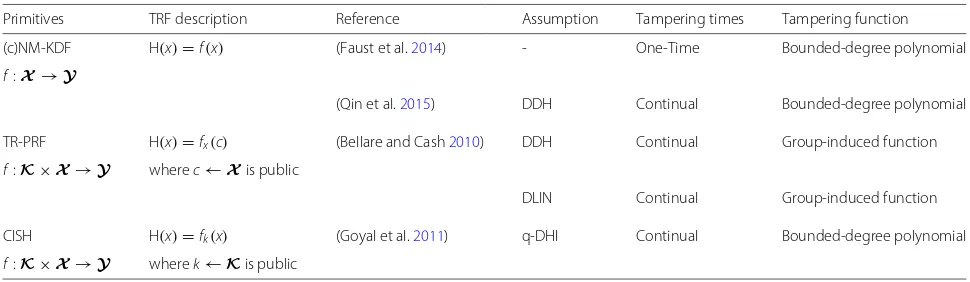
Primitives TRF description Reference Assumption Tampering times Tampering function
(c)NM-KDF H(x)=f(x) (Faust et al.2014) - One-Time Bounded-degree polynomial
f:X →Y
(Qin et al.2015) DDH Continual Bounded-degree polynomial
TR-PRF H(x)=fx(c) (Bellare and Cash2010) DDH Continual Group-induced function
f:K×X →Y wherec←Xis public
DLIN Continual Group-induced function
Table 3Theoretical analysis of TRF
Reference Description Assumption Size of PP Cost of evaluation
(Faust et al.2014)** - f:Zt
p×Ztp→ZN t|Zp|
-(Qin et al.2015)*** DDH f:Hn×n×Zn
p→Hn 2|Zp| +(n2+1)|H| 2n2Exp
(Bellare and Cash2010) DDH f:Zn+1
p × {0, 1}n→H (n+1)|Zp| + |H| 1Exp
DLIN f:(Z2×2
p )n+1× {0, 1}n→H 4(n+1)|Zp| + |H| 1Exp
(Goyal et al.2011) q-DHI f:Zp×Zp→H |Zp| + |H| 1Exp *His a group of prime orderpoverZ
N.|Zp|and|H|denote the size of an element inZpandH, respectively. Exp denotes a modular exponentiation inH **Here we consider the simplestt-wise independent hash functionf=t−1
i=0aiximodpmodNwherea $
←−Zp ***Only partial PP of OT-LF is considered here
algebraic tampering functions. For any PPT adversaryA, there exist adversaries B1,. . .,B4 with almost the same running time asAsuch that for any security parameterλ:
AdvtrpeA (λ)≤2AdvSD1B1 (λ)+(2qall+1)AdvSD2B2 (λ)
+AdvTRFB3 −SD3(λ)+qallAdvTRFB4 (λ)
Instantiations of tampering resilient functions
Tampering Resilient Function (TRF) is an important building block for our tampering resilient PE framework. In this section, we present several instantiations of TRF. A function H is a tapering resilient function if the output is random even when the adversary sees outputs of related inputs. A simple construction of TRF is the random ora-cle. But the existing PE frameworks based on the dual system encryption technique are designed to construct fully secure PE schemes without the random oracle, we’d better instantiate TRF in the standard model. A compari-son of TRF based on different cryptographic primitives is given in Table2.
TRF based on (c)NM-KDF. Faust et al. (2014) intro-duced a notion called Non-Malleable Key Derivation Function (NM-KDF) for tampering function family F, which uses randomnessxto derivey=f(x)in such a way that, evenxis tampered to a different value x = φ(x), y = f(x)does not reveal any information abouty. The definition is almost the same as ours of TRF. Since we want to give our tampering resilient PE framework in a unified way, we define a new primitive TRF to cover cur-rent similar notions. Faust et al. (2014) proposed a simple construction of NM-KDF based on a t-wise indepen-dent hash function but the construction is secure against one-time tampering attacks. Soon after, Qin et al. (2015) extended the notion to continuous NM-KDF (cNM-KDF) in which unbounded polynomially tampering queries are allowed. They also present constructions of cNM-KDF for any polynomials of bounded degree under the stan-dard assumptions, e.g., DDH and DCR. Applying these constructions to our PE framework, we obtain tampering resilient PE framework for the same class of tampering functions.
TRF based on TR-PRF. Tampering Resilient Pseudo-random Function (TR-PRF) was first formalized by Bel-lare and Kohno (2003), in which the adversary can observe the input-output of the PRF not just under the target key k, but under others keysφ1(k),. . .,φq(k)derived fromkin
adversary-specified ways. Later, Bellare and Cash (2010) gave the first construction of TR-PRF (based on the Naor-Reingold PRF) whose security is proven under the DDH assumption for group-induced functions5. They also pro-vided a construction (based on Lewko-Waters PRF) under the DLIN assumption for similar tampering functions. Combining TR-PRF with our PE framework, we obtain secure PE schemes against tampering attacks, in which the key of TR-PRF is the master key and the input is a public randomness. Because of the restricted range of TR-PRF, we can only obtain tampering resilient PE schemes for linear or group-induced functions6.
TRF based on CISH Functions.Another way of con-structing TRF is based on Correlated Input Secure Hash (CISH) functions introduced by Goyal et al. (2011), which can be interpreted as a dual version of TR-PRF. Specifi-cally, a CISH function f with the keyk ensures that the output fk(x) is random even given the hash values of
multiple correlated inputs(fk(φ1(x)), ...,fk(φq(x))), where
functionsφi are chosen by the adversary. Compare with
TRF, the CISH function has an extra key k. In our PE framework with TRF based on the CISH function, the key k is part of the public parameters and the input is the master key. Goyal et al. (2011) give a concrete construc-tion of the CISH funcconstruc-tion for a large class of polynomial functions of bounded degree under the variant of q -Diffie Hellman Inversion (q-DHI) assumption. However, the construction is only non-adaptively secure, that is, the adversary must submit functions φi at the begin of
the game. This makes our PE framework non-adaptively tampering resilient as well.
5A functionφ=a∗dis a group-induced function if the operation∗
corresponds to the component-wise multiplication onZ∗p.
6Recent work (Matsuda and Schuldt2018) provided a TR-PRF construction
64 96 128 160 192 224 256 0
20 40 60 80 100 120
The length of the prime order of group
The time of generating public parameters (ms)
CISH RKA−PRF
64 96 128 160 192 224 256
0 0.1 0.2 0.3 0.4 0.5 0.6 0.7 0.8 0.9
The length of the prime order of group
The time of evaluation (ms)
CISH RKA−PRF
Fig. 2ZNwhereNis prime.aThe time of generating PPbThe time of evaluation
Performance Evaluation.We give a concrete analysis of the performance of TRF, which is the only additional primitive in our tampering resilient PE compared with the original PE schemes. Table 3 presents the public parameters (PP) size and evaluation efficiency of TRF the-oretically. Since module exponentiation offers the main cost, we ignore other computations, such as addition and multiplication. In addition, it should be pointed out the construction of cNM-KDF employs three primitives: one-time lossy filter (OT-LF), pairwise independent hash function (i.e. t = 2) and one-time signature (OT-Sig) and here we only present costs of OT-LF based on DDH and pairwise independent hash function, but even so, the performance of TRF based on cNM-KDF is the worst. As shown in Table 3, almost all of TRF need additional public parameters except TRF based on NM-KDF in
Faust et al. (2014), which only allows one-time tampering query, however. In general, storage overhead and com-putation overhead introduced by TRF are negligible compared to PE schemes. Hence, the efficiency of our TR-PE schemes is comparable to that of original PE schemes.
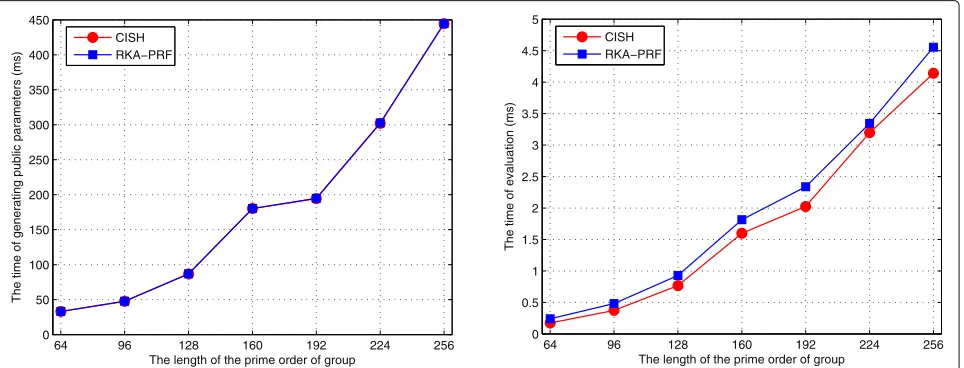
To evaluate the practical performance of TRF, we implement TRF with DDH-based TR-PRF in Bellare and Cash (2010) and TRF with q-DHI based CISH in Goyal et al. (2011). The output of both TRF is H, a prime-order group overZN. Since TRF can apply to PE in both
composite-order (N = p1p2p3) and prime-order (N is a prime larger thanp) groups, we setNcomposite or prime accordingly and both cases are tested here.
Our experiments are conducted on an Intel Core(TM) i7-4790 CPU @3.6GHz and 12 GB RAM. The prime order
64 96 128 160 192 224 256
0 50 100 150 200 250 300 350 400 450
The length of the prime order of group
The time of generating public parameters (ms)
CISH RKA−PRF
64 96 128 160 192 224 256
0 0.5 1 1.5 2 2.5 3 3.5 4 4.5 5
The length of the prime order of group
The time of evaluation (ms)
CISH RKA−PRF
pinfluences computational cost. We set the length ofp increasing from 64 to 256, and repeat each instance 5 times for group generation and 5000 times for function evaluation, then take the average. As depicted in Figs.2a (Figs. 3a) and 2b (3b), we show the time of generating PP and evaluation whenNis prime (Nis composite) and the time is given in milliseconds. The most-consuming operation is generating group, specifically generating the prime-order generator, which takes about 100 ms in case of|p| =256 whenNis prime, while the evaluation opera-tion only takes less than 1 ms. Even whenNis composite, the runtime of TRF is on the order of milliseconds. Over-all, TRF is practical that has little impact on the efficiency of PE.
Further directions
In this work we explore the security of PE frameworks against tampering attacks on the master key. In our tampering resilient model, the tampering functions are restricted to algebraic functions and the number of pering queries is unbounded. In practice, algebraic tam-pering functions may not describe specific attacks and constructing tampering resilient PE schemes with broader classes of tampering functions is an important direction. Besides, in PE there are two type of keys: the master key and secret keys. Compared to the master key, secret keys are more vulnerable to tampering attacks because we may store the master key in tamper-proof hardware which is expensive for secret keys. How to design secure PE schemes in this case is another direction of our further work.
Appendix
Proof of Theorem1
Lemma 1For any adversaryAcan distinguishGamereal
fromGameres, there exists an adversaryB, such that for
any security parameterλ,AdvrealA −AdvresA≤AdvSD1B +
AdvSD2B .
Proof The proof is the same as that in Attrapadung
(2014) which reduced to the soundness of domain-transferability. If the adversaryAcan distinguishGameres
fromGame0, then we can find a factor ofNto break the assumptionSD1orSD2.
Lemma 2For any adversaryAcan distinguishGameres
fromGame0, there exists an adversaryB, such that for any security parameterλ,|AdvresA −Adv0A| ≤AdvSD1B .
Proof We will build a PPT adversaryBagainst Assump-tion SD1 with the help of an adversary A. B is given D=paramG,g1,g3,Tβ
and will simulate eitherGameres
orGame0withD.
Setup. B chooses h ←−$ ZnN,α ←−$ ZN, H ←−$ Hand
computes the public key PP=g1,g3,gh1,e(g1,g1)H(α)and the master key MSK = α. Then B gives PP to A. Let g2be an unknown random generator ofGp2.Bimplicitly
sets hˆ modp2 = h modp2. hˆ is properly distributed and is independent from h modp1due to the Chinese Remainder Theorem.
Phase 1. In this phase, B answers all key generation queries and tampering queries fromAwith the master key and sending (tampered) normal secret keys toA.
Challenge. In this phase, A submits two messages M0,M1and the challenge parameterY∗.Bflips an
unbi-ased coinb←− {$ 0, 1}and runs(c;w2)←Enc2(Y∗). Then it pickss = s,s1,. . .,sw2 ←−$ Zw2+1
N and computes the
challenge ciphertext CT∗Y∗=(C0,C1)as follows:
C0=Tc(s ,h)
β ,C1=e(Tβ,g1)H(α)s
Mb.
BsendsAthe challenge ciphertext CT∗Y∗.
Phase 2.Banswers key generations fromAas same as inPhase 1.
• Ifβ =0,
C0=guc(s ,h)
1 =g
c(us,h)
1 ,C1=e(g1,g1)H(α)us
Mb.
CT∗Y∗is a properly distributed and normal ciphertext wheres=us modp1is uniform. In this case,Bhas properly simulatedGameres.
• Ifβ =1,
C0=guc(s,
ˆ h)
1 gv
c(s,hˆ)
2 =g
c(us,hˆ)
1 g
c(vs,hˆ)
2 ,
C1=e
g1ug2v,g1 H(α)s
Mb=e(g1,g1)H(α)us
Mb.
CT∗Y∗is a properly distributed and semi-functional ciphertext wherehˆ=h modp2andsˆ=vs modp2are uniform and independent fromh,sdue to the Chinese Remainder Theorem. In this case,B has properly simulatedGame0. Hence,Acan distinguishGameresfromGame0with negligible probability, otherwiseBcan break AssumptionSD1.
Lemma 3For any adversary A can distinguish
Gamek−1,3 from Gamek,1, there exists an
adver-sary B, such that for any security parameter λ,
|AdvkA−1,3−AdvkA,1| ≤AdvSD2
B .
Proof We will build a PPT adversaryBagainst Assump-tion SD2 with the help of an adversary A. B is given D = paramG,g1,g3,g1ug2z,g2vg3ρ,Tβ
and will simulate eitherGamek−1,3orGamek,1withD.
Setup. B chooses h ←−$ ZnN,α ←−$ ZN, H ←−$ Hand