WG-8
: A Lightweight Stream Cipher for
Resource-Constrained Smart Devices
Xinxin Fan
∗, Kalikinkar Mandal and Guang Gong
Department of Electrical and Computer Engineering University of Waterloo
Waterloo, Ontario, N2L 3G1, CANADA
Abstract
Lightweight cryptographic primitives are essential for securing pervasive embedded devices like RFID tags, smart cards, and wireless sensor nodes. In this paper, we present a lightweight stream cipher WG-8, which is tailored from the well-known Welch-Gong (WG) stream cipher family, for resource-constrained devices.WG-8 inherits the good randomness and cryptographic properties of theWGstream cipher family and is resistant to the most common attacks against stream ciphers. The software implementations of theWG-8stream cipher on two popular low-power microcontrollers as well as the extensive comparison with other lightweight cryptography implementations highlight that in the context of securing lightweight embedded applicationsWG-8has favorable performance and low energy consumption.
Keywords: Lightweight stream cipher, resource-constrained smart device, cryptanalysis, efficient implementation.
1. Introduction
The Internet of Things (IoT) is an emerging computing and communication paradigm in which smart devices (e.g., RFID tags, smart cards, wireless sensor nodes, etc.) are linked through both wired and wireless networks to the Internet. Those smart devices interact and cooperate with each other to conduct complicated tasks such as sensing the environment, interpreting the data, and responding to events. While the IoT provides new and exciting experience for end users, it also opens up new avenues to hackers and organized crime. Recent attacks to a wide range of smart devices [14,41] have emphasized that without adequate security the IoT will only become pervasive nightmare.
The challenges for deploying security solutions for smart devices are threefold: 1) The overhead (i.e., the gate count in hardware or the memory footprint in software) of security solutions should
∗Corresponding author.[email protected]
be minimal due to the low-cost nature of smart devices; 2) The power consumption of security solutions should be minimal due to the low-power characteristic of smart devices; and 3) The performance of security solutions should be reasonable to support applications and end-user requirements. To address the aforementioned challenges for securing smart devices, a new research direction called lightweight cryptography
has been established which focuses on designing novel cryptographic algorithms and protocols tailored for implementation in resource-constrained environments.
A host of lightweight symmetric ciphers that particularly target for resource-constrained smart devices have been proposed in the past few years. Early work focuses on optimizing hardware implementations of standardized block ciphers such as AES [18], IDEA [26] and XTEA [23]. Later on, researchers have shown how to modify a classical block cipher like DES [25] for lightweight applications. Recent proposals deal with new low-cost designs, including lightweight block ciphers
Research
Article
RQ
6HFXULW\DQG6DIHW\
Receivedon29 March 2014;acceptedon23 December 2014, published on 30 January 2015
Copyright©2014 Xinxin Fan et al., licensedtoICST.Thisisanopenaccessarticledistributedunderthetermsofthe CreativeCommons Attribution license (http://creativecommons.org/licenses/by/3.0/), which permits unlimiteduse,distributionandreproductioninanymediumsolongastheoriginalworkisproperlycited.
PRESENT[5],KATAN/KTANTAN [6], PRINTcipher[24], LED [21], and Piccolo [38], lightweight stream ciphers Grain [22], Trivium [7], and MICKEY [3], as well as a lightweight hybrid cipher Hummingbird/Hummingbird-2 [16,17]. A good research survey about recently published lightweight cryptographic implementations can be found in [15].
In this paper we present the stream cipher WG-8, which is a lightweight variant of the well-known WG stream cipher family [31] as submitted to the eSTREAM project. WG-8 inherits good randomness properties of the WG stream cipher family such as period, balance, ideal two-level autocorrelation, ideal tuple distribution, and exact linear complexity. Moreover, WG-8is able to resist the most common attacks against stream ciphers including algebraic attack, correlation attack, differential attack, cube attack, distinguish attack, discrete fourier transform attack, and time-memory-data tradeoff attack, thereby providing adequate security for lightweight embedded applications.
We also propose several techniques for efficient imple-mentation of the stream cipher WG-8 on two low-power microcontrollers, including an 8-bit microcon-troller ATmega128Lfrom Atmel and a 16-bit microcon-trollerMSP430from Texas Instruments. Our experimen-tal results show thatWG-8can achieve high throughput of 185.5 Kbits/s and 95.9 Kbits/s on the above two microcontrollers with energy efficiency of 458 nJ/bit and 125 nJ/bit, respectively. When compared to other lightweight cryptography implementations in the litera-ture, the throughput of theWG-8is about 2∼15 times higher and the energy consumption is around 2∼220 times smaller than those of most previous ciphers.
The remainder of this paper is organized as follows. Section 2 gives a description of the lightweight stream cipher WG-8. Subsequently, in Section 3 we analyze the security of the WG-8 against the most common attacks to stream ciphers. Section 4 describes efficient techniques for implementing theWG-8stream cipher on low-power microcontrollers and reports our experimental results and comparisons with previous work. In Section5, we briefly review recent progress on efficient hardware implementation of the WG-8 stream cipher. Finally, Section6 concludes this contribution.
2. The Lightweight Stream Cipher WG-8
2.1. Preliminaries
We define the terms and notations that will be used to describe the lightweight stream cipher WG-8 and its architecture as well as to characterize its randomness and cryptographic properties.
• F2={0,1}, the Galois field with two elements 0 and 1.
• p(x) =x8+x4+x3+x2+ 1, a primitive polyno-mial of degree 8 overF2.
• F28, the extension field of F2 defined by the primitive polynomialp(x) with 28 elements. Each element in F28 is represented as an 8-bit binary vector. Let ω be a primitive element of F28 such thatp(ω) = 0.
• Tr(x) =x+x2+x22+· · ·+x27, the trace func-tion fromF287→F2.
• l(x) =x20+x9+x8+x7+x4+x3+x2+x+ω, the feedback polynomial of LFSR (which is also a primitive polynomial overF28).
• q(x) =x+x23+1+x26+23+1+x26−23+1+ x26+23−1, a permutation polynomial overF28.
• WGP-8(xd) =q(xd+ 1) + 1, the WG-8
permuta-tion with decimapermuta-tion d from F287→F28, where d is coprime to 28−1.
• WGT-8(xd) = Tr(WGP-8(xd)) = Tr(x9+x37+ x53+x63+x127), the WG-8 transformation with decimation d from F28 →F2, where d is coprime to 28
−1.
• Polynomial basis (PB) ofF28: A polynomial basis of
F28overF2is a basis of the form{1, ω, ω2,· · ·, ω7}.
• Normal basis (NB) of F28: A normal basis of F28 overF2is a basis of the form{θ, θ2,· · · , θ2
7
}, where θ=ω5(i.e., a normal element) is used in this work.
the out-of-phase autocorrelation is equal to −1, then the sequence is said to have ideal two-level autocorrelation.
• Linear span (LS): The linear span or linear complexity of a binary sequence is defined as the length of the smallest linear feedback shift register (LFSR) which generates the entire binary sequence.
• Nonlinearity: The nonlinearity of a function f is defined as the minimum distance from f to any affine function with the same number of variables.
• Algebraic immunity (AI): The algebraic immunity of a function f is defined as the minimum degree of an annihilator Boolean function g such that g is equivalent to either f or the complement of f (i.e.,f g= 0 or (f + 1)g= 0). In the ideal case, the algebraic immunity of a functionf is equal to the degree of f, thus making it immune to algebraic attacks.
• ⊕, the bitwise addition operator (i.e., XOR).
• ⊗, the multiplication operator overF28.
2.2. The Description of the Stream Cipher WG-8
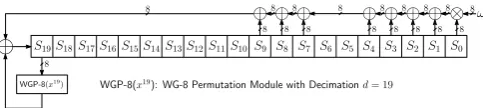
WG-8 is a lightweight variant of the well-known Welch-Gong (WG) stream cipher family with 80-bit secret key and 80-bit initial vector (IV), which can be regarded as a nonlinear filter generator over finite field F28. The stream cipher WG-8 consists of a 20-stage LFSR with the feedback polynomial l(x) followed by a WG-8 transformation module with decimation d= 19, and operates in two phases, namely an initialization phase and a running phase.
Initialization Phase. The key/IV initialization phase of the stream cipherWG-8is shown in Figure1.
S0
S1
S2
S3
S4
S5
S6
S7
S8
S9
S10
S11
S12
S13
S14
S15
S16
S17
S18
S19
⊕
8
8
8 8
WGP-8(x19
) WGP-8(x19): WG-8 Permutation Module with Decimationd= 19
⊕
⊕
8 ⊕8 8 8
⊕
8 ⊕8 ⊕8 8 8
⊗ ⊕
8 8
8 8 ω 8
Figure 1. The Initialization Phase of the Stream Cipher WG-8
Let the 80-bit secret key be K= (K79, . . . , K0)2, the 80-bit IV be IV = (IV79, . . . , IV0)2, and the internal state of the LFSR be S0, . . . , S19∈F28, where Si = (Si,7, . . . , Si,0)2 for i= 0, . . . ,19. The key and IV initialization process is conducted as follows: S2i= (K8i+3, . . . , K8i, IV8i+3, . . . , IV8i)2 and S2i+1=
(K8i+7, . . . , K8i+4, IV8i+7, . . . , IV8i+4)2 fori= 0, . . . ,9. Once the LFSR is loaded with the key and IV, the apparatus runs for 40 clock cycles. During each clock cycle, the 8-bit internal state S19 passes through the nonlinear WG-8 permutation with decimation d= 19 (i.e., theWGP-8(x19) module) and the output is used as the feedback to update the internal state of the LFSR. The LFSR update follows the recursive relation:
Sk+20= (ω⊗Sk)⊕Sk+1⊕Sk+2⊕Sk+3⊕Sk+4⊕
Sk+7⊕Sk+8⊕Sk+9⊕WGP-8(Sk19+19), 0≤k <40.
After the key/IV initialization phase, the stream cipher WG-8 goes into the running phase and 1-bit keystream is generated after each clock cycle.
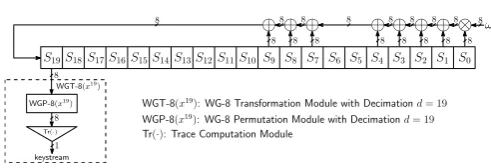
Running Phase. The running phase of the stream cipher WG-8 is illustrated in Figure 2. During the running phase, the 8-bit internal stateS19passes through the nonlinearWG-8transformation with decimationd= 19 (i.e., theWGT-8(x19) module) and the output is the keystream. Note that the only feedback in the running phase is within the LFSR and the recursive relation for updating the LFSR is given below:
Sk+20= (ω⊗Sk)⊕Sk+1⊕Sk+2⊕Sk+3⊕Sk+4⊕
Sk+7⊕Sk+8⊕Sk+9, k≥40.
TheWG-8transformation moduleWGT-8(x19) comprises of two sub-modules: a WG-8 permutation module WGP-8(x19) followed by a trace computation module Tr(·). While theWGP-8(x19) module permutes elements overF28, the Tr(·) module compresses an 8-bit input to 1-bit keystream.
2.3. Randomness Properties of the WG-8
Keystream
Tr(·)
8
1
8
WGP-8(x19) 8
WGT-8(x19)
keystream
WGT-8(x19): WG-8 Transformation Module with Decimationd= 19 WGP-8(x19): WG-8 Permutation Module with Decimationd= 19 Tr(·): Trace Computation Module
⊕
8
8
⊕
8 ⊕8 8 8
⊕
8 ⊕8 ⊕8 8 8
⊗ ⊕
8 8
8 8 ω 8
S0
S1
S2
S3
S4
S5
S6
S7
S8
S9
S10
S11
S12
S13
S14
S15
S16
S17
S18
S19
Figure 2. The Running Phase of the Stream Cipher WG-8
1. The keystream has a period of 2160 −1.
2. The keystream is balanced, i.e., the number of 0’s is only one less than the number of 1’s in one period of the keystream.
3. The keystream is an ideal two-level autocorrelation sequence.
4. The keystream has an ideal t-tuple (1≤t≤20) distribution, i.e., every possible output t-tuple is equally likely to occur in one period of the keystream.
5. The linear span of the keystream can be determined exactly, which is 233.32.
3. Cryptanalysis of the Stream Cipher
WG-8
In this section, we analyze the security of the stream cipherWG-8under the context of lightweight embedded applications. Note that for security applications (e.g., encryption, authentication, etc.) with smart devices the communication sessions are typically short (i.e., a few rounds among communication entities) and the length of transmitted messages is generally quite limited (i.e., tens to hundreds of bytes) in each communication session, due to the constrained power and communication bandwidth of smart devices. As a result, it is extremely difficult, if not impossible, for an adversary collecting consecutive and long enough keystream to conduct cryptanalysis in practice for a well-designed lightweight stream cipher. The design of the stream cipher WG-8 keeps in mind the real-world embedded security applications and the appropriate selection of system parameters enables WG-8 to thwart various cryptanalytic attacks in practice, as detailed in the following subsections.
3.1. Algebraic Attack
The algebraic attack is a powerful attack against LFSR based filtering sequence generators [11]. The goal of the algebraic attack is to form a lower degree multivariate equation by multiplying the filtering function by a low-degree multivariate polynomial. This gives an overdefined system of nonlinear equations for sufficiently many keystreams, which can be solved to recover the internal state of the LFSR. The algebraic immunity of theWGT-8(x19) is equal to 4. According to the algebraic attack, the time complexity and the data complexity for recovering the internal state of the LFSR are about 7
64· 160
4
log27
= 266.0037 and 160 4
= 224.65, respectively. For applying the fast algebraic attacks [10] to the stream cipherWG-8, one needs to respectively find two multivariate polynomials g and h of degree e and d (e < d) such that f·g=h. For the WGT-8(x19) and e= 1, there does not exist a multivariate polynomial h
in 8 variables with degree less than 7. Hence, in order to launch the fast algebraic attack one needs to obtain more keystream bits with a higher complexity. For lightweight embedded applications, it is hard for an attacker to obtain about 224.65 keystream bits. Even if the attacker can get those many bits for a fixed key and IV, he needs to perform the operations with the time complexity 266.0037, which completely defeats this attack.
3.2. Correlation Attack
In the correlation attack, the objective of an attacker is either to find the correlation between a keystream and an output sequence of an LFSR or to find the correlation among the keystreams [9,28,39]. The stream cipher WG-8 is secure against the correlation among the keystreams as it produces keystreams with 2-level autocorrelation. We now consider the fast correlation attack in which the keystream of the stream cipher is considered as a distorted version of the LFSR output. In the fast correlation attack, the linear approximation of WGT-8(x19) can be used to derive a generator matrix of a linear code that can be decoded by a maximum likelihood decoding (MLD) algorithm. Letting f(x) be a linear function in 8 variables, we have Pr(WGT-8(x19)(x) = f(x)) = (28−28108)= 0.578125. Applying the results of
N) required for the attack to be successful is given
by N ≈(k·12·ln 2)13 ·−2·2 160−k
3 and the decoding complexity is given by Cdec= 2k·k· 2 ln 2(2)6, where = (Pr(WGT-8(x19) =f(x))−0.5) = 0.078125 and k is the number of LFSR internal state bits recovered. If we choose a small value of k (e.g., k= 7), the number of bits required to launch the attack is about 260.31, which is not possible in practice. Similarly, if we choose a large value ofk (e.g., k= 80), the number of bits required to mount the attack is about 237.15. However, the decoding complexity of the attack is approximately 2102.68, which is worse than the exhaustive search. Hence, the stream cipherWG-8is secure against the fast correlation attack.
3.3. Differential Attack
The initialization phase in the first design of the WG stream cipher was vulnerable to the chosen IV attack [43], where an attacker can distinguish several output bits by building a distinguisher based on the differential cryptanalysis. This weakness has been fixed in the later design by placing the WGpermutation module at the last position of the LFSR [31]. For the proposed stream cipher WG-8, the differential distribution of the WGP-8(x19) is 8-uniform, which provides a maximum 2−5 possibility for differential characteristic. During the initialization phase the WGP-8(x19) is applied for 40 times. Thus, after the initialization phase, it would be quite hard for an attacker to distinguish the output keystream since the differentials become complex and contain most key/IV bits.
3.4. Cube Attack
Cube attack [13] is a generic key-recovery attack that can be applied to any cryptosystem, provided that the attacker can obtain a bit of information that can be represented by a low-degree decomposition multivariate polynomial in Algebraic Normal Form (ANF) of the secret and public variables of the target cryptosystem. Note that the nonlinearity of WGP-8(x19) is 92 and the algebraic degrees of the component functions of WGP-8(x19) are 7. Moreover, the ANF representations of 8 component functions contain 133, 113, 146, 124, 137, 109, 122, and 120 terms, respectively, and only the ANF of the second component contains 7 linear terms and other
terms are of degree greater than or equal to 2. In the WG-8stream cipher, after 40 rounds of the initialization phase, the degree of the output polynomial can be very high. As a result, it would be hard for an attacker to collect low-degree relations among the secret key bits.
3.5. Distinguishing Attack
Recently, a distinguishing attack has been proposed against the stream cipher WG-7 [32]. Due to the small number of tap positions in the LFSR of the WG-7, the characteristic polynomial of the LFSR allows an attacker to build a distinguisher for distinguishing a keystream generated by WG-7 from a truly random keystream. For the WG-8 cipher, the characteristic polynomial of the LFSR consists of 8 tap positions and a similar distinguisher as in [32] can be built as
F(Si, ..., Si+4, Si+7, ..., Si+9) =WGT-8(ω⊗Si⊕
Si+1⊕Si+2⊕Si+3⊕Si+4⊕Si+7⊕Si+8⊕Si+9)⊕
WGT-8(Si)⊕WGT-8(Si+1)⊕WGT-8(Si+2)⊕
WGT-8(Si+3)⊕WGT-8(Si+4)⊕WGT-8(Si+7)⊕
WGT-8(Si+8)⊕WGT-8(Si+9),
which is a Boolean function in 64 variables. For the distinguisher F, the probability Pr(F(x) = 0) = 12±, where x= (a0, ..., a7), ai ∈F28. Note that the value of will be quite small due to a huge number of variables in the distinguisher, which requires an attacker to obtain more keystream bits for distinguishing the keystream. However, the computation of the exact value of is infeasible in this case because the number of possible values of x is 264. Hence the WG-8 stream cipher is resistant to the distinguishing attack. Note that this type of distinguishing attacks can also be extended to the case in which a distinguisher can be built using a linear relation of a remote term of the LFSR, say Sτ for
not large τ, and the sequences addressed in a subset of tap positions of the LFSR, denoted byI={i1,· · · , it} ⊂
polynomial l(x), there is no remote term Sτ for 20≤
τ≤234 for which the size of setI is less than 5. Thus, theWG-8 stream cipher is also resistant to this general distinguishing attack.
3.6. Discrete Fourier Transform Attack
The Discrete Fourier Transform (DFT) attack is a new type of attack to recover the internal state of a filtering generator, which was first proposed by Rønjom and Helleseth in [36] and extended to attacking filtering generators over F2n by Gong et al. in [20]. For mounting the DFT attack against theWG-8 stream cipher, an attacker needs to obtain 233.32 (i.e., the linear complexity) consecutive keystream bits. Hence, the online complexity of this attack for recovering the internal state is 233.32, after an offline computation with complexity 248.49. For typical lightweight embedded applications like RFID systems, a reader and a tag only exchange 32-bit random numbers in each communication session. Hence, an attacker can never obtain 233.32 consecutive keystream bits.
3.7. Time-Memory-Data Tradeoff Attack
The Time-Memory-Data (TMD) tradeoff attack [4] is a generic cryptanalytic attack that is applicable to any stream cipher, especially those with low sampling resistance. The complexity of the TMD tradeoff attack isO(2n2), wherenis the size of the internal state. For the WG-8stream cipher, the size of the internal state is 160-bit and thus the complexity of launching a TMD attack is at least 280. Moreover, the sampling resistance of the WG-8stream cipher is high due to the usage of the WGT-8(x19) as the filtering function. The ANF representation of theWGT-8(x19) contains 109 terms, among which only four terms are linear and other terms have degree greater than 2 and less than 8. Hence, only by fixing 7 out of 8 variables can one obtain a linear equation.
3.8. Related-key Attack
A related-key attack is a cryptanalytic attack that can also be applied to a stream cipher and allows to launch a key-recovery attack. In [12], Ding et al. proposed a key-recovery attack in the related key settings on WG-8
stream cipher by exploiting the slide property of WG-8 stream cipher. The key-recovery attack has a time complexity of 253.32and needs 252chosen IVs. From the DFT attack on WG-8stream cipher, it can be observed that the DFT attack has an online time complexity of 233.32 and data complexity of 233.32, which are much lower than the complexities of Dinget al.’s key-recovery attack. We believe that the key-recovery attack by Ding
et al.is not a real threat on our WG-8stream cipher.
3.9. Mihaljevi´c
et al.
’s Attack
In [30], Mihaljevi´c et al. proposed an internal state recovery attack on Grain-v1by exploiting the normality of the filtering function of Grain-v1. Their cryptanalysis exploits three facts: a) the bias towards a subset of the internal states; b) recovering some partial key bits; and c) adaptation of the TMD tradeoff approach to use the bias of the internal state. We note that the bias of the internal states is detected by using the normality of the filtering function. Since an LFSR that generates an m-sequence is used to update the internal state of WG-8 stream cipher, no such bias on the internal state exists in the internal state. Moreover, the normality ofWGT-8(x19) is 3. Therefore, Mihaljevi´cet al.’s attack cannot be applied to theWG-8stream cipher.
4. Efficient Software Implementation of the
Stream Cipher WG-8
In this section, we address efficient software implementa-tion of the WG-8 cipher on low-power microcontrollers. For each platform we provide three implementation variants that deal with trade-offs among speed, code size, and energy consumption.
4.1. Implementation of the WG-8 Permutation
Module WGP-8
(
x
19)
The most complicated WGP-8(x19) module can be implemented using three different methods: a) a 256-byte direct up table; b) a 34-byte coset leader based look-up table; or c) tower field (TF) arithmetic.
permutation with decimationd= 19 by
WGP-8(x19) =q(x19+ 1) + 1
for all elementsx∈F28. Hence, a 256-byte look-up table TWGP-8can be generated to computeWGP-8(x19).
Coset Leader Based Look-up Table (CLT) Approach.
This approach assumes that a normal basis is used to represent elements inF28 and uses the essential property of theWG-8permutation with decimationdbelow:
WGP-8(x2i)d=q(x2i
)d+ 1+ 1
=q(xd)2i+ 1+ 1 = q(xd+ 1)2i
+ 1
= q(xd+ 1) + 12i
= WGP-8(xd)2i
(1)
for x∈F28 and i= 0,1, . . . ,7. According to the Equation (1), if we know the WG-8 permutation WGP-8(xd) for an elementx∈F28, we can easily obtain the WG-8 permutation WGP-8((x2i)d) for the entire
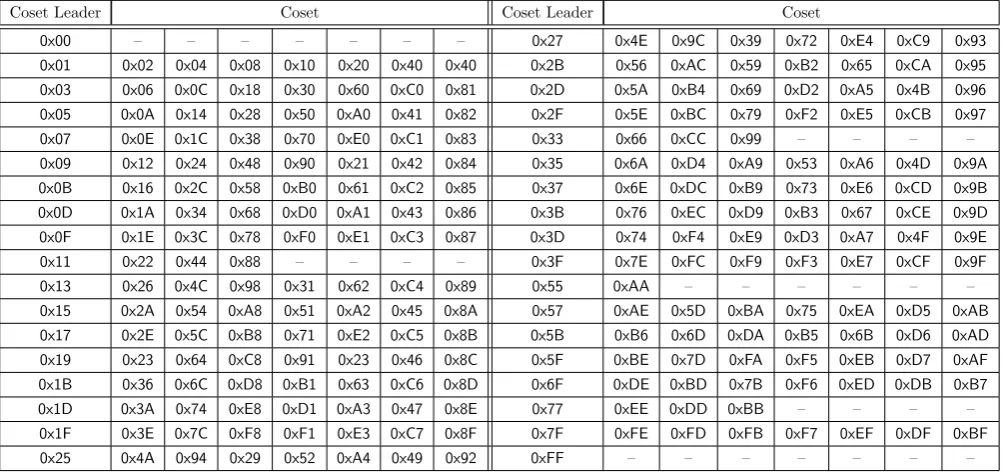
conset {x2, x22, . . . , x27} of x by cyclically shifting WGP-8(xd) to the right by i positions, provided that a normal basis is employed to represent finite field elements. The complete cosets and coset leaders of F28 (in hexadecimal notation) are shown in Table1. We note that under the normal basis representation the elements inF28 have been grouped into 34 different cosets except for 0 and 1. Since WGP-8(0) =0x00 and WGP-8(1) = 0xFF, we only need to generate a 34-byte look-up tableTCo-WGP-8for storing theWG-8permutation results for each coset leader. Here we present the following Algorithm 1 that uses the table TCo-WGP-8 to compute WGP-8(xd) for anyx
∈F28.
Tower Field Arithmetic (TFA) Based Approach. The software implementation of the WGP-8(x19) module involves the arithmetic (i.e., addition, multiplication, and exponentiation) over finite field F28. Although we can directly implement all the operations overF28, it is well known that using the isomorphic tower constructions of
F28 might save the memory consumption. Therefore, we investigate the tower constructionF(24)2 in this work.
Tower Construction F(24)2 and Its Arithmetic.
To obtain the tower construction F(24)2, we first construct F24 by using an irreducible polynomial e(X)
Algorithm 1 Coset Leader Based Look-up Table
Approach
Input: x∈F28, a decimation d, a look-up table
TCo-WGP-8
Output: WGP-8(xd)
1: if x=0x00orx=0xFFthen
2: return x
3: end if
4: Find the coset leaderxc ofxby cyclically shiftingx
to the right byipositions, where 0≤i≤7 (i.e.,xcis
the smallest odd integer in the coset containingx.) 5: Find the positionj ofxc in the tableTCo-WGP-8
6: a←TCo-WGP-8[j]
7: return a≪i
of degree 4 over F2, and then construct F(24)2 by using a certain irreducible polynomial f(X) of degree 2 over
F24. In our tower construction, we use e(X) =X4+ X3+ 1 with its polynomial basis {1, α, α2, α3} for F24 and f(X) =X2+X+αwith its normal basis{β, β16} forF(24)2, whereα=ω119∈F24andβ=ω7∈F(24)2 are zeros of the polynomials e(X) andf(X), respectively.
Arithmetic operations inF24. The arithmetic inF24
is conducted with the aid of a 4×4 exponentiation table Texp and a 4×4 logarithm table Tlog. While the table
Texp stores exponentiation αi, i= 0,1, . . . ,14, the table
Tlog keeps the exponent i for each αi, i= 0,1, . . . ,14.
Let A=a0+a1α+a2α2+a3α3 and B=b0+b1α+ b2α2+b3α3 be two non-zero elements in F24, where
ai, bi∈F2, i= 0,1,2,3. We can perform the arithmetic
in F24 as follows:
AB=Texp[(Tlog[(a0, a1, a2, a3)]+
Tlog[(b0, b1, b2, b3)]) mod 15],
A2=Texp[(Tlog[(a0, a1, a2, a3)]1) mod 15],
αA=Texp[(Tlog[(a0, a1, a2, a3)] + 1) mod 15].
Arithmetic operations in F(24)2. Let A=a0β+
a1β16 andB=b0β+b1β16, wherea0, a1, b0, b1∈F24. A multiplicationABin F(24)2 is computed as follows:
AB= (a0β+a1β16)(b0β+b1β16)
Table 1. The Cosets and Coset Leaders ofF28
Coset Leader Coset Coset Leader Coset
0x00 – – – – – – – 0x27 0x4E 0x9C 0x39 0x72 0xE4 0xC9 0x93
0x01 0x02 0x04 0x08 0x10 0x20 0x40 0x40 0x2B 0x56 0xAC 0x59 0xB2 0x65 0xCA 0x95 0x03 0x06 0x0C 0x18 0x30 0x60 0xC0 0x81 0x2D 0x5A 0xB4 0x69 0xD2 0xA5 0x4B 0x96
0x05 0x0A 0x14 0x28 0x50 0xA0 0x41 0x82 0x2F 0x5E 0xBC 0x79 0xF2 0xE5 0xCB 0x97
0x07 0x0E 0x1C 0x38 0x70 0xE0 0xC1 0x83 0x33 0x66 0xCC 0x99 – – – –
0x09 0x12 0x24 0x48 0x90 0x21 0x42 0x84 0x35 0x6A 0xD4 0xA9 0x53 0xA6 0x4D 0x9A 0x0B 0x16 0x2C 0x58 0xB0 0x61 0xC2 0x85 0x37 0x6E 0xDC 0xB9 0x73 0xE6 0xCD 0x9B 0x0D 0x1A 0x34 0x68 0xD0 0xA1 0x43 0x86 0x3B 0x76 0xEC 0xD9 0xB3 0x67 0xCE 0x9D
0x0F 0x1E 0x3C 0x78 0xF0 0xE1 0xC3 0x87 0x3D 0x74 0xF4 0xE9 0xD3 0xA7 0x4F 0x9E
0x11 0x22 0x44 0x88 – – – – 0x3F 0x7E 0xFC 0xF9 0xF3 0xE7 0xCF 0x9F
0x13 0x26 0x4C 0x98 0x31 0x62 0xC4 0x89 0x55 0xAA – – – – – –
0x15 0x2A 0x54 0xA8 0x51 0xA2 0x45 0x8A 0x57 0xAE 0x5D 0xBA 0x75 0xEA 0xD5 0xAB 0x17 0x2E 0x5C 0xB8 0x71 0xE2 0xC5 0x8B 0x5B 0xB6 0x6D 0xDA 0xB5 0x6B 0xD6 0xAD
0x19 0x23 0x64 0xC8 0x91 0x23 0x46 0x8C 0x5F 0xBE 0x7D 0xFA 0xF5 0xEB 0xD7 0xAF 0x1B 0x36 0x6C 0xD8 0xB1 0x63 0xC6 0x8D 0x6F 0xDE 0xBD 0x7B 0xF6 0xED 0xDB 0xB7
0x1D 0x3A 0x74 0xE8 0xD1 0xA3 0x47 0x8E 0x77 0xEE 0xDD 0xBB – – – –
0x1F 0x3E 0x7C 0xF8 0xF1 0xE3 0xC7 0x8F 0x7F 0xFE 0xFD 0xFB 0xF7 0xEF 0xDF 0xBF
0x25 0x4A 0x94 0x29 0x52 0xA4 0x49 0x92 0xFF – – – – – – –
wherec= (a0⊕a1)(b0⊕b1). For a non-zero elementA∈
F(24)2, the squaring ofAis calculated as follows:
A2= (a0β+a1β16)2
= [(a0⊕a1)2α⊕a20]β+ [(a0⊕a1)2α⊕a21]β16.
The Frobenius mapping ofAwith respect toF24, which is the 16th power operation, is computed as follows:
A24 = (a0β+a1β16)16=a0β16+a1β256=a1β+a0β16.
Implementation of WGP-8(x19) Module. For an
element x∈F28, the WGP-8(x19) can be computed as follows:
WGP-8(x19) =q(x19+ 1) + 1
=y+y23+1+y26(y23+1+y23−1) +y23(23−1)+1+ 1,
where y=x19+ 1 =x24·x2·x+ 1. Note that for the tower constructionF(24)2, 1 can be denoted by the vector (1,0,0,0,1,0,0,0). Therefore, the addition with 1 under the TF representation is equivalent to XORing with a constant0x88.
4.2. Implementation of the Trace Computation
Module
Tr(
·
)
Depending on the bases chosen, the trace of an element x∈F28 can be computed as shown in Table 2.
4.3. Implementation of the Multiplication by
ω
Module
The multiplication by ω module can be implemented using either finite field arithmetic or an 8×8 look-up table.
Multiplication by ω Using Finite Field Arithmetic.
We consider the following three cases when the PB, NB, and TF are used to represent finite field elements, respectively. With the PBrepresentation, the multiplication of an element x∈F28 by ω can be computed as follows:
x·ω=x0ω+x1ω2+· · ·+x6ω7+x7ω8
=x7+x0ω+ (x1⊕x7)ω2+ (x2⊕x7)ω3+
(x3⊕x7)ω4+x4ω5+x5ω6+x6ω7. (2)
Table 2. Trace Computation of an Elementx∈F28 Using Different Bases
Basis Element Representation Tr(x)
Polynomial Basis (PB) x0+x1ω+· · ·+x7ω7 x5 Normal Basis (NB) x0θ+x1θ2+· · ·+x7θ27 L7
i=0xi
Tower Field (TF) (x0+x1α+x2α 2+x
3α3)β+
x1⊕x2⊕x3⊕x5⊕x6⊕x7 (x4+x5α+x6α2+x7α3)β16
With the NBrepresentation, the multiplication of an elementx∈F28 byω can be calculated as follows:
x·ω= (x0θ+x1θ2+· · ·+x6θ26+x7θ27)·ω
=M·(x0, x1,· · · , x6, x7)T, (3)
where the matrixMis given below:
M=
1 1 1 0 1 0 1 1
0 0 0 0 1 1 1 0
1 0 1 0 1 0 0 1
1 0 1 1 1 0 0 0
0 0 1 0 1 1 1 0
0 1 1 0 0 1 1 1
1 0 1 1 1 1 0 0
0 1 1 0 1 0 1 1
.
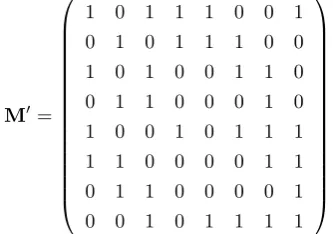
With the TF representation, the multiplication of an elementx∈F28 byω can be calculated as follows:
x·ω= [(x0+x1α+x2α2+x3α3)β+
(x4+x5α+x6α2+x7α3)β16]·ω
=M0·(x0, x1,· · · , x6, x7)T, (4)
where the matrixM0 is given below:
M0=
1 0 1 1 1 0 0 1
0 1 0 1 1 1 0 0
1 0 1 0 0 1 1 0
0 1 1 0 0 0 1 0
1 0 0 1 0 1 1 1
1 1 0 0 0 0 1 1
0 1 1 0 0 0 0 1
0 0 1 0 1 1 1 1
.
Multiplication byω Using Look-Up Tables. Based on the Equations (2)–(4), one can generate 256-byte look-up tables with respect to the chosen bases.
4.4. Implementation Platforms and Development
Tools
In this section, we briefly describe two low-power microcontrollers for implementing the WG-8 stream cipher as well as the corresponding development tools.
8-Bit Microcontroller ATmega128L and Develop-ment Tool. The low-power 8-bit microcontroller ATmega128L [1] from Atmel is based on the AVR enhanced RISC architecture with 128 Kbytes of In-System Self-Programmable Flash, 4 Kbytes EEPROM and 8 Kbytes Internal SRAM. It is equipped with 133 highly-optimized instructions and most of them can be executed within one clock cycle. Moreover, the clock frequency of the ATmega128Lcan run from 0 to 8 MHz and the power supplies can go from 2.7 to 5.5 V. We use the latest integrated development environmentAtmel Studio 6.0 [2] from Atmel for implementing and testing the performance of theWG-8on the target platform.
4.5. Experimental Results and Comparisons
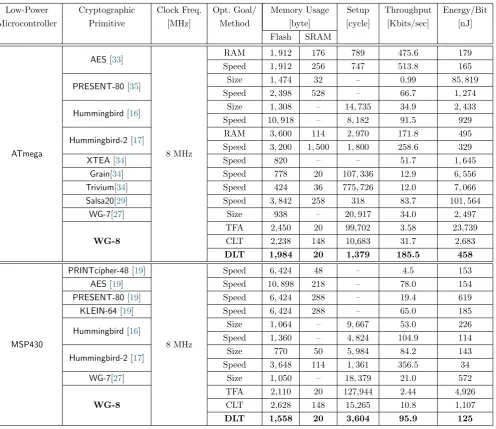
In this section, we report our experimental results for implementing the stream cipherWG-8on the low-power microcontrollers ATmega128L and MSP430F1611 and compare our results with other lightweight-cryptography implementations on the same or similar platforms. We focus on three major performance criteria for implement-ing cryptographic primitives on resource-constrained environments, namely throughput, code size, and energy consumption (i.e., energy/bit). Table 3 compares our implementation results with previous work in terms of the aforementioned three performance criteria. Note that we estimate the per bit energy consumptions by the formula: energy/bit = Clock FrequencySupply Voltage××CurrentNumber of Bits×Cycles, which is based on the typical current consumption of a low-power microcontroller for the given clock frequency and supply voltage.
From Table 3, we note that on 8-bit ATmega microcontrollers the throughput ofWG-8is about 2∼15 times higher than that of stream ciphersGrain,Trivium, Salsa20, and WG-7, block ciphers PRESENT-80 and XTEAas well as the hybrid cipherHummingbird, whereas the energy consumption of WG-8 is around 2∼220 times smaller than that of those ciphers. Moreover, WG-8 has the comparable throughput and energy efficiency with the hybrid cipher Hummingbird-2 (optimized with assembly language). On the 8-bit platform,WG-8is less efficient than AES in terms of throughput and energy consumption. The main reason is that WG-8 is a bit-oriented stream cipher whereas AES is a block cipher with block size 128-bit. Furthermore, the code size of WG-8is medium and the SRAM usage of WG-8is small among all the lightweight implementations.
On 16-bit MSP430 microcontrollers, the throughput of WG-8 is about 1∼20 times higher than that of the stream cipherWG-7as well as block ciphers PRINTcipher-48, AES, PRESENT-80, and KLEIN-64, whereas the energy efficiency is comparable with that of those ciphers. WhileWG-8has similar throughput and energy efficiency as the hybrid cipher Hummingbird, it is less efficient when compared to the Hummingbird-2 cipher. The main reason comes from the optimization with the assembly language in the speed-optimized Hummingbird-2 implementation. Furthermore, the code
size of WG-8 is about 2∼7 times smaller than block ciphersPRINTcipher-48,AES,PRESENT-80, and KLEIN-64 as well as the hybrid cipher Hummingbird-2, and is comparable with the Hummingbirdcipher. Regarding to the SRAM usage, the stream cipherWG-8is superior to other block cipher and stream ciphers.
In addition, for the three implementation variants, we note that on both 8-bit and 16-bit platforms the DLT method is consistently better than both CLT and TFA methods with respect to throughput and energy consumption. The reason lies in the efficient memory access for look-up tables on both microcontrollers.
5. Efficient Hardware Implementation of the
Stream Cipher WG-8
Efficient hardware implementation of the WG-8 stream cipher on both FPGA and ASIC platforms has been extensively investigated in [42]. One look-up table based and three tower field based hardware architectures were proposed and compared to each other in terms of throughput, area, and power consumption. The experimental results show that a direct look-up table based hardware architecture can achieve a maximum throughput of 190 Mbps (resp. 500 Mbps) and require 137 slices (resp. 1786 Gate Equivalents (GEs)) on a Xilinx Spartan-3 FPGA (resp. 65nm CMOS ASIC) platform, at the cost of the dynamic power consumption of 0.005 W (resp. 0.983 mW). Moreover, the look-up table based method is optimal with respect to the defined performance metrics when compared to the tower field based approaches. For certain performance metrics, the WG-8hardware core compares well with the lightweight stream ciphersGrain[22],Trivium[7], and MICKEY[3].
6. Conclusion
Table 3. Performance Comparison of Lightweight-Cryptography Implementations on Low-Power Microcontrollers
Low-Power Cryptographic Clock Freq. Opt. Goal/ Memory Usage Setup Throughput Energy/Bit Microcontroller Primitive [MHz] Method [byte] [cycle] [Kbits/sec] [nJ]
Flash SRAM
ATmega
AES[33]
8 MHz
RAM 1,912 176 789 475.6 179 Speed 1,912 256 747 513.8 165
PRESENT-80[35] Size 1,474 32 – 0.99 85,819
Speed 2,398 528 – 66.7 1,274
Hummingbird[16] Size 1,308 – 14,735 34.9 2,433
Speed 10,918 – 8,182 91.5 929
Hummingbird-2[17] RAM 3,600 114 2,970 171.8 495
Speed 3,200 1,500 1,800 258.6 329
XTEA[34] Speed 820 – – 51.7 1,645
Grain[34] Speed 778 20 107,336 12.9 6,556
Trivium[34] Speed 424 36 775,726 12.0 7,066
Salsa20[29] Speed 3,842 258 318 83.7 101,564
WG-7[27] Size 938 – 20,917 34.0 2,497
WG-8
TFA 2,450 20 99,702 3.58 23,739 CLT 2,238 148 10,683 31.7 2,683
DLT 1,984 20 1,379 185.5 458
MSP430
PRINTcipher-48[19]
8 MHz
Speed 6,424 48 – 4.5 153
AES[19] Speed 10,898 218 – 78.0 154
PRESENT-80[19] Speed 6,424 288 – 19.4 619
KLEIN-64[19] Speed 6,424 288 – 65.0 185
Hummingbird[16] Size 1,064 – 9,667 53.0 226
Speed 1,360 – 4,824 104.9 114
Hummingbird-2[17] Size 770 50 5,984 84.2 143
Speed 3,648 114 1,361 356.5 34
WG-7[27] Size 1,050 – 18,379 21.0 572
WG-8
TFA 2,110 20 127,944 2.44 4,926 CLT 2,628 148 15,265 10.8 1,107
DLT 1,558 20 3,604 95.9 125
low energy consumption of the WG-8 stream cipher, when compared to most of previous block ciphers and stream ciphers. Therefore, the stream cipherWG-8 is a competitive candidate for securing a wide range of smart devices and embedded applications.
Ackowledgement
The authors would like to thank the reviewers for their helpful and constructive comments that greatly improve the final version of this paper. This work is supported by NSERC Discovery and ORF-RE grants.
References
[1] Atmel Corporation (2011) ATmega128(L): 8-bit Atmel Microcontroller with 128 KBytes In-System Pro-grammable Flash, Available athttp://www.atmel.com/
Images/doc2467.pdf.
[2] Atmel Corporation (2012) Atmel Studio 6 – The Integrated Development Environment, Available at
http://www.atmel.com/microsite/atmel_studio6/.
[3] Babbage S. and Dodd M. (2006) The Stream Cipher MICKEY 2.0, ECRYPT Stream Cipher, Available
at http://www.ecrypt.eu.org/stream/p3ciphers/
mickey/mickey_p3.pdf.
Advances in Cryptology - ASIACRYPT 2000, LNCS 1976, T. Okamoto (Ed.), Berlin, Germany: Springer-Verlag, pp. 1-13.
[5] Bogdanov A. and Knudsen L. R. and Leander G. and Paar C. and Poschmann A. and Robshaw M. J. B. and Seurin Y. and Vikkelsoe C. (2007) PRESENT: An Ultra-Lightweight Block Cipher, The 9th International Workshop on Cryptographic Hardware and Embedded Systems - CHES 2007, LNCS 4727, P. Paillier and I. Verbauwhede (eds.), Berlin, Germany: Springer-Verlag, pp. 450-466.
[6] De Canni`ere C. and Dunkelman O. and Kneˇzevi´c M. (2009) KATAN and KTANTAN – A Family of Small and Efficient Hardware-Oriented Block Ciphers, The 11th International Workshop on Cryptographic Hardware and Embedded Systems - CHES 2009, LNCS 5747, C. Clavier and K. Gaj (eds.), Berlin, Germany: Springer-Verlag, pp. 272-288.
[7] De Canni`ere C. and Preneel B. (2005) Trivium – A Stream Cipher Construction Inspired by Block Cipher Design Principles, ECRYPT Stream Cipher, Available
at http://www.ecrypt.eu.org/stream/papersdir/
2006/021.pdf.
[8] Chen L. and Gong G. (2012) Communication System Security, Boca Raton, Florida, USA: Chapman & Hall/CRC.
[9] Chepyzhov V.V. and Johansson T. and Smeets B.J.M. (2000) A Simple Algorithm for Fast Correlation Attacks on Stream Ciphers,The 7th International Workshop on Fast Software Encryption - FSE 2000, LNCS 1978, B. Schneier (Ed.), Berlin, Germany: Springer-Verlag, pp. 181-195.
[10] Courtois N. (2003) Fast Algebraic Attacks on Stream Ciphers with Linear Feedback, Advances in Cryptology - CRYPTO 2003, LNCS 2729, D. Boneh (Ed.), Berlin, Germany: Springer-Verlag, pp. 176-194.
[11] Courtois N. and Meier W. (2003) Algebraic Attacks on Stream Ciphers with Linear Feedback, Advances in Cryptology - EUROCRYPT 2003, LNCS 2656, E. Biham (Ed.), Berlin, Germany: Springer-Verlag, pp. 345-359. [12] Ding L. and Jin C. and Guan, J. and Wang Q.
(2014) Cryptanalysis of Lightweight WG-8 Stream Cipher, IEEE Transactions on Information Forensics and Security, vol.9, no.4, pp. 645 – 652.
[13] Dinur I. and Shamir A. (2009) Cube Attacks on Tweakable Black Box Polynomials, Advances in Cryptology - EUROCRYPT’09, LNCS 5479, A. Joux (Ed.), Berlin, Germany: Springer-Verlag, pp. 278-299.
[14] Driessen B. and Hund R. and Willems C. and Paar C. and Holz T. (2012) Don’t Trust Satellite Phones: A Security Analysis of Two Satphone Standards,The 33th IEEE Symposium on Security and Privacy - S&P 2012, pp. 128-142.
[15] Eisenbarth T. and Kumar S. and Paar C. and Poschmann A. and Uhsadel L. (2007) A Survey of Lightweight-Cryptography Implementations, IEEE
Design & Test of Computers, vol. 24, no. 6, pp. 522-533. [16] Engels D. and Fan X. and Gong G. and Hu H. and Smith E.M. (2010)Hummingbird: Ultra-Lightweight Cryptography for Resource- Constrained Devices, FC 2010 Workshops, RLCPS, WECSR, and WLC 2010, LNCS 6054, R. Sion et al. (Eds.), Berlin, Germany: Springer-Verlag, pp. 3-18.
[17] Engels D. and Saarinen M.-J. O. and Schweitzer P. and Smith E.M. (2011) The Hummingbird-2
Lightweight Authenticated Encryption Algorithm, The 7th International Workshop on RFID Security and Privacy - RFIDSec 2011, LNCS 7055, A. Juels and C. Paar (Eds.), Berlin, Germany: Springer-Verlag, pp. 19-31.
[18] Feldhofer M. and Wolkerstorfer J. and Rijmen V. (2005) AES Implementation on a Grain of Sand, IEE Proceedings Information Security, vol. 15, no. 1, pp. 13-20.
[19] Gong Z. and Nikova S. and Law Y. (2012) KLEIN: A New Family of Lightweight Block Ciphers, The 7th
International Workshop on RFID Security and Privacy -RFIDSec 2011, LNCS 7055, A. Juels and C. Paar (Eds.), Berlin, Germany: Springer-Verlag, pp. 1-18.
[20] Gong G. and Rønjom S. and Helleseth T. and Hu H. (2011) Fast Discrete Fourier Spectra Attacks on Stream Ciphers,IEEE Transactions on Information Theory, vol. 57, No. 8, pp. 5555-5565.
[21] Guo J. and Peyrin T. and Poschmann A. and Robshaw M.J.B. (2011) The LED Block Cipher, The 13th
International Workshop on Cryptographic Hardware and Embedded Systems - CHES 2011, LNCS 6917, B. Preneel and T. Takagi (eds.), Berlin, Germany: Springer-Verlag, pp. 326-341.
[22] Hell M. and Johansson T. and Meier W. (2007) Grain: A Stream Cipher for Constrained Environments, Interna-tional Journal of Wireless and Mobile Computing, vol. 2, no. 1, pp. 86-93.
(eds.), Berlin, Germany: Springer-Verlag, pp. 363-375. [24] Knudsen L. and Leander G. and Poschmann A. and
Robshaw M. J. B. (2010) PRINTcipher: A Block Cipher for IC-Printing, The 12th International Workshop on Cryptographic Hardware and Embedded Systems - CHES 2010, LNCS 6225, S. Mangard and F.-X. Standaert (eds.), Berlin, Germany: Springer-Verlag, pp. 16-32. [25] Leander G. and Paar C. and Poschmann A. and
Schramm K. (2007) New Lightweight DES Variants,The 14th Annual Fast Software Encryption Workshop - FSE 2007, LNCS 4593, A. Biryukov (ed.), Berlin, Germany: Springer-Verlag, pp. 196-210.
[26] Liu D. and Yang Y. and Wang J. and Min H. (2009) A Mutual Authentication Protocol for RFID Using IDEA,
Auto-ID Labs White Paper, WP-HARDWARE-048,
available at http://www.autoidlabs.org/uploads/
media/AUTOIDLABS-WP-HARDWARE-048.pdf.
[27] Luo Y. and Chai Q. and Gong G. and Lai
X. (2010) WG-7: A Lightweight Stream Cipher with Good Cryptographic Properties, IEEE Global Communications Conference – GLOBECOM 2010, pp. 1-6.
[28] Meier W. and Staffelbach O. (1989) Fast Correlation Attacks on Certain Stream Ciphers, Journal of Cryptology, vol. 1, No. 3, pp. 159-176.
[29] Meiser G. and Eisenbarth T. and Lemke-Rust K. and Paar C. (2008) Efficient Implementation of eSTREAM Ciphers on 8-bit AVR Microcontrollers, International
Symposium on Industrial Embedded Systems – SIES 2008, pp. 58-66.
[30] Mihaljevi´c M.J. and Gangopadhyay S. and Paul G. and Imai H. (2012) Internal State Recovery of Grain-v1 Employing Normality Order of the Filter Function,IET Information Security, vol.6, No.2, pp.55 – 64.
[31] Nawaz Y. and Gong G. (2008) WG: A Family of Stream Ciphers with Designed Randomness Properties,
Information Science, vol. 178, no. 7, pp. 1903-1916. [32] Orumiehchiha M.A. and Pieprzyk J. and Steinfeld R.
(2012) Cryptanalysis of WG-7: A Lightweight Stream Cipher,Cryptography and Communications, vol. 4, Iss. 3-4, pp. 277-285.
[33] Osvik D. A. and Bos J. W. and Stefan D. and Canright D. (2010) Fast Software AES Encryption, The 17th
International Workshop on Fast Software Encryption -FSE 2010, LNCS 6147, S. Hong and T. Iwata (eds.), Berlin, Germany: Springer-Verlag, pp. 75-93.
[34] Otte D. (2012) AVR-Crypto-Lib, Available at http:
//www.das-labor.org/wiki/AVR-Crypto-Lib/en.
[35] Poschmann A. (2009) Lightweight Cryptography – Cryptographic Engineering for a Pervasive World, Ph.D. Thesis, Department of Electrical Engineering and Information Science, Ruhr-Universit¨aet Bochum, Bochum, Germany.
[36] Rønjom S. and Helleseth T. (2007) A New Attack on the Filtering Generator,IEEE Transactions on Information Theory, vol 53, No. 5, pp. 1752-1758.
[37] Rowley Associates, (2012) CrossWorks for MSP430, Available athttp://www.rowley.co.uk/msp430/. [38] Shibutani K. and Isobe T. and Hiwatari H. and Mitsuda
A. and Akishita T. and Shirai T. (2011) Piccolo: An Ultra-Lightweight Blockcipher, The 13th International
Workshop on Cryptographic Hardware and Embedded Systems - CHES 2011, LNCS 6917, B. Preneel and T. Takagi (eds.), Berlin, Germany: Springer-Verlag, pp. 342-357.
[39] Siegenthaler T. (1985) Decrypting a Class of Stream Ciphers Using Ciphertext Only, IEEE Transactions on
Computers, vol. 34, No. 1, pp. 81-85.
[40] Texas Instuments Inc., MSP430F15x, MSP430F16x, MSP430F161x Mixed Signal Microcontroller, Available
at http://www.ti.com/lit/ds/symlink/msp430f1611.
pdf, 2011.
[41] Verdult R. and Garcia F. D. and Balasch J. (2012) Gone in 360 Seconds: Hijacking with Hitag2, The 21st
USENIX Security Symposium - USENIX Security 2012, USENIX Association, pp. 237-252.
[42] Yang G. and Fan X. and Aagaard M. and Gong G. (2013) Design Space Exploration of the Lightweight Stream CipherWG-8for FPGAs and ASICs,The 8th Workshop on Embedded Systems Security (WESS’13), ACM Press, Article No. 8, 2013.
[43] Wu H. and Preneel B. (2005) Chosen IV Attack on Stream Cipher WG, ECRYPT Stream Cipher
Project Report 2005/045. Available at http://cr.yp.