AN APPROACH FOR CBIR SYSTEM
THROUGH ADAPTIVE RESONANCE
THEORY (ART1)
K. Eswara Rao$1 P. Sankara Rao#2 G.SusmithaValli#3 P.Anuradha#4 V.Sujatha#5
$1 Asst Professor, Dept. of CSE, AITAM, Tekkali, AP, India. #2, #3 ,#4,#5Asst Professor, Dept. of CSE, GITAM University, AP, India.
Abstract: In these days an image retrieval system has become a challenging task. Many systems based on the text based retrieval but the need of image based retrieval system that takes an image as the input query and retrieves images based on image content is more complicated task. Content Based Image Retrieval is an approach for retrieving semantically-relevant images from an image database based on automatically-derived image features. The aim and Objective of the Paper is classifying the soils using Adaptive resonance theory, a Neural Network concepts for more efficient and effective results. Forthcoming problems or disasters are easily studied and predicted with help of ART .So that priory we can rescue the human kind and mother earth.
Key words: CBIR, ART1, Clustering,
Introduction
This section gives an introduction to content based image retrieval system (CBIRS) and the technologies used in them. Image retrieval has been an extremely active research area over the last 10 years, but first review articles on access methods in image databases appeared already in the early 80s[1]. Enser [2] gives an extensive description of image archives, various indexing methods and common searching tasks, using mostly text based searches on annotated images. In [3], an overview of the research domain in 1997 is given and in [4], the past, present and future of image retrieval is highlighted There are several reasons why there is a need for additional, alternative image retrieval methods apart from the steadily growing rate of image production. It is important to explain these needs and to discuss possible technical and methodological improvements. Image retrieval is the process of browsing, searching and retrieving images from a large database of digital images. Advances in data storage and image acquisition technologies have enabled the creation of large image datasets. In order to deal with these data, it is necessary to develop appropriate information systems to efficiently manage these collections. It is simple to identify a desired image from a small collection simply by browsing, but we need more effective techniques with collections containing thousands of items. Image searching is one of the most important services that need to be supported by such systems. In general, two different approaches have been applied to allow searching on image collections: one based on image textual metadata and another based on image content information. The first retrieval approach is based on attaching textual metadata to each image and uses traditional database query techniques to retrieve them by keywords [5, 6]. However, these systems require a previous annotation of the database images, which is a very laborious and time-consuming task. Furthermore, the annotation process is usually inefficient because users, generally, do not make the annotation in a systematic way. In fact, different users tend to use different words to describe a same image characteristic. The lack of systematization in the annotation process decreases the performance of the keyword-based image search. Image retrieval systems have not kept pace with the collections they are searching. The shortcomings of these systems are due both to the image representations they use and to their methods of accessing those representations to find images. The problems of image retrieval are becoming widely recognized, and the search for solutions an increasingly active area for research and development.
contrasting to the effort needed to annotate images. In this paper it was focused on soil classification of various fields on the earth map/remote sensed image. Generally classification can be done with aid of various filter techniques but in order to calssify the soils we are using an advanced platform called Neural Networks.
Digital Image Definitions
A digital image a[m,n] described in a 2D discrete space is derived from an analog image a(x,y) in a 2D continuous space through a sampling process that is frequently referred to as digitization. The mathematics of that sampling process will be described in Section 5. For now we will look at some basic definitions associated with the digital image. The effect of digitization is shown in Figure1.1
The 2D continuous image a(x,y) is divided into N rows and M columns. The intersection of a row and a column is termed a pixel. The value assigned to the integer coordinates [m,n] with {m=0,1,2,...,M-1} and {n=0,1,2,...,N-1} is a[m,n]. In fact, in most cases a(x,y)--which we might consider to be the physical signal that impinges on the face of a 2D sensor--is actually a function of many variables including depth (z), color ( ), and time (t). Unless otherwise stated, we will consider the case of 2D, monochromatic, static images in this chapter.
Figure1.1: Digitization of a continuous image. The pixel at coordinates [m=10, n=3] has the integer brightness value 110.
The image shown in Figure 1 has been divided into N = 16 rows and M = 16 columns. The value assigned to every pixel is the average brightness in the pixel rounded to the nearest integer value. The process of representing the amplitude of the 2D signal at a given coordinate as an integer value with L different gray levels is usually referred to as amplitude quantization or simply quantization.
Common Values
Characteristics of Image Operations Video Parameters
Common Values
There are standard values for the various parameters encountered in digital image processing. These values can be caused by video standards, by algorithmic requirements, or by the desire to keep digital circuitry simple. Table1.1 gives some commonly encountered values.
Parameter Symbol Typical values
Rows N 256,512,525,625,1024,1035 Columns M 256,512,768,1024,1320 Gray Levels L 2,64,256,1024,4096,16384
Quite frequently we see cases of M=N=2K where {K = 8,9,10}. This can be motivated by digital circuitry or by the use of certain algorithms such as the (fast) Fourier transform The number of distinct gray levels is usually a power of 2, that is, L=2B where B is the number of bits in the binary representation of the brightness levels. When B>1 we speak of a gray-level image; when B=1 we speak of a binary image. In a binary image there are just two gray levels which can be referred to, for example, as "black" and "white" or "0" and "1".
Proposed Method
This systems based on features like color, shape, texture, spatial layout, object motion, etc., are cited in[11],[12].Color is one of the most widely used features for image similarity retrieval, Color retrieval yields the best results, in that the computer results of color similarity are similar to those derived by a human visual system that is capable of differentiating between infinitely large numbers of colors. One of the main aspects of color feature extraction is the choice of a color space. A color space is a multidimensional space in which the different dimensions represent the different components of color [13]. Most color spaces are three dimensional. Example of a color space is RGB, which assigns to each pixel a three element vector giving the color intensities of the three primary colors, red, green and blue. The space spanned by the R, G, and B values completely describes visible colors, which are represented as vectors in the 3D RGB color space. As a result, the RGB color space provides a useful starting point for representing color features of images.
The Adaptive Resonance Theory-ART
In 1976, Grossberg (Grossberg, 1976) introduced a model for explaining biological phenomena. The model has three crucial properties:
1. a normalisation of the total network activity. Biological systems are usually very adaptive to large changes in their environment. For example, the human eye can adapt itself to large variations in light intensities; 2. contrast enhancement of input patterns. The awareness of subtle di erences in input patterns can mean a lot
in terms of survival. Distinguishing a hiding panther from a resting one makes all the diference in the world. The mechanism used here is contrast enhancement;
3. short-term memory (STM) storage of the contrast-enhanced pattern. Before the input pattern can be decoded, it must be stored in the short-term memory. The long-term memory (LTM) implements an arousal mechanism (i.e., the classi cation), whereas the STM is used to cause gradual changes in the LTM.
The system consists of two layers, F1 and F2, which are connected to each other via the LTM.
The input pattern is received at F1, whereas classi cation takes place in F2. As mentioned before, the input is not directly classified. First a characterisation takes place by means of extracting features, giving rise to activation in the feature representation field. The expectations, residing in the LTM connections, translate the input pattern to a categorisation in the category representation field. The classi cation is compared to the expectation of the network, which resides in the LTM weights from F2 to F1. If there is a match, the expectations are strengthened, otherwise the classification is rejected.
ART1: The simplified neural network model
The ART1 simplified model consists of two layers of binary neurons (with values 1 and 0), called F1 and F2
Each neuron in F1 is connected to all neurons in F2 via the continuous-valued forward long term memory (LTM) Wf , and vice versa via the binary-valued backward LTM Wb. The other modules are gain 1 and 2 (G1 and G2), and a reset module. Each neuron in the comparison layer receives three inputs: a component of the input pattern, a component of the feedback pattern, and a gain G1. A neuron outputs a 1 if and only if at least three of these inputs are high: the 'two-thirds rule.' The neurons in the recognition layer each compute the inner product of their incoming (continuous-valued) weights and the pattern sent over these connections. The winning neuron then inhibits all the other neurons via lateral inhibition. Gain 2 is the logical 'or' of all the elements in the input pattern x. Gain 1 equals gain 2, except when the feedback pattern from F2 contains any 1; then it is forced to zero. Finally, the reset signal is sent to the active neuron in F2 if the input vector x and the output of F1 di er by more than some vigilance level.
Operation
The network starts by clamping the input at F1. Because the output of F2 is zero, G1 and G2 are both on and the output of F1 matches its input. The pattern is sent to F2, and in F2 one neuron becomes active. This signal is then sent back over the backward LTM, which reproduces a binary pattern at F1. Gain 1 is inhibited, and only the neurons in F1 which receive a 'one' from both x and F2 remain active. If there is a substantial mismatch between the two patterns, the reset signal will inhibit the neuron in F2 and the process is repeated.
1. Initialisation:
where N is the number of neurons in F1, M the number of neurons in F2, 0 i < N, and 0 ≤ j <M. Also, choose the vigilance threshold ρ, 0 ≤ ρ ≤ 1;
3. compute the activation values y0 of the neurons in F2: 4. select the winning neuron k (0 ≤ k <M):
5. vigilance test: if
where . denotes inner product, go to step 7, else go to step 6. Note that essentially is the inner product ,which will be large if and near to each other; 6. neuron k is disabled from further activity. Go to step 3;
7. Set for all l, 0 ≤ l < N:
8. re-enable all neurons in F2 and go to step 2.
Color of soil IS type
9. 0.1-Brown 1- Clayey sand
10. 0.2Brownish grey 2- Clay with medium Compressibility 11. 0.7 Yellowish red 3- Clay with lowcompressibility 12. 4- Silt with medium Compressibility
Reference data of soil Classification
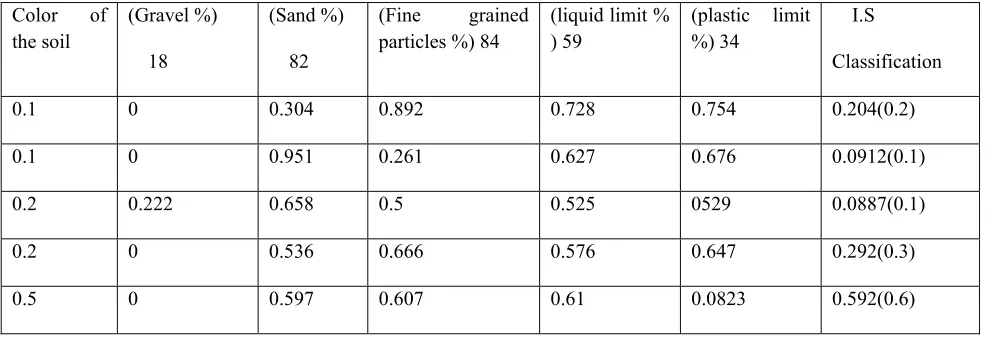
Table 2.1: Sample training data for soil classification
Color of the soil
(Gravel %) 18
(Sand %) 82
(Fine grained particles %) 84
(liquid limit % ) 59
(plastic limit %) 34
I.S Classification
0.1 0 0.304 0.892 0.728 0.754 0.204(0.2)
0.1 0 0.951 0.261 0.627 0.676 0.0912(0.1)
0.2 0.222 0.658 0.5 0.525 0529 0.0887(0.1)
0.2 0 0.536 0.666 0.576 0.647 0.292(0.3)
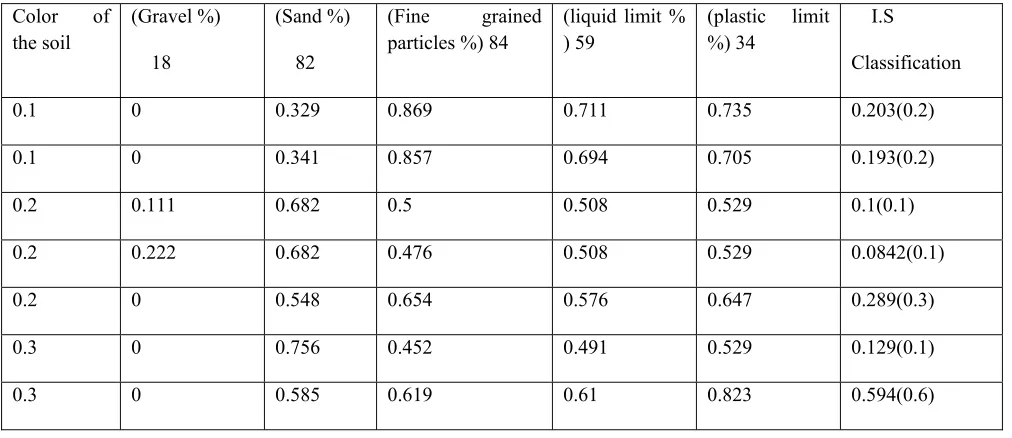
Table 2.2: Inference results for the soil classification (untrained data)
Color of the soil
(Gravel %) 18
(Sand %) 82
(Fine grained particles %) 84
(liquid limit % ) 59
(plastic limit %) 34
I.S Classification
0.1 0 0.329 0.869 0.711 0.735 0.203(0.2)
0.1 0 0.341 0.857 0.694 0.705 0.193(0.2)
0.2 0.111 0.682 0.5 0.508 0.529 0.1(0.1)
0.2 0.222 0.682 0.476 0.508 0.529 0.0842(0.1)
0.2 0 0.548 0.654 0.576 0.647 0.289(0.3)
0.3 0 0.756 0.452 0.491 0.529 0.129(0.1)
0.3 0 0.585 0.619 0.61 0.823 0.594(0.6)
Experimental Results:
Conclusion
This paper is embedded with Three different domains of sciences i.e Basics of Digital image Processing, Soil Fundamentals, Neural Networks. So in order to study the two important learning techniques (Supervised and Unsupervised) we are using the concepts of ART1 algorithms. The algorithm which are used in the project are predefined functions, which cannot be altered according to our task .The most important algorithms that are used in this paper is BPN, ART1, Simplified FUZZY ARTMAP for soil classification as well as image recognition. All three algorithms are completely mathematical based tools i.e the functions that are used in these algorithms are predefined one. Presenting these algorithms in java is really a challenging task, working with dynamic image and collecting the relevant data such as position of the pixel, RGB values and converting it into the intensity values and then giving these values as the inputs to the these algorithms through java and verifying the output values with the trained data ends the project.
ENVI 17%.It is an attempt to study two important learning techniques which plays a vital role in the image processing through these algorithms makes the project more interesting and challenging using Neural Network and Java Flat form.
References
[1] S-K Chang,T.Kunii Pictorial database applications, IEEE Computer 14 (11)(1981) 13-21.
[2] P. G. B. Enser, Pictorial information retrieval, Journal of Documentation 51 (2) (1995) 126-170.
[3] 3. A. Gupta, R. Jain, Visual information retrieval, Communications of the ACM 40 (5) (1997) 70-79.
[4] Y. Rui, T.S.Huang, S.-F.Chang, Image retrieval Past, present and future, in: M. Liao(Ed.),Proceedings of the International
Symposiumon Multimedia Information Processing Taipei,Taiwan,1997.
[5] V.E. Ogle andM. Stonebraker. Chabot: Retrieval from Relational Database of Images. IEEE Computer, 28(9):40–48, Sep 1995.
[6] H. Lieberman, E. Rosenzweig, and P. Singh. Aria: An Agent for Annotating and Retrieving Images. IEEE Computer, 34(7):57–62,
2001.
[7] M. Flickner, H. Sawhney, W. Niblack, Q. Huang J. Ashley, B. Dom, M. Gorkani, J. Hafner,D. Lee, D. Petkovic, D. Steele, and P.
Yanker. Query by Image and Video Content: theQBIC System. IEEE Computer, 28(9):23–32, Sep 1995.
[8] A. W. M. Smeulders, M. Worring, S. Santini, A. Gupta, and R. Jain. Content-Based Image Retrieval at the End of the Years. IEEE
Transactions on Pattern Analysis and MachineIntelligence, 2(12):1349–1380,December 2000.
[9] Y. Rui, T. S. Huang, and S. F. Chang. Image Retrieval: Current Techniques, PromisingDirections, and Open Issues. Journal of
Communications and Image Representation,10(1):39–62,March 1999.
[10] Ritendra Datta, Dhiraj Joshi, Jia Li, And James Z. Wang, “Image Retrieval: Ideas, Influences, and Trends of the New Age”, ACM