ENHANCING NETWORK LIFETIME IN WIRELESS SENSOR
NETWORK
THROUGH
GREY
WOLF
OPTIMIZATION
Er.Navpreet Kaur1, Er.Amarpreet Singh2, Er.Parambir Singh3
1. INTRODUCTION
A wireless sensor network (WSN) is considered to be an intelligent and low cost effective that facilitates the competency and trustworthiness enhancement of various industrial applications like security surveillance [1], home automation, smart grid etc. The Sensor networks are made up of large number of senor nodes that are low powered to maintain and also quite smaller in size. The feature of these installed sensor nodes is that they can operate as a self-governed device. The sensors can be installed on various surroundings [2]. Though, there are various confronts to use the WSN in real life based applications. The major concern taken to the consideration while developing WSN is the concept of energy consumption in the network [3]. In various applications, a sensor node is empowered by restricted sources of energy like battery or super capacitor that limits the lifetime of the network. The renewable sources of energy such as solar energy have been analyzed and collaborated with the sensors currently for longevity of the network [4]. Nevertheless, sporadic nature of energy source still has a specific impact on overall performance of the network. Consequently, energy consumption of network is major factor that need to be considered while designing a network model [4].
For satisfying this requirement of energy efficient network design, the concept of clustering has been introduced and found to be quite commendable [6]. The clustering process is an indispensable phenomenon to perform. The following are the major components that are involved in the process of clustering:
Sensor Node: A sensor node can play various roles in network such as to sense the data as a sensing device, to store the data as a storage device [7], to route the packets by participating to the routing process and to process the data.
Clusters: A cluster is recognized as a group or collection of nodes that are similar in nature. The dense nature of the sensor network raises the requirement [8] of dividing the network into sections in order to simplify the operations such as data sharing.
Cluster Head: A node that represents the cluster. In other words, it can be said as a leader node of the group [9].
Base Station: Base station is a node in the network that acts as a sink node in the communication. This comes at the upper level of the hierarchy of WSN [10]. It is a communication link among sensor network and client.
The clustering process is implemented by using various clustering protocols. The well known cluster- based energy efficient routing protocols are Low Energy Efficient Clustering (LEACH), Power-Efficient Gathering in Sensor Information Systems (PEGASIS), Distributed Energy Efficient Clustering (DEEC), Hybrid Energy Efficient Distributed (HEED), Threshold sensitive Energy Efficient sensor Network (TEEN) etc [11]. These protocols are facilitates the operations of to be highly energy efficient. These protocols also have specific advantages related to scalability as well as efficient data transmission . The essential principle of cluster based protocols is to classify the sensor nodes into a group known as clusters [12-14]. Each and every cluster or group of nodes has a sensor node as a representative i.e. cluster head (CH). The responsibility of CH is to gather the data from cluster members, aggregate the collected data and to transform this to base station or sink node [15]. By
1
Reseacrh Scholar, Department of computer science and technology, Amritsar College Of Engineering And Technology, Amritsar,Punjab,India
2,3
Associate Professor, Department of computer science and technology, Amritsar College Of Engineering And Technology, Amritsar,Punjab,India
DOI: http://dx.doi.org/10.21172/1.124.04
e-ISSN:2278-621X
Abstract—Wireless Sensor Networks are the key components that are used to analyze the surroundings in order to utilize the sensor data for further processing’s such as weather prediction, health related predictions of a patient, traffic control etc. In these environments, the sensor nodes of the network are expected to operate individually in the region for a long period, since it is impossible to manually refill the energy of the nodes due to high maintenance cost of the network. Therefore, the depletion of a single sensor node may effects the processing of the whole network. Consequently, there is a requirement to propose a energy efficient solution in order to increase the network lifetime.
In this study, the proposed energy efficient clustering technique is compared with the traditional ACOPSO mechanism in terms of throughput, energy consumption and network lifetime. The proposed work uses the energy and distance as major parameters for measuring the capabilities of a node to become a CH. Along with this, the GWO optimization is implemented to optimize the outcomes.
using this principle, it is becomes capable to decrease the transferred amount of data within the network and in this manner the energy saving is attained [16]. Various clustering protocols suffer from following issues:
Limited Energy: the limited amount of energy in sensor node should be taken as a proper clustering to reduce the overall energy consumption of the network.
Network Lifetime: The limited amount of energy in the networks leads to the decrement in the network lifetime.
Limited Abilities: The small physical size and limited amount stored energy in a sensor node restricts the capabilities of the nodes in the terms of data processing and data transmission.
Application Dependency: While designing clustering strategies, application robustness should be deemed for an efficient clustering algorithm.
This study is a continuation art of previous work in which a proposal was given on energy efficient clustering protocol in WSN. Before giving a proposal, review to the past researches has been conducted. In review it has been studied that a variety of work has been done by using the clustering protocols and optimization protocols collaboratively. But the thing was that for optimizing cluster head selection process did not cover all the major features and parameters such as energy and distance.
2. OVERVIEW TO THE IMPLEMENTATION
In traditional work, a hybrid clustering mechanism was developed that operated by utilizing the clustering, tree based data aggregation approach and hybrid optimization i.e. ant colony optimization (ACO) and particle swarm optimization (PSO). In this approach, the cluster formation was done on the basis of the energy of the nodes then, data aggregation was done by applying the hybrid optimization approach. After analyzing the traditional work, following issues are observed. The CH selection strategy was quite weak as it considers only energy as a major factor. The hybrid optimization technique leads to the delay in data transmission. The reason behind increased delay is the large number of iterations that are required for the processing of ACO and PSO. Therefore, it is necessary to analyze the traditional energy efficient protocol.
Thus a proposal is given in the previous work. The proposal was given by using Grey Wolf Optimization protocol to optimize the CH selection process. The energy of the nodes and distance of the nodes are considered as major factors. The energy model that is applied in this work is defined as follows:
In above equations stands for amount of energy consumed for transmitting a bit/m2 can be evaluated by using the following formula:
In eqn (3) represents the amount of energy that is consumed for data aggregation. For Receiving Energy the following formulation is used:
Here depicts the amount of energy consumed for receiving bit/m2. The distance is measured by using the following formulation:
The figure 1 shows the framework or flowchart of the proposed work.
Figure 1 Working of proposed energy efficient clustering protocol Initialize the network parameters as area, nodes, location
etc
Evaluate the Energy and Distance of the nodes in the network
Generate Initial population for CH selection
Perform CH selection on the basis of the GWO
Perform Data Transmission or communication from source to destination node
3. PERFORMANCE ANALYSIS
The previous study in this chain has implemented the proposed work in MATLAB simulation platform. The performance of the protocol was analyzed in the terms of throughput of the network, dead nodes in the network, alive nodes in the network and energy consumption of the nodes. The network set up parameters of the proposed work is shown in table 1 below.
Table 1: Proposed Network Setup
Parameters Value
Network Area 100,100
Base Station (x,y) 50,50 or 50,150
Number of nodes 100
Probability 0.1
Initial Energy 0.1 joule
Transmitter Energy 50*10-9
Receiver Energy 50*10-9
Free Space (amplifier) 10*10-13 Multipath (amplifier) 0.0013*10-13 Effective Data Aggregation 50*10-9
Maximum Lifetime 2500
Data packets size 4000
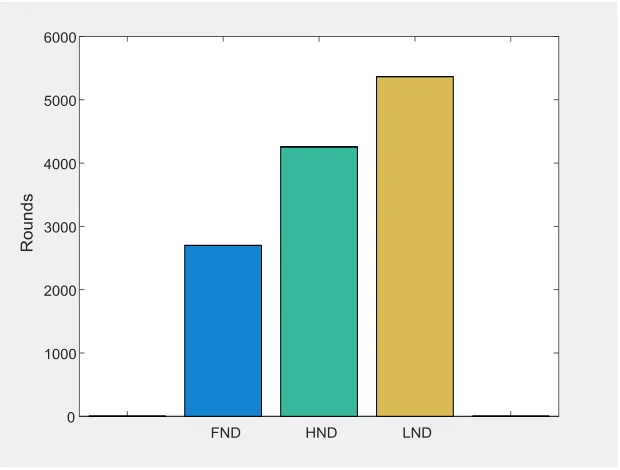
The graph in figure 2 shows the performance of the proposed protocol in the terms of First dead node, half dead node and last dead node in the network. The dead nodes are evaluated on the basis of the number of communication rounds in the network. The bar in blue refers to the first dead node, bars in green shows the half dead node and bar in yellow delineates the last dead node. On the basis of the observations, it is obtained that the first node dead is found at 2800 round approximately. The half node dead is located at 4200 rounds and last node dead is at 5100 rounds approximately. The total 6000 communication rounds are considered for analysis purpose.
Figure 2 FND, HND and LND analysis of proposed network
Figure 3 Comparison Analysis of Packets received at BS
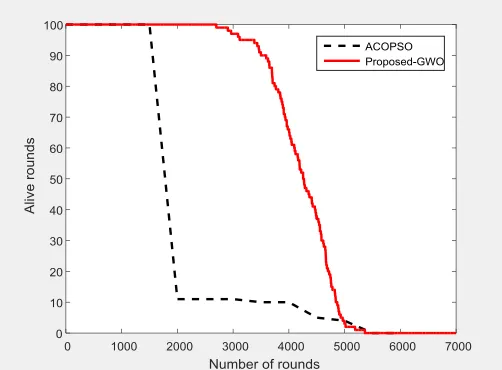
The graph in figure 4 clarifies the comparison analysis of number of alive nodes for proposed and traditional approach. The alive nodes in proposed work is higher than the number of alive nodes in traditional work.
Figure 4 Comparison analysis of Alive node
4. CONCLUSION
The energy plays an important role for operating the sensor networks. The working of whole network relies upon the basis of the energy that is allotted to the nodes initially. It is mandatory to manage the energy consumption of the network to enhance the network lifetime. This study is divided into two parts, one is energy efficient clustering protocols by using the grey wolf optimizing mechanism. The work has been analyzed and found to be quite effective in terms of energy consumption, throughput and network lifetime. In this work a comparison analysis of proposed work is done with traditional ACOPSO algorithm. After evaluation, the proposed GWO mechanism is observed to be outperforming than the traditional ACOPSO technique. The proposed work is capable enough to enhance the lifetime and energy efficiency of the network, but still more amendments could be done in this work in direction of managing the congestion in the network and to enhance the network reliability.
5. REFERENCES
[1] Supreet Kaur, Rajiv Mahajan, (2018), “Hybrid meta-heuristic optimization based energy efficient protocol for wireless sensor networks”, ELSEVIER,
pp1-6.
[2] Er. Navpreet Kaur, Er. Amarpreet Singh, Er. Parambir Singh, (2018), “Review On Clustering For Enhancing Network Lifetime In Wireless Sensor
Network”, International Journal of Innovations in Engineering and Technology, vol 11, issue 4, pp 1-6.
[3] Meena Malik, (2013), “Analysis of LEACH Protocol in Wireless Sensor Networks”, International Journal of Advanced Research in Computer Science
and Software Engineering, Vol 3, Pp 178-183.
[4] R.Rajeshwari, (2015), “Towards Energy Efficient Cluster Based Approach In Wireless Sensor Networks Using Mobile Sink”, IJETCSE, Vol 13 Issue
[5] Nayak Padmalaya, Devulapalli Anurag (2016). “A fuzzy logic-based clustering algorithm for wsn to extend the network lifetime”. IEEE Sens J 2016;16(1):137–44.
[6] Gong Pu, Chen Thomas M, Xu Quan (2015). “ETARP: an energy efficient trust-aware routing protocol for wireless sensor networks”. J Sens
2015;2015.
[7] Hassan El Alami, (2016), “Energy-efficient fuzzy logic cluster head selection in wireless sensor networks”, IEEE.
[8] Shankar T, Shanmugavel S, Rajesh A, (2016). “Hybrid HSA and PSO algorithm for energy efficient cluster head selection in wireless sensor
networks”. Swarm Evol Comput 2016;30:1–10.
[9] Zahedi Zeynab Molay, Akbari Reza, Shokouhifar Mohammad, Safaei Farshad, Jalali Ali, (2016). “Swarm intelligence based fuzzy routing protocol for
clustered wireless sensor networks. Expert Syst Appl 2016; 55:313–28.
[10] Mahmoud M. Salim, Hussein, (2014),"PR-LEACH: Approach for Balancing Energy Dissipation of LEACH Protocol for WSNs"in 31st National Radio
Science Conference (NRSC2014),Ain Shams University, Egypt.
[11] Sunita Rani (2012), “An Improved PEGASIS Protocol to Enhance Energy Utilization in WSN”, International journal of computing and corporate
research, Vol 2.
[12] Arun K. Kumar, (2010), “Energy-Efficient Mobile Data Collection in Wireless Sensor Networks with Delay Reduction using Wireless
Communication”, IEEE.
[13] EZ-ZAIDI Asmaa, (2014), “Efficient data collection in wireless sensor networks using mobile sink”, IEEE, 978-1-4799-7391-0, Vol 14.
[14] Asis Nasipuri, Robert Cox, (2010), “Design Considerations for a Large-Scale Wireless Sensor Network for Substation Monitoring”, 5th IEEE
International Workshop on Practical Issues in Building Sensor Network Application, pp 866-873.
[15] Buyanjargal, (2009), “An Energy Efficient Clustering Algorithm for Event-Driven Wireless Sensor Networks (EECED)”, IEEE, pp 1758 – 1763.
[16] Otgonchimeg Buyanjargal, (2010), “Adaptive and Energy Efficient Clustering Algorithm for Event-Driven Application in Wireless Sensor Networks
(AEEC)”, Journal of Networks, Vol. 5, Issue. 8, pp 904-911.
[17] Chu-Fu Wang, (2014), “A Network Lifetime Enhancement Method for Sink Relocation and Its Analysis in Wireless Sensor Networks”, IEEE Sensors
Journal, Vol. 14, Issue. 6, pp 1932-1943.
[18] Ramandeep kaur,Amarpreet singh (2016), ” Weighted Clustering Algorithm based onO-Leach (WC-OLEACH) in Wireless Sensor Network”,
International Journal of Innovations in Engineering and Technology (IJIET), Volume 6 Issue 3.
[19] Manisha Dhawan, Amarpreet Singh(2017), ” Clustering Aspects In Wireless Sensor Network“, International Journal of Innovations in Engineerin g and
Technology (IJIET),Vol.8 Issue(4-1).
[20] Bikramjit Singh, Amarpreet Singh(2018) ,” Review of Energy Based Routing Protocols in Wireless Sensor Network ”,International Journal of