Sharif University of Technology
Scientia IranicaTransactions B: Mechanical Engineering www.scientiairanica.com
On determination of mode shapes of linear continuous
systems
S.A.A. Hosseini
Department of Mechanical Engineering, Kharazmi University, Mofatteh Avenue, Tehran, P.O. Box 15719-14911, Iran. Received 4 September 2012; received in revised form 29 December 2013; accepted 8 February 2014
KEYWORDS Mode shape; Normal equation; Linear continuous system.
Abstract. Determination of mode shapes of a vibrating system is an important step in vibration analysis. A procedure to determine the mode shapes of linear continuous systems, based on the concept of normal equation, is presented. This procedure is very eective, especially when implemented by computers. This method can be applied easily to multi-step structures, such as multi-stepped beams and bars. To demonstrate the application of the proposed method, some examples are solved.
© 2014 Sharif University of Technology. All rights reserved.
1. Introduction
Determination of mode shapes of a linear continuous system is an important step in vibration analysis [1,2]. For a simple structure, such as single-step beams and bars, this is an easy task. But, for multi-step structures, such as stepped beams with many segments, this should be carried out using a computer. The pre-sentation of an algorithm suitable for implementation by a computer is the aim of the present paper.
Analysis of the longitudinal vibration of stepped rods with non-classical boundary conditions was in-vestigated by Hsueh [3]. Li [4] used the transfer matrix method and the solutions of one step non-uniform bars to analyze the stepped beams. Yavari et al. [5] presented a solution to the bending problem of beams under singular loading conditions with dierent discontinuities using a generalized function theory. By selecting suitable expressions, Li et al. [6] reduced the equation of motion of a non-uniform bar to an equation having an analytical solution. Koplow et al. [7] obtained an analytical solution for the response of a discontinuous beam. Their analysis was validated by experimental tests. Bashash et al. [8] presented
*. Tel.: +98 26 34569555; Fax: +98 26 34569555
E-mail address: [email protected] (S.A.A. Hosseini)
a new method for forced vibration analysis of beams with multiple discontinuities in the cross section. A new analytical method is developed by Yang. [9] for transient vibration analysis of stepped systems. Using a transfer function method and a residue formula for inverse Laplace transform, this method can give the exact transient response of stepped systems with multiple discontinuities. Using a dierential transfor-mation method, Suddoung et al. [10] considered the free vibration analysis of stepped beams made from functionally graded materials.
The determination of mode shapes is a basic step in vibration analysis. To calculate the mode shapes, the temporal part of the solution is assumed as harmonic. With this assumption, the partial dier-ential equation of motion is reduced to a dierdier-ential eigenvalue problem as [1]:
L[u] = mu; (1)
where u is deection of the system, L[:] is the ho-mogenous linear dierential operator of order 2p, is eigenvalue and m is mass density. The boundary conditions are:
Bi[u] = 0; i = 1; 2; :::; p; (2)
where Bi[:] is the homogenous linear dierential
For example, in longitudinal vibrations of a xed-free bar, with length, l, Young's modulus, E, and cross-sectional area, A, the above operators are [1]:
L[u] = dxd
EAdxd (u)
; B1[u] = ujx=0;
B2[u] = EAd(u)dx jx=l: (3)
It is assumed that the rod is xed in x = 0 and is free in x = l.
The solution of Eq. (1) is found as:
u(x) = c1'1(x) + ::: + cp'p(x): (4)
There are p constants cj(j = 1; :::; p) determined by
using p boundary conditions (2). It is noted that 'j(x), j = 1; :::; p is also a function of eigenvalue, .
With application of boundary conditions (Eq. (2)), a homogenous system of linear algebraic equations are found as:
2 6 6 4
A11 : : A1p
: :
: :
Ap1 : : App
3 7 7 5
2 6 6 4 c1
: : cp
3 7 7 5 =
2 6 6 4 0
: : 0 3 7 7
5 ; (5)
or:
[A]ppfcjgp1= f0gp1:
The components of the matrix [A] are found as:
[A]ij = Bi['j(x)]: (6)
To determine the natural frequency of the system, the determinant of [A] is equated to zero. This is a well-known result. Our contribution is in nding the mode shapes. To nd the mode shapes, one variable (say c1) is chosen and then, other variables are solved with
respect to this variable. With this procedure, the mode shape is found as:
u(x) = c1(x): (7)
In the next section, we propose a simple and systematic method to compute the mode shape of a linear continu-ous system. This procedure is very eective, especially when implemented by computer. Some examples are solved using the proposed method. The usefulness of the method is more obvious when dealing with stepped structures with many segments.
2. The proposed method
Now, the problem is how one may solve variables (say) c2:::cn in terms of c1. In vibrations and
struc-tural dynamics textbooks, a procedure is applied as follows: rst, the variable, c2, is solved with respect
to c1; c3; :::; cp and, then, substituted in the second
equation. So, the second equation is written only in terms of c1; c3; :::; cp. Similarly, variable c3 in the
second equation is solved, with respect to c1; c4; :::; cp,
and the procedure is continued until all variables, c2; c3; :::; cp, are written in terms of c1. The results
are then substituted into Eq. (4) to nd the mode shape (i.e. Eq. (7)). For problems with large p (e.g. stepped beams with many segments), this is a lengthy procedure and not suitable for implementation by computer.
Here, a systematic procedure, based on the con-cept of normal equation, is proposed to carry out the above mentioned computations, easily. The approach is especially appropriate for computer programming.
Suppose that coecients c2; c3; :::; cp should be
solved with respect to c1. To do this, the terms in
Eq. (5) that contain c1 are moved to the right hand
side of the equation. So, Eq. (5) reads as: 2
6 6 4
A12 : : A1p
: :
: :
Ap2 : : App
3 7 7 5
2 6 6 4 c2
: : cp
3 7 7 5 = c1
2 6 6 4
A11
: : Ap1
3 7 7
5 ; (8)
or:
[A]p(p 1)fcjg(p 1)1= fBgp1;
where: [B] = c1
2 6 6 4
A11
: : Ap1
3 7 7 5 :
Now, Eq. (8) is a system with p equations and p 1 un-knowns. So, this system of equations is overestimated. To solve this matrix equation, the normal equation should be obtained [11]. The normal equation is that which minimizes the sum of the square dierences between the left and right sides of the matrix equation (Eq. (8)). To compute a normal equation, both sides of Eq. (8) are multiplied by [A]T
(p 1)p as:
[A]T
(p 1)p[A]p(p 1)fcjg(p 1)1=[A]T(p 1)pfBgp1:
(9) The above equation can be written as:
[ A]fcjg = f Bg; (10)
[ A] [A]T
(p 1)p[A]p(p 1); f Bg [A]TfBg:
Now, Eq. (10) is a normal equation and may be solved with any methods in linear algebra.
Consequently, nding the mode shape, i.e. solving coecients c2; c3; :::; cp with respect to c1, is reduced
to solving a system of linear algebraic equations and, therefore, the procedure is fully systematic. The power of the present procedure is revealed when a large number of boundary conditions are applied (e.g. stepped structures).
In the above, the coecient c1 was chosen and
the rst column in the coecient matrix was moved to the right hand side of the equation. Now, the question arises as to which coecient can be chosen? The response is that every column can be chosen provided that the determinant of the matrix [ A] [A]T
(p 1)p[A]p(p 1) does not vanish (i.e. matrix [ A]
must not be singular). For example, if a column exists in the coecient matrix in which all its elements vanish, then, this column must be chosen to move to the right hand side and other columns cannot move to the right hand side. The reason is that, in this case (when a zero column does not move to the right hand side), the matrix [ A] becomes singular and the normal equation does not have a solution. In the next section, a sample example is presented for this case.
3. Sample examples
For the rst example, the mode shape of a simply-supported beam with length l is found. The boundary value problem corresponding to the equation of motion and boundary conditions is [2]:
d4u(x)
dx4 4u(x) = 0; (11)
u(0) = u00(0) = u(l) = u00(l) = 0: (12)
The form of mode shape is found from Eq. (11) as: u=c1sin(x)+c2cos(x)+c3sin h(x)+c4cos h(x):
(13) Applying boundary conditions (Eq. (12)) to the mode shape (Eq. (13)) gives:
2 6 6 4
0 1 0 1
sin(l) cos(l) sin h(l) cos h(l)
0 2 0 2
2sin(l) 2cos(l) 2sin h(l) 2cos h(l)
3 7 7 5 2
6 6 4
c1
c2
c3
c4
3 7 7 5 =
2 6 6 4 0 0 0 0 3 7 7 5 :
(14)
To obtain the eigenvalue, as usual, the determinant of the above matrix is equated to zero; the result is = n=l(n = 1; 2; :::).
Suppose that coecients c2:::c4 are solved with
respect to c1, then, Eq. (14) is written as:
2 6 6 4
1 0 1
cos(l) sin h(l) cos h(l)
2 0 2
2cos(l) 2sin h(l) 2cos h(l)
3 7 7 5
2 4cc23
c4
3 5
= c1
2 6 6 4
0 sin(l)
0 2sin(l)
3 7 7 5 :
(15) Since = n=l(n = 1; 2; :::), the right hand side of Eq. (10) is zero; consequently the solution of the normal equation is c2 = c3 = c4 = 0. Therefore, the mode
shape becomes u = c1sinnxl . This is the same as
Eq. (11.51) in Ref. [2].
The above example is a special case. As explained in the last paragraph of Section 2, since the rst column in Eq. (14) is zero (when substituting = n=l(n = 1; 2; :::)), only this column can be moved to the right hand side. If other columns are chosen, then the normal equation does not have any solution.
If one compares our procedure with others [1,2], it is observed that it is very eective.
For the second example, the mode shape of a free-free beam with length l is obtained. The form of mode shape and the boundary conditions are:
u =c1sin(x) + c2cos(x) + c3sin h(x)
+ c4cos h(x); (16)
u00(0) = u000(0) = u00(l) = u000(l) = 0:
Applying the boundary conditions to the mode shape (i.e. Eq. (6)), it is found that:
2 6 6 4
0 2 0 2
3 0 3 0
2sin l 2cos l 2sin hl 2cos hl
3cos l 3sin l 3cos hl 3sin hl
3 7 7 5 2
6 6 4
c1
c2
c3
c4
3 7 7 5 =
2 6 6 4 0 0 0 0 3 7 7 5 :
(17) The eigenvalue equation becomes:
cos l cos hl = 1; (n = 1; 2; :::): (18) Suppose that coecients c1; c3; c4 are solved with
respect to c2. Then Eq. (17) is written as:
2 6 6 4
0 0 2
3 3 0
2sin l 2sin hl 2cos hl
3cos l 3cos l 3sin hl
3 7 7 5 2
4cc13 c4
3 5 = c2
2 6 6 4
2
0 2cos l
3sin l
3 7 7
5 : (19)
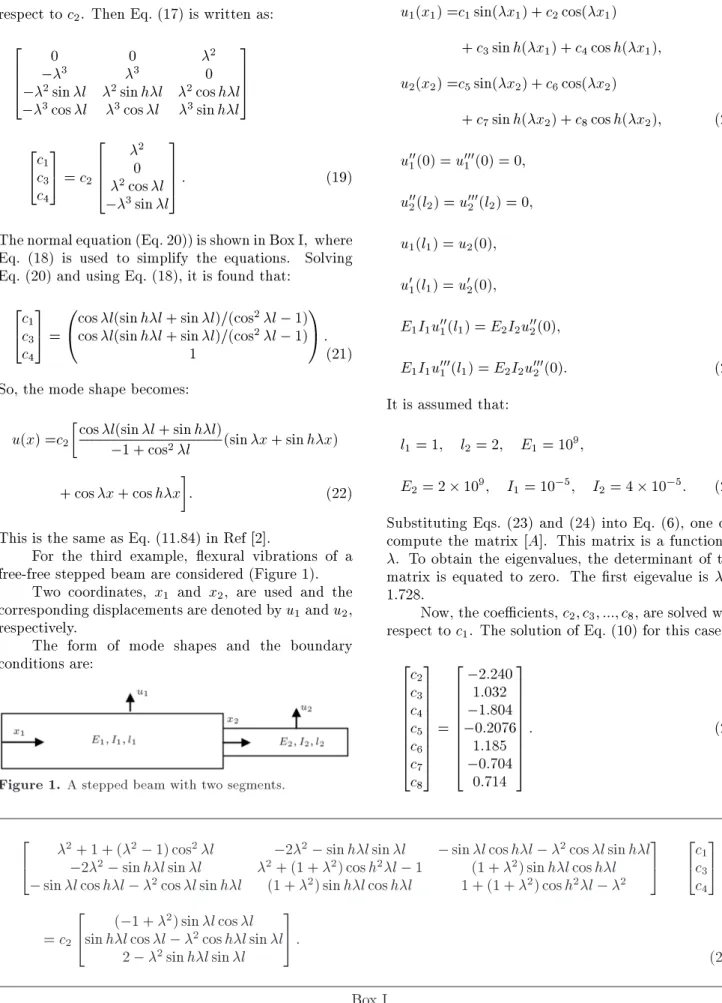
The normal equation (Eq. 20)) is shown in Box I, where Eq. (18) is used to simplify the equations. Solving Eq. (20) and using Eq. (18), it is found that:
2 4cc13
c4
3 5 =
0
@cos l(sin hl + sin l)=(cos
2l 1)
cos l(sin hl + sin l)=(cos2l 1)
1
1 A :
(21) So, the mode shape becomes:
u(x) =c2
cos l(sin l + sin hl)
1 + cos2l (sin x + sin hx)
+ cos x + cos hx
: (22)
This is the same as Eq. (11.84) in Ref [2].
For the third example, exural vibrations of a free-free stepped beam are considered (Figure 1).
Two coordinates, x1 and x2, are used and the
corresponding displacements are denoted by u1and u2,
respectively.
The form of mode shapes and the boundary conditions are:
Figure 1. A stepped beam with two segments.
u1(x1) =c1sin(x1) + c2cos(x1)
+ c3sin h(x1) + c4cos h(x1);
u2(x2) =c5sin(x2) + c6cos(x2)
+ c7sin h(x2) + c8cos h(x2); (23)
u00
1(0) = u0001(0) = 0;
u00
2(l2) = u0002 (l2) = 0;
u1(l1) = u2(0);
u0
1(l1) = u02(0);
E1I1u001(l1) = E2I2u002(0);
E1I1u0001(l1) = E2I2u0002(0): (24)
It is assumed that:
l1= 1; l2= 2; E1= 109;
E2= 2 109; I1= 10 5; I2= 4 10 5: (25)
Substituting Eqs. (23) and (24) into Eq. (6), one can compute the matrix [A]. This matrix is a function of . To obtain the eigenvalues, the determinant of this matrix is equated to zero. The rst eigevalue is = 1:728.
Now, the coecients, c2; c3; :::; c8, are solved with
respect to c1. The solution of Eq. (10) for this case is:
2 6 6 6 6 6 6 6 6 4 c2
c3
c4
c5
c6
c7
c8
3 7 7 7 7 7 7 7 7 5
= 2 6 6 6 6 6 6 6 6 4
2:240 1:032
1:804 0:2076 1:185
0:704 0:714
3 7 7 7 7 7 7 7 7 5
: (26)
2
4
2+ 1 + (2 1) cos2l 22 sin hl sin l sin l cos hl 2cos l sin hl
22 sin hl sin l 2+ (1 + 2) cos h2l 1 (1 + 2) sin hl cos hl
sin l cos hl 2cos l sin hl (1 + 2) sin hl cos hl 1 + (1 + 2) cos h2l 2
3 5
2 4cc13
c4
3 5
= c2
2
4 ( 1 +
2) sin l cos l
sin hl cos l 2cos hl sin l
2 2sin hl sin l
3 5 :
(20) Box I
Therefore, the rst mode shape is found as: u1(x1) = sin(1:728x1) 2:24 cos(1:728x1)
+1:032 sin h(1:728x1) 1:804 cos h(1:728x1);
u2(x2) = 0:207 sin(1:728x2)+1:185 cos(1:728x2)
0:704 sin h(1:728x2)+0:714 cos h(1:728x2):(27)
Since the solution of the above problem was not found in the literature, one can directly validate the result. That is, we substitute solution (27) into Eq. (11) and boundary conditions (24), and it is observed that this solution satises these equations. So, Eq. (27) is our desired solution. It is seen that the proposed method is especially suitable for implementation by computer. 4. Conclusions
A procedure to determine mode shapes, based on the concept of a normal equation, was presented. In this approach, rst, an arbitrary column of the coecient matrix is moved to the right hand side of the equation, and then, with the use of the normal equation concept, the resulted algebraic equation is solved. The method is systematic and easy. This procedure is very eective, especially when implemented by computer. Some examples were solved using the proposed method. The usefulness of the method is more obvious when one deals with multi-step structures with many segments. The proposed method can also be applied to discrete systems.
References
1. Meirovitch, L., Principles and Techniques of Vibra-tions, Prentice Hall, New Jersey (1996).
2. Rao, S.S., Vibration of Continuous Systems, John Wiley & Sons, New York (2007).
3. Hsueh, W.-J. \Free and forced vibrations of stepped
rods and coupled systems", J. Sound Vib., 226, pp. 891-904 (1999).
4. Li, Q.S. \Free longitudinal vibration analysis of multi-step non-uniform bars based on piecewise analytical solutions", Eng. Struct., 22, pp. 1205-1215 (2000).
5. Yavari, A., Sarkani, S. and Moyer Jr, E.T. \On applications of generalized functions to beam bending problems", Int. J. Solids and Struct., 37, pp. 5675-5705 (2000).
6. Li, Q.S. Wu, J.R. and Xu, J. \Longitudinal vibration of multi-step non-uniform structures with lumped masses and spring supports", Appl. Acoust., 63, pp. 333-350 (2002).
7. Koplow, M.A., Bhattacharyya, A. and Mann, B.P. \Closed form solutions for the dynamic response of Euler-Bernoulli beams with step changes in cross section", J. Sound Vib., 295, pp. 214-225 (2006).
8. Bashash, S., Salehi-Khojin, A. and Jalili, N., \Forced vibration analysis of exible Euler-Bernoulli beams with geometrical discontinuities", American Control Conference, Westin Seattle Hotel, Seattle, Washing-ton, USA pp. 11-13 (2008).
9. Yang, B. \Exact transient vibration of stepped bars, shafts and strings carrying lumped masses", J. Sound Vib., 329, pp. 1191-1207 (2010).
10. Suddoung, K., Charoensuk, J. and Wattanasakulpong, N. \Vibration response of stepped FGM beams with elastically end constraints using dierential transfor-mation method", Appl. Acoust., 77, pp. 20-28 (2014).
11. http://mathworld.wolfram.com/NormalEquation.html.
Biography
Seyyed Ali Asghar Hosseini was born in Qom, Iran, in 1978. He received his BS degree from Iran University of Science and Technology, and MS and PhD degrees from Tarbiat Modares University, Tehran, Iran. He is currently Assistant Professor in the Mechani-cal Engineering Department of Kharazmi University, Tehran, Iran. His research interests include nonlinear vibrations, rotor dynamics, and random vibrations.