AN APPROACH TO MANAGED
CLUSTERING FOR
KNOWLEDGE-BASED NETWORKS
A thesis submitted to the University of Dublin, Trinity College
for the degree of Doctor of Philosophy
Dominic Hugh Jones, B.Sc. (Hons), M.Sc. Knowledge and Data Engineering Group (KDEG)
School of Computer Science and Statistics Trinity College, Dublin,
[email protected]
II
Declaration and Online Access
I declare that this thesis has not been submitted as an exercise for a degree at this or any other university and it is entirely my own work.
I agree to deposit this thesis in the University’s open access institutional repository or allow the library to do so on my behalf, subject to Irish Copyright Legislation and Trinity College Library conditions of use and acknowledgement.
______________________
III
A
cknowledgements
I would first like to thank Dr. David Lewis for providing me with this opportunity to pursue the degree of Doctor of Philosophy. Dr. Lewis has been supportive, critical, encouraging and has become both a friend and mentor over my time in KDEG, it has been an honour to work with Dr. Lewis.
Dr. Lewis has been able to offer me funding through Science Foundation Ireland under Grant No 05/RFP/CMS014 (Mecon) and Grant number 07/CE/I1142 (CNGL). For this I am extremely appreciative.
It has been a privilege to have the co-supervision of Dr. O’Sullivan who offered me advice and support that has been invaluable over the years. Special thanks to Dr. John Keeney, Dr. Alexander O’Connor, Dr. Seamus Lawless, Dr. Owen Conlan and Mrs. Mary Sharp who have supported and encouraged me throughout the years and made the difference to many a day.
It was Ms. Marie Carroll who guided me through my undergraduate study, provided endless cups of tea and was there when needed. Marie will always be a great friend, who started me on my path through University level education and is herself an asset to education.
However most importantly I would like to thank my parents Jan and Hughie Jones as well as my de-facto American Mom Dr. P. Jane Gale. Without their combined support this thesis could easily have disappeared during its final year in which they picked me up, stood by me, guided me and had faith in me.
IV
Abstract
In publish/subscribe networks the capacity of the delivery network can easily be exceeded as the volume and range of content increases. This is known as the flooding problem. One solution to this problem is to group publishers and subscribers with similar interests into clusters.
A publish/subscribe network typically operates across a broker overlay. The work described in this thesis offers a novel solution to the flooding problem based on reducing the number of brokers between related publishers and subscribers, thus reducing the routing message volume. With fewer brokers between publisher and subscriber, fewer hops are required to route each message and ultimately the network is more efficient, with less resources required to deliver the same number of messages.
This thesis describes the design, implementation and evaluation of a prototype system in which a Semantic-based Publish/Subscribe network is used to cluster publishers of content with the message brokers that are responsible for routing content to subscribers with related interests. The objective of this clustering is to reduce the number of hops required in the routing process. This contribution has been implemented in a prototype, KBNCluster, as part of this thesis and provides a platform for the clustering of KBNImpl, which has been shown to reduce the hop count required to deliver publications to subscribers and thus decrease the time taken to deliver publications.
A further contribution of this work is the automatic calculation, placement and re-clustering of publishers and subscribers around their interests using a Policy-based Network Management approach. This contribution is evaluated in terms of management data collection costs, storage and policy execution and is shown to scale efficiently.
V
Table of Contents
Declaration and Online Access ... II!
Acknowledgements ... III!
Abstract ... IV!
Table of Contents ... V!
List Of Figures ... XI!
List Of Tables ... XIII!
List Of Code Examples ... XIV!
Abbreviations ... XV!
1!
INTRODUCTION ... 1!
1.1
!
Research Question ... 5!
1.2
!
Research Objectives ... 5!
1.3
!
Methodological Approach Taken ... 6!
1.4
!
Evaluation Findings ... 6!
1.5
!
Thesis Contribution ... 8!
1.6
!
Selected publications ... 9!
1.7
!
Thesis Outline ... 10!
2!
BACKGROUND ... 11!
2.1
!
Key Terms ... 11!
2.2
!
Semantics ... 12!
2.2.1
!
RDF and Ontologies ... 12!
2.3
!
Publish/Subscribe Middleware ... 15!
2.3.1
!
Topic-based Publish / Subscribe: ... 16!
2.3.2
!
Content-based Publish / Subscribe ... 16!
2.3.3
!
Knowledge-based Networks in comparison to CBNs ... 17!
2.4
!
Policy-based Network Management (PBNM) ... 20!
2.5
!
Conclusion ... 21!
3!
STATE OF THE ART ... 22!
3.1
!
Content-based Networks ... 22!
3.1.1
!
Siena ... 22!
3.1.2
!
Hermes ... 23!
VI
3.1.4
!
Elvin ... 24!
3.1.5
!
Analysis ... 25!
3.1.5.1
!
Advantages of CBNs ... 25!
3.1.5.2
!
Disadvantages of CBNs ... 25!
3.2
!
Semantic-based Publish/Subscribe (SBPS) ... 26!
3.2.1
!
Knowledge-based Networks ... 26!
3.2.1.1
!
KBNImpl ... 26!
3.2.1.2
!
KBNMap ... 26!
3.2.1.3
!
KBNCluster ... 27!
3.2.2
!
A semantic Infosphere ... 27!
3.2.3
!
Semantic Toronto Publish/Subscribe System (S-ToPSS) ... 28!
3.2.4
!
Graphed Toronto Publish/Subscribe System (G-ToPSS) ... 29!
3.2.5
!
Semantic Message Middleware for publish/subscribe networks (SMOM) ... 29!
3.2.6
!
An ontology-Based publish/subscribe System (OPS) ... 30!
3.2.7
!
Designing semantic Publish Subscribe networks Using Super-Peers (SPS-SP) ... 30!
3.2.8
!
iBroker ... 31!
3.2.9
!
Analysis ... 31!
3.2.9.1
!
Advantages of SBPS ... 31!
3.2.9.2
!
Disadvantages of SBPS ... 32!
3.3
!
Publish / Subscribe clustering Techniques ... 33!
3.3.1
!
Topic-based Publish/Subscribe Clustering ... 34!
3.3.1.1
!
Boosting topic-based publish-subscribe systems with dynamic clustering (Tamara) ... 34!
3.3.1.2
!
Scribe: a large-scale and decentralized application-level multicast infrastructure ... 34!
3.3.1.3
!
Data Aware Multicast (daMulticast) ... 35!
3.3.1.4
!
Topic-based Event Routing for peer-to-peer Architectures (TERA) ... 35!
3.3.2
!
Content-based Publish/Subscribe Clustering ... 36!
3.3.2.1
!
Sub-2-sub: Self-organizing content-based publish and subscribe for dynamic and large scale collaborative networks ... 36!
3.3.2.2
!
Efficient Publish Subscribe through a Self-Organizing broker Overlay and its Application to SIENA ... 37!
3.3.3
!
Conclusion ... 37!
3.4
!
Publish/Subscribe Classification II ... 38!
3.5
!
Research Challenges gathered from the SoA ... 39!
3.5.1
!
Design Ideas gathered from the SoA ... 40!
3.5.1.1
!
Subscription Regionalism ... 40!
3.5.1.2
!
Ontology Partitioning ... 41!
3.5.1.3
!
Ontological Change ... 42!
VII
4!
DESIGN ... 44!
4.1
!
Introduction ... 44!
4.1.1
!
Extended and New Technology ... 46!
4.2
!
High Level Design ... 47!
4.2.1
!
System Architecture ... 47!
4.2.2
!
Design Overview ... 48!
4.2.2.1
!
Managed Overlay Design Overview ... 48!
4.2.2.2
!
Trigger Broker Design Overview ... 48!
4.2.2.3
!
Policy Server Design Overview ... 48!
4.2.3
!
Clustering Design Assumptions and Scope ... 49!
4.2.3.1
!
Publisher and Subscriber Design Assumptions ... 49!
4.2.3.2
!
Design Assumptions around ontological clustering ... 49!
4.3
!
Clustering Process ... 51!
4.3.1
!
The Medoid ... 51!
4.3.2
!
Taxonomical Approach to Cluster Creation ... 53!
4.3.3
!
Creating an Ontological A* Map ... 55!
4.3.3.1
!
Extracting Semantic Elements from Subscriptions ... 56!
4.3.3.2
!
Extracting Semantic Elements from Publications ... 56!
4.3.4
!
Medoid Calculation ... 57!
4.3.4.1
!
Example Medoid Calculation ... 58!
4.3.4.2
!
Summary: Medoid Calculation ... 58!
4.3.5
!
Cluster Placement ... 59!
4.3.6
!
Re-clustering ... 60!
4.4
!
Trigger Broker ... 62!
4.4.1
!
Subscriptions to Trigger Broker ... 63!
4.4.2
!
Publications Received by the Trigger Broker ... 64!
4.4.3
!
Interactions between KBNImpl Publishers and the Trigger Broker ... 66!
4.5
!
Policy Server ... 67!
4.5.1
!
MIB/MO Design ... 68!
4.5.2
!
Policies ... 69!
4.5.3
!
Actionable events ... 70!
4.6
!
Key Design Characteristics and Conclusion ... 72!
5!
IMPLEMENTATION ... 74!
5.1
!
Introduction ... 74!
5.2
!
Technology Selection ... 75!
5.2.1
!
Core Technologies: ... 75!
VIII
5.2.3
!
Messaging Mechanisms: ... 76!
5.3
!
Order of Operation ... 77!
5.4
!
Communication Flow ... 79!
5.4.1
!
Overall Communication ... 80!
5.4.2
!
Broker Focused Communication ... 82!
5.4.3
!
Publisher Focused Communication ... 83!
5.4.4
!
Subscriber Focused Communication ... 85!
5.4.5
!
Conclusions – Communication Flow ... 86!
5.5
!
Trigger Broker ... 87!
5.5.1
!
Trigger Broker – Start-up Configuration ... 87!
5.5.2
!
Trigger Broker – Main Classes ... 87!
5.5.3
!
Trigger Broker - Summary of Key Characteristics ... 89!
5.6
!
Policy Server ... 90!
5.6.1
!
Policy Server - Start-up Configuration ... 90!
5.6.2
!
Main Classes ... 91!
5.6.3
!
MIB/MO Implementation ... 92!
5.6.4
!
Clustering Process ... 93!
5.6.4.1
!
Cluster Partitioning ... 93!
5.6.4.2
!
Overlaying an Ontology onto Brokers ... 94!
5.6.4.3
!
Calculating Client Cluster Placement ... 95!
5.6.5
!
Summary of Key Characteristics ... 95!
5.7
!
Starting Brokers, Publisher and Subscriber ... 96!
5.7.1
!
Starting a Broker ... 96!
5.7.2
!
Starting a Publisher ... 97!
5.7.3
!
Starting a Subscriber ... 99!
5.8
!
Conclusions and Summary of Technical Discussions ... 100!
6!
EVALUATION ... 101!
6.1
!
Experimental Setup ... 103!
6.1.1
!
Ontologies ... 103!
6.1.2
!
Platforms ... 104!
6.1.3
!
Metrics ... 105!
6.1.4
!
Sensitivity Analysis ... 106!
6.2
!
Static Approach to Clustering ... 109!
6.2.1
!
Introduction ... 109!
6.2.2
!
Experimental Metrics ... 109!
IX
6.2.4
!
Results ... 110!
6.2.5
!
Conclusion ... 112!
6.3
!
KBNImpl Operational Costs ... 113!
6.3.1
!
Operator Usage ... 113!
6.3.2
!
Subscription Tree Search Time ... 115!
6.3.3
!
Hop Count Experiments ... 117!
6.3.3.1
!
Hop Occurrences ... 117!
6.3.3.2
!
Hop Count Timing ... 119!
6.3.4
!
Conclusion ... 120!
6.4
!
Costs Associated with Dynamic Clustering ... 121!
6.4.1
!
Management Data Storage & Policy Execution Costs ... 122!
6.4.1.1
!
Memory Footprint ... 122!
6.4.1.2
!
Policy Execution Timing ... 123!
6.4.1.3
!
Conclusion ... 126!
6.4.2
!
Data Collection Costs ... 126!
6.4.2.1
!
Management Method 1 ... 127!
6.4.2.2
!
Management Method 2 ... 128!
6.4.2.3
!
Standard Error Calculation ... 129!
6.4.2.4
!
Subscription Processing Times ... 130!
6.4.2.5
!
Publication Processing Times ... 131!
6.4.2.6
!
Pub-to-Sub Delivery Times ... 133!
6.4.2.7
!
Conclusion ... 134!
6.4.3
!
Mobility Costs ... 136!
6.4.3.1
!
Moving Broker & Moving All Subscribers ... 137!
6.5
!
Dynamic Clustering Evaluation ... 139!
6.5.1
!
Experimental Metrics ... 140!
6.5.2
!
Subscription Tree Size ... 140!
6.5.3
!
Hop Count in Delivery ... 142!
6.5.4
!
Re-Clustering ... 144!
6.5.5
!
Conclusion ... 146!
6.6
!
Overall Conclusion ... 147!
7!
Conclusion ... 149!
7.1
!
Objectives and Achievements ... 149!
7.1.1
!
Research Objective 1 ... 150!
7.1.2
!
Research Objective 2 ... 151!
7.1.3
!
Research Objective 3 ... 151!
X
7.2.1
!
Major Contribution ... 152!
7.2.2
!
Minor Contribution ... 153!
7.2.3
!
Additional Supporting Publications: ... 154!
7.3
!
Future Work ... 155!
7.3.1
!
Subscriber Re-clustering ... 155!
7.3.2
!
Load Balancing of Clusters ... 155!
7.3.3
!
The trigger broker as a management event monitoring system ... 156!
7.3.4
!
Multiple Policy Servers ... 156!
7.4
!
Final Remarks ... 157!
Bibliography ... 158!
Appendices ... 161!
Appendix A ... 161
!
Appendix B ... 169
!
Appendix C ... 178
!
Appendix D ... 182
!
XI
List Of Figures
Figure 1: Example Ontology ... 13
!
Figure 2: Classification of Publish/Subscribe Systems ... 15
!
Figure 3: Classification of Publish/Subscribe Systems II ... 38
!
Figure 4: High Level Component Architecture ... 47
!
Figure 5: Sample Clustered Ontology ... 53
!
Figure 6: A* Ontological Map ... 55
!
Figure 7: Sample ontology graphed using A* algorithm ... 56
!
Figure 8: Example Medoid Calculation ... 58
!
Figure 9: Trigger Broker, High Level Overview ... 62
!
Figure 10: Trigger Broker Ontology ... 63
!
Figure 11: Policy Server, High Level Architecture ... 67
!
Figure 12: Components of KBNCluster ... 77
!
Figure 13: Overall Communication Mechanisms ... 80
!
Figure 14: Broker Based Communication ... 82
!
Figure 15: Publisher based communication ... 83
!
Figure 16: Subscriber based Communication ... 85
!
Figure 17: UML Class Diagrams for Broker, Publisher and Subscriber ... 92
!
Figure 18: Broker Hierarchy ... 110
!
Figure 19: Root Subscription Tree Size on the Master Node (shown in Figure 18) ... 111
!
Figure 20: Unique Subscriptions on a Broker on Level 3 (shown in Figure 18) ... 111
!
Figure 21: Example Topology, Operator Search Costs ... 114
!
Figure 22: Subscription tree search times (Semantic & Non Semantic) ... 116
!
Figure 23: Spread of Hop Counts in Delivered Notifications, across various cluster topologies 118
!
Figure 24: Average Message Delivery Timing, Semantic ... 119!
Figure 25: Average Message Delivery Times, Non Semantic ... 120
!
Figure 26: Memory Usage vs. MO Created ... 123
!
XII
Figure 28: Average Subscription Processing Times (ms) ... 131
!
Figure 29: Average Publication Processing Times (ms) ... 132
!
Figure 30: End-to-End Delivery Time (ms) ... 134
!
Figure 31: Moving Broker & All Subs and Moving All Subs Individually ... 138
!
Figure 32: Dynamic Clustering - Server Topology ... 139
!
Figure 33: Root Subscription Tree Size (Clustered and un-clustered) ... 141
!
Figure 34: Hop Count - Clustered and Un-Clustered Topology ... 143
!
XIII
List Of Tables
Table 1: Example RDF Triple ... 12
!
Table 2: Example Filter Constraint ... 16
!
Table 3: Example Publication ... 16
!
Table 4: Example Subscription ... 17
!
Table 5: Classification of Topic, Content and Knowledge-based Network ... 18
!
Table 6: Siena CBN Operators, Types and Symbols ... 19
!
Table 7: KBNImpl KBN Operators, Types and Symbols ... 19
!
Table 8: Bag Operators, Types and Symbols ... 19
!
Table 9: Broker, Subscriber & Publisher MO Key Elements ... 68
!
Table 10: Test Ontology Characteristics ... 104
!
Table 11: Matrix of Experimental Metrics ... 107
!
Table 12: Experimental set-up metrics used in experiments ... 109
!
Table 13: Experimental set-up metrics used in experiments ... 113
!
Table 14: Example Subscriptions and Matching Publications ... 113
!
Table 15: KBNImpl Operator Costs – End to end mean delivery times per match (ms) ... 114
!
Table 16: Experimental set-up metrics used in experiments ... 115
!
Table 17: Experimental set-up metrics used in experiments ... 117
!
Table 18: Experimental set-up metrics used in experiments ... 130
!
Table 19: Standard Error Subscription Processing Times (ms) ... 131
!
Table 20: Experimental set-up metrics used in experiments ... 132
!
Table 21: Standard Error Publication Processing Times (ms) ... 132
!
Table 22: Experimental set-up metrics used in experiments ... 133
!
Table 23: Standard Error End-to-End Delivery Times (ms) ... 134
!
Table 24: Experimental set-up metrics used in experiments ... 137
!
Table 25: Experimental Data ... 138
!
XIV
List Of Code Examples
Code Example 1: Example Managerial Subscription II ... 63
!
Code Example 2: Example Managerial Publication II ... 64
!
Code Example 3: Example Medoid Message ... 64
!
Code Example 4: Example Broker Info Message ... 64
!
Code Example 5: Example Subscriber Info Message (Publication) ... 65
!
Code Example 6: Example Publisher Info Message (Publication) ... 65
!
Code Example 7: Example Subscriber Notification Report (Publication) ... 65
!
Code Example 8: Starting the Trigger Broker ... 87
!
Code Example 9: Starting the Policy Server ... 90
!
Code Example 10: Starting the Top Level Master Broker ... 96
!
Code Example 11: Starting a Sub Broker ... 96
!
Code Example 12: Example Publishing Client ... 97
!
Code Example 13: Example Subscriber Client ... 99
!
Code Example 14: Example Semantic Subscription used within this section ... 116
!
Code Example 15: Example Semantic Publications used within this section ... 116
!
Code Example 16: Calculating Memory Usage ... 122
!
Code Example 17: Request Medoid ... 127
!
Code Example 18: Reduce down to N clusters ... 128
!
Code Example 19: Request Medoid Info ... 128
!
Code Example 20: Example Subscriptions used within the Section ... 136
!
Code Example 21: Dynamic Clustering, example subscriptions ... 140
!
Code Example 22: Dynamic Clustering, example publications ... 140
!
XV
Abbreviations
AC Attribute Constraint
API Application Programming Interface
AV Attribute Value
BIM Broker Information Message CBN Content-based Network
DEBS Distributed Event-based Systems
DHT Distributed Hash Table DPS Distributed-Publish/Subscribe GUI Graphical User Interface
IDE Integrated Development Environment IP Internet Protocol
JMS Java Messaging Service KBN Knowledge-based Network MIB Management Information Base
MO Managed Object
OAEI Ontology Alignment Evaluation Initiative
OWL Ontology Web Language
PAM Partitioning Around Medoids
PBNM Policy-based Network Management
PIM Publisher Information Message
RBAC Role-based Access Control
RDF Resource Description Framework RSS Really Simple Syndication
SBPS Semantic-based Publish/Subscribe
SIM Subscriber Information Message SoA State of the Art
SPARQL SPARQL Protocol and RDF Query Language
TBN Topic-based Network
1
INTRODUCTION
Publish/subscribe networks are made up of client content producers (publishers) and client consumers (subscribers) both attached to a network of message brokers/routers. Currently clients make an un-constrained choice as to the broker to connect to, often leading to an overloading of certain popular brokers in the network, resulting in performance degradation. This thesis is designed to improve the scalability of Semantic-based Publish/Subscribe (SBPS) networks by placing clients interested in similar content around similar brokers in the network.
These brokers asynchronously route messages from publisher to interested subscribers based on matches between publication and subscription. Publications are messages that may be of interest to subscribers, where those interests have been expressed in a subscription. Subscriptions are expressions of subscribers interests, often formed from a taxonomy of types/topics or from a set of one or more filter constraints defining the content they wish to receive from publishers. A broker maintains a set of these subscriptions, and applies their subscription constraints to publications as they arrive. If a publication is matched against a subscription, then it is forwarded to the associated subscriber.
Centralised publish/subscribe networks operate using a single broker, whereas distributed publish/subscribe networks operate across a network of inter-connected message brokers. In distributed publish/subscribe networks, messages are usually routed from publisher to relevant subscribers according to a routing table derived from subscription filters. This offers performance efficiencies, as messages are directed only to interested subscribers, rather than using an approach which floods the network in the search for all possible interested publishers.
The main differentiators between classes of publish/subscribe systems are the formats, types, values, ranges and filter operators supported in specifying subscriptions and publications. For example highly expressive filters can be argued to more accurately represent subscribers interests through a greater number of filter constructs. Therefore asserting that the more expressive the subscription filter, the greater the ability of the subscriber to accurately express their interests. In increasing order of expressivity, the three main classes of publish/subscribe network are:
2. Content-based publish/subscribe (CBN): Publications contain a set of one or more typed values, whereas subscriptions are a set of value-based filters that are applied to the body of the publication’s contents (Siena [2] being an example of a CBN.)
3. Semantic-based publish/subscribe (SBPS): Similar to content-based, but where both publications and subscriptions may have semantically enhanced operators, types and values based on a semantic model or ontology [3]. The use of the term SBPS is first referred to by Guo in [4]. (Examples of such SBPS can be found in [5-9] an example being Knowledge-based Networks (KBN) [9].)
Type / Topic-based Networks operate efficiently, as the extent of the routing information maintained at each broker is a list of types or topics associated with each interested subscriber, reducing the complexity involved in matching incoming publications to stored subscriptions. When an incoming publication arrives at a broker, a simple look-up for the type/topic in an ordered list is performed, and when matched, is forwarded to all the subscribers associated with that type/topic. This is all conducted via the message header, which is marked, with one or more topic or types for each publication. In comparison both content and semantic-based networks see the incoming publications contents being evaluated against the brokers’ stored subscription filters. Content-based subscriptions are usually constructed from one or more filters in the form of a
Name-Type-Operator-Value (Attribute-Constraint) and publications are constructed
from one or more Name-Value-Type (Attribute-Values). For each filter in each subscription the Type and Value must be compared, using its Operator against each Type and
Value in each element of every incoming publication. If a match occurs the publication is
forwarded towards the subscriber.
The time taken to search incoming publications against stored subscriptions depends on the particular set of subscriptions or publications. Importantly, with Type/Topic-based Networks the matching performance is predictable against the throughput of publications to subscriptions. For Content-based Networks performance is a function of the size (where the size = number of elements) in both subscriptions and publications and hence is less predictable. In Semantic-based Publish/Subscribe this problem is exacerbated as different semantic operators hold different associated costs. There is therefore a trade-off between the efficiency of Topic- and Content-based Networks like Scribe [10] and Siena [2] and the expressiveness of SBPS.
publications that match S2. Mühl et. al. [11] describe a benefit of this covering as being “a reduction in the number of entries in brokers’ routing tables.” If covering reduces the total number of routing entries in the broker, the matching and routing time involved in delivering publications to subscribers via those message brokers on which no covering has occured is also reduced through a reduction in the number of subscriptions which must be matched against incoming publications.
In this thesis work is conducted on a particular class of SBPS, Knowledge-based Networks (KBN), a specific implementation of a KBN (KBNImpl) extended to form KBNCluster. KBNCluster focuses on incorporating the expressivity of SBPS with the efficiency of content-based routing and subscription aggregation through subscription clustering. The continuing research challenge in SBPS is where the increase in expressivity results in an additional increase in the overhead involved in determining matches between semantic subscriptions and publications. This research challenge has motivated the solution proposed in this thesis, aiming to reduce the average number of hops and thus brokers required to deliver messages, where the time taken to deliver a publication is directly related to the number of hops taken in its routing and thus overall load on the broker network. This is an alternative to trying to further optimise individual operator match performance [6]. In clustering this allows publishers and subscribers, with shared interests, to be arranged closer to one another in the broker network and thus the number of hops that a publication is required to traverse is reduced, therefore reducing overall load on the network. More precisely when matching semantic terms in a publication to subscription, logical structures are used that make explicit a graph that expresses the ontology being referenced. Because this graph exists in definition, it can be analysed by its characteristics and the specific references made to it by publishers and subscribers in matches between publication and subscription.
It is assumed that shared interests will (as expressed by publications and subscriptions) involve terms nearer to each other in the semantic graph or ontology. Therefore clustering publishers and subscribers, using their semantic publications or subscriptions is predicted to reduce the number of hops a publication passes over in being routed to interested subscribers. This is in contrast to non-semantic CBNs, which operate only on the content (numbers, strings, sets etc of messages) and which do not have an explicit semantic structure that can be efficiently utilised in clustering. Publish/subscribe topologies generally allow these clients to connect to brokers in an un-constrained manner; meaning that the range of subscriber or publisher interests attached to any given broker cannot be predicted.
becomes possible to compare it to that of other clients publications or subscriptions, and thus create clusters of common interest, around message brokers. In support of clustering, the performance of the publish/subscribe network is predicted to be improved as follows:
1. The fewer hops (brokers) over which a publication message passes when being routed from publisher to relevant subscribers decreases both the time taken to deliver (based on per broker matching time and number of brokers involved in routing.)
2. Clustering reduces the semantic range of subscriptions that are received by brokers and the number of filter matches that must be made, on each broker. With clustering, a publication arriving at a broker, has a higher chance of matching a stored subscription, in that broker’s routing table. The same routing table is also better optimised in terms of subscription covering, as subscribers are clustered according to the semantics of that subscription and thus the probability of subscription covering also increases.
In this thesis two types of clustering are defined, as discussed below:
1. Static Clustering instructs the brokers, publishers and subscribers of their relationship between one another pre deployment. However if this relationship changes, the statically embedded logic in every client must also change, usually with a full re-start. With the relationships between publishers, subscribers and brokers potentially changing rapidly, such a static approach is seen in [7] as being inefficient in terms of the ability of a network manager to manage efficiently the relationship between publishers, subscribers and clusters. In static clustering every publisher or subscriber must be manually instructed, by a network administrator, as to the broker they should attach to and it is thus clear to see that this does not scale as the number of clients increases.
2. Managed Dynamic Clustering allows publishers, subscribers and brokers to hold no statically embedded logic or knowledge of how to cluster. All logic is maintained in a management entity, which enforces the rules of clustering across the network, using an embedded management agent in each client and broker to enforce managed dynamic clustering. The key motivator for such an approach is that changes in managerial policies can be made and enforced without requiring any change on the part of the client.
1.1 Research Question
This thesis examines whether a managed dynamic clustering approach improves the performance of Knowledge-based Networks, a sub-class of Semantic-based Publish/Subscribe.
1.2 Research Objectives
Three main research objectives have been drawn from the above research question:
Objective 1: Establish an approach for the formation, movement and re-clustering of semantic clusters in Knowledge Based Networks.
Objective 2: Establish the effect and overhead of implementing static and managed dynamic clustering in Knowledge Based Networks.
Objective 3: Apply Policy-based Network Management as an adaptable approach to the management of clustering.
In order to address research objective 1, a dynamic process for partitioning an ontology into a number of semantic clusters is presented. This partitioned ontology is then overlaid onto a broker network. This process directs into which cluster a subscriber or publisher should be placed. In addition, a misplaced subscriber can be identified and moved to a more suitable cluster.
In order to address research objective 2, it is shown that clustering decreases the average distance a message travels from publisher to subscriber. In addition to this, clustering is shown to reduce the overall load on individual brokers, and the broker network in general.
1.3 Methodological Approach Taken
This research was conducted using an iterative investigative approach in evaluating the effect clustering has upon knowledge-based networks. The positive effect of clustering had been shown in topic-based networks. In content-based networks clustering became more difficult as there exists no agreed model of knowledge used to form messages. With semantics and knowledge-based networks a common model is present for use in clustering opening a new avenue of research.
However there was no starting point on which to build using a comparative approach. There was no system in which the effects of clustering, as shown in topic-based networks, had been applied in a knowledge-based environment. Having established that a comparative approach was not possible, this research took an approach based on evaluating incremental improvements in KBN performance through clustering. This was conducted using a two-pronged methodology evaluating system performance and network delivery metrics in parallel. These two metrics offer a mechanism for evaluating whether the introduction of clustering had either a positive or negative effect on the network. An un-clustered KBN Implementation was used as a benchmark to test the effect of clustering upon performance. This was conducted by comparing the results of the same experiments in both a clustered and un-clustered topology.
This thesis itself provides, for future researchers, a base-line implementation, evaluating performance gains through clustering which can be built upon by others, using a comparative approach, looking for incremental improvements. The comparative methodology that was not available in the early stages of this research is now available to others especially when combined with the future work section of this thesis.
1.4 Evaluation Findings
In this section the evaluation findings from this research are outlined and briefly discussed. The factors used in evaluating this work these are:
• Message delivery hop count, which refers to the number of brokers a publication passes through in being delivered to the subscriber as a notification. This is shown to related to the time taken to deliver a notification referring, to the period between when a publisher inserts the publication into the network, and the point at which a subscriber receives it. • Subscription tree/set size refers to the number of subscriptions held by each broker at any
given point in time.
of brokers involved in routing message from publisher to subscriber (Hop count). A full evaluation of the approach taken to static clustering is included in the Evaluation Chapter 6, Section 6.2. However in order to be able to dynamically cluster clients around brokers of interest, a method for extracting the semantic interests of publisher, subscriber, or broker is introduced. This returns the client’s “Medoid” where this represents, in a single ontological value, the central ontological interest of the client. (A full definition of Medoid calculation is presented in the Design Chapter 4 Section 4.3) Once this Medoid has been calculated, clustering is achieved by placing publishers and subscribers around specific brokers that share, or have similar, Medoids to that of others. A full evaluation of this can be found in Chapter 6, Section 6.5.3 entitled “Hop Count in Delivery.”It will be shown, as a confirmatory finding, that the greater the number of hops taken in routing a message, the greater the time taken for delivery. Therefore, with fewer brokers involved, the routing process is deemed to be more efficient. A full evaluation of this can be found in Chapter 6, Section 6.3.3 entitled “Hop Count Experiments.”
Two types of node movement are introduced and evaluated in terms of efficiency:
1. Client based, where individual publisher or subscriber clients are moved from one broker to broker across the network..
2. Broker based, where a broker and all its directly attached clients are moved in unison from one position in the network topology to another.
It is shown that broker based movement requires less time and is more efficient than client based. These movement methods have been evaluated and can be found in Chapter 6, Section 6.4.3 entitled “Mobility Costs.”
Collecting management information from brokers, publishers and subscribers, across the network, will be shown to be expensive, depending on the type of information being collected. The process of clustering has been designed, as discussed in the Design Chapter 4, so that this cost is reduced. A full evaluation of this can be found in Chapter 6, Section 6.4.2 entitled “Data Collection Costs.”
Storing management information is evaluated in terms of the amount of memory used. In addition policy execution is evaluated in terms of the time taken to execute a number of policies against the set of previously stored management objects. A full evaluation of this can be found in Chapter 6, Section 6.4.1 entitled “Management Data Storage & Policy Execution Costs.”
1.5 Thesis Contribution
Much research has been conducted into clustering Topic-based Networks, [12] [10] [13] [14] [15], and is discussed in the State of the Art Chapter of this thesis. However the clustering of Content-based Networks has received less attention. Of the publish/subscribe architectures reviewed by Querzoni [16] in five operate as Topic-based Networks, whereas only two operate as Content-based Networks and none are semantic-Content-based. The small number of studies into clustering content-based publish/subscribe is due to the difficulty associated with extracting and reasoning about the interests of publisher and subscriber messages without a formal semantic model. Although Querzoni’s paper is only a single review of publish/subscribe architectures and their approach to clustering, his arguments are supported by the following problem: In topic-based publish/subscribe, clusters are easily formed around the taxonomy of topics used for publication and subscription. In content-based publish/subscribe, clustering becomes more difficult and involves subscription table comparison between brokers to calculate similarity between their subscribers. The solution however exists in Semantic-based Publish/Subscribe where an external model of knowledge, an ontology is used. This makes calculating semantic interests between clients an easier task, leading directly to the major contribution of this thesis, which is the ability to increase the scalability of semantic publish/subscribe networks through the introduction of clustering. The major contribution of this thesis is therefore formed from the ability to calculate the semantic centre of a publisher, subscriber or broker and thus allows common interest groups, or clusters, to be formed. The impact of this work compares an approach for clustering clients in semantic publish/subscribe systems with the ease at which it is achieved in topic-based publish/subscribe thus bypassing the problems of clustering Content-based Networks.
1.6 Selected publications
Seven peer-reviewed publications form the basis of this thesis. The full set of contributed publications is included in the Conclusion Chapter 7, Section 7.2. In this section a number of these publications are outlined and a brief description is provided as to how they add to the State of the Art in publish/subscribe clustering or publish/subscribe research in general. These publications were chosen as they represent the three main concepts of this thesis: Knowledge-based Networking, managed clustering using policy-Knowledge-based networking, and an approach to semantic clustering.
• John Keeney, Dominic Jones, Song Guo, David Lewis, and D. O'Sullivan, "Knowledge-based Networking”: book chapter, published in the "Handbook of Research on Advanced Distributed Event-Based Systems, Publish/Subscribe and Message Filtering Technologies. "IGI Global (Editor(s): Annika Hinze and Alejandro Buchmann) 2009.
o This peer reviewed book chapter introduces and presents a complete overview of the Knowledge-based Network, an implementation of which is used in this thesis. Work from this thesis contributed to the related work, motivational case studies and discussion/future work sections of this chapter.
• Dominic Jones, John Keeney, David Lewis, and D. O'Sullivan, "Policy-based Management of Semantic Clustering": conference paper, presented at the second International Conference on Distributed Event-Based Systems (DEBS 2008), Rome, Italy, July 2008.
o This paper presented the policy-based approach used within this thesis for controlling the clustering of publishers, subscribers and brokers. The application of using policy in publish/subscribe clustering is a novel contribution of this research. In this position paper the work in this thesis outlined the approach evaluated in the rest of this thesis.
• John Keeney, Dominic Jones, Dominik Roblek, David Lewis, and D. O'Sullivan, "Knowledge-based Semantic Clustering": conference paper, presented at the twenty third annual ACM Symposium on Applied Computing (SAC 2008), Fortaleza, Brazil, Mar 16-20 2008. (Included in Appendix A)
1.7 Thesis Outline
Chapter 2, Background: This chapter provides the reader with the necessary background knowledge for the thesis. By the end of this chapter the reader will have acquired an understanding of publish/subscribe networks, ontologies and policy-based network management. Chapter 3, State of the Art: This chapter places the work presented in this thesis within the context of existing research in both publish/subscribe networks and the clustering of these networks. By the end of this chapter the reader should be able to compare the research presented in this thesis against research completed by others, and see where this research contributes to the State of the Art.
Chapter 4, Design: This chapter presents the reader with a description of the design decisions made in the process of clustering of Knowledge-based Networks. By the end of this chapter the reader should have an understanding of how each part of the system connects together.
Chapter 5, Implementation: The reader will have gained an understanding of the various components of the evaluated system from the design chapter. This chapter introduces the various technologies and technical approaches taken to implement a proof of concept of the design, KBNCluster.
Chapter 6, Evaluation: The evaluation chapter presents the findings of the research conducted as part of this thesis. Each of these findings is supported in data. By the end of this chapter the reader will be able to identify the benefits of clustering KBNs and the evaluated efficiency of the management system.
Chapter 7, Future Work and Conclusions: This chapter presents the future direction of this research. In addition, it presents an overview of the research question and objectives backed by supporting data. Finally the benefits to the scientific community of this work are clearly outlined and discussed.
2
BACKGROUND
This chapter presents the technology and background knowledge important in fully understanding this thesis. In this chapter, ontologies, semantics, semantic reasoning, publish/subscribe middleware and Policy-based Network Management (PBNM) each are introduced in turn.
2.1 Key Terms
This first section describes for clarity some of the key terms in the context of this thesis, not specifically to the field of publish/subscribe.
Subscribers register subscriptions with a broker. Each subscription consists of one or more filters, where each filter is constructed from a Name, Type, Operator, and Value in the form of
an Attribute-Constraint. Publishers send publications into a broker across the network
constructed from a Name, Type, Value in the form of an Attribute-Value. These
publications are matched, by message brokers, to stored subscriptions and routed across the broker network towards subscribers as notifications, where matches occur.
Brokers route messages received from a publisher to a subscriber. Subscriptions are stored in a broker’s subscription set or tree. When a broker receives a publication, it checks its subscription set and forwards matches towards the subscriber that was the source of the subscription.
Hop Count relates to the number of brokers over which a publication passes as it travels from its source to a destination. It is initialised at zero, and the first broker to receive a publication increments it by one. This continues until the publication turns into a notification, when it is delivered to a subscriber with an attached final count.
An Un-clustered Topology is a broker topology where both subscribers and publishers are un-constrained in the choice as to where they publish or subscribe to across the broker network. There is no coordination as to where, in the overlay, from a logical point of view, a publisher or subscriber should connect. For the purposes of this thesis, a Clustered Topology utilises a managed process to attach both publishers and subscribers to an appropriate broker before they publish or subscribe, thereby clustering the clients around their interests. When a Publisher or Subscriber requests attachment, its semantic interests are used to calculate a suggested cluster within the network.
2.2 Semantics
2.2.1 RDF and Ontologies
In this section ontologies are introduced. However before this, the Resource Description Framework (RDF) is briefly discussed. Baader et. al. [20] define RDF as “a language for representing information about resources in the World Wide Web” written so that machines can parse it, and humans read it. In RDF, a resource can be either a Subject, Object, or
Predicate, each with a unique Uniform Resource Identifier (URI). Stringing together a subject
and an object with a predicate creates an RDF triple. Importantly objects and predicates can also form parts of other triples, and these can be extended into one another so that they form a knowledge base. By way of illustration, a simplistic example of an RDF is shown below:
Subject: John
Predicate: has_surname
Object: Smith
Table 1: Example RDF Triple
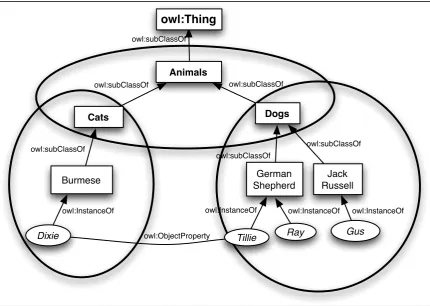
Moving on from RDF, Web Ontology Language (OWL) ontologies are seen as more detailed and formal representations of knowledge, formed from classes, instances/individuals and properties. The remainder of this section will introduce the main characteristics of a generic ontological model in the course of building a simplistic example ontology.
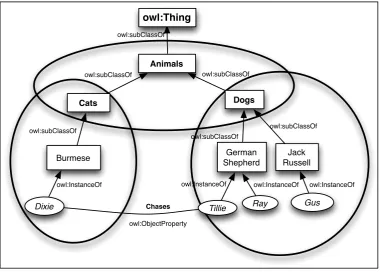
1) Classes: represent collections of individuals that share common characteristics. In the
example ontology built through this chapter a single root class is created, underneath Owl:Thing, where Owl:Thing represents all knowledge in the modelled domain.
The newly created class sub-class of Owl:Thing will be named Animals and have additional
sub-classes of Cats and Dogs. Classes named Burmese are created under Cat and
GermanShepherd and JackRussell under Dog. Using this approach sub- and super-classes
can be extended into a taxonomy as required. Equivalence and disjoint relationships can be encoded into class relationships, such that Dog and the class Canis lupus familiaris can be defined as being equivalent and Cat defined as being disjoint from Dog.
2) Instances/Individuals: are occurrences of entities and assigned to specific classes. By
extending the class structure created in the previous step, Dixie is associated to the class,
Burmese, Tillie and Ray to the class German Shepherd and Gus to the class Jack Russell.
This process populates the previously created class structure with instances of each class. The next step assigns some properties to the sample ontology.
3) Property Types: The two main properties used in OWL ontologies are either object- or data-type properties. The W3C defines object-type properties, in [21], as a directional relationship between “an individual(s) and another individual(s)” and data-type properties as
“individual(s) to datatype(s)” where data types equal strings, integers, Booleans, dates
etc. When dealing with object properties, the domain and range can be set. For data-type properties an instance is directionally related to typed data values expressed in XML schema. Expanding upon the example ontology a property is created where the Domain is set to Dog and the range is set to Cat. Once this property has been assigned a domain and range and subsequently when an instance of the Dog class is selected it is possible to assign the property
chases to the selected Dog. For example Tillie, a German Shepherd chases Dixie a
Burmese.
An example of data-type properties is hasAge which has a domain of Animal and its range being set to Integer. This allows any instances of any sub-class, below Animal, to be assigned an integer value. Shown in Figure 1 is the example ontology formed in this section.
[image:28.595.117.498.362.639.2]
Figure 1: Example Ontology
One limitation of the ontological representation of knowledge is in the ability of a machine to understand the meaning of that knowledge. Whether in OWL, RDF, or plain text, a machine can only understand the relationships among concepts based on the path between them, not by the semantic meaning of the concept’s label. At present it is difficult for a machine to understand meaning but it is possible to identify relationships between concepts in a particular knowledge model. Taking an object-property Father is_parent_of Child a machine could interpret
Animals
Cats Dogs
German Shepherd
Jack Russell Burmese
Dixie Tillie Ray Gus
owl:InstanceOf owl:subClassOf
owl:InstanceOf owl:InstanceOf owl:InstanceOf
owl:subClassOf owl:subClassOf
owl:subClassOf owl:subClassOf
Chases
through reasoning the link between the concept of Father and of Child, but not of the meaning of the wording of the property, is_parent.
2.3 Publish/Subscribe Middleware
Having discussed ontological semantics this section looks at the different types of publish/subscribe middleware responsible for delivering event messages from publishers to subscribers, whose interests are expressed as a subscription. This approach can be viewed in contrast to systems such as (RSS) Really Simple Syndication [23] where a pull-based delivery mechanism is used. In RSS a client is required to query for new content from a defined collection point, as it appears, whereas the push-based publish/subscribe paradigm sees content pushed towards a subscriber, with no action required on the part of the subscriber.
[image:30.595.89.525.358.573.2]Distributed publish/subscribe offers a de-coupled method of communication in which messages are routed from a publisher towards interested subscribers via a broker without any direct relationship existing between both. Agreement is only required in terms of the message format and the broker mechanism in use, often achieved through a boot-strap service. The remainder of this section looks, in detail, at three types of publish/subscribe middleware, topic-, content- and knowledge-based.
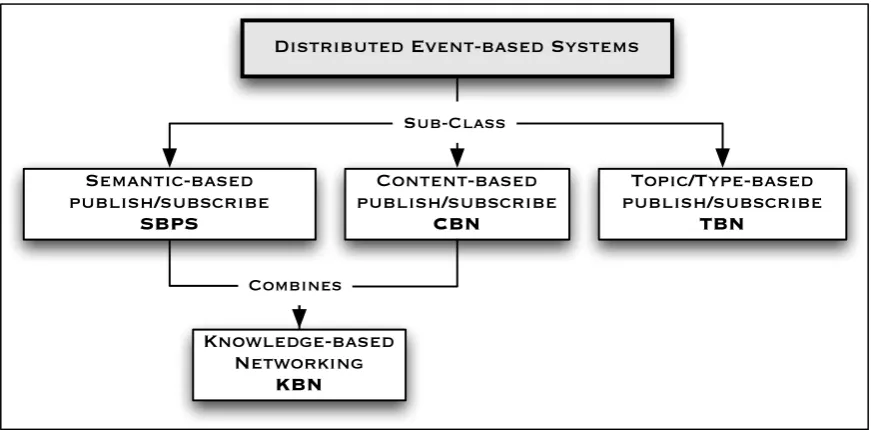
Figure 2: Classification of Publish/Subscribe Systems
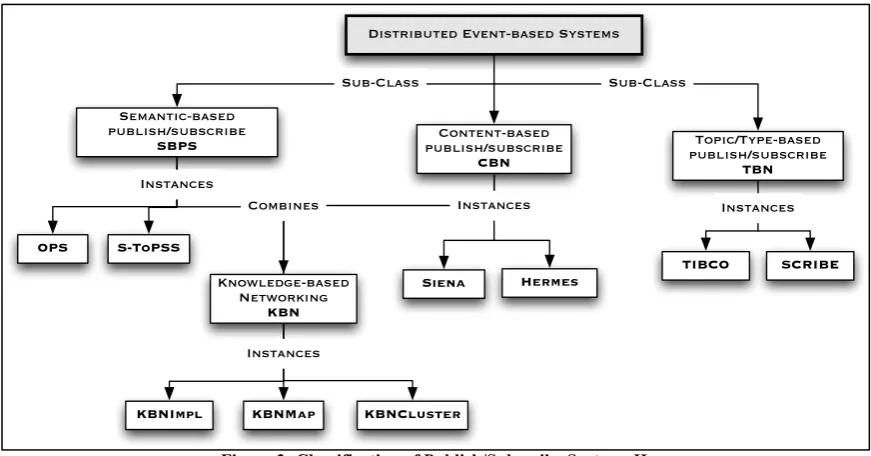
Shown in Figure 2 are sub-classes of Distributed Event-based Systems (DEBS) [24] discussed in the last three sections of this chapter. In this thesis the prototype system developed upon is an implementation of Knowledge-based Networking [9] which itself extends upon the Siena [2] Content-based Network (CBN). The State of the Art Chapter 3, of this thesis, extends the above diagram with the various implementations of the four classifications presented above, introducing topic-, content- and Knowledge-based Networks in turn.
Distributed Event-based Systems
Semantic-based publish/subscribe
SBPS
Content-based publish/subscribe
CBN
Topic/Type-based publish/subscribe
TBN
Knowledge-based Networking
KBN
Sub-Class
2.3.1 Topic-based Publish / Subscribe:
A highly cost-efficient and widely used publish/subscribe system is the topic-, type- or channel-based, network where clients subscribe and publish to particular topics or channels of information, each a specific reference to a stream of information. An example of the concept of subscriptions in such a system could include topics such as Wimbledon as a sub-topic of Tennis or
World_Cup_Final as a sub-topic of Football. Subscribers are delivered all messages
published to the specific topic-channel they have previously subscribed to. TIBCO [1] and Scribe [10] are examples of popular Topic-based Networks.
One requirement of topic-based publish/subscribe is that there must exist an agreement on the topic set, pre-defined by an administrator. De-coupling of clients is a key characteristic of publish/subscribe, yet the requirement for agreement upon a topic set reduces this de-coupling and requires a centralised service to advertise available topics. However, this is offset by the efficiency of routing messages to pre-defined topic channels, therefore in Topic-based Networks the only part of the message available to the event-service used in message matching is the topic identifier itself, included in the message header.
2.3.2 Content-based Publish / Subscribe
Content-based Networks (CBN), such as Siena [2], Hermes [25], Gryphon [26] and Elvin [27], allow subscriptions to be matched against the contents of publications. In CBNs publications are usually formed from a number of attributes composed of a name, type and value, whereas subscriptions are a conjunction of one or more name, type, operator and value filter(s). If a subscription is satisfied, from the contents of a publication, the publication is forwarded to the subscriber as a notification.
Type Name Operator Value
String User_Name = jonesdh
Table 2: Example Filter Constraint
Shown in Table 2 is a content-based subscription, constructed using a single filter in the form of a
Type, Name an Operator and a Value. Each of the filters in a given subscription must be matched to a candidate publication, if it is to be matched as a notification. However there may be more attributes in the publication than specified in a matching the subscription, but every part of the subscription must be satisfied by one or more parts of the publication.
Type
Name
Value
String User_Name jonesdh
int MailBoxSize 500
int ExtNumber 6099
The example publication shown above in Table 3 would be matched to the subscription shown in Table 2 as all of the subscription filters are satisfied. In contrast to this, shown in Table 4 is a non-matching subscription, as the MailBoxSize attribute does not match any of the attributes in the example publication, and therefore will not be delivered to the subscriber.
Type
Name
Operator
Value
String User_Name = jonesdh
int MailBoxSize > 590
Table 4: Example Subscription
2.3.3 Knowledge-based Networks in comparison to CBNs
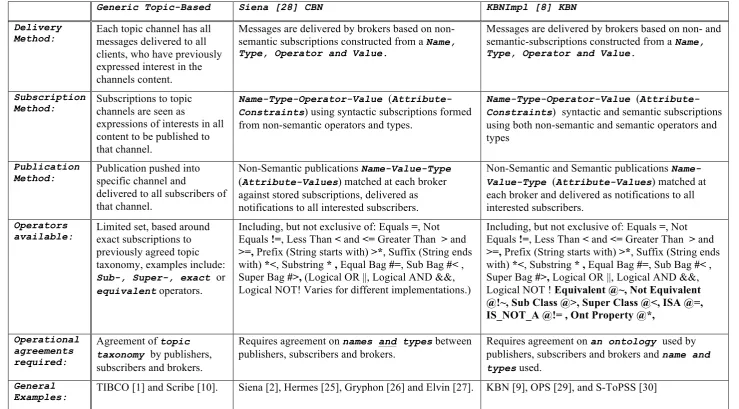
Knowledge-based Networks (KBNs) [9] are a classification of semantic-publish/subscribe middleware, allowing the semantics of the contents of publications and subscriptions to have an effect in message matching.
The semantic content in subscriptions and publications are based on a shared semantic web OWL ontology [3], using additional ontological types and operators. A key identifier of Knowledge-based Networks is that semantic types and operators are often integrated seamlessly with the existing (non-semantic) types and operators of CBNs, the KBN implementation used in this thesis offers an extended version of a CBN (Siena [2]) in which both semantic and non-semantic message attributes operate in unison, across the same network of brokers being matched either syntactically (available in both CBN + KBN) or semantically (only available in KBN).
One problem that exists with Knowledge-based Networks is in the requirement for pre-agreement on the common model of knowledge, or Ontology, used between clients and brokers. This pre-agreement is a drawback as it reduces the de-coupled nature of publish/subscribe however it also provides an increases level of expressivity in messaging. KBNCluster does not address the issue of agreement between ontological models nor does it require clients to communicate in a pre-operational agreement phase. However the work of Guo [4] looks in detail at the use of ontological mappings between different ontologies so to mitigate the problem of pre-agreement on ontological models as present in Knowledge-based Networks.
Table 5: Classification of Topic, Content and Knowledge-based Network
Generic Topic-Based Siena [28] CBN KBNImpl [8] KBN
Delivery
Method: Each topic channel has all messages delivered to all clients, who have previously expressed interest in the channels content.
Messages are delivered by brokers based on non-semantic subscriptions constructed from a Name, Type, Operator and Value.
Messages are delivered by brokers based on non- and semantic-subscriptions constructed from a Name, Type, Operator and Value.
Subscription
Method: Subscriptions to topic channels are seen as expressions of interests in all content to be published to that channel.
Name-Type-Operator-Value (Attribute-Constraints) using syntactic subscriptions formed from non-semantic operators and types.
Name-Type-Operator-Value (Attribute-Constraints) syntactic and semantic subscriptions using both non-semantic and semantic operators and types
Publication
Method: Publication pushed into specific channel and delivered to all subscribers of that channel.
Non-Semantic publications Name-Value-Type (Attribute-Values) matched at each broker against stored subscriptions, delivered as notifications to all interested subscribers.
Non-Semantic and Semantic publications Name-Value-Type (Attribute-Values) matched at each broker and delivered as notifications to all interested subscribers.
Operators
available: Limited set, based around exact subscriptions to previously agreed topic taxonomy, examples include: Sub-, Super-, exact or equivalent operators.
Including, but not exclusive of: Equals =, Not Equals !=, Less Than < and <= Greater Than > and >=, Prefix (String starts with) >*, Suffix (String ends with) *<, Substring * , Equal Bag #=, Sub Bag #< , Super Bag #>, (Logical OR ||, Logical AND &&, Logical NOT! Varies for different implementations.)
Including, but not exclusive of: Equals =, Not Equals !=, Less Than < and <= Greater Than > and >=, Prefix (String starts with) >*, Suffix (String ends with) *<, Substring * , Equal Bag #=, Sub Bag #< , Super Bag #>, Logical OR ||, Logical AND &&, Logical NOT ! Equivalent @~, Not Equivalent @!~, Sub Class @>, Super Class @<, ISA @=, IS_NOT_A @!= , Ont Property @*,
Operational agreements required:
Agreement of topic taxonomy by publishers, subscribers and brokers.
Requires agreement on names and types between publishers, subscribers and brokers.
Requires agreement on an ontology used by publishers, subscribers and brokers and name and types used.
General
Shown in Table 6 are the range of operators and applicable types available in the Siena CBN [2]. The combination of these operators and types, with a value, allows Attribute-Constraint-filters to be formed from one or more Name, Type, Operator and Value.
Operators Symbol Applicable Types
Equals = String, Byte Array, Integer, Long
Integer, Double, Float, Boolean.
Not Equals != String, Byte Array, Integer, Long
Integer, Double, Float, Boolean.
Less Than < Integer, Long Integer, Double, Float
Less Than Equal To <= Integer, Long Integer, Double, Float
Greater Than > Integer, Long Integer, Double, Float
Greater Than Equal To >= Integer, Long Integer, Double, Float
Prefix (starts with) >* String
Suffix (ends with) *< String
Substring * String
Table 6: Siena CBN Operators, Types and Symbols
Shown in Table 7 are the operators and applicable types available in the KBN implementation used, extending the CBNs operators and types, shown in Table 6, to include semantics.
Operators Symbols Applicable Types
CBN Operators. See Table 6. See Table 6.
Equivalent @~ Class or Property
Not Equivalent @!~ Class or Property
Sub Class @> Of a named Class
Super Class @< Of a named Class
ISA @= Individual against Class
IS_NOT_A @!= Individual against Class
ONT_PROP @* Individual, Property, Individual
Table 7: KBNImpl KBN Operators, Types and Symbols
Roblek introduces, in [31], shown in Table 8, Bag operators and types. A Bag can contain any valid KBNImpl (Table 7) type, including other Bags and their applicable operators in the form of subscriptions or as publications. Examples of matching a publication (Bag A) against a subscription (Bag B) are as follows: Equal Bag: all elements in Bag A must be in Bag B. Sub Bag: Some elements in Bag A must be in Bag B. Super Bag: Some elements in Bag B must be in Bag A. Each of these combinations is represented below, in Table 8, Bag operators and types.
Operator Symbol Applicable Types
Equal Bag #= See Table 6 and Table 7. Sub Bag #< See Table 6 and Table 7. Super Bag #> See Table 6 and Table 7.
Table 8: Bag Operators, Types and Symbols
2.4 Policy-based Network Management (PBNM)
The Design Chapter 4, Section 4.5, of this thesis outlines a number of dynamic management methodologies used in managing the clustering of clients who require a dynamic management approach. In this thesis the placement of clients is dynamic in that it is not based not on any pre-determined metrics, but on the specific semantic interests of the client at a given point in time, acquired during operation.
PBNM is seen as an appropriate choice for encoding enforceable management requirements as it enables for dynamic and rapidly changing rules to be integrated directly into the operation of the management process without any re-compilation or re-deployment of the management system. PBNM is defined by Boutaba et. al. as supporting this view in [19], where it is seen as “separating the rules governing the behaviour of a system from its functionality.” It is this level of separation between the policy system used for achieving clustering and the broker network itself that makes a PBNM approach highly suitable for this thesis.
PBNM simplifies the management of this thesis by declaring operating rules, which deal with situations that are likely to occur. Informally, policy rules can be regarded as a declarative instruction or authority for a manager to execute actions on a managed target to achieve an objective or execute a change. Supported by this premise, PBNM is used within this research to provide a set of external controls, which, in certain configurations, allow management level decisions to be filtered down from the networks management into the operational characteristics of a clustered KBN.
2.5 Conclusion
In this Background chapter, an initial introduction to semantics has been outlined showing how RDF triples [20], consisting of a Subject, Object and Predicate, can be used to represent semantic data. These triples have been extended and discussed in relation to the three main types of OWL ontologies. A sample ontology has been built in terms of classes, individuals/instances and properties. Classes have been defined as representing collections of individuals, and individuals as representing instances of classes where object properties may be used to relate one individual to another. Data-type properties, in RDF, have been discussed as resources that relate to some value (which may be another resource.) However, in OWL object properties relate individual to individual, and data-type properties individuals. An OWL reasoner can follow these properties to inter-logical relationships between individuals and data based on a given ontology. Various classes of publish/subscribe middleware have been introduced, including Topic-based, such as Scribe [10]; Content-based (CBN), such as Siena [2]; and Knowledge-based Networking [9] as a sub-class of Semantic-based Publish/Subscribe (SBPS). For each of these networks, the various types of operators and the various types that they apply to have been documented. It has been shown how topic structures are subscribed to and how content-based Attribute-Constraint filters are formed around Attribute-Values.
3
STATE OF THE ART
In the previous chapter the technology and background used in this thesis have been introduced. In this chapter the current State of the Art in the field of publish/subscribe is introdu