Multi-objective evolutionary design of robust controllers
on the grid
SHENFIELD, Alex <http://orcid.org/0000-0002-2931-8077> and FLEMING,
Peter
Available from Sheffield Hallam University Research Archive (SHURA) at:
http://shura.shu.ac.uk/8314/
This document is the author deposited version. You are advised to consult the
publisher's version if you wish to cite from it.
Published version
SHENFIELD, Alex and FLEMING, Peter (2011). Multi-objective evolutionary design
of robust controllers on the grid. In: BITTANTI, Sergio, CENEDESE, Angelo and
ZAMPIERI, Sandro, (eds.) Proceedings of the 18th IFAC World Congress, 2011.
World Congress (18/1). International Federation of Automatic Control, 14711-14716.
Copyright and re-use policy
See
http://shura.shu.ac.uk/information.html
Sheffield Hallam University Research Archive
Multi-objective Evolutionary Design of
Robust Controllers on the Grid
⋆
Alex Shenfield∗
Peter J. Fleming∗∗
∗
Manchester Metropolitan University, Manchester, M1 5GD (e-mail: [email protected]).
∗∗
University of Sheffield, Sheffield, S1 3JD (e-mail: [email protected]).
Abstract:
The emerging paradigm of grid computing provides a powerful platform for the solution of complex and computationally expensive problems. An example of this is the multi-objective evolutionary design of robust controllers, where each candidate controller design has to be synthesised and the resulting performance of the compensated system evaluated by computer simulation. This paper introduces a grid-enabled framework for the multi-objective optimisation of computationally expensive problems, before using the framework in the multi-objective
evolutionary design of a robust lateral stability controller for a real-world aircraft using H∞
loop shaping.
Keywords:Aerospace Stability Control,H∞Controller Design, Multiobjective Evolutionary
Algorithms, High Performance Computing
1. INTRODUCTION
Modern aircraft consist of many complex subsystems, all of which require robust and reliable control. These systems are often multi-variable, consisting of multiple inputs and multiple outputs, and frequently the desired responses of a subsystem (such as rise time and overshoot) are in conflict. Coupling evolutionary multi-objective optimisation tech-niques with conventional controller design methods such
as H∞ or LQG control can provide the engineer with a
powerful tool for addressing such problems (Fleming and Purshouse, 2002). However, such methods are frequently computationally expensive, requiring many thousands of controller designs to be evaluated.
Grid computing offers one potential solution to the compu-tationally expensive nature of this evolutionary controller design process. The grid computing paradigm aims to provide “a hardware and software infrastructure that pro-vides dependable, consistent, pervasive, and inexpensive access to high-end computational capabilities” (Foster and Kesselman, 1999). This paradigm is differentiated from traditional approaches to distributed computing by its em-phasis on providing “a seamless, integrated computational and collaborative environment” (Baker et al., 2002) for the solution of complex problems by allowing coordinated re-source sharing across dynamic virtual organisations (Fos-ter et al., 2001).
The purpose of this paper is to introduce a grid-enabled framework for evolutionary multi-objective controller de-sign. This framework will then be applied to the design of a robust controller for the flight dynamics of a
real-⋆
The authors gratefully acknowledge the financial support of the Engineering and Physical Research Council in the UK under Grant Number GR/R67668/01.
world aircraft - a complex problem with many (often conflicting) objectives to consider. The paper is organ-ised as follows: section 2 will provide a brief introduction to multi-objective evolutionary algorithms, section 3 will introduce the grid-enabled framework for multi-objective evolutionary optimisation, section 4 will outline the con-troller design problem considered in this paper and its solution using our grid-enabled framework, and section 5 will present our conclusions and outline some ideas for further work.
2. MULTI-OBJECTIVE EVOLUTIONARY ALGORITHMS
2.1 Evolutionary Algorithms
Evolutionary Algorithms (EAs) utilise some of the con-cepts behind natural selection to iteratively evolve a pop-ulation of candidate solutions to a problem (Goldberg, 1989). They both explore the solution space of a prob-lem (by using variation operators such as mutation and recombination) and exploit valuable information present in the previous generation of candidate solutions (by using a selection operator). The trade-off between exploration of undiscovered regions of the solution space and exploitation of promising areas already discovered by the algorithm is extremely important: too much exploration and the algo-rithm will take too long to converge on a useful solution, too much exploitation and the algorithm may converge prematurely to local optima.
auxiliary knowledge. For many non-trivial real-world ap-plications this evaluation function information is obtained by computer simulation of the system. For example, in the optimisation of maintenance schedules for gas turbine aero-engines (Shenfield et al., 2010), the cost information for each schedule is obtained by computer simulation of the candidate solution over 25 years.
The use of computer simulations to obtain this evaluation function information leads to some new issues. To ensure that the results gained from the evolutionary algorithm are meaningful, the simulation must be complex enough to capture all the relevant dynamics of the true system. How-ever, assuming that this level of complexity is obtainable, this may lead to the simulation becoming very computa-tionally expensive. Since EAs are iterative and population based the simulation may have to be run several thousand times.
2.2 Multi-objective Evolutionary Algorithms
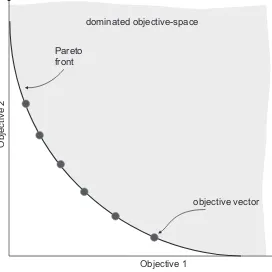
Many real-world engineering problems involve the satisfac-tion of multiple, often conflicting, objectives. In this case it is unlikely that a single optimal solution will exist. Instead, the solution of this kind of multi-objective problem leads to a set of Pareto optimal points, where any improvement in one objective will lead to a deterioration in one or more of the other objectives (see Fig. 1). Conventional multi-objective optimisation methods struggle in these situa-tions as they are often unable to obtain a distribution of potential solutions from this Pareto optimal set, instead just finding a single point. However, since evolutionary algorithms search a population of candidate solutions in parallel, they are able to find multiple Pareto optimal solutions. This provides the engineer with a set of potential solutions to choose from, rather than a single solution that may not meet the required performance criteria.
Objective 1
Objective 2
Pareto front
[image:3.595.339.523.217.274.2]objective vector dominated objective-space
Fig. 1. The optimal solution set for a bi-objective problem
2.3 Parallel Evolutionary Algorithms
The computationally expensive nature of the evaluation process of evolutionary algorithms has motivated the de-velopment of parallel EAs. Early approaches to the imple-mentation of parallel evolutionary algorithms can be clas-sified into two categories which still apply today: single-population global EA implementations and EA
implemen-tations with multiple communicating populations (Cant´
u-Paz and Goldberg, 1999).
Single-population parallel evolutionary algorithms consist
of a singlepanmicticpopulation maintained globally. This
form of parallelism may be effectively exploited using the well established Master-Slave communication paradigm (see Fig. 2). Typically the evaluation of candidate solutions in the algorithm is distributed amongst the worker nodes whilst the master node applies the evolutionary operators, such as selection and variation, centrally to the whole population (Fogarty and Huang, 1991). Chipperfield and Fleming (1995) also describe a similar scheme where both the evaluation of candidate solutions and the variation operators are performed by the worker nodes.
Master Node
[image:3.595.98.234.485.621.2]Slave 1 Slave 2 Slaven
Fig. 2. The master-slave communication paradigm
These single-population, globally parallel EAs represent an important case of parallelism because they are functionally equivalent to sequential EAs. This means that existing EA theory and design guidelines can easily be applied to their
use (Cant´u-Paz and Goldberg, 1999). Although this type
of strategy does not exploit all the parallelism inherent in the evolutionary algorithm, substantial improvements in performance can be achieved - especially in cases where the evaluation of candidate solutions is significantly more computationally expensive that the evolutionary operators themselves (Chipperfield and Fleming, 1995).
In contrast, the use of parallel EAs based around multiple communicating populations can potentially exploit more of the inherent parallelism in the algorithm by allowing subpopulations to evolve independently. However, using multiple populations substantially increases the complex-ity of the design process since consideration needs to be given to not only the number and size of subpopulations but also to the migration scheme and population topology used by the algorithm. The choice of each of these param-eters affects both the efficiency of the algorithm and the quality of the overall solution.
3. A GRID-ENABLED FRAMEWORK FOR EVOLUTIONARY MULTI-OBJECTIVE
OPTIMISATION
3.1 Grid Computing Technologies
The concept of grid computing is not new. As far back as 1969 Len Kleinrock suggested:
“We will probably see the spread of ‘com-puter utilities’, which, like present electric and telephone utilities, will serve individual homes and offices across the country.” (Klein-rock, 1969)
open-source Globus Toolkit is its ability to provide a common means of interacting with the diverse range of local resource management systems that are often found on compute resources in the real-world. Globus builds on current web service technologies to support the creation and management of ensembles of services maintained by virtual organisations (Foster et al., 2002).
3.2 Parallelisation of the Evolutionary Algorithm
In section 2.3 we considered two models of parallel evo-lutionary computation: multiple communicating popu-lations, and single-population master-slave implementa-tions. The decision as to which of these forms of parallelism to implement must consider several factors, including ease of implementation and the potential performance gains from parallelism. Single-population parallel EAs are often easiest to implement and use, since experience gained with sequential algorithms is directly applicable. In contrast, the implementation of parallel EAs with multiple commu-nicating populations requires the consideration of extra design choices increasing the complexity of the design process.
For the grid-enabled framework presented in this paper it was decided to use a single-population master slave model since it is less complex than the multiple communicating populations model and is well suited to implementation in a heterogeneous grid computing environment because it keeps inter-process communication to a minimum. Al-though this globally parallel EA does not exploit all the potential parallelism in the algorithm, it significantly ac-celerates the evaluation of candidate solutions (the most computationally expensive part of the algorithm).
3.3 Service-Oriented Architecture
We have chosen to implement our grid-enabled frame-work for evolutionary multi-objective optimisation in a service-oriented architecture using grid services based on the Globus Toolkit to provide access to the resources in the grid. This framework is written using the Java programming language so as to provide portable code that allows components of the framework to be easily run across various heterogeneous platforms.
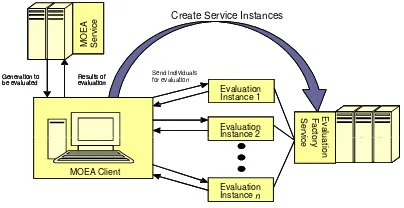
A service-oriented architecture is essentially a collection of services that communicate with each other in order to perform a complex task. This service-oriented archi-tecture approach to grid computing is well suited to the kind of master-slave parallelism used in our optimisation framework since, in this view of grid computing, the client acts as the master node and the service acts as the slave. The implementation of our optimisation framework (see Fig. 3) involves two different types of service. One service type exposes the operations of the evolutionary algorithm to the client and the other provides the ability to run evaluations of the objective function on the resources of the computational grid.
The Evaluation Factory Service shown in Fig. 3 imple-ments a grid-based meta-scheduling architecture to pro-vide access to the available grid resources via the Globus Toolkit. Our grid-enabled framework for evolutionary opti-misation then assigns these evaluation function instances
E v a lu F a c to S e rv i Evaluation Instance 1 Evaluation Instance 2 M O G A S e rv ic e Generation to be evaluated Results of evaluation
Create Service Instances
E v a lu F a c to S e rv i E v a lu F a c to S e rv i Evaluation Instance 1 Evaluation Instance 2 M O G A S e rv ic e M O E A S e rv ic e Generation to be evaluated Results of evaluation Send individuals for evaluation lu a tio n to ry v ic e Instance 2 Evaluation Instance n GA Client lu a tio n to ry v ic
e luatio
[image:4.595.333.535.83.187.2]n to ry v ic e Instance 2 Evaluation Instance n MOEA Client
Fig. 3. Overview of the multi-objective evolutionary opti-misation framework
to the available processors for execution (using an opti-mised workload allocation algorithm (Tang and Chanson, 2000)).
This approach to the grid-enabling of our multi-objective evolutionary optimisation framework also provides flex-ibility both in how the framework is used and in its maintenance. The use of services to provide functionality to our optimisation framework means that new features can be added, and existing features improved, simply by providing new services. In the context of our optimisation framework this functionality could be anything from the implementation of additional evolutionary operators to changes in the way candidate solutions are distributed and managed. The use of web services also means that the functionality can be accessed via the HTTP protocol. This allows elements of the optimisation framework to be easily integrated into an Internet portal and accessed by any device with a capable web browser.
3.4 The White Rose Grid
Our evolutionary multi-objective optimisation framework was implemented using the resources of the White Rose Grid (The White Rose University Consortium, 2010), a multi-institutional computational grid launched in 2002. The White Rose Grid consists of 4 core nodes - 2 at the University of Leeds, 1 at the University of Sheffield, and 1 at the University of York - providing over 500 processor cores for local users and distributed e-Science research. Each cluster is managed locally using a combination of Sun Grid Engine and the Globus Toolkit and is connected to the rest of the White Rose Grid via the high speed Yorkshire and Humberside Metropolitan Area Network (YHMAN).
4. DESIGN OF A ROBUST CONTROLLER FOR AIRCRAFT FLIGHT DYNAMICS
4.1 Flight Dynamics
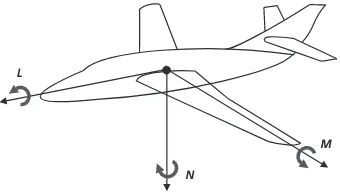
The dynamics of an aircraft in flight can be described by the rotational moments around its centre of gravity (CG) in Cartesian space. These are shown in Fig. 4 where:
• L is therolling moment of the aircraft.
• M is thepitching moment of the aircraft.
These flight dynamics can be separated into longitudinal motions, in which the wings remain level (e.g. pitch), and
lateral motions such as roll and yaw.
L
N
[image:5.595.82.252.119.217.2]M
Fig. 4. The rotational moments of an aircraft
The equations of motion describing these flight dynamics
are non-linear; however, by applying thesmall disturbance
theory (Nelson, 1998), a linearised model can be found.
This linearisation process will only give a good result in cases where the motion of the aircraft can be fully described by small deviations about a steady flight con-dition (such as in the flight of large commercial aircraft), and therefore should not be used in cases where large amplitude motions are likely to occur.
4.2 Controller Design
The control system for the flight dynamics of an aircraft must provide robust and responsive multi-variable control of the ailerons and the rudder, as well as guaranteeing
stability in the presence of modelling uncertainty. H∞
control theory (Zames, 1981) offers a proven method of designing controllers that are robust to such uncertainty.
However, a drawback of robust stabilisation usingH∞
con-trol is the inability of the designer to specify performance requirements (Skogestad and Postlethwaite, 1996), which can result in compensated systems that, whilst robust, perform unsatisfactorily. To overcome this limitation, Mc-Farlane and Glover (1990) proposed using pre- and post-compensators to ‘shape’ the open-loop response of the plant (see Fig. 5), and then applying robust stabilisation. Selecting the weighting matrices for the pre- and post-compensators is typically challenging since these choices govern the performance of the resulting system.
G
W1 W2
Shaped Plant Gs
[image:5.595.65.265.590.660.2]K
Fig. 5. The shaped and compensated plant
This paper aims to find an optimal H∞ loop shaping
controller for the lateral stability control of a Boeing 747 aircraft using our grid-enabled framework for evolutionary multi-objective optimisation. The Boeing 747 model used in this controller design is a linearised multivariable system with two inputs (the control signals for the aileron and rudder) and two outputs (the roll and sideslip angles),
and can be represented by the following transfer function matrix:
G=
g11 g12
g21 g22
!
where:
g11 =
0.1845s2
+ 0.04795s+ 0.1995
s4
+ 0.6807s3
+ 1.049s2
+ 0.3373s−0.001979
g12 = 0.06591s
2
−0.12s−0.5158
s4
+ 0.6807s3
+ 1.049s2
+ 0.3373s−0.001979
g21 = −
0.01448s2
−0.01962s+ 0.001359
s4+ 0.6807s3+ 1.049s2+ 0.3373s
−0.001979
g22 =
0.005334s3
+ 0.4377s2
+ 0.1884s−0.00432
s4+ 0.6807s3+ 1.049s2+ 0.3373s
−0.001979
We will use our grid-enabled framework for evolution-ary multi-objective optimisation to determine the optimal weights for the pre- and post-compensators used to im-prove the performance of the overall compensated system. These compensators have the following structures:
W1=
s+a s 0
0 s+b
s
W2=
c 0
0 d
with the order of these compensators being determined by the order of the plant.
4.3 Optimisation of Controller Performance
TheH∞loop shaping controller design process can be
for-mulated as a multi-objective optimisation problem, where each performance requirement is treated as a separate objective, and thus solved using a multi-objective evolu-tionary algorithm (see section 2). The decision variables
in this optimisation procedure are the weights,a, b, c, d, in
the compensators. However, this controller design problem is computationally expensive since, for every candidate
solution, anH∞ controller has to be synthesized and the
response of the compensated system obtained by computer simulation. The evaluation of a single candidate solution for this problem took in the order of 5.5 seconds on a Intel Core 2 Duo based PC with a clock speed of 2.60GHz.
many problems (Hancock, 1994). The extended intermedi-ate recombination operator and BGA mutation operator
(M¨uhlenbein and Schlierkamp-Voosen, 1993) were used
to introduce variation into the population and prevent the search process from stagnating. However, it is impor-tant to note that the implementation of our grid-enabled framework in a service-oriented architecture (see section 3.3) provides a high degree of flexibility in the choice of algorithm architecture, representation, and evolutionary operators used. This flexibility means it is simple to adapt our framework to other optimisation problems.
[image:6.595.362.493.84.301.2]A set of performance requirements arising from domain specific knowledge about the problem have been specified for the response of the compensated system (see Table 1). Some of these requirements are hard constraints and others are simply desired goals. Several of the performance requirements for this controller are in competition which makes achieving all the goals difficult. The grid-enabled MOEA implementation described in this paper uses the preference articulation operator proposed by Fonseca and Fleming (1998) to handle both the stated goals and hard contraints from Table 1.
Table 1. Performance requirements for theH∞
controller design problem
Requirements Type Minimise the Overshoot in re-sponse to a step input
Goal (Overshoot <
5%)
Minimise the Rise Time Goal (Tr <3 seconds)
Minimise the Settling Time Goal (Ts <4 seconds)
Prevent Aileron actuator satu-ration
Constraint (Aileron de-flection < 0.349
radi-ans) Prevent Rudder actuator satu-ration
Constraint (Rudder deflection < 0.52
radians) Controller must be robust to
30% multiplicitive uncertainty
Constraint
4.4 Results
It can be seen from Fig. 6 that there is a strong trade-off between the control signal for the aileron actuator and the other requirements in Table 1 (such as the rise time and settling time). This shows that the response of the final compensated system is limited by the maximum range of the aileron actuator.
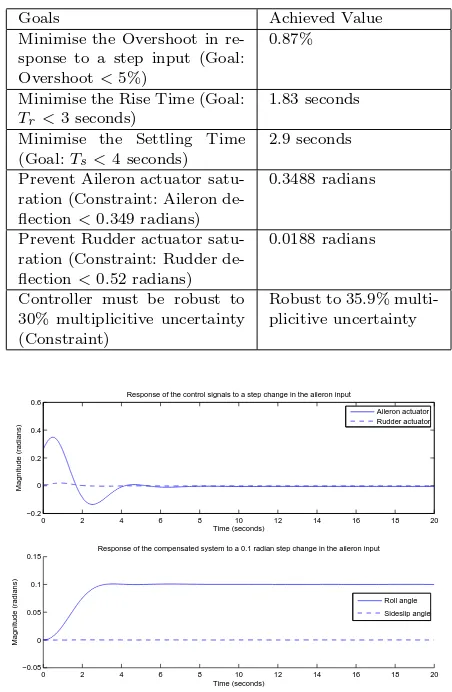
Table 2 shows the achieved performance of the compen-sated system and Fig. 7 shows the response of the system to a 0.1 radians step change in the aileron control signal. It can be seen from Table 2 that all the performance re-quirements specified in Table 1 are satisfied, and significant improvements over all the goal values have been achieved.
Table 3 shows a representative set of execution times from the evolutionary multi-objective optimisation of the controller design problem presented in this paper. These times are averaged over 5 runs for both the results obtained from a single workstation and the results obtained using the resources of the White Rose Grid. As Table 3 shows, the grid-enabled optimisation framework presented in this paper has significantly reduced the time taken to optimise the performance of the compensated system.
1 1.5 2 2.5 3
0.2 0.25 0.3 0.35 0.4 0.45 0.5
Rise time (seconds)
Aileron deflection (radians)
Rise time vs. aileron deflection
2 2.5 3 3.5 4
0.2 0.25 0.3 0.35 0.4 0.45 0.5
Settling time (seconds)
Aileron deflection (radians)
Settling time vs aileron deflection
[image:6.595.55.279.351.487.2]Fig. 6. Trade-offs between aileron control signal and other performance requirements
Table 2. Achieved performance of the compen-sated system
Goals Achieved Value Minimise the Overshoot in
re-sponse to a step input (Goal: Overshoot<5%)
0.87%
Minimise the Rise Time (Goal:
Tr<3 seconds)
1.83 seconds
Minimise the Settling Time (Goal:Ts <4 seconds)
2.9 seconds
Prevent Aileron actuator satu-ration (Constraint: Aileron de-flection<0.349 radians)
0.3488 radians
Prevent Rudder actuator satu-ration (Constraint: Rudder de-flection<0.52 radians)
0.0188 radians
Controller must be robust to 30% multiplicitive uncertainty (Constraint)
Robust to 35.9% multi-plicitive uncertainty
0 2 4 6 8 10 12 14 16 18 20
−0.2 0 0.2 0.4 0.6
Time (seconds)
Magnitude (radians)
Response of the control signals to a step change in the aileron input
Aileron actuator Rudder actuator
0 2 4 6 8 10 12 14 16 18 20
−0.05 0 0.05 0.1 0.15
Time (seconds)
Magnitude (radians)
Response of the compensated system to a 0.1 radian step change in the aileron input
Roll angle Sideslip angle
[image:6.595.317.543.382.728.2]Table 3. Execution times for the optimisation
of anH∞controller for aircraft flight dynamics
Single Workstation Computational Grid 50 gen. 100 gen. 50 gen. 100 gen. 28637 s 56698 s 8251 s 12582 s
5. CONCLUSIONS AND FURTHER WORK
Table 3 has shown that significant reductions in the exe-cution times of our evolutionary multi-objective controller design process can be achieved by using our grid-enabled optimisation framework. Whilst the example presented in this paper uses a multi-objective evolutionary algorithm in the optimisation process, the service-oriented nature of our framework means it is easily extensible to other iterative optimisation algorithms such as ant-colony or particle swarm optimisation.
The grid-enabled framework for multi-objective optimisa-tion described in this paper is best suited to computaoptimisa-tion- computation-ally expensive evaluation functions such as the robust con-troller design problem presented in section 4. This is due to the communication overheads involved in the distribution and management of the evaluation function jobs across multiple diverse resources. For some computationally triv-ial evaluation functions this distribution and management may result in a degradation in performance compared with a sequential MOEA on a single machine. Whilst further work is planned to determine the scale of problems for which this framework is most effective, it is expected that research and development in the field of grid-middleware, job submission services and job management services will result in a reduction in these communication overheads. This will allow our framework to provide increased perfor-mance for less computationally expensive problems. How-ever, our framework is not intended to replace sequential MOEAs in cases where the performance of the sequential MOEA is satisfactory.
REFERENCES
Baker, J.E. (1987). Reducing bias and inefficiency in
the selection algorithm. In J.J. Grefenstette (ed.),
Proceedings of the Second International Conference on
Genetic Algorithms, 14–21. Lawrence Erlbaum.
Baker, M., Buyya, R., and Laforenza, D. (2002). Grid and grid technologies for wide area distributed computing.
Software: Practice and Experience, 32(15), 1437–1466.
Cant´u-Paz, E. and Goldberg, D.E. (1999). On the
scala-bility of parallel genetic algorithms.Evolutionary
Com-putation, 7(4), 429–449.
Chipperfield, A.J. and Fleming, P.J. (1995). Parallel
genetic algorithms. In A.Y. Zomaya (ed.),Parallel And
Distributed Computing Handbook, chapter 39, 1118–
1144. McGraw-Hill.
Fleming, P.J. and Purshouse, R.C. (2002). Evolutionary algorithms in control systems engineering: a survey.
Control Engineering Practice, 10, 1223 – 1241.
Fogarty, T.C. and Huang, R. (1991). Implementing the ge-netic algorithm on transputer based parallel processing
systems. In H.P. Schwefel and R. M¨anner (eds.),Parallel
Problem Solving from Nature 1, volume 496 of Lecture
Notes in Computer Science, 145–149. Springer-Verlag,
Berlin.
Fogel, D.B. and Ghoziel, A. (1997). A note on
represen-tations and variation operators. IEEE Transactions on
Evolutionary Computation, 1(2), 159–161.
Fonseca, C.M. and Fleming, P.J. (1998). Multiobjective optimization and multiple constraint handling with evo-lutionary algorithms - Part I: A unified formulation. IEEE Transactions on Systems, Man, and Cybernetics
- Part A: Systems and Humans, 28(1), 26–37.
Foster, I. and Kesselman, C. (1999). The Globus Toolkit.
In I. Foster and C. Kesselman (eds.), The GRID:
Blueprint for a New Computing Infrastructure,
chap-ter 11, 259–278. Morgan Kaufmann.
Foster, I., Kesselman, C., Nick, J.M., and Tuecke, S. (2002). Grid services for distributed system integration.
IEEE Computer, 35(6), 37 – 46.
Foster, I., Kesselman, C., and Tuecke, S. (2001). The anatomy of the grid: Enabling scalable virtual
organi-zations. International Journal of Supercomputer
Appli-cations, 15(3), 200–222.
Goldberg, D.E. (1989). Genetic Algorithms in Search,
Optimization and Machine Learning. Addison-Wesley.
Hancock, P.J.B. (1994). An empirical comparison of selec-tion methods in evoluselec-tionary algorithms. In T.C.
Fog-arty (ed.), Evolutionary Computing - AISB Workshop,
volume 865 ofLecture Notes in Computer Science, 80–
94. Springer-Verlag.
Kleinrock, L. (1969). UCLA press release. URL
http://www.lk.cs.ucla.edu/LK/Bib/REPORT/press.html.
McFarlane, D. and Glover, K. (1990). Robust Controller
Design Using Normalized Coprime Factor Plant
De-scriptions, volume 138 ofLecture Notes in Control and
Information Sciences. Springer-Verlag.
Michalewicz, Z. and Fogel, D.B. (2000). How to Solve It:
Modern Heuristics. Springer.
M¨uhlenbein, H. and Schlierkamp-Voosen, D. (1993).
Pre-dictive models for the breeder genetic algorithm I:
Con-tinuous parameter optimization. Evolutionary
Compu-tation, 1(1), 25–49.
Nelson, R.C. (1998). Flight Stability and Automatic
Con-trol. McGraw-Hill, second edition.
Shenfield, A., Fleming, P.J., Allan, J., and
Kadirka-manathan, V. (2010). Optimisation of maintenance
scheduling strategies on the grid. Annals of Operations
Research, 180(1), 213 – 231.
Skogestad, S. and Postlethwaite, I. (1996). Multivariable
feedback control - Analysis and Design. John Wiley &
Sons.
Tang, X. and Chanson, S.T. (2000). Optimizing static job scheduling in a network of heterogeneous computers. In Proceedings of the International Conference on Parallel
Processing, 373–382.
The White Rose University Consortium (2010). The white
rose grid website. URL http://www.wrgrid.org.uk/.
Viewed 20 September 2010.
Zames, G. (1981). Feedback and optimal sensitivity: model reference transformations, multiplicitive seminorms, and
approximate inverse. IEEE Transactions on Automatic